The 7 Best Portable Generators for Home Backup
A portable generator is the cheapest way to keep a house running through an outage — if you buy the right size and connect it properly. We tested seven on the same household load.
Alex Rivers
Home Improvement Editor
Last Updated
September 12, 2026
In This Guide
A portable generator does roughly eighty percent of what a standby unit does for roughly a tenth of the money. The catch is the other twenty percent: somebody has to be home, go outside in the weather, start it, and keep feeding it fuel.
Our Picks at a Glance
- Best Overall: Champion 9200-Watt Dual Fuel — Portable, 9,200W Running / 11,500W Peak
- Best Quiet Option: Westinghouse iGen4500 — Inverter, 3,700W Running / 4,500W Peak
- Best for Whole-House Coverage: DuroMax XP12000EH — Portable, 9,500W Running / 12,000W Peak
- Best Electric Start: Generac GP8000E — Portable, 8,000W Running / 10,000W Peak
- Best Small Generator: Honda EU2200i — Inverter, 1,800W Running / 2,200W Peak
- Best Value: Westinghouse WGen9500DF — Portable, 9,500W Running / 12,500W Peak
- Best Mid-Size: Firman H05751 Dual Fuel — Portable, 5,700W Running / 7,100W Peak
1. How We Tested
Every machine here ran the same protocol, because generator specifications are written on a bench and outages happen in a back garden in February. We connected each unit through a manual transfer switch to a household load of refrigerator, chest freezer, furnace blower, a cycling sump pump and lighting, then added a window air conditioner and, on the larger units, a well pump and a central air compressor to find where each ran out.
Noise was measured at 23 feet under that load rather than at the manufacturer's quarter-load figure, which is where the published numbers come from and why they always sound optimistic. Runtime was measured to shutdown at half load. And every unit was cold-started at 34°F after sitting outdoors overnight, because a generator that starts easily in a warm garage in October is answering the wrong question.
What the Numbers Looked Like
48-76
dB range at 23 ft under load
8-18 hr
Runtime at half load per tank
~10%
Output lost running on propane
47-265
lbs — portability varies enormously
That last figure deserves attention. "Portable" spans a machine one person carries in one hand and a machine two people struggle to get up a step. Both are sold under the same word, and the difference determines where you can store it, how fast it deploys, and honestly whether you ever run it for maintenance.
2. The 7 Best Portable Generators in 2026

Champion 9200-Watt Dual Fuel
Portable, 9,200W Running / 11,500W Peak
The Champion 9200 sits at the output most homes genuinely need for backup: enough to carry the circuits that matter through a transfer switch, without stepping up to the weight and cost of a 12,000-watt machine. Across our household load — refrigerator, chest freezer, furnace blower, a cycling sump pump and lighting across half the house — it held everything simultaneously with real margin on gasoline, and around 8,300 running watts on propane, which is still comfortable for the same load with slightly less room for the sump pump's startup surge. Runtime came in at 10 to 12 hours at half load, enough to clear a night without a 3 a.m. refuelling trip in the dark. The feature that earns its keep is the remote electric start. Starting a generator from a covered doorway during horizontal rain rather than crouching over a pull cord genuinely changes how willing you are to go outside at all, and a generator you are reluctant to start is not a backup plan. The honest costs are noise and mass. At 74 dB under load it needs a 20-foot setback for reasons beyond carbon monoxide, ideally with a structure between it and the bedroom windows. At over 200 pounds it rolls but does not carry, so choose its storage spot with a level path to where it will run.
Pros
- 9,200 running watts covers most essential circuits through a transfer switch with headroom to spare
- Remote electric start by key fob — you can start it from a covered doorway in driving rain
- Runs on propane as well as gasoline, which matters when the pumps are down after a storm
- Roughly 10-12 hours of gasoline runtime at half load, so it clears a night without refuelling
- Started readily at 34°F on both fuels, one of the better cold performers in this group
Cons
- 74 dB under our test load — genuinely loud, and placement has to account for it
- Over 200 lbs; the wheel kit works on flat ground but this is a two-person job on steps
The Bottom Line
The portable generator most households should buy. Enough output to matter, remote start so it actually gets used, and priced sensibly for the class.

Westinghouse iGen4500
Inverter, 3,700W Running / 4,500W Peak
The iGen4500 answers a different question from the rest of this list. Instead of asking how many watts you can buy for the money, it asks how much generator you can live beside. At 52 dB under load it is quiet enough to hold a conversation next to, which in a suburban street or during a multi-day outage with the windows open is worth more than the specification sheet suggests. Inverter architecture is doing the work: the engine varies its speed with demand rather than pinning at 3,600 rpm, so it is quiet at low load and produces clean sine-wave power with low harmonic distortion — safe for laptops, televisions and the control boards in modern furnaces and refrigerators without a line conditioner in between. Fuel economy follows from the same design, and we measured roughly 18 hours at quarter load. The constraint is output. At 3,700 running watts it comfortably carries a refrigerator, a freezer, a furnace blower, lighting and devices, and it will not simultaneously start a well pump or run central air. That is a real limit, not a quibble, and buyers who ignore it end up disappointed. Weight is the compensation: at around 100 pounds with a telescoping handle, one person can move it alone, which is not true of anything else here above 4,000 watts.
Pros
- 52 dB at 23 feet under load — you can hold a conversation next to it
- Inverter output is clean enough for laptops, TVs and modern appliance boards without a conditioner
- Telescoping handle and wheels make it genuinely one-person portable at around 100 lbs
- Excellent fuel economy — roughly 18 hours at quarter load from a 3.4-gallon tank
- Electric start and a remote fob at a mid-range price
Cons
- 3,700 running watts covers essentials only — no central AC, no well pump
- Costs roughly twice as much per watt as a conventional open-frame generator
The Bottom Line
The one to buy if noise is the deciding factor, or if the neighbours are close. Just be clear that this is an essentials-only machine.
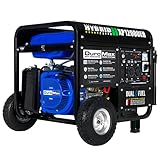
DuroMax XP12000EH
Portable, 9,500W Running / 12,000W Peak
The XP12000EH is what you buy when the goal is a portable that covers essentially the whole panel rather than a chosen list of circuits. Its 12,000 peak watts handled the hardest test we ran — starting a central air conditioning compressor while already carrying a refrigerator, chest freezer, furnace blower and lighting — without tripping or noticeable voltage sag. That is genuinely approaching what a small standby unit delivers, at roughly a fifth of the installed cost, and for households in hot climates where losing air conditioning is the actual emergency, it is the argument for going portable at all. Build quality supports the mission: an all-metal frame, copper windings rather than aluminium, and a general heft that suggests longevity. The 50-amp outlet connects directly to a transfer switch inlet, which is how a machine this size should be used — extension cords cannot carry what it can produce. On propane, peak output falls to roughly 10,800 watts, still enough for the same loads with the AC surge consuming most of the remaining margin. The costs scale with the capability. At over 260 pounds this is not repositioned casually. At 76 dB it was the loudest unit here. And as a conventional generator rather than an inverter, its power quality means sensitive electronics want a surge protector in between.
Pros
- 12,000 peak watts starts a central AC compressor while already carrying a household load
- 50-amp outlet lands straight into a transfer switch inlet with no adapters
- Copper alternator windings rather than aluminium — better heat tolerance and longevity
- All-metal frame that feels built to still be running in fifteen years
- Handled a well pump plus refrigerator, freezer and furnace simultaneously in testing
Cons
- Over 260 lbs — plan its position once and expect to leave it there
- 76 dB under load, the loudest machine in this test
The Bottom Line
The portable that comes closest to standby coverage, including central air. Accept that it is big, heavy and loud, and it is excellent.

Generac GP8000E
Portable, 8,000W Running / 10,000W Peak
Starting reliability is the specification nobody publishes and everybody needs, and the GP8000E was the standout here. Across repeated cold and warm attempts, including a 34°F morning after sitting overnight, it fired on the first turn of the key every time. For a machine that spends 51 weeks a year sitting still and is then asked to work in the worst conditions of the year, that record matters more than a few hundred watts either way. The 8,000 running watts is arguably the ideal size for home backup: enough to run most of an essential-circuit transfer switch including a furnace, sump pump, refrigeration and lighting, without the mass of a 12,000-watt machine. Generac's other advantage is unglamorous and real — a dealer network, published parts availability and service documentation, which is what determines whether the generator is repairable in year eight or disposable. The hour meter with maintenance reminders is a genuinely useful touch on a machine whose owner will otherwise have no idea when the oil was last changed. The limitation is fuel. This is gasoline only, so you carry the storage problem: stabiliser, rotation, and a plan for refilling cans when every station within thirty miles has a queue. Households in areas prone to multi-day regional outages should weigh that seriously against the dual-fuel options here.
Pros
- Push-button electric start that fired first time on every attempt, including at 34°F
- 8,000 running watts is the sweet spot for transfer-switch backup on most homes
- Generac's dealer network means parts and service are genuinely available years later
- Hour meter with maintenance reminders, which is more useful than it sounds on a stored machine
- Steel tube cradle and a covered outlet panel that survives being stored in a damp garage
Cons
- Gasoline only — no propane option, so fuel logistics matter more
- 73 dB under load and a coarse engine note at full output
The Bottom Line
The most reliable starter in the group and the easiest to get serviced a decade from now. Gasoline-only is the trade.

Honda EU2200i
Inverter, 1,800W Running / 2,200W Peak
The EU2200i is the most refined machine in this test and the least suited to the job most readers are shopping for, which makes it worth being precise about. At 48 dB it is the quietest generator we have measured anywhere, quiet enough that neighbours genuinely may not identify the sound. At 47 pounds it is carried in one hand and stored on a shelf. Its starting record is the standard the rest of the industry is measured against — ours has never required more than two pulls, warm or cold. Power quality is excellent, with harmonic distortion low enough that laptops, medical devices and modern appliance electronics run on it without hesitation. What it will not do is back up a house. At 1,800 running watts you get a refrigerator, a handful of lights, phone and laptop charging, and perhaps a furnace blower if nothing else is running — and that is the honest ceiling. Two units in parallel reach roughly 3,600 running watts, which approaches the iGen4500's territory at considerably more cost. Where this machine makes sense for home use is as a deliberate minimum: keeping food cold and the heating running during an outage, in a package one person can deploy in ninety seconds, with none of the storage or noise burden of an open-frame machine. For a small apartment, a second home or a household that mainly wants the food saved, that is a legitimate choice rather than a compromise.
Pros
- 48 dB at 23 feet — the quietest machine we have tested in any generator category
- 47 lbs, carried in one hand, stored on a shelf rather than a corner of the garage
- Legendary starting reliability; Honda's small engines are the benchmark for a reason
- Parallel a second unit to reach roughly 3,600 running watts when you need more
- Clean inverter power with very low harmonic distortion for sensitive electronics
Cons
- 1,800 running watts is a refrigerator, some lights and devices — nothing more
- Expensive per watt, by a wide margin, against every conventional generator here
The Bottom Line
The best small generator made, and the wrong tool for whole-house backup. Buy it for a fridge, a furnace and phones, or for camping.
Westinghouse WGen9500DF
Portable, 9,500W Running / 12,500W Peak
The WGen9500DF is the value benchmark for portable home backup, delivering output within a few hundred watts of the Champion for noticeably less money, with electric start, a remote fob and a battery included rather than treated as accessories. In testing its 9,500 running watts carried our full household load through a transfer switch with room left over on gasoline, settling around 8,500 running watts on propane, which remains comfortable for the same circuits. The standout figure was runtime: roughly 12 hours at half load, the longest gasoline runtime here, which meaningfully reduces overnight refuelling during a multi-day outage — and refuelling in the dark, in bad weather, with a hot engine that has to cool first, is the part of generator ownership nobody anticipates. The outlet configuration is sensible for its purpose, including the 30-amp twist lock a manual transfer switch inlet expects, so the machine connects to a house the way it should rather than through a spaghetti of cords. Where the savings show is refinement rather than capability. The fuel gauge is basic and awkward to read at night, and the control panel layout is functional rather than considered. Fit and finish sit a step below the premium machines. None of it affects whether the generator runs, and Westinghouse's long-term reliability record across a very large owner base is genuinely strong — which is what actually matters across a decade of occasional, urgent use.
Pros
- 9,500 running watts for meaningfully less than comparably specified competitors
- Electric start, remote fob and the battery included rather than sold separately
- Roughly 12 hours at half load — the longest gasoline runtime in this test
- Transfer-switch-ready outlets including the 30-amp twist lock a manual switch expects
- Strong long-term reliability record across a very large base of owner reports
Cons
- Fuel gauge and control panel are basic and hard to read in low light
- 72 dB under load; quieter than some here, but nothing in this class is quiet
The Bottom Line
The most watts per dollar in this test. If budget is a hard constraint and you still need serious output, buy this one.
Firman H05751 Dual Fuel
Portable, 5,700W Running / 7,100W Peak
Most buyers reach for 9,000-plus watts because the price step looks small, then discover they own a 250-pound machine they can barely reposition and rarely start. The H05751 is the argument for restraint. At 5,700 running watts it covered our essential load comfortably — refrigerator, freezer, furnace blower, cycling sump pump and lighting — while adding a window air conditioner with margin left. What it will not do is start a well pump while running central air, and if that combination is genuinely your requirement, this is the wrong size and no amount of careful load management will fix it. On propane it delivered roughly 5,100 running watts, still enough for the essentials package. The weight difference from the larger machines is the real story rather than a footnote. This is a generator one reasonably fit person can manoeuvre alone, which changes where it can be stored, how fast it gets deployed, and — in practice — how often the owner bothers to run it for maintenance. Electric start is included, which is unusual at this price. Runtime was excellent for the tank size at roughly 14 hours at half load. At 70 dB it was the quietest open-frame unit here, though the engine note is coarser and more intrusive than the premium machines measuring similarly.
Pros
- 5,700 running watts covers the essentials plus a sump pump and a window air conditioner
- Substantially lighter than the 9,000W machines, so one reasonably fit person can move it
- Electric start included at a price where it usually is not
- Around 14 hours at half load — excellent for the tank size
- Dual fuel, so propane is available when the pumps are down
Cons
- Will not start a well pump while running central air — this is not a whole-house machine
- 70 dB under load, with a coarser engine note than the premium units at similar levels
The Bottom Line
The right size for households that want transfer-switch backup without owning a 250-pound machine. Enough for what matters, and not more.
3. What Size Portable Generator Do You Need?
This is the decision that determines whether the machine is useful or resented, and it is made badly more often than any other in this category. Buy too small and it trips every time the well pump starts; buy too large and you own something heavy, thirsty and loud that never gets moved.
| Running Watts | What It Covers | Typical Price |
|---|---|---|
| 1,800-2,200W | Refrigerator, lights, devices, a furnace blower alone | $500-1,200 |
| 3,500-4,500W | Fridge, freezer, furnace, lights and devices together | $400-1,100 |
| 5,500-7,000W | The above plus a sump pump and a window AC | $600-1,000 |
| 8,000-9,500W | Most essential circuits through a transfer switch | $900-1,500 |
| 10,000-12,000W | Well pump plus central air — near whole-panel | $1,300-2,200 |
Size Against Starting Watts, Not Running Watts
Anything with a motor surges when it starts. A well pump drawing 1,200 running watts can demand 4,000 for a second or two, and a central air compressor is worse. Add the running watts of everything you want on at once, then confirm the generator's peak rating covers your largest motor's surge on top of that running total. Undersizing here does not show up on the spec sheet; it shows up as a tripped generator at 2 a.m.
Size Against the Fuel You Will Actually Use
Dual fuel machines lose roughly ten percent of their output on propane, and that loss lands squarely on surge capacity — precisely what starts the well pump. If propane is going to be your main fuel because it stores indefinitely, size against the propane rating rather than the headline gasoline figure. Our generator sizing guide works through the arithmetic with real appliance figures, and the wattage chart lists starting and running watts by appliance.
4. Can a Portable Generator Run a Whole House?
Close enough to matter, with two honest caveats. A 10,000 to 12,000 watt portable connected through a transfer switch or an interlock kit will carry a refrigerator, a chest freezer, a furnace, a well pump, lighting across the house and — with care about what starts when — central air conditioning. For most households that is everything they actually miss during an outage.
The first caveat is simultaneity. A standby generator sized for the house never asks you to think about which loads are on together. A portable at the top of its range does, particularly at the moment a compressor or a pump starts. In practice that means staging: get the heavy motors started one at a time rather than switching everything on at once.
The second is presence. A portable does not start itself. If the power fails while you are at work, on holiday or asleep, nothing happens until somebody goes outside and starts it — and the freezer has been thawing in the meantime. Households that are frequently away, or that depend on a sump pump to stay dry, are the clearest case for stepping up to a standby unit. The full comparison is in portable versus standby generators.
The Smallest Generator That Can Run a House
If the question is the minimum rather than the maximum, the honest answer is around 5,000 running watts — enough to carry a refrigerator, a freezer, a furnace blower, a sump pump and lighting simultaneously, which keeps a house warm, dry and stocked. That is a genuinely liveable outage.
Below roughly 3,500 running watts you are preserving food rather than running a house, which is a legitimate goal but a different one. And if central air or a well pump is non-negotiable, the real minimum jumps to 7,500 watts or more, because those two loads dominate everything else on the panel.
5. Inverter or Conventional?
This is the second real decision, and it is almost entirely a trade between noise and watts per dollar.
| Factor | Inverter | Conventional |
|---|---|---|
| Noise under load | 48-58 dB | 70-76 dB |
| Cost per watt | Roughly double | Best value |
| Power quality | Clean sine wave, under 3% THD | 15-25% THD — use a surge protector |
| Fuel economy | Excellent at part load | Fixed rpm, burns the same regardless |
| Practical ceiling | Usually under 7,500W | Up to 15,000W and beyond |
| Weight | Lighter for the output | Heavy, but more watts |
The practical rule: if you need more than about 7,500 running watts, the decision is made for you and you are buying conventional. Below that, the question is whether you would rather have quiet or watts, and how close the neighbours are. A multi-day outage with an open-frame machine running twenty feet from a bedroom window is a genuinely unpleasant experience that no specification sheet conveys. Our inverter generator testing covers that side of the category in depth.
What About Battery "Generators"?
Portable power stations are silent, produce no exhaust, and can run indoors — which no engine-driven generator can. The trade is capacity and recharging: they hold a fixed number of kilowatt-hours and then need mains power or solar to refill, so they suit short outages, apartments and medical equipment far better than a multi-day storm. Where they are the right answer, our portable power station picks cover them, and the direct comparison sets out where each wins.
6. Connecting It to the House
Never Backfeed Through a Dryer Outlet
Connecting a generator to household wiring with a double-male cord energises the utility lines outside your house and can kill the crew repairing the outage. It also bypasses every overcurrent device in your panel. It is illegal in most jurisdictions and it is the single most dangerous thing homeowners do with generators. Install a transfer switch or an interlock kit, or run extension cords directly to appliances. There is no third option.
A transfer switch roughly doubles what a portable generator is worth to you, because extension cords can only reach things with plugs. The furnace, the well pump, the sump pump and the lighting circuits — the loads that actually determine whether a house is habitable — are hardwired, and only a transfer switch or interlock reaches them.
Manual Transfer Switch
A small sub-panel beside your main panel carrying a fixed set of circuits, commonly six to ten, chosen at installation. During an outage you plug the generator into an exterior inlet box, start it, and flip each circuit from utility to generator. Typically $500 to $1,500 installed including the inlet, and it is the standard solution for a portable.
Interlock Kit
A mechanical plate on your existing panel that physically prevents the main breaker and a generator backfeed breaker being on at the same time. It gives access to every circuit rather than a fixed subset, usually for $200 to $500 installed. Availability depends on your panel brand and local code — the trade-offs are in interlock kit versus transfer switch, and installation costs in our transfer switch guide.
Extension Cords, Done Properly
If a switch is not in the budget yet, use heavy-gauge outdoor-rated cords — 12 gauge to 50 feet, 10 gauge beyond — run through a window with a sealed cord pass rather than a door left ajar, which defeats the whole setback. Never daisy-chain cords, and never run them through standing water or under rugs.
7. Fuel, Storage and Upkeep
The purchase price is the smaller half of owning a portable generator. The rest is fuel logistics and the discipline to keep a machine ready that spends fifty-one weeks a year doing nothing.
A 7,000 to 9,000 watt generator burns roughly half a gallon to a gallon of gasoline an hour at moderate load. Over a three-day outage that is 20 to 40 gallons — four to eight five-gallon cans, which is more than most households store and considerably more than they can buy after a regional storm, when the stations that still have power have hour-long queues and the ones that do not cannot pump at all.
This is the strongest practical argument for a dual fuel machine. Propane stores indefinitely without stabiliser, cannot go stale, and sits in exchange cages outside every hardware store after the pumps have failed. Four 20-pound tanks in a garage corner represent days of essential power that needs no rotation. Our guide to propane consumption works through how long each tank size actually lasts.
Exercise It Monthly
A carburetor gummed by stale gasoline is the number one reason a stored generator will not start when it is needed. Run the machine under load for 20 to 30 minutes every month. On a dual fuel unit, do those runs on propane, which leaves no varnish at all — this single habit prevents most no-start failures.
Oil Is the Real Consumable
These engines hold about a quart, so oil degrades far faster than in a car and a missed change matters more. Change after the first 20 to 25 hours, then every 50 to 100 hours of run time. During a long outage, check the level daily rather than trusting the interval — most units have a low-oil shutoff, and discovering that it works at 3 a.m. on day two is an avoidable problem.
8. Safety
Twenty Feet, Always
Never run a generator in a garage, a breezeway, a covered porch, or within 20 feet of any window, door or vent — with the garage door open included, because that is not outdoors. Carbon monoxide from a portable generator can reach lethal concentrations in minutes, and CO shutoff sensors are a backup rather than a permission slip. Fit battery-powered CO detectors inside the house as a second layer.
Two more practices matter in real use. Never refuel a hot or running engine — spilled gasoline on a hot exhaust is one of the most common causes of generator injury. And keep the machine dry and elevated in wet weather using a purpose-built generator canopy that preserves airflow and exhaust clearance, never a tarp draped over it, which traps exhaust heat against the housing. Whether to run one at all in bad weather is covered in running a generator in the rain.
9. Frequently Asked Questions
What is the best portable generator for home use in 2026?
The Champion 9200-Watt Dual Fuel is our overall pick — enough output to carry essential circuits through a transfer switch, remote electric start, and propane capability for when the pumps are down. For near whole-house coverage including central air, the DuroMax XP12000EH; for quiet, the Westinghouse iGen4500; for value, the Westinghouse WGen9500DF.
Can a portable generator power a whole house?
A large one comes close. A 10,000 to 12,000 watt portable through a transfer switch will run a refrigerator, freezer, furnace, well pump, lighting and often central air — most of what a house actually uses in an outage. What it will not do is run everything at once without thought, or start itself when the power fails.
What size portable generator do I need for home backup?
Essentials — fridge, freezer, lights, devices — need 3,500 to 4,500 running watts. Adding a sump pump and a window AC takes 5,500 to 7,000. Most essential circuits through a transfer switch need 8,000 to 9,500. A well pump plus central air needs 10,000 to 12,000.
What is the smallest generator that can run a house?
Around 5,000 running watts, on a selective definition of running a house — a refrigerator, freezer, furnace blower, sump pump and lighting together, which keeps the place warm, dry and stocked. Below 3,500 you are preserving food rather than running a house, and central air or a well pump pushes the minimum to 7,500 or more.
How do you connect a portable generator to a house?
Through a manual transfer switch ($500-$1,500 installed) or an approved interlock kit ($200-$500), fitted by an electrician. Never backfeed through a dryer outlet with a double-male cord — it energises the utility line outside your home, can kill line crews, bypasses your panel's protection, and is illegal in most jurisdictions.
How long can a portable generator run continuously?
Most run 8 to 14 hours per tank at half load, but the limit is oil rather than fuel. Plan to shut down roughly every 24 hours to check and top up the oil. These engines hold about a quart, so oil degrades far faster than in a car, and a low-oil shutdown mid-outage is a self-inflicted problem.
Are portable generators loud?
Open-frame conventional units run 70 to 76 dB at 23 feet under load — loud enough to be intrusive indoors and to strain neighbourly relations across a multi-day outage. Inverter generators run 48 to 58 dB because the engine varies its speed with demand rather than holding 3,600 rpm. That quiet costs roughly double per watt.
Is a portable generator better than a standby?
It is cheaper by an order of magnitude and it requires you to be home. A portable runs $500 to $2,000 plus a transfer switch, and somebody must go out, start it and manage fuel. A standby is $5,000 to $15,000 installed, starts itself in seconds and runs off natural gas indefinitely. How often the house is empty usually decides it.
10. Common Mistakes With Portable Generators
Running It in a Garage With the Door Open
An open garage is not outdoors, and carbon monoxide accumulates in it readily. This mistake kills people every winter. Twenty feet from any window, door or vent, exhaust pointed away from the house, with CO detectors inside as a second layer.
Backfeeding Through an Outlet
A double-male cord energises the utility lines outside your house and can kill the crew fixing the outage, while bypassing every breaker in your panel. Fit a transfer switch or an interlock kit, or run cords directly to appliances.
Buying Watts You Cannot Move
The step from 5,700 to 9,500 watts costs a few hundred dollars and about 80 pounds. If the machine lives in a shed at the end of the garden and needs to reach the inlet box, that weight decides whether it gets deployed at all — and whether it gets exercised monthly.
Storing It With Untreated Gasoline
A gummed carburetor is the leading reason a stored generator will not start during an outage. Either stabilise the fuel and run it through the carburetor, or shut the fuel valve and let the bowl run dry — and exercise the unit monthly regardless.
Ignoring Starting Watts When Sizing
A well pump running at 1,200 watts can demand 4,000 to start. Size against the surge of your largest motor stacked on top of everything already running, or the generator will trip at the worst possible moment and you will blame the machine rather than the arithmetic.
Related Generator Guides
Buyer's Guide
Best Home Generator for Outages
Standby, portable, inverter and battery options across a multi-day outage.
Buyer's Guide
Best Whole House Generators
Standby units ranked, with installed cost and sizing.
Buyer's Guide
Best Gas Generators
Gasoline machines, and the fuel logistics that decide whether they work.
The Bottom Line
The best portable generator for most homes is the Champion 9200-Watt Dual Fuel — enough output to carry the circuits that matter through a transfer switch, remote electric start so it actually gets used in bad weather, and propane capability for when the pumps are down. For near whole-house coverage including central air, the DuroMax XP12000EH; for quiet, the Westinghouse iGen4500; for value, the WGen9500DF.
Size against starting watts, not running watts, and against the fuel you will genuinely use. Around 5,000 running watts is the realistic minimum to run a house selectively; 10,000 or more gets you close to whole-panel coverage including air conditioning.
Then spend the money that makes it work: a transfer switch or interlock kit, so the generator reaches the hardwired circuits that actually matter, and a monthly exercise run so it starts when the lights go out. Never backfeed, and never run it within twenty feet of a window.
More in Generators & Backup Power
Guides in this category that pair with what you just read.
About the Author
Alex Rivers, Home Improvement Editor
Alex has spent over a decade working on residential and light commercial property maintenance, and now tests every tool, coating and machine that appears in these guides personally.