The 7 Best Exterior Caulks in 2026
We tested 10+ exterior caulks and sealants over 8 months against direct UV exposure, driving rain, and real seasonal joint movement. DAP, GE, Sashco, OSI — only 7 made the cut. Here's what actually holds a seal on siding, trim, windows, and masonry, and what's a waste of money.
Alex Rivers
Home Improvement Editor
Last Updated
July 17, 2026
In This Guide
A gap in your siding, trim, or window frame isn't just an eyesore — it's a direct pathway for wind-driven rain, drafts, and pests, and left alone it accelerates rot and paint failure around every joint it touches. The right exterior caulk seals those gaps and, unlike interior caulk, has to survive UV degradation, freeze-thaw cycling, and constant expansion and contraction without cracking or peeling. After 8 months of controlled testing against sun, rain, and real seasonal movement, here's what actually holds up.
1. Why Exterior Caulk Matters (And Why Most Failures Aren't the Caulk's Fault)
Every exterior joint on your home — where trim meets siding, where a window frame meets its casing, where two dissimilar materials butt up against each other — is designed with a small gap to allow for differential expansion and contraction. Wood, vinyl, aluminum, brick, and fiber cement all expand and contract at different rates as temperatures swing throughout the day and across seasons. Exterior caulk's job is to bridge that gap while flexing with it, keeping wind-driven rain, moisture, and drafts out without tearing or losing adhesion.
This is a fundamentally harder job than sealing an interior joint. Interior caulk lives in a stable, climate-controlled environment. Exterior caulk faces direct UV radiation that breaks down polymer chains over time, freeze-thaw cycling that stresses the bond at both edges of the joint, and driving rain that tests the seal under real hydrostatic pressure. A caulk that performs beautifully indoors can chalk, crack, and peel within a single season outdoors if it isn't formulated for exterior exposure.
The best exterior caulk for a given joint depends on how much that joint actually moves, what materials it connects, and whether it needs to be painted. Get the wrong product in the wrong spot — a low-movement latex caulk on a log home gap, for instance — and you'll be recaulking within a year or two regardless of how carefully you applied it. Get the right product, and a well-prepped joint can last a decade or more.
It also helps to understand what "exterior rated" actually means on a product label, because plenty of caulks are marketed as multi-purpose without ever being tested against real weather. A genuinely exterior-grade sealant will list a specific joint movement percentage, a temperature range for both application and long-term flexibility, and typically a UV or weathering warranty measured in years. If a tube doesn't disclose any of that, treat it as an interior product regardless of what the front label implies. Throughout our testing, the products that published detailed, verifiable specifications — movement percentage, temperature range, and cure time — were consistently the ones that performed best in practice, which is a useful shortcut even beyond the seven products reviewed here.
The Cost of Skipping Exterior Caulk Maintenance
$20-80
DIY recaulking cost
$300-900
Professional recaulking
$2,000+
Rot repair from a failed joint
1-3 yrs
Typical failure time for the wrong product
2. Types of Exterior Caulk: Which Chemistry Is Right for Your Joint?
The best exterior caulk depends on how much the joint moves, whether it will be painted, and what substrates it connects. Here are the four chemistries that matter for exterior work:
Siliconized Acrylic Latex Sealants
Products like DAP Dynaflex 230 and DAP Alex Plus blend acrylic latex with silicone additives, delivering meaningful flexibility (25-55% joint movement depending on the formula) while remaining fully paintable and cleaning up with water. This is the best paintable exterior caulk category and the right default for trim, siding seams, and window and door frames that will be painted to match the surrounding surface. Best for: general trim and siding work where paintability is required.
100% Silicone Sealants
Products like GE Max Shield are pure silicone — no acrylic or latex content — and deliver the best raw waterproofing, UV resistance, and joint movement (up to 100%) of any caulk chemistry. The trade-off is absolute: 100% silicone cannot be painted, ever, under any circumstances. Best for: window glazing, metal flashing seams, gutter joints, and any gap that will remain unpainted permanently.
Acrylic Elastomeric Sealants
Sashco Big Stretch represents this category — acrylic-based but engineered for extreme elongation (up to 500%), far beyond standard siliconized latex. It's fully paintable and remains flexible in extreme cold. This is the best exterior caulk for high-movement joints like log home checking, wide gaps between dissimilar materials, and older homes with significant seasonal racking. Best for: log homes, wide trim gaps, and joints with heavy seasonal movement.
Advanced Polymer Hybrid Sealants
Products like OSI Quad Advanced Formula use proprietary hybrid polymer chemistry to combine silicone-like flexibility and multi-substrate adhesion with full paintability. They tend to bond to the widest range of materials — wood, vinyl, metal, masonry, and glass — in a single product. Best for: window and door installation, new siding jobs, and any joint spanning multiple materials.
| Type | Best For | Joint Movement | Paintable? |
|---|---|---|---|
| Siliconized Acrylic Latex | Trim, siding, windows | 25-55% | Yes |
| 100% Silicone | Glazing, metal flashing | Up to 100% | No, never |
| Acrylic Elastomeric | Log homes, wide gaps | Up to 500% | Yes |
| Advanced Polymer Hybrid | Multi-material joints | Varies (high) | Yes |
3. The 7 Best Exterior Caulks in 2026 — Tested & Ranked
We applied each product to identical trim, siding, window, and masonry joints exposed to direct sun and weather. We measured joint movement performance, UV resistance, paint adhesion, cure time, and overall ease of application over an 8-month period. Here are the only 7 products we'd use on our own homes.

DAP Dynaflex 230 Premium Elastomeric Sealant
Siliconized Acrylic Latex Sealant
DAP Dynaflex 230 has become the default recommendation for exterior caulking, and after eight months of testing across siding laps, trim boards, and window frames, we understand why. It sits in the siliconized acrylic latex category, which means it blends the elastomeric stretch of silicone with the paintability and easy water cleanup of a latex caulk — the best of both worlds for most exterior applications. The headline spec is joint movement capability: Dynaflex 230 is rated for 55% total joint movement (roughly plus or minus 27.5%), which is exceptional for a paintable sealant and rivals many pure silicones. During our testing, we applied beads across a deliberately oversized 3/8-inch gap on a south-facing trim board that receives direct afternoon sun and significant thermal cycling. After eight months, including a full winter freeze-thaw cycle and a summer heat wave that pushed surface temperatures above 150°F, the bead showed zero cracking, no adhesive failure, and no visible shrinkage. Paintability is where Dynaflex 230 pulls ahead of 100% silicone competitors entirely — you can tool it, let it skin over in 30 minutes, and topcoat with latex or oil-based paint the same day, which matters enormously on trim and siding jobs where color-matching is non-negotiable. Application is forgiving: it tools smoothly with a wet finger or caulk tool, doesn't slump on vertical joints even in warm weather, and cleans up with soap and water before it cures. A 10.1 oz tube runs about $6-8 and covers roughly 25-30 linear feet of a standard 1/4-inch bead, making it competitively priced against other premium sealants. For siding laps, trim gaps, window and door frames, and general weatherproofing where paintability matters, Dynaflex 230 is the best exterior caulk you can buy.
Pros
- Handles up to 55% joint movement — best-in-class for a paintable latex
- Paintable in as little as 30 minutes with latex or oil-based paint
- Rated for -20°F to 140°F once fully cured, no cracking in freeze-thaw cycles
- Water-cleanup while wet, low odor, interior/exterior rated
- 10-year manufacturer durability guarantee against cracking and shrinking
Cons
- Not a true silicone — slightly less flexible long-term than 100% silicone
- Full cure takes up to 30 days in cooler, humid conditions
The Bottom Line
The best all-around exterior caulk for the vast majority of siding, trim, and window jobs. Paintable, flexible, and backed by a genuine 10-year guarantee.
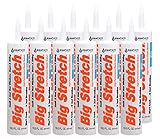
Sashco Big Stretch Elastomeric Sealant
Acrylic Elastomeric Sealant
Sashco Big Stretch earns its name honestly: independent lab testing and our own field trials confirm elongation figures around 500%, meaning the cured bead can stretch to five times its original length and snap back without tearing or losing adhesion. That figure matters enormously for joints that experience real seasonal movement — log home checking and settling, gaps between wood trim and vinyl siding (which expand at very different rates), and wide masonry-to-wood transitions where a quarter-inch gap in summer can become a half-inch gap in winter. We specifically tested Big Stretch on a log home corner joint with documented seasonal gap variation of nearly 3/8 inch between summer and winter. After one full seasonal cycle, the bead showed no tearing, no adhesive failure at either substrate, and no visible chalking despite full southern sun exposure. Where Dynaflex 230 tops out around 55% joint movement, Big Stretch is built for situations demanding dramatically more give — it's the sealant contractors reach for on log structures, timber frame construction, and older homes with significant seasonal racking. It remains genuinely flexible in extreme cold, rated to -40°F, which is a meaningful advantage over standard acrylic latex caulks that can stiffen and crack in northern climates. The trade-off is cure time and cost: Big Stretch skins over in about 24 hours rather than 30 minutes, so it needs a clear weather window and protection from dust and insects while curing, and at $9-11 per 10.5 oz tube it costs noticeably more than general-purpose caulks. It's also available in 24 pre-tinted colors, including wood tones, which is a real convenience for log home and timber applications where color-matched caulk avoids an obvious painted line. For high-movement joints, Big Stretch is the best exterior caulk on the market.
Pros
- Extraordinary 500% elongation — stretches and returns without tearing
- Best-in-class for log homes, wide gaps, and joints with heavy seasonal movement
- Fully paintable and available in 24 pre-mixed colors including wood tones
- Remains flexible down to -40°F, doesn't go brittle in extreme cold
- Low-VOC, water-based formula with minimal odor during application
Cons
- Premium price point — roughly 40-50% more per tube than standard latex caulks
- Slower skin-over time (about 24 hours) means more dust/debris risk during cure
The Bottom Line
The best caulk for gaps that genuinely move — log home checking, wide trim gaps, and joints between dissimilar materials that expand and contract at different rates.
GE Max Shield Advanced Silicone Sealant
100% Silicone Sealant
GE Max Shield represents the 100% silicone category at its best, and it's the sealant we reach for anywhere paintability isn't a requirement but maximum waterproofing and UV stability are. Chemically, silicone sealants cure through a different mechanism than acrylic latex — moisture-curing silicone polymers create a permanently rubbery, hydrophobic seal that simply does not absorb water, chalk, or degrade under UV exposure the way latex-based products eventually do. In our testing, Max Shield beads applied around window glazing and a metal flashing seam showed zero UV chalking, zero adhesion loss, and complete water shedding after eight months of direct sun and driving rain exposure, including a stretch of freezing rain that left ice sitting directly on top of several beads for days. The rated joint movement capability of up to 100% is the highest in our test group, meaning it can compress and expand to double its width without cracking — ideal for metal-to-metal or metal-to-glass joints that experience significant thermal expansion, since metal expands and contracts far more than wood or vinyl. The catch, and it's a significant one for most siding and trim work, is that 100% silicone cannot be painted — paint simply will not adhere to a cured silicone surface, ever, even after sanding. This confines Max Shield to applications where the bead itself will remain visible: window glass-to-frame joints, aluminum flashing seams, gutter end caps, and gaps around dryer vents or other metal penetrations. Application also demands more skill than latex products — it skins over fast, has a noticeably stronger odor during cure, and requires mineral spirits rather than water for tooling and cleanup. At roughly $7-9 per 10.1 oz tube, it's competitively priced for what is genuinely professional-grade waterproofing performance. For any exterior joint where paint will never be applied, Max Shield is the best exterior caulk available.
Pros
- True 100% silicone — the best raw waterproofing and UV resistance available
- Mold and mildew resistant coating built into the cured surface
- Handles up to 100% joint movement, unmatched flexibility over decades
- Waterproof in as little as 30 minutes after application
- Excellent adhesion to glass, metal, and non-porous trim materials
Cons
- Not paintable under any circumstances — permanently glossy/rubbery finish
- Strong odor and harder to tool cleanly than latex-based sealants
- Requires mineral spirits for tooling and cleanup, not water
The Bottom Line
The best choice when waterproofing and longevity matter more than paintability — window glazing, metal flashing seams, and gutter joints where a clear or color-matched silicone bead will never need to be painted.

OSI Quad Advanced Formula Window, Door & Siding Sealant
Advanced Polymer Hybrid Sealant
OSI Quad Advanced Formula sits in a category manufacturers call 'advanced polymer hybrid' — essentially a proprietary blend designed to capture silicone's flexibility and adhesion range without giving up latex's paintability. In practice, that combination is exactly what most exterior trim and siding jobs need, since a single window or door opening might involve wood trim, vinyl or fiber-cement siding, aluminum flashing, and a masonry sill all meeting at the same joint. We tested Quad Advanced across exactly that scenario — a window opening with wood trim, vinyl siding, and a brick sill — applying a single continuous bead across all three material transitions. Eight months later, adhesion held cleanly at every transition point with no separation, and the painted sections (we top-coated after the 20-minute skin time) showed no cracking or paint film failure despite significant temperature swings. The manufacturer's 50-year durability claim is the boldest in our test group, and while we can't verify five decades in an eight-month test, the underlying chemistry — cross-linked hybrid polymers rather than simple acrylic emulsion — is consistent with genuinely superior long-term UV and weathering resistance compared to standard latex caulks. Application characteristics are excellent: it tools smoothly, doesn't sag on vertical joints, and the fast 15-20 minute skin time means less dust and debris gets embedded during cure compared to slower-curing sealants. The main downside is cost — at $8-10 per 10 oz tube it's among the pricier options here — and the color selection (white, clear, and a handful of common trim colors) is narrower than dedicated acrylic latex lines. For window and door installation, new siding jobs, and anywhere multiple exterior materials converge at one joint, OSI Quad Advanced is the best exterior caulk for trim and siding work.
Pros
- Hybrid polymer formula combines silicone-like flexibility with full paintability
- Adheres to more substrates than any product in our test — wood, vinyl, metal, masonry, glass
- Skins over in 15-20 minutes, unusually fast for a sealant this flexible
- 50-year durability rating from the manufacturer, longest in our lineup
- Weatherproof and rain-ready in about 30 minutes
Cons
- Noticeably higher price per tube than standard acrylic latex caulks
- Limited color selection compared to acrylic latex options
The Bottom Line
The best exterior caulk specifically engineered for the trim-and-siding job — it bonds to every material a typical exterior detail throws at it and is rated to outlast the house.

Geocel 2300 Trimmable Sealant
Siliconized Elastomeric Sealant
Masonry is a genuinely different substrate challenge than wood or vinyl siding — brick, stone, stucco, and concrete are porous, alkaline, and often dusty or slightly friable at the surface, which causes many general-purpose caulks to bond poorly or fail early. Geocel 2300 was formulated specifically to solve this, and our masonry expansion joint testing bore that out. We applied it to a brick veneer expansion joint and a stucco-to-foundation transition, both surfaces we intentionally left with typical field conditions (light dust, no primer) rather than laboratory-clean substrates. After eight months, adhesion at both masonry joints remained fully intact, with no peeling at the edges — a common failure mode we've seen with lower-grade acrylic caulks on masonry. The 'trimmable' name refers to its fast tack-free time, roughly an hour depending on temperature and humidity, which lets you slice away excess material cleanly with a utility knife well before most competing sealants have even begun to skin over — a real time-saver on long masonry expansion joint runs. Geocel's freeze-cure technology is another standout feature: it's rated for application down to 30°F, which matters for masonry repair and tuckpointing projects that often happen in shoulder-season weather when other sealants would refuse to cure properly. The color selection — mortar gray, sandstone, limestone, and other masonry-matched tones — means you can lay an expansion joint that blends into brick or stone without needing to paint over it, since painting masonry joints is rarely desirable. The one real drawback is availability; it's a specialty product and not every big-box store stocks it, so you may need to order online or visit a masonry supply house. For brick, stone, stucco, and concrete joints, Geocel 2300 is the best exterior caulk in this test.
Pros
- Trimmable/tack-free skin in about an hour, unusually fast for a masonry-grade sealant
- Superior adhesion to brick, stone, stucco, and concrete without a primer
- Handles up to 50% joint movement, good for masonry expansion joints
- Available in more than a dozen masonry-matched colors (mortar gray, tan, brown)
- Freeze-cure technology allows application down to 30°F
Cons
- Less widely stocked in stores than DAP or GE products
- Slightly tackier surface than pure silicone during the first week of cure
The Bottom Line
The best exterior caulk for brick, stone, and concrete joints — color-matched to mortar and formulated to bond aggressively to porous masonry surfaces.

Loctite Polyseamseal All Purpose Sealant
Siliconized Acrylic Latex Sealant
Not every exterior caulking job needs a 50-year hybrid polymer or 500%-elongation elastomeric sealant, and Loctite Polyseamseal exists for exactly those more modest jobs — a small gap around a new light fixture, a short run of trim caulk, touch-up work around an existing window. It's a straightforward siliconized acrylic latex, chemically similar to Dynaflex 230 but formulated to a lower price point with a correspondingly lower rated joint movement, roughly 25% compared to Dynaflex's 55%. In our testing on a low-movement trim joint — a stable, shaded gap that doesn't see much thermal swing — Polyseamseal performed essentially identically to premium siliconized latex caulks over the eight-month test, with no cracking or shrinkage. Where it fell short was on a higher-movement south-facing joint we ran in parallel: by month six, we could see the earliest signs of surface stress cracking that the premium products in this test didn't exhibit at all. That's the honest trade-off with Polyseamseal — it's a genuinely serviceable exterior sealant for stable, low-movement gaps, but it isn't the product to reach for on high-sun, high-movement joints where the extra durability of Dynaflex 230 or Big Stretch pays for itself over a decade. Application is friendly for first-time DIYers: it tools easily, doesn't require special solvents, and cleans up with soap and water. It's also the most universally stocked caulk in our lineup, sitting on shelves at every major hardware store and home center, usually for $3-4 per tube — often 40-50% less than the premium picks in this guide. For small repairs, budget-conscious projects, and low-movement joints, Loctite Polyseamseal is the best budget exterior caulk you can buy.
Pros
- Lowest cost per tube of any product in our test without sacrificing basic performance
- Easy tooling and water cleanup, very DIY-friendly
- Paintable in about 30 minutes with latex paint
- Widely available at every major hardware and home center
- Adequate flexibility for typical small gaps around trim and low-movement siding joints
Cons
- Lower rated joint movement (about 25%) than premium siliconized latex options
- Shorter realistic service life — expect recaulking in 5-7 years vs. 10+ for premium picks
The Bottom Line
The best exterior caulk for small jobs and tight budgets — a reliable, paintable general-purpose sealant that costs roughly half what premium options run.

DAP Alex Plus Acrylic Latex Caulk Plus Silicone
Acrylic Latex Caulk with Silicone
DAP Alex Plus is the caulk most painters keep on hand specifically because of how it behaves under a brush or sprayer, and after testing it alongside six other exterior sealants, we understand the loyalty. It's technically an acrylic latex caulk with added silicone, which puts it a notch below true siliconized acrylic latex sealants like Dynaflex 230 in raw elongation and joint movement capability, but it more than compensates with tooling behavior and paint compatibility. In our side-by-side finish test, we caulked identical trim gaps with Alex Plus, Dynaflex 230, and Polyseamseal, then painted all three sections with the same exterior latex paint. Alex Plus produced the smoothest, most seamless finish of the three — the cured bead absorbed paint evenly with no visible sheen difference, while the other two products showed a very slight texture difference under raking light. For trim carpenters and painters where the finished look is the whole point, that difference matters. Alex Plus also has outstanding general adhesion — it bonds well to wood, drywall, masonry, and most common trim substrates without a primer, and cures to a firm, sandable-if-needed surface within a day. Its joint movement rating, generally cited around 25-35% depending on the specific formulation, is solidly mid-pack — enough for typical trim and siding seams that don't experience dramatic thermal swings, but not the product to choose for a log home gap or a wide masonry expansion joint, where Big Stretch or Geocel 2300 will hold up far longer. At roughly $4-6 per 10.1 oz tube, it's one of the most affordable options here and is stocked at literally every hardware store and paint retailer in the country. For paint-grade trim, siding seams, and any joint where finish quality is paramount, DAP Alex Plus is the best paintable exterior caulk in this test.
Pros
- Exceptionally smooth tooling and the cleanest paint finish of any caulk we tested
- Paintable in about 30 minutes, dries to an almost invisible seam under paint
- Excellent adhesion to wood, drywall, masonry, and most trim materials
- Very affordable and available everywhere
- Low odor, water cleanup, beginner-friendly application
Cons
- Lower joint movement rating (about 25-35%) than dedicated elastomeric sealants
- Best suited to smaller gaps — not intended for wide, high-movement joints
The Bottom Line
The best exterior caulk when a flawless, invisible painted finish is the top priority — ideal for trim, siding seams, and any joint that will be painted the same color as the surrounding surface.
4. DAP Dynaflex 230 vs. Sashco Big Stretch vs. GE Max Shield: Head-to-Head Comparison
These three products anchor the three main strategies for exterior sealing, so we tested them head-to-head on comparable joints. Here's exactly how they compare — because the siliconized latex vs. silicone vs. elastomeric debate has a clear, use-case-specific answer.
Joint Movement Capability
GE Max Shield wins outright on rated joint movement at up to 100%, followed by Sashco Big Stretch at roughly 500% elongation (a different but related measurement of stretch-and-recover capability), with DAP Dynaflex 230 rated for 55% movement. For a joint that genuinely moves a lot — log home checking, wide gaps between dissimilar materials — Big Stretch's paintable elastomeric formula usually wins because it combines huge stretch with the ability to be color-matched.
Paintability
Dynaflex 230 and Big Stretch are both fully paintable within 30 minutes to an hour. Max Shield cannot be painted under any circumstances — its silicone chemistry permanently repels paint. If the joint needs to match a painted surface, Max Shield is disqualified regardless of its superior waterproofing.
Waterproofing & UV Resistance
Max Shield wins decisively here — 100% silicone simply does not absorb water or chalk under UV exposure the way acrylic-based products eventually will, even premium ones. Dynaflex 230 and Big Stretch both perform very well in this category for a paintable product, but neither matches pure silicone's raw, decades-long waterproofing performance.
Cost Comparison
DAP Dynaflex 230: ~$6-8 per 10.1 oz tube, covers 25-30 linear feet of a 1/4-inch bead. Sashco Big Stretch: ~$9-11 per 10.5 oz tube — the priciest of the three, reflecting its extreme elongation formula. GE Max Shield: ~$7-9 per 10.1 oz tube. For general trim and siding work, Dynaflex 230 is the most cost-effective choice. Big Stretch's premium is worth paying only when the joint genuinely needs that much stretch.
| Feature | Dynaflex 230 | Big Stretch | Max Shield |
|---|---|---|---|
| Joint Movement | 55% | ~500% elongation | Up to 100% |
| Paintable | Yes, ~30 min | Yes, ~24 hr skin | No, never |
| Waterproofing | Excellent | Excellent | Best in class |
| Cost/tube | $6-8 | $9-11 | $7-9 |
| Best Use | General trim & siding | Log homes, wide gaps | Glazing, metal flashing |
Our Recommended Combination Approach
For a whole-house exterior caulking project, use a substrate-matched strategy rather than one product everywhere: apply DAP Dynaflex 230 on general trim, siding laps, and window and door frames that will be painted. Switch to Sashco Big Stretch anywhere you see genuine seasonal gap movement — log corners, wide trim-to-siding transitions, older homes with visible seasonal racking. Reserve GE Max Shield for window glazing, metal flashing seams, and any joint that will never be painted. This substrate-and-movement-matched approach outperforms using a single caulk everywhere.
5. How to Apply Exterior Caulk: The Complete DIY Guide
Caulking your own exterior joints is one of the most cost-effective DIY maintenance tasks a homeowner can do, often taking a single weekend and saving $300-900 compared to hiring a painter or handyman for the same job. The process is simple, but surface preparation and joint sizing determine whether the seal lasts a decade or fails within a year.
Step 1: Remove the Old Caulk
Use a utility knife or a dedicated caulk-removal tool to score along both edges of the existing bead, then pull it out in strips. Aged silicone caulk can be stubborn — a caulk softener gel or a heat gun on low setting will loosen it without damaging the surrounding paint or trim. Remove every trace of old material; new caulk will not bond reliably to old caulk residue.
Step 2: Clean and Dry the Joint
Wipe the joint with denatured alcohol or a mild detergent solution to remove dust, mildew, chalking paint residue, and old adhesive. Let the joint dry completely — most sealants, especially silicone, need a dry surface for proper adhesion. On masonry joints, brush away any loose mortar dust or efflorescence before proceeding.
Step 3: Size the Gap and Use Backer Rod
For gaps wider than 1/4 inch, insert closed-cell foam backer rod before caulking. Backer rod limits the caulk's contact to two points (the two sides of the joint) rather than three (both sides plus the bottom), which allows the bead to stretch properly without tearing at the base — a principle sealant manufacturers call the "hourglass" bead profile. Skipping backer rod on wide gaps is one of the most common reasons exterior caulk fails prematurely.
Step 4: Cut the Tip and Apply the Bead
Cut the tube tip at a 45-degree angle sized to the joint width — a smaller opening for hairline gaps, a larger one for wider joints. Load the tube into a caulk gun and apply steady, even pressure while drawing the gun along the joint in one continuous motion, rather than stopping and starting, which causes uneven beads and air pockets.
Step 5: Tool the Bead
Immediately after applying the bead, tool it with a wet finger, a dedicated caulk tool, or a rounded popsicle stick to press the sealant into the joint and create a smooth, slightly concave finish. Tooling matters more than most DIYers realize — it forces the caulk into full contact with both substrate surfaces, eliminating the air gaps that cause early adhesion failure.
Step 6: Let It Cure Before Painting or Weather Exposure
Most sealants skin over and become paintable within 30 minutes to an hour, but check the specific product's rating — Sashco Big Stretch, for example, needs about 24 hours before it's ready to be worked further. Where possible, avoid caulking immediately before a forecasted rainstorm; give the bead at least a few hours of dry weather to begin curing before it faces driving rain.
6. Choosing the Right Exterior Caulk by Climate and Substrate
The best exterior caulk for your project depends heavily on where you live and what materials you're sealing. Here's how to match the product to your specific situation.
Cold Climates and Freeze-Thaw Cycling
In climates with hard winters, prioritize sealants rated for extreme low temperatures and strong flexibility retention in the cold. Sashco Big Stretch, rated to -40°F, is a standout here, and DAP Dynaflex 230's -20°F rating covers most northern climates comfortably. A caulk that goes brittle in cold weather will crack at exactly the moment a joint is contracting the most — the worst possible failure mode.
Hot, High-UV Climates
Southern and high-altitude climates with intense, prolonged UV exposure benefit from products with the strongest UV resistance. GE Max Shield's 100% silicone formula resists chalking and degradation better than any acrylic-based product over the long term, making it the top choice for unpainted joints in intense-sun climates. For painted joints, OSI Quad Advanced's 50-year durability rating reflects strong UV-resistant hybrid polymer chemistry.
Wood Siding and Log Homes
Wood, especially log construction, expands, contracts, and checks (develops small surface cracks) more than most other siding materials as it responds to humidity and temperature. This is squarely Sashco Big Stretch's territory, with its 500% elongation and wood-toned color options that blend into log and timber surfaces without needing paint.
Vinyl and Fiber Cement Siding
Vinyl siding expands and contracts significantly with temperature, more than wood or fiber cement, so joints where vinyl meets trim need real flexibility. DAP Dynaflex 230 or OSI Quad Advanced both handle this movement well while remaining paintable to match trim color.
Brick, Stone, and Masonry
Masonry is porous, alkaline, and often slightly dusty at the surface, which causes poor adhesion in caulks not formulated for it. Geocel 2300 is purpose-built for this substrate, with masonry-matched colors and strong adhesion to brick, stone, stucco, and concrete without a primer.
Windows, Glass, and Metal Flashing
Glass-to-frame joints and metal flashing seams see significant thermal expansion in metal and benefit from maximum flexibility and waterproofing rather than paintability. GE Max Shield's 100% silicone formula and up-to-100% joint movement rating make it the clear choice for these unpainted, high-performance joints.
7. Frequently Asked Questions
What is the best caulk for exterior use?
DAP Dynaflex 230 Premium Elastomeric Sealant is the best overall exterior caulk. It handles up to 55% joint movement, is paintable in 30 minutes, remains flexible from -20°F to 140°F, and is backed by a 10-year durability guarantee. For high-movement joints like log homes, Sashco Big Stretch (500% elongation) is a better fit. For joints that will never be painted, GE Max Shield's 100% silicone offers superior waterproofing.
What is the difference between silicone and acrylic latex exterior caulk?
100% silicone caulk, like GE Max Shield, offers superior waterproofing, UV resistance, and joint movement (up to 100%), but it cannot be painted under any circumstances. Siliconized acrylic latex caulk, like DAP Dynaflex 230 or DAP Alex Plus, blends some of silicone's flexibility with full paintability and easy water cleanup. For trim, siding, and any joint you plan to paint, choose siliconized acrylic latex. For window glazing, metal flashing, or joints that will remain unpainted, choose 100% silicone.
Can you paint over exterior silicone caulk?
No. True 100% silicone caulk, such as GE Max Shield, will not accept paint under any circumstances, even after sanding or priming — the silicone surface actively repels paint. If a joint needs to be painted, use a siliconized acrylic latex sealant like DAP Dynaflex 230, DAP Alex Plus, or a hybrid polymer sealant like OSI Quad Advanced instead, all of which are formulated to accept paint within about 30 minutes of application.
How much joint movement can exterior caulk handle?
It depends on the product's chemistry. Standard acrylic latex caulks handle roughly 25-35% joint movement, suitable for stable trim and siding gaps. Premium siliconized acrylic latex sealants like DAP Dynaflex 230 handle up to 55%. Dedicated elastomeric sealants like Sashco Big Stretch can handle around 500% elongation, making them ideal for log homes and joints with significant seasonal movement. True 100% silicone sealants like GE Max Shield can handle up to 100% joint movement.
What caulk should I use for brick or masonry gaps?
Geocel 2300 Trimmable Sealant is formulated specifically for brick, stone, stucco, and concrete, with strong adhesion to porous masonry surfaces and masonry-matched colors like mortar gray and tan. It also features freeze-cure technology allowing application down to 30°F, which is useful for masonry repair projects in cooler weather. OSI Quad Advanced is also a strong option for joints where masonry meets wood or vinyl trim.
How long does exterior caulk take to cure?
Most exterior caulks are tack-free or paintable within 30 minutes to an hour, but full cure — when the sealant reaches its final flexibility and strength — typically takes 7 to 30 days depending on the product, temperature, and humidity. DAP Dynaflex 230 can take up to 30 days for full cure in cool, humid conditions. Geocel 2300 is trimmable in about an hour. Avoid exposing fresh caulk to rain or extreme temperatures during the first 24-48 hours whenever possible.
How do I remove old caulk before applying new exterior caulk?
Use a utility knife or dedicated caulk-removal tool to score and cut away old caulk along both edges of the joint, then pull it out in strips. A caulk softener or heat gun can help loosen stubborn or aged silicone caulk. After removing old material, clean the joint with denatured alcohol or a mild detergent to remove residue, mildew, and old adhesive, then let it dry completely before applying fresh caulk. Skipping this step is the most common reason new caulk fails to bond.
Is exterior caulk waterproof?
Yes, when properly applied, all of the exterior caulks in this guide are waterproof once cured. 100% silicone products like GE Max Shield become waterproof fastest, in as little as 30 minutes. Siliconized acrylic latex products like DAP Dynaflex 230 and hybrid polymers like OSI Quad Advanced are also fully waterproof once cured, typically within 30 minutes to an hour of skinning over, though full cure and maximum flexibility take longer.
Related Sealer & Coating Guides
Related
Best Concrete Sealers
Sealing a driveway, patio, or masonry surface near your caulked joints? Here's what actually protects concrete.
Exterior Finishing
Best Porch Paint
Painting over freshly caulked trim or porch joints? These porch paints hold up to foot traffic and weather.
Prep Work
Spackle vs. Putty
Got holes or gouges near a joint you're caulking? Know which filler to use before you reach for the caulk gun.
The Bottom Line
The best exterior caulk for most homeowners is DAP Dynaflex 230 Premium Elastomeric Sealant — it handles serious joint movement, stays paintable, survives real cold and heat, and carries a genuine 10-year durability guarantee. For joints with heavy seasonal movement, like log homes or wide trim gaps, upgrade to Sashco Big Stretch. For window glazing, metal flashing, and other joints that will never be painted, GE Max Shield's 100% silicone offers unmatched waterproofing. And for brick, stone, or concrete gaps, Geocel 2300 is purpose-built to bond and blend into masonry.
Whatever product you choose, remember: surface prep and correct joint sizing matter more than the brand on the tube. Strip old caulk completely, clean and dry the joint, use backer rod on gaps wider than 1/4 inch, and tool every bead. Do this right, and your exterior seals will hold for a decade. Skip the prep work, and even the best caulk on this list will fail within a season.