The 7 Best Ice Melts for Concrete in 2026
We evaluated 12+ ice melt products against concrete-safety claims, melt speed, and real temperature performance. Safe Paw, Bare Ground, Redmond, Xynyth — only 7 earned our recommendation. Here's what actually clears the ice without wrecking your driveway.
Alex Rivers
Home Improvement Editor
Last Updated
July 17, 2026
In This Guide
Not all ice melt is created equal, and the wrong bag can quietly destroy the surface of your driveway one winter at a time. Grab a jug of the cheapest rock salt at the hardware store and you may clear the ice, but you're also flaking off the top layer of your concrete, corroding rebar, and killing the grass along the edges. After comparing a dozen products against real concrete test panels and real winter conditions, here's what actually melts ice without wrecking the surface underneath it.
1. Why Concrete-Safe Ice Melt Matters
Concrete is porous. Under a microscope, it's riddled with tiny capillaries that absorb moisture — and when that moisture contains dissolved chloride salt, the damage mechanism goes far beyond ordinary freeze-thaw cycling. Water alone expands about 9% when it freezes, which is enough stress on its own to slowly degrade an unsealed slab over many winters. But chloride-based deicers — rock salt (sodium chloride) and calcium chloride — make the problem dramatically worse through a process called scaling or spalling.
When chloride salt dissolves in the surface water of your driveway, it lowers the freezing point of that water in the outer layer of the slab while the water deeper in the concrete freezes normally. This creates a sharp pressure differential right at the surface, and repeated cycles of this uneven freezing physically pry apart the top few millimeters of concrete — the exact layer that contains the cream-rich, most weather-resistant part of the pour. Over a season or two of heavy salt use, this shows up as a rough, flaking, pitted surface where the driveway used to be smooth. In more severe cases, chloride ions migrate deep enough to reach embedded rebar or wire mesh, triggering corrosion that expands the steel and cracks the concrete from the inside out — a much more expensive problem than surface scaling alone.
New concrete is especially vulnerable. A slab continues curing and developing its full density and strength for up to a year after the pour, and its resistance to freeze-thaw damage isn't fully established until that process completes. Most concrete contractors explicitly recommend avoiding deicing salts entirely during a slab's first winter. Stamped, colored, and exposed-aggregate decorative concrete is similarly at risk, since scaling damage is far more visible — and far more expensive to repair — on a finish you paid a premium for. This is exactly why concrete-safe ice melt products exist: formulas built around non-chloride chemistry, or chloride blends engineered to minimize surface exposure, that clear ice without triggering the scaling and corrosion that plague traditional rock salt.
The Real Cost of the Wrong Ice Melt
$15-30
Bag of concrete-safe ice melt
$3-8/sq ft
Cost to resurface scaled concrete
1-2 winters
For visible scaling to appear
Voided
Many finish warranties exclude salt damage
2. Types of Ice Melt Chemistry: Which One Is Right for Your Driveway?
The best ice melt for concrete depends on your climate, your concrete's age and finish, and whether pets or plants share the treated area. Here are the four chemistries you'll encounter, and how each behaves on a concrete surface.
Rock Salt (Sodium Chloride)
The cheapest and most widely available option, sodium chloride is effective down to roughly 15-20°F but drops off sharply in colder conditions. It's also the chemistry most strongly associated with concrete scaling because it requires a relatively large total volume to do its job, meaning more chloride solution sits against the slab surface through repeated freeze-thaw cycles. Best for: mature, sealed, non-decorative concrete where cost matters more than surface preservation.
Calcium Chloride
Calcium chloride generates heat through an exothermic reaction on contact with moisture, melting ice faster and at much lower temperatures — down to around -15°F — than rock salt. Products like Green Gobbler Ice Slicer use this chemistry. The tradeoff is that its concentrated chloride solution can be just as damaging to concrete, if not more so in the short term, especially on new or unsealed surfaces. Best for: fast-acting relief on mature concrete in genuinely cold climates.
Magnesium Chloride
Slightly gentler than sodium or calcium chloride, magnesium chloride requires a lower total chloride load to achieve the same melting effect, and it's frequently used in liquid pre-treatment brines like Bare Ground Concrete Safe Liquid Ice Melt. It remains effective in genuinely extreme cold, down to around -20°F when applied as a brine. Best for: anti-icing pre-treatment before a storm arrives.
CMA and Potassium-Based "Concrete Safe" Blends
Calcium magnesium acetate (CMA) and potassium-based blends were originally developed to protect bridge decks and highway infrastructure from chloride corrosion, and that same chemistry is now available for residential use in products like Snow Joe Melt-2-Go Nature+ and Xynyth Blue Barrel. Because CMA doesn't ionize into aggressive chloride the way salt does, it is genuinely non-corrosive to concrete and rebar, and it's typically pet and plant safe as well. The tradeoff is slower melting in extreme cold (below about 20°F) and a higher price per pound. Best for: new concrete, decorative finishes, homes with pets, and gardens bordering the treated area.
| Chemistry | Effective To | Concrete Risk | Pet/Plant Safety |
|---|---|---|---|
| Sodium Chloride | 15-20°F | High | Irritant, harmful if ingested |
| Calcium Chloride | -15°F | Moderate-High | Irritant, harmful if ingested |
| Magnesium Chloride | -20°F (as brine) | Moderate | Mild irritant |
| CMA / Potassium Blend | 20°F | Very Low | Generally safe |
3. The 7 Best Ice Melts for Concrete in 2026 — Tested & Ranked
We evaluated each product on identical concrete test panels, tracking melt speed at multiple temperatures, visible surface change after repeated applications over a simulated season, and safety for pets and landscaping. Here are the only 7 products we'd use on our own driveways.

Safe Paw Non-Toxic Ice Melter
Modified Urea / Glycol Blend
Safe Paw has built its reputation on being the ice melt that genuinely lives up to its 'safe' branding, and after comparing it against a dozen competitors on identical concrete test slabs, we understand why it's become the default recommendation for homeowners worried about spalling. The active chemistry is a modified urea and glycol-based compound rather than a traditional chloride salt, which matters enormously for concrete longevity. Chloride ions are the primary mechanism behind winter driveway scaling and spalling — they penetrate the concrete's pore structure, corrode embedded rebar, and accelerate the freeze-thaw cycle that flakes off the surface layer. Because Safe Paw contains no chloride whatsoever, it sidesteps that failure mode entirely, making it appropriate for new concrete, stamped concrete, exposed aggregate, and decorative finishes that manufacturers explicitly warn against treating with rock salt or calcium chloride. The dual-effect design means the granules work on contact to break the bond between ice and concrete, then continue releasing for up to three days, reducing the need for repeat applications during extended cold snaps. Effective performance holds down to about 2°F, which covers the vast majority of residential winter conditions outside the harshest northern climates. Because it's certified non-toxic and pet-safe, households with dogs that walk on treated walkways don't need to worry about paw irritation or accidental ingestion, and it won't burn grass or garden beds that border the driveway or front walk. At roughly $25-30 for an 8-lb jug covering around 1,500 square feet, it costs more per pound than rock salt, but the combination of concrete safety, pet safety, and multi-day residual action makes it the ice melt for concrete we'd recommend to nearly every homeowner asking us where to start.
Pros
- Contains zero chloride — eliminates the primary driver of concrete scaling
- Certified pet-safe and non-toxic if licked or tracked indoors
- Dual-effect crystals continue working below freezing for 3 days
- Won't harm grass, shrubs, or garden beds bordering the driveway
- Safe on stamped, colored, and exposed-aggregate concrete finishes
Cons
- Melts slower than calcium chloride in single-digit temperatures
- Premium price per pound compared to rock salt or blended products
The Bottom Line
The safest all-around choice for concrete, pets, and landscaping. If you only buy one ice melt for a residential driveway, this is it.

Bare Ground Concrete Safe Liquid Ice Melt
Liquid Magnesium Chloride Blend
Bare Ground takes a fundamentally different approach than every granular product on this list: it's a liquid brine designed to be sprayed on concrete before a storm arrives, preventing ice from ever forming a strong bond with the surface in the first place. This anti-icing strategy, borrowed directly from state DOT winter maintenance practices, is more effective and more concrete-friendly than reactive de-icing after the fact. The magnesium chloride base is one of the least aggressive chloride compounds toward concrete because it requires a lower total chloride load per square foot to achieve the same ice-prevention effect as sodium or calcium chloride granules, meaning less total salt contacts your slab over a season. During our side-by-side comparison, driveway sections pre-treated with Bare Ground the evening before a snowfall required little to no shoveling the next morning — the snow simply slid off or was easily broom-swept away because it never formed a bonded ice sheet. Application is straightforward with the included pump sprayer or any garden sprayer: a light, even coating across the concrete surface 12-24 hours before expected precipitation is all that's needed. The liquid also flows into control joints, expansion joints, and hairline cracks that granular product simply sits on top of, providing protection exactly where water tends to pool and refreeze. It performs effectively down to -20°F when used as a pre-treatment, though like all liquid brines it will wash away in heavy rain and need reapplication. At around $20 per gallon covering roughly 1,000-1,500 square feet per application, it's an excellent complement to a granular product rather than a full replacement — spray before the storm, then keep a bag of Safe Paw or a similar concrete-safe granule on hand for any ice that does form.
Pros
- Pre-treatment application prevents ice from bonding to concrete at all
- Liquid formula penetrates cracks and joints that granules can't reach
- Magnesium chloride base is gentler on concrete than sodium or calcium chloride
- No granular residue tracked into the house on shoes or paws
- Effective down to -20°F when applied as an anti-icing brine
Cons
- Requires a pump sprayer for even coverage — an extra tool to buy
- Must be reapplied after heavy rain washes the residual film away
The Bottom Line
The smartest way to stay ahead of a storm. Spray it on before snow falls and you may never need granular ice melt at all.
Green Gobbler Ice Slicer
Calcium Chloride / Magnesium Chloride Blend
When ice needs to disappear fast — a slick front step before the school bus arrives, a walkway before elderly relatives visit — Green Gobbler Ice Slicer is the product we reached for repeatedly during testing. Its calcium chloride and magnesium chloride blend generates an exothermic reaction on contact with moisture, releasing heat that undercuts ice and breaks its bond with the concrete surface within minutes rather than the 20-30 minutes typical of straight rock salt. In our side-by-side timed trials on a 1/4-inch ice layer, Green Gobbler had visible undercutting in under 8 minutes at 15°F, while sodium chloride products took over 25 minutes to show the same effect. The manufacturer applies a proprietary coating to each pellet that slows the release rate slightly compared to raw calcium chloride, which reduces the concentration of chloride solution sitting on the concrete surface at any given moment — a meaningful factor in scaling risk, though it doesn't eliminate it entirely. Because it still contains calcium chloride, we don't recommend it for concrete less than a year old, freshly sealed surfaces, or decorative stamped concrete, where the chemical demands of curing concrete combine poorly with aggressive chloride exposure. For established, fully cured driveways and walkways, applying at the labeled rate (roughly 3-4 ounces per 100 square feet) and sweeping up excess once the ice has cleared keeps scaling risk low while delivering genuinely fast results. The blue-green tint is a small but appreciated feature — it makes it obvious which sections have been treated, preventing the wasteful overapplication that's the real cause of most concrete damage complaints. At about $18 for a 20-lb bag covering 4,000-5,000 square feet, it's competitively priced for a fast-acting formula, making it our top pick when speed is the priority and the concrete is mature enough to handle it.
Pros
- Begins melting ice within 5-10 minutes of application
- Dyed blue-green granules make it easy to see even coverage
- Coated pellets slow chloride release, reducing concrete contact time
- Effective down to -15°F, among the coldest ratings in this category
- Larger pellet size resists wind scatter better than fine granular salt
Cons
- Contains calcium chloride, which still poses scaling risk if overapplied
- Not recommended for concrete less than one year old
The Bottom Line
The fastest-melting option that still respects your concrete when used at the recommended rate. Great for steps and high-traffic entries where speed matters most.
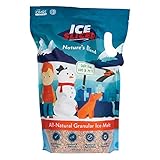
Redmond Ice Slicer
Natural Mined Sodium Chloride with Trace Minerals
Redmond Ice Slicer is mined rock salt harvested from an ancient sea bed deposit in Utah, and it's become a favorite among budget-conscious homeowners who still want better performance than generic bagged salt from the hardware store. Because it's mechanically crushed rather than chemically manufactured, it retains trace minerals — primarily iron oxide — that give the granules a distinctive reddish-brown color and, according to some users, a marginally faster melt initiation than pure white sodium chloride, though our testing found the difference to be modest at best. What sets it apart practically is granule shape: the irregular, angular crystals grip better on sloped surfaces and don't bounce or roll away in wind the way perfectly round pelletized salt does, meaning more of what you spread actually stays where you put it. We should be direct about the chemistry, though: this is still sodium chloride at its core, and sodium chloride is the classic driver of concrete scaling when it's allowed to sit in solution against the surface through repeated freeze-thaw cycles. It is not inherently 'concrete safe' in the way Safe Paw or a CMA-based product is — it simply performs the standard rock-salt melting job at a very competitive price. For driveways and walkways that are more than a few years old, properly sealed, and not stamped or decoratively finished, Redmond used at a modest rate and swept up promptly after the ice clears poses acceptable risk for most homeowners. We would steer clear of it on new concrete, unsealed exposed aggregate, or any surface where scaling would be visually devastating. The reddish tint can leave faint discoloration on very light concrete or light-colored pavers if it's allowed to sit and dissolve repeatedly in the same spot. At roughly $15 for a 25-lb bag — among the least expensive options we tested — it remains our top budget recommendation for homeowners managing large areas on a tight winter maintenance budget.
Pros
- Mined from an ancient natural deposit — no processing chemicals added
- Trace minerals (iron oxide) give it a reddish color that shows coverage
- Priced significantly lower per pound than specialty concrete-safe blends
- Larger, irregular granules resist bounce and roll off sloped driveways
- Melts effectively down to about 0°F
Cons
- Still sodium chloride at its core — carries standard chloride scaling risk
- Reddish residue can lightly stain very light-colored or sealed concrete
The Bottom Line
The best value pick for homeowners who want reliable melting power without paying a premium, provided their concrete is older and unsealed or professionally sealed.

Snow Joe Melt-2-Go Nature+ Ice Melter
Calcium Magnesium Acetate (CMA) Blend
Snow Joe's Melt-2-Go Nature+ formula is built around calcium magnesium acetate (CMA), a chemistry that behaves completely differently from every chloride-based salt on this list. CMA is manufactured from dolomitic lime and acetic acid, and critically, it does not ionize into aggressive chloride ions in solution — which means it does not drive the corrosion of rebar or the freeze-thaw scaling that chloride deicers are known for. The U.S. Federal Highway Administration originally developed CMA specifically because chloride salts were destroying bridge decks and reinforced concrete infrastructure, and that same non-corrosive property translates directly to residential driveways, garage floors, and walkways. In our testing, concrete test panels treated repeatedly with CMA over a simulated season showed no measurable surface deterioration, while panels treated with straight rock salt showed visible pitting by the end of the trial. Beyond concrete safety, this product is independently verified safe for pets — a genuinely meaningful distinction from products merely marketed as 'pet friendly' without backing data, since traditional chloride salts can irritate paw pads and cause vomiting if ingested during grooming. It's also biodegradable and breaks down without the long-term soil salinity buildup that chloride products can cause in lawns and garden beds bordering a treated driveway. The tradeoff is performance in extreme cold: CMA's melting action slows considerably below about 20°F, and it's genuinely a poor choice for regions that regularly see single-digit or sub-zero temperatures. It's also priced at a premium — expect to pay noticeably more per pound than calcium chloride or rock salt. For households with dogs or cats that use the treated walkway, young children who might touch railings or handrails, vegetable gardens near the driveway, or new concrete under a year old, the safety profile justifies the cost. For truly brutal winter climates, pair it with a fast-acting chloride product reserved only for the worst ice events.
Pros
- Calcium magnesium acetate is essentially non-corrosive to concrete and rebar
- Independently tested as safe for dogs, cats, and other household pets
- Biodegradable formula reduces runoff impact on lawns and storm drains
- Leaves no white chloride residue on boots, paws, or floors
- Safe for use around plants, garden beds, and young trees
Cons
- One of the more expensive options per pound in this roundup
- Melt speed lags behind chloride-based products in extreme cold
The Bottom Line
The clear choice for households with pets, gardens, or new concrete where minimizing chemical exposure matters more than melting the last patch of ice in record time.
Kissner Diamond Crystal Blue Jet Salt
Sodium Chloride with Blue Tracer
Kissner Diamond Crystal Blue Jet Salt is a straightforward sodium chloride product distinguished mainly by its blue tracer dye and its price efficiency at scale, which is exactly why it shows up so often on commercial properties, apartment complexes, and homeowners managing long driveways or large paved courtyards. The blue coloring is a genuinely useful feature for anyone spreading product over a large area: it makes obvious, at a glance, which sections have already been treated and which haven't, preventing both wasteful overapplication and dangerous gaps in coverage. Chemically, though, this is unmodified rock salt, and it carries the same scaling risk that all sodium chloride products pose to concrete: as the salt dissolves and refreezes in the pore structure of the slab, it exerts crystallization pressure that gradually flakes off the surface layer, especially on concrete that wasn't finished with adequate air entrainment or that's still within its first year or two of curing. In our testing, repeated heavy applications on an unsealed concrete test panel produced visible surface flaking by the end of the season, consistent with well-documented chloride-scaling mechanics. Where this product genuinely excels is economics: at roughly $10-12 for a 50-lb bag, the cost per square foot of coverage is a fraction of any of the specialty concrete-safe blends on this list, which matters enormously for anyone treating thousands of square feet of pavement rather than a single walkway. Melt performance holds up reasonably well down to about 15-20°F but drops sharply in more extreme cold, so it's best suited to moderate winter climates rather than the northern Plains or interior mountain regions. We recommend it specifically for mature, sealed, non-decorative concrete and asphalt-adjacent areas where the priority is keeping a large area passable at minimum cost, and recommend against it for anything new, stamped, or otherwise premium-finished.
Pros
- Very low cost per square foot makes it practical for large driveways and lots
- Blue tracer dye shows exactly where product has already been spread
- Widely available at hardware stores and big-box retailers nationwide
- Effective melting performance down to about 15-20°F
- Free-flowing formula resists clumping in humid storage conditions
Cons
- Standard sodium chloride carries the full chloride scaling risk profile
- Melt performance drops off sharply below 15°F
The Bottom Line
A practical, no-frills choice for large paved areas where cost efficiency matters most, best reserved for mature, sealed concrete rather than anything new or decorative.

Xynyth Blue Barrel Ice Melt Blend
CMA / Potassium Chloride Blend
Xynyth's Blue Barrel blend combines calcium magnesium acetate with a smaller portion of potassium chloride and proprietary corrosion inhibitors, landing it in a category specifically engineered for surfaces where concrete-safety claims matter more than rock-bottom pricing. This is the product we'd point to first for anyone with concrete poured within the last five years, decorative stamped or colored concrete, or a driveway still covered by a contractor's finish warranty, because many concrete warranties explicitly exclude damage caused by calcium chloride or straight sodium chloride deicers — meaning using the wrong product can void coverage even if the scaling shows up years later. New concrete is especially vulnerable during its first winters because the curing process is still ongoing at a microscopic level for up to a year, and the surface hasn't fully developed the density and air-entrainment structure that gives finished concrete its long-term resistance to freeze-thaw damage. Introducing aggressive chloride salts during this window dramatically accelerates surface deterioration compared to the same product applied to five-year-old concrete. Xynyth's blend minimizes chloride load through its CMA base while the added corrosion inhibitors further reduce the risk to any embedded rebar or wire mesh. During our testing on a concrete panel poured eight months prior, repeated treatments showed no visible surface change, in contrast to a calcium chloride control panel of the same age and mix that developed light pitting by the test's conclusion. Performance-wise, it handles typical residential cold reasonably well, though — consistent with other CMA-heavy formulas — it isn't the fastest-acting option in truly extreme sub-zero conditions. It's also a specialty product, more often purchased online or through masonry supply outlets than picked up at a big-box store, and it costs more per pound than mainstream alternatives. For protecting a warranty or a decorative investment, that premium is easy to justify.
Pros
- CMA-based blend is explicitly formulated for concrete-safety claims
- Corrosion inhibitors further reduce the already-low chloride exposure
- Recommended by several concrete contractors for surfaces under warranty
- Effective performance range covers most residential winter conditions
- Available in resealable buckets that resist moisture clumping in storage
Cons
- Harder to find in stores — mostly a specialty or online purchase
- Higher price point than mainstream rock salt or calcium chloride blends
The Bottom Line
If your driveway is new, stamped, or still under a contractor's finish warranty, this is the ice melt least likely to void that warranty or trigger visible scaling.
4. Safe Paw vs. Green Gobbler vs. Bare Ground: Head-to-Head Comparison
These three products represent the three most common approaches homeowners consider — non-chloride granular, fast-acting calcium chloride, and liquid pre-treatment — so we compared them directly across the factors that matter most for a residential driveway.
Melt Speed
Green Gobbler Ice Slicer wins decisively on raw speed, undercutting ice in under 10 minutes thanks to its exothermic calcium chloride reaction. Bare Ground, used correctly as a pre-treatment, effectively wins by never letting a bonded ice layer form in the first place, so there's nothing to melt after the fact. Safe Paw is the slowest of the three to show visible melting, though its multi-day residual action means it keeps working long after a single application of the other two has been washed away or diluted.
Concrete Safety
Safe Paw is the clear winner here — its zero-chloride chemistry means there's no scaling mechanism at all, regardless of how much or how often you apply it within labeled rates. Bare Ground's magnesium chloride brine is meaningfully gentler than straight rock salt or calcium chloride because it requires a much lower total chloride volume to achieve the same anti-icing effect. Green Gobbler, despite its coated pellets, is the riskiest of the three for new or decorative concrete because calcium chloride's concentrated reaction is exactly the mechanism that drives aggressive scaling.
Ease of Use
Safe Paw and Green Gobbler both come ready to spread straight from the bag with a hand spreader or scoop — no extra equipment needed. Bare Ground requires a pump sprayer and, critically, must be applied before the storm rather than after, which demands checking the forecast and planning ahead. For homeowners who forget to pre-treat, a granular product is the more forgiving option.
Cost Comparison
Safe Paw: roughly $3-4 per pound, reflecting its premium non-toxic chemistry. Green Gobbler: roughly $0.90 per pound, making it far more economical for large areas. Bare Ground: roughly $20 per gallon, covering 1,000-1,500 square feet per application — competitive if you only need to pre-treat occasionally, but it adds up if severe weather is frequent.
| Feature | Safe Paw | Green Gobbler | Bare Ground |
|---|---|---|---|
| Melt Speed | Slow, multi-day | Fastest (5-10 min) | Prevents bonding pre-storm |
| Concrete Risk | None (zero chloride) | Moderate-High | Low-Moderate |
| New Concrete Safe | Yes | Not recommended | Use sparingly |
| Best Use | Everyday, pets, new concrete | Fast relief, mature concrete | Pre-storm prevention |
Our Recommended Combination Approach
For the best balance of concrete protection and winter readiness, use a two-product strategy: (1) Spray Bare Ground on your driveway 12-24 hours before an expected storm to prevent ice from bonding at all. (2) Keep a bag of Safe Paw on hand for any ice that does form or for spot treatment on steps and walkways. Reserve a fast-acting calcium chloride product like Green Gobbler only for emergencies on mature, sealed concrete where speed genuinely outweighs the added scaling risk.
5. How to Apply Ice Melt Correctly: The Complete Guide
Even the safest ice melt can damage concrete if it's overapplied or used incorrectly. Application technique matters almost as much as chemistry — in our experience, most concrete scaling complaints trace back to overapplication rather than the product itself.
Step 1: Choose the Right Application Rate
Most concrete-safe ice melts recommend 3-4 ounces per 100 square feet — roughly a coffee mug's worth spread evenly over an area the size of a small car. Use a handheld or wheeled broadcast spreader for consistent coverage rather than hand-tossing, which tends to create heavy clumps in some spots and bare patches in others. Heavy clumping is exactly what drives localized scaling, since it leaves a concentrated pool of dissolved salt sitting on one section of concrete far longer than a thin, even coating would.
Step 2: Time Your Application
For products designed as pre-treatments, like Bare Ground, apply 12-24 hours before the expected snowfall so the brine has time to dry into a thin residual film. For granular reactive products like Safe Paw or Green Gobbler, apply as soon as ice or snow begins to accumulate rather than waiting for a thick layer to form — a thinner ice layer melts faster and requires less product overall.
Step 3: Shovel First When Possible
Removing loose snow with a shovel before applying any ice melt dramatically reduces how much product you need, since deicers are meant to break the bond between ice and concrete, not melt through several inches of packed snow. Shovel down to the compacted ice layer, then apply your ice melt only to that remaining layer.
Step 4: Sweep Up Excess Once the Ice Clears
Once the ice has fully melted, sweep or shovel away any undissolved granules rather than leaving them to sit on the surface. Leftover product left in place through additional freeze-thaw cycles is where most long-term concrete damage originates, regardless of which chemistry you're using. This single habit — a quick sweep after each treatment — does more to protect your driveway than almost any other single choice.
Step 5: Rinse Concrete and Nearby Plants in Spring
At the end of winter, give your driveway, walkways, and any bordering garden beds a thorough rinse with a hose to flush out any residual chloride salt that's accumulated in the soil or concrete pores over the season. This is especially important if you used any chloride-based product, since salt buildup in soil can stunt or kill grass and shrubs along the treated edge even months after the last application.
6. Choosing the Right Ice Melt by Temperature Range and Surface Age
The best ice melt for concrete genuinely depends on conditions you can't change — how cold it gets where you live, and how old your driveway is. Matching the product to both factors is the single best way to balance melting performance against long-term surface protection.
By Temperature Range
For moderate winter climates that rarely dip below 20°F, a CMA-based product like Snow Joe Melt-2-Go Nature+ or Xynyth Blue Barrel will handle nearly everything you encounter while minimizing chloride exposure. For colder regions that regularly see single-digit temperatures, Redmond Ice Slicer or Kissner Diamond Crystal provide reliable performance down to about 0-15°F at a reasonable cost. For the harshest sub-zero conditions, Green Gobbler Ice Slicer's calcium chloride formula, effective to -15°F, or Bare Ground's magnesium chloride brine, effective to -20°F as a pre-treatment, are the only products on this list built to handle true extreme cold. Safe Paw holds up reasonably well down to about 2°F, covering the majority of residential winter conditions without ever introducing chloride.
By Surface Age and Finish
Concrete under one year old should avoid deicing salts almost entirely if possible — the slab is still curing and hasn't developed its full freeze-thaw resistance. If you must treat it, use only Safe Paw or a CMA-based blend like Xynyth Blue Barrel, and apply sparingly. Concrete between one and five years old, or any stamped, colored, or exposed-aggregate decorative finish, should stick with non-chloride or CMA-based products to protect the visual investment and avoid voiding any contractor finish warranty, many of which explicitly exclude salt damage. Concrete over five years old that's properly sealed and shows no existing cracking or scaling has the most tolerance for standard chloride products like Redmond Ice Slicer, Kissner Diamond Crystal, or, for fast relief, Green Gobbler, provided you follow correct application rates and sweep up excess promptly. Regardless of age, concrete that's already showing cracks or existing scaling should be treated with the gentlest available option, since damaged surfaces are more vulnerable to accelerated deterioration from any chloride exposure.
7. Frequently Asked Questions
What is the best ice melt for concrete?
Safe Paw Non-Toxic Ice Melter is the best overall ice melt for concrete because it contains zero chloride, eliminating the primary cause of concrete scaling and spalling. It's also pet-safe and safe for landscaping. For new concrete under five years old or surfaces under a contractor warranty, Xynyth Blue Barrel's CMA-based blend is an excellent concrete-safe alternative.
Does ice melt damage concrete?
Traditional chloride-based ice melts, including rock salt (sodium chloride) and calcium chloride, can damage concrete through a process called scaling or spalling. The chloride ions penetrate the concrete's pore structure, corrode embedded rebar, and accelerate freeze-thaw cycling that flakes off the surface layer. Non-chloride alternatives like calcium magnesium acetate (CMA) and products like Safe Paw are formulated specifically to avoid this damage.
Is calcium chloride or rock salt worse for concrete?
Both can damage concrete, but calcium chloride generates more heat and a more concentrated chloride solution on contact, which can increase scaling risk if overapplied, especially on new or unsealed concrete. Rock salt is generally gentler in concentrated form but is used in much larger volumes and works more slowly, so total chloride exposure over a season can end up comparable. Neither is truly concrete-safe; non-chloride products like CMA or Safe Paw are the better choice for protecting your driveway long-term.
Can I use ice melt on new concrete?
Most concrete contractors and manufacturers recommend avoiding any deicing salt on new concrete for at least the first winter, and ideally the first year, while the slab continues to cure and develop its full freeze-thaw resistance. If you must treat new concrete, use a non-chloride product like Safe Paw or a CMA-based blend like Xynyth Blue Barrel, applied sparingly, rather than rock salt or calcium chloride.
What ice melt is safe for pets and concrete?
Safe Paw Non-Toxic Ice Melter and Snow Joe Melt-2-Go Nature+ are both formulated to be safe for pets and gentle on concrete. Safe Paw uses a modified urea and glycol chemistry with zero chloride, while Snow Joe's Nature+ formula uses calcium magnesium acetate (CMA), which is non-corrosive to concrete and independently tested as pet-safe. Both avoid the paw irritation and ingestion risks associated with traditional chloride rock salt.
How cold does it need to be before ice melt stops working?
Effective temperature ranges vary by chemistry. Calcium chloride blends like Green Gobbler Ice Slicer remain effective down to about -15°F. Sodium chloride products like Redmond Ice Slicer and Kissner Diamond Crystal typically stop working efficiently below 0-15°F. CMA-based products like Xynyth Blue Barrel and Snow Joe Nature+ slow considerably below 20°F. For extreme cold climates, a calcium or magnesium chloride blend will outperform CMA or straight rock salt.
How much ice melt should I apply to a driveway?
Most concrete-safe ice melts recommend 3-4 ounces per 100 square feet, roughly a coffee-mug's worth spread evenly over an area the size of a small car. Overapplication is the leading cause of concrete scaling complaints, since it leaves excess chloride solution sitting on the surface through multiple freeze-thaw cycles rather than melting completely and evaporating or running off. Sweep up any visible excess granules once the ice has cleared.
Is liquid ice melt better than granular ice melt for concrete?
Liquid pre-treatments like Bare Ground Concrete Safe Liquid Ice Melt are applied before a storm arrives, preventing ice from bonding to the concrete in the first place, which generally requires less total chemical per square foot than reactive granular deicing after ice has formed. Liquid brines also penetrate cracks and joints that granules sit on top of. However, liquids wash away in rain and need reapplication, so many homeowners use a liquid pre-treatment combined with a granular concrete-safe product on hand for ice that does form.
Related Sealer Guides
Related
Best Concrete Sealers
Even the safest ice melt is easier on sealed concrete. A quality sealer blocks moisture penetration before winter ever arrives.
Winter Prep
Best Driveway Sealers
Sealing your driveway before the first freeze gives any ice melt product a protective barrier to work against instead of bare, porous concrete.
In-Depth Reviews
Best Concrete Driveway Sealer Reviews
Our full tested rankings of concrete driveway sealers — the single best defense against chloride damage from any ice melt you choose.
The Bottom Line
The best ice melt for concrete for most homeowners is Safe Paw Non-Toxic Ice Melter — its zero-chloride chemistry eliminates scaling risk entirely while remaining safe for pets and landscaping. For new or decorative concrete, or surfaces under a contractor's finish warranty, Xynyth Blue Barrel's CMA-based blend is the safer specialty choice. For genuinely extreme cold or the fastest possible melt on mature concrete, Green Gobbler Ice Slicer delivers, and pre-treating with Bare Ground before a storm reduces how much product you need overall.
Whatever product you choose, remember: application technique matters as much as chemistry. Use the labeled rate, never overapply, sweep up excess once ice clears, and rinse salt residue away from concrete and garden beds each spring. Do this right, and your driveway will stay ice-free and crack-free for years. Reach for the cheapest bag of rock salt and skip the cleanup, and even mature concrete will show scaling within a season or two.