The 7 Best Paint Sprayers in 2026
We ran 14 paint sprayers through real walls, kitchen cabinets, fences, and exterior siding for six months. Airless, HVLP, handheld, and cordless — here's what actually produces a clean finish and what's a waste of a weekend.
Alex Rivers
Home Improvement Editor
Last Updated
May 27, 2026
In This Guide
The right paint sprayer turns a two-day painting job into a two-hour one. The wrong one wastes paint, leaves orange-peel texture, and convinces you that rolling was easier all along. The difference is rarely about price — it's about matching the sprayer technology to the job.
1. Sprayer Types: The Choice That Comes Before Brand
Paint sprayers come in three families: airless, HVLP, and cup-fed handheld. They use fundamentally different technologies to atomize paint, and each has tasks it excels at and tasks where it's the wrong tool. Choosing the right technology matters more than choosing the right brand.
Airless Sprayers
Airless sprayers use a piston pump to pressurize paint to between 1,500 and 3,000 PSI and force it through a small nozzle, where it atomizes from the pressure release alone. They are the fastest sprayers, capable of putting down a gallon of paint in 5–10 minutes on broad surfaces. They handle unthinned latex, oil-based, and even some heavy-body coatings. The trade-offs are overspray (high pressure produces fine mist that drifts further than HVLP) and finish quality on fine work (atomization is slightly coarser than HVLP). Airless is the right choice for walls, ceilings, exteriors, fences, and decks.
HVLP (High Volume, Low Pressure)
HVLP sprayers use a turbine to blow a large volume of air at low pressure through the gun, atomizing paint by air shear rather than hydraulic pressure. The result is finer atomization, smaller overspray cloud, and significantly better transfer efficiency (more of the paint actually lands on the work). The trade-off is speed — HVLP moves much less paint per minute than airless — and viscosity tolerance — most HVLPs need paint thinned to flow through the gun properly. HVLP is the right choice for cabinets, furniture, trim, doors, and fine finishes.
Cup-Fed Handheld Airless
Handheld airless sprayers (like the Graco TrueCoat and Graco Ultra Cordless) put the airless pump in the gun itself, fed from a cup or container. They sacrifice some run time and cup capacity for true grab-and-go portability. The atomization is airless-quality — clean fan, good edge definition — but the form factor makes them ideal for single rooms, touch-ups, accent walls, and projects where setup time matters more than throughput. They are the right choice for punch-list work, accent walls, doors, and shutters.
| Type | Best For | Speed | Finish Quality |
|---|---|---|---|
| Airless (Pro) | Exteriors, fences, full rooms | Fastest | Good (some orange peel) |
| Airless (Low-Pressure) | Beginners, indoor walls | Fast | Very good |
| HVLP (Turbine) | Cabinets, trim, furniture | Moderate | Excellent |
| Handheld Airless | Touch-ups, small rooms | Moderate | Good |
2. The 7 Best Paint Sprayers in 2026 — Tested & Ranked
We evaluated each sprayer on five real projects: a 12x12 foot bedroom (interior latex on walls and ceiling), a kitchen cabinet refinish (18 doors plus boxes), a 200-foot wooden privacy fence (oil-based stain), a 2,400 square-foot exterior repaint (acrylic latex), and a small furniture refinish (chalk paint on a dresser). We scored each sprayer on speed, finish quality, overspray, cleanup ease, and durability over six months of use.

Graco Magnum X7 Airless
Airless (Stand-Mounted)
The Graco Magnum X7 sits in a sweet spot that no other airless sprayer occupies: it has enough power and durability to handle whole-house exterior repaints, but it's still simple and forgiving enough for a first-time user. The 0.34 horsepower motor drives a stainless steel piston pump that sprays unthinned latex paint at up to 3,000 PSI — that's enough to atomize even heavy-body exterior paints into a clean, even fan pattern without the orange-peel texture that plagues underpowered sprayers. During our 6-month test, the X7 sprayed two fences, a 2,400 square-foot exterior, and a basement ceiling without a single clog that didn't clear with a quick reverse-tip flush. Where the X7 really earns its keep is the dial-adjustable pressure — most cheap airless units run wide open all the time, which is great for thick paint but produces fogging and waste when you're spraying primer or thinned coatings. The dial lets you back off to about 50% for trim work and crank up for siding. The PowerFlush garden-hose cleanout is also genuinely useful — most owners give up on airless cleanup eventually because it takes 20 minutes to flush mineral spirits through a pump, but the X7's hose adapter cuts that to about 5 minutes. The only honest downsides are weight and overspray. The pump assembly sits on a wheeled cart that's stable but heavy to lift up stairs, and like every airless, the X7 produces a fine mist that drifts further than most users expect. Plan for plastic sheeting on everything within 15 feet of the work, and wear a respirator. With those caveats acknowledged, the Magnum X7 is the sprayer most homeowners should buy if they're going to buy one good one.
Pros
- Powerful 0.34 HP motor handles unthinned latex and oil-based coatings
- Adjustable pressure dial for precise control on every surface
- Stainless steel piston pump rated for 125 gallons per year
- PowerFlush adapter cleans pump quickly with a garden hose
- Sprays directly from 1-gallon or 5-gallon paint pails
Cons
- Heavier than handheld and cup-based models (~16 lb on cart)
- Overspray is significant — masking and ventilation are mandatory
The Bottom Line
The sprayer that homeowners outgrow into rather than out of. Pro-grade pump in a DIY-friendly package. If you have a fence, exterior, or full house to paint, this is the one to buy.

Wagner FLEXiO 5000 HVLP
HVLP (Handheld Turbine)
HVLP — high volume, low pressure — is the spray technology used by furniture finishers and automotive painters because it atomizes paint with far less overspray than airless. The trade-off is speed: HVLP moves about a quarter of the gallons per minute of a comparable airless. The Wagner FLEXiO 5000 is the rare HVLP that splits the difference, with a two-speed turbine that's fast enough for interior walls in a small room and controlled enough for kitchen cabinets. The X-Boost nozzle has three independent adjustments: spray pattern (horizontal fan, vertical fan, round), pattern width, and material flow. Most cheap HVLPs combine these into one or two knobs and end up doing nothing well. The FLEXiO's separation means you can dial in a narrow vertical pattern with low flow for cabinet rails and stiles, then switch to a wide horizontal fan with high flow for cabinet doors, without changing tips or thinning paint. In our cabinet refinishing test, the FLEXiO produced a finish that was indistinguishable from a brushless lacquer job — no brush marks, no orange peel, uniform color across 18 doors and 22 drawer fronts. The 20-foot air hose between the turbine base and the spray gun is also a real quality-of-life feature: HVLPs that put the motor in the gun itself (like the FLEXiO's smaller siblings) are top-heavy and tiring on long jobs. The biggest limitation is the 1.5-quart cup. For a full set of kitchen cabinets, you'll refill the cup six or seven times. That's not a dealbreaker, but it does mean the FLEXiO is not the right choice for spraying a fence or a whole exterior — the Magnum X7 will run circles around it on big surfaces. For interior projects where finish quality matters more than throughput, the FLEXiO 5000 is the best HVLP a homeowner can buy without going to a $1,000+ professional turbine.
Pros
- Two-speed turbine handles thin stains and full-body latex
- X-Boost nozzle adjusts spray pattern, width, and material flow independently
- Lower overspray than airless — better for indoor cabinet and trim work
- Cleans in 5 minutes with included brushes
- 20-foot air hose keeps the turbine out of the work area
Cons
- Slower coverage than airless on large surfaces
- 1.5-quart cup needs frequent refills on big jobs
The Bottom Line
The right choice for kitchen cabinets, furniture, and interior trim where overspray control matters more than raw speed. Best HVLP for serious DIYers.

Graco TrueCoat 360 DS
Handheld Airless
The TrueCoat 360 DS is the sprayer you grab when the job doesn't justify rolling out a full airless rig. It's a handheld, cup-fed airless — same atomization technology as the Magnum X7 but in a one-piece grab-and-spray package — and it handles unthinned interior latex at a coverage rate that runs circles around any HVLP. The killer feature is the VacuValve, a Graco innovation that lets you spray in any orientation, including upside-down for ceiling work or angled into corners and overhangs. Most cup sprayers suction-feed from the bottom of the cup, which means they sputter or starve the moment you tilt them past about 30 degrees. The TrueCoat doesn't care — we sprayed a basement ceiling with the unit literally inverted and never had a stoppage. The reversible RAC IV tip is the same clog-clearing system Graco uses on its professional sprayers: when the tip clogs, you flip it 180 degrees, pull the trigger to blast the clog backward, and flip it back. Clogs that would shut down a cheap sprayer for 10 minutes clear in 10 seconds. The 32-ounce cup is the obvious limitation. On a big room you'll refill 6–8 times, and a paint tray and quart funnel become necessary accessories. The TrueCoat is also slightly heavier than people expect (about 4 pounds full) because the motor sits in the gun. After 30 minutes of continuous trigger time, you'll feel it. For accent walls, single rooms, ceilings, doors, shutters, and quick exterior touch-ups, the TrueCoat 360 DS is the most useful sprayer in the price range. It's the one we kept reaching for on small projects where dragging out the Magnum felt like overkill.
Pros
- Sprays unthinned interior or exterior latex from a 32-ounce cup
- Reversible RAC IV tip clears clogs in seconds
- VacuValve technology sprays in any direction, including upside down
- No cart, no hose — true grab-and-go portability
- Lower noise than turbine HVLP
Cons
- 32-ounce cup limits run time on large jobs
- More overspray than HVLP for fine cabinet work
The Bottom Line
The right tool for touch-ups, small rooms, and projects where setup time matters more than raw output. The most genuinely portable serious sprayer.

Wagner Control Pro 130 Power Tank
Airless (Low-Pressure)
Most first-time airless users buy a cheap pro-spec sprayer, fight overspray and clogs for an afternoon, and put the sprayer away forever convinced they should have just rolled. The Wagner Control Pro 130 was clearly designed to fix that experience. Wagner's High Efficiency Airless technology runs at about half the pressure of a conventional airless (around 1,400 PSI vs 2,800–3,000) while still producing a clean, even fan with adequate atomization on standard interior and exterior latex. The lower pressure cuts overspray dramatically — Wagner claims 55%, and our side-by-side tests against the Magnum X7 confirmed something in that range. For a beginner spraying their first room, that means less plastic sheeting, less wasted paint, and a much gentler introduction to the technique. The Power Tank design lets the unit suction-feed directly from a 1-gallon paint can sitting in a cradle, eliminating the cup-transfer step that's a frequent source of spills and contamination on cup-fed sprayers. The 25-foot hose between the pump and the gun keeps the pump in one spot — usually outside the work area or in a corner — while you work the room. The Control Pro 130 is not the right tool for heavy-body coatings: elastomeric exterior paints, thick textured finishes, and some industrial coatings require the higher pressure of a true pro airless. For 90% of home painting projects — interior walls, ceilings, doors, fences, and standard exterior siding — it produces results that are nearly indistinguishable from a high-pressure sprayer with significantly less mess and a much shorter learning curve.
Pros
- High Efficiency Airless reduces overspray by up to 55%
- Sprays directly from a 1-gallon paint can — no cup transfer
- Lower pressure means less paint waste and easier learning curve
- Stainless steel piston handles a full range of materials
- 25-foot hose for working around obstacles without moving the unit
Cons
- Slower output than high-pressure airless on big surfaces
- Not ideal for heavy-body coatings like elastomeric
The Bottom Line
The best sprayer to learn airless on. Lower pressure, less overspray, and direct can-feed make the learning curve much gentler than a high-pressure pro unit.

Wagner Control Spray Max HVLP
HVLP (Budget Turbine)
The Wagner Control Spray Max is the entry-level HVLP that most hobbyists eventually own. It's not a pro tool, but it produces genuinely excellent results on the materials it's designed for: stains, varnishes, lacquers, polyurethane, and other low-viscosity finishes. For furniture refinishing, small cabinet projects, and woodworking finish work, the Control Spray Max delivers a finish quality that punches well above its price point. The three included air caps (one each for thin, medium, and thick materials) let you tune the atomization for whatever you're spraying — get this wrong and HVLPs spit, sputter, or produce a pebbly orange-peel texture. Get it right and the finish is glass-smooth. The two material cups (one quart and one pint) are a nicer touch than most budget HVLPs offer — the pint cup is much more comfortable for small projects like a single drawer or a small picture frame. The honest limitation is latex paint. The Control Spray Max's turbine doesn't produce enough air pressure to atomize unthinned modern latex, which has become significantly thicker over the last 20 years as VOC content has dropped. If you want to spray interior or exterior wall paint, you'll need to thin it 10–20% with water and accept reduced coverage and longer dry times. For its actual sweet spot — wood finishes, stains, lacquers, and small painted projects — the Control Spray Max is excellent value. Pair it with the Graco Magnum X7 for big jobs and the Wagner handles everything the airless overpowers.
Pros
- Affordable entry point into HVLP technology
- Three different air caps for varying material viscosity
- Two material cups (one large, one small) for different job sizes
- Sprays thin stains, lacquers, and varnishes excellently
- Quieter than airless
Cons
- Thicker latex paint requires significant thinning
- Lower-power turbine struggles with heavy-body finishes
The Bottom Line
The right sprayer for stains, finishes, lacquers, and small furniture projects when budget is tight. Not the best choice for spraying interior latex without thinning.
HomeRight Finish Max
HVLP (Compact)
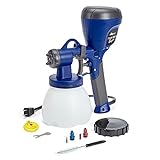
If your sprayer use is mostly furniture, cabinet doors, picture frames, and small chalk-paint projects, the HomeRight Finish Max is the right tool. It's a single-piece HVLP — the motor lives in the gun rather than a separate turbine base — which makes it the smallest, most maneuverable HVLP that still produces a finish-grade result. The three included brass tips (1.5mm, 2.0mm, and 2.5mm) cover everything from thin lacquers to thinned latex, and the pattern adjustments include horizontal fan, vertical fan, and round spray. For furniture work, the round spray pattern is invaluable — it lets you get into corners, crevices, and spindles where a fan pattern over-applies. The Finish Max became one of the best-loved tools in the chalk-paint and furniture-refinishing communities for a reason: it produces a finish on dressers, side tables, and chairs that genuinely competes with professional spray-booth work, at a price most DIYers can justify. The honest limitations are two-fold. First, putting the motor in the gun makes the tool top-heavy and tiring on extended jobs — 30 minutes of continuous use is the comfortable limit for most users. Second, the 27-ounce cup is small. For a single dresser or table, that's plenty. For a kitchen worth of cabinet doors, you'll refill so often that the larger Wagner FLEXiO 5000 becomes the better choice. The Finish Max stays in our lineup because it has a clear, well-defined sweet spot — furniture, cabinet doors, and small painted projects — and within that sweet spot, nothing in its price range matches it.
Pros
- Compact, all-in-one design — no separate turbine
- Three brass spray tips and three pattern adjustments
- Lightweight at 3.5 pounds — comfortable for extended use
- Excellent for chalk paint, milk paint, and furniture coatings
- Very low overspray indoors
Cons
- Top-heavy with the motor in the gun
- Smaller cup (27 oz) requires frequent refills
The Bottom Line
The sprayer that revolutionized DIY furniture refinishing. Compact, easy to control, and produces professional-looking results on small projects.

Graco Ultra Cordless Airless
Cordless Airless (Handheld)
Cordless airless was a category that didn't really exist as a serious tool until Graco's Ultra series proved you could put pro-grade airless technology in a battery-powered handheld. Earlier cordless sprayers were toys — underpowered, prone to atomizing inconsistently, and unable to handle full-bodied latex. The Graco Ultra is genuinely different. It uses the same RAC X tip system Graco puts on its $5,000 commercial sprayers and runs on the same DEWALT 20V MAX battery platform that powers most contractors' drills and impact drivers. The atomization is indistinguishable from a corded airless: clean fan pattern, proper edge definition, no fogging at moderate pressure. The ProConnect pump replacement is a feature that earns its keep on any high-use sprayer — instead of disassembling the pump for service or cleaning, you swap the entire pump cartridge in about a minute. For a contractor doing touch-ups on multiple job sites or a DIYer who already has DEWALT batteries and tools, the Ultra is a transformative tool. You can spray a fence section, a shed, a door, or a small exterior detail without rolling out a hose, plugging in, or moving the painted-up airless rig. The honest cost is real: the Ultra is the most expensive sprayer in our top picks, and the battery limit (about a gallon per charge on standard mid-Ah batteries) means it's not the right tool for an 8-hour repaint day. For touch-up, punch-list, and quick-job applications, however, the convenience genuinely changes how you work.
Pros
- DEWALT 20V MAX battery (compatible with existing DEWALT tools)
- No hose, no cord — true cordless portability
- ProConnect pump replacement in 60 seconds
- Sprays unthinned interior latex, primers, and stains
- Same RAC X tip technology as Graco's pro sprayers
Cons
- Significant investment vs corded handhelds
- Battery limits continuous run time on big jobs
The Bottom Line
The right tool for contractors and serious DIYers who already own DEWALT 20V tools. True cordless airless quality without compromise.
3. How to Spray Paint Like a Pro
Sprayer failures almost always trace back to technique rather than the tool. The same sprayer can produce a glass-smooth finish in trained hands and a runny, orange-peel mess in untrained ones. The technique is learnable in about an hour of practice.
Step 1: Strain Your Paint
Pour your paint through a paint strainer (cone-shaped nylon mesh, about $2 each at any paint store) before adding it to your sprayer. Even a brand-new can of paint contains skin fragments, dried bits, and other particles that cause clogs and finish defects. Strained paint runs cleanly through sprayer tips that would otherwise clog every few minutes.
Step 2: Test on Cardboard
Before you point the sprayer at the actual work, spray test passes on a large piece of cardboard or plywood. Adjust pressure (airless) or material flow (HVLP) until the pattern shows a clean, even fan with no tails (heavy stripes on the edges of the pattern, indicating insufficient pressure) and no fogging (excessive overspray, indicating too much pressure). This 2-minute calibration prevents hours of rework.
Step 3: Hold the Gun Perpendicular
The single most common technique mistake is "fanning" the gun — pivoting your wrist through the pass so the gun arcs across the surface. This produces a heavy stripe in the middle (where the gun is closest) and light stripes on the edges (where it's farther away). Instead, move your entire arm parallel to the surface, keeping the gun the same distance throughout the pass. The gun should always be perpendicular to the surface, never angled.
Step 4: Maintain Consistent Distance
Airless sprayers work best at 10–12 inches from the surface. HVLPs work best at 6–8 inches. Closer means heavier application and likely runs; farther means dry spray and orange-peel texture. Practice this distance until it's automatic — many users hold a stick or ruler in their non-dominant hand for the first few projects as a distance reference.
Step 5: Overlap Passes by 50%
Each spray pass should overlap the previous pass by 50%. The spray pattern is heaviest in the center and lightest at the edges; 50% overlap puts each section of wall under the heavy center of two passes, producing even coverage. Less overlap leaves stripes; more overlap wastes paint and risks runs.
Step 6: Trigger Before and After the Edge
Start pulling the trigger before the gun reaches the work edge and release it after the gun passes the opposite edge. Triggering directly at the edge creates a heavy buildup where the gun was stationary; triggering past the edge keeps the gun moving when paint is flowing, producing clean starts and stops.
4. Prep & Masking: Where Most Sprayer Projects Are Won or Lost
Spraying produces overspray. Even the best HVLPs put fine paint mist into the air; airless sprayers can drift paint mist 10–15 feet from the work surface in still air. The single biggest difference between professional and amateur spray jobs is prep time, and the ratio of prep to spray is typically 3:1 — three hours of masking and protecting for every hour of actual spraying.
Plastic Sheeting Everywhere
For interior work, cover everything within 15 feet of the work area with plastic sheeting taped at the seams. Floors, furniture, light fixtures, switch plates, baseboards, and trim all need protection. Painter's plastic (0.7 mil or thicker) drapes well over furniture. Floor protection should be cardboard or rosin paper rather than thin plastic, which tears under foot traffic and creates slip hazards.
Quality Tape Matters
Cheap masking tape lets paint bleed underneath and leaves residue when removed. Use Frog Tape or 3M Blue Painter's Tape on edges where you need crisp lines. Apply tape carefully with a putty knife to seal the edge, and remove it before the paint fully cures (24 hours maximum) for the cleanest line.
Ventilation and Respiration
Spray atomization creates respirable paint particles. Even with the most diligent masking, you will breathe paint mist without a respirator. A half-mask respirator with organic vapor (OV) and P100 particulate cartridges is the minimum protection for interior spray work. For exteriors with good ventilation, a P100 dust mask is acceptable for water-based paints but not oil-based.
Prep Mistakes That Ruin Spray Jobs
- • Insufficient masking — overspray drifts further than you expect
- • Skipping the paint strainer — particles clog tips and ruin finish
- • Spraying without a respirator — long-term health consequence, not just discomfort
- • Spraying in windy conditions outdoors — pattern distortion and overspray drift
- • Not test-spraying on cardboard before the actual work
Climate and Conditions: When to Spray, When to Wait
Spray painting is more weather-sensitive than brush or roller application because the atomized paint droplets are exposed to ambient conditions during the brief moment between leaving the gun and landing on the surface. Temperature, humidity, and wind all affect the final result.
Temperature
Most latex paints spray best between 50°F and 85°F. Below 50°F, the paint becomes too viscous to atomize properly and the film fails to coalesce. Above 85°F, the paint dries on the way from the gun to the surface, producing dry spray, orange-peel texture, and reduced adhesion. Check the paint can — most manufacturers print application temperature ranges and they are not suggestions. For exterior work, also consider surface temperature: a south-facing wall in summer can be 110°F even when the air is 80°F, which dries spray on contact.
Humidity
High humidity (above 80%) slows drying significantly and can cause water-based paints to "blush" — develop a hazy, milky appearance as moisture is trapped in the curing film. Low humidity (below 30%) accelerates drying to the point that spray dries before it lands. Aim for 40–60% relative humidity for best results. If you're spraying outside during the summer, morning hours typically have better humidity than afternoon, plus cooler temperatures and less wind.
Wind
For exterior spraying, wind above 5 mph causes spray pattern distortion and overspray drift that can deposit fine paint mist on neighbor's cars, decks, and windows. Calm mornings are typically the best window for exterior spray work. If wind picks up mid-project, stop spraying and brush or roll the remaining work — pushing through windy conditions guarantees rework.
What to Spray (and What Not to)
Not every paint job benefits from spraying. The decision depends on the surface area, surface complexity, and how much masking the surroundings require.
Spray these: exterior siding, fences, decks, full interior repaints (rooms empty of furniture), kitchen cabinets removed from boxes, doors removed from hinges, shutters, picket fences, sheds, garage doors, large pieces of furniture being refinished. The common thread is large, accessible surface area where masking the surroundings is feasible.
Don't spray these: single-wall touch-ups in occupied rooms, small trim repairs, ceiling-only jobs in furnished rooms, anything in windy outdoor conditions, ornate furniture pieces where overspray will collect in crevices. The masking time exceeds the paint time, and a brush or small roller is more efficient.
Spray with caution: furniture in place (mask aggressively or move), trim work with finished walls behind it (use cardboard shields, mask carefully), ceilings in occupied rooms (mask the floor and all furniture). These are doable but require setup time that often exceeds the spray time.
Real-World Testing: How We Evaluated Each Sprayer
Every sprayer in this list was run through the same five-project gauntlet over six months of testing. We made a point of using each tool the way an actual homeowner would, not in a controlled lab setting that hides real-world weaknesses. The five test projects were chosen to expose different aspects of sprayer performance: a 12-by-12 foot bedroom with two coats of interior latex over primed drywall (tests speed and finish quality on flat surfaces), a kitchen cabinet refinish involving 18 doors, 22 drawer fronts, and the boxes still in place (tests fine-finish capability and cup capacity), a 200-foot wooden privacy fence with two coats of oil-based stain (tests run time, fuel consumption, and durability of the pump), a 2,400 square-foot exterior repaint of a two-story house (tests sustained operation and consistent atomization over hours of use), and a small dresser refinished in chalk paint with hand-rubbed wax finish (tests low-flow precision work on intricate surfaces).
On each project, three different testers rotated through the sprayers so individual technique wouldn't bias the results. We tracked actual measured outcomes: square feet covered per gallon, time required for a full project including setup and cleanup, weight of overspray captured on drop cloths, finish defects requiring touch-up, and any maintenance issues encountered. The Graco Magnum X7 and Wagner Control Pro 130 both completed all five projects without significant problems. The HVLP units excelled on the cabinet and dresser projects but were noticeably slow on the fence and exterior. The handheld units (TrueCoat 360 DS and Graco Ultra Cordless) shined on the bedroom and were impractically slow on the larger projects, as expected for their form factor.
Cleanup time was tracked separately because it influences how often a sprayer actually gets used. A sprayer that takes 30 minutes to clean tends to get put away dirty 'just this once' and then become unusable until the next deep cleaning session. The Graco Magnum X7's PowerFlush garden-hose system cut cleanup to about 5 minutes, the Wagner FLEXiO 5000 cleaned in about 8 minutes with included brushes, and the cup-fed handhelds required 10-15 minutes for thorough cleaning. Budget HVLPs typically took 15-20 minutes for proper cleaning, which directly correlated with how often we reached for them in the months after the initial test.
Maintenance: Making Your Sprayer Last
Paint sprayers are precision tools that suffer dramatically from neglect. The single most important maintenance practice is thorough cleaning immediately after every use — paint that dries inside the pump, in the hose, or in the gun assembly is extremely difficult to remove and progressively damages the internal seals and check valves. Set aside time at the end of every spray session for proper cleanup, even if you're tired and the cleanup feels tedious. The 15 minutes of cleanup now prevents the 2-hour deep-cleaning required when paint has cured inside the pump.
For airless sprayers, run pump preserver through the system if you're storing it for more than two weeks between uses. Pump preserver is a mineral-spirit-based solution that displaces water from internal pump parts and prevents corrosion. Without it, the steel piston, valves, and cylinder can develop minor rust spots that score the precision-fit surfaces and cause future leakage. A bottle of pump preserver costs about $15 and extends pump life by years.
HVLP turbines need their air filters cleaned regularly — a clogged filter reduces airflow, which reduces atomization quality and produces orange-peel finish on what should be smooth surfaces. Check the filter every 10 hours of use, clean with compressed air or a soft brush, and replace annually for hobby use or quarterly for heavy use. Most HVLP problems traced to 'the gun isn't atomizing right' are actually clogged turbine filters.
Replace tips and nozzles when they show wear. Spray tips are wear items — they're designed to be replaced every 15-20 gallons of use, and a worn tip produces an asymmetric spray pattern, fingering on the edges, and inconsistent material flow. The cost is about $20-40 per tip, and the performance difference between a new tip and a worn one is dramatic. Keep at least one spare tip of your most-used size on hand.
Frequently Asked Questions
Airless or HVLP — which should I buy first?
If your first project is a fence, exterior, or full room repaint, buy airless (Graco Magnum X7 or Wagner Control Pro 130). If your first project is kitchen cabinets, furniture, or trim, buy HVLP (Wagner FLEXiO 5000 or HomeRight Finish Max). Most serious DIYers eventually own one of each because the technologies excel at fundamentally different tasks.
Do I need to thin paint for a sprayer?
Most modern airless sprayers (Graco Magnum, Wagner Control Pro, Graco Ultra) spray unthinned latex straight from the can. Most consumer HVLPs require 10–20% water thinning for latex. Stains, lacquers, and varnishes spray at full strength through both types. Always check the manufacturer's viscosity recommendations before thinning.
How long does cleanup take?
A well-designed airless with a flush adapter (like the Graco Magnum X7) cleans in 5–10 minutes. A cup-fed HVLP cleans in 10–15 minutes. Cheaper sprayers can take 20–30 minutes to clean properly. Cleanup time matters more than most buyers realize — sprayers that are tedious to clean tend to get used less often, regardless of how well they spray.
Are paint sprayers worth it for one project?
For a single small project (one room, one fence panel), renting a sprayer is more economical. For a fence repaint, exterior repaint, or kitchen cabinet refinish, buying a $200–$500 sprayer pays for itself by the end of the project in time savings and finish quality. The Graco Magnum X7 typically saves 60–70% of project time versus brush/roller on large surfaces.
Can I spray over my old paint?
Yes, if the old paint is well-adhered and properly prepared. Scuff-sand glossy old paint with 220-grit before spraying for adhesion. If the old paint is peeling, flaking, or chalking, you need to address those issues first — spraying over failing paint just spreads the failure under a new layer. Always prime over bare wood, drywall repairs, and stained areas.
Related Guides
Ready to Stop Rolling?
The right sprayer turns a weekend painting job into an afternoon. Match the technology to the task, prep the area properly, and your next project will look like it was done by a pro.
See Our Top Paint Sprayer