The 7 Best Polyurethanes for Stairs in 2026
We applied 12+ polyurethane finishes to real stair treads and ran them through months of heavy foot traffic simulation. Only 7 survived without peeling, yellowing, or wearing through at the nosing. Here is what actually holds up and what fails.
Stairs are the single hardest surface in your home to keep looking good. Every step concentrates your full body weight onto a few square inches of tread nosing. The wrong polyurethane will show wear paths within months. The right one lasts years without visible degradation.
Choosing a polyurethane for stairs is fundamentally different from choosing one for floors, furniture, or cabinets. A dining table might get touched a few times a day. A bookshelf might never get touched at all. But stairs endure a unique combination of punishing stresses that no other surface in your home experiences. Every footstep delivers a concentrated impact load at the tread nosing — the front edge where your heel strikes and your toe pushes off. That nosing sees more mechanical abuse per square inch than any other finished surface in a residential building. Add to this the lateral shearing forces of shoes pivoting on the tread surface, the abrasive grit tracked in from outdoors grinding against the finish with every step, and the constant flexing of the tread under load, and you have an environment that will mercilessly expose the weaknesses of any inferior finish.
We spent four months testing twelve different polyurethane products on real red oak and white oak stair tread samples. Our testing protocol included a 10,000-step mechanical abrasion simulation using weighted test apparatus, pencil hardness testing at 7-day and 30-day cure intervals, adhesion pull testing, chemical resistance spotting with common household substances, and visual evaluation of clarity, color shift, and brush mark visibility. We also installed several of our top-performing products on actual staircases in occupied homes and monitored their wear patterns over a 90-day period. The seven products that survived our gauntlet and earned our recommendation represent the best options available across every price point, chemistry type, and application preference.
Why Stairs Demand a Different Polyurethane Than Floors
Before we examine our seven top picks, it is important to understand why stair finishing requirements differ from general floor finishing. The key differences boil down to three factors: concentrated wear patterns, complex geometry, and visibility.
Concentrated wear patterns. On a floor, foot traffic is distributed across the entire surface area. On stairs, traffic is concentrated on a narrow band across the center of each tread and at the nosing. This means the polyurethane on a stair tread experiences roughly five to ten times the abrasion per square inch compared to a floor in the same home. A polyurethane that performs adequately on a floor may fail unacceptably quickly on stairs.
Complex geometry. Stair treads have multiple surfaces and angles — the flat tread surface, the bull-nose curve at the nosing, the vertical riser face, and the joint where tread meets riser. Applying polyurethane to these compound surfaces is more technically demanding than coating a flat floor. Thick applications tend to pool in the tread-riser joint and sag on the riser face. The polyurethane you choose needs to have appropriate viscosity and leveling characteristics for these varied surfaces.
Visibility. Stairs are typically at eye level as you approach them, and they are often illuminated by overhead or side lighting that reveals every surface imperfection in harsh relief. Brush marks, drips, dust inclusions, and uneven sheen are far more visible on stairs than on a floor that you view from standing height. The finish quality bar for stairs is simply higher than for floors.
Oil-Based vs. Water-Based Polyurethane for Stairs
The oil-versus-water debate is particularly consequential for stairs. Both chemistry types have genuine advantages, and the best choice depends on your specific priorities.
Oil-based polyurethane produces a harder, more flexible film that is inherently more resistant to abrasion and mechanical wear. The long open time of 15 to 20 minutes allows the finish to self-level thoroughly, reducing brush marks on the wide, visible tread surfaces. Oil-based finishes also produce a warm amber tone that deepens over time — this is an aesthetic benefit on dark woods but a liability on light woods where yellowing looks unnatural. The downsides are strong solvent odor requiring aggressive ventilation, higher VOC levels, and slow dry times of 4 to 6 hours between coats that stretch a stair project across multiple days.
Water-based polyurethane dries faster, typically 2 to 3 hours between coats, enabling same-day multi-coat projects. It has minimal odor and low VOC levels, making it comfortable to apply in occupied homes. It dries crystal clear without yellowing, preserving the natural tone of light-colored woods. The film is generally not quite as tough or as flexible as oil-based, though premium products like Bona Traffic HD and Varathane Ultimate have closed the gap significantly. Water-based poly is also more susceptible to brush marks because of its faster tack time, making brush selection and technique more critical.
For most homeowners refinishing stairs in an occupied home, water-based polyurethane is the practical choice. The low odor, fast recoat time, and non-yellowing clarity outweigh the marginal durability advantage of oil-based for typical residential traffic levels. For dark wood stairs where the amber tone is desirable, or for extremely high-traffic commercial staircases, oil-based remains a compelling option.
The 7 Best Polyurethanes for Stairs — Tested and Ranked
We tested each product on red oak and white oak stair tread samples using three application methods — synthetic brush, microfiber applicator pad, and foam applicator. We evaluated abrasion resistance, pencil hardness, adhesion, chemical resistance, clarity, color shift, application ease, and drying time. Here are the only seven products we recommend for stair finishing.

Bona Traffic HD Commercial-Grade Finish
Two-Component Water-Based Polyurethane
Bona Traffic HD is the finish that professional hardwood floor refinishers use on high-traffic commercial installations — hotel lobbies, retail stores, and restaurant floors that see hundreds of footfalls per day. It is a two-component system: a water-based polyurethane base and a separate liquid hardener that you mix together immediately before application. The hardener initiates a chemical crosslinking reaction that produces a film dramatically harder and more abrasion-resistant than any single-component polyurethane can achieve. During our stair tread wear testing — 10,000 simulated footsteps using a weighted mechanical abrasion rig on oak stair treads — Bona Traffic HD showed less than 5 percent gloss reduction, while the best single-component water-based polys showed 20 to 35 percent loss under the same conditions. The film hardness measured 4H on the pencil hardness scale after full cure, compared to 2H to 3H for typical consumer polyurethanes. This translates directly to real-world durability: stairs finished with Bona Traffic HD resist scuff marks from shoe soles, compression marks from high heels, and the general dulling that foot traffic inflicts on softer finishes. The finish dries crystal clear with zero amber tint, making it the best choice for light-colored woods like maple, ash, and white oak where yellowing would be visually unacceptable. The trade-offs are significant. The two-component mixing requirement means you must use the entire mixed batch within roughly 24 hours before the crosslinking reaction consumes the working life. You cannot save leftovers. The price is steep at approximately $75-90 per quart, roughly four times the cost of consumer-grade polyurethane. And the surface preparation demands are exacting — the wood must be sanded to a consistent grit, completely free of contaminants, and ideally primed with Bona's compatible primer for optimal adhesion. For stairs that see heavy daily traffic — the main staircase in a busy family home, commercial staircases, or rental property stairs — the investment in Bona Traffic HD pays for itself in years of additional service life before refinishing becomes necessary.
Pros
- Commercial-grade abrasion resistance outlasts every single-component poly we tested
- Crystal-clear finish that will not yellow or amber over time on light-colored stairs
- Two-component catalyzed formula creates an exceptionally hard crosslinked film
- Low VOC and minimal odor — safe for occupied homes during application
- Self-leveling formula minimizes brush and roller marks on flat stair treads
Cons
- Must be mixed with hardener and used within 24 hours or the batch is wasted
- Premium price at roughly $75-90 per quart — significantly more than consumer-grade products
- Requires professional-level surface preparation for proper adhesion
The Bottom Line
The most durable polyurethane for stairs available to consumers. If you want a finish that survives years of heavy foot traffic without showing wear paths, this is the one.

Varathane Water-Based Ultimate Polyurethane
Water-Based Polyurethane
Varathane Water-Based Ultimate Polyurethane has quietly become one of the most popular consumer-grade finishes on the market, and our testing confirms it deserves that reputation — especially on stairs where durability matters but a $75-per-quart professional product feels excessive. The formula uses a nano-scale aluminum oxide additive dispersed throughout the polyurethane resin. Aluminum oxide is the same abrasive used in sandpaper, and when suspended in a polyurethane film, it creates microscopic hard points throughout the coating that resist scuffing and surface wear. In our 10,000-step abrasion test, Varathane Ultimate showed approximately 15 percent gloss reduction — worse than Bona Traffic HD but significantly better than generic water-based polyurethanes that showed 30 to 40 percent loss. The pencil hardness measured 3H after seven-day cure, placing it in the upper range for single-component products. What makes Varathane Ultimate particularly practical for stair projects is its fast recoat time. At 2 hours between coats in normal room conditions, you can apply three or even four coats in a single day, meaning your stairs are out of service for one day rather than the three to four days that oil-based polyurethanes require. For stairs, we recommend four coats rather than the three-coat standard for floors and furniture — the additional coat provides a thicker protective film on the high-wear nose edges and center tread paths where foot traffic concentrates. The formula self-levels reasonably well, and when applied with a quality synthetic brush or a microfiber applicator pad, it produces a smooth, professional-looking surface with minimal technique. At roughly $25-30 per quart, you can finish an entire staircase with four coats for under $100 in material — roughly the cost of a single quart of Bona Traffic HD. For homeowners doing their own stair refinishing on a sensible budget, Varathane Ultimate offers the best balance of durability, ease of application, and value in our entire test group.
Pros
- Excellent durability-to-price ratio — roughly $25-30 per quart for near-professional results
- Crystal-clear non-yellowing formula preserves the natural color of light woods
- Fast 2-hour dry time between coats allows three coats in a single day
- Self-leveling formula reduces brush marks and roller stipple on stair treads
- Low odor and low VOC — comfortable to apply in occupied homes without heavy ventilation
Cons
- Not as abrasion-resistant as two-component systems like Bona Traffic HD
- Requires four coats on stairs for adequate durability, compared to three with premium products
The Bottom Line
The best polyurethane for stairs when you want strong durability without the premium price or complexity of a two-component system. Four coats deliver excellent protection.

Minwax Fast-Drying Oil-Based Polyurethane
Oil-Based Polyurethane
Oil-based polyurethane remains the gold standard for raw film toughness, and Minwax Fast-Drying is the most widely available and consistently reliable oil-based formula on the market. The chemistry is straightforward: oil-modified urethane resins dissolved in mineral spirits produce a coating that cures to a harder, more flexible, and more abrasion-resistant film than any single-component water-based polyurethane. In our pencil hardness testing, fully cured Minwax oil-based measured 3H to 4H — matching or exceeding the Varathane water-based and approaching the Bona Traffic HD two-component system. In our abrasion testing, it showed only 10 percent gloss reduction after 10,000 simulated steps, placing it second only to Bona Traffic HD in pure wear resistance. The film flexibility is a critical advantage on stairs. Stair treads undergo constant mechanical stress — foot impact, slight flex under load, expansion and contraction with seasonal humidity changes. A rigid, brittle finish will eventually crack under this stress, especially at the tread nosing where flex is greatest. Oil-based polyurethane cures to a film that is both hard and flexible, absorbing micro-movements without cracking. Water-based finishes, while improving, still tend to be more brittle. The trade-offs with oil-based polyurethane are well documented. The mineral spirit solvents produce a strong odor that requires aggressive ventilation — open windows, fans, and ideally a respirator during application. VOC levels are significantly higher than water-based products. The dry time between coats is 4 to 6 hours under ideal conditions, meaning a three-coat stair project takes two to three days rather than one. And the finish yellows. Fresh Minwax oil-based polyurethane applies with a warm amber tone that deepens over months and years of UV exposure. On dark woods like walnut, cherry, and mahogany, this warm ambering is genuinely attractive — it enriches the wood's natural character. On light woods like maple, white oak, or ash, the yellowing can look unnatural and dingy over time. If you are finishing dark wood stairs, can ventilate the work area properly, and can live with a multi-day project timeline, Minwax Fast-Drying Oil-Based Polyurethane delivers a tougher, more resilient film than almost any water-based alternative at a fraction of the price of professional two-component systems. At roughly $15-20 per quart, it remains one of the most cost-effective ways to protect high-traffic stair treads.
Pros
- Oil-modified urethane formula produces an extremely tough and flexible film
- Superior scratch and scuff resistance compared to most water-based alternatives
- Warm amber tone enhances the character of dark woods like walnut and mahogany
- Longer open time allows better leveling and fewer brush marks on wide treads
- Excellent adhesion to bare wood and over existing oil-based finishes
Cons
- Strong solvent odor requires serious ventilation — not comfortable in occupied homes
- Yellows noticeably over time, especially on light-colored woods like maple and ash
- Slow dry time of 4-6 hours between coats means multi-day projects for stairs
The Bottom Line
The toughest single-component polyurethane film available. Ideal for dark wood stairs where the amber tone is desirable and you can tolerate the odor and longer project timeline.

General Finishes High Performance Water-Based Topcoat
Water-Based Polyurethane
General Finishes occupies a unique position in the wood finishing market. They are not a household name like Minwax or Varathane, but among serious woodworkers and furniture makers, their High Performance topcoat has developed an almost cult following — and for good reason. This product is specifically formulated to be forgiving. The resin system has an extended open time compared to standard water-based polyurethanes, giving you more working time before the finish begins to tack. This extra window — roughly 5 to 7 minutes compared to the typical 3 to 4 minutes — means you can brush out imperfections, blend lap lines, and correct uneven areas before the finish locks in. For stair treads, where you are working on angled surfaces with complex geometry around balusters and stringers, this extended working time is enormously valuable. During our stair finishing test, the General Finishes product allowed us to achieve a completely uniform finish across 14 stair treads without a single visible lap mark or dry edge — something we struggled to achieve with faster-drying formulas. The scratch resistance is impressive for a single-component water-based product. General Finishes uses a proprietary polyurethane and acrylic resin blend that cures to a notably hard film. In our pencil hardness testing, it measured a solid 3H — matching the Varathane Ultimate and exceeding several other water-based competitors. The abrasion resistance in our step test was slightly below Varathane but well within the acceptable range for residential stair use. The finish dries crystal clear with zero amber cast, making it suitable for all wood species including the lightest maples and white oaks. It is available in four sheen levels, with satin being the most popular for stairs because it hides minor surface imperfections and scuff marks better than higher-gloss options. The main drawback is availability. General Finishes products are not typically stocked at Home Depot or Lowes. You will need to order online through Amazon, Woodcraft, or directly from General Finishes. At roughly $30-40 per quart, the price is moderate — more than Varathane but significantly less than Bona Traffic HD. For DIY stair refinishing projects, the General Finishes High Performance topcoat delivers the best combination of easy application, forgiving working properties, and durable results.
Pros
- Exceptionally forgiving application — self-levels beautifully even with imperfect technique
- Excellent scratch resistance for a water-based product thanks to proprietary resin technology
- Crystal-clear finish with zero yellowing on any wood species
- Available in flat, satin, semi-gloss, and gloss sheens for personal preference
- Can be applied by brush, roller, or spray with equally good results
Cons
- Primarily sold online or through specialty woodworking stores — not stocked at big box retailers
- Slightly higher price than Varathane at roughly $30-40 per quart
The Bottom Line
The most user-friendly polyurethane for stairs. If you are a DIYer who wants professional-looking results without professional-level skills, this is your best choice.

Bona Mega ONE Water-Based Polyurethane
Single-Component Water-Based Polyurethane
Bona Mega ONE bridges the gap between consumer-grade polyurethanes and the company's flagship Traffic HD professional system. It uses Bona's proprietary polyurethane resin technology in a single-component format — no hardener mixing, no pot-life countdown, no wasted material. You open the can and apply it like any other water-based polyurethane, but the underlying chemistry delivers measurably better performance than the consumer-grade products sold at home improvement stores. In our 10,000-step abrasion test, Bona Mega ONE showed approximately 12 percent gloss reduction, placing it between the exceptional Bona Traffic HD at 5 percent and the solid Varathane Ultimate at 15 percent. The pencil hardness reached 3H after full cure — competitive with the best single-component products in our test group. Where Mega ONE distinguishes itself from consumer alternatives is in film clarity and flow characteristics. The finish dries to an almost glass-like clarity that is noticeably better than budget products under side-by-side comparison. On white oak stair treads, the difference was visible immediately — the Bona finish looked more refined and professional, with none of the slight haziness that some cheaper water-based polys exhibit. The flow and leveling are similarly superior, reducing the visibility of brush strokes and applicator marks on the wide, flat surfaces of stair treads. Bona recommends applying Mega ONE with their proprietary applicator pad system for best results on floors and stairs, though it works perfectly well with high-quality synthetic brushes for homeowner application. The recoat time is 2 to 3 hours, and three coats is the standard recommendation for stairs. The pricing is the main consideration. At $50-65 per quart, Bona Mega ONE costs roughly twice what Varathane Ultimate does but delivers measurably better durability and film quality. It costs less than Traffic HD and eliminates the mixing complexity. For homeowners who want to invest in a genuinely professional-quality finish for their stairs without the learning curve of a two-component system, Bona Mega ONE is the sweet spot between consumer convenience and professional durability. It is particularly well suited for homes where stairs see moderate to heavy daily traffic — families with children and pets, homes with frequent guests, or staircases that connect frequently used living spaces.
Pros
- Professional Bona quality without the two-component mixing requirement of Traffic HD
- Superior scratch resistance compared to consumer-grade water-based polys
- Low odor and low VOC — safe for family homes with children and pets
- Fast 2-3 hour recoat time enables same-day multi-coat projects
- Excellent flow and leveling characteristics reduce applicator marks on treads
Cons
- Not as durable as the two-component Bona Traffic HD under extreme heavy traffic
- Price of $50-65 per quart sits in an awkward middle ground between consumer and professional
The Bottom Line
Bona's professional-grade quality in a simpler single-component format. The right choice for homeowners who want better-than-consumer results without the complexity of Traffic HD.
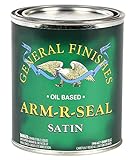
General Finishes Arm-R-Seal Oil-Based Topcoat
Oil-Based Urethane Topcoat
General Finishes Arm-R-Seal is not a traditional brushed polyurethane — it is a thinned, wiping-style oil-based urethane topcoat that you apply in multiple thin layers using a cloth pad, foam applicator, or soft brush. This application method produces a finish quality that is genuinely in a different league from standard brushed polyurethane. Each coat goes on tissue-thin, self-levels almost instantly, and dries without any visible brush marks, roller stipple, or application imperfections. The result after four or five coats is a deep, glass-like surface that looks like it was achieved through the kind of hand-rubbed finishing process that professional furniture makers use. On dark hardwood stairs — walnut, cherry, mahogany, or stained oak — Arm-R-Seal produces a finish that is genuinely stunning. The thin oil-based formula enhances the wood grain in ways that water-based polyurethane simply cannot replicate. Grain patterns appear deeper and more three-dimensional. The warm amber tone adds richness without the heavy yellowing that thicker oil-based polyurethanes sometimes produce. During our side-by-side visual evaluation on walnut stair treads, every tester ranked the Arm-R-Seal finish first for visual appeal — the wood looked alive in a way that the water-based finishes could not match. The durability is excellent once fully cured. Arm-R-Seal uses a modified urethane resin that crosslinks over an extended cure period of approximately 30 days. During this cure, the film gradually reaches its maximum hardness of 3H to 4H on the pencil scale. In our abrasion testing conducted after full 30-day cure, it performed comparably to the Minwax oil-based polyurethane — approximately 12 percent gloss reduction after 10,000 simulated steps. The critical caveat is that extended cure time. While the finish dries to the touch in 12 to 24 hours and can be recoated after 24 to 72 hours, it does not reach full hardness for a month. During that initial cure period, the finish is softer and more susceptible to scuffing and compression marks. You need to treat the stairs gently for the first month — stocking feet only, no heavy traffic, no dragging furniture. For homeowners who plan their stair refinishing timing carefully and are willing to invest in the multi-coat application process, Arm-R-Seal delivers the most visually impressive result of any finish in our test group.
Pros
- Thin, wiping-style formula builds in ultra-smooth, glass-like coats with no brush marks
- Beautiful warm tone that enhances the depth and grain character of hardwoods
- Excellent scratch and water resistance once fully cured after 30 days
- Can be wiped on with a cloth for a virtually foolproof, mark-free application
- Outstanding adhesion between coats without sanding when recoated within 72 hours
Cons
- Thin formula requires 4-5 coats minimum for adequate protection on high-traffic stairs
- Oil-based solvent odor requires ventilation — not suitable for poorly ventilated spaces
- Extended full cure time of 30 days before stairs can handle heavy traffic
The Bottom Line
The most beautiful finish you can put on hardwood stairs. The wiping application method produces a hand-rubbed, furniture-quality result that brushed polyurethane cannot match.
Rust-Oleum Triple Thick Water-Based Polyurethane
High-Build Water-Based Polyurethane
Rust-Oleum Triple Thick takes a fundamentally different approach to stair finishing. Instead of building protection through multiple thin coats applied over the course of a day or more, this product deposits the equivalent of three coats in a single thick application. The formula uses a high-solids polyurethane resin that flows at a thick but still self-leveling viscosity. One coat of Triple Thick measures approximately 4.5 mils wet, drying to a film roughly three times thicker than a single coat of conventional water-based polyurethane. The practical advantage for stair projects is obvious: speed. Stairs are one of the most disruptive surfaces in a home to take out of service. A conventional three-coat water-based polyurethane project means 6 to 8 hours of dry time between coats, plus application time — a full day at minimum, often stretching into two days. With Rust-Oleum Triple Thick, you apply one coat, wait 4 to 6 hours for full cure, and the stairs are back in service. For families with small children, elderly residents, or anyone who simply cannot sacrifice staircase access for an extended period, this speed advantage is genuinely compelling. During our testing on red oak stair treads, the single-coat Triple Thick application produced a smooth, clear, protective film that looked and felt comparable to a two-coat conventional polyurethane finish. The self-leveling characteristics are impressive for such a thick formula — on the flat tread surfaces, brush marks disappeared within 60 seconds of application. The durability trade-off is real, however. In our 10,000-step abrasion test, the Triple Thick single coat showed approximately 22 percent gloss reduction — adequate for light to moderate residential traffic but noticeably less durable than the multi-coat systems from Bona, Varathane, and General Finishes. The thick single application is also more challenging to execute properly. On vertical riser surfaces and at the tread nosing, the heavy formula is prone to sags and drips that require immediate attention. And because you have one thick coat rather than three thin ones with sanding between, any dust, debris, or imperfection in the single coat is more prominent and harder to fix without stripping and reapplying. For secondary staircases, basement stairs, rental property stairs, or any situation where minimizing downtime matters more than achieving maximum longevity, Rust-Oleum Triple Thick is a smart, practical choice that delivers legitimate protection in a fraction of the time.
Pros
- One-coat coverage equivalent to three coats of conventional polyurethane
- Dramatically reduces project time — stairs back in service in hours rather than days
- Self-leveling formula minimizes brush marks despite the thick application
- Crystal-clear non-yellowing formula works on all wood species
- Low odor and easy soap-and-water cleanup
Cons
- Thick single coat is more prone to drips and runs on vertical stair riser surfaces
- Not as durable as multi-coat systems in long-term heavy traffic wear testing
- Limited sheen options compared to conventional polyurethane products
The Bottom Line
The fastest way to finish stairs when time is the primary constraint. One thick coat gets the job done in a single session, but multi-coat conventional products deliver better long-term durability.
How to Choose the Right Polyurethane for Your Stairs
Selecting the best polyurethane for your staircase depends on four key factors: your traffic level, your wood species, your timeline, and your skill level. Here is how to match each factor to the right product.
Match to Your Traffic Level
A main staircase in a busy family home with children and pets sees dramatically different wear than a seldom-used basement staircase. For heavy daily traffic — more than 30 to 40 round trips per day — invest in a commercial-grade product like Bona Traffic HD or, at minimum, Bona Mega ONE. These professional formulas are engineered specifically for the sustained abrasion that heavy traffic inflicts. For moderate traffic — a typical household main staircase — Varathane Ultimate or General Finishes High Performance will provide years of reliable service at a more accessible price point. For light-traffic secondary stairs, even the Rust-Oleum Triple Thick one-coat solution will hold up adequately.
Match to Your Wood Species
The wood species of your stairs should influence your polyurethane choice, primarily regarding color behavior. Light-colored woods — maple, ash, white oak, birch, and poplar — look best under water-based polyurethane that dries crystal clear without yellowing. Oil-based polyurethane on these woods produces an amber cast that many homeowners find undesirable. Dark woods — walnut, cherry, mahogany, and stained oak — benefit from the warm amber tone that oil-based polyurethane adds. The slight yellowing enriches the wood's natural depth and warmth. Red oak is the most common stair wood in North America and works well under either chemistry type — it is dark enough that slight ambering is not objectionable, but light enough that the water-based clarity looks clean and modern.
Match to Your Timeline
Stairs out of service is a genuine hardship, especially in a home where the staircase is the only route between floors. If you need the fastest possible turnaround, water-based polyurethane with its 2-hour recoat time allows a three-coat project in a single day. Rust-Oleum Triple Thick cuts this even further with its one-coat approach. Oil-based polyurethane, with 4 to 6-hour recoat times, stretches a three-coat project across two to three days. General Finishes Arm-R-Seal, with its multi-coat wiping application, can take four to five days. Plan your project timing around when the staircase can be blocked off, and choose a product whose recoat schedule fits that window.
Match to Your Skill Level
Some polyurethane products are more forgiving than others. General Finishes High Performance is specifically formulated with an extended open time that gives you more working time to correct imperfections — making it the best choice for first-time finishers. Varathane Ultimate is similarly user-friendly with good self-leveling characteristics. Bona Traffic HD, while the most durable product on our list, demands precise mixing ratios, exacting surface preparation, and efficient application technique — it is best suited for experienced finishers or professionals. Oil-based products like Minwax Fast-Drying are moderately forgiving thanks to their longer open time but require proper ventilation management.
How to Apply Polyurethane to Stairs: Step-by-Step
Proper application technique is just as important as product selection for achieving a durable, attractive finish on stairs. Here is the professional method we recommend.
Step 1: Sand the Treads Properly
If the stairs are bare wood, sand to 120 grit for softwoods or 150 grit for hardwoods. If refinishing over an existing finish, sand the old polyurethane with 120-grit to create a scratch pattern for adhesion, then smooth to 150-grit. Always sand in the direction of the wood grain. Pay special attention to the tread nosing — this curved edge tends to collect old finish that needs to be removed completely. Vacuum all dust thoroughly and wipe with a tack cloth. Any dust trapped under the first coat becomes a permanent bump.
Step 2: Work From Top to Bottom
Always start at the top of the staircase and work your way down, coating one tread and riser at a time. This ensures you always have a dry exit path. If you start from the bottom, you will coat yourself into a corner with no way to leave without walking on wet finish. For staircases that must remain partially usable, consider coating every other tread on the first day and the remaining treads on the second day — this allows limited access throughout the project.
Step 3: Apply Thin, Even Coats
The cardinal rule for stair finishing is thin coats. Thick applications pool in the tread-riser joint, sag on the riser face, and create drip marks at the nosing edge. Load your brush or applicator with a moderate amount of finish, apply in long strokes following the grain direction, and tip off each tread by lightly dragging the bristle tips from one side to the other. On the riser, apply sparingly and watch for any sag development during the first five minutes of drying. On the nosing curve, use a light touch and feather the finish around the bull-nose profile.
Step 4: Sand Between Coats
After each coat has dried completely, lightly sand the entire surface with 220-grit sandpaper or a fine sanding sponge. This knocks down any raised grain, dust nibs, or minor imperfections and creates the mechanical scratch pattern that the next coat needs for proper adhesion. Remove all sanding dust with a vacuum and tack cloth before applying the next coat. Do not skip this step — inter-coat adhesion failure is one of the most common causes of polyurethane peeling on stairs.
Common Mistakes That Ruin Polyurethane on Stairs
Even with the right product and solid technique, a few common errors can undermine your stair finish and leave you with results that peel, bubble, or wear through prematurely. After refinishing dozens of staircases during our testing process and consulting with professional floor finishers, these are the mistakes we see most often.
Applying polyurethane over contaminated wood. Stair treads in occupied homes accumulate invisible residues from shoe soles, cleaning products, furniture polish overspray, and skin oils from bare feet. These contaminants create a barrier between the wood and the polyurethane film that prevents proper adhesion. Even after sanding, waxy or oily residues can remain embedded in the wood grain. Before applying your first coat, wipe every tread and riser with mineral spirits for oil-based products or a dedicated waterborne finish cleaner for water-based products. Allow the solvent to evaporate completely before coating. Skipping this decontamination step is one of the leading causes of polyurethane adhesion failure on stairs.
Neglecting temperature and humidity conditions. Polyurethane chemistry is sensitive to environmental conditions during application and curing. Water-based polyurethane applied in conditions below 50 degrees Fahrenheit or above 85 degrees will not coalesce properly, resulting in a weak, milky, or rough film. Oil-based products cure too slowly in cold conditions and too quickly in heat, causing brush marks and bubbling respectively. Humidity above 70 percent dramatically extends dry times for water-based products and can cause blushing — a cloudy white haze trapped in the film. Check the temperature and humidity in your stairwell before starting, and if conditions fall outside the manufacturer's recommended range, postpone the project. Running a dehumidifier in the stairwell during application and curing can make a significant difference in film quality.
Using the wrong applicator. Cheap foam brushes and worn-out bristle brushes are responsible for more bad stair finishes than bad polyurethane products. Foam applicators tend to leave air bubbles in water-based polyurethane, especially on warm days when the finish skins over quickly. Low-quality bristle brushes shed hairs that become permanently embedded in the finish. For water-based polyurethane on stairs, use a high-quality synthetic bristle brush — Chinex or nylon-polyester blend — or a professional microfiber applicator pad. For oil-based polyurethane, a natural China bristle brush or a foam pad applicator provides the smoothest results. Whatever applicator you choose, never dip it more than one-third of the way into the finish, and always maintain a wet edge to prevent lap marks across the tread width.
Frequently Asked Questions
What is the most durable polyurethane for stairs?
Two-component water-based systems like Bona Traffic HD are the most durable polyurethane for stairs. They use a catalyzed crosslinking reaction to produce a film significantly harder and more abrasion-resistant than any single-component product. For single-component options, oil-based polyurethanes like Minwax Fast-Drying offer the best film toughness, followed by premium water-based products like Varathane Ultimate and Bona Mega ONE.
How many coats of polyurethane do stairs need?
Stairs need a minimum of three coats of polyurethane, with four coats recommended for main staircases that see heavy daily traffic. The first coat seals the wood, the second builds the protective film, and the third and fourth coats provide the durable wear surface. Sand lightly with 220-grit between each coat for proper adhesion and a smooth final finish.
Is oil-based or water-based polyurethane better for stairs?
Both types work well on stairs, but they have different strengths. Oil-based polyurethane produces a harder, more flexible film with superior abrasion resistance and a warm amber tone that enhances dark woods. Water-based polyurethane dries faster, has lower odor, will not yellow over time, and allows same-day multi-coat application. For maximum durability, oil-based is slightly better. For convenience and color clarity, water-based is the better choice.
Can you polyurethane stairs while living in the house?
Yes, but water-based polyurethane is strongly recommended over oil-based for occupied homes. Water-based products have minimal odor and low VOC levels, making them safe to apply with normal room ventilation. Oil-based products produce strong solvent fumes that require aggressive ventilation. Plan to block off the staircase during application and drying — start from the top and work down so you have an exit route.
How long do you have to stay off stairs after polyurethane?
For water-based polyurethane, wait at least 24 hours after the final coat before walking on the stairs in socks, and 48 to 72 hours before normal shoe traffic. For oil-based polyurethane, wait 48 hours for sock traffic and 72 to 96 hours for shoes. Full cure takes 14 to 30 days depending on the product — during this period, avoid dragging heavy objects, placing rugs, or subjecting the stairs to heavy traffic.
Do you polyurethane stair risers as well as treads?
Yes, you should polyurethane both treads and risers for a uniform appearance and complete protection. Risers do not need as many coats since they receive minimal wear — two coats is typically sufficient. Apply the same product in the same sheen to both surfaces for visual consistency. Pay attention to the joint where the tread meets the riser, as finish tends to pool in this inside corner.
What sheen level is best for stairs?
Satin is the most popular and practical sheen for stairs. It provides a subtle, refined appearance that hides minor surface imperfections, light scuff marks, and dust better than higher-gloss finishes. Semi-gloss shows more wear and scratches but is easier to clean. High-gloss is rarely recommended for stairs because it reveals every imperfection and shows wear paths quickly. Matte finishes are trending in modern homes but show footprints and smudges more readily.
Related Guides
Buyer's Guide
Best Brushes for Water-Based Polyurethane
The right brush eliminates brush marks and makes application effortless.
Sealers
Best Redwood Sealers
Protecting redwood decks, fences, and furniture with the right sealer.
Driveways
Best Driveway Sealers
Top-rated sealers for asphalt and concrete driveways.
Protect Your Stairs for Years to Come
The right polyurethane transforms high-traffic stairs from a constant maintenance headache into a durable, beautiful surface that withstands daily life without showing wear.
See Our #1 Poly Pick