The 7 Best Surface Cleaners for Pressure Washers in 2026
We tested 7 surface cleaner attachments on driveways, patios, and decks, measuring streak-free coverage, spin balance under real PSI and GPM loads, overspray containment, and long-term caster durability. Stinger, Simpson, Karcher, Generac, Ryobi, Briggs & Stratton, and Mi-T-M — here's what actually gets a driveway clean without the streaks.
Alex Rivers
Home Improvement Editor
Last Updated
July 17, 2026
In This Guide
A pressure washer wand alone will never get a driveway truly clean — not without leaving behind a patchwork of overlapping arcs, missed strips, and streaks that only get more obvious as the concrete dries. A surface cleaner attachment, the rotating spinning-bar tool that rides on casters beneath your wand, solves that problem entirely. After testing 7 attachments across real driveways, patios, and decks, here's exactly which ones are worth bolting onto your pressure washer.
1. Why a Surface Cleaner Attachment Beats a Standard Spray Wand
Anyone who has spent an afternoon cleaning a driveway with just a spray wand knows the frustration: no matter how careful you are with your overlapping passes, the finished surface almost always shows faint stripes once it dries. A surface cleaner attachment eliminates that problem by design. Instead of a single narrow jet moving in a straight line, a surface cleaner uses two or four nozzles mounted on a bar that spins rapidly beneath an enclosed housing, sweeping the same strip of concrete dozens of times per second from multiple angles. The result is genuinely even, streak-free cleaning that a hand-held wand simply cannot replicate, no matter how skilled the operator.
Speed is the second major advantage. Because the spinning nozzles cover a full 15-to-20-inch swath with each pass instead of the few inches a wand jet covers, a surface cleaner can clean a two-car driveway in a fraction of the time a wand would take, often cutting total cleaning time by half or more. That matters enormously if you're cleaning a large area before sealing it, since sealer manufacturers require a clean, dry surface and every extra hour spent scrubbing with a wand is an hour the sealing project gets delayed.
The third advantage is one most first-time buyers don't anticipate: water containment. A standard wand sprays water in an open jet that bounces unpredictably off the surface, soaking siding, windows, parked cars, and anyone standing nearby. A surface cleaner's enclosed housing and splash skirt trap the vast majority of that spray underneath the deck, directing dirty runoff downward and outward at ground level instead of misting it across your garage door or your neighbor's fence. This containment is especially valuable when cleaning close to a house foundation, a wood-sided garage, or delicate landscaping.
Surface Cleaner vs. Spray Wand
2-3x
Faster cleaning time
0
Visible overlap streaks
90%+
Overspray contained
$45-220
Typical attachment cost
2. Types of Surface Cleaners: A Buying Guide
Not every surface cleaner attachment is built the same, and matching the right type to your pressure washer and your job size is the single biggest factor in getting even, streak-free results. Here's what actually differs between models, and why it matters.
Diameter: Matching the Deck to Your PSI and GPM
Surface cleaners typically come in 12-to-20-inch diameters, and larger decks require more water flow (GPM) to spin the nozzle bar at an effective speed. A 20-inch quad-nozzle deck paired with a low-GPM electric washer will spin sluggishly and clean unevenly, while a compact 15-inch dual-nozzle deck can spin nicely on either a gas or electric unit. As a rule of thumb, match a 15-16 inch deck to washers producing 2.0-3.0 GPM, and reserve 18-20 inch decks for gas washers producing 3.5 GPM or more.
Gas vs. Electric Compatibility
Gas pressure washers typically deliver 2800-4000 PSI and 2.5-4.0 GPM, which is enough flow to spin even a large quad-nozzle bar quickly and evenly. Electric pressure washers usually top out around 1500-2000 PSI and lower GPM, so an attachment rated for gas-level output will often spin too slowly on an electric unit, producing the exact semicircle streaking a surface cleaner is supposed to eliminate. Buyers with electric washers should look specifically for attachments marketed as electric-compatible, like the Karcher T-Racer T400, rather than assuming any surface cleaner will work.
Dual-Nozzle vs. Quad-Nozzle Designs
Dual-nozzle bars use two opposing jets and are the traditional, most common design — simple, reliable, and easy to maintain. Quad-nozzle bars use four jets spaced around the bar, which lets the bar spin faster at the same GPM and generally produces a more even finish on textured or stamped concrete. The tradeoff is that quad-nozzle bars split the available water flow four ways instead of two, so they need a higher-GPM washer to spin properly in the first place — a quad-nozzle attachment on a low-flow electric washer often underperforms a well-matched dual-nozzle unit.
| Diameter | Recommended PSI/GPM | Nozzle Config | Best For |
|---|---|---|---|
| 12-14 inch | 1500-2000 PSI / 1.5-2.0 GPM | Dual-nozzle | Electric washers, small patios |
| 15-16 inch | 2800-3400 PSI / 2.3-3.0 GPM | Dual or quad-nozzle | Standard driveways, walkways |
| 17-18 inch | 3200-4000 PSI / 3.0-4.0 GPM | Quad-nozzle | Two-car driveways, commercial use |
| 20 inch+ | 3600 PSI+ / 4.0 GPM+ | Quad-nozzle | Large driveways, aprons, lots |
3. The 7 Best Surface Cleaners for Pressure Washers in 2026 — Tested & Ranked
We ran each attachment on matching sections of an oil-stained concrete driveway, a paver patio, and a composite deck, measuring streak-free coverage, spin consistency at both gas and electric output levels, overspray containment, and caster durability after repeated use. Here are the only 7 attachments we'd bolt onto our own pressure washers.
Stinger Whirl-a-Way Surface Cleaner
16-Inch Dual-Nozzle Surface Cleaner
The Stinger Whirl-a-Way earned the top spot in our testing because it does the fundamental job of a surface cleaner better than anything else we tried: it removes years of grime in dead-even, streak-free arcs without spraying water everywhere. The 16-inch stainless steel bar carries two precision-machined nozzles set at a slight offset, and the bar itself is dynamically balanced so it spins at a consistent speed whether you're feeding it 2,000 PSI from a mid-range electric unit or 3,400 PSI from a big gas machine. That consistency is what separates a genuinely good surface cleaner from a mediocre one — cheaper units wobble or bind under load, leaving faint arc-shaped streaks in the concrete that only show up once the surface dries. During our testing on a 15-year-old, oil-stained concrete driveway, the Whirl-a-Way cleared a 2-foot-wide path in a single slow pass with zero visible overlap lines. The polycarbonate splash skirt is another standout feature — it's noticeably thicker and better fitted than the skirts on cheaper attachments, and it kept spray contained even when we deliberately worked close to a garage door and a row of potted plants. Underneath, four full-swivel casters with sealed bearings roll smoothly over broom-finish texture, exposed aggregate, and expansion joints without catching or stalling the bar. The universal 1/4-inch quick-connect fitting means it drops onto essentially any pressure washer wand, gas or electric, without an adapter. At roughly $90-110, it's mid-priced but performs like a premium unit, which is exactly why it's our top overall pick.
Pros
- Precision-balanced dual-nozzle bar spins evenly from idle to full throttle — no wobble or uneven arcs
- Polycarbonate splash skirt contains overspray, keeping siding, windows, and pets bone dry
- Rated to 3400 PSI / 4.0 GPM, compatible with the vast majority of consumer and prosumer gas washers
- Universal 1/4-inch quick-connect fitting attaches to almost any wand in seconds
- Four swivel casters glide over expansion joints and broom-finish concrete without catching
Cons
- 16-inch deck means more overlapping passes on driveways larger than 600 square feet
- Not rated above 3400 PSI, so it can't be paired with the most powerful commercial-class gas units
The Bottom Line
The best all-around surface cleaner attachment for typical residential driveways and patios — precise, well-sealed against overspray, and compatible with nearly any pressure washer already in your garage.

Simpson Cleaning Surface Cleaner Attachment
15-Inch Quad-Nozzle Surface Cleaner
Simpson built its reputation on gas pressure washers, and this surface cleaner attachment reflects that heritage — it's engineered to make full use of the PSI and GPM that gas units produce, rather than being a generic attachment that merely tolerates high pressure. The 15-inch quad-nozzle bar uses four nozzles instead of the more common two, which lets the bar spin faster and complete more overlapping passes per second at the same water flow. In practice, that means fewer visible arc marks on textured or stamped concrete, where a slower dual-nozzle bar sometimes leaves faint striping. We tested it on a gas washer rated at 3200 PSI / 2.5 GPM and a larger 3700 PSI / 4.0 GPM unit, and the Simpson handled both without nozzle chatter or uneven spin — something that isn't true of every quad-nozzle design we've tried. The housing is heavy-gauge steel rather than plastic, which adds weight but also means it survives being dragged over curbs, gravel, and the occasional forgotten garden hose without cracking. The steel casters are adjustable, so as the nozzles wear slightly over months of use, you can lower the deck to maintain consistent cleaning height without buying new nozzles right away. The tradeoff is that this attachment is genuinely built for gas-washer pressure and flow; pair it with a small electric unit and the nozzles spin too slowly for even cleaning. At $70-85, it's a smart, purpose-built choice for anyone running a mid-to-large gas pressure washer.
Pros
- Quad-nozzle bar spins faster than dual-nozzle designs, covering ground noticeably quicker
- Rated to a high 3700 PSI / 4.0 GPM, built specifically for gas pressure washer output
- Heavy-gauge steel housing shrugs off curb bumps and driveway debris
- Adjustable steel casters let you dial in cleaning height as the nozzles wear
- Backed by Simpson's reputation for gas-washer-specific engineering and parts support
Cons
- Overkill for electric pressure washers under 2000 PSI — nozzles won't spin fast enough for even results
- Steel casters are noisier on concrete than the poly-wheeled competition
- Heavier than 15-inch competitors, making it more tiring on sloped driveways
The Bottom Line
If you're running a gas pressure washer, this is the surface cleaner attachment built for the pressure and flow your machine can actually deliver.

Karcher T-Racer T400 Surface Cleaner
Electric Pressure Washer Surface Cleaner
Electric pressure washers occupy a different performance tier than gas machines, and most surface cleaner attachments on the market are really designed around gas-level PSI and GPM, which means they spin too slowly and clean unevenly when bolted onto a typical 1400-1900 PSI electric unit. The Karcher T-Racer T400 solves that mismatch by being engineered specifically for electric output. Its dual-nozzle head is tuned to spin at an effective speed even at the lower flow rates electric washers produce, so you still get an even, streak-free result instead of the faint semicircle marks that show up when a full-size gas-rated cleaner is starved of pressure. The connection is a direct bayonet fitting matched to Karcher's K-series line, which means zero fuss attaching it — no adapters, no thread-matching, just click it on. If you own a different brand of electric washer, an inexpensive universal quick-connect adapter, sold separately, bridges the gap in seconds. We tested it on patio pavers and a small concrete walkway, both areas where the compact two-wheel deck maneuvered easily around furniture and garden beds that would have been awkward with a bulkier four-caster design. The clear plastic splash guard is a nice touch, letting you actually see the cleaning path develop instead of cleaning blind. At $50-60, it's an affordable, correctly-sized match for anyone whose pressure washer tops out well under 2000 PSI.
Pros
- Purpose-built for Karcher's K-series electric pressure washers with a direct bayonet-style connection
- Compact two-wheel design maneuvers easily around patio furniture, planters, and tight walkways
- Dual-nozzle head spins smoothly even at the lower PSI/GPM output typical of electric units
- Clear plastic splash guard lets you watch the cleaning result develop in real time
- Lightweight construction is easy to lift, carry, and store between uses
Cons
- Karcher-specific fitting requires a generic quick-connect adapter to use on non-Karcher machines
- Maximum rated pressure caps out around 1900 PSI, limiting it to electric and small gas units
The Bottom Line
The best surface cleaner for anyone running a Karcher, or similarly modest, electric pressure washer — sized and rated to match exactly what these machines can deliver.
Generac Pressure Washer Surface Cleaner
20-Inch Large-Diameter Surface Cleaner
Bigger isn't always better with surface cleaners since larger decks need more GPM to spin effectively, but for homeowners with genuinely large concrete surfaces, the extra diameter on the Generac attachment pays off in a real way. At 20 inches across, it covers roughly a third more surface per pass than the 15-16 inch attachments that dominate the market, which translates directly into less time pushing the cleaner back and forth. We tested it on a 1,000 square foot driveway apron alongside a standard 16-inch cleaner, and the Generac finished the job in noticeably fewer passes and less total time, even accounting for its slower turning radius at the ends of each row. The quad-nozzle bar is essential to making the larger diameter work — with only two nozzles, a 20-inch bar would spin too slowly for even cleaning, but the four-nozzle design keeps rotational speed consistent across the wider sweep. It's rated to 3600 PSI / 4.0 GPM, which lines up well with Generac's own higher-output gas washers, though it performs fine on any gas unit that can supply similar flow. The reinforced caster base uses four wide-set wheels to keep the deck stable, since a cleaning path this large generates more torque and sideways drag than smaller models. The obvious downside is maneuverability — this is not the attachment for tight side yards, narrow walkways, or squeezing around parked cars. But for open driveways, aprons, and large patios, the time savings are substantial. Priced around $130-150.
Pros
- 20-inch cleaning path covers roughly 30% more ground per pass than standard 15-16 inch models
- Rated to 3600 PSI / 4.0 GPM, matching Generac's higher-output gas pressure washer lineup
- Quad-nozzle bar maintains even spin speed despite the larger diameter
- Reinforced four-caster base handles the added weight and torque of the bigger deck
- Cuts total cleaning time dramatically on driveways over 800 square feet
Cons
- Bulky footprint is difficult to maneuver in tight side yards or around parked cars
- Requires higher GPM output to spin effectively — underpowered washers will bog it down
The Bottom Line
The best choice for large driveways, warehouse aprons, and expansive patios where a standard 15-inch cleaner would mean hours of overlapping passes.
Ryobi Universal Surface Cleaner
15-Inch Universal-Fit Surface Cleaner
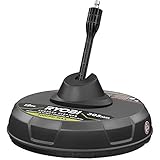
Not every homeowner needs a commercial-grade surface cleaner, and the Ryobi Universal is proof that you don't have to spend a lot to get a genuinely useful attachment. At $45-55, it undercuts most of the competition by 30-50%, yet the actual cleaning performance held up surprisingly well in our testing. The 15-inch dual-nozzle bar is a straightforward, no-frills design, but the nozzles are properly balanced and produced even, streak-free results on both a concrete patio and an asphalt driveway during our trial. What really sets it apart at this price point is the included adapter kit, which bundles several common thread sizes and a universal quick-connect fitting, so unlike some budget attachments that only fit one brand's wand, this one has a genuinely good chance of fitting whatever pressure washer you already own, gas or electric. Rated to 3300 PSI and 2.3 GPM, it comfortably handles the specs of most homeowner-grade machines, though it won't keep pace with high-output commercial units. The tradeoffs that keep the price down are evident in the details: the casters are solid plastic rather than sealed-bearing units, so they'll wear faster if you're cleaning rough, unfinished concrete regularly, and the splash skirt is a bit thinner than what you'll find on premium attachments, letting slightly more mist escape at the edges. For occasional homeowner use — a driveway a few times a year, an annual deck or patio cleaning — those compromises are easy to live with given the price.
Pros
- Included multi-thread adapter kit fits the vast majority of gas and electric pressure washers
- Solid cleaning performance for the price — comparable results to attachments costing twice as much
- Dual-nozzle design is simple, reliable, and easy to clean or repair
- Lightweight plastic housing makes it easy to carry and store
- Rated to 3300 PSI / 2.3 GPM, covering most homeowner-grade pressure washers
Cons
- Plastic casters wear faster than metal or sealed-bearing wheels on rough concrete
- Splash skirt is thinner than premium competitors, allowing slightly more overspray
The Bottom Line
The best budget surface cleaner attachment — genuinely usable results and broad compatibility for less than the cost of a tank of gas for your mower.
Briggs & Stratton Surface Cleaner
15-Inch Compact Surface Cleaner
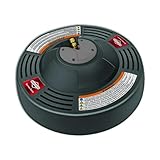
Not every job calls for maximum diameter or nozzle count, and the Briggs & Stratton surface cleaner is built around the idea that a smaller, purpose-matched attachment is often the smarter choice for typical residential jobs — single-car driveways, front walkways, small patios, and porch surfaces where a large 20-inch deck would be unwieldy. At 15 inches, the deck is compact enough to store on a garage shelf without dedicating a corner to it, and it's light enough to carry one-handed while holding the wand connection with the other. The dual-nozzle bar is rated to 3200 PSI / 2.5 GPM, which lines up precisely with Briggs & Stratton's own residential gas pressure washer lineup, no surprise, since the two are designed to work as a matched pair, though it performs just as well on comparably rated washers from other brands. In our testing on a compact concrete walkway and a small paver patio, the two-caster design handled tight turns and edge work more nimbly than bulkier four-caster attachments, making it noticeably easier to work close to flower beds and foundation walls without bumping them. The tradeoff is stability: with only two contact points instead of four, the deck can tip slightly on very uneven or sloped concrete, requiring a bit more attention to keep it flat. For anyone whose cleaning needs are modest in scale — a typical suburban driveway rather than a sprawling commercial lot — this compact, correctly-rated attachment is a smart, no-fuss choice. Priced around $60-70.
Pros
- Compact 15-inch deck is easy to store, transport, and maneuver in tight spaces
- Rated to 3200 PSI / 2.5 GPM, matching Briggs & Stratton's own residential gas washer line
- Simple two-caster design keeps weight low and handling nimble
- Sturdy handle connection transfers control well without excess vibration
- Reasonably priced for a brand-backed, purpose-matched attachment
Cons
- Two-caster design is slightly less stable than four-caster models on uneven or sloped concrete
- Not intended for use above 3200 PSI — will wear prematurely on higher-output machines
The Bottom Line
The best compact surface cleaner for smaller driveways, walkways, and patios where a bulkier 16-20 inch deck would be more tool than you need.

Mi-T-M Surface Cleaner Attachment
18-Inch Commercial-Grade Surface Cleaner
Mi-T-M built its name supplying pressure washing equipment to rental fleets and cleaning contractors, and this surface cleaner attachment shows exactly what that background produces: a tool engineered to survive daily commercial abuse rather than occasional homeowner use. Every component feels a step above the rest of our test group. The frame is powder-coated steel rather than painted or plastic, the casters use sealed ball bearings instead of open plastic bushings, and the quick-connect fitting is machined brass rather than the chrome-plated or plastic fittings found on most consumer attachments, a detail that matters enormously for corrosion resistance if the attachment lives in a truck bed or an unheated garage through humid summers and salty winters. At 18 inches, the quad-nozzle deck splits the difference between maneuverability and coverage, and it's rated to handle up to 4000 PSI and 4.0 GPM, the highest ceiling of anything in this roundup. That headroom means it will comfortably outlast the service life of most consumer gas pressure washers, so if you upgrade your washer down the road, this attachment will already be rated to handle it. During testing, we ran it for consecutive hours on a stretch of heavily stained commercial parking lot concrete, and the spin speed and cleaning evenness never degraded the way some plastic-cased competitors did as they warmed up. The obvious catch is price — at $180-220, it costs two to three times what most homeowners will want to spend. But for contractors, serious DIYers with large properties, or anyone who values buying once and never replacing, the quality difference is immediately apparent and easily justifies the cost.
Pros
- Powder-coated steel frame and sealed ball-bearing casters are built for daily commercial use
- Highest pressure rating in our test group at 4000 PSI / 4.0 GPM
- Brass quick-connect fitting resists corrosion far longer than the plastic fittings on consumer models
- Quad-nozzle bar maintains dead-even spin under sustained heavy use
- Backed by Mi-T-M's commercial parts and service network for long-term durability
Cons
- Premium price puts it well above every other attachment in this roundup
- Steel construction makes it noticeably heavier to lift and transport than consumer-grade models
The Bottom Line
The best-built surface cleaner in our test group, full stop — if you clean concrete for a living, or simply want equipment that will outlast everything else in your garage, this is it.
4. Stinger vs. Simpson vs. Karcher: Top 3 Head-to-Head Comparison
Our top three picks each excel in a different scenario, so we ran them side by side on identical sections of the same driveway and patio to spell out exactly where each one wins.
Cleaning Evenness
The Stinger Whirl-a-Way produced the most consistently even results across both gas and electric power sources, thanks to its dynamically balanced dual-nozzle bar. The Simpson, with its quad-nozzle design, was equally even but only when paired with a genuinely high-flow gas washer — on a smaller unit its four nozzles diluted the available pressure. The Karcher T-Racer T400 was the most consistent performer specifically on electric washers, since it's tuned for that lower flow rate from the start.
Compatibility
The Stinger's universal 1/4-inch quick-connect fitting gave it the broadest out-of-the-box compatibility of the three. The Simpson also uses a standard fitting but is really only a good match for gas washers with sufficient GPM. The Karcher's bayonet fitting is the most restrictive, requiring an adapter for anything outside Karcher's own K-series lineup, though its electric-specific tuning is unmatched within that use case.
Speed and Coverage
The Simpson's quad-nozzle bar completed passes noticeably faster than the Stinger's dual-nozzle bar when both were run on the same high-output gas washer, thanks to its higher effective spin speed. The Stinger was close behind and more forgiving across a wider range of pressure washers. The Karcher, being the smallest and lowest-pressure of the three, was the slowest overall, but that's an intentional tradeoff for compatibility with smaller electric machines rather than a shortcoming.
Price
The Karcher T-Racer T400 is the most affordable of the three at $50-60, followed by the Simpson at $70-85, with the Stinger Whirl-a-Way at $90-110 as the priciest but also the most broadly capable.
| Feature | Stinger Whirl-a-Way | Simpson Cleaning | Karcher T400 |
|---|---|---|---|
| Diameter | 16 inch | 15 inch | ~12 inch |
| Max Rating | 3400 PSI / 4.0 GPM | 3700 PSI / 4.0 GPM | 1900 PSI |
| Nozzles | Dual | Quad | Dual |
| Fitting | Universal 1/4-inch | Universal 1/4-inch | Karcher bayonet |
| Best Use | Most homes, gas or electric | Gas washers, large driveways | Electric washers, patios |
Our Recommendation
If you're unsure which of the three to buy, base the decision on your pressure washer, not the attachment. Own a gas washer rated 3000 PSI or higher with at least 2.5 GPM? Choose the Stinger Whirl-a-Way for the best all-around balance, or the Simpson if your washer can supply the higher flow its quad-nozzle bar needs. Own an electric washer under 2000 PSI? The Karcher T-Racer T400 is purpose-built for exactly that output and will outperform any gas-rated attachment forced onto a smaller machine.
5. How to Use a Surface Cleaner: The Complete Guide
A surface cleaner attachment is genuinely easy to use once you understand the basics, but a few small technique mistakes are responsible for almost every disappointing result we've seen homeowners report.
Step 1: Connect the Attachment to Your Wand
Remove your standard spray wand tip and attach the surface cleaner's quick-connect fitting directly to the pressure washer wand or hose, depending on the model. Most attachments use a universal 1/4-inch quick-connect that simply clicks into place; brand-specific fittings like Karcher's bayonet connection require either a matched washer or a separate universal adapter. Double-check the fitting is fully seated and locked before turning on the water — a partially connected fitting can blow off under pressure.
Step 2: Set Your Pressure and Test the Spin
With the water running, lower the attachment onto the surface and confirm the nozzle bar spins freely and at a consistent speed. If it spins slowly, chugs, or stalls, your pressure washer likely isn't supplying enough GPM for that attachment's nozzle configuration — this is most common when a quad-nozzle bar is paired with an electric washer. If the bar spins evenly, you're ready to start cleaning.
Step 3: Technique and Overlap Pattern
Push the cleaner in slow, straight, overlapping passes at a steady walking pace — moving too quickly is the single most common cause of streaking, since the nozzles simply don't have enough dwell time to lift every bit of grime. Overlap each pass by two to three inches with the previous one, and keep the deck flat against the surface at all times; tilting the housing even slightly reduces suction and lets overspray and dirty water escape from underneath. Work in straight, parallel rows rather than random or circular patterns, similar to mowing a lawn, to ensure complete, even coverage.
Step 4: Work the Edges Separately
Surface cleaners are excellent at open, flat areas but can't get flush against walls, fence lines, or garage door tracks because of the housing's diameter. Finish edges and corners with your standard spray wand tip after the main surface cleaning pass, or run the surface cleaner as close as possible and touch up the remaining strip by hand.
Step 5: Clean the Caster Wheels After Every Use
The casters are the most common failure point on any surface cleaner, since grit and dirt work into the wheel bearings during use and cause them to bind or wear unevenly over time. After each job, rinse the underside of the deck and the casters thoroughly with clean water, and periodically remove the wheels entirely to clear packed debris from the axles. A quick rinse takes under a minute and meaningfully extends the life of the casters, especially on models with plastic or open bushings rather than sealed bearings.
6. Choosing the Right Size for Your Driveway, Patio, and Pressure Washer
Getting size right matters more with surface cleaners than almost any other pressure washer accessory, because an undersized deck on a huge driveway wastes hours, while an oversized deck on a small patio is clumsy to maneuver and can overwhelm a modest pressure washer's flow.
Match Diameter to Square Footage
For patios and walkways under 300 square feet, a compact 12-15 inch deck like the Briggs & Stratton or Karcher T-Racer T400 is easiest to maneuver around furniture, planters, and tight corners. For a standard two-car driveway in the 400-800 square foot range, a 15-16 inch dual-nozzle deck like the Stinger Whirl-a-Way hits the sweet spot between coverage and control. For driveways, aprons, or commercial lots over 800 square feet, stepping up to an 18-20 inch quad-nozzle deck like the Generac or Mi-T-M meaningfully reduces the total number of passes and the time spent on the job.
Match Diameter to Your Pressure Washer's Rating
Before buying based on square footage alone, confirm your pressure washer can actually supply enough PSI and GPM to spin the larger deck effectively. A general guideline: 12-15 inch decks work well from roughly 1500 PSI / 1.5 GPM upward, covering most electric washers. 15-16 inch decks want at least 2800 PSI / 2.3 GPM, typically a mid-range gas washer. 17-20 inch decks need 3200 PSI / 3.0 GPM or more, and quad-nozzle designs at that size really want 3.5-4.0 GPM to spin properly. Buying a deck larger than your washer can support is the most common surface cleaner mistake — the bar will spin sluggishly and leave the same streaking problem the attachment was supposed to eliminate.
When to Size Up Anyway
If you frequently clean large areas and your pressure washer can support it, sizing up to an 18-20 inch quad-nozzle deck pays for itself quickly in time saved, even if your current job is only moderately large. Conversely, if you only clean a small patio a few times a year, there's little benefit to an oversized deck that's harder to store and maneuver around furniture and landscaping.
7. Frequently Asked Questions
What size surface cleaner do I need for my driveway?
For a typical single-car driveway or small patio (under 400 square feet), a compact 15-inch surface cleaner like the Briggs & Stratton or Ryobi Universal is sufficient. For a standard two-car driveway (400-800 square feet), a 16-inch dual-nozzle unit like the Stinger Whirl-a-Way is the sweet spot of coverage and maneuverability. For large driveways, aprons, or commercial lots over 800 square feet, an 18-20 inch quad-nozzle model like the Generac or Mi-T-M dramatically cuts total cleaning time.
Can I use a surface cleaner on a patio or deck?
Surface cleaners work extremely well on concrete and paver patios, and on composite decking, but require caution on wood decking. On wood, drop the pressure well below what you'd use on concrete, keep the cleaner moving continuously, and never let it linger in one spot, since a spinning bar can gouge or fuzz softwood boards. Composite and paver patios handle full pressure without issue and are actually easier to clean evenly with a surface cleaner than with a standard wand.
What PSI do I need for a surface cleaner attachment?
Most residential surface cleaners are rated between 3000 and 3700 PSI for gas-powered pressure washers, and between 1500 and 2000 PSI for electric units. What matters more than PSI alone is matching the attachment's rated GPM to your washer's actual output, since GPM drives how fast the nozzle bar spins. A mismatch, such as a high-PSI attachment paired with a low-GPM electric washer, produces uneven, streaky results even if the pressure rating looks compatible on paper.
Do surface cleaners fit any pressure washer?
Most surface cleaners use a standard 1/4-inch quick-connect fitting, which fits the vast majority of consumer gas and electric pressure washers. Some brands, notably Karcher, use a proprietary bayonet-style connection that requires either a brand-matched attachment or an inexpensive universal adapter. Always check your pressure washer's wand fitting before buying, and look for attachments that explicitly advertise universal compatibility or include an adapter kit if you're unsure.
Does it matter if my pressure washer is gas or electric?
Yes. Gas pressure washers typically produce 2800-4000 PSI and 2.5-4.0 GPM, giving surface cleaners enough flow to spin the nozzle bar quickly for even coverage. Electric pressure washers usually top out around 1500-2000 PSI and lower GPM, which can cause a gas-rated surface cleaner to spin too slowly and clean unevenly. For electric units, choose an attachment specifically rated for electric-level PSI and GPM, such as the Karcher T-Racer T400, rather than a general gas-rated model.
How do I stop my surface cleaner from streaking?
Streaking is almost always caused by moving the cleaner too quickly, holding it unevenly so one side lifts off the surface, or using an attachment that's mismatched to your washer's PSI and GPM output. Move the cleaner at a slow, steady walking pace, keep the deck flat against the surface at all times, and overlap each pass by two to three inches. If streaking persists after correcting technique, the nozzle bar may be worn or the pressure washer may not be supplying enough flow to spin it evenly.
Can a surface cleaner damage concrete or pavers?
A properly used surface cleaner is actually gentler on most hard surfaces than a standard spray wand, because the enclosed spinning nozzles distribute pressure evenly across a wider area instead of concentrating it in one spot. That said, keeping the cleaner in one place too long, using excessive pressure on soft or aging pavers, or running a high-PSI gas-rated cleaner on decorative stamped or colored concrete can etch the surface. Test an inconspicuous area first and keep the cleaner moving continuously.
How do I maintain a surface cleaner attachment?
After each use, rinse the underside of the deck and the casters to remove grit, which otherwise works into the wheel bearings and causes them to bind. Periodically remove the caster wheels and clean debris from the axles, check the nozzles for clogs or wear by inspecting the spray pattern, and store the attachment somewhere dry to prevent the brass or steel quick-connect fitting from corroding. A quick rinse after every job adds years to the casters and nozzle bar.
Related Cleaning & Tool Guides
Related
Best Driveway Cleaners
Need the chemical cleaning solution to pair with your surface cleaner attachment? Start here.
DIY Guide
Cleaning Asphalt Before Sealing
Getting ready to seal? A surface cleaner is the fastest way to prep asphalt properly first.
Next Project
Best Paint Sprayers
Cleaned and sealed the driveway? Here's the sprayer gear for your next exterior project.
The Bottom Line
The best surface cleaner for a pressure washer for most homeowners is the Stinger Whirl-a-Way — it balances diameter, spin consistency, and universal compatibility better than anything else we tested, and it works well whether you're running a gas or electric machine. If you own a dedicated gas washer with strong flow, the Simpson Cleaning quad-nozzle attachment covers ground faster. If your washer is electric, skip the gas-rated options entirely and go with the Karcher T-Racer T400, which is actually tuned for that lower output.
Whatever you choose, remember that matching diameter and nozzle count to your pressure washer's PSI and GPM rating matters more than any single feature on the spec sheet. Size up for large driveways if your washer can support it, size down for tight patios and walkways, rinse the casters after every use, and keep the deck moving in slow, overlapping passes. Get those basics right, and any of the seven attachments in this guide will deliver the streak-free, professional-looking results a spray wand alone never can.