The 7 Best Hydraulic Cements for Leaks
Fast-setting, expanding cement that plugs holes and keyed cracks while water is still coming through. Compared on set time, strength and how much working time you actually get.
Alex Rivers
Home Improvement Editor
Last Updated
October 18, 2026
In This Guide
For most basement leaks, DRYLOK Fast Plug is the hydraulic cement to buy, with Quikrete Hydraulic Water-Stop a close, widely stocked alternative. Both set in about three to five minutes. Which one you choose matters less than how you prepare the crack, because the product sets far faster than most people expect and a badly cut crack fails no matter what is in the tub.
Our Picks at a Glance
The Short Answer
DRYLOK Fast Plug Hydraulic Cement (Best Overall). The well-documented, widely stocked hydraulic cement to reach for first on a leaking basement wall.
We may earn a commission when you buy through these links, at no extra cost to you. How we test
Best Overall
DRYLOK Fast Plug Hydraulic Cement
1. How We Picked These Cements
We did not plug leaks in a test wall with seven products and wait for spring rain, and we are not going to claim we did. This guide is built from technical data sheets, which for hydraulic cement are unusually informative, plus retailer listings and the way these products are actually used in basement repairs. Every figure is attributed, and where a retailer number disagrees with the manufacturer, we say so.
The comparison that matters is set time. Hydraulic cement exists to harden fast enough to stop water while it is still flowing, so we looked at initial and final set times, the test method behind them, and the working window each manufacturer recommends. Strength comes second, because a plug in a foundation crack does not carry much load, but early strength tells you how soon you can coat over it.
We also weighed availability and package size. A product you cannot buy on the Saturday morning your basement is leaking is not much use, so the list leans toward brands sold at home centers and hardware stores, with a few pro products where they offer something specific, such as a longer working time or a crystalline repair system.
If you are new to the product, read our guide on how to use hydraulic cement before you open a tub. The technique matters more than the brand, and most failed plugs fail because of how the crack was cut or how the batch was mixed.
2. What Hydraulic Cement Does, and Does Not Do
Hydraulic cement is a rapid-setting cement blended so that it expands very slightly as it cures instead of shrinking. That expansion is the point. Packed into a properly undercut crack or hole, it locks itself in place and seals against the sides, which is why it can stop water that is actively coming through a wall or floor.
It is a plug, not a coating. It fills individual holes, cracks and the joints around pipe penetrations; it does not waterproof a whole wall. For broad dampness through block or concrete, a coating such as a masonry waterproofer is the right tool, and our basement wall sealer guide covers those. The usual sequence on a leaking wall is to plug the active leaks with hydraulic cement, then coat the wall.
It is also rigid. A crack that is still moving, such as a settlement crack that opens and closes with the seasons, may crack around a hydraulic cement plug, because the plug cannot flex. Those cracks are better served by flexible injection products, which our basement crack repair guide explains.
And it does not fix the cause. Water pushed through a wall by saturated soil or poor drainage will look for the next weak point once you plug the first. Hydraulic cement buys time and stops the immediate leak; grading, gutters and drainage stop the water reaching the wall in the first place.
3. Our 7 Picks
Every set time and strength figure below comes from the manufacturer's technical data sheet or a retailer listing repeating it, and we note where those disagree. We did not lab-test these cements. We picked them on set speed, strength, availability and package size, and checked each against current data sheets. Set times are measured under lab conditions; warm water or a warm basement shortens them noticeably.
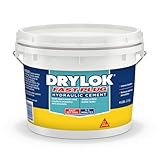
Best OverallDRYLOK Fast Plug Hydraulic Cement
Hydraulic Cement, Powder
DRYLOK Fast Plug is the hydraulic cement most homeowners should buy first, and the reason is the paperwork as much as the powder. DRYLOK's product data sheet gives a set time of 3 to 5 minutes, a mix of 3 parts powder to 1 part water to a putty consistency, coverage of about 16 cubic inches per pound, and an application requirement of 40°F and above. It also publishes a strength curve: 311 psi at 1 hour, 2,650 psi at 24 hours and 3,050 psi at 7 days. The data sheet advises mixing only what you can place in about three minutes, which is the practical working window. Fast Plug comes in 4, 10 and 50 pound sizes, so a single leak and a whole foundation are both covered, and it can be painted with DRYLOK waterproofer once set, which makes it the natural first step before a wall coating. Like all cementitious products it contains crystalline silica, so wear a dust mask when mixing.
Pros
- Data sheet set time of 3 to 5 minutes
- Published strength curve, 2,650 psi at 24 hours
- Sold in 4, 10 and 50 lb sizes
- Paintable with DRYLOK waterproofers once set
Cons
- Roughly three minutes of real working time
- Not for use below 40°F
- Contains crystalline silica; mask up when mixing
The Bottom Line
The well-documented, widely stocked hydraulic cement to reach for first on a leaking basement wall.

Best ValueQuikrete Hydraulic Water-Stop Cement (No. 1126)
Hydraulic Cement, Powder
Quikrete's Hydraulic Water-Stop Cement is the alternative you will find on the shelf next to Fast Plug, and on paper it is every bit as capable. Quikrete's data sheet lists a final set of 5 minutes or less under ASTM C191, the standard needle test for cement set time, and compressive strength of 1,000 psi at 2 hours rising to 5,500 psi at 28 days under ASTM C109. It advises mixing no more than you can place in 2 to 3 minutes, warns that hot temperatures reduce set time, and recommends warm water below 50°F. Retail listings describe it as stopping active leaks in 3 to 5 minutes. It comes in 10, 20 and 50 pound pails. Practically, it behaves much like Fast Plug, and buying whichever is in stock is a sensible strategy. Do not confuse it with Quikrete's FastSet Water-Stop, a different, faster product.
Pros
- Final set of 5 minutes or less per ASTM C191
- 1,000 psi at 2 hours, 5,500 psi at 28 days on the data sheet
- Sold in 10, 20 and 50 lb pails
- Widely stocked at home centers and hardware stores
Cons
- Only 2 to 3 minutes of working time
- Set time shortens in heat
- Easy to confuse with Quikrete's faster FastSet product
The Bottom Line
An equally capable, often cheaper alternative to Fast Plug; buy whichever your store stocks.
Fastest for Running WaterQuikrete FastSet Water-Stop Cement
Rapid-Set Repair Cement
When water is not seeping but actually running out of a hole, a faster product earns its place, and Quikrete's FastSet Water-Stop is built for that. Quikrete's product page describes it as a rapid-setting repair material for stopping active leaks in masonry and concrete, above or below grade, that stops flowing water in 60 to 90 seconds. Ace Hardware's listing gives a 2-minute set time, though that figure does not appear in the manufacturer text we found. It is sold in 20 pound pails, and Quikrete gives a yield of about 0.17 cubic feet per pail. The very short window is both the advantage and the risk: there is time to form a plug and hold it, and almost no time for anything else. Mix tiny batches, have everything staged, and keep this one for actively running leaks rather than routine crack filling.
Pros
- Stops flowing water in 60 to 90 seconds, per Quikrete
- Rated for above and below-grade repairs
- 20 lb pail covers several leaks
- The right tool when water is actively running
Cons
- Extremely short working time
- Set time figures differ between manufacturer and retailer
- Overkill for slow seeps and dry cracks
The Bottom Line
The plug for a hole that is actively running water, if you can work fast.
Best for Underwater LeaksSakrete Leak Stopper Hydraulic Cement
Hydraulic Cement, Powder
Sakrete Leak Stopper is a solid alternative with an unusually clear technical data sheet. It lists an initial set of 1 to 3 minutes under ASTM C191 and a final set of 3 to 4 minutes, with compressive strength above 1,000 psi at 2 hours and 3,000 psi at 28 days. The data sheet specifies application between 40°F and 90°F for both air and substrate, and describes placing the mixed material in a plastic bag and forcing it into the opening for underwater or active leaks, a technique that also works well in a basement. Retailers sell it in 10 and 20 pound sizes. The faster initial set means it starts stiffening sooner than Fast Plug, so mix smaller batches. It is a good pick where your local store stocks Sakrete rather than DRYLOK or Quikrete.
Pros
- Clear data sheet: 1 to 3 minute initial, 3 to 4 minute final set
- Over 1,000 psi at 2 hours
- Rated for active and underwater leaks
- Defined 40°F to 90°F application range
Cons
- Starts stiffening faster than Fast Plug
- Smaller package range than DRYLOK
- Lower 28-day strength than Quikrete's published figure
The Bottom Line
A well-specified alternative, especially handy for leaks that are actively wet.
Best Pro-Grade OptionSikaSet Waterplug (formerly MasterSeal 590)
Fast-Setting Water Stop Mortar
Contractors may know this product by its older names, Thoro Waterplug and later MasterSeal 590, and Sika now lists it as SikaSet Waterplug. It is a one-component, cement-based fast-setting mortar for plugging active water leaks. Retailer listings give a set time of about 3 to 5 minutes, and manufacturer material says it can be topcoated with an appropriate product after 15 minutes, which is useful when the plug is the first step before a waterproof coating. We could not read the current Sika technical data sheet, so the set time here comes from retailer spec fields, and you should check the TDS for an authoritative figure. It is sold in quart, 10 lb and 50 lb sizes through hardware and commercial suppliers. The main reason to choose it is familiarity: if your contractor specifies Waterplug, this is the same product under a new name.
Pros
- Long track record under the Thoro Waterplug name
- Topcoat after about 15 minutes, per manufacturer material
- Sizes from a quart to a 50 lb pail
- Sold through hardware and pro supply channels
Cons
- Set time here comes from retailers, not the current TDS
- Name changes make it confusing to find
- Pricier than home-center brands
The Bottom Line
The contractor-familiar Waterplug, now under the Sika name, for when a pro specifies it.

Best With a Crystalline SystemXypex Patch'n Plug
Fast-Setting Hydraulic Repair Compound
Xypex Patch'n Plug is the choice when the plug is the first step in a crystalline waterproofing repair rather than a standalone fix. Xypex's North American data sheets list an initial set of 1:30 to 4:00 and a final set of 4:30 to 9:00 under ASTM C266, with a note that results vary significantly with conditions, while the newer metric sheet uses a different test and gives 2 to 4 minutes initial and 5 to 9 minutes final. The somewhat longer final set gives more time to shape and finish the plug than the fastest home-center products. Patch'n Plug is designed to work with Xypex's crystalline products, which react with moisture in the concrete to block capillary pores, so it makes most sense if you plan to treat the wall with that system afterwards. It is sold mainly through specialty and pro channels.
Pros
- Final set of 4:30 to 9:00, more time to shape the plug
- Designed to pair with Xypex crystalline waterproofing
- Data sheets published for multiple test standards
- Suited to structural concrete repairs
Cons
- Mostly sold through specialty and pro suppliers
- Set figures vary by data sheet version and test
- Costs more than home-center hydraulic cement
The Bottom Line
The plug to use when the wall is getting a crystalline waterproofing treatment afterwards.
Fastest to Full StrengthRapid Set WATER STOP
Rapid-Set Repair Material
CTS Cement's Rapid Set WATER STOP is a blend of Rapid Set hydraulic cement and graded fine aggregates designed for stopping leaks in concrete and masonry. CTS's datasheet says it sets in less than 5 minutes and achieves structural strength in 1 hour, which is the fastest strength gain claim on this list and useful when a repair needs to take load or a coating soon after. It is sold in a 25 pound box. Rapid Set products use a calcium sulfoaluminate cement rather than ordinary portland cement, which is where the fast strength comes from. The trade-off is availability: Rapid Set is easiest to find at concrete supply houses and some home centers rather than every hardware store, and CTS's guideline specification is written for professionals, so homeowners get less hand-holding than with DRYLOK or Quikrete.
Pros
- Sets in under 5 minutes, per CTS
- Structural strength in 1 hour, per CTS
- 25 lb box suits larger repairs
- Aggregate blend for a stronger patch
Cons
- Harder to find than DRYLOK or Quikrete
- Documentation aimed at professionals
- Only one package size listed
The Bottom Line
The fastest route to a load-bearing patch, if you can find it locally.
4. Set Time Is the Whole Job
Every product on this list sets in minutes. DRYLOK publishes 3 to 5 minutes, Quikrete Hydraulic Water-Stop a final set of 5 minutes or less, Sakrete Leak Stopper an initial set of 1 to 3 minutes, and Quikrete's FastSet claims to stop flowing water in 60 to 90 seconds. Those figures are measured under lab conditions, typically around room temperature. In practice your working window is shorter than the set time, and the manufacturers say so: DRYLOK advises mixing only what you can place in about three minutes, and Quikrete says two to three.
Temperature changes everything. Quikrete's data sheet notes that hot temperatures reduce set time and recommends warm water below 50°F. A batch mixed with warm water in a warm basement in August can stiffen in a couple of minutes. Cool water helps in summer, and the material should not go on when the substrate is colder than the minimum on the label, typically around 40°F.
The practical rule is small batches. Mix a golf-ball to tennis-ball sized amount, place it, and mix again. Never add water to a batch that has started to stiffen; the set has begun, and remixing breaks the structure that is forming, leaving a plug that looks fine and crumbles later.
If you need more working time, Xypex Patch'n Plug's final set of up to nine minutes gives a little more room, while the FastSet and Rapid Set products give less. Choose based on the leak: slow seeps reward a slightly longer window, while a running hole needs the fastest product you can handle.
5. Preparing the Crack So the Plug Holds
A hydraulic cement plug is only as good as the opening it locks into. Smearing cement over the face of a hairline crack does almost nothing, because there is nothing for the expansion to grip. The crack needs to be opened up first, typically to around three quarters of an inch wide and deep, with a cold chisel or a grinder.
Undercut it. The channel should be wider at the back than at the face, an inverted V or dovetail, so the expanding cement keys in and cannot be pushed back out by water pressure. Clean out every bit of loose material, dust and old paint, because hydraulic cement bonds to sound concrete, not to debris.
Dampen the surface before placing the cement on a dry crack, so the dry concrete does not suck water out of the mix. On an actively leaking crack, the water is already there. Work from the top of a vertical crack downward, or from the driest end toward the wettest, and leave the point where the water flows strongest until last.
Press the cement in hard and hold it. Many data sheets describe forming the material into a plug and holding it in place by hand until it sets, and Sakrete describes pushing material from a plastic bag into underwater leaks. Holding pressure for the full set time is what turns a lump of cement into a plug that stays.
6. When Hydraulic Cement Is the Wrong Fix
Hydraulic cement is the right fix for an active leak through a hole, a tie-rod opening, a pipe penetration, or a non-moving crack in a concrete or block wall. It is the wrong fix for several common basement problems, and using it in those cases wastes the afternoon.
Moving cracks need flexibility. Settlement cracks that change width with the seasons, or horizontal cracks in block walls that suggest the wall is bowing, are not leaks to be plugged but symptoms to be assessed. Horizontal cracks and walls that bulge inward are structural warning signs and deserve a professional look.
Water at the joint between floor and wall, the cove joint, is often hydrostatic pressure pushing water under the wall rather than through it. Plugging the joint can simply move the water somewhere else. Our guide to water coming through a basement floor covers why, and interior or exterior drainage is often the lasting answer.
General dampness, efflorescence and a damp smell without visible leaks are usually a coating and humidity problem rather than a plugging problem. A masonry waterproofer and a properly sized dehumidifier do more there than any amount of hydraulic cement, and our basement moisture control guide walks through the options.
A small number of jobs suit a slower, stronger patching mortar rather than hydraulic cement at all. Large spalled areas, broken corners and shallow surface damage that is not leaking are easier to repair with a conventional repair mortar or vinyl concrete patch, which gives you time to shape and feather the edges. Hydraulic cement's speed is a liability there, and it is not meant to be feathered thin. Keep it for openings that are wet or leaking, where the fast set and slight expansion are exactly what the job needs.
7. After the Plug: Coating and Finishing
Once the plug has set, you can usually shave it flush and move on. Many products can be coated soon after: DRYLOK says Fast Plug can be painted with its waterproofers once set, and Sika's material says Waterplug can take an appropriate topcoat after about 15 minutes. Check the specific waterproofer's instructions for cure time before coating, because some want the patch fully cured.
Coating the whole wall after plugging is good practice. The plug stops the leak you can see; a masonry waterproofer reduces the general seepage through the rest of the wall. Applying both in the same weekend is a common and sensible basement repair.
Keep an eye on the repair through the next heavy rain or snowmelt. A plug that stays dry has done its job. A plug with water running around its edges usually means the crack was not undercut enough or the water found a path around it, and the answer is to cut it out and redo it rather than layer more cement over the top.
If you are finishing the basement afterwards, wait until the walls and floor have stayed dry through a wet season. A finished wall or floor hides leaks until they become mold problems, which is why our basement flooring guide puts fixing water entry first, before any flooring decision.
8. Choosing a Brand and Package Size
For a single leaking hole or a few short cracks, a 4 to 10 pound tub is plenty. DRYLOK gives coverage of about 16 cubic inches per pound, so even a 4 pound tub fills a meaningful length of three-quarter-inch channel, and a partly used tub keeps if sealed and stored dry; DRYLOK lists a three-year shelf life.
For a whole foundation with many tie-rod holes and cracks, or for contractors, a 20 to 50 pound pail is better value per pound. Quikrete, DRYLOK and Sika all sell 50 pound sizes.
Between the big home-center brands, the differences are small. DRYLOK Fast Plug and Quikrete Hydraulic Water-Stop perform similarly on paper, and buying whichever is in stock is a reasonable strategy. Choose Quikrete FastSet for running water, Sakrete Leak Stopper if that is what your store carries, and the pro products when you need their specific strengths.
Whatever you buy, wear gloves and eye protection. Cement is alkaline and irritates skin and eyes, and the dry powders contain crystalline silica, so mix in a ventilated space and wear a dust mask when pouring powder.
Store unused powder sealed and off the floor. Moisture in a damp basement can start to hydrate the cement in an opened tub, leaving hard lumps that will not mix or set properly. If the powder no longer flows freely, buy a fresh tub; a few dollars of new material is cheaper than redoing a failed plug.
9. Common Mistakes to Avoid
Mixing Too Much at Once
Hydraulic cement gives you two to three minutes of working time. A big batch sets in the bucket before you can place it. Mix a golf-ball to tennis-ball sized amount, place it, and mix again until the job is done.
Not Undercutting the Crack
Smearing cement over a hairline crack gives the expansion nothing to grip, and water pushes the patch out. Open the crack to about three quarters of an inch and undercut it so the back is wider than the face.
Re-tempering a Stiffening Batch
Adding water to cement that has started to set breaks the structure that is forming. The patch may look fine and crumble weeks later. Throw it out and mix a fresh, smaller batch.
Plugging a Moving or Structural Crack
Rigid hydraulic cement cannot flex with a crack that opens and closes, and it does nothing about a wall that is bowing. Horizontal cracks and bulging walls need a structural assessment, not a plug.
Treating the Plug as a Waterproof Wall
Hydraulic cement stops individual leaks; it does not waterproof the rest of the wall. Follow up with a masonry waterproofer and fix drainage, or the water will find the next weak spot.
10. Frequently Asked Questions
What is the best hydraulic cement?
For most basement leaks, DRYLOK Fast Plug is the best all-round choice, with a published 3 to 5 minute set time, a clear strength curve and sizes from 4 to 50 pounds. Quikrete Hydraulic Water-Stop performs similarly on paper and is a good alternative if that is what your store stocks.
How long does hydraulic cement take to set?
Most set in about three to five minutes. DRYLOK lists 3 to 5 minutes, Quikrete a final set of 5 minutes or less, and Sakrete an initial set of 1 to 3 minutes. Warm water and warm rooms shorten the set, and your real working window is usually only two to three minutes.
Can hydraulic cement stop running water?
Yes, that is what it is designed for. For water actively running out of a hole, a faster product such as Quikrete FastSet Water-Stop, which Quikrete says stops flowing water in 60 to 90 seconds, is easier to use. Form a plug, press it in and hold it until it sets.
Is hydraulic cement waterproof?
The set cement is dense and seals the opening it fills, but it is a plug, not a waterproof coating. It stops a leak through a specific hole or crack. For general seepage through a wall, apply a masonry waterproofer over the wall after plugging.
Can you use hydraulic cement on a basement floor crack?
Yes, for non-moving cracks that leak. Undercut the crack, clean it, and pack the cement in. Water coming up at the joint between the floor and wall is often a drainage or pressure problem, though, and plugging it may just move the water elsewhere.
Can you paint over hydraulic cement?
Usually yes. DRYLOK says Fast Plug can be painted with its waterproofers once set, and Sika says Waterplug can be topcoated after about 15 minutes. Check the coating's own instructions for cure time before painting.
How long does a hydraulic cement repair last?
A properly undercut plug in a non-moving crack can last for many years. Plugs fail early when the crack was not undercut, the batch was re-tempered, or the crack is still moving. If water runs around the plug after the next storm, cut it out and redo it.
Related Basement Waterproofing Guides
The Bottom Line
The best hydraulic cement for most basement leaks is DRYLOK Fast Plug, with Quikrete Hydraulic Water-Stop an equally capable alternative. Use Quikrete FastSet for actively running water, and Xypex Patch'n Plug when the wall is getting a crystalline treatment afterwards.
Whatever is in the tub, the repair depends on technique. Undercut the crack, mix small batches, hold the plug until it sets, then coat the wall and fix the drainage that sent water there in the first place.
More in Home Improvement
Guides in this category that pair with what you just read.
About the Author
Alex Rivers, Home Improvement Editor
Alex has spent over a decade working on residential and light commercial property maintenance, and now tests every tool, coating and machine that appears in these guides personally.