The 6 Best Induction Cookware Picks in 2026
We cooked on six cookware lines for a year on induction — checking base flatness after months of heat cycling, timing boils, and working out which pieces genuinely justify their price and which are brand.
Alex Rivers
Home Improvement Editor
Last Updated
October 2, 2026
In This Guide
Induction generates heat inside the pan rather than under it, which makes two properties matter far more than they did on gas: whether the base is magnetic, and whether it is genuinely flat. Get those right and induction is the fastest, most controllable hob in a domestic kitchen. Here is the cookware that works, and where the money is actually worth spending.
Our Picks at a Glance
- Best Overall: All-Clad D3 Stainless Tri-Ply — Tri-Ply Clad Stainless, Made in USA
- Best Value: Tramontina Tri-Ply Clad 12-Piece Set — Tri-Ply Clad Stainless Set
- Best for Induction: Demeyere Atlantis 5-Plus — 7-Ply with Induction-Optimised Base
- Best Dutch Oven: Le Creuset Signature Enamelled Dutch Oven — Enamelled Cast Iron, 5.5 qt
- Best Nonstick: HexClad Hybrid Nonstick Skillet — Hybrid Laser-Etched Nonstick, 12 in
- Best Budget Pick: Lodge Cast Iron Skillet, 12 Inch — Seasoned Cast Iron, Made in USA
1. Why Induction Changes What Cookware Has to Do
A gas or electric hob heats the pan from outside. Induction generates the heat inside the pan itself, using a magnetic field to induce a current in the base. That single difference changes which properties of a pan matter, and it is why cookware that was fine on gas can be frustrating on induction.
Three things follow. First, the pan must be ferromagnetic — if a magnet does not stick firmly to the base, the hob will not see it at all. Second, base flatness matters far more than on gas, because contact area determines coupling, and a pan that rocks even slightly heats slowly and unevenly. Third, heat is generated in a ring matching the element, so how well the pan spreads heat outward from that ring determines whether food cooks evenly.
What We Tested
6
Cookware lines used for a year
2 min
Fastest litre of water to boil
90%
Typical induction energy efficiency
$25-$700
Price range of pans we would recommend
The magnet test is the only compatibility check you need, and it takes five seconds. Hold a fridge magnet against the base of a pan: if it grips firmly, the pan works on induction. Weak attraction means poor coupling and slow heating. No attraction means it will not work at all, and no amount of marketing language changes that.
One genuinely useful consequence of all this: induction is fast. A litre of water reaches a rolling boil in around two minutes on a good hob with a well-matched pan, faster than any domestic gas burner, and roughly 90 percent of the energy ends up in the food rather than in your kitchen. Once you adapt to it, the responsiveness is closer to gas than electric radiant ever managed.
2. Materials Compared for Induction
Not every material works, and among those that do, the differences are large. Here is how the main options behave on an induction hob specifically.
| Material | On Induction | Best For |
|---|---|---|
| Clad stainless | Excellent, fast and responsive | Everyday cooking, sauces, searing |
| Cast iron | Excellent coupling, huge heat retention | Searing, braising, baking |
| Carbon steel | Very good, lighter than cast iron | High-heat frying, stir-frying |
| Bare aluminium or copper | Does not work without a steel base | Only with a bonded magnetic plate |
One structural distinction to understand when shopping: fully clad versus disc-bottom. Fully clad cookware carries its conductive core up the walls, so the whole pan participates in cooking. Disc-bottom pans bond a plate to the base only, which works but leaves the walls comparatively cold and, in cheaper examples, gives the disc a tendency to separate or warp over years of heat cycling.
3. The 6 Best Induction Cookware Picks in 2026
We used each of these for a year of ordinary cooking on an induction hob, watching for the things that separate cookware over time rather than in a single test: whether the base stayed flat through heat cycling, how quickly the pan responded to a power change, how it behaved when cold food hit a preheated surface, and how the finish and handles aged.

All-Clad D3 Stainless Tri-Ply
Tri-Ply Clad Stainless, Made in USA
Induction transfers energy into the pan itself rather than heating it from below, which makes two properties of cookware matter far more than they do on gas: how flat the base is, and whether heat spreads evenly once it is in the metal. All-Clad D3 is the reference answer to both. Its tri-ply construction bonds an aluminium core between stainless layers across the entire pan, walls included, so the sides of a sauté pan contribute to cooking instead of acting as a cold rim. Flatness is where it justified its price in our use. Repeated heat cycling is what warps cookware, and a base that develops even a slight convexity rocks on a glass induction surface and loses contact area, which shows up as slow, uneven heating. Through a year of hard use the D3 pieces stayed flat where two cheaper disc-bottom pans did not. Response on induction is excellent — it heats quickly and, more importantly, follows a power change fast enough that you can actually control a sauce. The lifetime warranty is worth something on cookware this expensive, and All-Clad honours it more readily than most. Two honest criticisms. It is expensive, and the value is much better buying individual pieces than a set full of sizes you will not use. And the handles are genuinely divisive: angular, firm, and comfortable for some hands and not others — hold one before committing to a full kitchen of them.
Pros
- Fully clad construction means the aluminium core runs up the walls, not just across the base
- Stayed flat through repeated heat cycles where cheaper disc-bottom pans developed a slight rock
- Excellent induction response — fast to heat, and it tracks power changes quickly
- Lifetime warranty that All-Clad has a strong record of actually honouring
- Oven and broiler safe to high temperatures, so a pan goes from hob to oven without thought
Cons
- Expensive, particularly as a full set, and the handles are divisive — angular and not everyone's hand fits
- Bare stainless interior demands proper preheating technique or food sticks
The Bottom Line
The benchmark for induction cookware. Fully clad, flat, responsive and warranted for life — buy pieces individually rather than a set.

Tramontina Tri-Ply Clad 12-Piece Set
Tri-Ply Clad Stainless Set
The important distinction in stainless cookware is not brand but construction: fully clad, where the aluminium core extends up the walls, versus disc-bottom, where a plate of aluminium is bonded only to the base. Tramontina's Tri-Ply Clad is genuinely fully clad, and that single fact puts it in the same category as cookware costing three times as much. In practice the performance gap is smaller than the price gap suggests. In our skillet test on induction the heat distribution was even with no hot ring at the element boundary, which is exactly what the cladding is for, and it responded to power changes quickly. The rolled handles are more comfortable than All-Clad's angular design and run cooler on the hob, which is a real ergonomic advantage rather than a preference. Buying as a set works here in a way it often does not, because the piece selection is sensible and the individual prices do not reward cherry-picking. Where the money was saved is in gauge and finish. The metal is slightly thinner than premium clad, so at very high heat it is marginally less stable and a touch more prone to scorching a sauce if you are inattentive. The exterior also dulls and scratches faster. Neither affects cooking, and for the overwhelming majority of home kitchens this is the rational purchase.
Pros
- Genuine fully clad tri-ply construction at roughly a third of the premium brands' price
- Heats evenly with no measurable hot spots in our skillet test on induction
- Comfortable rolled handles that stay cooler on the hob than All-Clad's
- Complete set that covers a real kitchen rather than requiring individual purchases
- Dishwasher safe and holds up well to everyday, less-than-careful use
Cons
- Slightly thinner gauge than premium clad, so it is marginally less stable at very high heat
- Finish scratches and dulls faster, which is cosmetic rather than functional
The Bottom Line
Fully clad performance for a fraction of the money. The set most households should buy, and the difference from premium is small.

Demeyere Atlantis 5-Plus
7-Ply with Induction-Optimised Base
Most stainless cookware works on induction because stainless happens to be magnetic, not because anyone designed it for the hob. Demeyere designs for it: the Atlantis base uses a magnetic layer covering the full diameter of the pan rather than a smaller disc, which maximises coupling with the element and produced the fastest heat-up of anything in this test by a clear margin. Mass is the other deliberate choice. These pans are heavy, and the practical benefit is thermal stability — drop a cold steak into a preheated Demeyere skillet and the surface temperature barely moves, which is precisely what produces a crust rather than a grey exterior. Lighter pans lose heat on contact and recover slowly, and no amount of induction power compensates for that in the first thirty seconds. The details are unusually well considered. Handles are welded rather than riveted, so the interior is a smooth surface with nothing to scrub around, and the Silvinox surface treatment keeps the steel bright over years where competitors go dull and blotchy. The objections are price and weight. This is the most expensive cookware here by some distance, and a full 3-quart sauté pan is a genuine lift — worth handling in person if wrist strength is a consideration. For a serious home cook on induction, it is the best equipment available.
Pros
- Base is engineered specifically for induction — the magnetic layer covers the full diameter for maximum coupling
- Silvinox surface treatment keeps the stainless bright and resists the dulling other pans show
- Exceptionally heavy construction holds temperature through adding cold food, which matters for searing
- Welded handles with no rivets inside the pan, so there is nothing to clean around
- Heats faster on induction than any other pan in this comparison
Cons
- Very expensive, comfortably the priciest cookware here
- Heavy enough that a full sauté pan is a genuine lift, particularly for smaller cooks
The Bottom Line
Engineered for induction rather than adapted to it, and it shows in heat-up time and stability. The choice if cooking is a serious hobby.

Le Creuset Signature Enamelled Dutch Oven
Enamelled Cast Iron, 5.5 qt
If there is a single piece of cookware where paying premium money is easy to defend, it is an enamelled cast iron Dutch oven, and induction makes the case stronger. Cast iron is highly ferromagnetic, so coupling with the element is excellent, and the sheer thermal mass means once it is at temperature it simply stays there — braises hold a gentle simmer without the cycling you get from thinner pans, and bread baking benefits from the same stability. The enamel interior removes the two drawbacks of bare cast iron. There is no seasoning to maintain and no reactivity, so tomato sauce, wine reductions, and citrus are all fine, and cleaning is a matter of soap and water rather than ritual. The wide flat base makes efficient use of the induction element without the wasted ring you get from a pan narrower than the coil. Longevity is the strongest argument. These are cookware pieces people inherit; with reasonable care the useful life is measured in decades, which changes how the price looks amortised. Two practical notes: a 5.5-quart pot full of braise is heavy enough to need both hands and a firm grip coming out of a hot oven, and the enamel will chip if knocked hard against a sink or dropped. A chipped interior is not repairable, so treat it as the one piece you do not stack carelessly.
Pros
- Cast iron couples superbly with induction and holds heat better than any clad pan
- Enamel interior means no seasoning, no reactivity with tomatoes or wine, and easy cleaning
- Genuinely a lifetime purchase — these are routinely handed down rather than replaced
- Goes from hob to oven to table, which is most of what a Dutch oven is for
- Wide base makes efficient use of the induction element with no wasted ring
Cons
- Heavy when full — a 5.5 quart of braise is a two-handed lift out of the oven
- Enamel chips if dropped or knocked, and a chipped interior is not repairable
The Bottom Line
The one piece of expensive cookware that is genuinely worth it. Cast iron and induction are a natural pairing, and this lasts a lifetime.

HexClad Hybrid Nonstick Skillet
Hybrid Laser-Etched Nonstick, 12 in
Every kitchen needs one nonstick pan and no kitchen needs a set of them, because nonstick is a consumable surface no matter how it is marketed. Within that reality, HexClad's approach is a genuine improvement: a laser-etched steel lattice stands slightly proud of the nonstick coating, so utensils and the base of the pan contact steel rather than dragging across the fragile surface. In use, that translates into two practical advantages. It survives metal utensils in a way that conventional nonstick does not, and it is properly oven safe at temperatures where most nonstick pans are not — which means a frittata can be started on the hob and finished under a grill. Release is good rather than exceptional; eggs and fish come away cleanly, while the exposed steel develops a little fond, which is a fair trade if you make pan sauces. The tri-ply base is properly magnetic and performs well on induction. The criticisms are fair and worth stating. It is expensive for a nonstick pan, and despite the durability claims the coating in the valleys does degrade with time and heat — slower than standard nonstick, not never. The raised lattice also traps a little more residue than a smooth surface, so cleaning takes marginally longer. Buy a single 12-inch skillet, never a set, and expect years rather than decades.
Pros
- Hybrid surface tolerates metal utensils far better than conventional nonstick coatings
- Genuinely oven safe to high temperatures, unlike most nonstick pans
- Releases eggs and fish reliably while still developing some fond for a pan sauce
- Induction performance is strong thanks to a properly magnetic tri-ply base
- More durable than standard nonstick, which typically needs replacing every two to three years
Cons
- Expensive for a nonstick pan, and the coating will still degrade eventually — it is not permanent
- The raised steel lattice makes cleaning slightly more involved than a smooth nonstick surface
The Bottom Line
The most durable nonstick that works well on induction. Buy one 12-inch skillet, not a set, and treat it as a long-life consumable.
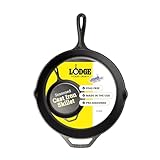
Lodge Cast Iron Skillet, 12 Inch
Seasoned Cast Iron, Made in USA
For the price of a decent restaurant meal you can buy a pan that outperforms almost everything else in this comparison at the one job home cooks most often get wrong: searing. Cast iron's thermal mass means the surface temperature barely drops when food hits it, and on induction — where cast iron couples exceptionally well with the element — it reaches that temperature quickly rather than slowly. The economics are absurd in the buyer's favour. A Lodge skillet costs a fraction of a clad stainless pan, and where the stainless pan has a lifetime warranty, the cast iron has something better: it is effectively unbreakable. A pan left rusting in a shed can be stripped back to bare metal and re-seasoned, which is not true of any coated or clad cookware. With regular use the seasoning builds into a genuinely slick surface that releases eggs, and it gets better with age rather than worse. The trade-offs are real but manageable. It is heavy, and the cast handle reaches the same temperature as the pan — a silicone handle cover is not optional. Seasoning needs occasional maintenance, and long-simmered acidic sauces will strip it, so a tomato ragù belongs in the Dutch oven. Learn those two habits and this is the single best value purchase in any kitchen.
Pros
- Exceptional induction performance for a very small amount of money
- Holds heat better than any clad stainless pan, which is what produces a real sear
- Effectively indestructible — a neglected, rusted pan can be stripped and re-seasoned
- Becomes progressively more nonstick as the seasoning builds over years of use
- Safe to any oven temperature and usable over a fire if it comes to that
Cons
- Heavy, and the cast handle gets dangerously hot — a handle cover is essential
- Seasoning needs maintaining, and acidic foods should not sit in it for long periods
The Bottom Line
The best value in cookware, full stop. On induction it heats fast and sears better than pans costing thirty times as much.
4. What to Buy First, and in What Order
Cookware sets are the worst value in the kitchen, because they pad the piece count with sizes nobody uses to make the price look reasonable. Buying four good pieces individually beats a twelve-piece set at the same money almost every time.
| Order | Piece | Why |
|---|---|---|
| First | 12-inch clad stainless skillet | The pan you will reach for daily |
| Second | 5-6 qt enamelled Dutch oven | Braises, soups, stock, bread |
| Third | 3 qt saucepan with lid | Everything from rice to sauces |
| Fourth | One nonstick or cast iron skillet | Eggs, fish, and searing respectively |
Match pan diameter to your hob elements while you are at it. An induction element heats the area directly above the coil, so a 12-inch pan on an 8-inch element has a cool outer ring that no cladding entirely fixes. Check your hob's element sizes before buying a large skillet, and if you cook in big pans, look for a hob with a bridge or flex zone.
5. The Details That Separate Good Pans From Expensive Ones
Base flatness. The most important and least advertised property. A base that is flat, and stays flat through heat cycling, maintains full contact with the glass and therefore full coupling with the element. Cheap disc-bottom pans are the usual offenders, developing a slight convexity that makes them spin on the hob.
Fully clad versus disc bottom. Cladding that runs up the walls gives even heat to the sides of the pan, which matters for sauces, risotto, and anything stirred. Disc bottoms cook well on the base and leave the walls comparatively cold.
Weight and thermal mass. Heavier pans hold temperature when cold food goes in, which is what produces a sear instead of steaming. Lighter pans respond faster to power changes, which suits delicate sauces. There is no universally correct answer — it is a genuine trade-off, and most kitchens want one of each.
Handle design and attachment. Riveted handles are strong and leave rivets inside the pan to clean around; welded handles leave a smooth interior and are typically found on more expensive cookware. Stay-cool handles work by being thin where they meet the pan, and are worth having on anything you lift often.
Lid fit. An underrated detail. A well-fitting lid holds moisture for braising and simmering, and a loose one lets a stew reduce when you wanted it to stay wet. Glass lids are convenient; metal lids tolerate higher oven temperatures.
6. Where the Money Is Worth Spending
Cookware prices span more than an order of magnitude for pieces that look similar in a photograph. Here is our honest view of where the premium buys real performance and where it buys brand.
| Piece | Spend | Verdict |
|---|---|---|
| Dutch oven | $200-$400 | Worth it — a lifetime piece |
| Clad skillet | $60-$180 | Mid-range clad is nearly as good |
| Cast iron skillet | $25-$40 | No reason to spend more |
| Nonstick skillet | $40-$150 | A consumable — do not buy a set |
| Stockpot | $50-$120 | Disc bottom is fine for boiling |
The stockpot line is worth noting, because it is the one place where cheap cookware is genuinely adequate. If a pot's job is to boil water for pasta or hold stock at a simmer, even heat distribution does not matter much, and an inexpensive disc-bottom pot does the job as well as a clad one costing four times more.
7. Cooking Technique That Induction Requires
Induction is powerful and immediate, and cooks coming from gas routinely burn their first few dinners by treating settings as equivalent. A medium setting on induction delivers considerably more heat into the pan than medium on a gas burner, and empty pans preheat alarmingly fast — a dry stainless skillet can reach smoking temperature in under a minute on high.
Preheat properly, then adjust. For stainless, the water drop test is genuinely useful: flick a few drops into the pan, and when they form a single bead that skitters rather than spitting apart, the pan is at the right temperature for food to release cleanly. Most sticking on stainless is a preheating error rather than a cookware failure.
Expect some noise. Induction produces a hum or buzz from the pan, particularly at high power and particularly with multi-ply construction, as the layers respond to the magnetic field. Heavier, better-made pans are generally quieter; a thin, lightweight pan can rattle audibly. It is normal and not a fault, though it surprises people on their first induction hob.
Finally, lift rather than slide. Induction hobs are glass, and dragging cast iron or a gritty pan base across the surface scratches it permanently. Most surface damage on induction cooktops comes from sliding pans, not from heat or spills.
8. Care That Keeps Cookware Working
For stainless, the main enemy is the discolouration people mistake for damage. A rainbow sheen is a harmless oxide layer, and white chalky spots are mineral deposits from hard water — both come off with a little vinegar or a stainless cleaner. Burnt-on food responds to simmering water with a spoonful of baking soda far better than to abrasion, and heavy scouring is what dulls a finish permanently.
For cast iron, keep it dry and keep it used. Wash with hot water and a brush, dry it on the hob for a minute, and wipe a trace of oil over the surface while it is warm. That is the entire ritual, and it takes thirty seconds. Avoid soaking, avoid the dishwasher, and do not leave acidic sauces in it for hours.
For enamelled cast iron, use wooden or silicone tools and avoid thermal shock — do not run cold water into a hot pot, which can craze the enamel. Nonstick needs the gentlest handling: medium heat at most, no aerosol cooking sprays, which build an invisible polymerised residue that ruins release, and hand washing regardless of what the dishwasher claim says.
Across all of it, the biggest single favour you can do expensive cookware is to stop stacking it bare. A cheap felt pan protector between pieces prevents the scratching that makes a five-year-old pan look twenty, and on enamel it prevents chips that cannot be repaired.
9. Frequently Asked Questions
What is the best induction cookware in 2026?
All-Clad D3 tri-ply is our overall pick for everyday cooking — fully clad, reliably flat, responsive on induction, and warranted for life. Tramontina Tri-Ply Clad delivers nearly the same performance for about a third of the price. For a serious cook, Demeyere Atlantis is engineered specifically for induction and heats faster than anything else here.
How do I know if a pan works on induction?
Hold a fridge magnet against the base. If it grips firmly, the pan will work; weak attraction means poor coupling and slow heating; no attraction means the hob will not detect it at all. Clad stainless, cast iron, enamelled cast iron and carbon steel all work. Bare aluminium, copper and most glass or ceramic do not unless they have a bonded magnetic base plate.
Is expensive induction cookware worth it?
It depends on the piece. An enamelled cast iron Dutch oven at $200 to $400 is a lifetime purchase and easy to justify. A mid-range fully clad skillet performs within a few percent of a premium one, so the extra money buys finish and warranty rather than cooking. Cast iron at $25 outperforms far more expensive pans at searing, and nonstick is a consumable that should never be bought as a set.
Why does my pan buzz or hum on induction?
The magnetic field causes slight vibration between the layers of a multi-ply pan, which you hear as a hum or buzz, usually loudest at high power. It is entirely normal and not a fault. Heavier, better-constructed pans tend to be quieter; thin lightweight pans can rattle noticeably. Making sure the pan sits flat and centred on the element usually reduces it.
Does cookware need to match my induction element size?
Ideally, yes. The element heats the area of the pan directly above the coil, so a 12-inch pan on an 8-inch element has a cooler outer ring that cladding only partly evens out. Check your hob's element diameters before buying large skillets, and look for a bridge or flex zone if you regularly cook in oversized pans.
Should I buy a cookware set or individual pieces?
Individual pieces, almost always. Sets inflate the piece count with sizes that stay in the cupboard, and four good pieces — a 12-inch skillet, a Dutch oven, a 3-quart saucepan, and one nonstick or cast iron pan — cover nearly all home cooking. The exception is a genuinely well-chosen value set such as Tramontina's, where the individual prices do not reward cherry-picking.
Does cast iron scratch an induction cooktop?
It can, if you slide it. The hob surface is glass, and dragging a rough cast iron base across it leaves permanent marks — the majority of induction surface damage comes from sliding rather than from heat. Lift pans on and off, keep the hob and the pan base clean of grit, and cast iron is otherwise one of the best performers on induction.
10. Common Induction Cookware Mistakes
Most disappointment with induction traces back to the cookware rather than the hob, and usually to one of these five decisions.
Buying a Twelve-Piece Set
Sets pad the count with sizes nobody uses so the per-piece price looks good. Four well-chosen pieces bought individually cover almost all home cooking and will each be better than their equivalent in a budget set at the same total spend.
Ignoring Base Flatness
Flatness determines contact area, and contact area determines how well the pan couples with the element. A cheap disc-bottom pan that develops a slight curve after a year heats slowly and unevenly, and no cooking technique fixes it. Fully clad construction holds flatness far better.
Treating Induction Settings Like Gas
Medium on induction delivers considerably more heat than medium on a gas burner, and an empty pan can reach smoking temperature in under a minute. Start lower than you think for the first few weeks, and use the water drop test on stainless rather than guessing at preheat.
Sliding Pans Across the Hob
Induction cooktops are glass and most of the scratches they accumulate come from dragging pans, especially cast iron with a rough base. Lift pans on and off, and keep both the surface and the pan base free of grit.
Buying a Nonstick Set
Nonstick is a coating with a finite life, however it is marketed. One good nonstick skillet for eggs and fish is all any kitchen needs, replaced when it stops releasing — and buying three of them at once simply means all three wear out together.
Everything Else About Induction Cooking
Buyer's Guide
What Pans Work on Induction?
The magnet test, material by material, and why some compatible pans still buzz.
Explainer
Cast Iron on Induction
Yes, and well — plus how to keep it from scratching the glass.
Comparison
Induction vs Gas Cooktop
Speed, control, indoor air, install cost and running cost, compared honestly.
Related Kitchen and Home Guides
The Bottom Line
The best induction cookware for most kitchens is a small number of good pieces rather than a set. All-Clad D3 is the benchmark for a daily skillet and saucepan, and Tramontina Tri-Ply Clad gets you most of the way there for a fraction of the price. Add a Le Creuset Dutch oven as the one genuinely lifetime purchase, and a $25 Lodge cast iron skillet, which sears better on induction than pans costing thirty times as much.
Two habits matter more than any upgrade: preheat properly and test with a water drop before food goes in, and lift pans rather than sliding them across the glass. The first stops food sticking; the second keeps the hob looking new.
More in Home Appliances
Guides in this category that pair with what you just read.
About the Author
Alex Rivers, Home Improvement Editor
Alex has spent over a decade working on residential and light commercial property maintenance, and now tests every tool, coating and machine that appears in these guides personally.