Best Crawl Space Dehumidifiers
Seven purpose-built units compared on what matters under a house: output in cool air, minimum operating temperature, drainage and whether it will even fit through the hatch.
Alex Rivers
Home Improvement Editor
Last Updated
September 29, 2026
In This Guide
A crawl space dehumidifier is only as good as the crawl space it sits in. Seal the vents and cover the soil first, then buy a low-profile unit rated for cold air, sized at roughly 70 pints per 1,000 square feet, with a drain route you have planned before it arrives.
Our Picks at a Glance
- Best Overall: AlorAir Sentinel HD55 Crawl Space Dehumidifier — 55 PPD at AHAM, 120 PPD Saturation, Up to 1,300 Sq Ft
- Best Pro-Grade: Aprilaire E070 70 Pint Crawl Space Dehumidifier — 70 PPD at 80°F/60%, 12.5-Inch Tall, Up to 2,200 Sq Ft
- Most Compact: Santa Fe Compact70 Dehumidifier — 70 PPD at 80°F/60%, 12 x 12 x 21 Inches, ENERGY STAR Most Efficient
- Best for Large Crawl Spaces: AlorAir Sentinel HD90 Crawl Space Dehumidifier — 90 PPD at AHAM, 198 PPD Saturation, Up to 2,600 Sq Ft
- Best for Small Crawl Spaces: AlorAir Sentinel HD35P Dehumidifier with Pump — 35 PPD at AHAM, 70 PPD Saturation, Built-In Pump, Up to 1,000 Sq Ft
- Best for Ducted Installs: Santa Fe Advance90 Dehumidifier — 90 PPD at 80°F/60%, 309 CFM, MERV-13 Filter
- Best for Wet Crawl Spaces: AlorAir Storm LGR Extreme Dehumidifier with Pump — 85 PPD at AHAM, 180 PPD Saturation, Built-In Pump
1. How We Picked
A crawl space dehumidifier has a harder job than almost any other dehumidifier in the house. It runs in a dark, cramped, often cold space that nobody visits, it may run thousands of hours a year, and when it fails, nobody notices until the floor above smells musty or the joists start growing mold. So we did not start from the list of best-selling dehumidifiers. We started from the list of units that were designed for crawl spaces in the first place.
That filter removed almost every plastic portable dehumidifier on the market. What remained were compact, low-profile units from AlorAir, Aprilaire and Santa Fe, plus one LGR restoration unit that crawl space owners increasingly buy for recovery work. We then compared them on four things that decide whether a crawl space stays dry: rated capacity at realistic temperatures, minimum operating temperature, drainage options and physical size.
Capacity at realistic temperatures was the most important of the four. Every crawl space unit is sold on its AHAM pint rating at 80°F and 60% relative humidity, and almost no crawl space is 80°F. We gave credit to manufacturers that publish a second figure at cooler conditions, such as the Aprilaire E070 rating at 73°F and the AlorAir HD90 rating at 60°F, because those numbers let you size honestly.
Size is the spec people forget until the unit arrives. Many crawl spaces have 18 to 24 inches of clearance under the beams and an access hatch not much bigger than the machine, so a 12-inch-tall unit and an 18-inch-tall unit are not interchangeable. We list the height of every pick where the manufacturer publishes it, and you should measure the hatch, the lowest beam and the path to the install spot before you order.
We also looked at warranty length, filter quality, whether the unit can be ducted and what owners report after a year or two of continuous running. If you are drying a basement rather than a crawl space, our guide to the best dehumidifiers for basements covers the portable and whole-house units that make more sense there.
2. Encapsulate First, Then Dehumidify
The single most expensive mistake in this category is buying a crawl space dehumidifier for a vented crawl space. A dehumidifier dries the air inside a volume. If that volume is open to the outside through foundation vents and sitting on bare soil, it is not drying a crawl space. It is trying to dry the neighborhood, and it will run nonstop, rack up a large electric bill and still lose on a humid July day.
Bare soil is the other half of the problem. The ground under a house releases water vapor continuously, and a crawl space with an exposed dirt floor can take on many gallons of moisture a day from evaporation alone. Before any machine goes in, the floor should be covered with a continuous vapor barrier, seams overlapped and taped, run up the foundation walls and sealed at the top. Our comparison of vapor barriers versus waterproofing membranes explains which material does what and why a thin 6-mil sheet laid loose on the dirt is not encapsulation.
Full encapsulation usually means four things: a reinforced liner of 10 to 20 mil on the floor and up the walls, sealed foundation vents, a sealed or insulated rim joist and a sealed access door. Once those are done, the crawl space becomes a small conditioned volume, and a dehumidifier sized for it can hold the humidity at 50% to 55% with modest run time. That is the environment every unit in this guide is designed for.
Recent editions of the International Residential Code reflect the same logic. The code allows an unvented crawl space when the ground is covered with a sealed vapor retarder and the space is either supplied with conditioned air or dehumidified, and the dehumidification option is sized around 70 pints per day per 1,000 square feet of floor area. Your local code may differ, so check before you seal vents, but the principle is universal: seal first, then dry.
If water is actually entering the crawl space as liquid, from a high water table, poor grading or a plumbing leak, deal with that before encapsulation too. A dehumidifier removes vapor. It is not a sump pump, and no amount of pint capacity will keep up with standing water.
THE RULE
A dehumidifier cannot out-run an open crawl space.
Seal the vents, cover the soil with a taped liner that runs up the walls, and close the rim joist before you buy. A 55-pint unit in a sealed crawl space will outperform a 90-pint unit in a vented one, and it will cost far less to run.
3. Our 7 Top Picks
Every unit below was designed for crawl spaces or for restoration work, and every one drains continuously without a bucket. They are ranked for the most common situation: a fully sealed crawl space of 800 to 2,000 square feet under a single-family house. If yours is much smaller, much larger or still wet, skip to the pick labeled for that case. Pay attention to the height figures, the minimum operating temperature and whether a pump is built in, because those three specs rule out more units than capacity does.

AlorAir Sentinel HD55 Crawl Space Dehumidifier
55 PPD at AHAM, 120 PPD Saturation, Up to 1,300 Sq Ft
Most sealed crawl spaces under an average house need a low-profile, low-temperature unit rated somewhere around 50 to 70 pints at AHAM conditions, and that is exactly where the HD55 sits. AlorAir rates it at 55 pints per day at 80°F and 60% relative humidity and 120 pints at saturation, and it covers up to roughly 1,300 square feet of properly encapsulated space. What matters more than either number is the operating range: the HD55 is rated from 33.8°F to 104°F with automatic defrost, which is the difference between a machine that runs through a January cold snap and one that ices its coil and sits idle. It draws about 4.1 amps and delivers roughly 2.4 liters per kWh, and the housing is metal rather than the thin plastic of a bedroom dehumidifier. It ships with a drain line, a washable MERV-8 filter and a 6-inch duct collar, so you can pull air from the far end of a long crawl space instead of just drying the corner it sits in. If you have no downhill path for a gravity drain, buy the HD55P, the version with a built-in condensate pump, rather than bolting on a separate pump later. We would size up to the HD90 for anything over 1,500 square feet or for a crawl space that is not fully sealed yet.
Pros
- Rated to run down to 33.8°F with automatic defrost, so it keeps working through a cold crawl space winter
- Draws about 4.1 amps, low enough to share a circuit with a sump pump or crawl space lighting
- Metal housing and a 6-inch duct collar, which a plastic portable never offers
- Washable MERV-8 filter and a gravity drain line included; a pump version (HD55P) is sold for sites without a drain
- Current versions add Wi-Fi app control, useful for a space you rarely crawl into
Cons
- Sized for up to about 1,300 sq ft of sealed crawl space, so large or leaky crawl spaces need the HD90
- App and firmware experience is functional rather than polished
The Bottom Line
The right size, the right temperature range and a sensible price for the typical encapsulated crawl space under a 1,000 to 1,800 sq ft house.

Aprilaire E070 70 Pint Crawl Space Dehumidifier
70 PPD at 80°F/60%, 12.5-Inch Tall, Up to 2,200 Sq Ft
Aprilaire builds whole-house humidifiers and dehumidifiers that HVAC contractors install every day, and the E070 is its purpose-built crawl space model. The first thing you notice is the shape: 12.5 inches wide, 12.5 inches tall and 25 inches deep, which lets it sit between floor joists or slide through a small access hatch without drama. The second is the spec sheet, which lists two capacity figures instead of one. At the AHAM condition of 80°F and 60% relative humidity it removes 70 pints per day; at 73°F and 60% it removes 53. That second number is closer to what a crawl space actually looks like in summer, and it is refreshing to see a manufacturer publish it rather than leave you to discover the gap. Aprilaire rates it for spaces up to about 2,200 square feet and says it operates down to 40°F with automatic defrost. It includes a washable MERV-8 filter and 10 feet of drain tubing, and the coils are corrosion-resistant aluminum, which matters in an environment that stays damp for years. The one gap is drainage: there is no built-in pump, so if the crawl space has no floor drain, sump pit or downhill exit, budget for a separate condensate pump. For a sealed crawl space with a drain route, it is the most refined unit here.
Pros
- Only 12.5 inches tall and 12.5 inches wide, so it slides between joists and fits low crawl spaces
- Honest dual rating: 70 pints at 80°F/60% and 53 pints at the cooler 73°F/60% condition
- Rated to operate down to about 40°F with automatic defrost
- Washable MERV-8 filter, corrosion-resistant aluminum coils and a 10-foot drain tube included
- Made by the company whose whole-house humidity equipment many HVAC contractors already install
Cons
- No built-in pump; you need a gravity route or a separate condensate pump
- Its 40°F floor is fine for most sealed crawl spaces but not as low as AlorAir's 33.8°F
The Bottom Line
The contractor's choice for tight, low crawl spaces, with a spec sheet that tells you what it does at realistic temperatures instead of only the flattering one.
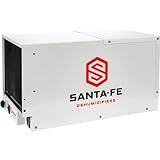
Santa Fe Compact70 Dehumidifier
70 PPD at 80°F/60%, 12 x 12 x 21 Inches, ENERGY STAR Most Efficient
Santa Fe is the Therma-Stor brand that basement and crawl space contractors have used for years, and the Compact70 is the smallest unit in its range. It removes 70 pints per day at 80°F and 60% relative humidity from a body just 12 inches wide, 12 inches tall and 21 inches deep, which makes it the easiest unit in this guide to carry through a small access hatch. Efficiency is the other selling point. Santa Fe advertises an ENERGY STAR Most Efficient designation for it, and on a crawl space unit that may run several thousand hours a year, efficiency shows up on the electric bill. It moves 150 CFM, draws around 580 watts and 5.1 amps, and Santa Fe sizes it for roughly 1,800 to 2,600 square feet of sealed crawl space. The six-year warranty is the longest we found. The honest drawback is temperature. Santa Fe lists a 49°F minimum, which is fine for a sealed crawl space in the South or a mild coastal climate but not ideal where the crawl space dips into the low 40s every winter. Humidity load is usually lowest in the cold months, so this is less of a problem than it sounds, but in the far North we would pick the AlorAir or the Aprilaire instead. There is no built-in pump.
Pros
- 70 pints at 80°F/60% from the smallest body in this guide
- Tiny 12 x 12 x 21 inch body is the easiest unit here to get through a small access door
- 150 CFM blower and 580-watt draw on a standard 120-volt circuit
- Six-year manufacturer warranty, the longest of any unit in this guide
- Santa Fe advertises an ENERGY STAR Most Efficient designation for this model
Cons
- Minimum operating temperature is listed at 49°F, so it is less suited to cold-climate crawl spaces
- No built-in pump and a premium price for a compact unit
The Bottom Line
The easiest unit to get into a tight crawl space and a strong long-term pick in mild or warm climates, where its temperature floor never comes into play.

AlorAir Sentinel HD90 Crawl Space Dehumidifier
90 PPD at AHAM, 198 PPD Saturation, Up to 2,600 Sq Ft
The HD90 is the big brother of the HD55, and it earns its place in homes where the crawl space is large, the climate is humid or the encapsulation is not yet perfect. AlorAir rates it at 90 pints per day at 80°F and 60% and 198 at saturation, and it covers up to about 2,600 square feet. The most useful number on its spec sheet, though, is the one most brands leave off: about 48 pints per day at 60°F and 60%. That is what a big crawl space dehumidifier really delivers on a mild spring day in a cool crawl space, and it is a good reminder of why you should not size a crawl space unit on the AHAM figure alone. It is ENERGY STAR certified with a listed efficiency of about 2.69 liters per kWh, it is rated to run down to 33.8°F with defrost, and it comes with a five-year warranty. The downside is height. At roughly 23 by 15 by 18 inches it needs about 18 inches of clearance, which many crawl spaces simply do not have, so measure the hatch and the lowest beam before ordering. In a typical 1,000 square foot sealed crawl space it is more machine than you need and will cycle on and off; buy it when the space is genuinely large or genuinely wet.
Pros
- 90 pints at AHAM conditions and 198 at saturation handles big footprints and recovery after a wet spell
- ENERGY STAR certified with a listed efficiency of about 2.69 liters per kWh
- Rated to operate down to 33.8°F, like the smaller Sentinel units
- AlorAir publishes a 60°F capacity figure of roughly 48 pints, a useful reality check
- Five-year manufacturer warranty
Cons
- About 17.7 inches tall, which rules it out for very low crawl spaces
- Oversized for an average sealed crawl space, where it will short-cycle
The Bottom Line
The pick for crawl spaces over about 1,500 sq ft, for homes with partial encapsulation, or for a humid climate where a 55-pint unit runs all day and still loses ground.

AlorAir Sentinel HD35P Dehumidifier with Pump
35 PPD at AHAM, 70 PPD Saturation, Built-In Pump, Up to 1,000 Sq Ft
Not every crawl space needs a 70-pint machine. A fully sealed crawl space under a small house, an addition or a cottage often only needs something that can hold 50% to 55% relative humidity against a light moisture load, and the HD35P is built for that job. AlorAir rates it at 35 pints per day at AHAM conditions and 70 at saturation, for spaces up to roughly 1,000 square feet. It is ENERGY STAR certified, it is rated to operate down to 33.8°F, and its listed maximum noise level is 55 dB, noticeably quieter than the bigger units if the crawl space sits under a bedroom. The feature that makes it the easiest install here is drainage. It includes a built-in condensate pump with its own hose for pushing water up and out through a rim joist or into a sump pit, plus a longer hose for gravity drainage if you have a downhill route. That flexibility matters because drainage is where most crawl space installs go wrong. The limits are the obvious ones. Thirty-five pints is not much headroom, so if your vapor barrier is incomplete, the vents are still open or the crawl space floods in spring, it will run constantly and still lose. In that case, fix the envelope first or step up to the HD55P.
Pros
- Built-in condensate pump plus a gravity option, so it works whether or not you have a downhill drain
- ENERGY STAR certified and rated to operate down to 33.8°F
- Sized for up to about 1,000 sq ft, which suits small homes, additions and cottages
- Quieter than the larger units at a listed 55 dB maximum
- Lowest purchase price of the purpose-built crawl space units here
Cons
- 35 pints at AHAM is modest, so it will struggle in a leaky or partially sealed crawl space
- Pump hose is shorter than the gravity hose, so long runs need extra tubing
The Bottom Line
For a small, fully sealed crawl space it is all the machine you need, and the built-in pump makes it the easiest install in this guide.
Santa Fe Advance90 Dehumidifier
90 PPD at 80°F/60%, 309 CFM, MERV-13 Filter
The Advance90 is Santa Fe's larger contractor unit, and it is the one to look at when you intend to duct the air rather than let the unit sit in one spot. It removes 90 pints per day at 80°F and 60%, and its 309 CFM blower moves far more air than the compact units here, which is what makes ducting worthwhile: you can pull return air from the damp far end of a long crawl space and push dry air back across the whole floor. Santa Fe lists it at about 6.4 pints per kWh, which is excellent for a machine this size, and it uses a MERV-13 filter, a noticeable step up from the MERV-8 filters on most crawl space units. It sizes the unit at around 2,200 square feet of crawl space based on a five-foot height. Auto defrost and auto restart are included. The drawbacks are physical and financial. It weighs about 80 pounds and measures roughly 14.5 by 19.4 by 26 inches, so it needs a crawl space with real headroom and an access opening you can get it through. It is also priced as a professional unit. For a standard 1,000 to 1,500 square foot sealed crawl space, the Compact70 or HD55 does the job for less; the Advance90 earns its keep in large homes, ducted systems and spaces with a basement and crawl space served together.
Pros
- 90 pints per day at 80°F/60% with a 309 CFM blower that moves serious air across a big space
- Horizontal design with dual airflow outlet options suits ducted installs
- MERV-13 filter is a step above the MERV-8 filters on most crawl space units
- Efficient for its size at about 6.4 pints per kWh
- Auto defrost and auto restart after a power cut
Cons
- 80 lb and about 19.4 inches tall, so it needs a generous crawl space and two people to install
- Overkill and overpriced for an average sealed crawl space
The Bottom Line
A contractor-grade unit for large crawl spaces or basement-plus-crawl-space setups where you plan to duct the supply air, not a first choice for a standard install.
AlorAir Storm LGR Extreme Dehumidifier with Pump
85 PPD at AHAM, 180 PPD Saturation, Built-In Pump
Low grain refrigerant, or LGR, dehumidifiers were built for water damage restoration, where the job is to dry a soaked structure fast and keep pulling moisture even as the air gets drier. The Storm LGR Extreme brings that design into a unit you can buy and run yourself. AlorAir rates it at 85 pints per day at AHAM conditions and 180 at saturation, and it covers up to roughly 2,300 square feet. It moves about 210 CFM, draws 5.62 amps and runs at around 2.44 liters per kWh. The heavy-duty condensate pump is built in, and it is rated to operate from 33.8°F to 104°F with automatic defrost. Where it belongs is the crawl space that is actively wet: after a plumbing leak, after a spring when the crawl space took on water, or while you are still waiting on a drainage contractor. In those conditions a 55-pint unit falls behind for days, and the Storm pulls the space down quickly. It is less ideal as a permanent crawl space dehumidifier. At about 22.8 by 13.7 by 17.3 inches and 70.5 pounds it needs headroom and a strong back, and at up to about 58 dB it is the loudest unit here. Many owners use it for the recovery phase and then run a Sentinel for maintenance.
Pros
- 180 pints at saturation makes it the fastest way to pull down a crawl space after a leak or flood
- Heavy-duty built-in condensate pump designed for continuous commercial use
- Rated from 33.8°F to 104°F with automatic defrost
- Top handles and a rugged housing built to be moved between job sites
- 210 CFM airflow at a 5.6-amp draw on a standard outlet
Cons
- About 17.3 inches tall and 70 lb, too bulky for many low crawl spaces
- Louder than the Sentinel units at up to about 58 dB
The Bottom Line
Buy it for recovery after water intrusion or for a crawl space that is still wet while you fix the drainage, then consider something smaller for the long haul.
4. Low-Temperature Performance and LGR Design
Crawl spaces are cool. Even in summer, a sealed crawl space in most of the country sits somewhere in the 60s, and in winter it can drop into the 40s or lower. That matters because a refrigerant dehumidifier works by chilling air below its dew point so water condenses on the coil. The cooler and drier the incoming air, the lower the coil has to run, and below the mid-60s an ordinary portable dehumidifier starts to ice its coil and spend more time defrosting than drying.
Purpose-built crawl space units handle this in two ways. First, they are engineered to keep working at low air temperatures, and their spec sheets say so: AlorAir rates its Sentinel units down to 33.8°F, Aprilaire rates the E070 down to about 40°F, and Santa Fe rates the Compact70 down to 49°F. Second, they defrost intelligently, cycling the compressor off while the fan clears the coil and then resuming, rather than simply shutting down.
Low grain refrigerant, or LGR, is a related idea borrowed from the restoration industry. A grain is a unit of moisture, and LGR units are designed to keep extracting water as the air gets drier, where a conventional dehumidifier loses efficiency quickly. That is why restoration companies use them to dry flooded buildings, and why a unit like the AlorAir Storm LGR Extreme makes sense after water intrusion. For a sealed crawl space in steady state, a well-designed compact unit like the HD55 or Compact70 is usually enough.
The practical takeaway is to read the minimum operating temperature before you buy, and to match it to your climate. In the Deep South, a 49°F floor may never matter. In Ohio or Pennsylvania, a crawl space can sit in the low 40s for weeks, and a unit rated to 33.8°F or 40°F will keep holding the humidity while a 49°F unit sits idle. Moisture load is lower in winter, but it is not zero, especially in the shoulder seasons.
MINIMUM OPERATING TEMPERATURE
33.8°F
AlorAir Sentinel HD35, HD55, HD90
40°F
Aprilaire E070
49°F
Santa Fe Compact70
~41°F
Typical portable (with collapsing capacity)
5. Pint Ratings: AHAM at 80°F vs the 2019 Standard
Dehumidifier pint ratings are genuinely confusing, and crawl space shoppers get caught by it more than anyone. There are three different ratings in circulation, and they describe the same machine under different conditions, so a 70-pint crawl space unit and a 50-pint basement portable may be closer in real output than the numbers suggest.
The AHAM rating is the older industry standard: pints removed per day at 80°F and 60% relative humidity. Almost every crawl space unit is still marketed on this figure, including the 55-pint HD55, the 70-pint E070 and the 90-pint HD90. It is a useful comparison number within the category, but 80°F and 60% is warmer and more humid than a sealed crawl space almost ever gets.
In 2019, the Department of Energy changed the test for portable dehumidifiers to 65°F and 60%, which is closer to real basement conditions. Cooler air holds much less water, so the same machine removes fewer pints under the new test. A portable once sold as 70 pints is now sold as 50 pints, and nothing about the machine changed. Whole-home units are tested under a separate DOE condition of 73°F and 60%, which is why the Aprilaire E070 lists both 70 pints at 80°F and 53 pints at 73°F.
Saturation ratings are the third number, usually measured at 90°F and 90% relative humidity. They produce dramatic figures such as 120 pints for the HD55 or 198 pints for the HD90, and they describe conditions you will see only in a flooded space. Treat them as a measure of how quickly a unit can recover a very wet space, not as its everyday output.
For sizing, use the AHAM number to compare crawl space units with each other, and use the lower published figures as your sanity check. Our guide on what size dehumidifier you need for a basement walks through the same conversion if you are comparing a crawl space unit with a portable.
| Rating | Test condition | Example | What it tells you |
|---|---|---|---|
| AHAM (older) | 80°F / 60% RH | HD55: 55 pints | Comparison within crawl space units |
| DOE portable (2019) | 65°F / 60% RH | Old 70-pint portable = 50 pints | Realistic basement output |
| DOE whole-home | 73°F / 60% RH | E070: 53 pints | Closer to a summer crawl space |
| Saturation | 90°F / 90% RH | HD90: 198 pints | Flood recovery ceiling only |
6. Sizing a Crawl Space Dehumidifier
Crawl space sizing is simpler than basement sizing because the space is small, sealed and has a fairly predictable moisture load once it is encapsulated. The code-referenced starting point is about 70 pints per day, at AHAM conditions, for every 1,000 square feet of crawl space floor. That is a conservative figure with headroom built in, and it lines up with how manufacturers size their units.
For most homes, that means a unit in the 55 to 70 pint class. A sealed 800 to 1,300 square foot crawl space in a moderate climate is well served by the AlorAir HD55. A 1,300 to 2,200 square foot crawl space, or a smaller one in a very humid climate, is where the Aprilaire E070 and Santa Fe Compact70 fit. Above about 2,000 square feet, or where encapsulation is incomplete, the HD90 or Advance90 make sense. Small, fully sealed spaces under about 1,000 square feet can get away with the 35-pint HD35P.
Adjust for a few conditions. A crawl space in a humid coastal or Gulf climate should be sized up one step. So should one with a high water table, a history of standing water or a liner that is not yet sealed to the walls. A crawl space that shares air with a basement, or that is served by the HVAC system, should be sized for the combined volume rather than just the crawl space floor.
Do not oversize by too much, though. A unit far larger than the load pulls the humidity down quickly, shuts off, and cycles on and off all day. That short-cycling is harder on the compressor and does a worse job of drying the wood framing, which responds to long, steady periods of low humidity rather than brief dips.
If you are weighing a crawl space unit against a larger system that serves the whole house, our comparison of whole-house versus portable dehumidifiers covers when a ducted whole-home unit is the better investment.
7. Condensate Drain vs Built-In Pump
A crawl space dehumidifier running in humid weather can produce several gallons of water a day, and none of the units in this guide has a bucket. The water has to go somewhere automatically, and deciding where is the part of the install that fails most often.
Gravity drainage is the simplest and most reliable option. If the crawl space has a floor drain, a sump pit or a grade that falls away from the house, run the drain tube downhill with a steady slope, no sags and no uphill sections, and terminate it where the water cannot run back toward the foundation. Most units ship with 10 to 20 feet of tube. A sump pit is a common and sensible destination, because the sump pump already handles the water.
When there is no downhill route, you need a pump. Some crawl space units have one built in, such as the AlorAir HD35P, HD55P and the Storm LGR Extreme, and those are the tidiest installs because the pump is sized and wired for the unit. Others, including the Aprilaire E070 and Santa Fe Compact70, need a separate condensate pump, typically a small reservoir pump that lifts water up and out through the rim joist.
Whichever route you take, protect the discharge. Run the line outside at least a few feet from the foundation or into a drain, keep the outdoor end from freezing in winter and check it every season for kinks and slime buildup. A blocked drain line leaves water in the unit, and a unit that stops draining will either shut off or spill onto the liner. Our guide to the best dehumidifiers with a built-in pump covers pump lift, hose runs and the ways built-in pumps fail.
8. Ducting, Placement and Airflow
A crawl space is usually long, narrow and obstructed by piers, ductwork and plumbing. A dehumidifier dries the air it pulls in, and in a cramped, cluttered space that air does not always mix well. Where you put the unit, and whether you duct it, decides whether the whole crawl space dries or just the corner nearest the hatch.
For an average rectangular crawl space, place the unit near the center, raised off the liner on blocks or a stand, with at least a foot of clear space around the intake and the exhaust. That keeps the filter from pulling in dust and lets the dry air spread in both directions. Avoid tucking it against a wall or behind a pier, where it will mostly re-dry its own exhaust.
Ducting solves the problem in larger or oddly shaped spaces. Many crawl space units, including the AlorAir Sentinel models with their 6-inch duct collar and the Santa Fe Advance90 with its dual outlet design, let you run flexible duct to pull return air from the dampest end of the space or push supply air to a distant corner. A single duct run of 10 to 20 feet is usually enough, and it is well within what these blowers can handle.
Ducting also matters when you want the crawl space dehumidifier to help the house above. Some homeowners run a supply duct from the unit into the return side of the HVAC system or into a basement. That can work, but it is a job to plan carefully, because you are now moving air between spaces, and codes around combustion appliances and return air still apply. When in doubt, have an HVAC contractor lay it out.
Keep the unit accessible. You will need to reach the filter every few months, and a unit wedged behind ductwork at the far end of a 40-foot crawl space will not get its filter cleaned.
9. Why Portable Dehumidifiers Fail in Crawl Spaces
It is tempting to push a 50-pint portable into a crawl space and call it done. The portables cost a fraction as much, they are sold everywhere and many advertise a low-temperature setting. In our experience, and in the experience of most crawl space contractors, they rarely last, and there are specific reasons why.
The first is temperature. Most portables are rated to operate down to the low 40s, but their capacity collapses well before that. At the 55°F to 65°F common in a crawl space, a portable spends much of its time defrosting, and its real output is a fraction of the number on the box. Crawl space units are engineered for those temperatures and still deliver useful capacity there.
The second is drainage and duty cycle. A portable is designed to run for a season in a room someone visits. In a crawl space it has to run year after year with nobody watching, drain continuously through a hose or pump and restart on its own after every power cut. Buckets are useless, gravity hose ports on portables are small and easy to kink, and the built-in pumps on portables are the part that fails first when they run constantly.
The third is construction and warranty. Crawl space units use metal housings, corrosion-resistant coils and serviceable filters, and they carry warranties of five or six years. Portables use thin plastic housings and typically carry a year or two of coverage. In a damp space, that difference in build quality shows up as corroded coils and dead fans. Portables also cannot be ducted, so they only dry the air around them.
None of this means portables are bad machines. In a finished or semi-finished basement, where temperatures sit in the 60s and 70s and someone checks on the unit, a good portable is the right tool. Our guide to the best basement dehumidifiers covers those. A crawl space is simply a different environment, and it rewards a different kind of machine.
10. Setpoints, Monitoring and Maintenance
Once the unit is in, set it and verify it. Most crawl space contractors aim for 50% to 55% relative humidity. That is comfortably below the roughly 60% level where mold and dust mites get a foothold, and it keeps wood framing well below the moisture content where rot and fungal growth start. Setting it much lower than 45% wastes energy for little benefit.
Do not rely on the dehumidifier's own display to tell you the space is dry. Its sensor reads the air entering the unit, which can differ noticeably from the far end of a long crawl space. Put an independent digital hygrometer at the opposite end, ideally a wireless one you can read from inside the house. Our guide to the best hygrometers covers accurate, inexpensive options that log readings over time.
Check the numbers for the first few weeks. If the far end reads within a few points of the setpoint, the unit and placement are right. If it reads much higher, either the unit is too small, the air is not mixing or there is a moisture source you have not dealt with, such as a gap in the liner, an open vent or a plumbing leak.
Maintenance is simple but easy to forget. Clean or replace the filter every two to three months, more often in a dusty crawl space. Check the drain line and discharge point at least twice a year and after any hard freeze. Every year or two, inspect the coil for dust buildup and clean it gently. A clogged filter cuts airflow, raises coil temperatures and quietly reduces capacity, which is why many owners notice the crawl space creeping up in humidity in the unit's third or fourth year.
Finally, keep an eye on the house above. A musty smell returning, cupping hardwood floors or condensation on ductwork in the crawl space are all signs the humidity has drifted up, and they usually show up before visible mold does.
11. Common Mistakes to Avoid
Buying a dehumidifier for a vented crawl space
If the foundation vents are open and the soil is bare, the unit is trying to dry outdoor air and ground moisture that never stop coming. It will run constantly, cost a lot to operate and still lose in humid weather. Seal the vents, install a taped liner and close the rim joist before you buy any machine.
Sizing on the saturation rating
A saturation figure measured at 90°F and 90% humidity describes a flooded room, not a sealed crawl space. Compare units on their AHAM rating at 80°F and 60%, then use any cooler-condition figure the maker publishes as a reality check. Sizing on saturation numbers leaves most crawl spaces with too small a machine.
Not measuring the access hatch
Crawl space units range from about 12 inches tall to nearly 20. Many access openings and beam clearances are smaller than people assume, and a unit that will not fit through the hatch is an expensive return. Measure the hatch, the lowest beam and the path to the install spot before ordering, and add an inch for handling.
Leaving the drain line to chance
A drain tube with a sag, an uphill section or a discharge that freezes in winter will back water into the unit and shut it down. Plan the route before install day, slope gravity lines steadily, use a pump when there is no downhill path, and inspect the discharge end every season and after hard freezes.
Trusting the unit's built-in humidity display
The onboard sensor reads the air entering the machine, which is often drier than the far corner of a long crawl space. Place an independent hygrometer at the opposite end and check it for the first few weeks. If it reads much higher than the setpoint, the unit is undersized, badly placed or fighting a leak.
12. Frequently Asked Questions
What size dehumidifier do I need for a crawl space?
A common starting point, reflected in recent editions of the residential building code, is about 70 pints per day at AHAM conditions for every 1,000 square feet of sealed crawl space. For a typical 800 to 1,300 square foot sealed crawl space, a 55 to 70 pint unit is right. Size up for humid climates, high water tables or incomplete encapsulation.
Can I use a regular portable dehumidifier in a crawl space?
You can, but it rarely lasts. Portables lose most of their capacity in the cool temperatures common in crawl spaces, spend long periods defrosting, and are not built for years of unattended continuous running. Their plastic housings and short warranties reflect that. A purpose-built crawl space unit costs more upfront but usually costs less over its life.
Do I need to encapsulate my crawl space before adding a dehumidifier?
Yes. A dehumidifier in a vented crawl space with bare soil is drying outdoor air and ground moisture that never stop arriving. At minimum, cover the floor with a sealed vapor barrier that runs up the walls and close the foundation vents. Without that, even a large unit will run constantly and struggle to hold humidity.
What humidity should a crawl space be kept at?
Most contractors target 50% to 55% relative humidity. That keeps conditions below the roughly 60% level where mold and dust mites thrive and keeps wood framing dry enough to prevent rot. Going below about 45% wastes energy. Verify the level at the far end of the space with a separate hygrometer rather than trusting the unit's display.
Where should the dehumidifier water drain in a crawl space?
The best destination is a floor drain or sump pit reached by a steadily sloping gravity line. Without a downhill route, use a unit with a built-in pump or add a condensate pump, and discharge outside well away from the foundation. Protect the outside end from freezing and inspect it every season so a blockage does not shut the unit down.
How much does it cost to run a crawl space dehumidifier?
A 55 to 70 pint crawl space unit draws roughly 500 to 600 watts while running. In a well-sealed crawl space it may run a third to half the time in summer and much less in winter, which typically works out to tens of dollars per month in peak season. Efficient models and good encapsulation both cut run time significantly.
What is an LGR dehumidifier and do I need one?
LGR stands for low grain refrigerant. These units are designed to keep removing moisture as air gets drier and cooler, and they come from the water damage restoration industry. You need one for drying a crawl space after a leak or flood. For a sealed crawl space in steady state, a compact crawl space unit is usually enough and costs less.
Related Crawl Space and Dehumidifier Guides
Buyer's Guide
Best Dehumidifiers With a Pump
Built-in pumps compared on lift height, hose runs and the ways they fail.
Explainer
Vapor Barrier vs Waterproofing Membrane
Which material stops vapor, which stops water and why encapsulation needs the right one.
Sizing Guide
What Size Dehumidifier Do You Need?
How to convert pint ratings and size a unit for your space and climate.
The Bottom Line
For most sealed crawl spaces under an average house, the AlorAir Sentinel HD55 is the right buy: it keeps working down to 33.8°F, it is sized correctly for the typical space, and a pump version is available if you have no drain. Choose the Aprilaire E070 for very low crawl spaces, the Santa Fe Compact70 for the tightest access hatches in mild climates, and the HD90 or Advance90 when the space is genuinely large.
Whichever you buy, the machine is the last step, not the first. Seal the vents, lay and tape the liner, plan the drain route and put a separate hygrometer at the far end. Do those four things and even a modest unit will hold the crawl space at 50% to 55% for years.
More in Basement Waterproofing
Guides in this category that pair with what you just read.
About the Author
Alex Rivers, Home Improvement Editor
Alex has spent over a decade working on residential and light commercial property maintenance, and now tests every tool, coating and machine that appears in these guides personally.