The Best Foundation Sealers in 2026
The right foundation sealer depends less on the brand than on which side of the wall you can reach, what the wall is made of, and whether it moves. Get those three straight and the product almost picks itself.
Alex Rivers
Home Improvement Editor
Last Updated
September 18, 2026
In This Guide
A foundation sealer is one of the highest-value things you can do to an older house, and one of the easiest to waste money on. The difference between those two outcomes is almost never the product — it is whether the wall was the right candidate, and whether the water was coming through the masonry or around it.
Our Picks at a Glance
- Best Exterior Sealer: Liquid Rubber Foundation & Basement Sealant — Exterior Elastomeric Membrane
- Best Interior Coating: DRYLOK Extreme Masonry Waterproofer — Interior Cementitious Coating
- Best for Cracking Walls: Ames Blue Max Liquid Rubber — Elastomeric, Interior or Exterior
- Best for Poured Concrete: RadonSeal Deep Penetrating Sealer — Reactive Penetrating Sealer
1. Damp Proofing vs Waterproofing
These two terms get used interchangeably in marketing and mean genuinely different things in practice, and the gap between them explains a lot of surprised homeowners.
Damp proofing resists moisture vapour and light seepage. The thin spray-on asphalt coating applied to the outside of many new foundations before backfilling is damp proofing. It is a code minimum in many places, it is not rated for liquid water under pressure, and it degrades over the decades. Plenty of people discover a wet basement and assume the foundation was never treated; usually it was, with a product that was never intended to hold back water.
Waterproofing is rated to resist liquid water under hydrostatic pressure — the force water exerts when saturated soil presses against a wall. Elastomeric membranes and cementitious coatings with published psi ratings sit in this category. The distinction matters when you are reading a product label: "water resistant" and "damp proofing" are not the same claim as a pressure rating.
A third category, penetrating sealers, sidesteps the surface entirely by reacting inside the concrete. They do not carry pressure ratings in the same way, because there is no coating to be pushed off — the capillaries themselves are blocked.
The Four Numbers That Decide It
15 psi
Best interior pressure rating
2
Coats needed for that rating
6 ft
Where downspouts should discharge
6"/10 ft
Minimum grade fall from the wall
Signs Your Foundation Wants Sealing
Five symptoms point at moisture moving through the wall rather than around it, and all five are the case sealing genuinely solves.
A musty smell that never clears. The most reliable early sign, and the one people stop noticing because it arrives gradually. Moisture evaporating off masonry into a poorly ventilated space feeds the mould and mildew responsible for the odour.
White chalky bloom on the walls. Efflorescence is mineral salt deposited as water evaporates out of the masonry surface. It is proof that water is travelling through the wall, and it comes back after every wipe-down until the movement is stopped.
Walls that feel cool and slightly damp. Especially at the base, and especially after a wet spell. Cardboard boxes stored against the wall going soft is the same signal, noticed sooner.
Paint or coatings peeling from the inside face. Vapour pressure pushing outwards lifts anything applied to the surface, which is why ordinary paint on a below-grade wall rarely survives more than a couple of years.
Rust on anything metal stored against the wall. Shelf brackets, tool boxes and appliance feet corroding faster than they should is a quiet indicator of persistently high humidity coming off the masonry.
2. Which Side to Treat
Exterior is better engineering and interior is what most people can actually do, and being honest about that trade-off is more useful than pretending otherwise.
The case for exterior. Water is stopped before it enters the wall at all. The membrane is pressed against the foundation by the very soil pressure that would push an interior coating off. The masonry never gets saturated, so freeze-thaw damage inside the wall stops as well. Combined with a drainage board and a working footing drain, this is the genuine, long-term solution, and our exterior waterproofing guide walks through the full build-up.
The case for interior. It costs a fraction as much, it can be done over a weekend, and for the most common problem — moisture migrating through porous masonry, showing as damp walls, musty air and efflorescence — it genuinely works. What it cannot do is stop water arriving in volume, because an interior coating is the last thing in the water's path and the least able to resist.
The practical rule: if an excavator is on site for any reason, seal the outside while the wall is exposed. If not, treat the inside and be realistic that you are managing seepage rather than defeating a drainage failure. Our interior vs exterior comparison puts costs and disruption side by side.
3. The Best Foundation Sealers, Reviewed
These four cover the four real situations: an exterior dig, a damp interior wall, a wall that cracks, and dense poured concrete. They are not interchangeable, and the badge on each is a description of the case it suits rather than a ranking.
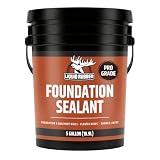
Liquid Rubber Foundation & Basement Sealant
Exterior Elastomeric Membrane
This is the textbook answer to a wet foundation and the one most people cannot use, because applying it means digging out around the house. Where an excavation is happening anyway — for drainage work, a repair, or new construction — a water-based elastomeric membrane on the exterior face is the correct engineering: it works with the water pressure rather than against it, cures seamlessly with no laps, and stays flexible through the freeze-thaw movement that cracks rigid coatings. Combined with a drainage board and a functioning footing drain, it is as close to a permanent solution as residential waterproofing gets.
Pros
- Applied to the side water actually arrives from
- Cures seamlessly — no laps for water to track behind
- Stays flexible through freeze-thaw movement
- Water-based and low odour for a rubber membrane
- Bonds to concrete, block and most existing coatings
Cons
- Only realistic if you are already excavating
- Needs a settled dry window to cure properly
The Bottom Line
The right product on the right side of the wall. If the excavator is booked, this is what goes on before the soil goes back.

DRYLOK Extreme Masonry Waterproofer
Interior Cementitious Coating
When digging is not an option, the interior face is what you have, and DRYLOK Extreme is the strongest coating available for it. The cementitious latex reacts with the masonry and becomes part of the wall rather than a film on top, which is what allows its 15 psi rating and 15-year warranty. It demands bare, clean, dry masonry and two full coats, the first brushed in hard rather than rolled. Applied that way it holds for years; applied over paint or a damp wall it lifts within a season, which accounts for most of the negative reviews it attracts.
Pros
- Rated to 15 psi of hydrostatic pressure
- 15-year warranty on properly prepped masonry
- Bonds chemically with the wall rather than sitting on it
- Tintable, so a finished basement need not be white
- Available everywhere at a sensible price
Cons
- Requires bare, stripped, dry masonry — no exceptions
- Two full coats are mandatory for the rating
The Bottom Line
The best interior option for a damp foundation wall, provided you do the stripping and brushing the product actually requires.
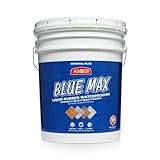
Ames Blue Max Liquid Rubber
Elastomeric, Interior or Exterior
Rigid coatings fail at cracks, and plenty of foundation walls open hairline cracks seasonally. Blue Max is a high-solids elastomeric that cures to a genuinely elastic membrane, so it stretches across those cracks rather than splitting along them. It also tolerates a slightly damp substrate — a real advantage in a basement that never fully dries — and can be used on either face of the wall. The costs are money and finish: it is meaningfully more expensive per square foot, and the cured rubber surface needs framing and board over it rather than paint.
Pros
- Genuinely elastic — bridges hairline cracks
- Tolerates application to slightly damp masonry
- Works on both faces of a foundation wall
- High build per coat with a heavy-nap roller
- Stays sound through seasonal movement
Cons
- Rubbery finish will not accept ordinary wall paint
- Costs considerably more per square foot than DRYLOK
The Bottom Line
The answer for a foundation wall that keeps cracking, and the only one here that tolerates masonry which never fully dries.
RadonSeal Deep Penetrating Sealer
Reactive Penetrating Sealer
RadonSeal is not a coating at all: it is a reactive sodium silicate that soaks into cured concrete and crystallises inside the capillary structure, blocking moisture movement from within. Nothing remains on the surface, so there is nothing to peel and no recoating cycle, and the wall stays paintable afterwards. The constraint is the substrate — it needs dense poured concrete or tight block to react with, and does very little on coarse, porous CMU. On a poured foundation wall it is an excellent, genuinely permanent option, with the useful side benefit of reducing radon entry.
Pros
- Seals from within — nothing on the surface to peel
- Effectively permanent once cured
- Leaves the wall paintable afterwards
- Also reduces radon and vapour transmission
- No maintenance or recoating cycle at all
Cons
- Only works on dense poured concrete, not porous block
- Invisible when applied, so coverage must be measured
The Bottom Line
On a poured concrete foundation, sealing the capillaries from the inside beats coating the surface — and it never needs doing again.
4. Matching Product to Wall
| Your Situation | Product Type | Our Pick |
|---|---|---|
| Excavating anyway | Exterior elastomeric membrane | Liquid Rubber Foundation Sealant |
| Damp, musty block wall | Cementitious waterproofer | DRYLOK Extreme |
| Wall cracks seasonally | Elastomeric membrane | Ames Blue Max |
| Dense poured concrete | Reactive penetrating sealer | RadonSeal |
| Wall never fully dries | Damp-tolerant elastomeric | Ames Blue Max |
| Water after every storm | None — drainage work | Gutters, grading, perimeter drain |
Coverage is worth checking before you buy as well: cementitious coatings cover far less per gallon on rough block than the tin implies, often 75 to 100 square feet per coat, and both coats are mandatory. Elastomeric membranes go on thicker still and cover less again, which is the main reason they are usually reserved for the walls that genuinely need flexibility.
The last row is the one worth reading twice. No sealer on this page, at any price, resists water arriving in volume through a failed drainage path. Sealing in that situation moves the problem rather than solving it, and often moves it somewhere less visible.
5. Preparation and Application
Strip the wall. Interior coatings that bond chemically need bare masonry. Old paint, whitewash or a previous coating all have to come off with a masonry stripper or a grinder with dust extraction, and silica dust demands proper respiratory protection.
Brush efflorescence off dry. Wire brush and vacuum. Washing it dissolves the salts back into the wall, where they recrystallise later and can push a new coating off from behind.
Fill every crack first. Hydraulic cement in a chased-out V-groove for stable cracks; polyurethane injection for an actively leaking crack in poured concrete. Let repairs cure fully. Our crack repair guide covers which is which.
Work the first coat in. With cementitious products the first coat is brushed hard into the pores with a masonry brush — rolling bridges them and leaves pinholes. The second coat, 24 hours later, can be rolled and should cross the first so misses are visible.
On the exterior, protect the membrane. A cured membrane can be damaged by sharp backfill. A drainage board over it does two jobs at once: it shields the coating and gives water a path down to the footing drain instead of pressing against the wall.
Block Walls vs Poured Walls
The two common foundation types behave differently enough that the same product can be right on one and wrong on the other.
Concrete block is hollow and coarse. Water entering the wall can travel vertically inside the cores, which means moisture that enters high can emerge low, often at the bottom course or the wall-floor joint — and that migration makes a purely surface diagnosis misleading. Block also has mortar joints, which are frequently the weakest path. Cementitious coatings suit block well because they fill the open pore structure; reactive silicates do far less, because coarse block does not give the reaction enough to work with.
Poured concrete is denser and has no cores, so moisture movement is slower and more uniform, but it cracks in a way block does not — vertical shrinkage cracks from the original cure are extremely common and are the usual leak path. Poured walls are where reactive penetrating sealers perform best, and where polyurethane crack injection is the correct repair rather than a surface patch.
Stone and rubble foundations in older houses are a third case entirely: irregular, full of mortar joints, and often built without any damp proof course. They rarely take a modern coating well, and the realistic approach is usually managing the moisture — drainage, ventilation and dehumidification — rather than trying to seal the wall as if it were a flat block surface.
6. What to Fix Before You Seal Anything
Three cheap jobs solve a surprising share of wet foundations, and all of them belong before a single tin is opened.
Gutters. A blocked gutter delivers the entire roof's runoff straight down the wall. Clearing them costs nothing and changes the volume of water reaching the foundation more than any coating can.
Downspouts. Discharge should be at least six feet from the house, ideally further. A downspout dumping at the foundation is a hose pointed at the wall every time it rains.
Grade. Soil should fall away from the house — a common target is six inches over the first ten feet. Settled beds and patios that slope back towards the wall are among the most frequent causes of a suddenly damp basement in an old house.
Do those three, watch through one wet season, and then decide what sealing the wall needs. A great many foundations turn out to need much less than the owner feared, and our wet basement solutions guide orders every remaining option by cost.
What to Do About a Crawl Space
Crawl spaces get asked about in the same breath as foundations and want a different answer. The walls can be treated with the same interior coatings, but the dominant moisture source in most crawl spaces is not the walls at all — it is the exposed soil floor, which evaporates water into the space continuously.
The standard fix there is encapsulation: a heavy polyethylene vapour barrier laid over the ground, lapped and sealed at the seams, run up the walls and fastened, with a dehumidifier to handle what remains. Coating the walls without addressing the floor treats a fraction of the problem and rarely changes the humidity reading enough to notice. If the crawl space smells and the joists above show surface mould, start with the ground cover rather than a tin of sealer.
Common Mistakes
Sealing Before Fixing the Water Source
Gutters, downspouts and grading come first, always. A coating applied while the roof is still discharging against the wall is treating a symptom at considerable expense.
Assuming the Builder Waterproofed It
Most new foundations get damp proofing, not waterproofing — a thin asphalt spray rated for vapour rather than pressure, which degrades over decades. Finding damp on a relatively modern house does not mean something failed; it means the original spec was lighter than assumed.
Coating Over Paint or Efflorescence
Cementitious sealers bond by reacting with bare masonry. Anything in between prevents that, and the coating lifts in sheets within a season. Stripping is the job; painting is the easy part.
Backfilling Straight Onto a Fresh Membrane
Sharp fill damages an exterior coating as it goes in, and every puncture is a path for water. A drainage board protects the membrane and relieves pressure at the same time — do not skip it to save a few dollars per foot.
Ignoring a Structural Crack
Horizontal cracking, stair-stepping through mortar joints, or a wall that bows is a structural question. Coating over it hides the evidence while the underlying problem continues. Get it assessed before anything covers it.
Frequently Asked Questions
What is the best foundation sealer?
It depends on the side you can reach. Exterior during an excavation: a water-based elastomeric membrane like Liquid Rubber's foundation sealant. From inside: DRYLOK Extreme for damp block or poured walls, Ames Blue Max where the wall cracks, and RadonSeal on dense poured concrete.
Inside or outside?
Outside is better engineering — it stops water before it enters the wall and uses soil pressure to hold the membrane on. Inside is what most owners can do without excavating, and it genuinely works against seepage and damp, just not against water arriving in volume.
How much does it cost?
Interior DIY is mostly materials — typically several hundred dollars of coating for a basement perimeter, plus preparation tools. Exterior means excavation, which puts a professional job into the thousands, with the sealer itself a small fraction of the total.
Does interior sealing actually work?
For moisture migrating through porous masonry, yes — two coats of a cementitious waterproofer on bare, prepared walls reliably stops the damp, musty, efflorescent case. It will not stop water entering through a failed drain, a cracked wall or a rising water table.
How long does it last?
An exterior membrane buried and protected from UV is effectively permanent for the life of the backfill. Interior cementitious coatings commonly exceed a decade, with DRYLOK Extreme warranted for 15 years. Reactive penetrating sealers do not wear at all. All of that assumes correct preparation.
Do cracks need fixing first?
Yes — coatings seal pores, not gaps. Fill with hydraulic cement, or inject an actively leaking crack in poured concrete with polyurethane, and let the repair cure before coating. Wide, stepped or moving cracks should be assessed structurally first.
Damp proofing or waterproofing — what is the difference?
Damp proofing resists vapour and light seepage; waterproofing is rated against liquid water under hydrostatic pressure. The asphalt spray on many new foundations is damp proofing, which is why a relatively modern house can still show damp without anything having failed.
Will sealing stop a wet basement?
Only if water is seeping through the masonry itself. If it arrives after heavy rain, pools on the floor, or shows at the wall-floor joint, the answer is drainage — gutters and grading first, then a perimeter drain and sump. Sealing before those is money on a symptom.
Related Guides
Guide
Waterproofing From Outside
Excavation, membranes, drainage board and footing drains, layer by layer.
Review
Best Basement Waterproofing Paint
The interior coating field, tested through a full wet season.
Cost Guide
Basement Waterproofing Cost
Interior against exterior pricing, and what drives it by thousands.
The Bottom Line
If the ground is already open, seal the exterior with a liquid rubber membrane and protect it with a drainage board — nothing else comes close. Working from inside, DRYLOK Extreme is the strongest coating for a damp wall, Ames Blue Max is the one for a wall that cracks or never dries, and RadonSeal is the permanent answer on dense poured concrete.
Before any of that, spend an afternoon on the gutters, the downspouts and the grade. Those three fix more wet foundations than every product on this page combined, and they cost almost nothing — which makes them the only sensible place to start.
More in Basement Waterproofing
Guides in this category that pair with what you just read.
About the Author
Alex Rivers, Home Improvement Editor
Alex has spent over a decade working on residential and light commercial property maintenance, and now tests every tool, coating and machine that appears in these guides personally.