Best Gutter Sealants
A gutter seam that drips after one winter was usually sealed with the wrong product over a dirty joint. We compared tripolymer, butyl and rubber sealants on the three leaks that matter: seams, end caps and downspout outlets.
Alex Rivers
Home Improvement Editor
Last Updated
September 29, 2026
In This Guide
The best gutter sealant is a tripolymer or synthetic rubber sealant made for gutters, applied from inside the trough over bare, clean metal. Silicone bathroom caulk and general-purpose acrylic are the two most common choices for this job, and they are the two most likely to fail by next spring.
Our Picks at a Glance
- Best Overall: Geocel 2320 Tripolymer Gutter Seal — Tripolymer, 10.3 oz, Aluminum Gray / Clear / White
- Best for Wet Weather: Sashco Through the Roof Sealant — Synthetic Rubber, 10.5 oz, Clear
- Best Budget: DAP Butyl-Flex Gutter & Flashing Sealant — Butyl Rubber, 10.1 oz, Aluminum Gray / White
- Best for Inside Seams: Amerimax SeamerMate Gutter Sealant — Tripolymer, 10 oz, Gray
- Best for Downspouts: Geocel 2300 Construction Tripolymer Sealant — Tripolymer, 10.3 oz, Non-Sag
- Best Cold-Weather Butyl: Red Devil Gutter & Foundation Butyl Rubber Sealant — Butyl Rubber, 10.1 oz, Gray
- Best for Holes: Flex Tape Rubberized Waterproof Tape — Rubberized Patch Tape, 4, 8 and 12 in Widths
1. How We Picked
We judged gutter sealants on the conditions that actually destroy them. A gutter joint sits in standing water after every rain, cycles between below freezing and well over 100 degrees in summer sun, and moves every time the metal expands and contracts. A sealant that looks fine on day one can pull away from the metal after a single winter.
Adhesion to the right materials came first. We looked for products that list aluminum, galvanized steel, copper and vinyl as substrates, because many houses have a mix of original sections and later repairs. We gave extra credit to products that bond to damp surfaces, since gutter repairs are rarely done on a perfectly dry day.
Flexibility and temperature range came next. We checked each product's service range and how much movement it tolerates, and we favored tripolymer and synthetic rubber sealants that stay elastic over acrylics and hard caulks that crack. For more on why rigid products fail outdoors, see our explainer on why exterior caulk keeps cracking.
Consistency mattered too. A sealant that flows into a horizontal seam is ideal inside the trough, but the same product sags off a vertical downspout joint. We ranked products for the leak type they handle best rather than pretending one tube does everything equally well.
Finally, we left out products that manufacturers say are not suited to permanent water contact. Some excellent polyurethane roof and flashing sealants carry that caveat, and a gutter seam sits in water after every storm, so they did not make the list despite their strength elsewhere.
2. Find Your Leak Type First
Before you buy anything, figure out exactly where the water is coming from. Go out during a steady rain, or run a garden hose into the gutter at the high end, and watch the underside. Most gutter leaks fall into four categories, and each calls for a slightly different fix.
Seam leaks happen where two sections of sectional gutter join, usually with a slip connector. The sealant between the lapped pieces has failed, and water wicks through the joint and drips from the bottom edge. These are the most common leaks on older sectional gutters and the easiest to fix with a flowing sealant like Geocel 2320. On seamless gutters there are no mid-run seams at all, so if you have seamless gutters, look at the corners and ends instead.
End cap leaks show up as drips from the very end of a run. End caps are crimped onto the gutter and sealed from the inside, and when the sealant fails or the crimp loosens, water runs out around the edge. If the cap is loose, secure it with a couple of aluminum rivets before sealing; sealant is not a fastener.
Downspout outlet leaks happen where the outlet tube passes through the bottom of the gutter. The flange around the hole was sealed when installed, and it often fails first because it sits at the lowest point where water pools. Leaks at downspout elbows and joints lower down are usually vertical joints and need a non-sag sealant.
Finally, some apparent leaks are not leaks at all. Water pouring over the front edge usually means a clog or poor pitch, and water running behind the gutter onto the fascia often means missing drip edge. Sealant will not fix either.
THE HOSE TEST
Run water at the high end, watch the underside, and mark every drip with tape before you buy a single tube.
Five minutes with a garden hose tells you whether you have a seam, end cap, outlet or hole, and whether you have one leak or six. That decides which sealant to buy and how much.
3. Our 7 Top Picks
These seven cover the realistic options for a homeowner fixing a leaking gutter: two tripolymer sealants from Geocel, one made specifically for gutter seams and one heavier general-purpose version, a synthetic rubber sealant that bonds to wet surfaces, a sealant from a gutter manufacturer, two inexpensive butyl rubber options, and a patch tape for holes that sealant cannot bridge. Each is ranked for the leak it handles best, because the right product for a hairline seam is not the right one for a rusted-through hole.

Geocel 2320 Tripolymer Gutter Seal
Tripolymer, 10.3 oz, Aluminum Gray / Clear / White
Most gutter leaks happen at joints that sit in water, move with every temperature swing and are exposed to sun on one side and shade on the other, and a sealant has to handle all of that at once. Geocel formulated 2320 specifically for that job. It is a tripolymer, a solvent-based blend that stays elastic, resists ultraviolet light far better than acrylic caulk and bonds to aluminum, galvanized steel, copper and vinyl without a primer. That last point matters more than it sounds, because many homes have a mix of original steel sections and newer aluminum or vinyl repairs. The consistency is the other reason it leads. It is looser than a standard construction sealant, and on a horizontal seam it flows into the lap and around rivet heads rather than sitting on top as a ridge. That is exactly where a seam leaks. It will adhere to damp metal, so a gutter that has not fully dried after a rain is not a problem, although standing water and debris still need to come out. It skins over quickly but reaches full strength slowly, especially in cold weather, so give it several days before you flush the gutter with a hose. The drawbacks are the usual solvent ones: a strong smell and cleanup with mineral spirits rather than water.
Pros
- Formulated specifically for gutter seams, end caps and outlets rather than adapted from a general caulk
- Bonds to aluminum, galvanized steel, copper and vinyl without a primer
- Can be applied to damp surfaces, so you are not waiting for a dry week
- Flows slightly into seams, which gets sealant into the lap rather than just over it
- Aluminum gray color blends with most gutters, and it is paintable once cured
Cons
- Solvent-based, with a strong odor and mineral-spirits cleanup
- Slow to reach full cure in cold weather, so avoid flushing the gutter for several days
The Bottom Line
The sealant we would reach for first on any leaking gutter seam or end cap, on any common gutter material.

Sashco Through the Roof Sealant
Synthetic Rubber, 10.5 oz, Clear
Sashco markets Through the Roof as a sealant you can apply in the rain, and that is the case for owning a tube. It is a synthetic rubber sealant that bonds to wet surfaces and can be applied at surface temperatures from 0 to 120 degrees, which covers the late autumn and early winter period when gutter leaks tend to show up and most sealants are simply too cold to cure. Its service range runs from about minus 25 to 180 degrees, and it stays highly elastic after curing, so it moves with an aluminum gutter through a winter of freeze and thaw rather than tearing away at the edges. It dries clear, which makes it forgiving on white, brown or gray gutters alike, and Sashco lists gutters and downspouts alongside flashing, vents and skylights among its intended uses. A 10.5-ounce cartridge covers about 26 linear feet with a standard bead, which is enough for several seams and end caps. The downside is handling. It is stringy coming out of the tube and very sticky, so wear gloves, keep a rag with mineral spirits nearby and tool it quickly. On a matte painted gutter the clear glossy finish is noticeable up close. For a dry-weather repair we slightly prefer Geocel 2320, but when the leak cannot wait, this is the one to buy.
Pros
- Sashco says it can be applied to wet surfaces and even during rain
- Can be applied at surface temperatures down to 0 degrees, well below most sealants
- Stays highly elastic, with a service range from about minus 25 to 180 degrees
- Dries clear, so it disappears on any gutter color
- Works on gutters, flashing, vents and chimneys, so one tube covers several roof-edge repairs
Cons
- Stringy and sticky to apply, and messy without gloves and a solvent rag
- Clear finish looks glossy on a matte painted gutter
The Bottom Line
The pick when you need to stop a leak in wet or freezing weather and cannot wait for a dry, mild day.

DAP Butyl-Flex Gutter & Flashing Sealant
Butyl Rubber, 10.1 oz, Aluminum Gray / White
Butyl rubber has been sealing gutter seams and flashing for decades, and DAP Butyl-Flex is the most widely available version. Its strength is adhesion to metal. Butyl stays slightly tacky and very flexible, so it grips aluminum and galvanized steel and moves with them rather than cracking or pulling loose. DAP rates it for performance from about minus 20 to 180 degrees, and it meets ASTM C1085, the specification for butyl rubber sealants. It is also excellent value: DAP lists coverage of about 56 linear feet with a 3/16-inch bead, far more than you will need for a typical repair. Butyl has two real limits, and both are relevant to gutters. First, it needs a clean, dry surface. It does not have the damp-surface tolerance of tripolymers or synthetic rubber sealants, so pick a dry day and dry the joint with a rag before applying. Second, butyl picks up dirt and degrades faster in direct sunlight. Inside a gutter, where the sealant is shaded by the back wall and often covered by debris or a guard, that matters less than on exposed flashing. The consistency is stringy, so tool it quickly with a gloved finger dipped in mineral spirits. For a homeowner sealing a few seams on a dry autumn afternoon on a tight budget, it does the job well.
Pros
- Butyl rubber grips metal tenaciously and stays tacky and flexible for years
- Covers about 56 linear feet with a 3/16-inch bead, excellent value per tube
- Performs from about minus 20 to 180 degrees
- Meets ASTM C1085, the standard specification for butyl rubber sealants
- Widely stocked and one of the least expensive gutter sealants available
Cons
- Needs a dry surface; it will not bond reliably to wet or damp metal
- Picks up dirt and weathers faster in direct sun than a tripolymer
The Bottom Line
A solid, inexpensive choice for dry-day seam repairs on metal gutters, if you accept a shorter service life in full sun.
Amerimax SeamerMate Gutter Sealant
Tripolymer, 10 oz, Gray
Amerimax makes a large share of the vinyl and aluminum gutter parts sold at home centers, and SeamerMate is the sealant it sells alongside them. Amerimax describes it as a tripolymer and as semi-self-leveling, and that consistency is both its strength and its limitation. On a horizontal joint inside the gutter trough, such as a slip connector, an end cap or the base of an outlet, it settles into the seam and flows around the edges of the connector, creating a continuous seal without much tooling. That is useful when you are working from a ladder and cannot easily reach in with a finger to press sealant into the joint. Amerimax says it can be applied in wet conditions, and it is UV resistant and paintable after about 24 hours. On a vertical joint, the same flow works against you. On the connection between a downspout and an elbow, or on the face of an end cap, it will sag and run before it skins over. For those joints, a non-sag sealant such as Geocel 2300 is the better choice. It is widely available next to the gutter parts in most home centers, which is convenient if you are replacing a connector or end cap at the same time. If your gutters are Amerimax, using its matched sealant is a sensible default.
Pros
- Made by one of the largest residential gutter manufacturers, for its own products
- Semi-self-leveling, so it settles into horizontal seams and around connectors
- Amerimax says it can be applied in wet conditions
- UV resistant and paintable after about 24 hours
- Inexpensive and stocked alongside gutter parts in most home centers
Cons
- Runny consistency makes it a poor choice for vertical joints such as downspout connections
- Gray is the only common color
The Bottom Line
A good match for sealing inside the trough, especially on Amerimax gutter systems, but not for vertical joints.

Geocel 2300 Construction Tripolymer Sealant
Tripolymer, 10.3 oz, Non-Sag
Geocel 2300 is the general-purpose version of the tripolymer used in 2320, and on a gutter job it is the product for the joints where a flowing sealant fails. It is a non-sag construction sealant, so it stays where you put it on vertical surfaces: the face of an end cap, the joint between a downspout and an elbow, or the connection where an outlet tube meets the downspout. Geocel lists a gap span of about 1/2 inch, which is wider than most gutter sealants handle, and a service range from about minus 40 to 180 degrees. Like 2320, it adheres to damp surfaces and resists ultraviolet light well, and it is resealable, meaning a future repair can go directly over it without scraping it all out. That is a real advantage over silicone, which nothing sticks to. The trade-off is flow. On a horizontal seam inside the gutter trough, 2300 sits on top of the joint unless you work it in firmly with a tool or gloved finger, and a gutter-specific sealant like 2320 or SeamerMate gets into the lap more easily. It is also a general construction sealant, useful for siding, trim and flashing repairs, so a tube rarely goes to waste. If you only buy one sealant for both horizontal seams and vertical downspout joints, this is the more versatile choice.
Pros
- Non-sag body stays put on vertical joints, end cap faces and downspout connections
- Bonds to building surfaces even when damp
- Bridges gaps up to about 1/2 inch, wider than most gutter sealants
- Service range from about minus 40 to 180 degrees
- Resealable, so a later repair can go directly over it
Cons
- Thicker consistency does not flow into horizontal seams as well as a gutter-specific sealant
- Solvent odor and slower cure than water-based products
The Bottom Line
The heavier, non-sag partner to Geocel 2320, and the better choice for vertical joints and wider gaps.

Red Devil Gutter & Foundation Butyl Rubber Sealant
Butyl Rubber, 10.1 oz, Gray
Red Devil sells this butyl as a gutter and foundation sealant, and it makes a sensible alternative to DAP Butyl-Flex, particularly in cold climates. Red Devil rates it for a service range from about minus 40 to 225 degrees, which is wider than most butyl products, and the formulation stays flexible enough to handle the constant expansion and contraction of a metal gutter through a northern winter. It becomes tack-free in about 2 hours, which is quicker than many butyls, but full cure takes about 7 days. For a gutter repair, that means avoiding heavy rain for the first day and not flushing the gutter with a hose until it has cured. A 10.1-ounce cartridge covers about 30 linear feet. Like DAP Butyl-Flex, it needs a clean, dry surface to bond reliably, and it will collect dirt and weather faster than a tripolymer if it sits in direct sun. Inside the gutter, where most seams are shaded and hidden, that is acceptable. Its other advantage is versatility: it also works below grade, on basement and foundation joints, masonry and concrete. Cleanup is with mineral spirits. If you already have a tube for a foundation job, it is a perfectly good gutter sealant; if you are buying specifically for gutters, a tripolymer is the better investment.
Pros
- Rated for a wide service range of about minus 40 to 225 degrees
- Butyl adhesion to aluminum and galvanized steel
- Skins over in about 2 hours, faster than many butyls
- Also useful below grade and on foundation joints, so one tube serves several jobs
- Budget-priced
Cons
- Takes about 7 days to fully cure
- Like all butyls, needs a dry surface and weathers in direct sun
The Bottom Line
A dependable budget butyl with a wide temperature range, best for dry-day seam repairs you will not see.
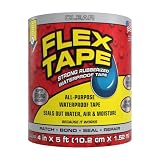
Flex Tape Rubberized Waterproof Tape
Rubberized Patch Tape, 4, 8 and 12 in Widths
Sealant is for joints. When a gutter has a hole, a split or a patch of rust-through, there is nothing solid for a bead of sealant to bridge, and that is where Flex Tape earns its place. It is a thick, rubberized tape with an aggressive adhesive that can be applied to wet surfaces, and it comes in 4, 8 and 12-inch widths, so a strip can be laid across a hole or wrapped around the entire cross-section of a gutter to cover a failed joint. Flex Seal rates it for application from about 20 to 120 degrees. For gutters, the value is speed. You can clean the area, press on a patch and stop a leak that is soaking the fascia or pouring onto a door step, all in about ten minutes. Be realistic about how long it lasts. The thick backing sits proud of the gutter floor, where it can catch leaves and grit, and on a gutter that is also rusting underneath, the edges eventually lift. In our view it is a very good medium-term bridge, not a permanent structural repair. For a lasting fix on aluminum, cut an aluminum flashing patch, set it in tripolymer sealant and rivet it. On a steel gutter with widespread rust, replace the section. The black tape is also very visible on white gutters.
Pros
- Covers holes and rust-through spots that sealant alone cannot bridge
- Can be applied to wet surfaces
- Available in 4, 8 and 12-inch widths, wide enough to wrap a whole gutter cross-section
- Rated for application from about 20 to 120 degrees
- Quick and clean compared with cutting and riveting a metal patch
Cons
- A temporary-to-medium-term fix; the thick backing can collect debris and eventually lift at the edges
- Black color is highly visible on white or light gutters
The Bottom Line
The fastest way to stop a leak through a hole or rusted spot, as a bridge until you can patch or replace the section.
4. Tripolymer vs Butyl vs Silicone
Gutter sealants come in a handful of chemistries, and the differences explain most early failures. For a gutter, you want a product that stays elastic, bonds to metal and vinyl, tolerates standing water and can be resealed over later.
| Chemistry | Damp Surfaces | Flexibility | UV Resistance | Verdict for Gutters |
|---|---|---|---|---|
| Tripolymer | Good | Excellent | Excellent | Best overall choice |
| Synthetic rubber / elastomeric | Excellent | Excellent | Good | Best in wet or cold weather |
| Butyl rubber | Poor | Very good | Fair | Good budget option, dry days only |
| 100% silicone | Poor | Excellent | Excellent | Avoid on gutters |
| Acrylic latex | Poor | Limited | Fair | Avoid on gutters |
Tripolymers, such as Geocel 2300 and 2320, are solvent-based blends that stay flexible, resist sunlight and bond to most building materials, even when damp. They are the default choice for gutter repairs. Synthetic rubber and elastomeric sealants, a family that includes block-copolymer products sometimes labelled SEBS, go further on wet adhesion; Sashco Through the Roof is the best-known example. Butyl is cheap and grips metal well but needs a dry surface and degrades faster in sun.
Silicone is the one to avoid, even though it is flexible and weather resistant. It bonds poorly to oxidized aluminum and dirty metal without a primer, it cannot be painted, and nothing, including new silicone, adheres well to silicone residue. Once a gutter joint has been siliconed, every future repair starts with scraping every trace of it away. We explain the trade-offs in detail in polyurethane vs silicone caulk.
Acrylic latex caulk is the other common mistake. It is designed for interior trim and dry exterior joints, not for continuous water exposure, and it shrinks and hardens as it cures. In a gutter, it cracks and lets go within a season.
5. Aluminum, Vinyl, Steel and Copper
The gutter material changes both how you prepare the joint and which sealant bonds best. Most American homes have aluminum gutters, but vinyl, galvanized steel and copper are all common, and many houses have a mix after decades of repairs.
Aluminum is the easiest to seal. All of our picks bond to it, but aluminum grows a thin oxide layer that looks clean and still prevents adhesion. Scuff the joint with a stiff wire brush or abrasive pad until it looks bright, then wipe it with a solvent. Painted aluminum gutters are fine as long as the paint itself is sound; seal over the paint, not over peeling flakes.
Vinyl gutters move much more with temperature than aluminum, roughly twice as much, and their joints usually rely on rubber gaskets inside snap-together connectors rather than sealant. If a vinyl joint leaks, the first fix is often a new gasket or connector. Where sealant is needed, use a tripolymer that lists vinyl as a substrate, such as Geocel 2320, and avoid butyl, which does not bond as reliably to PVC. Cold also makes vinyl brittle, so a cracked vinyl section is usually better replaced than patched.
Galvanized steel gutters bond well to butyl and tripolymers, but rust is the enemy. Sealant applied over rust fails as the rust keeps growing underneath. Wire brush down to sound metal, treat the area with a rust converter or metal primer if it is extensive, and seal once that is dry. If rust has perforated the metal along a run, the section is at the end of its life.
Copper gutters are traditionally soldered at the seams, and solder is still the permanent repair. A tripolymer that lists copper as a substrate works as a stopgap. Whatever the material, never patch with a dissimilar metal. Steel screws or patches on aluminum, or aluminum on copper, set up galvanic corrosion that eats the joint from the inside.
6. Cleaning and Prep
Almost every failed gutter repair we have seen failed because of prep, not product. The sealant bonded perfectly to a layer of grime, old caulk or oxide that was itself only loosely attached to the gutter. Ten minutes of cleaning is the difference between a repair that lasts a decade and one that drips by spring.
Start by clearing the gutter completely. Scoop out leaves, shingle grit and sludge, then flush the run with a hose to confirm the downspouts flow. If you have not done this in a while, our guide to cleaning gutters before winter covers the full process and the safety side of working from a ladder.
Next, remove the old sealant. Use a stiff putty knife, a plastic scraper or an old chisel to lift out as much as you can from the joint. Old butyl will come away in stringy strips; old silicone must be removed completely, because new sealant will not bond to it. Get down to bare metal or vinyl across at least an inch on each side of the joint.
Then scuff and clean. On metal, scrub the area with a wire brush or abrasive pad until it looks bright. Wipe it with a rag dampened with mineral spirits or denatured alcohol to remove oils and residue, and let the solvent flash off. On vinyl, skip the wire brush and use a mild abrasive pad and alcohol.
Finally, check the joint mechanically. If a slip connector or end cap moves when you push on it, secure it before sealing. Aluminum pop rivets are the standard fix; drill through both layers and set two or three rivets per joint. Seal over the rivet heads as part of the repair. Sealant should close a gap, not hold a loose part in place.
7. How to Seal Seams, End Caps and Outlets
Always seal from inside the gutter, on the side the water reaches first. A bead applied only on the underside is pushed off by water pressure from above. Work on a mild, dry day if you can, even with a wet-tolerant sealant, because curing speed and adhesion both improve.
For a seam, cut the nozzle to give a bead roughly 1/4 inch wide. Lay a continuous bead along the joint on the inside of the trough, across the bottom and up both the front and back walls, so there is no gap at the corners. Then press it into the joint with a gloved finger or a plastic spreader, feathering it about an inch onto each side. The aim is a thin, continuous film bonded to both pieces, not a tall ridge sitting on top.
For an end cap, run the bead around the full inside perimeter where the cap meets the gutter, paying extra attention to the bottom corners, where most end cap leaks start. Tool it firmly into the crimp. If the cap was loose, rivet it first and seal over the rivets.
For a downspout outlet, seal around the flange inside the gutter, forming a smooth ramp from the gutter floor down into the outlet so water does not pool against the bead. Check that the rivets or screws holding the outlet are tight and sealed too. On the downspout itself, joints should be assembled so the upper piece fits inside the lower one, and any sealant there should be a non-sag product such as Geocel 2300.
Give the repair time. Most gutter sealants skin over quickly but reach full strength slowly, often several days in cool weather. Avoid flushing the gutter with a hose until it has cured, and check the joint after the first real rain.
8. Sealing Wet, Dirty or Cold Gutters
Gutter leaks tend to reveal themselves in the wettest, coldest part of the year, which is also when sealants are hardest to use. Some products handle those conditions far better than others, but every one of them has limits.
Wet-surface tolerance is the most useful feature. Sashco Through the Roof is sold as a sealant you can apply in the rain, and tripolymers like Geocel 2320 and 2300 bond to damp surfaces. Butyl and silicone need a dry joint to bond reliably. Even with a wet-tolerant product, bail out standing water and wipe the joint with a rag; wet-tolerant means damp metal, not a puddle of sludge.
Dirt is a different problem. No sealant bonds properly through a layer of shingle grit, algae or decomposed leaves, however well it handles water. If you cannot clean a joint properly because of the weather, a temporary patch of Flex Tape over a wiped surface can stop the leak until you can do the job properly.
Temperature is the third limit. Most sealants list a minimum application temperature, commonly 40 degrees, and cure far more slowly as it drops. Through the Roof can be applied at surface temperatures down to 0 degrees, which is unusual. For others, pick the warmest part of the day, and keep cartridges indoors until you use them, because cold sealant is stiff and hard to tool.
If you are replacing a whole section in winter, prepare as much as you can indoors. Crimping and sealing end caps, or riveting outlets into a new length of gutter, is far easier on a bench in a warm garage, where the sealant can cure before it goes up. Our guide to the best garage heater covers keeping a workspace warm enough for that kind of job.
9. Patch or Replace the Section?
Sealant fixes joints, and it is very good at that. It does not fix a gutter that is failing as a whole, and knowing the difference saves both money and repeat ladder climbs.
Patch when the problem is local: one or two leaking seams, a loose end cap, a failed outlet flange, or a small hole in otherwise sound metal. For holes up to a couple of inches, cut a patch of matching metal a couple of inches larger than the hole on all sides, set it into a bed of tripolymer sealant inside the gutter, rivet it at the corners and seal over the edges. Flex Tape works as a quicker, less permanent version.
Replace when the problem is systemic. Rust-through at several points along a steel gutter means the rest will follow soon. Several seams leaking at once on an older sectional gutter usually means the sealant everywhere is at the end of its life. Cracked or brittle vinyl will keep cracking. And if the gutter sags, has lost its slope or is pulling away from the fascia, no amount of sealant will fix it; the water pools, finds the weakest joint and overflows.
Check the slope while you are up there. A gutter should fall toward its downspout, commonly about 1/4 inch for every 10 feet of run. Water standing in the gutter a day after rain means the pitch is wrong, and standing water shortens the life of every seam in the run.
Finally, look at the fascia behind the gutter. Soft, dark or crumbling wood means water has been getting behind the gutter for some time. Fix that before rehanging or sealing anything, because the hangers need solid wood to hold.
10. Making the Repair Last
A properly sealed joint on clean metal should last many years, but a few habits make the difference between a repair that holds and one you redo every spring.
Keep the gutter clear. Debris holds water against every seam in the run, and a gutter that stays wet for days wears out its sealant far faster than one that drains quickly. Gutter guards reduce how often you need to clean, and our comparison of the best gutter guards covers which types actually keep out the debris common in your area.
Inspect twice a year. Look at every seam, end cap and outlet in late autumn after the leaves have come down, and again in spring after the freeze and thaw. Catching a sealant bead that has started to lift at one edge is a two-minute fix; waiting until it leaks means cleaning, scraping and resealing the whole joint.
Treat the rest of the roof edge while you are there. Fascia boards, trim and flashing around the gutters often need the same attention, and the joints between them and the siding are where water gets behind. For those, the right product is often a high-performance exterior caulk rather than a gutter sealant; see our tested picks for the best exterior caulk.
Finally, record what you used. A note of the sealant and the date, kept with your house paperwork, tells you what is in each joint next time. That matters most if you inherit a joint sealed with silicone, which has to be removed completely before anything else will bond.
11. Common Mistakes to Avoid
Using silicone bathroom caulk
Silicone bonds poorly to oxidized aluminum and dirty metal, cannot be painted, and leaves a residue that nothing else will stick to. When it fails, and on a gutter it often does, every trace must be scraped out before a proper repair. Use a tripolymer, synthetic rubber or butyl sealant made for gutters instead.
Sealing over old sealant and dirt
New sealant bonds to whatever is on the surface. If that is flaking old caulk, shingle grit or aluminum oxide, the repair is only as strong as that layer. Scrape out the old material, wire brush the joint to bright metal and wipe it with solvent before applying a single bead.
Sealing only from underneath
A bead on the outside of the gutter is pushed off by water pressure from above, however good the product. Always seal from inside the trough, on the side the water reaches first, and press the sealant into the joint rather than laying it on the surface.
Using sealant as a fastener
If an end cap, connector or outlet moves when you push on it, sealant alone will not hold it. The joint flexes, the bead tears, and the leak returns. Secure loose parts with aluminum pop rivets first, then seal over the joint and the rivet heads.
Patching a gutter that needs replacing
Sealant fixes joints, not failing gutters. Rust-through along a steel run, cracked vinyl, sagging sections or lost slope all mean the problem is bigger than one seam. Patching buys a season at best. Replace the section, check the fascia, and reset the pitch toward the downspout.
12. Frequently Asked Questions
What is the best sealant for gutter seams?
A tripolymer sealant made for gutters, such as Geocel 2320, is the best all-round choice. It stays flexible, bonds to aluminum, steel, copper and vinyl, and tolerates damp surfaces. For wet or freezing weather, Sashco Through the Roof is the better pick, and butyl sealants such as DAP Butyl-Flex are a good budget alternative on dry days.
Can I use silicone to seal gutters?
We do not recommend it. Silicone bonds poorly to oxidized aluminum and dirty metal without a primer, cannot be painted and leaves a residue that no sealant sticks to. If it fails, every trace must be removed before a proper repair. Tripolymer and synthetic rubber gutter sealants are better suited to the job and easier to reseal later.
Can you apply gutter sealant when the gutter is wet?
Some products are designed for it. Sashco Through the Roof can be applied to wet surfaces, and Geocel tripolymers bond to damp metal. Butyl and silicone need a dry surface. With any product, remove standing water and debris and wipe the joint first; wet-tolerant means damp metal, not a puddle of sludge.
How long does gutter sealant last?
A good tripolymer or synthetic rubber sealant applied to clean, bare metal can last many years, often ten or more on a shaded seam. Butyl tends to degrade sooner in direct sun. The biggest factor is preparation: sealant applied over dirt, oxide or old caulk may fail within a single winter regardless of the product.
Should I seal gutters from the inside or outside?
From the inside. Water fills the gutter from above and pushes against the inside of every joint, so a bead on the outside is forced off. Clean the inside of the joint, apply the sealant across the seam and up both walls, and press it in so it bonds to both pieces.
How do I fix a leaking gutter end cap?
Clean out the gutter end, scrape out the old sealant and wire brush the joint to bright metal. If the cap is loose, secure it with two or three aluminum pop rivets. Then run a bead of gutter sealant around the full inside perimeter of the cap, press it into the crimp, and seal over the rivet heads.
When should I replace a gutter instead of sealing it?
Replace a section when the problem is widespread rather than local: rust-through at several points, cracked or brittle vinyl, several seams failing at once, sagging, or a gutter that holds standing water because it has lost its slope. Sealant is the right fix for one or two failed joints in otherwise sound gutter.
Related Gutter & Caulk Guides
Buyer's Guide
Best Gutter Guards
Keep debris off your freshly sealed seams so they drain fast and last longer.
How-To
How to Clean Gutters Before Winter
The cleaning and flushing routine to do before any seam repair, and before the freeze.
Buyer's Guide
Best Exterior Caulk
For the fascia, trim and siding joints around your gutters, where a caulk rather than a gutter sealant fits.
The Bottom Line
For most leaking gutters, Geocel 2320 is the sealant to buy. It is made for gutter seams, bonds to every common gutter material and tolerates damp metal. Add a tube of Geocel 2300 if you have vertical downspout joints to seal, keep Sashco Through the Roof on hand for repairs that cannot wait for dry weather, and choose DAP Butyl-Flex if budget matters most and you can work on a dry day.
Whatever you buy, the prep decides the result. Clear the gutter, scrape out the old sealant, brush the joint to bright metal, rivet anything loose and seal from the inside. And if the gutter is rusting through, cracking or sagging, spend the money on a new section instead of another tube.
More in Home Improvement
Guides in this category that pair with what you just read.
About the Author
Alex Rivers, Home Improvement Editor
Alex has spent over a decade working on residential and light commercial property maintenance, and now tests every tool, coating and machine that appears in these guides personally.