The 6 Best Rice Cookers in 2026
We cooked short-grain, jasmine, basmati and brown rice in six machines with identical measurements, then held each batch on keep-warm for eight hours to find out which ones still had dinner at the end of it.
Alex Rivers
Home Improvement Editor
Last Updated
September 18, 2026
In This Guide
A rice cooker costing $40 and one costing $400 both make rice. The difference is what happens when your water measurement is slightly off, how the rice tastes four hours later, and whether brown rice is something you enjoy or tolerate. Here is where that money goes, and when it is worth spending.
Our Picks at a Glance
- Best Overall: Zojirushi Neuro Fuzzy NS-ZCC10 — Micom Fuzzy Logic, 5.5 Cup
- Best Premium: Zojirushi Induction Heating NP-NWC10 — Pressure Induction, 5.5 Cup
- Best Value: Tiger JBV-A10U 4-in-1 — Micom, 5.5 Cup, Multi-Function
- Best for Brown Rice: Cuckoo CRP-P0609S Pressure Cooker — Pressure Micom, 6 Cup
- Best Budget Pick: Aroma Housewares ARC-954SBD — Digital, 8 Cup, Steamer
- Best Multi-Cooker: Instant Pot Duo 7-in-1 — Multi-Cooker with Rice Function, 6 qt
1. Why a Dedicated Rice Cooker Still Wins
Rice on a hob is not difficult, and anyone can produce a good pot of it with attention. The argument for a rice cooker is not that it makes rice possible; it is that it makes rice consistent and unattended, every time, without occupying a burner or a thought.
Two capabilities separate a good rice cooker from a pot. The first is monitoring: a microcomputer-controlled cooker measures temperature through the cycle and adjusts heat and timing, which compensates for an imprecise water measurement rather than failing because of it. The second is keep-warm. A proper rice cooker holds rice at a safe, pleasant texture for hours, which quietly changes how a household eats — rice cooked at six is still good at nine.
What We Tested
6
Cookers, same rice, same water
4
Grain types cooked in each
8 hr
Keep-warm hold we tested
$40-$450
Price range in this test
The third argument is durability, and it is the one that makes the premium machines defensible. A good Japanese rice cooker running daily for ten to fifteen years is unremarkable, which works out to a few dollars a month for an appliance used at nearly every meal. Judged as a purchase per use, it is among the better value items in a kitchen that eats rice regularly.
Where the argument breaks down is frequency. If rice appears on your table twice a week, a multi-cooker that also pressure cooks, slow cooks and makes stock is the better use of counter space, and we have included one here for exactly that reason.
2. The Four Types of Rice Cooker
The technology inside determines both the price and how forgiving the machine is. These are the four categories, and the step from the first to the second is the one that matters most.
| Type | How It Works | Price |
|---|---|---|
| Basic on/off | Heats until water is gone, then switches to warm | $25-$60 |
| Micom / fuzzy logic | Monitors temperature and adjusts as it cooks | $100-$220 |
| Induction heating | Heats the whole bowl, not just the base | $250-$450 |
| Pressure | Raises boiling point for brown rice and grains | $180-$450 |
If you cook only white rice and measure carefully, a basic cooker genuinely suffices. If you cook brown rice, mixed grains, or you would like the machine to tolerate an approximate water measurement, the step up to fuzzy logic is where the money buys something real. Pressure is the specialist answer for brown rice and beans.
3. The 6 Best Rice Cookers in 2026
Each machine cooked the same four grains — short-grain white, jasmine, basmati and brown — using identical measurements and its own recommended programme. We judged evenness top to bottom, whether a gummy layer formed at the base, brown rice texture, and how the rice held up after eight hours on keep-warm, which is where cheap machines separate themselves fastest.
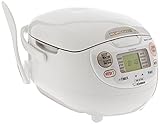
Zojirushi Neuro Fuzzy NS-ZCC10
Micom Fuzzy Logic, 5.5 Cup
The difference between a basic rice cooker and a fuzzy logic one is what happens when your measurement is slightly off. A simple cooker heats until the water is gone and then stops; it has no way to know whether the result is right. The Neuro Fuzzy monitors temperature through the cycle and adjusts heat and timing to compensate, which in practice means a forgiving machine that produces good rice even when the rice-to-water ratio was approximate. That forgiveness is why it earns the top spot. Across repeated batches of short-grain, jasmine and basmati it produced evenly cooked, separate grains with no gummy layer at the bottom and no dry ring at the top — the two failure modes that define cheap cookers. The brown rice setting is a genuine program with a soak phase rather than a longer white rice cycle, and it makes a visible difference to texture. Keep-warm is the underrated feature. It holds rice at a safe, edible state for many hours without the crust that forms in lesser machines, which changes how a household eats: rice made at six is still good at nine. Durability is the last part of the argument — these routinely run a decade or more of daily use, which reframes the price. The honest objections are cost, and that the nonstick inner bowl is a wear item that eventually needs replacing at a meaningful price.
Pros
- Fuzzy logic adjusts time and temperature as it cooks, correcting for slightly wrong water measurements
- The most consistent white rice of anything at this price — evenly cooked, separate grains, no gummy bottom layer
- Genuinely good brown rice and porridge settings rather than token menu entries
- Keep-warm holds rice edible for many hours without drying it into a crust
- Legendary durability — ten to fifteen years of daily use is normal rather than exceptional
Cons
- Costs several times a basic cooker, which is hard to justify if you cook rice occasionally
- The nonstick inner bowl will eventually wear and replacements are not cheap
The Bottom Line
The rice cooker to buy if rice is a staple in your house. Consistent, forgiving of imprecision, and it will outlast most of your kitchen.

Zojirushi Induction Heating NP-NWC10
Pressure Induction, 5.5 Cup
Induction heating solves the last structural limitation of a conventional rice cooker. A heating plate warms the bottom of the bowl and relies on convection to distribute that heat; induction turns the bowl itself into the heating element, so heat arrives evenly from the sides as well as the base. The result is the most uniform cooking of any machine here, and it shows most clearly in short-grain rice where texture differences are easy to taste. Pressure is the second advantage. The Umami setting extends the soak and cooks under slight pressure, which softens the grain's exterior while keeping the centre intact — the distinction between good rice and the rice you remember from a very good Japanese restaurant. On brown rice the gap widens further: this was the only machine that produced brown rice we would actively choose to eat rather than tolerate, and the GABA activation setting, which holds the grain at a germination temperature before cooking, is a genuine feature rather than a marketing line. The reasons to hesitate are price and proportion. This costs several times a good Micom cooker, and for plain everyday white rice the improvement over the Neuro Fuzzy, while real, is modest. If rice appears at most meals in your house, particularly brown or short-grain, the money buys something. If it appears twice a week, it does not.
Pros
- Induction heats the entire bowl rather than just the base, giving the most even cooking of any machine here
- Pressure cooking under the Umami setting produces noticeably better texture in short-grain rice
- Best brown rice results of anything we tested, with a proper extended soak and GABA activation option
- Extremely precise temperature control that handles difficult grains without fuss
- Build quality and materials are a clear step above the standard Micom range
Cons
- Very expensive for a single-purpose appliance — this is a serious commitment to rice
- The benefit over a good Micom cooker is real but modest for everyday white rice
The Bottom Line
The best rice a domestic machine can make, particularly brown and short-grain. Worth it if rice is central to how you cook, not otherwise.

Tiger JBV-A10U 4-in-1
Micom, 5.5 Cup, Multi-Function
Tiger and Zojirushi have competed in Japan for decades, and the JBV-A10U is where that rivalry benefits a budget-conscious buyer. It brings microcomputer control — the thing that separates a cooker that measures and adjusts from one that simply heats until the water is gone — at a price much nearer the basic machines than the premium ones. For everyday white rice, the difference from the Zojirushi in blind tasting was small. The synchro-cooking feature is the one that surprises people. A shallow tray sits above the rice so a piece of fish or a dish of vegetables steams while the rice cooks below, and the tray is designed well enough that liquid from the dish does not drip through and flavour the rice. For a one-pot weeknight meal in a small kitchen, it is genuinely useful rather than a gimmick. Slow cooking is included and works adequately. The compromises appear at the margins. Keep-warm is less refined than Zojirushi's — rice held for four hours is noticeably drier — and the brown rice program is a longer cycle rather than a properly designed soak-and-cook sequence, so results are acceptable rather than good. If you mostly cook white rice and want a capable machine without a premium price, this is the sensible answer.
Pros
- Micom control at a price much closer to basic cookers than to premium Japanese machines
- Genuinely useful slow cook and synchro-cooking functions that let you steam a dish above the rice
- Tacook plate is well designed — the steamed dish does not drip into and flavour the rice
- Consistent, reliable white rice that is close to the Zojirushi in everyday use
- Straightforward controls that do not require reading a manual
Cons
- Keep-warm dries rice faster than the Zojirushi over long holds
- Brown rice results are acceptable rather than good
The Bottom Line
Most of the Zojirushi's everyday performance for meaningfully less money, plus a genuinely useful synchro-cooking tray.

Cuckoo CRP-P0609S Pressure Cooker
Pressure Micom, 6 Cup
Brown rice is the problem that separates rice cookers. The bran layer resists water absorption, so conventional machines need long cooking times and still produce grains that are chewy at the centre or blown out at the edges. Pressure solves it directly by raising the boiling point, and the Cuckoo makes better brown rice, faster, than any non-pressure machine in this comparison. The same capability extends to mixed grains, multigrain blends and beans, which is why these machines are popular in Korean kitchens where those are staples. The programme list is genuinely broad, including GABA rice, porridge, and a scorched rice setting that produces the crisp bottom layer some cuisines prize. White rice is very good too, though the gap to a good Micom cooker is smaller there than it is with brown. Practical design is better than most pressure cookers: the stainless inner lid detaches for cleaning, which matters a great deal because a pressure cooker's lid accumulates starch and cannot simply be wiped. Two quirks. Voice prompts are enabled by default and speak at a volume that startles people in a quiet kitchen — they can be turned off, though the setting takes some finding. And a pressure machine inherently has more parts, seals and cleaning steps than a simple cooker, which is a real if minor ongoing cost in time.
Pros
- True pressure cooking transforms brown rice, producing soft, evenly cooked grains in far less time
- Excellent for mixed grains, beans and multigrain rice that defeat conventional cookers
- Stainless inner lid detaches for cleaning, which most pressure rice cookers do not allow
- Wide range of programs including porridge, GABA rice and scorched rice
- Strong value against the premium Japanese pressure machines
Cons
- Voice prompts are on by default and can be startling — they are switchable but the setting is buried
- Pressure mechanism adds parts, seals and cleaning steps that a simple cooker does not have
The Bottom Line
The best machine here for brown rice, multigrain and beans. Pressure does something no conventional cooker can match.
Aroma Housewares ARC-954SBD
Digital, 8 Cup, Steamer
Before recommending a machine that costs as much as a small appliance budget, it is worth saying plainly that a basic rice cooker makes good rice if you measure accurately. The Aroma ARC-954SBD does exactly that: rinse the rice, use the correct ratio, press the button, and the result is perfectly pleasant white rice for a fraction of the money. Capacity is generous at eight cooked cups, which is more than several machines costing five times as much, and the included steam tray genuinely works for vegetables and dumplings above the cooking rice. Digital controls include a delay timer that is reliable, so rice can be ready when you get home. The inner pot and lid go in the dishwasher, which the premium Japanese machines generally discourage. The limitation is that it cannot compensate for you. Without fuzzy logic there is no monitoring and no adjustment — the machine heats until the water is gone and switches to warm, so a slightly wrong ratio produces slightly wrong rice, and a significantly wrong one produces mush or a scorched base. Keep-warm is similarly basic, drying rice noticeably within an hour or two. For a household that cooks rice a couple of times a week and measures properly, none of that matters much, and the value is excellent.
Pros
- Costs a small fraction of the Japanese machines and makes perfectly acceptable white rice
- Eight-cup cooked capacity is generous for the price and suits a family
- Includes a steam tray, which works well for vegetables and dumplings
- Simple digital controls with a delay timer that works reliably
- Inner pot and lid are dishwasher safe, which the premium machines often are not
Cons
- No fuzzy logic, so results depend entirely on getting the water ratio right
- Keep-warm dries rice out within an hour or two rather than holding it well
The Bottom Line
Honest, inexpensive, and entirely adequate if you measure carefully. The right first rice cooker for most people.

Instant Pot Duo 7-in-1
Multi-Cooker with Rice Function, 6 qt
The honest question for most households is not which rice cooker to buy but whether to buy one at all, and the Instant Pot is why. It makes competent rice — genuinely good, if not at the level of a fuzzy logic machine — while also pressure cooking beans in forty minutes, making stock in two hours, braising, and slow cooking. In a kitchen with limited counter and cupboard space, one appliance doing eight jobs beats two appliances doing nine. The stainless inner pot is an underrated advantage over dedicated rice cookers, because there is no nonstick coating to wear out and eventually replace. And the size of the user community means any dish you want to attempt has been documented in detail by somebody. Where it falls short is precisely where a dedicated machine earns its price. Rice ratios matter more because there is no monitoring and adjustment, so results are more sensitive to your measuring than a Zojirushi's are. Keep-warm is the bigger gap: rice held in an Instant Pot dries and firms within an hour, where a good rice cooker holds it pleasant for most of a day. If rice appears at most meals in your house, that difference is felt daily and a dedicated cooker is worth the counter space. If rice appears twice a week, this is the better buy.
Pros
- Cooks rice competently while also doing everything else a pressure cooker and slow cooker do
- Saves counter and cupboard space in a kitchen that cannot host another single-purpose appliance
- Fast pressure cooking for beans, stock and braises where a rice cooker offers nothing
- Stainless inner pot with no nonstick coating to wear out
- Enormous user community, so recipes and troubleshooting for any dish are easy to find
Cons
- Rice results are good rather than excellent, and it is fussier about ratios than a fuzzy logic cooker
- Keep-warm is markedly inferior — rice dries and firms quickly compared with a dedicated machine
The Bottom Line
The right choice if you cook rice a few times a week and want one appliance that also does everything else. Not the right choice if rice is a daily staple.
4. Sizing, and the Cup That Is Not a Cup
Rice cooker capacity is quoted in uncooked Japanese cups of 180 millilitres, not the 240 millilitre US cup, and that catches almost everybody. A "5.5 cup" cooker holds 5.5 rice-cups of uncooked rice, which yields roughly eleven US cups cooked — considerably more food than the number suggests.
| Household | Cooker Size | Cooked Yield |
|---|---|---|
| 1-2 people | 3 cup | About 6 US cups |
| 2-4 people | 5.5 cup | About 11 US cups |
| 5+ or batch cooking | 10 cup | About 20 US cups |
Bigger is not automatically better here. Most cookers cook best at between a third and two-thirds of their rated capacity, and a large machine making one cup of rice tends to produce a poorer result than a small machine doing the same job. Size for your typical meal rather than for the once-a-year occasion.
5. Features That Matter and Features That Do Not
Fuzzy logic control. The single most valuable feature and the reason to spend past the entry level. It measures and adjusts during cooking, which means the machine compensates for your approximation rather than failing because of it.
Keep-warm quality. Hugely variable and rarely compared. A premium cooker holds rice pleasant for eight hours or more; a basic one dries it within two. If your household eats at staggered times, this is worth more than any other feature on the list.
Inner bowl construction. A thicker bowl with a durable nonstick coating cooks more evenly and survives longer. Bowls are replaceable but not cheap, so treat coating durability as a real specification — and never use metal utensils in one.
A detachable inner lid. Starch condenses and collects on the lid every time you cook, and a lid that removes for washing is far more hygienic than one you wipe around. This is a genuine quality-of-life difference on a machine used daily.
Programme lists. Largely marketing past a point. Sushi rice, porridge and brown rice settings are genuinely different cycles worth having. Beyond that, a long menu of grain-specific programmes mostly reflects slightly different times and temperatures you would never notice.
6. Rice Types, Rinsing and Water Ratios
The ratios below are for cooking in a rice cooker after rinsing, using the machine's own measuring cup. If you are using a basic on/off cooker, getting these right is the whole game, because the machine cannot correct for you.
| Rice | Water Ratio | Notes |
|---|---|---|
| Short-grain white | 1 : 1.1 | Rinse until water runs nearly clear |
| Jasmine | 1 : 1.25 | Rinse twice; do not oversoak |
| Basmati | 1 : 1.5 | Soak 20 minutes for longer grains |
| Brown | 1 : 2 | Use the brown rice programme, not white |
Rinsing is not optional for most rice. It removes surface starch that otherwise makes the finished rice gluey and causes the foaming that leads to overflow. Rinse in cool water, swirling with your fingers, until the water runs from milky to nearly clear — usually three or four changes. The exception is enriched rice sold in the US, where rinsing removes the added vitamins, and risotto rice, where you want that starch.
Finally, let the rice rest. Every machine here benefits from ten minutes on keep-warm after the cycle ends, with the lid closed, before you fluff it. That rest lets moisture equalise through the grains, and skipping it is the most common reason home-cooked rice is wetter at the bottom than the top.
7. What Else a Rice Cooker Does Well
A rice cooker is a precisely controlled pot with a lid, which makes it quietly good at several things beyond rice. Steaming is the obvious one: most machines include a tray, and vegetables, dumplings and fish steam above cooking rice with no additional effort or pans.
Porridge and congee are where the programmed cookers shine, because both want a long, gentle cook that is tedious to babysit on a hob and trivially easy to set overnight with a delay timer. Steel-cut oats ready at seven in the morning is one of the genuinely life-improving uses of the delay function.
Beyond that, rice cookers handle quinoa, farro, pearl barley and other grains perfectly well — treat them roughly as you would brown rice and adjust water slightly. Some households use them for steamed cakes, hard-boiled eggs, and even small braises, and the machines tolerate it. A pressure model like the Cuckoo extends the range considerably further into beans and multigrain blends.
The one thing to avoid is using a rice cooker as a general deep pot. Oil and high-fat cooking damage the nonstick bowl faster than anything else, and the bowl is the most expensive consumable part of the machine.
8. Care That Makes One Last a Decade
The inner bowl is the part that determines the machine's usable life, and its nonstick coating is the part that fails. Never use metal utensils, never stack anything inside it, and wash it by hand with a soft sponge even where the manufacturer permits a dishwasher — detergent and high heat degrade nonstick faster than hand washing does. Use the plastic paddle supplied.
Clean the inner lid and the steam vent after every few uses. Starch condenses there each time you cook, and a neglected lid develops an unpleasant smell that transfers to the rice. On machines where the inner lid detaches, this is a thirty-second job; on those where it does not, wipe thoroughly with a damp cloth including the gasket.
Wipe the heating plate and the outside of the bowl before each use. A grain of rice or a drop of water trapped between the bowl and the plate creates a hot spot, cooks unevenly, and over time pits the plate. It is the most common cause of a cooker that starts scorching the bottom layer after a couple of years.
Store the machine with the lid slightly ajar if it lives in a humid kitchen. A sealed cooker put away damp holds moisture against the gasket and the bowl, and that is how a machine develops a stale smell that then transfers into the next batch of rice.
Finally, if the rice is suddenly worse and nothing else has changed, check the bowl for scratches and the gasket for damage before blaming the machine. Both are replaceable parts, and on the better brands they are available years after purchase — which is part of what you paid for.
9. Frequently Asked Questions
What is the best rice cooker in 2026?
The Zojirushi Neuro Fuzzy NS-ZCC10 is our overall pick — fuzzy logic that forgives imprecise measuring, the most consistent white rice at its price, and keep-warm that holds rice pleasant for hours. For brown rice and multigrain, the pressure-based Cuckoo CRP-P0609S is better. If rice is occasional in your house, an Instant Pot Duo makes competent rice and does everything else too.
Is a fuzzy logic rice cooker worth the money?
If you cook rice more than a couple of times a week, yes. A basic cooker heats until the water is gone with no ability to judge the result, so your measuring has to be right. Fuzzy logic monitors temperature and adjusts as it cooks, which forgives approximation and handles brown rice and porridge properly. It also holds rice far better on keep-warm.
What size rice cooker should I buy?
Rice cooker cups are 180 ml, not 240 ml, so capacities sound smaller than they are. A 3-cup machine suits one or two people, a 5.5-cup suits two to four, and a 10-cup suits five or more. Cookers perform best between a third and two-thirds full, so size for your normal meal rather than the largest quantity you might ever make.
Can an Instant Pot replace a rice cooker?
For occasional rice, yes — it makes good rice and also pressure cooks, slow cooks and makes stock, which is a better use of counter space. For daily rice, a dedicated cooker wins on two counts: it tolerates imprecise water ratios thanks to fuzzy logic, and its keep-warm holds rice pleasant for hours where an Instant Pot dries it within one.
Do I need to rinse rice before cooking?
For most rice, yes. Rinsing removes surface starch that makes the finished rice gluey and causes foaming that can overflow the cooker. Rinse in cool water until it runs from milky to nearly clear, usually three or four changes. The exceptions are enriched rice sold in the US, where rinsing removes added vitamins, and risotto rice, where the starch is the point.
Why is my rice mushy or crunchy?
Almost always water ratio, rinsing, or programme choice. Mushy rice usually means too much water or cooking brown rice on a white rice setting; crunchy or unevenly cooked rice usually means too little water, no rinse, or not letting the rice rest ten minutes on keep-warm before fluffing. A fuzzy logic cooker corrects for small errors that a basic machine cannot.
How long do rice cookers last?
A premium Japanese machine running daily commonly lasts ten to fifteen years, and the failure point is usually the nonstick inner bowl rather than the electronics — bowls are replaceable on the better brands. Budget cookers typically last three to six years. Hand washing the bowl, avoiding metal utensils, and keeping the heating plate clean extend any machine's life considerably.
10. Common Rice Cooker Mistakes
Most bad rice from a good machine comes down to five habits, and every one of them is easy to fix.
Measuring With a US Cup
The cup supplied with a rice cooker is 180 ml, not 240 ml, and the water lines inside the bowl assume it. Using a US measuring cup for the rice and then filling to the marked line produces too little water and undercooked rice. Use the cup that came in the box, every time.
Skipping the Rinse
Unrinsed rice carries surface starch that makes the finished result gluey and causes foaming that can boil over. Three or four changes of cool water takes a minute and is the single biggest improvement most people can make to their rice.
Cooking Brown Rice on the White Setting
Brown rice has an intact bran layer that resists water absorption and needs both more water and a longer cycle with a soak. Run it on the white programme and you get grains that are chewy at the centre however much water you add.
Using Metal Utensils in the Bowl
The nonstick inner bowl is the most expensive consumable part of the machine and metal ruins it. Use the supplied plastic paddle, hand wash with a soft sponge, and do not stack other pans inside the bowl in the cupboard.
Fluffing Immediately at the Beep
Rice needs ten minutes resting on keep-warm with the lid closed so moisture equalises through the grains. Opening and stirring at the beep is the most common reason home-cooked rice ends up wetter at the bottom than the top.
Related Kitchen Guides
The Bottom Line
The best rice cooker for a household that eats rice regularly is the Zojirushi Neuro Fuzzy: forgiving, consistent, and likely to still be working in a decade. If brown rice and mixed grains are staples, the pressure-based Cuckoo CRP-P0609S does something no conventional cooker can match. For a tight budget the Aroma ARC-954SBD makes genuinely good white rice if you measure properly, and if rice is occasional, an Instant Pot Duo is the better use of counter space.
Two habits improve any machine immediately: use the 180 ml cup that came in the box, and let the rice rest ten minutes on keep-warm before fluffing. Between them they fix most of what people blame on the cooker.
More in Home Appliances
Guides in this category that pair with what you just read.
About the Author
Alex Rivers, Home Improvement Editor
Alex has spent over a decade working on residential and light commercial property maintenance, and now tests every tool, coating and machine that appears in these guides personally.