Best Snow Shovels for Your Car
Compact, collapsible and telescoping shovels that dig out tires, break plow ridges and clear the tailpipe, sized for the space you actually have.
Alex Rivers
Home Improvement Editor
Last Updated
October 17, 2026
In This Guide
The best snow shovel for a car is the one that is in the car when you get stuck. That means it has to fit where you will keep it, dig through the hard ridge a plow leaves, and reach your tailpipe. Most of our picks are aluminum for that reason, and each one is sized for a different kind of vehicle.
Our Picks at a Glance
The Short Answer
Lifeline Aluminum Sport Utility Shovel (Best Overall). For a trunk shovel that stores flat, extends to a usable length and digs into hard plow spoil, the Lifeline is the most sensible all-round pick.
- Check Price
- Check Price
- Check Price
- Best Budget Aluminum SubZero 17222 Heavy-Duty Aluminum Emergency Shovel — Two-Piece Aluminum, Convertible ScoopCheck Price
- Check Price
- Check Price
We may earn a commission when you buy through these links, at no extra cost to you. How we test
Best Overall
Lifeline Aluminum Sport Utility Shovel
1. What a Car Snow Shovel Has to Do
A car snow shovel has a narrower job than the one in your garage, and that is why the best snow shovel for a car looks nothing like a driveway pusher. It needs to dig snow out from in front of and behind four tires, chop through the hard ridge a plow leaves along your car, and clear the exhaust pipe if you end up stranded. Moving snow across a long distance is secondary. Every pick on this page was chosen for those three tasks, not for clearing a driveway, which is the job of our main snow shovel guide.
Tire clearance is the task that gets people home. A car stuck in snow is usually high-centered on packed snow under the chassis or spinning on a ramp of ice in front of the tires. The fix is to clear a path of a car length or so in front of each drive wheel and to knock down the snow under the bumper. That work happens in a crouch, in a tight space, often against the side of a plow berm. A shovel with a compact blade and a stiff edge does it faster than a big, flimsy one.
The exhaust pipe is the task that keeps people safe. News reports relaying National Highway Traffic Safety Administration winter guidance say drivers should keep the tailpipe clear of snow and ice to avoid carbon monoxide poisoning, should stay with the vehicle if stranded, and should run the engine only in short stretches with a window cracked. Carbon monoxide has no smell, and the early symptoms of headache, dizziness and confusion are easy to miss. A shovel you can reach the tailpipe with, even when the car is half buried, is safety equipment, not convenience.
The third job is breaking hard snow. A plow throws a wall of compacted, partly frozen snow along parked cars, and that wall is denser than anything you shovel at home. Plastic blades skate on it. Aluminum and steel bite into it. That is why most of our picks are metal, and why the one poly-blade shovel on the list is there for powder country, not for city streets after the plow comes through.
Finally, a car shovel has to live in the car. A shovel left in the garage does nothing when you are stuck in a parking lot. Collapsed length, weight and whether the shovel rattles around in the trunk decide whether it stays in the vehicle all winter. The picks below range from a folding spade that fits under a seat to telescoping avalanche shovels that want a cargo area, so match the size to the space you have.
2. How We Picked
We did not lab-test these shovels. This is a researched buying guide: every specification on this page comes from the manufacturer's listing, a major retailer's spec sheet, or a named independent reviewer, and we say which in each product write-up. Where sources disagreed, such as on blade width or weight, we gave the range rather than pick the most flattering number. Where we could not find a figure at all, we left it out instead of estimating it.
We started from the three jobs above and filtered for shovels that are actually sold now, through retailers you can walk into or order from in the United States. That ruled out discontinued models and unbranded marketplace listings whose specifications change from seller to seller. Every brand here, from Lifeline and SubZero to Black Diamond, Backcountry Access and Gerber, has a long track record in either automotive emergency gear or backcountry equipment.
Next we weighed blade material, because that decides whether a shovel can break plow spoil. Aluminum and steel blades made the shortlist easily. Plastic blades had to earn a spot with something else, which is why only one made the cut, on the strength of its reach and price. We also weighed collapsed length against extended length, since a shovel that packs tiny but only reaches two feet forces you to kneel in slush for every scoop.
Finally, we spread the picks across budgets and car types. A commuter sedan, a compact hatchback with no real trunk, a pickup in ranch country and an SUV that crosses a mountain pass every weekend all need different shovels. Each pick has a badge that says who it is for, and the sections after the picks explain the trade-offs behind those badges so you can judge a shovel we did not list.
3. Our 6 Picks
We did not lab-test these shovels. Specifications come from the manufacturers' and major retailers' listings, credited in each write-up, and where sources disagreed we give the range. For clearing a driveway rather than digging out a car, see our main snow shovel guide.

Best OverallLifeline Aluminum Sport Utility Shovel
Three-Piece Aluminum, Adjustable Length
The Lifeline Aluminum Sport Utility Shovel is the car shovel we would put in most trunks because it hits the middle of every trade-off. It breaks down into three pieces, so it lies flat under a cargo floor or beside a spare tire, and AAA's listing describes three working lengths of 21, 26 and 32 inches. That range matters: the short setting gets you under a bumper and in beside a tire, while the long one lets you stand up and clear a path. Retailers including AAA list it at roughly 1.3 pounds, light enough that you will not resent carrying it all winter. The blade and shaft are aluminum, which digs into packed plow spoil far better than plastic. Its weakness is the blade itself: an independent backcountry reviewer describing a Lifeline aluminum shovel noted the blade is narrower than most avalanche models, which means more scoops to move the same snow. For digging out a car, that is a reasonable price for a shovel that actually fits.
Pros
- Breaks into three pieces for flat storage
- Three length positions listed by AAA: 21, 26 and 32 inches
- About 1.3 lb per retailer listings
- Aluminum blade bites into packed plow spoil
- Widely sold, including through AAA clubs
Cons
- Blade is narrower than avalanche-grade shovels
- No published blade dimensions from the maker
- Not marketed as avalanche-rated
The Bottom Line
For a trunk shovel that stores flat, extends to a usable length and digs into hard plow spoil, the Lifeline is the most sensible all-round pick.

Best Avalanche-GradeBCA Dozer 1T Avalanche Shovel
Telescoping Aluminum, T-Grip
If you drive mountain passes or rural roads where a stuck car can mean hours of digging, the BCA Dozer 1T is the step up. Backcountry Access built it for avalanche rescue, and BCA states its extendable shovels are designed to meet the UIAA standard for avalanche rescue shovels. Retailer spec sheets list a 9 by 10.5 inch blade, a weight of 1.2 pounds (545 grams), and an assembled length of 22.25 inches collapsed and 30 inches extended. The blade and shaft are listed as 6061 T6 aluminum, and the extendable T-grip lets you pull back on a load of heavy snow without your hand slipping. A bigger, stiffer blade is the difference between fifteen minutes and forty minutes when a plow has buried your wheels in a berm of chunky ice. The catch is price and grip style: avalanche shovels cost several times what a hardware-store compact does, and some drivers prefer a D-grip with gloves on.
Pros
- BCA says it is designed to the UIAA avalanche shovel standard
- 9 x 10.5 inch aluminum blade per spec sheets
- 1.2 lb (545 g) listed weight
- 22.25 in collapsed, 30 in extended
- Built for hard, chunky debris like plow berms
Cons
- Costs several times more than a basic compact
- T-grip rather than D-grip
- Collapsed length is longer than a folding spade
The Bottom Line
For drivers who regularly face deep snow far from help, the Dozer 1T moves more snow per scoop than any compact here and is built to take abuse.

Best ReachBlack Diamond Transfer Shovel
Telescoping Aluminum, Avalanche-Style
The Black Diamond Transfer is the pick for taller drivers and anyone who wants to clear snow standing up rather than kneeling in it. Black Diamond's European product page lists it at 660 grams with a collapsed length of 61 centimeters (about 24 inches), and retailers list an extended length of 79 centimeters (about 31 inches), the longest reach among the avalanche-style shovels here. The blade is anodized aluminum, and Black Diamond describes a redesigned extendable handle on the current version. In a car, that extra length is what lets you reach the far side of a tire or clear the snow piled against a door without lying on the ground. The trade-off is storage: at 24 inches collapsed it wants a trunk or cargo area, not the space under a seat. Retailer weight figures also vary, from 660 to about 720 grams depending on version, so check the listing you are buying from.
Pros
- 79 cm (about 31 in) extended per retailers
- Black Diamond lists 660 g weight
- Anodized aluminum blade
- Redesigned extendable handle on the current model, per Black Diamond
Cons
- 61 cm (24 in) collapsed needs trunk space
- Listed weight varies by retailer and version
- Premium price for a car-only shovel
The Bottom Line
Choose the Transfer if reach matters more than packed size; it is the longest avalanche-style shovel here.

Best Budget AluminumSubZero 17222 Heavy-Duty Aluminum Emergency Shovel
Two-Piece Aluminum, Convertible Scoop
SubZero is a Hopkins brand, and the 17222 is the inexpensive aluminum emergency shovel you will find at auto-parts and farm stores. Listings describe a 9-inch blade on a 22-inch aluminum handle with a 30-inch overall length, and Hopkins lists a trick that suits car use: the handle detaches and can be repositioned into the blade so it works as a short scoop when you are digging in a tight wheel well. That makes it more useful under a bumper than a fixed-handle shovel of the same size. At a fraction of the price of an avalanche shovel, it is the right answer for a commuter car that rarely gets stuck but should never be without something to dig with. The trade-offs are the small blade, which makes clearing a long path slow, and the lack of a published weight from the maker in the listings we found.
Pros
- Aluminum blade at a budget price
- 9-inch blade and 30-inch overall length listed
- Handle repositions into the blade as a short scoop
- Sold widely at auto-parts and farm stores
Cons
- Small blade is slow for clearing a long path
- No maker weight figure in the listings we found
- Two-piece design is longer stored than a folding spade
The Bottom Line
The SubZero 17222 is the cheapest way to put an aluminum blade in your trunk, and the scoop conversion helps in tight wheel wells.
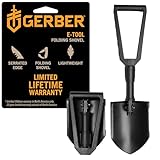
Most CompactGerber E-Tool Folding Spade
Folding Steel Spade
The Gerber E-Tool is the shovel for cars with no trunk to speak of. Gerber lists a folded length of about 9.4 inches and REI lists an extended length of 23.75 inches, so it slips under a seat or into a door pocket where nothing else on this list will go. It is a steel-bladed military-style entrenching tool with a serrated edge, a glass-filled nylon handle and an anodized aluminum shaft, per retailer listings. That steel blade is the best tool here for chopping refrozen slush and the icy ridge a plow leaves behind your tires. It is not a snow-moving shovel, though: the blade is small and the tool is heavy for its size, with REI listing 2 lb 5.3 oz. Treat it as the ice and berm breaker in a small car, and accept that clearing loose snow will take a while.
Pros
- About 9.4 in folded, per Gerber
- Steel blade with serrated edge chops ice
- Fits under a seat or in a door pocket
- Nylon handle with aluminum shaft
Cons
- Small blade moves loose snow slowly
- About 2.3 lb, heavy for its size
- Short 23.75 in reach means kneeling to dig
The Bottom Line
For a small car or a motorcycle-style storage budget, the E-Tool is the only shovel here that disappears under a seat, and it breaks ice better than any of them.
Best Telescoping PolySubZero Auto Emergency Shovel
Telescoping Steel Pole, Poly Blade
The SubZero Auto Emergency Shovel takes a different approach: a plastic blade on a steel pole that twists to extend. Listings describe the handle extending to 37 inches, the longest reach on this list, and Tractor Supply lists a 23-inch metal handle with a plastic head roughly 9.5 inches wide, though another retailer lists the blade at 8.5 inches, so check the box. That reach makes it the easiest shovel here for pulling snow off a windshield or roof and clearing around the whole car while standing. It is often sold in two-packs, which makes it a cheap way to stock two vehicles. The poly blade is the compromise: it skims loose snow well but will not bite into hard plow spoil or ice the way aluminum or steel does. Pair it with a brush and scraper and it covers the light-snow commute.
Pros
- Twist-lock steel pole extends to a listed 37 inches
- Long reach clears roofs and windshields
- Frequently sold in two-packs
- Light plastic blade does not scratch paint
Cons
- Poly blade will not bite into hard plow spoil
- Blade width differs between listings
- Twist locks can loosen when caked with ice
The Bottom Line
If your winters bring powder rather than plow berms, the SubZero telescoping shovel gives the longest reach for the least money.
4. Aluminum vs Plastic vs Steel Blades
Blade material is the single biggest difference between car shovels, and it matters more here than on a driveway shovel. Aluminum is the default for a reason: it is light, stiff and has an edge that bites into packed snow. Avalanche shovels like the BCA Dozer 1T and Black Diamond Transfer use aluminum because avalanche debris is dense, chunky and closer to plow spoil than to fresh powder. The same property helps when a plow has buried your tires.
Plastic, usually polypropylene or a similar polymer, is cheaper and lighter and will not scratch paint if you are clearing snow off the car itself. The problem is hard snow. A plastic blade flexes and skates off compacted snow and ice, and in deep cold some plastics get brittle. For a light-snow region where the main job is brushing off a windshield and clearing powder from around the tires, plastic is fine. For anywhere plows run, it is the wrong blade to rely on.
Steel blades are the heaviest and most durable. Folding entrenching tools like the Gerber E-Tool use steel, and a serrated steel edge is the best thing you can put in a car for chopping refrozen slush and ice. The trade-off is weight and blade size: steel spades are small and heavy, so they move loose snow slowly. Think of steel as a chisel and aluminum as a shovel. Some drivers carry both.
| Blade | Breaks Plow Spoil | Weight | Best For |
|---|---|---|---|
| Aluminum | Yes | Light | Most cars, most climates |
| Steel | Yes, and chops ice | Heavy | Ice, small cars, under-seat storage |
| Plastic (poly) | Poorly | Lightest | Powder regions, clearing the car body |
Whatever the material, look at the joint between blade and shaft. That is where cheap shovels fail, usually the first time you lever against a frozen ridge. Riveted or bolted aluminum joints and avalanche-style locking shafts hold up better than push-button joints in thin tubing. If a shovel's shaft flexes noticeably when you press on it in the store, it will bend in the snow.
5. Collapsed Size and Where It Rides
Measure your storage before you buy. The picks on this page range from about 9.4 inches folded for the Gerber E-Tool, per Gerber, to 24 inches collapsed for the Black Diamond Transfer, per Black Diamond. That is the difference between a door pocket and a cargo area. A shovel that does not fit where you want it ends up in the garage, which is the same as not owning one.
Under-seat storage is the tightest and the most useful, because it keeps the shovel inside the cabin where you can reach it even if the trunk is frozen shut or blocked by a snowbank. Only folding spades fit there reliably. Under the cargo floor, beside the spare tire, is the next best spot in hatchbacks and SUVs, and three-piece shovels like the Lifeline break down flat enough to fit. Telescoping avalanche shovels need a trunk or cargo area, but they collapse to a single unit that does not rattle.
Rattle is worth thinking about. A loose aluminum shovel sliding around a trunk all winter is annoying and can damage other gear. Most avalanche shovels collapse into a tidy package, and a cheap strap or a pair of hook-and-loop ties keeps any shovel in place. If you carry a blanket or a winter kit bag, the shovel can ride beside it as one unit.
Reach matters as much as packed size. A shovel that is only two feet long extended forces you to kneel in slush, and a stranded driver who gets soaked is in more danger than one who stays dry. Telescoping and three-piece designs solve this by packing short and extending to 30 inches or more. The SubZero Auto Emergency Shovel has the longest listed reach here at 37 inches, which also makes it the easiest for clearing the roof and windshield.
6. Blade Size vs Leverage
A bigger blade moves more snow per scoop, but in a car-stuck situation the limiting factor is usually leverage, not volume. You are digging in tight spaces, around tires and under bumpers, often prying out compacted chunks. A medium blade around 9 to 10 inches wide, like the 9 by 10.5 inch blade listed for the BCA Dozer 1T, is a good balance: big enough to clear a path quickly, small enough to fit in a wheel well.
Very small blades, like the one on a folding entrenching tool, are excellent for chipping and prying but slow for clearing. If you expect to dig through more than a few inches of snow regularly, a small blade means many more scoops and more time in the cold. That is fine for a backup tool. It is not ideal as the only shovel in a car that sees rural roads.
Blade shape matters too. Avalanche shovels have a flat or slightly curved blade with raised sides that hold a load, and a sharpened or squared leading edge that cuts into hard snow. Cheap compacts often have rounded, thin edges that bounce off ice. A squared, stiff edge is what you want for plow spoil, and it is the main reason avalanche shovels outperform their weight class.
The shaft length sets your leverage. A short shaft gives you control for precise digging near the car. A longer shaft lets you throw snow farther and stand more upright, which reduces strain. Adjustable shafts give you both, which is why every pick here except the folding spade has more than one length.
7. D-Grip, T-Grip or Straight Shaft
Grips are easy to overlook until you are wearing thick gloves. A D-grip, the closed loop at the end of the shaft, is the easiest to hold with bulky mittens and lets you pull back on a load without your hand slipping off. Many driveway shovels and some avalanche shovels use it, and it is the safest default for a car shovel you may use in the dark and cold.
A T-grip, like the extendable one on the BCA Dozer 1T, is lighter and packs smaller. It gives good control and is comfortable with gloves, though some people find it less secure when pulling heavy snow toward them. Avalanche shovel users debate D versus T endlessly. For car use either works, as long as it is large enough for your gloved hand.
A straight shaft with no grip at all, like on most folding spades and some cheap telescoping shovels, is the least comfortable. You end up holding the shaft itself, and your hand slides when you pull. For short bursts of digging it is acceptable. For clearing a car length in front of each tire, a proper grip makes a real difference to how tired your forearms get.
Check the grip with the gloves you actually wear in winter before you commit. A grip that looks fine bare-handed can be too small to close a heavy mitten around. That small detail decides whether the shovel is pleasant or miserable to use when it counts.
8. How to Dig a Stuck Car Out
Start by clearing the tailpipe before anything else if the engine is running or you plan to run it for heat. Then stop and look at why the car is stuck. If the drive wheels are spinning in place, the problem is traction. If the car rocks but will not move, it is probably high-centered on packed snow under the chassis. The digging plan is different for each, and a minute of looking saves ten minutes of shoveling.
For traction problems, clear a path about one car length in front of each drive wheel, or behind if you are backing out, and dig down to the pavement if you can. Knock down the ridge of snow in front of each tire, since that ridge is what the tire keeps climbing and sliding back from. Then add traction under the tires: sand, cat litter or traction mats. Accelerate gently in the highest gear your car allows to keep wheel spin down.
For a high-centered car, the job is clearing the snow packed under the bumpers and the chassis so the wheels can carry the weight again. This is where a short blade and a stiff edge earn their place, because you are digging horizontally under the car. Work from both sides and clear as much as you can reach before trying to drive. Rocking gently between forward and reverse can help once the worst of it is gone.
Pace yourself. Shoveling heavy snow is hard work, and cardiologists routinely warn that it strains the heart, especially in cold air and for people who do not exercise regularly. Take breaks in the car, stay dry and keep the tailpipe clear. If the car will not come free and you are on a remote road, the guidance relayed from NHTSA is to stay with the vehicle, make it visible and call for help rather than walk off into a storm.
9. Avalanche Shovels vs Cheap Compacts
Avalanche shovels, like the BCA Dozer 1T and Black Diamond Transfer, cost several times more than a hardware-store compact, and the question is whether a car needs one. The honest answer depends on where you drive. If you commute in a city with plowed streets and rarely get more than a few inches of snow, a cheap aluminum compact is enough. You will use it a few times a winter to clear a plow ridge, and it will do the job.
If you drive mountain passes, rural roads or anywhere a stuck car can mean an hour or more of digging before help arrives, an avalanche shovel is worth it. These shovels are built to move dense, chunky debris quickly, and BCA states its extendable shovels are designed to meet the UIAA standard for avalanche rescue shovels. That standard is about strength and durability under exactly the kind of load a plow berm puts on a blade.
There is a middle ground. Three-piece aluminum shovels like the Lifeline cost much less than an avalanche shovel and dig better than plastic compacts. An independent backcountry reviewer who looked at a Lifeline aluminum shovel noted its blade is narrower than avalanche-grade models and it is weaker for chopping heavy debris, but for digging out a car that is a reasonable trade for the price.
Skiers and snowboarders often already own an avalanche shovel. If yours lives in a backpack all winter, it can double as the car shovel on drive days, but do not let it become the only shovel when you leave the pack at home. A cheap compact that never leaves the car is better than an expensive shovel that is somewhere else.
10. What Else Goes in a Winter Car Kit
A shovel is one piece of a winter car kit, not the whole kit. News reports relaying NHTSA winter driving advice list a snow shovel, broom and ice scraper, sand or cat litter for traction, jumper cables, flares, a first aid kit, blankets, a phone charger, water and food. Most of that fits in a single bag beside the shovel.
Traction aids are the most useful addition. A bag of sand or non-clumping cat litter, or a pair of folding traction mats, often gets a car moving after you clear the path. A brush and scraper keeps your windows clear, and a pair of warm gloves dedicated to the car means you are not digging bare-handed when you forgot yours.
For staying put safely, carry a warm blanket, a hat, and a bright cloth to tie to the antenna or door so rescuers can see the car. Reports relaying NHTSA advice suggest keeping the dome light on at night for visibility and running the engine only for short periods with a window cracked, after making sure the tailpipe is clear.
At home, the rest of your winter prep is about keeping the car from getting stuck in the first place. Our guide to preparing a driveway for winter covers clearing paths and markers, and choosing an ice melt that will not damage concrete helps keep the end of the driveway passable. For heavy snow at home, our snow blower guide covers the machines, and our roundup of snow removal tools covers the rest of the garage kit.
11. Common Mistakes to Avoid
Leaving the Shovel in the Garage
A shovel only helps if it is in the car when you get stuck. Buy one that fits where you will actually store it, under a seat, beside the spare or in the cargo area, and leave it there from the first snow to the last. A smaller shovel that never leaves the car beats a better one at home.
Buying a Plastic Blade for Plow Country
Plastic blades skate off the compacted, partly frozen ridge a plow throws against parked cars. If you park on streets that get plowed, choose aluminum or steel. Plastic is fine for powder regions and for clearing snow off the car itself, but it is the wrong tool for breaking a plow berm.
Forgetting the Tailpipe
If you are stranded and running the engine for heat, clear the tailpipe first and keep it clear. News reports relaying NHTSA guidance warn that a blocked exhaust can push carbon monoxide into the cabin, and it has no smell. Check it every time you restart the engine during a storm.
Digging Without a Plan
Look at why the car is stuck before you dig. Spinning wheels need a cleared path and traction under the drive tires. A car that rocks but will not move is probably high-centered on packed snow under the chassis. Each needs different digging, and guessing wastes time in the cold.
Overexerting in the Cold
Shoveling heavy snow strains the heart, and cold air makes it harder. Take breaks inside the car, stay dry and do not push through chest pain or dizziness. If the car will not come free on a remote road, stay with it, make it visible and call for help.
12. Frequently Asked Questions
What is the best snow shovel to keep in a car?
For most drivers, a compact aluminum shovel that breaks down or telescopes, like the Lifeline Aluminum Sport Utility Shovel, is the best balance. It fits under a cargo floor, extends to a usable length and digs into hard plow spoil. Drivers who often face deep snow far from help should consider an avalanche-grade shovel like the BCA Dozer 1T.
Is a plastic snow shovel good enough for a car?
Only in light-snow regions. Plastic blades work on powder and are safe on paint, but they flex and skate off the compacted, partly frozen ridge a plow leaves along parked cars. If you park on plowed streets or drive rural roads, choose an aluminum or steel blade instead.
Can I use an avalanche shovel as a car shovel?
Yes, and it is one of the best options. Avalanche shovels are built to move dense, chunky debris, which is very similar to plow spoil. The catch is cost and that skiers often keep theirs in a backpack, so make sure one stays in the car rather than relying on a shovel that is somewhere else.
How big should a car snow shovel be?
A blade around 9 to 10 inches wide is a good balance between moving snow and fitting in a wheel well. For storage, measure the space first: folding spades fit under a seat at around 9 to 10 inches, three-piece shovels lie flat beside a spare, and telescoping avalanche shovels need about 22 to 24 inches of trunk space.
Do I need to clear the tailpipe if my car is stuck?
Yes, if you are running the engine. News reports relaying NHTSA winter driving guidance say to keep the exhaust clear of snow and ice to avoid carbon monoxide poisoning, run the engine only in short periods and crack a window. Carbon monoxide has no smell, so check the tailpipe every time you restart.
What else should I keep in my car in winter?
Alongside a shovel, carry an ice scraper and brush, sand or cat litter or traction mats, jumper cables, a blanket, warm gloves and a hat, a phone charger, water and some food. A bright cloth to tie to the antenna helps rescuers find you. Keep it all in one bag so nothing gets left behind.
Is a folding entrenching tool good for snow?
It is excellent for chopping ice and hard plow ridges and fits under a seat, but the small blade moves loose snow slowly. A tool like the Gerber E-Tool is a great choice for a small car or as an ice-breaker alongside a larger shovel, but it is not the fastest way to clear deep snow.
Related Snow Removal Guides
The Bottom Line
The best snow shovel for a car for most drivers is the Lifeline Aluminum Sport Utility Shovel: it breaks down flat, extends to a usable length and digs into plow spoil. Drivers who face deep snow far from help should step up to the BCA Dozer 1T, and small cars with no trunk space should carry a Gerber E-Tool under the seat.
Whatever you choose, buy aluminum or steel if plows run where you park, keep the shovel in the car all winter, and clear the tailpipe first if you are ever stranded with the engine running.
More in Home Improvement
Guides in this category that pair with what you just read.
About the Author
Alex Rivers, Home Improvement Editor
Alex has spent over a decade working on residential and light commercial property maintenance, and now tests every tool, coating and machine that appears in these guides personally.