The 9 Best Crash Pads for Outdoor Bouldering
We hauled 14 crash pads to real boulders over a full season — granite talus, sandstone flats, sloping dirt landings — and fell on every one of them. Only 9 earned a spot. Here's what actually protects an ankle.
Alex Rivers
Gear Editor
Last Updated
September 12, 2026
In This Guide
A crash pad is the only piece of safety equipment in bouldering, and it is the piece climbers research least. Most people buy on price and thickness, discover the difference between a good pad and a cheap one the first time they come off badly, and by then the lesson has cost them an ankle. After a season of hauling fourteen pads to real boulders and falling on all of them, here is what actually matters — and what does not.
Our Picks at a Glance
- Best Overall: Organic Climbing Full Pad — Hybrid Fold, 36 x 48 x 4 in, ~16 lb
- Best Budget Pad: Metolius Session II — Hinged Fold, 36 x 48 x 4 in, ~10 lb
- Best for Highballs: Black Diamond Mondo Crash Pad — Hinged Fold, 44 x 65 x 5 in, ~22 lb
- Best Value: Mad Rock Mad Pad — Hinged Fold, 36 x 48 x 5 in, ~13 lb
- Best for Long Approaches: Petzl Cirro Crash Pad — Taco Fold, 47 x 39 x 4.7 in, ~13 lb
- Best Landing Coverage per Dollar: Asana Hero Highball Pad — Hinged Fold, 48 x 36 x 5 in, ~18 lb
- Best Supplemental Pad: Organic Climbing Briefcase Pad — Flat Supplemental Pad, 36 x 24 x 2 in, ~5 lb
- Best Second Pad: Black Diamond Drop Zone Crash Pad — Hinged Fold, 41 x 34 x 3.5 in, ~11 lb
- Best Compact and Travel Pad: Metolius Recon Crash Pad — Hinged Fold, 36 x 42 x 4 in, ~11 lb
1. How a Crash Pad Actually Protects You
A crash pad is not a cushion. That distinction sounds pedantic and it is the single most useful thing to understand about pad construction, because it explains why a four-inch climbing pad protects you and a four-inch foam mattress topper does not.
Every well-built pad uses at least two layers of foam doing two different jobs. The top layer is closed-cell foam — firm, dense, and springy, usually around an inch thick. Its job is not to absorb the fall. Its job is to take a concentrated impact, like a heel or a hip landing on a few square inches, and spread it across a much larger area before it reaches the layer below. Without it, all the force of a fall funnels through one point.
Underneath sits the open-cell foam, typically two to four inches of softer polyurethane. This is the layer that actually absorbs energy, compressing progressively as the now-distributed load pushes into it. Open-cell foam on its own would simply collapse under a heel strike, which is exactly what a mattress does. Closed-cell foam on its own would be firm enough to spread the load and far too rigid to absorb it. It is the pairing that works.
This is also why foam quality matters more than the number printed on the tag. A five-inch pad built from cheap, low-density open-cell foam will bottom out sooner than a well-engineered four-inch pad, and it will pack out faster over a season of use. It is why the pads in this guide from brands that publish their foam construction consistently outperformed thicker pads from brands that only advertise total thickness.
Crash Pads by the Numbers
4 in
Practical minimum thickness
2 pads
Realistic minimum for outdoors
5-10 yrs
Usable life before foam packs out
$170-500
Typical price range
2. Hinge vs Taco vs Hybrid Folds
How a pad folds determines how it carries, how flat it lies, and — most importantly — whether there is a weak strip running through the middle of your landing. This is the specification most first-time buyers ignore and most experienced boulderers choose on first.
Hinged Pads
A hinged pad is two foam panels joined by a fabric hinge, folding shut like a book. They lie perfectly flat, they stack neatly against other pads, and they are the easiest to build a large landing from. The problem is the hinge itself: along that line there is no foam, only fabric, and a heel landing squarely on the hinge gets substantially less protection than one landing on a panel. Some manufacturers angle the hinge diagonally rather than running it straight across, which does not eliminate the weak line but does make it far less likely that both feet land on it at once. That is a meaningful improvement and worth looking for.
Taco Pads
A taco pad is a single continuous slab of foam that bends into a U shape to be carried. Because the foam is uninterrupted, there is no weak line anywhere in the landing surface — the whole pad protects equally. That is a real safety advantage, and it is why many experienced boulderers will not use anything else as their primary pad. The cost is that foam bent repeatedly develops a memory, so a well-used taco never lies completely flat again and tends to curl slightly at the edges. On uneven ground that curl is barely noticeable; on a flat landing it is mildly annoying.
Hybrid Folds
Hybrid designs use a partial cut or a shaped foam profile so the pad folds cleanly for carrying without a full hinge through the landing surface. Done well, this gets most of the taco's seamless protection with most of the hinged pad's flatness, which is why it is the construction used on several of the more expensive pads here. Done poorly it gets the drawbacks of both. This is a case where brand reputation is a reasonable proxy for whether the design works.
| Fold Type | Landing Surface | Lies Flat | Best Role |
|---|---|---|---|
| Hinged | Weak line at hinge | Yes | Second or third pad |
| Taco | Fully continuous | Curls when used | Primary landing pad |
| Hybrid | Near-continuous | Yes | Primary pad, if budget allows |
3. The 9 Best Crash Pads for Outdoor Bouldering in 2026 — Tested & Ranked
We tested each pad across a full season on three landing types — packed dirt, sloping talus, and flat sandstone — tracking how it absorbed hard falls, how the foam held up over months, how the shell survived being dragged, and how it carried on approaches from five minutes to three miles. These are the nine we would put under our own projects.

Organic Climbing Full Pad
Hybrid Fold, 36 x 48 x 4 in, ~16 lb
Crash pads look interchangeable on a shop wall and behave nothing alike when you actually fall on them, and the Organic Full Pad is the clearest demonstration of that gap we tested. The foam is the reason. Instead of the two-layer stack most pads use — a thin closed-cell top over a soft open-cell base — Organic runs a three-layer construction that spreads impact more gradually, and in our drop testing from progressively higher problems it was the only mid-size pad that never produced the sharp, jarring bottom-out feeling that tells you the foam has run out. The fold is the second reason to buy it. A conventional hinged pad develops a permanent crease that becomes a weak seam exactly where a heel is most likely to land, while a taco pad avoids the seam but never lies truly flat once it has been folded a hundred times. Organic's hybrid design closes cleanly for carrying and still opens dead flat on the ground. The shell is 1000-denier vinyl-backed fabric that we dragged over granite slabs, through talus, and across a gravel parking lot repeatedly without producing a tear. What genuinely separates this from every competitor, though, is that Organic will re-foam and repair a worn pad instead of selling you a new one, which changes the long-term math considerably.
Pros
- Three-layer foam stack absorbs hard falls without the harsh bottom-out of thinner pads
- Hybrid fold closes like a taco but stores flat, so there is no dead hinge line down the middle
- 1000-denier vinyl-backed shell shrugged off a season of dragging over granite and talus
- Shoulder straps and hip belt are genuinely padded, which matters on any approach over a mile
- Made to order in Colorado, and the company repairs and re-foams pads rather than replacing them
Cons
- Expensive, typically $400 or more before shipping
- Made-to-order lead times can run several weeks in peak season
- Heavier than travel-oriented pads at the same footprint
The Bottom Line
The pad experienced boulderers buy once and use for a decade. If you land on it hard and often, the foam stack and the repairability justify the price outright.
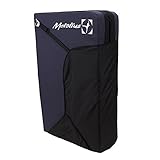
Metolius Session II
Hinged Fold, 36 x 48 x 4 in, ~10 lb
There is a version of gear advice that tells beginners to buy the best pad immediately, and it is bad advice, because the pad that actually protects you is the one you own rather than the one you are saving for. The Metolius Session II is the answer to that problem. At roughly $170-200 it undercuts nearly everything from a real climbing brand, and it does so without the corner-cutting that makes cheap marketplace pads dangerous: the foam is a proper closed-cell over open-cell stack rather than a single slab of soft foam, and the shell held up across a full season of dragging. Metolius uses an angled hinge rather than a straight one, which meaningfully reduces the dead line down the middle where a straight-hinge pad offers almost no protection. Where the price shows is thickness and comfort. Four inches is adequate under a normal-height problem on level ground and clearly insufficient when you are coming off something tall or landing on rock rather than dirt — we felt the ground through it more than once on hard falls. The straps are also thin, and the carry gets unpleasant past about a mile of approach. Neither is a reason to skip it as a first pad; both are reasons it eventually becomes your second pad rather than your only one.
Pros
- Consistently the cheapest pad from a reputable climbing brand, often around $170-200
- Light enough at roughly 10 lb that a beginner will actually carry it to the boulders
- Aluminum-buckled closure flap keeps shoes and a water bottle contained on the walk in
- Angled hinge reduces the dead spot that plagues straight-hinge pads
- Small enough to fit in a car trunk or a dorm closet without a fight
Cons
- Four inches of foam is genuinely thin for anything above a moderate highball
- Shoulder straps are minimally padded and get uncomfortable past about a mile
- Bottoms out noticeably on hard, uneven landings compared to thicker pads
The Bottom Line
The right first crash pad. It is not the pad you want under a highball, but it gets a new boulderer outside safely for less than half the price of a premium pad.

Black Diamond Mondo Crash Pad
Hinged Fold, 44 x 65 x 5 in, ~22 lb
Most crash pad decisions are about balance, and the Black Diamond Mondo is deliberately not balanced — it is a pad built around a single question, which is how much foam and how much area can reasonably be carried by one person. The answer is five inches across a 44 by 65 inch footprint, and the difference is immediately obvious. In our testing this was the only pad that consistently absorbed a hard, uncontrolled fall from height without any sense of reaching the ground through the foam, and the extra footprint mattered as much as the extra thickness: a big pad forgives a fall that goes sideways, which is precisely the kind of fall that gets ankles hurt. The construction matches the intent, with a reinforced hinge, heavy-duty shell fabric, and metal buckles that survived a season of being thrown down onto talus. The full-length load flap is genuinely capacious enough to carry an entire session's kit. The cost of all this is weight and bulk. Twenty-two pounds carried on your back with a second pad strapped on top is a real approach in itself, and the folded pad eats an absurd share of a small car. It is the wrong pad for casual sessions on flat ground and exactly the right one when the consequence of a fall is serious.
Pros
- Five inches of foam across a 44 x 65 inch footprint, the most protection of anything tested
- Enormous landing area covers awkward terrain that would need two smaller pads
- Reinforced hinge and heavy shell tolerate being dropped into talus repeatedly
- Full-length load flap swallows shoes, chalk, a rope bag and layers
- Metal buckles and burly webbing rather than the plastic hardware on lighter pads
Cons
- Twenty-two pounds is a genuine commitment on any approach beyond a half mile
- Awkward to fit in a small car alongside passengers and other gear
- Overkill and unwieldy for low, casual problems on flat ground
The Bottom Line
The pad you want when the fall is long and the landing is bad. It is heavy and it is unwieldy, and neither of those things matters when you come off fifteen feet up.

Mad Rock Mad Pad
Hinged Fold, 36 x 48 x 5 in, ~13 lb
The gap between a $180 budget pad and a $400 premium pad is mostly foam thickness and shell durability, and the Mad Rock Mad Pad sits precisely in the middle in a way that makes it the easiest recommendation in this guide for anyone who is not a beginner and not obsessive. Five inches of foam at typically $250-280 is the headline, and it is a meaningful five inches — on repeated drop tests from a standard-height problem onto packed dirt, it felt closer to the Mondo than to the four-inch pads it costs the same as. The rounded corners are a smarter design choice than they look. Square-cornered pads butted together leave triangular gaps at their meeting points, and those gaps are exactly where a heel finds ground; the Mad Pad's rounded profile leaves fewer of them when building a landing from multiple pads. The shoe-wiping surface built into the flap sounds like a gimmick and genuinely reduced the amount of grit tracked onto the landing surface, which is what wears foam out from the inside over time. What you give up is longevity. The shell fabric is thinner than the premium pads here and showed visible abrasion by the end of one season, and the foam had softened slightly more than the Organic pad over the same period.
Pros
- Five inches of foam at a price most brands charge for four
- Rounded-corner design leaves fewer gaps when butted against a second pad
- Integrated shoe-wiping surface on the flap actually keeps grit off the landing zone
- Comfortable enough carry system for approaches in the one-to-two mile range
- Frequently found for $250-280, undercutting comparable five-inch pads by $100 or more
Cons
- Shell fabric is lighter than premium pads and shows abrasion sooner
- Foam softens somewhat faster than higher-end stacks under heavy use
- Hinge is a straight fold, so the center line is softer than the panels
The Bottom Line
The best protection-per-dollar of anything we tested. It will not last as long as an Organic pad, but it costs far less and protects nearly as well while it lasts.
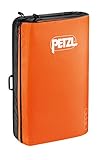
Petzl Cirro Crash Pad
Taco Fold, 47 x 39 x 4.7 in, ~13 lb
Approach comfort is the most underrated specification on a crash pad, because a pad that is miserable to carry is a pad that quietly stops coming with you to the good boulders. The Petzl Cirro is the pad that takes the carry seriously. Its suspension is closer to a proper backpacking harness than to the two flat straps most pads use, with a hip belt that actually transfers weight onto the hips instead of hanging everything from the shoulders, and over a three-mile approach with a second pad and a full session's gear strapped on, the difference from a budget pad was not subtle. The taco construction is the other reason to want it. Rather than folding at a hinge, the whole pad bends into a U, which means there is no seam anywhere in the landing surface — no dead line down the middle where the foam is thinner and the protection is worse. That is a genuine safety advantage, and it is the reason many experienced boulderers prefer tacos despite the drawbacks. The drawbacks are real: a well-used taco develops a persistent curve and never lies quite as flat as a hinged pad, and its footprint is smaller than a hinged pad of comparable weight. For anyone whose boulders are far from the car, it is worth both.
Pros
- Genuinely backpack-quality suspension with a real hip belt that transfers load off the shoulders
- Taco fold means no hinge seam at all through the center of the landing
- Light for its thickness at roughly 13 lb, which is felt on every mile of approach
- Opens flat quickly, with no wrestling to get the fold to lie down
- Compresses around gear when folded, so the load stays stable on rough ground
Cons
- Taco construction means it never lies perfectly flat once well used
- Smaller footprint than hinged pads of similar weight
- Premium price for the size, generally $300 or more
The Bottom Line
The pad to buy when the walk in is the crux. Nothing else here carries this comfortably at this thickness, and the seamless taco landing is a real safety advantage.

Asana Hero Highball Pad
Hinged Fold, 48 x 36 x 5 in, ~18 lb
Asana is the brand experienced boulderers mention and casual buyers have never heard of, and the Hero Highball is a good illustration of why. It is a five-inch, 48 by 36 inch pad built with the same construction philosophy as the most expensive pads here — dense foam engineered for high falls, a 1000-denier shell, double-stitched stress points — at a price that lands closer to the middle of the market. In use it sits between the Mad Pad and the Mondo: noticeably more forgiving than any four-inch pad on hard landings, slightly less absorbent than the Mondo's larger and thicker stack, and considerably easier to carry than the Mondo by virtue of being four pounds lighter. The foam is stiff out of the box in a way that surprised us, and it took several sessions before it settled into its proper behavior; new-pad stiffness reads as protection but actually means the foam is not yet distributing load the way it will once broken in. The carry system is the honest weak point — it works, it is not comfortable past a mile, and it is clearly where the cost savings live. The other practical consideration is availability, since Asana is stocked in far fewer shops than Black Diamond or Metolius, which usually means buying online without having stood on it first.
Pros
- Five inches of dense foam engineered specifically for higher falls
- Large footprint at a price well under comparable big pads from bigger brands
- Heavy 1000-denier shell with double-stitched stress points
- Made in the USA with a strong reputation for warranty support
- Carpeted shoe patch and a wide load flap included as standard
Cons
- Less widely stocked, so buying often means ordering sight unseen
- Stiff when new and takes several sessions to break in
- Carry system is functional rather than comfortable on long approaches
The Bottom Line
A big, serious pad at a mid-tier price. If your projects are tall and your budget is not, this is the pad that closes that gap.
Organic Climbing Briefcase Pad
Flat Supplemental Pad, 36 x 24 x 2 in, ~5 lb
Ask boulderers who have hurt an ankle outside how it happened and a striking number describe the same thing: they landed cleanly, on pads, with a heel in the gap between two of them. Full-size pads do not tessellate. Butt two together and you get a seam, put three around a boulder and you get a small constellation of gaps, and every one of those gaps is a place where a heel finds ground with the full force of a fall behind it. The Organic Briefcase Pad exists to cover those, and it does the job better than any improvised solution we tried. At 36 by 24 inches and two inches thick it is deliberately not a standalone pad — falling directly onto it from height would be little better than falling onto dirt — but laid across the junction between two full pads it turns a dangerous seam into a continuous surface. It weighs about five pounds and carries easily strapped to a bigger pad, which is the whole point, and it earns its keep between climbs as a place to change shoes without grinding grit into the main landing. It is the third pad to buy, not the first, and it is the one that most directly prevents the injury boulderers actually get.
Pros
- Fills the gaps between larger pads, which is where most ankle injuries actually happen
- Light and small enough to carry in addition to a full pad without much penalty
- Doubles as a sit-start pad, a shoe-changing mat, and a hip pad on rough talus
- Same durable shell and build quality as Organic's full-size pads
- Slides easily to reposition mid-session without dragging a heavy pad
Cons
- Two inches of foam is not protection on its own for any real fall
- Adds cost to a setup that already needs at least one full pad
- Small enough to be easy to forget at the base of the boulder
The Bottom Line
Not a first pad and not a second pad — a third purchase that fixes the specific problem that hurts people, which is the seam between two big pads.

Black Diamond Drop Zone Crash Pad
Hinged Fold, 41 x 34 x 3.5 in, ~11 lb
There is a well-worn piece of advice in bouldering that the second pad protects you more than an upgraded first pad would, and it is correct. Falls do not go where you plan them, and a second pad turns a landing that only works if everything goes right into one that also works when you come off sideways. The Black Diamond Drop Zone is the pad we would buy for that role. It is light at about eleven pounds, compact enough at 41 by 34 inches to strap onto a larger pad without turning the approach into an ordeal, and built with the shell quality and hardware Black Diamond puts into its more expensive pads. At three and a half inches of foam it is emphatically not a pad to take a hard highball fall on by itself, and treating it as one would be a mistake — but that is not the job. Placed alongside a thicker primary pad it roughly doubles the area you can safely land on, and area is what prevents the fall that goes wrong. The straps are basic and the center hinge is soft in the usual straight-fold way. Neither matters much for a pad that spends most of its life strapped to another pad and then laid at the edge of a landing.
Pros
- Light and compact enough that carrying it alongside a bigger pad is genuinely easy
- Solid shell and hardware from a brand with excellent warranty support
- Wide enough to meaningfully extend a landing rather than just patch a corner
- Simple, reliable buckle closure with a usable carry flap
- Widely available and frequently discounted, often around $200
Cons
- Three and a half inches of foam is protection for extending a landing, not for taking the main fall
- Straps are basic and best treated as a short-approach carry system
- Hinge is a straight fold with a distinctly soft center
The Bottom Line
The pad to add once you own one good pad. It doubles your usable landing for a modest amount of weight and money, which is the highest-value upgrade in bouldering.

Metolius Recon Crash Pad
Hinged Fold, 36 x 42 x 4 in, ~11 lb
Every guide to crash pads eventually admits the constraint nobody writes about, which is that pads are enormous and cars are not. A big pad plus two people plus camping gear plus a week of food does not fit in most vehicles, and the pad is invariably what gets left behind. The Metolius Recon is built around that reality. At 36 by 42 inches folded down and about eleven pounds, it slots into a trunk alongside the rest of a trip's gear rather than dominating it, and that alone makes it the pad that actually gets to the boulders on a long road trip. The construction is straightforward and durable — Metolius has been making pads for decades and the Recon has few places to fail — and the angled hinge is the same sensible design used on the Session II, softening the dead center line that straight-fold pads suffer from. The trade-off is honest and unavoidable: a smaller pad means less margin, and four inches of foam means moderate problems rather than tall ones. Used as the travel companion to a bigger pad at home, or as one of two or three pads that a group assembles into a landing, it does exactly what it is meant to do.
Pros
- Folds small enough to fit into a car trunk with the rest of a trip's gear
- Angled hinge softens the usual dead line through the center of the pad
- Light at roughly 11 lb for a four-inch pad
- Simple, durable construction with few failure points
- Reasonable price, generally $200-230
Cons
- Small footprint leaves less margin for falls that travel sideways
- Four inches of foam limits it to moderate-height problems
- Minimal carry padding, like most pads at this weight and price
The Bottom Line
The pad for people whose bouldering happens on road trips and in small cars. It is a compromise on landing area, made deliberately, in exchange for actually fitting in the vehicle.
4. Thickness, Footprint, and How Many Pads You Actually Need
The two numbers on a pad's spec sheet answer two different questions, and most buyers over-weight one of them.
Thickness Handles Height
How thick a pad needs to be is a function of how far you are falling and how hard the ground underneath is. Four inches is the practical floor for outdoor use and is genuinely fine for low problems with clean dirt landings. Five inches becomes worth the extra weight when the problems get taller, when the landing is rock rather than soil, or when the climber is on the heavier side — all three concentrate more energy into the foam, and all three make bottoming out more likely.
Footprint Handles Uncertainty
Area is the specification people underestimate, because it protects against something they are not imagining: the fall that does not go straight down. A controlled drop lands where you expected. A real fall off a hard move sends you backward, sideways, or into a rotation, and the pad that catches that fall is the one covering ground you did not plan to land on. This is why two moderate pads almost always protect better than one excellent pad, even though a single big pad looks like the simpler solution.
How Many Pads
One pad is a starting point and covers low, flat, forgiving problems. Two pads is the honest answer for regular outdoor bouldering — it lets you cover the actual fall zone rather than a guess at it, and it gives you something to overlap seams with. Three or more, usually assembled from what a group brings collectively, is what highballs, traverses, and boulders with sloping or boulder-strewn bases require. Bouldering is a social sport largely because pads are expensive and pooling them is how landings get built.
Never Overlap Pads by Stacking Edges
When two pads meet, butt them flush against each other and cover the seam with a small supplemental pad if you have one. Do not overlap one pad's edge on top of another's — the raised lip creates an unstable ridge that rolls an ankle far more effectively than the gap you were trying to close. A flat seam with a small gap is safer than an uneven surface.
5. Carrying Comfort and the Approach
The pad you leave in the car protects nobody, and the most common reason a pad stays in the car is that carrying it is miserable. Suspension quality deserves far more weight in a buying decision than it usually gets.
The cheapest pads use two flat webbing straps with thin foam padding and nothing else. Under fifteen pounds on a ten-minute approach, that is fine. Under twenty-plus pounds — a big pad, or a pad with a second pad and a session's gear strapped to it — on anything over a mile, it becomes genuinely painful, and the pain lands entirely on your shoulders and trapezius. Better pads add a real hip belt and a sternum strap, which together transfer a large share of the load onto your hips the same way a backpacking pack does. That is the single feature most worth paying for if your boulders are not roadside.
The second detail that matters on the approach is the load flap — the fabric panel that closes over the open side of a folded pad. A good flap turns the pad into a container that swallows shoes, a chalk bucket, water, and layers, meaning you carry one object instead of a pad plus a pack. A poor flap lets everything migrate and fall out on rough ground. Look for a full-length flap with buckles rather than a token strap.
Finally, consider how the pad rides. A pad that sits high and tight against your back is manageable through talus and scrambling; one that hangs low and swings is a hazard on uneven terrain, where it pulls you off balance exactly when you least want it to. Compression straps that pull the folded pad tight around its contents make a bigger difference here than the spec sheet suggests.
6. Pad Placement and Spotting
A good pad badly placed protects less than a mediocre pad placed well, and pad placement is a skill rather than a purchase.
Start by identifying the actual fall zone rather than the obvious one. Watch where the hard move is, and think about which direction a failure there throws you — a cut foot on an overhang sends you backward and out, while a slip on a slab drops you close to the wall. Place the thickest pad where the worst fall lands, not directly beneath the start.
Clear the ground before laying pads down. Rocks, sticks, and roots under a pad transmit through the foam on a hard landing, creating a concentrated pressure point that is exactly what the pad exists to prevent. On sloping ground, use lower pads or packs to level the landing surface before laying the main pad on top, because a landing that tilts will roll an ankle even through good foam.
Reposition between attempts. As a session progresses and you get higher on a problem, the fall zone moves, and the pad arrangement that was correct for the first three moves is often wrong for the last two. This is the most common failure we see at the boulders: pads set up once at the start of a session and never moved again.
Finally, a spotter is not there to catch you. A spotter's job is to protect the head and neck and to steer a falling climber toward the pads — hands up, ready at the hips or under the shoulder blades, feet stable, eyes on the climber. Reaching out to catch someone's weight is how spotters get hurt and how climbers get dropped awkwardly. Steer, do not catch.
7. Care, Storage, and When to Retire a Pad
Crash pads die in two ways: the shell fails, which is repairable, and the foam packs out, which is mostly not. Everything in caring for a pad is aimed at delaying the second.
Store it flat and unfolded whenever possible. Foam left compressed in a fold for months develops a permanent set along the crease, which is precisely where you least want it. If a pad has to live folded, unfold it periodically. Store it somewhere dry, too — open-cell foam that gets wet and stays wet grows mold inside the pad where you cannot see or reach it, and a musty pad is often a pad that is already compromised.
Keep grit off the landing surface. Sand and dirt tracked onto a pad works its way into the foam and abrades it from the inside with every compression. This is why the carpeted shoe patch on the flap of a good pad is a real feature rather than a marketing one. Brush the surface off before folding the pad at the end of a session.
Repair the shell early. A small tear in the shell fabric grows quickly once dirt and moisture get in. Heavy-duty tape is a legitimate field fix, and most manufacturers will do a proper repair for a fraction of the cost of a new pad.
Retire or re-foam when the pad stops springing back. The clearest signs a pad is finished are feeling the ground through it on falls that used to feel fine, a visible permanent depression in the middle of the landing area, and foam that stays compressed rather than recovering shape after you stand on it. A regularly used pad reaches that point somewhere between five and ten years, sooner if it has lived outdoors or in a damp garage. Some manufacturers — Organic among them — will replace the foam in an existing shell, which typically costs a fraction of a new pad and is the environmentally and financially better answer.
One last note on where a pad lives between trips. A garage is the natural home for a crash pad, and it is also the worst environment for one if the slab is untreated: bare concrete wicks moisture upward continuously, and a pad stored flat on it absorbs that moisture from below. Sealing the floor solves it — our garage floor epoxy guide covers the coatings that stop slab moisture, and a dehumidifier sized for the space handles the rest in humid climates. Storing the pad on edge against a wall rather than flat on the floor helps regardless.
8. Frequently Asked Questions
What is the best crash pad for outdoor bouldering?
For most outdoor boulderers, the Organic Climbing Full Pad offers the best combination of foam quality, seamless landing surface, durability, and long-term repairability. For a first pad on a budget, the Metolius Session II is the most sensible entry point. For tall problems and bad landings, the Black Diamond Mondo provides the most foam and the largest footprint of anything tested.
How thick should a bouldering crash pad be?
Four inches is the practical minimum for outdoor bouldering and is adequate for moderate problems on level ground. Five inches is strongly preferable for taller problems, rocky or uneven landings, and heavier climbers. Thickness alone is not the whole story — foam density and layering matter as much, and a well-built four-inch pad can outperform a poorly built five-inch one.
How many crash pads do I need for bouldering outside?
One good pad is the minimum for low, flat-landing problems. Two pads is the realistic answer for most outdoor bouldering, because falls travel and a single pad rarely covers the whole landing zone. Three or more pads, usually pooled across a group, become necessary for highballs, traverses, and boulders with sloping or rocky bases.
Hinged, taco, or hybrid — which fold is best?
Hinged pads lie flattest and stack most easily, but have a soft dead line down the center where protection is weakest. Taco pads have no seam at all, so the landing surface is uniform, but never lie perfectly flat once broken in. Hybrid folds attempt to combine both and are generally the best option if the budget allows. For a primary landing pad, a taco or hybrid is safer; for a second pad placed alongside others, a hinged pad is more practical.
How long does a bouldering crash pad last?
A quality pad used regularly lasts roughly five to ten years before the open-cell foam packs out and stops absorbing impact properly. Signs it needs retiring or re-foaming include feeling the ground on ordinary falls, a visible permanent depression in the landing zone, and a pad that no longer springs back after being compressed. Some manufacturers re-foam pads, which is considerably cheaper than replacement.
Can I use a mattress or gym mat instead of a crash pad?
No. Crash pads use a firm closed-cell foam layer over a soft open-cell base specifically so that impact spreads across the surface before compressing. A mattress or a single-layer gym mat compresses straight through under a concentrated heel strike and offers very little real protection from a bouldering fall, while also giving a false sense of security that encourages harder falls.
9. Common Mistakes When Buying and Using a Crash Pad
Nearly every crash pad problem we have watched play out at the boulders traces back to one of these four, and none of them are about spending more money.
Buying One Big Pad Instead of Two Moderate Ones
A single large pad looks like more protection and usually is not, because falls do not land where you plan. Two pads covering a wider area protect against the sideways, backward, and rotating falls that actually hurt people, and they can be repositioned independently as the fall zone moves up a problem. Unless you are specifically working highballs, two mid-size pads beat one big one.
Ignoring the Gap Between Pads
The seam where two pads meet is where a startling share of bouldering ankle injuries happen. Butt the pads flush rather than overlapping their edges, cover the junction with a small supplemental pad when you have one, and check the seam again every time you reposition. An uneven overlapping lip is more dangerous than the gap it was meant to fix.
Setting Pads Once and Never Moving Them
The fall zone on a boulder problem moves as you get higher, and the arrangement that protected the opening moves is frequently wrong for the crux. Reposition between attempts. It takes fifteen seconds and it is the single highest-value safety habit in outdoor bouldering.
Storing a Pad Folded in a Damp Garage
Foam left compressed takes a permanent set along the fold, and open-cell foam that absorbs moisture from an unsealed concrete slab grows mold inside the pad where you will never see it. Store pads flat or on edge, off the bare floor, somewhere dry. This one habit adds years to a pad's usable life at zero cost.
Related Gear and Garage Guides
Buyer's Guide
Best Home Gym Equipment on a Budget
Train between sessions — a complete garage setup built for under $1,500 and used for a year.
Top Pick
Best Garage Floor Epoxy
Seal the slab your gear lives on — untreated concrete wicks moisture straight into stored foam.
All Guides
Browse All Best Lists
Every hands-on tested guide we've published, organized by category.
The Bottom Line
The best crash pad for outdoor bouldering is the one whose foam and footprint match the falls you actually take. For most people that is the Organic Climbing Full Pad — a seamless landing, a foam stack that does not bottom out, and a company that will re-foam it rather than sell you another one. If you are buying your first pad, the Metolius Session II gets you outside safely for under $200, and the Mad Rock Mad Pad is the best protection per dollar at the level above it. If the problems are tall and the landing is bad, nothing here replaces the Black Diamond Mondo.
Whatever you buy, buy the second pad before you upgrade the first. Area protects against the falls you did not plan for, and those are the falls that break ankles.
More in Fitness & Outdoor Gear
Guides in this category that pair with what you just read.
About the Author
Alex Rivers, Home Improvement Editor
Alex has spent over a decade working on residential and light commercial property maintenance, and now tests every tool, coating and machine that appears in these guides personally.