The 7 Best Garage Door Openers
Pick the drive type for your house, the power for your door, and battery backup for the day the lights go out. The brand matters less than you think.
Alex Rivers
Home Improvement Editor
Last Updated
October 17, 2026
In This Guide
For an attached garage, buy a belt drive with a DC motor and built-in battery backup; it is quiet, reliable and legal everywhere, including California. Choose a chain drive only for a detached garage, a wall-mount opener for tall, heavy or high-lift doors, and spend on cameras and smart features last.
Our Picks at a Glance
The Short Answer
Chamberlain B4310 3/4 HP Smart Belt Drive Garage Door Opener with Camera (Best Overall). The opener most attached-garage homes should buy: quiet, smart, battery-backed, and powerful enough for a standard double door.
- Best Overall Chamberlain B4310 3/4 HP Smart Belt Drive Garage Door Opener with Camera — Belt Drive, 3/4 HP DC, Camera + Battery BackupCheck Price
- Best for Alexa & Google Homes Genie StealthDrive Connect 7155-TKV Belt Drive Garage Door Opener — Belt Drive, 1-1/4 HPc DC, Aladdin ConnectCheck Price
- Best Wall-Mount Chamberlain RJO101 Wall Mount Smart Garage Door Opener — Wall Mount (Jackshaft), Direct Drive DCCheck Price
- Best Budget Belt Drive Chamberlain B3000 1/2 HP Belt Drive Garage Door Opener with Battery Backup — Belt Drive, 1/2 HP DC, Battery BackupCheck Price
- Best Budget Chain Drive Genie Chain Drive 750 7035-TKV Garage Door Opener with Battery Backup — Chain Drive, 3/4 HPc DC, Battery BackupCheck Price
- Best for Heavy Doors Chamberlain B6630 1 HP Smart Belt Drive Garage Door Opener with Camera — Belt Drive, 1 HP DC, Camera + Battery BackupCheck Price
- Best Value Smart Opener (Outside California) Genie QuietLift Connect 3053-TKV Belt Drive Garage Door Opener — Belt Drive, 3/4 HPc DC, Aladdin ConnectCheck Price
We may earn a commission when you buy through these links, at no extra cost to you. How we test
Best Overall
Chamberlain B4310 3/4 HP Smart Belt Drive Garage Door Opener with Camera
1. How We Picked
A garage door opener is a motor, a drive and a safety system, and the differences between brands matter far less than matching the drive type and power to your door and your house. We started from the three questions that decide most purchases: is the garage under or beside living space, how heavy and tall is the door, and do you need it to work when the power is out. Every opener on this list is the best answer to one combination of those questions.
We favored DC motors. Almost every current opener from Chamberlain and Genie now uses one, and for good reason: DC motors start and stop softly, run more quietly, and are what makes integrated battery backup practical. We also gave heavy weight to battery backup itself. It is legally required on new openers sold in California, and it is the feature you will be most grateful for the first time a storm knocks out power with the car inside.
Smart features came next. Built-in Wi-Fi is now standard on mid-range openers, and the ability to check whether the door is closed from your phone is genuinely useful. We noted where cameras and video history require subscriptions, because that is a running cost the box does not mention. We also looked hard at what is included, since a keypad and second remote can add a meaningful amount to the real price.
Chamberlain introduced a new retail lineup in late 2025, and older favorites such as the B6765T are now listed as previous versions. Every opener here is a current model, specifications come from the manufacturer's listings, and rating counts are from Amazon at the time of writing. We did not include LiftMaster models, because they are sold and installed through dealers rather than off the shelf; we cover when a pro install makes sense below.
2. Belt vs Chain vs Wall-Mount vs Screw
Belt drives use a steel-reinforced rubber belt to pull the trolley along the rail. They are the quietest ceiling-mounted option, transmit little vibration into the joists, and are the default choice for any garage under a bedroom or next to a living room. They cost a little more than chain drives and the belt is the wear item, though modern warranties on belts are long. For most attached garages, a belt drive is the right answer.
Chain drives do the same job with a metal chain. They are the cheapest, very durable, and handle heavy doors well, but they are noticeably louder and the clank travels through the structure. In a detached garage or one with no living space above or beside it, that does not matter and a chain drive saves money. Modern DC chain openers are much quieter than the AC chain units many people remember, but they are still louder than a belt.
Wall-mount openers, also called jackshaft openers, mount on the wall beside the door and turn the torsion bar directly. There is no rail, no trolley and nothing on the ceiling, which frees overhead space for storage racks, car lifts or a ceiling fan. They are the quietest option of all and they handle tall, heavy and high-lift doors that a rail opener struggles with. They require a sectional door with torsion springs above it, and they cost the most.
| Drive type | Noise | Best for | Watch out for |
|---|---|---|---|
| Belt | Quiet | Attached garages, bedrooms above | Slightly higher price than chain |
| Chain | Loudest | Detached garages, tight budgets | Vibration into the house |
| Wall-mount (jackshaft) | Quietest | Tall, heavy, high-lift or low-headroom doors | Torsion springs required, highest price |
| Screw | Moderate | Few moving parts | Largely discontinued, sensitive to cold |
Screw-drive openers use a threaded steel rod to move the trolley. They have fewer moving parts but are noisier than belts and can be sluggish in very cold garages, and the major brands have largely stopped making them for the consumer market. If you have one that works, there is no reason to replace it; if you are buying new, choose belt, chain or wall-mount.
3. Our 7 Top Picks
Four Chamberlain and three Genie openers make the list, because those two brands dominate the openers you can buy and install yourself. Belt drives lead for attached garages, a wall-mount covers tall and high-lift doors, a chain drive covers detached garages on a budget, and one value pick is flagged for its lack of battery backup. Power ratings, door limits and warranties below are the manufacturers' own figures.

Best OverallChamberlain B4310 3/4 HP Smart Belt Drive Garage Door Opener with Camera
Belt Drive, 3/4 HP DC, Camera + Battery Backup
The B4310 is part of Chamberlain's 2025 opener lineup and hits the combination most homeowners actually need. A 3/4 HP rated DC motor drives a steel-reinforced belt, which is the quiet choice for a garage under or beside a bedroom, and it has enough lift for a standard insulated double door. A built-in battery backup keeps it working through outages, which also makes it compliant for sale in California. Wi-Fi is built in, so the myQ app can open, close and report the door's status from anywhere, and the integrated camera gives a 130-degree wide-angle live view of the garage. That camera is handy for checking whether you left the door open or watching a delivery go inside, but recorded clips need a myQ video storage subscription; without one you get alerts and live view only. Lighting is a pair of standard bulb sockets for front and rear coverage, and bulbs are not included. Chamberlain warns that most older accessories are not compatible, so budget for new remotes or a keypad if you rely on old ones. If you want a camera-free version, the B3000 below drops the camera and a little power for a lower price.
Pros
- Steel-reinforced belt and DC motor for quiet operation under bedrooms
- Built-in battery backup keeps the door working through outages
- Integrated 130-degree wide-angle camera viewable in the myQ app
- Wi-Fi and myQ app control built in, plus HomeLink compatibility
- Chamberlain lists a 5-year motor and belt warranty
Cons
- Most older Chamberlain remotes and keypads will not pair with it
- Recorded video history needs a paid myQ storage plan; bulbs are sold separately
The Bottom Line
The opener most attached-garage homes should buy: quiet, smart, battery-backed, and powerful enough for a standard double door.

Best for Alexa & Google HomesGenie StealthDrive Connect 7155-TKV Belt Drive Garage Door Opener
Belt Drive, 1-1/4 HPc DC, Aladdin Connect
Genie's StealthDrive Connect is the opener with the most included in the box. You get a 1-1/4 HPc DC motor driving a steel-reinforced belt, integrated battery backup that Genie rates for up to 50 cycles when the power is out, two 3-button remotes, a wireless keypad and a multi-function wall console with a light button and vacation lock. Buy the Chamberlain equivalent and the keypad is often an extra. The bigger difference is the smart platform. Genie's Aladdin Connect is built in and works with Alexa, Google Assistant, SmartThings and Amazon Key In-Garage Delivery, and the app lets you hand out virtual keys to family members on their own phones. Chamberlain's myQ has a larger ecosystem of cameras and accessories but has historically been less open to third-party integrations, so if your home is built around a voice assistant, Genie is the easier fit. Installation help comes through the BILT app's 3D step-by-step guide. The 7155 is rated for sectional doors up to 7 feet high and 500 lbs, and taller doors need an extension kit, so measure before you order. For a typical two-car door it has more than enough lift.
Pros
- 1-1/4 HPc DC motor with a steel-reinforced belt
- Built-in Aladdin Connect Wi-Fi works with Alexa, Google Assistant, SmartThings and Amazon Key
- Integrated battery backup rated for up to 50 cycles during an outage
- Ships with two 3-button remotes, a wireless keypad and a wall console with vacation lock
- Interactive 3D install instructions in the BILT app
Cons
- Rated for sectional doors up to 7 feet high and 500 lbs; 8-foot doors need an extension kit
- Aladdin Connect has a smaller accessory ecosystem than myQ
The Bottom Line
The most complete box on the list, and the better smart-home citizen if your house runs on Alexa or Google.

Best Wall-MountChamberlain RJO101 Wall Mount Smart Garage Door Opener
Wall Mount (Jackshaft), Direct Drive DC
A wall-mount opener, also called a jackshaft, does not hang from the ceiling or pull the door along a rail. It sits on the wall beside the door and turns the torsion bar directly, which is why it is so quiet and why it frees the entire ceiling for overhead storage, a car lift or a ceiling fan. The RJO101 is Chamberlain's current retail wall-mount model. Chamberlain rates it for standard sectional doors up to 14 feet high and 18 feet wide, up to 180 square feet, including high-lift tracks of up to 54 inches, which covers doors a ceiling-mount opener struggles with. The automatic garage door lock is a real security upgrade: a deadbolt drops into the track every time the door closes, so the door cannot be forced up. Battery backup and myQ app control are built in. The catch is compatibility. It only works on sectional doors with torsion springs, needs an outlet near the mounting point, and costs well above a belt-drive opener. If your door uses extension springs along the tracks, you need a spring conversion before this is an option.
Pros
- Mounts beside the door on the torsion bar, freeing the ceiling for storage, lifts or a fan
- Rated for sectional doors up to 14 feet high, 18 feet wide and 180 sq ft, including high-lift tracks
- Automatic garage door lock deadbolts the door each time it closes
- Integrated battery backup and myQ smartphone control
- Very quiet, with almost no vibration transmitted into the house
Cons
- Only works with sectional doors on torsion spring assemblies
- Costs considerably more than a ceiling-mount belt opener
The Bottom Line
The right opener for tall, heavy, high-lift or low-headroom doors, and for anyone who wants the ceiling back.
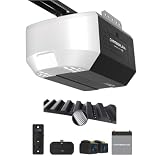
Best Budget Belt DriveChamberlain B3000 1/2 HP Belt Drive Garage Door Opener with Battery Backup
Belt Drive, 1/2 HP DC, Battery Backup
The B3000 is the starting point of Chamberlain's current belt-drive line, and it keeps the two features that matter most for an attached garage: a quiet DC motor with a reinforced belt, and a built-in battery backup. That backup is not optional in California, where new openers must have one, and it is worth having anywhere power fails. The 1/2 HP rating is enough for a standard single door and most lightweight steel double doors that are properly balanced, which is what a typical tract home has. Chamberlain markets it as myQ compatible and HomeLink compatible, so you can run it from your car's built-in buttons, and the box includes a wall control, safety sensors and a remote. Lighting is a single bulb socket with the bulb sold separately, which is less light than the camera models offer. As with the rest of the new lineup, Chamberlain notes that most older accessories will not pair with it, so do not plan on reusing your old remotes. Step up to the B4310 if your door is a heavy insulated double, you want the camera, or you want front and rear lighting.
Pros
- Quiet DC motor and reinforced belt at an entry-level price
- Battery backup included, so it is legal to install in California
- myQ compatible and HomeLink compatible for car-button control
- Wall control, safety sensors and remote in the box
- Chamberlain lists a 5-year motor and belt warranty
Cons
- 1/2 HP rating suits standard single doors and light double doors, not heavy wood ones
- Single bulb socket and the bulb is sold separately
The Bottom Line
The cheapest way into a quiet, battery-backed Chamberlain belt opener for a standard door.

Best Budget Chain DriveGenie Chain Drive 750 7035-TKV Garage Door Opener with Battery Backup
Chain Drive, 3/4 HPc DC, Battery Backup
Chain drive is the oldest and cheapest way to move a garage door, and in a detached garage or one that is not under living space, the noise does not matter much. Genie's Chain Drive 750 pairs that chain with a 3/4 HPc DC motor, which is enough for most double doors, and includes an integrated battery backup rated for up to 50 cycles after a power failure. Genie lists it as compliant with California's SB 969 battery-backup law. The kit is generous for the price: two pre-programmed remotes, a wireless keypad and a multi-function wall console with vacation lock and light control. The five-piece rail snaps together, which removes one of the fiddlier steps of installation. Warranty coverage is a limited lifetime on the motor, five years on the chain and parts and one year on accessories. The trade-offs are noise and smarts. Chains clank and transmit vibration into ceiling joists, so do not put this under a bedroom. Built-in Wi-Fi is not listed, so app control requires an add-on. If the garage is attached, spend the extra on a belt drive.
Pros
- 3/4 HPc DC motor with a heavy-duty chain at a budget price
- Integrated battery backup rated for up to 50 cycles, compliant with California SB 969
- Includes two remotes, a wireless keypad and a wall console with vacation lock
- Five-piece rail snaps together for a faster install
- Limited lifetime motor warranty with 5-year chain and parts coverage
Cons
- Chain drive is noticeably louder than a belt, so it is best for detached garages
- No built-in Wi-Fi listed, so app control needs an add-on
The Bottom Line
A tough, inexpensive, battery-backed opener for a detached garage or a door far from any bedroom.

Best for Heavy DoorsChamberlain B6630 1 HP Smart Belt Drive Garage Door Opener with Camera
Belt Drive, 1 HP DC, Camera + Battery Backup
The B6630 is the higher-powered sibling of the B4310 in Chamberlain's current belt-drive range. It uses a DC motor that Chamberlain rates as comparable to a 1 HP AC motor, which is the honest way to describe DC opener power, paired with a reinforced belt for quiet operation. It is the right choice for heavy doors: insulated steel double doors with windows, wood or wood-composite carriage doors, and doors in busy households that cycle many times a day. Like the B4310, it has built-in Wi-Fi, myQ app control, an integrated camera and battery backup. The most meaningful upgrade over the 3/4 HP model may be the warranty. Chamberlain lists 10 years on the motor and belt, double the coverage of the cheaper models in the lineup. Lighting is a single LED arrangement. This is a newer model with only a few dozen owner ratings so far, so it lacks the track record of older openers, though it shares its platform with the rest of the current line. If your door is a standard steel double and is properly balanced, the extra power is not needed and the B4310 is the better buy.
Pros
- 1 HP rated DC motor for heavy insulated or wood-clad double doors
- Built-in camera and Wi-Fi with myQ app control
- Battery backup for power outages
- Chamberlain lists a 10-year motor and belt warranty
- Quiet reinforced belt drive
Cons
- Newer model with few owner ratings so far
- Costs noticeably more than the 3/4 HP B4310
The Bottom Line
Worth the step up only for heavy doors or very high daily cycles; otherwise the B4310 does the same job for less.

Best Value Smart Opener (Outside California)Genie QuietLift Connect 3053-TKV Belt Drive Garage Door Opener
Belt Drive, 3/4 HPc DC, Aladdin Connect
The QuietLift Connect is Genie's value smart belt drive, and on paper it is excellent: a 3/4 HPc DC motor and steel-reinforced belt for quiet running, built-in Aladdin Connect Wi-Fi that works with Alexa and Google Assistant, and the same generous kit as the more expensive Genie, with two 3-button remotes, a wireless keypad and a wall console. Warranty coverage is a limited lifetime on the motor, 15 years on the belt, five years on parts and one year on accessories, which is better belt coverage than most rivals offer. The reason it ranks last is a single omission. Genie's documentation says the 3053 is not compatible with a battery backup. That means it cannot legally be sold or installed in California, where every new residential opener needs one, and anywhere else it means a power cut leaves you pulling the emergency release. If outages are rare where you live and you are comfortable releasing the door by hand, it is a quiet, smart opener at a good price. If not, the 7155-TKV adds the backup and more power. Like the 7155, it is rated for doors up to 7 feet high and 500 lbs.
Pros
- Quiet 3/4 HPc DC motor with a steel-reinforced belt
- Built-in Aladdin Connect Wi-Fi with Alexa and Google Assistant support
- Two 3-button remotes, a wireless keypad and a wall console included
- Limited lifetime motor and 15-year belt warranty
- Snap-together five-piece rail
Cons
- Not compatible with a battery backup, so it cannot be installed in California
- Rated for doors up to 7 feet high and 500 lbs
The Bottom Line
A quiet, smart belt drive at a lower price, provided you live outside California and accept no outage backup.
4. Horsepower, HPc and Newtons
Opener horsepower ratings are less straightforward than they look. Old AC openers were rated by true motor horsepower, and the familiar 1/2, 3/4 and 1 HP classes come from that era. Modern DC motors produce their lifting force differently, so manufacturers rate them by comparison. Genie uses HPc, meaning horsepower comparable, and Chamberlain notes on its listings that its DC horsepower figures are for comparison with AC motors because DC lift capacity is not typically measured in horsepower. In Europe and Australia, openers are usually rated in Newtons of pulling force instead, which is the most direct measure of all.
The practical meaning is the same: a higher rating lifts heavier doors more easily and with less strain over time. As a rough guide, a 1/2 HP class opener suits a standard single door and lightweight steel double doors, a 3/4 HP class opener suits most insulated double doors, and a 1 HP class or larger is for heavy wood, wood-composite or oversized doors and very high daily use. If you are between two sizes, size up. A motor that is not working near its limit lasts longer and runs more quietly.
The most important thing to understand is that the opener is not supposed to lift the door's full weight. The springs do that. A properly balanced door should stay put when you lift it halfway by hand with the opener disconnected, and should feel like it weighs only a few pounds to lift. If your door slams down or shoots up, the springs need adjustment, and no opener should be asked to compensate for that. An unbalanced door is the single biggest cause of premature opener failure.
Door weight varies far more than people expect. An uninsulated single-layer steel double door is light; a triple-layer insulated door with windows can weigh much more; a solid wood carriage door can weigh several times as much. Check the door's paperwork or label if it has one. Doors that are heavy and tall are where wall-mount openers and 1 HP class belt drives earn their price.
5. Battery Backup and California's Law
California's SB 969, signed after the 2017 wildfires in which people were trapped by garage doors they could not open without power, requires every residential garage door opener manufactured for sale, sold, offered for sale or installed in the state since July 1, 2019 to have a battery backup function. It also prohibits installing a replacement garage door that connects to an existing opener without backup. Violations carry a civil penalty. If you live in California, battery backup is not a feature to weigh; it is the law.
Outside California, it is still one of the most useful features an opener can have. Integrated backup batteries typically give a few dozen cycles after the power fails; Genie rates the 7155 and Chain Drive 750 for up to 50. That is enough to get the car out during an outage and to close the door behind you, which matters both for security and for keeping weather out of the garage.
Backup batteries are a wear item. Expect to replace a sealed lead-acid or lithium backup battery every few years, and test it once or twice a year by unplugging the opener and running the door. If the opener beeps or flashes to warn of a weak battery, replace it then rather than at the next outage. If you rely on a generator during outages, an opener is a small load, and our guides to a whole house generator and a portable power station cover keeping it running longer.
If you choose an opener without backup, such as the Genie 3053-TKV outside California, learn where the emergency release cord is and practice using it. Pulling it disconnects the door from the trolley so you can lift it by hand, which is only easy when the springs are balanced. Never pull the release with the door open and unsupported, because a door with a broken spring can drop.
6. Smart Features: myQ, Aladdin Connect and Subscriptions
Built-in Wi-Fi is now common across mid-range openers, and its core function is simple and valuable: your phone tells you whether the door is open, lets you close it from anywhere, and can alert you when it opens. That alone fixes the most common garage worry, which is driving away and wondering whether you closed it. You can also let in a family member, contractor or delivery driver without handing out a code.
Chamberlain and LiftMaster openers use myQ. It has the largest ecosystem of compatible keypads, cameras and car integrations, and it supports Amazon Key in-garage delivery. Historically it has been less open to third-party smart-home platforms than some rivals, so check that your preferred assistant or hub is supported before you buy. Genie openers use Aladdin Connect, which works with Alexa, Google Assistant and SmartThings and supports virtual keys for individual users.
Cameras are the newest addition. A built-in camera, as on the Chamberlain B4310 and B6630, lets you see inside the garage live, which is reassuring when a package is delivered or you are not sure whether the door closed on something. Live view and motion alerts are free, but saved video history requires a myQ video storage plan, sold as a yearly or monthly subscription. Without it there is no local recording, so decide in advance whether you will pay for clips.
Do not let smart features decide the purchase. Drive type, power and battery backup determine whether you will be happy with an opener in five years; Wi-Fi and cameras are what you use day to day. If you already own a standalone smart garage controller or camera, a non-smart opener with the right drive and backup is a perfectly good choice.
7. Door Size, Weight, Headroom and Ceiling Height
Before buying, measure the door height. Most ceiling-mount openers ship with a rail for 7-foot doors and need an extension kit for 8-foot doors; Genie rates the 7155-TKV and 3053-TKV for 7-foot doors up to 500 lbs, with an extension for 8-foot doors. Doors taller than that, or doors on high-lift tracks that run up the wall before turning, are where a wall-mount opener like the RJO101, rated for doors up to 14 feet high, makes sense.
Measure the headroom, the space between the top of the door's travel and the ceiling. Ceiling-mount openers need clearance for the rail and trolley above the highest point the door reaches. Low-headroom garages, common in older homes and basement garages, often cannot fit a rail opener at all, and a wall-mount opener is the usual fix. Also check where the opener will hang. It needs solid framing to attach to and a receptacle within reach of its cord.
Check the springs. Look above the door: torsion springs sit on a bar across the top of the door, while extension springs run alongside the horizontal tracks. Any ceiling-mount opener works with either. Wall-mount openers require torsion springs, and converting from extension springs is a job for a door technician, not a weekend project.
Finally, think about what else is going on the ceiling. If you are planning overhead storage, a car lift or a ceiling-mounted garage heater, a rail opener down the middle of the ceiling can get in the way. Plan the layout first, and if space is tight, the wall-mount opener solves it.
8. DIY Install vs Professional Install
Replacing an opener on a door that is balanced and in good condition is a reasonable DIY project for someone comfortable on a ladder with basic tools. Plan on most of a day for a first install. You assemble the rail, hang the motor from the ceiling framing, attach the door bracket, mount and align the safety sensors, run low-voltage wire to the wall control, and program the travel limits and force. Genie's BILT app instructions and the manufacturers' videos make it more approachable than it used to be.
The part that is not a DIY project is the springs. Torsion and extension springs hold enormous stored energy, and adjusting or replacing them is the most dangerous job in a garage. If the door does not balance, if a spring is broken, or if cables are frayed, call a door technician before installing anything. A new opener on a bad door will fail early and can be dangerous.
LiftMaster is the professional brand of the same company that makes Chamberlain, and its openers are sold and installed through authorized dealers rather than off the shelf. Dealer installation costs more, but you get an installer who will check and adjust the springs, a professional warranty and models with features such as higher force ratings. If your door needs spring work anyway, or you want a wall-mount opener on a tall or heavy door, getting quotes from a dealer is often worth it.
Whoever installs it, finish the job properly. Replace the bottom weatherstrip while the door is being adjusted, because a new opener's travel limits are set against the floor seal; our guide to the best garage door bottom seal covers the options. If water has been getting under the door for years, it is worth checking the bottom of the wood jambs and trim with a moisture meter before you close up the job.
9. Safety: Sensors, Reversal Tests and Maintenance
Every opener sold in the United States has to reverse when it meets an obstruction, and the photo-eye safety sensors mounted a few inches above the floor on each side of the door are the main line of defense. Mount them as low as the instructions specify, keep them aligned and clean, and never bypass them by mounting them high on the wall or bundling them together. Children and pets are the reason they exist.
Test the reversal function monthly. With the door open, lay a 2x4 flat on the floor in the door's path and close the door. It should reverse as soon as it touches the board. Then wave something through the sensor beam while the door is closing; it should reverse without touching anything. If either test fails, adjust the force or travel settings according to the manual, and if it still fails, stop using the opener until it is fixed.
Twice a year, run the door with the opener disconnected and check that it moves smoothly and balances halfway. Lubricate the rollers, hinges and springs with a garage-door lubricant, not grease, and check that the rail and mounting brackets are tight. Belt and chain tension should follow the manual; a chain that sags badly or a belt that slaps the rail needs adjusting.
A good opener also makes the rest of the garage easier to use. Bright, reliable lighting and a door that seals well at the floor turn the garage into usable space, which is why many people tackle the opener alongside the floor. If that is on your list, our guides to garage flooring options and the best garage floor epoxy cover the next step.
10. Common Mistakes to Avoid
Blaming the opener for an unbalanced door
Springs lift the door; the opener only guides it. If the door slams down or will not stay halfway with the opener disconnected, the springs need adjusting by a technician. A new opener on an unbalanced door strains, trips its force limits and fails early, whatever its horsepower rating.
Buying a chain drive for an attached garage
Chain drives are cheap and strong, but they clank and transmit vibration through ceiling joists into the house. If there is a bedroom above or beside the garage, the small saving is not worth hearing the door every time someone leaves early or comes home late.
Skipping battery backup to save money
In California it is illegal to sell or install a new residential opener without one, and everywhere else an outage with the car inside turns into a struggle with the emergency release. Integrated backup costs little extra, and the batteries are inexpensive to replace every few years.
Mounting safety sensors high or out of line
Photo-eyes belong a few inches above the floor, aimed at each other, on both sides of the door. Mounting them high to avoid bumping them defeats their purpose, because a child or pet can pass beneath the beam. Test the reversal monthly with a 2x4 laid flat.
Ignoring door height before ordering
Most ceiling-mount openers are set up for 7-foot doors, and an 8-foot door needs an extension kit. High-lift tracks and low headroom need a wall-mount opener. Measuring the door and the space above it before ordering avoids a stalled install and a second trip to the store.
Before You Buy
Also Needed for This Job
11. Frequently Asked Questions
What horsepower garage door opener do I need?
For a standard single door or a light steel double door, a 1/2 HP class opener is enough. Most insulated double doors are better served by a 3/4 HP class opener, and heavy wood, carriage-style or oversized doors call for 1 HP class or a wall-mount unit. When in doubt, size up, because a motor working below its limit lasts longer and runs quieter.
Is a belt or chain garage door opener better?
Belt drives are quieter and transmit less vibration, so they are the better choice for any garage attached to the house, especially with bedrooms above. Chain drives cost less and are very durable, which makes them sensible for detached garages. With modern DC motors both are reliable; the real difference is noise.
Do garage door openers need battery backup?
In California, yes. Since July 1, 2019, state law has required every residential opener sold or installed there to have a battery backup function. Elsewhere it is optional but strongly recommended, because it lets you open and close the door during an outage without pulling the emergency release and lifting the door by hand.
Can I install a garage door opener myself?
Yes, if the door is balanced and in good repair and you are comfortable on a ladder. Expect most of a day for a first install. Do not attempt spring adjustment or replacement yourself; springs store dangerous energy. If the door does not balance or a spring is broken, call a door technician before installing the opener.
What is the difference between Chamberlain and LiftMaster?
They are made by the same company. Chamberlain openers are sold at retail for homeowners to install, while LiftMaster openers are sold and installed through professional dealers, typically with dealer support and pro-oriented features. If you plan to install it yourself, buy Chamberlain or Genie; if you want installation included, get dealer quotes for LiftMaster.
Do I need a subscription for a garage door opener camera?
Not to use it live. With Chamberlain's camera openers you can view the garage live and receive motion alerts without paying. Saved video history requires a myQ video storage plan, and there is no SD card for local recording. Decide before buying whether you want recorded clips, because that is an ongoing cost the box price does not include.
How long do garage door openers last?
A well-installed opener on a balanced door commonly lasts 10 to 15 years or more, and many models carry long motor warranties. The things that shorten life are an unbalanced door, overloading a small motor with a heavy door, and neglect. Backup batteries and remotes wear out sooner and are inexpensive to replace.
Everything Else About Garage Door Openers
Related Garage Guides
The Bottom Line
For most attached garages, the Chamberlain B4310 is the opener to buy: a quiet belt drive with a DC motor, built-in battery backup, Wi-Fi and a camera. If your home runs on Alexa or Google, or you want a keypad in the box, the Genie StealthDrive Connect 7155-TKV is the better fit. Tall, heavy or high-lift doors belong on a wall-mount opener like the Chamberlain RJO101.
Before you spend anything, check that the door is balanced and the springs are sound, measure its height and the headroom, and make sure your choice includes battery backup. Get those right and almost any current opener from Chamberlain or Genie will serve you well for a decade or more.
More in Home Improvement
Guides in this category that pair with what you just read.
About the Author
Alex Rivers, Home Improvement Editor
Alex has spent over a decade working on residential and light commercial property maintenance, and now tests every tool, coating and machine that appears in these guides personally.