The 7 Best Moisture Meters
Pin meters for firewood and framing, pinless meters for walls and floors, and the scale on the display that decides whether the number means anything.
Alex Rivers
Home Improvement Editor
Last Updated
October 17, 2026
In This Guide
A moisture meter is only as useful as your understanding of its scale. On wood it gives a real percentage you can compare with published targets; on drywall and concrete it usually gives a comparison number that only means something next to a dry reference. Buy a pin meter for firewood and framing, a pinless meter for finished walls and floors, and learn which scale you are reading.
Our Picks at a Glance
The Short Answer
General Tools MMD4E Digital Pin Moisture Meter (Best Overall). The meter most homeowners should buy first: accurate enough for firewood, framing and drywall checks, simple to read, and cheap enough to keep in a drawer.
- Best Overall General Tools MMD4E Digital Pin Moisture Meter — Pin-Type, Wood + Building Material ScalesCheck Price
- Best Pinless for Walls Klein Tools ET140 Pinless Moisture Meter — Pinless, Drywall/Masonry/Hardwood/Softwood ModesCheck Price
- Best for Flooring & Woodworking Wagner Meters Orion 930 Dual Depth Pinless Moisture Meter — Pinless, Species-Adjustable, Dual DepthCheck Price
- Best Pin/Pinless Combo General Tools MMD950 Pin/Pinless Deep Sensing Moisture Meter — Pin + Pinless Combo, Remote ProbeCheck Price
- Best for Home Inspections Protimeter Mini BLD2000 Pin Moisture Meter — Pin-Type, WME Scale, Building DiagnosticsCheck Price
- Budget Pinless Pick General Tools MMD7NP Pinless Moisture Meter — Pinless, Wood + Relative Drywall/MasonryCheck Price
- Best Pro Pin Meter Delmhorst BD-2100 Digital Pin Moisture Meter — Pin-Type, Wood + Calibrated Gypsum ScaleCheck Price
We may earn a commission when you buy through these links, at no extra cost to you. How we test
Best Overall
General Tools MMD4E Digital Pin Moisture Meter
1. How We Picked
A moisture meter is a measuring tool, and the best one is the one whose number you can act on. We started with the jobs readers buy these meters for: checking whether firewood is seasoned, finding out whether a ceiling stain is an old leak or an active one, confirming that a basement wall or subfloor has dried after water got in, and checking hardwood flooring before installation. Each of those jobs rewards a different kind of meter, which is why this list mixes pin, pinless and combination models instead of crowning one winner for everybody.
We weighted scale design heavily. A meter that only offers a single generic scale forces you to guess what a reading on drywall means. The meters here either give a true wood moisture content scale with a separate building-material scale, express non-wood readings as wood moisture equivalent, or are honest that their drywall mode is a relative comparison. We avoided cheap no-name meters that print a percentage on drywall without saying what it is a percentage of.
We also looked for features that make readings repeatable: a hold button for awkward reading positions, a backlit display for crawlspaces, a calibration check in the box, and species or material settings for anyone working with real lumber. Accuracy ratings matter less than you would think. A meter rated plus or minus 2 percent and one rated plus or minus 4 percent will both tell you a wall at 40 is wet and a wall at 8 is dry. Where accuracy matters, for flooring and woodworking, we picked meters with species correction and field calibration.
2. Pin vs Pinless Meters
Pin meters measure the electrical resistance between two metal pins pushed into the material. Water conducts electricity, so the wetter the material, the lower the resistance and the higher the reading. The strengths are that the reading comes from exactly where the pin tips sit, pin meters are cheap, and they read very wet material that pinless meters cannot. The weaknesses are the holes, the need for species and temperature corrections on wood, and the fact that pins only read as deep as they penetrate, usually about 5/16 inch with integral pins.
Pinless meters send an electromagnetic field into the material through a flat sensor pad and read how the material responds. They read an average across a zone, typically down to 3/4 inch, without leaving a mark, and you can sweep them across a wall or floor in seconds. That makes them excellent for mapping where water has spread. Their weaknesses are that the reading is affected by the density of the material, by anything metal behind the surface, and by an uneven contact surface, and most of them treat drywall and masonry as relative scales rather than true moisture content.
| Pin meter | Pinless meter | |
|---|---|---|
| How it reads | Resistance between two pins | Electromagnetic field under a flat pad |
| Leaves marks | Yes, two small holes | No |
| Depth | Pin length, about 5/16 inch | Fixed zone, usually up to 3/4 inch |
| Speed over large areas | Slow, spot by spot | Fast, sweep and watch |
| Best for | Firewood, framing, confirming a wet spot | Finished floors, walls, mapping a leak |
| Main weakness | Species and temperature corrections | Density, metal behind the surface |
For most homes the right answer is both, either as two inexpensive meters or one combination meter. Scan with a pinless meter to find the edges of the wet area, then confirm the worst spot with pins to get a number. If you can only buy one, buy a pin meter for firewood and framing, and a pinless meter if most of your use is finished surfaces like hardwood floors, painted walls and tile.
3. Our 7 Top Picks
The list is built around jobs rather than price. A budget pin meter leads because it handles firewood, framing and drywall for most homeowners. Two pinless meters cover leak mapping on finished surfaces, a species-adjustable Wagner covers flooring and woodworking, a combination meter covers scanning and confirming in one tool, and two professional pin meters cover home inspections and water-damage documentation. Ranges and features below are the manufacturers' own figures.
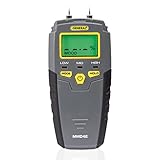
Best OverallGeneral Tools MMD4E Digital Pin Moisture Meter
Pin-Type, Wood + Building Material Scales
The MMD4E is the best-selling moisture meter on Amazon for good reason. It is a plain pin meter that does the jobs homeowners actually have: checking whether firewood is ready, finding out whether a stain on the ceiling is still wet, and confirming that framing has dried out after a leak. General Tools gives it two scales selected by a switch. The wood scale reads 5 to 50 percent, and the building-material scale reads 1.5 to 33 percent for drywall, plaster and similar materials. On top of the number, the meter shows a low, medium or high icon and beeps at a different rate for each, which is genuinely useful when you are holding it against a wall at arm's length. The manufacturer rates it at plus or minus 2 percent with 0.1 percent resolution, which is plenty for go or no-go decisions. The 8mm pins are short, so readings stay near the surface, and there is no species adjustment, so treat hardwood numbers as approximate. If you need to scan finished floors or large wall areas without making holes, pair it with a pinless meter or choose one instead.
Pros
- Separate wood (5-50%) and building-material (1.5-33%) scales selected with a switch
- Backlit LCD plus low/medium/high icons and tones, so you can read it in a dark crawlspace
- 8mm stainless pins with spares in the box, and the cap doubles as a calibration check
- Hold button freezes a reading when the display is out of sight
- Small, light, runs on a single 9V battery and sells for budget money
Cons
- No species correction, so hardwood and softwood readings are approximate
- Every reading leaves two small pin holes, which rules it out on finished floors
The Bottom Line
The meter most homeowners should buy first: accurate enough for firewood, framing and drywall checks, simple to read, and cheap enough to keep in a drawer.
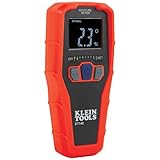
Best Pinless for WallsKlein Tools ET140 Pinless Moisture Meter
Pinless, Drywall/Masonry/Hardwood/Softwood Modes
A pinless meter changes how you hunt for leaks. Instead of poking holes every few inches, you slide the ET140 across the wall and watch for the number to climb. Klein's meter uses an electromagnetic field to sense moisture up to 3/4 inch below the surface, through paint, wallpaper and finished wood, and it switches between drywall, masonry, hardwood and softwood modes with one button. In wood modes it gives a percentage, 0 to 35 percent for hardwood and 0 to 55 percent for softwood. In drywall and masonry modes it reads 0 to 100 on a relative scale. That is the key to using it well: take a reading on a section of wall you know is dry, then compare. A spot that reads three or four times the dry reference is wet whatever the absolute number says. The nine-bar LED display makes that comparison obvious from a step back. Klein rates it for a 6.6-foot drop and lists accuracy at plus or minus 4 percent, which is fine for finding water and not fine for certifying lumber. For wood flooring decisions, a species-adjustable meter like the Orion 930 is the better tool.
Pros
- Reads up to 3/4 inch deep without leaving a mark on paint, tile or finished wood
- Four modes: drywall, masonry, hardwood and softwood
- Nine-segment LED bar beside the number makes wet and dry areas easy to map quickly
- Rated for a 6.6-foot drop, which matters on a ladder
- Hold, low-battery and auto power-off functions
Cons
- Drywall and masonry modes are relative (0-100), not percent moisture content
- Klein lists accuracy at plus or minus 4 percent, looser than a good pin meter
The Bottom Line
The fastest way to map a leak across a wall or ceiling, as long as you treat the drywall reading as a comparison rather than a percentage.

Best for Flooring & WoodworkingWagner Meters Orion 930 Dual Depth Pinless Moisture Meter
Pinless, Species-Adjustable, Dual Depth
Wagner's Orion series is what flooring installers and serious woodworkers use, and the 930 is the most versatile model for a home shop. Its pinless sensor scans a 2 by 2-1/2 inch area and offers two depth settings. The 1/4-inch mode reads only the top of the board, which is what you want for thin flooring and veneered stock. The 3/4-inch mode uses Wagner's IntelliSense technology to look deeper while ignoring surface moisture, so a damp morning does not skew a reading on thicker lumber. You set the species with up and down arrows using the included settings booklet, and a relative mode handles plywood, OSB, drywall and other non-solid materials. The feature that justifies the price is the On-Demand Calibrator that ships in the kit, which lets you confirm the meter is reading correctly before an expensive install, plus a seven-year warranty. The display reads 4 to 32 percent, so this is a precision tool for wood that is close to dry, not a leak finder for drenched framing. If your projects are mostly firewood and wall leaks, it is more meter than you need.
Pros
- Two depth modes: surface to 1/4 inch for thin stock and flooring, and 3/4 inch for thicker boards
- Species settings for almost any hardwood or softwood, plus relative mode for other materials
- Included On-Demand Calibrator lets you verify accuracy in the field
- Readings are not thrown off by wood temperature the way pin meters are
- Seven-year warranty
Cons
- Premium price, several times the cost of a basic pin meter
- Wood range tops out at 32 percent, so it is not a tool for soaking-wet framing
The Bottom Line
The meter to buy if wood flooring, furniture or lumber drying decisions are riding on the number.
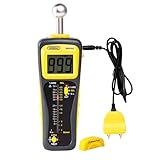
Best Pin/Pinless ComboGeneral Tools MMD950 Pin/Pinless Deep Sensing Moisture Meter
Pin + Pinless Combo, Remote Probe
The best way to investigate a leak is to scan with a pinless sensor to find the wet area, then confirm with pins to get a number. The MMD950 does both in one housing. Its pinless mode uses a ball-shaped sensor on the back of the meter that General Tools says can detect moisture up to 4 inches behind walls and ceramic tile, which is far deeper than the 3/4 inch most pinless meters reach and handy for finding a slow drip behind a tiled shower. That reading is relative, 0 to 99, so you compare against a known dry spot. When you find the wet zone, switch to pin mode and use the remote probe on its 46-inch cable to read 6 to 87.6 percent wood moisture equivalent, including in places you cannot get your face near. A jumbo LCD and a 40-dot tri-color bar graph show both readings clearly. The trade-offs are size, price and the fact that a deep-reading sensor sees everything in the wall, including copper pipe and metal studs, so learn what a dry wall reads before you panic. For restoration-minded homeowners it is the most complete single meter here.
Pros
- Pin mode reads 6 to 87.6 percent WME; pinless mode reads 0 to 99 on a relative scale
- Spherical sensor detects moisture up to 4 inches behind walls and ceramic tile
- Remote pin probe on a 46-inch cable reaches behind toilets, under sinks and into cavities
- Jumbo LCD plus a 40-dot tri-color LED bar graph
- Selectable auto power-off at 3, 5 or 10 minutes
Cons
- Bulkier and pricier than a single-mode meter
- Deep pinless readings are relative and can pick up pipes or metal inside the wall
The Bottom Line
One meter that scans first and confirms second, which is exactly how a leak investigation should go.

Best for Home InspectionsProtimeter Mini BLD2000 Pin Moisture Meter
Pin-Type, WME Scale, Building Diagnostics
Protimeter is the brand building surveyors and home inspectors have used for decades, and the Mini is its compact pin meter. Instead of a digital readout, it uses a column of 60 LEDs colored green for dry, yellow for at risk and red for wet. That sounds less precise, and for logging numbers it is, but for walking a house it is faster: you push the pins in, glance at the color and move on. The scale runs from 6 to 90 percent and reads actual moisture content in wood and wood moisture equivalent in other materials, which means drywall, plaster and masonry readings are expressed as the moisture level that wood would have in the same conditions. That is why inspectors like WME. It puts every material on one scale. The pins are small and sharp, so marks are minor. In the box you get a calibration check device, an extension pin probe for awkward spots and a carry pouch, with a two-year warranty. The Mini is overkill for checking firewood, but if you are buying a house, chasing a recurring basement problem or want readings you can explain to a contractor, it is a step up from consumer meters.
Pros
- Reads 6 to 90 percent on a wood moisture equivalent scale that works across materials
- 60-LED display split into green (dry), yellow (at risk) and red (wet) zones
- Fine, sharp pins leave very small marks
- Ships with a calibration check device, extension pin probe and pouch
- Two-year warranty
Cons
- LED bar instead of a digital number makes precise logging harder
- Costs more than consumer pin meters with similar basic function
The Bottom Line
A surveyor's meter that turns readings into dry, at-risk or wet at a glance, which is what a home inspection needs.

Budget Pinless PickGeneral Tools MMD7NP Pinless Moisture Meter
Pinless, Wood + Relative Drywall/Masonry
The MMD7NP is General Tools' answer to the Klein ET140 and it does the same core job: slide it across a surface and watch for the number to rise, without leaving a single hole. The 1-1/2 by 1-1/2 inch sensor pad reads up to 3/4 inch deep. In wood modes you get a percentage, 0 to 53 percent for softwood and 0 to 35 percent for hardwood, and for wallboard and masonry it switches to relative readings that you compare against a dry area. The display pairs a backlit LCD with a green, yellow and red bar graph, and an out-of-range alarm sounds when wood reads above 17 percent or drywall and masonry above 70 on the relative scale. That alarm is genuinely useful when you are checking a run of baseboard or subfloor and do not want to stare at the screen. The pad is smaller than the Klein's sensor, so press it flat and keep it away from edges and nail lines. General Tools backs it with a one-year warranty. Between the two, the Klein is tougher and the General is often cheaper. Either is a good partner for the MMD4E pin meter.
Pros
- Non-marring pinless pad reads up to 3/4 inch deep
- 0-53 percent softwood and 0-35 percent hardwood ranges, plus relative modes for wallboard and masonry
- Backlit LCD paired with a three-color LED bar graph
- Out-of-range alarm flags readings above 17 percent in wood
- Hold button and auto power-off
Cons
- Smaller 1-1/2 inch sensor pad needs a flat surface to read reliably
- Only a one-year warranty
The Bottom Line
A solid pinless alternative to the Klein if you want the alarm threshold and a lower price.

Best Pro Pin MeterDelmhorst BD-2100 Digital Pin Moisture Meter
Pin-Type, Wood + Calibrated Gypsum Scale
Delmhorst has built pin meters for over 70 years, and the BD-2100 is its general building-diagnostics model. What sets it apart for homeowners dealing with water damage is the sheetrock scale. Most meters read drywall on a relative scale or as wood moisture equivalent, both of which need interpretation. The BD-2100 has a gypsum-specific scale that reads 0.2 to 50 percent moisture content, so a number on a wet wall means what it says. A separate wood scale reads 6 to 40 percent, and a 0 to 100 reference scale covers concrete, roofing, insulation and EIFS. The meter averages up to 100 accumulated readings, which is how you characterize a whole wall rather than one spot, and an adjustable alarm beeps when a reading crosses the threshold you set. The integral pins penetrate 5/16 inch. For deeper work there is a jack for external electrodes such as a slide-hammer probe for framing or insulated pins for reading wood at depth, which are sold as packages. This is professional equipment at a professional price, and only worth it if you are drying out a structure or want documentation an adjuster will accept.
Pros
- Calibrated sheetrock scale (0.2-50 percent) rather than a relative or WME reading
- Wood scale (6-40 percent) and a 0-100 reference scale for other materials
- Averages up to 100 readings and has an adjustable set-point alarm
- Jack for external electrodes such as hammer probes and insulated pins
- Built-in calibration check
Cons
- Expensive, and the useful accessory electrodes add more
- Only 5/16-inch integral pins, so deep readings need the optional probes
The Bottom Line
The meter restoration pros reach for when a drywall reading has to be defensible.
4. Wood Scales, WME and Relative Readings
The single most confusing thing about moisture meters is that the number means different things on different materials. On wood, a calibrated meter reads moisture content: the weight of water in the wood as a percentage of the dry weight of the wood. A board at 12 percent holds 12 grams of water for every 100 grams of wood. That is a real physical measurement, and it is why wood readings can be compared across meters and against published targets.
Drywall, plaster, brick and concrete are a different story. Gypsum and masonry conduct differently from wood, and their actual moisture contents when dry are tiny. Meters handle that in three ways. Some, like the Delmhorst BD-2100, carry a material-specific scale calibrated for gypsum. Some, like the Protimeter Mini, express readings as wood moisture equivalent, or WME, which is the moisture content wood would reach if it sat in contact with that material. And many, especially pinless meters, simply give a relative number from 0 to 100.
None of those is wrong, but you have to know which one you are reading. A WME of 18 on a basement wall does not mean the concrete contains 18 percent water; it means the wall is damp enough to push wood touching it to 18 percent, which is close to the range where decay fungi get going. A relative reading of 40 on a pinless meter means nothing on its own. It only becomes useful when you compare it with a reading from a section of the same wall you know is dry.
THE RULE
Read the dry wall first.
On drywall and masonry, a single number is close to meaningless. A reading two or three times higher than the same material in a known-dry spot is the signal that matters.
5. What the Numbers Mean
Once you know which scale you are on, the targets are reasonably well established. Wood indoors in a heated or air-conditioned home settles at a moisture content in the single digits for much of the year in most of the United States, though it varies with region and season. Furniture-grade lumber and interior trim should be close to that before you build with it, or the joints will open as it dries in your house.
Framing lumber is graded dry at 19 percent or below, which is what the KD-19 or S-DRY stamp on a stud means. Wood that stays above roughly 20 percent for long periods is in the range where mold and decay fungi can grow, so after a leak or flood the goal is to get framing back under 19 percent and keep it there before you close up walls. For firewood, the EPA recommends burning wood with a moisture content of 20 percent or less, because wetter wood smokes, creosotes chimneys and wastes heat boiling off water.
| Material or job | Target reading | Notes |
|---|---|---|
| Firewood | 20% or lower | Split a piece and read the fresh face |
| Framing after a leak | 19% or lower | Compare with unaffected studs nearby |
| Interior trim and furniture | Close to indoor equilibrium, often single digits | Acclimate in the room first |
| Hardwood flooring vs subfloor | Within 2-4 points of each other | Narrower strips tolerate a larger gap |
| Drywall | Same as the dry reference area | Relative or gypsum scale only |
| Concrete slab | Do not rely on a pin or pinless meter | Use an RH probe or calcium chloride test |
Drywall is the odd one out. On a calibrated gypsum scale, sound dry drywall reads a fraction of a percent, and readings climb steeply once it gets wet. Because most meters do not have a true gypsum scale, the practical rule is to compare with the dry reference. If an area reads clearly higher and the room has had time to dry, the water is either still arriving or trapped behind the board. Either way, it needs investigating, and if the paper face has stained or softened, cut a test hole and look.
6. Finding Leaks and Mold in Drywall and Basements
Leak hunting is where a meter pays for itself fastest. Start at the visible stain and sweep outward with a pinless meter, or take pin readings every six inches in a grid, until readings drop to the dry baseline. Mark the edge of the wet area with painter's tape. Water travels along framing, top plates and pipes before it shows, so the wettest spot is often above or to one side of the stain, and following the readings uphill usually leads you to the source.
In basements, take readings low on finished walls, just above the baseboard, and on any wood in contact with concrete: bottom plates, furring strips and the rim joist. Those are where moisture shows up first. High readings at the bottom of a wall with normal readings at chest height point to water coming through the slab or footing, while readings that are high near the top of a foundation wall point to grading, gutters or a rim-joist problem. Our guide to fixing a damp basement walks through the fixes for each pattern.
A meter also tells you whether a dehumidifier is working. Pair your meter readings with a hygrometer, which measures the moisture in the air rather than in the materials. If the air is held around 50 percent relative humidity and wall readings are still not dropping, the water is coming from outside the room, not from the air. If both are high, the room needs more drying capacity, and our picks for the best basement dehumidifier are sized for exactly that job.
For mold, the meter is a prevention and verification tool rather than a mold detector. It cannot see spores. What it can show is whether materials are wet enough to support growth, which is the condition you have to fix before any cleanup lasts. Before you scrub or replace anything, use the meter to confirm that the source is fixed and the materials are dry; otherwise the growth comes back. Our step-by-step on getting rid of mold in a basement and our roundup of the best mold removers cover the cleanup side.
When readings stay high inside a wall cavity, or the drywall is soft or crumbly, stop measuring and open the wall. A meter can tell you there is water; it cannot tell you how much damage it has done to insulation or framing you cannot see. Cutting a small inspection hole low on the wall costs a patch and some paint, and our spackle guide covers that repair.
7. Testing Firewood Properly
Firewood is the most common reason people buy a pin meter, and also the most commonly mis-measured. The outside of a log dries first, so a reading taken on the end grain or bark side of a stacked piece will usually read drier than the wood actually is. The correct method is to take a piece from the middle of the stack, split it, and push the pins into the freshly exposed face across the grain, about halfway along the split.
Read several pieces, not one. Different species dry at different rates, and the pieces at the top and sun side of a stack can be months ahead of the ones on the bottom row. If most of your readings are at or below 20 percent, the wood is ready. If they are in the mid-20s, give it more time. Readings in the 30s or higher usually mean the wood was cut recently or has been stored where it cannot breathe, such as under a tarp that wraps down the sides of the stack.
Temperature matters too. Pin meters read lower on cold wood than on warm wood, so a reading taken outdoors in winter will look drier than it really is. If you can, bring a couple of split pieces inside for a few hours before reading them. Some pro meters have a temperature correction setting; consumer meters like the MMD4E do not, which is one more reason to test indoors.
Firewood is also a good reason to keep a meter even after the stack is dry. Buying cordwood labeled seasoned is a gamble, and a two-minute check on a few split pieces tells you whether you are paying for wood or water. If you process your own wood with a log splitter and a chainsaw, a meter is the tool that tells you when a stack is actually ready to burn rather than when the calendar says it should be.
8. Flooring Installs and Woodworking
Wood flooring is where meter accuracy really earns its price. Solid hardwood that is installed too wet shrinks as it dries and leaves gaps; flooring installed over a subfloor that is much wetter than the boards will cup as the boards take on moisture from below. The National Wood Flooring Association's guidance is to compare the moisture content of the flooring and the subfloor before installation, with a tighter allowable difference for wider planks than for narrow strip flooring.
That comparison needs a species-adjustable meter. Oak, maple and hickory each read differently on the same meter, and a meter set for the wrong species can easily be off by a few points, which is the entire allowable margin. Pinless meters like the Orion 930 are popular with installers because they read a box of flooring in seconds without marking the face, and the shallow mode avoids reading through a thin board into whatever it is sitting on. Read 20 or more boards and average them, rather than trusting one.
Engineered wood, laminate and vinyl plank follow different rules. Engineered wood and laminate still care about subfloor moisture, and the manufacturer's installation instructions will specify a maximum. Vinyl plank is waterproof itself but can trap moisture against a wood subfloor or let mold grow under it. If you are choosing between those floors, our comparison of LVP and laminate covers how each one handles moisture.
In the shop, a meter stops you from building furniture with lumber that is still moving. Stack new boards in the room where you will work, take readings every few days, and start cutting when the numbers stop dropping. If you are gluing up a tabletop, check every board, because one wet board in a panel will shrink after glue-up and crack the panel or pop a joint. A pin meter with species settings or a pinless meter like the Orion is the right tool here; a basic meter without species correction is fine for relative comparisons between boards of the same species.
9. Why Concrete Needs a Different Test
Every meter on this list will produce a number when you put it on concrete, and almost none of those numbers should be used to decide whether a slab is dry enough for flooring, epoxy or adhesive. Concrete's conductivity depends on its mix, density, salts and surface condition, and the moisture that ruins floor coverings often sits deep in the slab, well below what any pin or pinless meter reads.
Flooring manufacturers specify one of two tests instead. The in-situ relative humidity test, ASTM F2170, drills holes to a set depth, seals probes inside, and reads the humidity in the slab after it equilibrates. The calcium chloride test, ASTM F1869, measures how much moisture comes out of the surface under a sealed dome over a few days. Both take time and both are what warranties are written against. The plastic-sheet test is a quick, free screening check, and our guide to the garage floor moisture test explains how to run it and when to step up to the formal tests.
If you are planning a coating, a moisture problem in the slab is the most common reason epoxy peels. Whatever floor you are putting down, settle the moisture question first; it is far cheaper than redoing the floor. The same is true in garages, where our guide to garage flooring options notes which systems tolerate a damp slab and which do not.
10. Getting Readings You Can Trust
Most bad readings come from technique, not from the meter. Check the battery first. A weak 9V battery is the most common cause of drifting, low readings, and every meter here runs on one. If your meter came with a calibration cap or check device, use it at the start of each session. It does not recalibrate the meter, but it tells you the circuitry is reading where it should, which rules out the meter when a number looks wrong.
With pin meters, push the pins in fully and hold the meter steady. On wood, drive the pins across the grain, not along it, because most meters are calibrated that way. Set the species if the meter allows it, and remember that cold wood reads low. On drywall, push only through the paper face and gypsum; do not try to read the stud behind it with a short pin. Wipe the pins after use, because corrosion on the tips raises resistance and lowers readings.
With pinless meters, press the whole pad flat against the surface and hold it there for a second or two. Keep it away from edges, corners and the lines of drywall screws and nails, which read high. Avoid reading directly over pipes, ductwork, wiring or metal corner bead, and over tile backed by a metal lath. If a single spot reads very high and nothing around it does, move the pad an inch and read again before deciding it is wet.
Finally, write the readings down. A sheet of painter's tape with dates and numbers on it, stuck beside each test spot, turns a meter from a curiosity into a drying log. That record is what tells you when to close a wall, when to install a floor and when to call a contractor, and it is exactly what an insurance adjuster will ask for if a leak becomes a claim.
11. Common Mistakes to Avoid
Reading drywall as if it were wood
A pinless meter in drywall mode or a pin meter on its wood scale will print a number on gypsum, but that number is not percent moisture. Always take a reference reading on a known-dry section of the same wall and judge the suspect area against it, not against a firewood or lumber target.
Testing firewood on the outside of the log
The surface and ends of a log dry long before the core, so a reading on bark side or end grain flatters the wood. Split a piece from the middle of the stack and read the fresh face across the grain. Check several pieces from different parts of the stack.
Using a meter to approve a concrete slab
Pin and pinless meters only read the top of a slab and are thrown off by its mix and salts. Flooring and coating warranties are written against relative humidity probes or calcium chloride tests, so use the meter for comparisons and the proper test for the install decision.
Ignoring species and temperature settings
On hardwood flooring and furniture lumber, a meter set for the wrong species or read on cold wood can be off by several points, which is the entire margin that flooring guidelines allow. Set the species, let the wood reach room temperature, and average many boards.
Taking one reading and calling it done
A single number tells you almost nothing about whether something is drying. Mark test spots, read them at the same places every day or two, and write the numbers down. A falling trend means the drying plan is working; a flat one means there is still a source.
Before You Buy
Also Needed for This Job
12. Frequently Asked Questions
Pin or pinless: which moisture meter should I buy?
If you mainly check firewood, framing and the occasional wet wall, buy a pin meter, because it is cheaper and reads very wet material accurately. If you mainly scan finished floors, painted walls or tile and do not want holes, buy a pinless meter. If you deal with leaks often, own both or buy a combination meter like the MMD950.
What moisture reading means drywall is wet?
It depends on the meter's scale. On a true gypsum scale, dry drywall reads a fraction of a percent. On relative or WME scales, compare with a reading on a known-dry section of the same wall in the same room. An area reading two to three times higher than that baseline is wet and needs investigating.
What moisture content should firewood be?
The EPA recommends burning firewood at 20 percent moisture content or less. Wetter wood smokes, builds creosote in the chimney and wastes heat. Test by splitting a piece from the middle of the stack and reading the freshly exposed face, and check several pieces rather than one, ideally after they have warmed to room temperature.
Can a moisture meter detect mold?
No. A moisture meter measures water in materials, not mold spores. What it does tell you is whether wood or drywall is wet enough to support mold growth, which is the condition you must fix first. Use it to find the wet area, confirm the source is stopped, and verify materials are dry before and after cleanup.
Can I use a moisture meter on a concrete floor?
Only for comparisons. A meter in masonry or relative mode can show one part of a slab or wall is wetter than another, but it reads only the surface and is affected by the concrete mix. Flooring and epoxy decisions should rely on an in-situ relative humidity test or a calcium chloride test as the manufacturer specifies.
How accurate are cheap moisture meters?
Budget pin meters like the MMD4E are rated around plus or minus 2 percent on wood, which is plenty for firewood and leak checks. Their limits are the lack of species and temperature correction, not the electronics. For hardwood flooring and furniture lumber, where a few points matter, a species-adjustable meter with a calibration check is worth the money.
Is a hygrometer the same as a moisture meter?
No. A hygrometer measures relative humidity in the air, while a moisture meter measures water inside materials like wood, drywall and masonry. They work best together: the hygrometer tells you whether the room air is dry enough, and the meter tells you whether the walls, floors and framing are actually drying out.
Related Moisture & Basement Guides
The Bottom Line
Most homeowners should start with a General Tools MMD4E pin meter. It reads firewood and framing accurately, handles drywall on its building-material scale, and costs little enough to keep around for the next leak. Add a pinless Klein ET140 or General MMD7NP if you regularly check finished walls or floors, or buy the MMD950 to get both modes in one tool.
Spend more only when the number has money riding on it. A Wagner Orion 930 is worth it before a hardwood floor install or for serious woodworking, and a Protimeter or Delmhorst earns its price when you are documenting water damage. Whatever you buy, take a dry reference reading first and log your numbers over time; that habit matters more than the meter.
More in Tools & Equipment
Guides in this category that pair with what you just read.
About the Author
Alex Rivers, Home Improvement Editor
Alex has spent over a decade working on residential and light commercial property maintenance, and now tests every tool, coating and machine that appears in these guides personally.