Best Mold Removers
Mold killers, stain removers and preventers compared from their labels: EPA registration, active ingredient, contact time and the surfaces each one is actually for.
Alex Rivers
Home Improvement Editor
Last Updated
October 17, 2026
In This Guide
The best mold remover depends on the job, because the products on the shelf do three different things. Some kill mold, some remove the stains it leaves, and some help stop it coming back. A bleach spray is the right tool for black mildew in shower grout and the wrong one for a basement wall, where it whitens the stain and leaves growth behind. Pick by surface and job, read the label for the EPA registration and contact time, and fix the moisture first, because no spray beats a damp wall.
Our Picks at a Glance
The Short Answer
RMR-141 RTU Disinfectant and Mold Killer (Best Overall Mold Killer). The mold killer we would reach for first: a genuine EPA-registered fungicide with clear directions, gentle enough for wood and drywall.
- Best Overall Mold Killer RMR-141 RTU Disinfectant and Mold Killer — EPA-Registered Fungicide, Ready to UseCheck Price
- Best for Prevention and Large Areas Concrobium Mold Control — Mold Treatment and Inhibitor, Spray or FoggerCheck Price
- Best for Shower Grout and Tile Clorox Plus Tilex Mold & Mildew Remover — Bleach-Based Spray, Bathrooms and TileCheck Price
- Check Price
- Fastest Kill on Hard Surfaces Mold Armor Rapid Clean Remediation — Kill, Clean and Prevent Spray, Hard SurfacesCheck Price
- Best for Exterior Surfaces Wet & Forget Outdoor Moss, Mold, Mildew & Algae Stain Remover — Outdoor No-Rinse Treatment, ConcentrateCheck Price
We may earn a commission when you buy through these links, at no extra cost to you. How we test
Best Overall Mold Killer
RMR-141 RTU Disinfectant and Mold Killer
1. Kill, Remove or Prevent: Three Different Jobs
The shelf labelled mold removers holds three different kinds of product, and buying the wrong one is the most common reason a mold problem comes back. Some products kill mold. Some remove the stains it leaves. Some leave the surface resistant to regrowth. A few claim to do two or three of these at once. Knowing which job you need done, and reading the label to see which job a product actually claims, matters more than any brand name.
Mold killers are pesticides in the legal sense, because they claim to kill a living organism, and in the United States any product making that claim must be registered with the EPA and carry an EPA registration number on the label. RMR-141 is an example: a registered fungicide and disinfectant with a defined contact time. Stain removers, such as RMR-86, use bleach to whiten the dark pigment mold leaves behind, and some say clearly that they do not kill mold at all.
Preventers and inhibitors, such as Concrobium Mold Control, are applied and left on the surface to discourage regrowth, and are most useful after cleanup or across large areas like crawlspaces. There is also a fourth category that is not really a product at all: plain detergent and water. For mold on hard surfaces, the EPA's guidance is to scrub it off with detergent and water and dry the area completely, and it does not recommend routinely using biocides like bleach during cleanup.
That last point frames this whole guide. No spray fixes a mold problem on its own. Mold grows where there is moisture, and if the moisture stays, the mold returns whatever you put on it. Our guide to getting rid of mold in a basement walks through the full process. The products below are tools for specific parts of that job, and the sections after them explain which to use where.
2. How We Picked
We built this list from labels, safety data sheets and manufacturers' own directions rather than marketing copy, because mold products are full of claims that sound similar and mean very different things. For each product, we checked what it actually claims to do, whether it carries an EPA registration where it makes a kill claim, what the active ingredient is, how long it must stay wet to work, which surfaces it is approved for, and what protective equipment the maker recommends.
We gave priority to products that are honest about their limits. RMR states that its stain remover does not kill mold. Clorox lists the surfaces its Tilex spray must not be used on. Mold Armor states its product is for hard, non-porous surfaces. That kind of clarity is worth more than a bold promise, because using the right product on the right surface is the whole game.
We also wanted coverage of the real situations people face: black mildew in a shower, a stained basement wall, a damp crawlspace, mildew on siding and decks, and the aftermath of a small leak. No single product covers all of them well. The six picks below are chosen so that between them, and with detergent, water and a dehumidifier, you can handle every small mold job a homeowner should take on alone.
Ratings and review counts are Amazon figures at the time of writing, rounded down, and for listings where we could not confirm the count we used a deliberately conservative figure. We excluded products that make kill claims without an identifiable registration, devices such as ozone generators and UV lamps sold as mold cures, and anything whose label we could not read.
3. Our 6 Top Picks
The picks are grouped by job. RMR-141 leads as a registered fungicide that kills mold without bleach. Concrobium covers prevention and large areas, Clorox Plus Tilex and Mold Armor handle bathrooms and other hard surfaces, RMR-86 removes the stains a killer leaves behind, and Wet & Forget treats mildew on siding, roofs and decks. Claims, ingredients and contact times come from each maker's label, product page or safety data sheet.

Best Overall Mold KillerRMR-141 RTU Disinfectant and Mold Killer
EPA-Registered Fungicide, Ready to Use
RMR-141 is the product we would use to actually kill mold on a surface, and it earns that place because its claims rest on an EPA registration rather than marketing. The registration number, 61178-2-93443, appears on its safety data sheet, and the active ingredients are two quaternary ammonium compounds at 0.07 percent each, the same class of chemistry used in many hospital disinfectants. RMR Solutions says it kills over 140 microorganisms, including black, grey and green mold. The directions are the part that matters. To treat mold, you saturate the surface and keep it wet for 10 minutes, then wipe away the excess or let it air dry. That contact time is what the kill claim depends on, so spraying and wiping straight away does not do the job. Because it is not bleach, it does not whiten fabrics or attack most finishes, and its safety data sheet lists only mild eye irritation as a hazard. What it will not do is remove staining. Dead mold can still leave dark marks in grout or wood, which is why RMR sells a separate stain remover. Use RMR-141 to kill and RMR-86 or scrubbing to clean up what is left.
Pros
- EPA-registered (Reg. No. 61178-2-93443) disinfectant and fungicide
- Quaternary ammonium formula, not bleach, so it does not whiten or corrode most surfaces
- Label directions for mold: saturate, keep wet for 10 minutes, then wipe or air dry
- Maker lists porous and non-porous surfaces; no rinsing or dilution needed
- Low hazard: the safety data sheet lists mild eye irritation as the main concern
Cons
- Does not remove the dark stains mold leaves behind
- The 10-minute wet contact time means re-spraying on vertical surfaces
The Bottom Line
The mold killer we would reach for first: a genuine EPA-registered fungicide with clear directions, gentle enough for wood and drywall.

Best for Prevention and Large AreasConcrobium Mold Control
Mold Treatment and Inhibitor, Spray or Fogger
Concrobium Mold Control, now part of Rust-Oleum's range, takes a different approach from bleach-based removers. Instead of bleaching a stain away in seconds, it is sprayed onto the affected surface and left to dry, and the maker says it eliminates existing mold, prevents regrowth and removes musty odors. That makes it most useful in two situations: as the final step after you have cleaned a moldy area and dried it out, and across large areas where scrubbing everything is impractical. Rust-Oleum lists a long range of compatible surfaces, including drywall, wood, composite wood, plastic, concrete, siding, shakes, metal, brick, stone, tile, grout, stucco, fabric, upholstery and flooring, which is far broader than any bleach product can claim. The Concrobium Mold Control fogger version treats whole rooms, basements, attics, crawlspaces and wall cavities in one go, which is the job it does best. The limitation is that it is not a stain remover. Dead mold can still leave a dark mark, so visible staining needs cleaning, sanding or a stain-blocking primer afterwards. And like every product here, it cannot fix the damp that let the mold grow, so treat it as a second line of defence behind humidity control.
Pros
- Treats existing mold and leaves the surface resistant to regrowth, per the maker
- Also eliminates musty odors
- Works on drywall, wood, concrete, brick, tile, grout, fabric, upholstery and more
- Fogger version treats whole rooms, crawlspaces and wall cavities
- Rust-Oleum says it uses no harmful chemicals
Cons
- Works slowly; you apply it and let it dry rather than watching stains vanish
- Leaves staining behind, so visible marks still need cleaning or painting
The Bottom Line
The product to use after cleanup, or across a large area like a crawlspace, when stopping regrowth matters more than instant results.

Best for Shower Grout and TileClorox Plus Tilex Mold & Mildew Remover
Bleach-Based Spray, Bathrooms and Tile
For the black spots that colonise shower grout and caulk lines, a bleach-based spray is genuinely the fastest fix, and Clorox Plus Tilex Mold & Mildew Remover is the one most households already know. Its active ingredient is sodium hypochlorite, and Clorox says it kills 99.9 percent of mold and mildew. You spray it on, let the stains disappear, and rinse. On glazed tile and grout the stains often fade while you watch. The product page is unusually clear about where not to use it. It is approved for grout, glazed ceramic tile, tubs, fiberglass, glass shower doors, vinyl curtains, counters, sinks and no-wax floors. It should not be used on wood or painted surfaces, aluminum, fabric, carpet or paper, and should be rinsed promptly off rubber, plastic and vinyl. That list is the whole argument for this page: bleach is a non-porous surface product. Clorox also notes the sodium hypochlorite loses strength after about a year, so an old bottle under the sink may not be doing much. Ventilate the bathroom and never mix it with toilet bowl cleaners, rust removers, acids or ammonia, because the combination releases dangerous fumes.
Pros
- Sodium hypochlorite formula kills 99.9 percent of mold and mildew, per Clorox
- Removes black mildew stains from grout and caulk lines quickly
- Approved for grout, glazed tile, tubs, fiberglass, glass doors and vinyl curtains
- Sold everywhere, in a trigger spray made for showers
Cons
- Not for wood, painted surfaces, fabric, carpet or aluminum
- Strong bleach fumes; dangerous if mixed with ammonia or acidic cleaners
The Bottom Line
The right tool for black mildew in a shower, and the wrong one for walls, wood or anything porous.

Best Stain RemoverRMR-86 Instant Mold & Mildew Stain Remover
Bleach-Based Stain Remover, Spray
RMR-86 is the product people buy after seeing a video of black stains vanishing from a wall in seconds, and on staining it really is fast. What makes RMR worth recommending is its honesty about what the product is. Its own FAQ answers the question directly: this product does not kill mold, it only removes the stains caused by mold and mildew. That makes RMR-86 a cleanup step, not a treatment. The safety data sheet lists sodium hypochlorite at 1 to 5 percent, which explains both the speed and the strong chlorine odor. Directions are simple: spray from 6 to 8 inches until the area is covered, let it work for at least 15 seconds, and rinse once the stains have gone. RMR lists decks, wood, vinyl, siding, drywall, concrete and brick as suitable, and warns against metals and fabrics because of the bleaching effect. Take the protective equipment seriously. RMR recommends a full face respirator with appropriate cartridges, a chemical suit and nitrile gloves, and you should ventilate the space and never mix it with other cleaners. Use it after RMR-141 or another registered fungicide has done the killing, on surfaces that will not be damaged by bleach.
Pros
- Removes mold and mildew staining in as little as 15 seconds, per RMR
- Usable on decks, wood, vinyl, siding, drywall, concrete and brick
- Sodium hypochlorite at 1 to 5 percent, per the safety data sheet
- Pairs with RMR-141 for a kill-then-clean routine
Cons
- RMR states plainly that it does not kill mold; it removes stains
- Strong chlorine odour; RMR recommends a respirator and skin protection
The Bottom Line
The fastest way to remove the dark marks mold leaves behind, used after a real mold killer rather than instead of one.
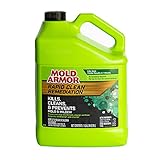
Fastest Kill on Hard SurfacesMold Armor Rapid Clean Remediation
Kill, Clean and Prevent Spray, Hard Surfaces
Mold Armor Rapid Clean Remediation is built around speed. Mold Armor says it kills mold and mildew with a 60-second contact time, sanitizes in 10 seconds and disinfects in 30, which is far shorter than the 10 minutes many fungicides need and makes it practical on vertical tile and shower walls where a product runs off before a long contact time can elapse. It is sold as a kill, clean and prevent product: you spray until the surface is wet, wait for the time on the label, then rinse or wipe, and Mold Armor says routine cleaning needs no scrubbing. For heavier staining the label allows a longer 10-minute dwell. The limits are clear on the product page. It is meant for hard, non-porous surfaces such as acrylic, fiberglass, laminate, steel, porcelain, glass and granite, and Mold Armor warns against using it on clothing, carpet, fabric, painted wood or paper. That makes it a bathroom, kitchen and laundry room product rather than a basement-wall or attic treatment. Check the label in your store for the active ingredient and registration details before buying, and as with any cleaner, never mix it with other products and keep the room ventilated while you work.
Pros
- Kills mold and mildew with a 60-second contact time, per Mold Armor
- Also sanitizes in 10 seconds and disinfects in 30 seconds
- Kills, cleans and helps prevent regrowth in one product
- No scrubbing required for routine cleaning; rinse or wipe
- Sold in a 32 oz spray plus 1 gallon and 2.5 gallon sizes
Cons
- For hard, non-porous surfaces only
- Not for clothing, carpet, fabric, painted wood or paper
The Bottom Line
A quick, convenient kill-and-clean spray for bathrooms, laundry rooms and other hard surfaces, where a short contact time matters.

Best for Exterior SurfacesWet & Forget Outdoor Moss, Mold, Mildew & Algae Stain Remover
Outdoor No-Rinse Treatment, Concentrate
Exterior mold and mildew is a different problem from the patch on a basement wall. It grows on siding, roofs, decks, fences and patios, it is too big to scrub by hand, and pressure washing can damage wood, force water behind siding and strip a roof's granules. Wet & Forget Outdoor avoids all of that. You dilute the concentrate, spray it onto a dry surface and leave it, with no scrubbing and no rinsing. Wind and rain gradually wash away the dead growth. The catch is patience: the maker says green algae often fades within a few weeks, while darker mold and moss stains can take several months. It is bleach-free, so it does not carry the plant damage and corrosion risks of chlorine washes, but rinse any plants you accidentally spray. Wet & Forget lists a long range of compatible surfaces, including concrete, pavers, brick, wood, stone, slate, stucco, vinyl and composite. Note that this is an outdoor product. For mold inside the house, use one of the indoor products above and fix the moisture source. Outside, if you can wait for results, it is the easiest way we know to clean a mildewed north wall or a green roof.
Pros
- No scrubbing and no rinsing: spray on a dry day and let weather finish the job
- Bleach-free, so it is gentler on siding, roofs, decks and plants than chlorine washes
- Works on concrete, pavers, brick, wood, stone, stucco, vinyl and composite
- Treated surfaces often stay clean for a long time, per the maker
Cons
- Slow: green growth fades over weeks, dark mold stains can take months
- Outdoor product only; not for interior mold
The Bottom Line
The low-effort way to clear mildew and algae from siding, roofs and decks, for anyone patient enough to let it work.
4. How to Read a Mold Product Label
Start with the EPA registration number, usually printed as EPA Reg. No. followed by a series of digits. If a product claims to kill mold, mildew, bacteria or viruses, that number should be there. RMR-141's is 61178-2-93443. You can look up a registration on the EPA's pesticide product label system to see the approved label. If a bottle promises to kill mold and has no registration number, treat the claim with suspicion.
Next, find the active ingredient and its concentration. Bleach-based products list sodium hypochlorite; RMR-86's safety data sheet gives it as 1 to 5 percent. Many registered disinfectants use quaternary ammonium compounds, which RMR-141 contains at 0.07 percent each of two types. Botanical products often use thymol from thyme oil. The active ingredient tells you how the product behaves: bleach whitens and corrodes, quats do not whiten, and botanicals tend to be milder.
The contact time, sometimes called dwell time, is the most overlooked line on the label. It is how long the surface must stay visibly wet for the kill claim to hold. RMR-141 calls for 10 minutes of saturation for mold. Mold Armor Rapid Clean Remediation claims 60 seconds. Spray-and-wipe use that ignores the contact time does not deliver the kill the label promises, so on vertical surfaces you may need to re-spray to keep it wet.
Finally, read the surfaces and precautions. The label tells you where a product can be used and where it will cause damage, what protective equipment to wear, and what must never be mixed with it. The signal word, Caution, Warning or Danger, indicates the level of acute hazard. With pesticide products, the label is a legal document, and using a product in a way that contradicts it is both less effective and, technically, a violation of federal law.
5. Porous vs Non-Porous Surfaces
Whether a surface is porous decides whether any product can fix it. On non-porous materials such as glazed tile, glass, metal, sealed countertops, plastic and fiberglass, mold grows on the surface. It can be scrubbed off, the surface disinfected if you choose, and the job is done once the area is dry. Any of the indoor products on this list will work, with bleach sprays especially quick on tile and grout.
Porous materials such as drywall, ceiling tiles, carpet, insulation, upholstery and paper absorb water, and mold grows into them, not just onto them. The EPA advises that absorbent materials that become moldy may need to be thrown away, because mold can fill the empty spaces and crevices and be impossible to remove completely. A spray may kill what it reaches and make the stain disappear, but the growth inside the material remains.
| Surface | Examples | What to do | Products that fit |
|---|---|---|---|
| Non-porous | Glazed tile, glass, metal, fiberglass | Scrub, rinse, dry; optional disinfectant | Tilex, Mold Armor, RMR-141 |
| Semi-porous | Wood, concrete, grout, unglazed tile | Scrub, treat, dry; sand wood if growth remains | RMR-141, Concrobium, RMR-86 for stains |
| Porous | Drywall, ceiling tile, carpet, insulation | Usually cut out and replace | Treat surrounding framing after removal |
| Exterior | Siding, roofs, decks, pavers | Low-pressure treatment, let weather finish | Wet & Forget Outdoor |
Semi-porous materials are the grey zone. Framing lumber, subfloor, concrete and grout can usually be saved. Scrub them, treat them with a registered fungicide, and let them dry completely. On wood, if staining or growth remains in the grain after it dries, sanding or wire brushing removes it, with a respirator on and a HEPA vacuum close by. A stain-blocking primer can then seal what remains of the discoloration.
Drywall is where people most often get it wrong. A small surface spot on painted drywall in a dry room can be cleaned and treated. A patch that has been wet, is soft, or shows growth on the paper facing should be cut out, generally a foot or so beyond the visible edge, and replaced after the cavity behind it is dry. Spraying it and painting over the stain only hides the problem until the next damp spell.
6. The Truth About Bleach and Vinegar
Bleach is the first thing most people grab, and on hard, non-porous surfaces it does kill surface mold and remove staining quickly, which is why bleach sprays are a reasonable choice for shower grout. But the EPA does not recommend biocides like chlorine bleach as a routine part of mold cleanup, and on porous materials bleach gives a misleading result: it whitens the stain so the surface looks clean while doing little about growth below the surface.
Household bleach is mostly water. Soaking drywall or wood with it adds moisture to the material you are trying to dry, and it can damage finishes, corrode metal and fade fabrics. It also loses strength over time; Clorox notes the sodium hypochlorite in its Tilex spray loses strength after about a year. If you do use bleach, use it on hard surfaces, follow the label dilution, ventilate the room, and never mix it with ammonia or acidic cleaners.
Vinegar is the other household favourite. Its acetic acid has some effect on mold, and it is a reasonable mild cleaner for light mildew on non-porous surfaces. It is not an EPA-registered mold killer, so there is no approved contact time or kill claim to rely on, and it is not a substitute for drying the area. Never combine vinegar with bleach: the mixture releases chlorine gas. Mixing vinegar and hydrogen peroxide in one container also creates a corrosive acid.
The practical rule is simple. For shower grout and tile, a bleach spray is fine. For wood, concrete and drywall, scrub with detergent and water, use a registered non-bleach fungicide such as RMR-141 if you want to treat the surface, then use a stain remover only on the marks that remain and only where bleach will not cause damage. Dry everything thoroughly afterwards; drying is the step that actually prevents regrowth.
7. Fix the Moisture First
Mold needs moisture, and every mold problem is really a moisture problem with a symptom on the surface. The EPA's guidance starts with finding and fixing the water source, whether that is a plumbing leak, a roof leak, groundwater coming through a foundation, condensation on cold walls or simply humid air. Clean the mold without fixing the source and it returns, often within weeks.
Indoor humidity is the most common cause in basements and bathrooms. The EPA recommends keeping relative humidity below 60 percent and ideally between 30 and 50 percent. In a basement, that usually means running a dehumidifier through the humid months; our guide to the best basement dehumidifiers covers sizing, and our article on dehumidifier settings covers where to set it. In bathrooms, a properly sized exhaust fan run for 20 minutes after showers does the same job.
Measure rather than guess. A cheap hygrometer tells you room humidity, and a moisture meter tells you whether a wall, floor or piece of framing is actually wet. That matters after cleanup, because you should not close up a wall or repaint until the material has dried to normal levels. Our guide to the best moisture meters explains pin and pinless types and the readings that mean dry for wood and drywall.
Speed matters after any leak or flood. The EPA's window for drying water-damaged materials is 24 to 48 hours, after which mold growth becomes likely. Run fans and a dehumidifier, remove wet carpet pad and soaked insulation, and open up wet wall cavities if needed. In attics, mold on the roof sheathing usually traces back to warm, moist house air leaking upward; our attic fan guide explains why air sealing the ceiling matters more than adding a fan.
8. Safety: Respirators, Ventilation and Never Mixing
Mold cleanup disturbs spores and fragments, and some people react strongly to them, especially those with asthma, allergies or weakened immune systems. The EPA's minimum kit for a small cleanup is an N-95 respirator, gloves that reach the middle of the forearm, and goggles without ventilation holes. A loose paper dust mask does very little. If anyone in the house has respiratory problems, they should stay away from the area while you work.
Chemical safety is the second layer. Bleach-based products such as Tilex and RMR-86 release strong fumes, and RMR recommends a full face respirator with the appropriate cartridges for its stain remover, along with skin protection. Open windows, run an exhaust fan, and take breaks. Read each label's signal word and precautions before you start rather than after you smell something.
Never mix cleaning products. Bleach mixed with ammonia produces toxic chloramine vapours, and bleach mixed with acids, including vinegar and many toilet bowl and rust cleaners, releases chlorine gas. Clorox warns against mixing Tilex with toilet bowl cleaners, rust removers, acids or ammonia. Even using two products one after another on the same surface can mix them, so rinse thoroughly between products and use one at a time.
Contain the work. Close doors to the rest of the house, cover vents in the room, and bag moldy debris before carrying it through living areas. Clean up dust with a HEPA vacuum rather than a regular one, which can blow fine particles around. An air purifier with a true HEPA filter can capture airborne spores during and after the work; our guide to the best air purifiers for mold covers what they can and cannot do.
9. How to Clean Mold Step by Step
First, find and stop the moisture source, and decide whether the job is yours. If the moldy area is under about 10 square feet, roughly a three-by-three-foot patch, the EPA says you can in most cases handle it yourself. Larger areas, mold in the heating and cooling system, mold after sewage or contaminated flooding, and anyone with health concerns all point to a professional.
Second, set up. Put on the N-95, gloves and goggles, ventilate the room, close it off from the rest of the house and lay plastic under the work area. Remove and bag porous materials that are moldy, such as ceiling tiles, carpet pad and soaked drywall, before cleaning anything else, because they will keep releasing spores while you work around them.
Third, clean. Scrub hard and semi-porous surfaces with detergent and water using a stiff brush, then wipe them down. If you want to treat the surface, apply a registered fungicide such as RMR-141 and keep it wet for the full contact time on the label. On tile and grout, a bleach spray such as Tilex does the cleaning and staining together. On wood, sand out any growth left in the grain once it is dry.
Fourth, dry and finish. Run fans and a dehumidifier until a moisture meter shows the materials are dry, which may take days. Deal with remaining stains using a stain remover where the surface can take bleach, or a stain-blocking primer where it cannot. Apply an inhibitor such as Concrobium if the area is prone to dampness. Only then rebuild, repaint or put belongings back, and keep watching humidity.
10. When to Call a Pro, and What Not to Buy
Call a professional when the moldy area is larger than about 10 square feet, when mold is inside ductwork or the air handler, when the water involved was sewage or floodwater, or when the mold keeps returning despite your cleanup. The same applies if anyone in the house has asthma, a weakened immune system or symptoms that seem to track the problem. A good remediator will find the moisture source, contain the area properly and remove damaged materials rather than just spraying them.
Be wary of anyone whose main tool is a fogger or a machine. Ozone generators are sold as mold cures, but ozone at levels safe for people does little to mold, and at levels high enough to affect it, ozone is a lung irritant; our article on whether ozone generators kill mold covers the evidence. UV lamps have similar limits, because they only affect what the light directly reaches, as explained in our guide to whether UV light kills mold.
Air purifiers are useful for capturing airborne spores, but they do not remove mold growing on a surface. They are a support tool during and after cleanup, not a treatment. Our article on whether air purifiers help with mold explains where they fit. The same goes for any product, however good, that promises to fix mold without anyone fixing the water.
Mold testing kits are another common waste. If you can see or smell mold, you already know it is there, and the EPA notes that sampling is usually unnecessary for deciding to clean it up. Spend the money on a dehumidifier, a moisture meter and the right cleaning product instead. Testing has its place, for example to check a professional's work or in legal disputes, but it does not make the mold go away.
11. Common Mistakes to Avoid
Painting Over Mold
Covering mold with paint, even a mold-resistant paint, hides it rather than removing it, and growth often reappears through the new coat. Clean and dry the surface first, treat it if needed, and only then use a stain-blocking primer and paint. Fix the moisture source, or none of it lasts.
Using Bleach on Drywall and Wood
Bleach whitens the stain on porous materials so the surface looks clean, while adding water and leaving growth below the surface. On drywall and wood, scrub with detergent and water, use a registered non-bleach fungicide if needed, and replace drywall that is soft or heavily stained.
Ignoring the Contact Time
A mold killer only delivers its label claim if the surface stays wet for the full contact time, such as 10 minutes for RMR-141. Spraying and wiping immediately leaves the job half done. On walls and ceilings, re-spray as needed to keep the area visibly wet.
Mixing Products
Bleach mixed with ammonia releases toxic vapours, and bleach mixed with vinegar or acidic cleaners releases chlorine gas. Use one product at a time, rinse thoroughly between products, and keep the room ventilated. Read the warnings on each label before you start, not after something smells wrong.
Cleaning Without Fixing the Moisture
Every mold problem is a moisture problem first. Clean without fixing the leak, condensation or high humidity, and mold returns within weeks. Find the source, keep indoor humidity below 60 percent and ideally 30 to 50, and dry wet materials within 24 to 48 hours.
Before You Buy
12. Frequently Asked Questions
What is the best mold remover?
It depends on the job. For killing mold, RMR-141, an EPA-registered quaternary ammonium fungicide, is our top pick. For shower grout and tile, a bleach spray such as Clorox Plus Tilex works fastest. For stains, RMR-86. For prevention and large areas, Concrobium Mold Control. Outdoors on siding and decks, Wet & Forget Outdoor.
What is the best mold killer?
Choose an EPA-registered fungicide and follow its contact time. RMR-141 is registered, uses quaternary ammonium rather than bleach, and requires 10 minutes of wet contact for mold. On hard surfaces, Mold Armor Rapid Clean Remediation claims a 60-second kill. Remember that killing mold does not remove the stains it leaves behind.
Does bleach kill mold?
On hard, non-porous surfaces like tile and glass, bleach kills surface mold and removes stains. On porous materials it mostly whitens the stain and adds moisture, leaving growth below the surface. The EPA does not recommend biocides like bleach as a routine part of mold cleanup, and bleach must never be mixed with ammonia.
Can I remove mold myself?
Usually, if the total area is under about 10 square feet, the EPA's rough limit for do-it-yourself cleanup. Wear an N-95 respirator, long gloves and sealed goggles, fix the moisture source, scrub hard surfaces, remove moldy porous materials and dry everything. Call a professional for larger areas, HVAC mold or contaminated water.
Is vinegar better than bleach for mold?
Neither is ideal. Vinegar can clean light mildew on hard surfaces, but it is not an EPA-registered mold killer, so there is no approved contact time or kill claim. Bleach works on non-porous surfaces but not on porous ones. Never mix the two, because the combination releases toxic chlorine gas.
What kills mold on wood?
Scrub with detergent and water, then apply a registered non-bleach fungicide such as RMR-141 and keep it wet for its full contact time. Let the wood dry completely, check it with a moisture meter, and sand out any growth left in the grain. Seal remaining staining with a stain-blocking primer.
How do I stop mold from coming back?
Fix the moisture. Keep indoor humidity below 60 percent and ideally 30 to 50, run bathroom fans after showers, repair leaks quickly and dry wet materials within 24 to 48 hours. An inhibitor such as Concrobium Mold Control can help on surfaces prone to dampness, but humidity control does most of the work.
Everything Else About Mold Removal
Related Mold and Moisture Guides
How-To
How to Get Rid of Mold in a Basement
The full cleanup process, from finding the moisture source to keeping humidity down afterwards.
Buyer's Guide
Best Air Purifiers for Mold
True HEPA purifiers that capture airborne spores during and after cleanup.
Buyer's Guide
Best Basement Dehumidifiers
The machines that keep humidity below the level where mold grows back.
The Bottom Line
Match the product to the job. RMR-141 is our pick for killing mold on most indoor surfaces without bleach, Clorox Plus Tilex is the fast fix for shower grout and tile, RMR-86 handles leftover stains, Concrobium helps prevent regrowth, and Wet & Forget takes care of mildew outside.
None of them works if the moisture stays. Fix the leak or the humidity, keep indoor air below 60 percent relative humidity, remove porous materials that are badly affected, and call a professional for anything larger than about 10 square feet.
More in Home & Indoor Air Quality
Guides in this category that pair with what you just read.
About the Author
Alex Rivers, Home Improvement Editor
Alex has spent over a decade working on residential and light commercial property maintenance, and now tests every tool, coating and machine that appears in these guides personally.