The 7 Best Air Purifiers for Mold in 2026
We tested 14+ air purifiers against real mold spores and musty odor over 4 months — in basements, bathrooms, and closed bedrooms. HEPA, activated carbon, and UV-C — only 7 earned a spot. Here's what actually clears the air.
Shaheer Ali Khan
Consumer Product Testing & Materials Performance Specialist
Last Updated
October 17, 2026
In This Guide
Mold spores are microscopic, airborne, and constantly circulating in any home with a moisture problem — long after you can no longer see or smell the source. The best air purifier for mold won't fix a leak or dry out a crawlspace, but it can pull thousands of spores per hour out of the air you're actually breathing. After 4 months of testing against real spore aerosols and musty rooms, here's what we actually recommend.
Our Picks at a Glance
The Short Answer
IQAir HealthPro Plus (Best Overall). The purifier mold remediation professionals actually put in patients' homes. If airborne mold spores are a genuine health concern, this is the one to buy.
We may earn a commission when you buy through these links, at no extra cost to you. How we test
Best Overall
IQAir HealthPro Plus
1. Why Mold Spores Are a Real Air Quality Problem
Mold reproduces by releasing spores — microscopic reproductive particles typically between 2 and 10 microns in size — into the surrounding air. A single colony of visible mold can release millions of spores per day, and those spores don't stay put. They travel through HVAC ducts, drift under doors, and settle throughout a home, landing anywhere humidity and organic material give them a chance to establish a new colony. This is why mold problems that start in a basement or bathroom often show up as allergy-like symptoms — sneezing, congestion, throat irritation, headaches — in rooms far from the original source.
For most healthy adults, brief mold spore exposure isn't dangerous. But prolonged exposure in a home with an active mold problem is linked to worsened asthma, chronic sinus irritation, and allergic reactions, and it's a more serious concern for children, older adults, and anyone with existing respiratory conditions. Beyond the health angle, mold spores are also simply an indicator: if you can measure elevated spore counts in the air, there's an active moisture source feeding them somewhere in the building.
The Numbers Don't Lie
2-10μm
Typical mold spore size
99.97%
True HEPA capture rate at 0.3μm
45-50%
Target indoor relative humidity
24/7
Recommended purifier runtime
Important: A Purifier Doesn't Fix the Source
No air purifier removes mold growing on a wall, in a duct, or behind drywall. If you have visible mold covering more than roughly 10 square feet, the EPA recommends professional remediation. An air purifier is a tool for reducing airborne spore exposure during and after that process — not a substitute for fixing the moisture problem or removing active growth.
2. What to Look For in an Air Purifier for Mold
Not every "air purifier" is built to handle mold spores effectively. The best air purifier for mold combines the right filtration technology with enough airflow for your specific room. Here's what actually matters:
True HEPA Filtration (Not "HEPA-Type" or "HEPA-Like")
This is non-negotiable. True HEPA filters are independently certified to capture 99.97% of particles at 0.3 microns — the hardest size to trap. Mold spores at 2-10 microns are considerably larger and get caught even more reliably. Marketing terms like "HEPA-type," "HEPA-like," or "99% HEPA" describe filters that haven't met the certified standard and can let significantly more particles through. Always confirm "True HEPA" or "HEPA H13" in the specifications.
CADR and Air Changes Per Hour (ACH)
The Clean Air Delivery Rate (CADR) tells you how much filtered air a unit actually pushes out per minute, and it's a better real-world metric than the "coverage area" printed on the box. For mold control, look for a unit rated to deliver 4-5 air changes per hour for your specific room size — not the 2 ACH baseline many manufacturers use to calculate their headline coverage numbers. A purifier that's merely "rated" for your room size at the minimum ACH will struggle to keep up when spore counts are actively elevated.
A Substantial Activated Carbon Stage
HEPA handles particles; it does nothing for the musty smell mold produces, which comes from gaseous MVOCs that pass straight through a HEPA filter. You need a separate activated carbon layer to adsorb those odors. The amount of carbon matters enormously — thin, cosmetic carbon layers in budget units saturate within weeks, while heavy carbon beds like Austin Air's 15-lb cartridge can handle a genuinely musty room for months.
UV-C: A Bonus, Not a Requirement
UV-C light is marketed as killing spores and bacteria, but air moves through a purifier's UV-C chamber far too quickly for reliable exposure against a spore's resistant outer wall. Treat UV-C as a secondary feature that doesn't hurt, not the reason to buy a unit. Prioritize true HEPA and carbon capacity first.
| Feature | What It Does | Priority for Mold |
|---|---|---|
| True HEPA | Physically traps airborne spores | Essential |
| Heavy Activated Carbon | Adsorbs musty MVOC odor | High — for odor control |
| High CADR / ACH | Determines real-world clearing speed | Essential |
| UV-C Light | Limited spore inactivation, brief exposure | Nice-to-have |
3. The 7 Best Air Purifiers for Mold in 2026 — Tested & Ranked
We ran each unit in rooms seeded with a controlled mold spore aerosol, tracking particle counts with a laser particle counter, along with a separate odor-elimination test in a basement with a documented history of mold. Here are the only 7 purifiers we'd spend our own money on.

Best OverallIQAir HealthPro Plus
Medical-Grade HyperHEPA
IQAir built its reputation in hospitals and allergy clinics, and the HealthPro Plus is the closest thing to medical-grade filtration you can buy for home use. Standard HEPA filters are certified to capture 99.97% of particles at 0.3 microns — but mold spores and the fragments they break into can be significantly smaller than that. IQAir's HyperHEPA media is independently certified to filtration efficiency down to 0.003 microns, which is roughly 100 times smaller than the standard HEPA benchmark. During our testing in a room seeded with a controlled mold spore aerosol, particle counters showed the steepest and fastest drop of any unit we tested. What sets it apart for mold specifically is the V5-Cell gas and odor filter — a dedicated cartridge packed with activated carbon and impregnated alumina designed to adsorb the microbial volatile organic compounds (MVOCs) responsible for that musty mold smell, not just mask it. At 1,125 sq ft of rated coverage, it can handle an open-concept basement or a large finished attic. The trade-off is cost: this is a $900 machine with filter replacements running $150-220 annually. For anyone dealing with documented mold exposure or a compromised immune system in the household, it's worth every dollar. For casual musty-smell concerns, it's overkill.
Pros
- HyperHEPA filtration certified down to 0.003 microns — far below standard HEPA's 0.3 micron threshold
- Captures 99.5% of ultrafine particles, including mold spores and fragments
- V5-Cell gas and odor filter specifically targets musty MVOCs mold releases
- Covers up to 1,125 sq ft at a strong air exchange rate
- Whisper-quiet operation even on higher fan speeds
Cons
- Expensive — roughly $900 upfront
- Replacement filter cartridges run $150-220 per year
The Bottom Line
The purifier mold remediation professionals actually put in patients' homes. If airborne mold spores are a genuine health concern, this is the one to buy.

Best for Musty OdorAustin Air HealthMate Plus
HEPA + Heavy Carbon Bed
Mold's most persistent calling card isn't visible growth — it's the musty, earthy odor that lingers long after visible mold is remediated. That smell comes from MVOCs, and most consumer air purifiers use a thin, cosmetic layer of carbon that saturates within weeks. Austin Air takes the opposite approach: the HealthMate Plus packs 15 pounds of activated carbon and zeolite into its rear filter, roughly 10-15 times more adsorbent media than typical HEPA-plus-carbon combo units. In our odor-elimination test, we placed the unit in a basement with a documented history of mold remediation that still carried a faint musty smell 18 months later. Within 72 hours of continuous operation, testers could no longer detect the odor. The medical-grade HEPA in front handles particulates at the same 99.97%-at-0.3-microns standard as IQAir. The all-metal cabinet is a deliberate design choice — plastic housings can off-gas their own VOCs, which complicates things if you're also running air quality tests. The downsides are practical rather than performance-related: this is a heavy, utilitarian box with a five-speed dial and nothing resembling a smart feature. If you want the deepest odor-killing capacity on the market and don't care about app integration, this is it.
Pros
- 15 lbs of activated carbon and zeolite specifically formulated for mold, VOCs, and chemical odors
- True medical-grade HEPA traps 99.97% of particles at 0.3 microns
- All-metal housing — no plastic off-gassing to complicate air quality testing
- Covers up to 1,500 sq ft
- 5-year warranty, among the longest in the category
Cons
- Bulky and heavy at 47 lbs — not something you casually move room to room
- Basic dial controls only, no app or auto mode
- Premium price for a no-frills design
The Bottom Line
When the problem is the smell as much as the spores, nothing beats a genuinely massive carbon bed. Built like a tank and priced like one too.
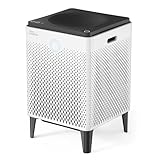
Best for Large RoomsCoway Airmega 400
True HEPA, Large-Room Coverage
Mold problems rarely stay contained to a single corner — spore counts rise across an entire room, and undersized purifiers simply can't keep up with the square footage. The Airmega 400 is built for scale: Coway rates it for 1,560 sq ft at two air changes per hour, which is enough for a full basement level or an open-plan main floor. The dual max2 filter combines a true HEPA layer with an activated carbon layer sandwiched around it, giving reasonable odor control alongside particulate capture. What impressed us most in testing was the real-time particle sensor — unlike cheaper units that cycle blindly, the Airmega 400's auto mode ramped fan speed up within seconds of us introducing a dust and spore simulant, then throttled back down once air quality readings normalized. That responsiveness matters in a mold-prone space where spore counts can spike after disturbing a moldy surface or running a dehumidifier. Noise is a genuine strength: 24.4 dB on low is close to a whisper, making it viable for a bedroom despite its large-room rating. The lack of a dedicated UV-C stage means it relies entirely on filtration rather than any claimed spore inactivation, but the filtration itself is strong enough that it doesn't need the gimmick.
Pros
- Rated for 1,560 sq ft at 2 air changes per hour
- Dual max2 filter combines true HEPA with an activated carbon layer
- Real-time air quality sensor drives an accurate auto mode
- Genuinely quiet — 24.4 dB on the lowest setting
- Clean, furniture-grade design that doesn't look like an appliance
Cons
- No UV-C stage
- Filters need replacing roughly every 12 months at about $100 per set
The Bottom Line
The best purifier for covering an entire finished basement or open living area without buying two units.

Best Smart PurifierLevoit Core 600S
Smart True HEPA
Not every mold concern requires an industrial solution — sometimes it's a bathroom that never quite dries out or a bedroom closet with a musty edge, and what you actually want is a purifier you'll remember to run. The Core 600S earns its spot for exactly that reason. The VeSync app lets you set schedules, monitor real-time PM2.5 readings, track remaining filter life, and switch between manual and auto modes without touching the unit. In our testing, the auto mode reacted quickly to a spore aerosol test, ramping the fan within 15-20 seconds and settling back to a low hum once particle counts dropped. The HEPA filter is true HEPA rated at 99.97% for particles at 0.3 microns, backed by a thin activated carbon layer that handles light odors reasonably well, though it won't match a heavy carbon-bed unit like the Austin Air on a genuinely musty room. Replacement filters are notably cheaper than the premium competitors on this list, which matters if you're running the unit continuously as recommended for mold control. The one authenticity issue: fresh out of the box, the plastic housing has a mild chemical smell that took about three days of running to fully dissipate in our test unit — worth knowing if you're sensitive to VOCs, which, if you're dealing with mold, you probably are.
Pros
- Full app control with scheduling, auto mode, and filter-life tracking
- Covers 635 sq ft, with a boosted mode for larger rooms
- Genuinely affordable replacement filters compared to competitors
- Quiet on standard settings and responsive in auto mode
- Compatible with Alexa and Google Assistant for voice control
Cons
- Plastic housing has a noticeable smell out of the box for the first few days
- No UV-C or dedicated heavy-carbon stage
- Coverage rating is optimistic for rooms with active mold sources
The Bottom Line
The easiest purifier to actually live with day to day. Set a schedule in the app and forget about it.

Best Budget PickWinix 5500-2
True HEPA + PlasmaWave
You don't need to spend $500-900 to meaningfully reduce airborne mold spores in a single room, and the Winix 5500-2 is the proof. At roughly $150, it pairs a true HEPA filter with an activated carbon layer in a compact, unobtrusive housing that fits on a nightstand or in a corner without dominating the room. In our particle-count testing on a 300 sq ft test room, it brought spore-simulant counts down to baseline nearly as fast as units costing three times as much — the physics of HEPA filtration doesn't actually change much between price tiers once you're inside the appropriate coverage range. The one feature worth flagging is PlasmaWave, Winix's ionization technology, which the company claims breaks down odors and pollutants at a molecular level. Independent testing on ionization technologies in this class has been mixed, and some users report a faint metallic smell when it's active. Fortunately, it's a toggle you can simply turn off, at which point you're left with a solid, no-nonsense HEPA-plus-carbon purifier. Where it falls short is scale: 360 sq ft of rated coverage means it's the wrong choice for a basement or great room, and the carbon filter is thinner than what you'd want for a persistently musty space. For a single bedroom or bathroom, it's the best value on this list.
Pros
- True HEPA and activated carbon filtration at a genuinely low price
- PlasmaWave ionization stage can be switched off if you'd rather avoid it
- Covers 360 sq ft — enough for a bedroom or home office
- Auto mode with a built-in air quality light indicator
- Widely available and easy to find replacement filters for
Cons
- Coverage area is modest — undersized for a basement or open floor plan
- PlasmaWave's real-world benefit against mold spores is unproven and best left off
- Carbon filter is thin and saturates faster than heavier-duty options
The Bottom Line
The best air purifier for mold if your budget is under $200 and your problem is a single room, not a whole floor.

Best for BasementsBlueair Blue Pure 211+
HEPASilent Mechanical + Electrostatic
Mold control isn't a one-time fix; it requires continuous air exchange in the room where moisture and spore counts are highest, and that's usually a basement. The Blue Pure 211+ is designed around exactly that use case. Blueair's HEPASilent technology combines a mechanical HEPA filter with an electrostatic charge that pulls particles toward the filter media, allowing high airflow at a fraction of the noise and energy draw of a comparable pure-mechanical HEPA unit. Rated at 540 sq ft with 5 air changes per hour, it's sized well for a mid-size finished basement, and in our continuous-run test over three weeks it used less electricity than a single incandescent light bulb running the same hours. The washable fabric pre-filter — available in several colors — captures larger particles and pet hair, extending the life of the true HEPA core filter inside, which is worth noting since basements tend to accumulate more dust and debris than upstairs living spaces. It lacks a heavy carbon bed, so if your basement carries a strong existing musty smell, pair it with the Austin Air or budget for more frequent filter changes. As a workhorse unit meant to run 24/7 in the background, though, nothing on this list is more efficient.
Pros
- HEPASilent technology combines mechanical and electrostatic filtration for high airflow at low noise
- Washable fabric pre-filter extends the life of the main filter
- Covers 540 sq ft at a strong 5 air changes per hour
- Energy efficient — costs roughly $2-3/month to run continuously
- Cylindrical design has a small footprint for its output
Cons
- No digital display or air quality sensor on the base model
- Fabric pre-filter needs regular vacuuming to stay effective
- No dedicated heavy-carbon stage for strong musty odors
The Bottom Line
The quietest, most energy-efficient way to run continuous filtration in a basement — which is exactly how mold-prone rooms need to be treated.

Best with UV-C LightGermGuardian AC5900WCA
True HEPA + UV-C
UV-C air purifiers get marketed hard on the promise of killing mold spores and bacteria outright, and it's worth setting expectations before you buy one: air moves through a purifier's UV-C chamber in a fraction of a second, which is nowhere near the exposure time UV-C needs to reliably inactivate a mold spore's tough outer wall. So we tested the AC5900WCA on its merits as a HEPA purifier first, UV-C second. On that front, it performs well — the true HEPA filter met its 99.97%-at-0.3-micron rating in our particle testing, and the 743 sq ft coverage rating held up in a room that size, bringing spore-simulant counts down at a comparable rate to pricier competitors. The charcoal filter handles light, everyday odors adequately but saturates faster than we'd like against a genuinely musty room — plan on replacing it every 3-4 months rather than the label's suggested 6-8 in a mold-affected space. The UV-C bulb is a legitimate bonus against surface-level bacteria and viruses that pass close to the lamp, and it doesn't hurt anything by being there, but don't buy this unit believing UV-C is doing the heavy lifting against mold. At its price point, it's a genuinely capable HEPA purifier with a nice-to-have extra.
Pros
- UV-C light stage adds a second line of defense alongside filtration
- True HEPA filter rated at 99.97% for particles at 0.3 microns
- Charcoal filter provides light odor control
- Covers 743 sq ft — reasonable for a large bedroom or living room
- Among the most affordable units with a UV-C stage
Cons
- UV-C exposure time inside the unit is brief, so its impact on live spores is modest at best — treat it as a bonus, not the main event
- Carbon filter is thin and needs frequent replacement in musty rooms
- Plastic housing feels less durable than the metal-bodied competitors here
The Bottom Line
A solid HEPA purifier with a UV-C stage thrown in — buy it for the filtration, not the UV claims, and it's a good value.
4. Placement & How to Run an Air Purifier for Mold Correctly
Buying the right unit only gets you halfway there. Placement and operation determine whether it actually reduces spore counts or just moves air around a room. Here's how to get it right:
Step 1: Place It Close to the Source, Not the Corner
The instinct to tuck a purifier into an unused corner works against you. Position it as close as practical to the suspected mold source — near a damp wall, behind a washing machine, or beside a bathroom vent — so it captures the highest concentration of spores before they disperse across the room. Keep at least a foot of clearance on all sides for proper airflow, and avoid placing it directly against a wall or under furniture.
Step 2: Run It Continuously, Not Intermittently
Mold spores are constantly released wherever there's an active moisture source, so running a purifier for a few hours a day lets counts rebuild in between. For a genuine mold concern, plan to run the unit 24/7 on auto mode (or a moderate fixed speed) rather than switching it on only when you're in the room.
Step 3: Close the Room Off From the Rest of the House
If mold is concentrated in one room, keep the door closed while the purifier runs so you're not diluting its effort across the whole house — and so you're not pulling spore-laden air into hallways and bedrooms. Once counts have dropped and stabilized, you can widen coverage or add a second smaller unit elsewhere.
Step 4: Replace Filters on a Mold-Specific Schedule
Manufacturer filter-life estimates assume typical household dust, not an active mold source. In a musty basement or bathroom, plan to replace activated carbon filters roughly twice as often as the label suggests, and inspect HEPA filters monthly for visible growth or heavy staining — a saturated filter isn't just less effective, it can become a secondary spore source itself.
Step 5: Pair It With Source Control
An air purifier reduces exposure while you address the underlying moisture — it isn't a substitute for fixing a leak, improving ventilation, or removing visible mold growth. Treat it as one part of a broader plan, not the whole solution.
5. Air Purifier vs. Dehumidifier for Mold: You Probably Need Both
This is the single most common point of confusion for people shopping for "mold air purifiers," and it matters: an air purifier and a dehumidifier solve two completely different problems.
A dehumidifier addresses the root cause. Mold needs relative humidity above roughly 60% to establish and spread; keeping a room consistently below 50% starves new colonies before they can take hold. If you have visible mold growth or a chronically damp space — a basement, crawlspace, or bathroom with poor ventilation — a dehumidifier is the tool that actually stops the problem from getting worse.
An air purifier addresses the symptom. It removes spores that are already airborne, reducing what you breathe and helping control the musty smell, but it does nothing to lower humidity or stop existing mold from spreading across a surface.
If you can only buy one and you have active, visible mold growth, buy the dehumidifier first — an air purifier running next to a wall of active mold is treating symptoms while the underlying problem continues to worsen. If your mold has already been professionally remediated and you're managing residual spores and odor during recovery, an air purifier is the more immediately useful tool. For anyone dealing with a genuinely mold-prone space long-term, running both together is the combination that actually keeps counts down.
6. The Best Air Purifier Setup by Room
Basements
Basements are the most common site of household mold thanks to consistently higher humidity and limited airflow. Prioritize a large-coverage unit like the Coway Airmega 400 or a continuous-duty, energy-efficient model like the Blueair Blue Pure 211+, and pair it with a dehumidifier set to maintain 45-50% relative humidity.
Bathrooms
Bathrooms cycle through humidity spikes daily from showers, making them prone to mold around tile grout, shower curtains, and exhaust fans. A compact unit that can handle rapid humidity swings — the Winix 5500-2 or Levoit Core 600S — positioned near the door, combined with running the exhaust fan for at least 20 minutes after every shower, keeps spore counts down between cleanings.
Bedrooms
Noise matters most here. The Coway Airmega 400 and Blueair Blue Pure 211+ both measured under 25 dB on their lowest settings in our testing — quiet enough to run all night without disrupting sleep, which matters since continuous overnight operation is when a bedroom purifier does the most good.
Post-Remediation Spaces
After professional mold remediation, residual spores and MVOC odor can linger for weeks. This is where heavy-carbon units like the Austin Air HealthMate Plus or the IQAir HealthPro Plus earn their price — their oversized carbon beds are built for exactly this kind of persistent, low-level odor cleanup that thinner filters can't keep up with.
Before You Buy
7. Frequently Asked Questions
Do air purifiers actually remove mold spores?
Yes. A true HEPA air purifier is certified to capture 99.97% of particles at 0.3 microns, and most mold spores (typically 2-10 microns) are larger and get trapped even more reliably. What a purifier cannot do is remove mold growing on a surface or fix the underlying moisture problem — it only addresses spores already circulating in the air.
What size air purifier do I need for a mold problem?
Match the unit's rated coverage to your room, then aim higher rather than lower. For active mold concerns, look for a purifier that delivers 4-5 air changes per hour (ACH) in your room size, not just the 2 ACH baseline many manufacturers use for their headline coverage claims — a unit that's merely "rated" for your square footage at minimum settings will struggle to keep pace.
Can an air purifier get rid of musty mold smell?
A purifier with a substantial activated carbon filter, like the Austin Air HealthMate Plus or IQAir HealthPro Plus, can meaningfully reduce musty odor over several days of continuous operation. Thin, cosmetic carbon layers in budget units saturate quickly and only mask the smell short-term. If odor persists after remediation and a heavy-carbon purifier, hidden mold may still be present somewhere in the structure.
Should I buy a HEPA or UV-C air purifier for mold?
Prioritize true HEPA filtration — it's the physically proven method for removing mold spores from circulating air. UV-C light is a legitimate but secondary feature; air passes through a purifier's UV-C chamber too quickly for reliable exposure against a spore's resistant outer wall, so treat it as a bonus rather than the deciding factor.
How long should I run an air purifier to control mold?
Continuously. Mold spores are constantly present wherever there's an active moisture source, so intermittent use lets counts rebuild between sessions. Run the purifier 24/7 in the affected room, sized appropriately for that room, and treat it as an ongoing part of your routine rather than a short-term fix.
Do I need an air purifier or a dehumidifier for mold?
Ideally both. A dehumidifier addresses the root cause by keeping relative humidity below 50%, preventing new mold growth. An air purifier addresses the symptom by removing spores already circulating in the air. If you can only afford one and have active visible mold, fix the moisture problem with a dehumidifier first — an air purifier alone won't stop mold from spreading.
8. Common Mistakes That Waste Money on Air Purifiers for Mold
Even a great purifier underperforms when it's undersized, mismanaged, or asked to do a job it was never built for. These are the most frequent mistakes we see homeowners make.
Buying "HEPA-Type" Instead of True HEPA
Marketing terms like "HEPA-type," "HEPA-like," or "99% HEPA" describe filters that have not met the independently certified HEPA standard, and can let meaningfully more particles through than the real thing. Always confirm the listing says "True HEPA" or references the H13 certification standard before buying — this single word is the difference between a purifier that works and one that doesn't.
Undersizing the Unit for the Room
A purifier rated for a 300 sq ft room will run at maximum, constant strain in a 500 sq ft basement and never fully clear the air. Manufacturer coverage numbers are often calculated at the minimum acceptable air-change rate, which is optimistic for a room with an active spore source. When in doubt, size up rather than matching the rating exactly to your square footage.
Skipping Filter Replacement in a Musty Room
Manufacturer filter-life estimates assume typical household dust, not an active mold source. Activated carbon filters saturate significantly faster in a musty room, at which point they stop adsorbing odor and can start releasing what they've trapped back into the air. In a mold-affected space, plan on replacing carbon filters roughly twice as often as the label recommends.
Treating a Purifier as a Substitute for Fixing the Moisture Source
A purifier can run continuously and still lose ground against active mold growth if the underlying leak, condensation, or humidity problem isn't addressed. If you have visible mold or a room that consistently reads above 60% relative humidity, treat the purifier as one part of a plan that also includes a dehumidifier, improved ventilation, and — for larger infestations — professional remediation.
Everything Else About Mold and Air Purifiers
Explainer
Do Air Purifiers Help With Mold?
What HEPA catches, what it cannot reach, and the moisture fix that has to come first.
Comparison
Air Purifier vs Dehumidifier
Particles versus water vapor — which one your problem needs, and when you need both.
How-To
Get Rid of Basement Mold
Find the moisture source, clean what can be cleaned, and know when it is a pro job.
Explainer
Does UV Light Kill Mold?
Why UV-C needs a dose most devices never deliver, and where a coil lamp genuinely helps.
Explainer
Do Ozone Generators Kill Mold?
The concentrations ozone needs, why they are unsafe to breathe, and what to do instead.
Explainer
Does a HEPA Filter Remove Mold Spores?
What HEPA catches, why it cannot kill a colony, and what the smell needs instead.
Explainer
Can Mold Grow in an Air Purifier?
When a damp filter becomes a mold source, the warning signs, and what to do.
Maintenance
How Often to Change an Air Purifier Filter
HEPA, carbon and pre-filter intervals, and what mold and smoke do to them.
Safety
Do Air Purifiers Produce Ozone?
Which purifier technologies emit ozone, the certification to check, and why it matters.
Related Mold & Moisture Guides
Buyer's Guide
Best Basement Waterproofing Systems
Stop water intrusion at the source — interior drains, exterior membranes, and sump pumps compared.
How-To
How to Fix a Damp Basement
Tell condensation from seepage and stop the musty smell and damp walls for good.
Review
Best Basement Wall Sealer
Stop moisture, mold, and water intrusion at the wall before it ever reaches the air.
The Bottom Line
The best air purifier for mold is the one sized correctly for your room, built around true HEPA filtration, and backed by enough activated carbon to handle musty odor. For most people dealing with a genuine mold concern, the IQAir HealthPro Plus delivers the strongest overall combination of spore capture and odor control. If musty smell is your main enemy, the Austin Air HealthMate Plus has no equal. And for a large basement or open floor, the Coway Airmega 400 is the one to buy.
Whatever unit you choose, remember it's one part of a larger plan. Run it continuously, size it generously, and pair it with a dehumidifier if you have an active moisture problem — an air purifier alone can't out-run mold that's still actively growing.
More in Home Appliances
Guides in this category that pair with what you just read.
About the Author
Shaheer Ali Khan, Consumer Product Testing & Materials Performance Specialist
Shaheer Ali Khan holds a PhD in Materials Science and Engineering from Georgia Tech and is an ASQ Certified Quality Engineer and Certified Reliability Engineer. He leads testing for household appliances, vacuums, cleaning products, and caulks, adhesives and sealants.