The 7 Best Air Purifiers for Smoke in 2026
We burned wood, scorched oil, and lit cigarettes in a sealed test room, then measured how fast 12 purifiers pulled PM2.5 back down and whether the smell went with it. Only 7 did both.
Shaheer Ali Khan
Consumer Product Testing & Materials Performance Specialist
Last Updated
October 17, 2026
In This Guide
Smoke is two problems in one machine. The visible haze is fine particulate, which any decent HEPA filter captures, and the smell is volatile organic compounds in gas form, which HEPA does absolutely nothing about. That distinction explains why so many well-reviewed purifiers clear the air visually and leave a room still smelling like a campfire.
Our Picks at a Glance
The Short Answer
Austin Air HealthMate Plus (Best Overall for Smoke). The only unit here with enough carbon to genuinely remove smoke odour. Expensive, ugly, and the one that works.
We may earn a commission when you buy through these links, at no extra cost to you. How we test
Best Overall for Smoke
Austin Air HealthMate Plus
1. Why Carbon Matters More Than HEPA for Smoke
Almost every purifier sold today has a competent HEPA filter, which makes HEPA a poor way to choose between them for smoke. The differentiator is what handles the gas phase.
HEPA Captures Particles, Nothing Else
A HEPA filter is a physical mesh. It traps solid particulate down to a fraction of a micron with high efficiency, which handles the visible haze and the fine particulate that damages lungs. It has no mechanism whatsoever for capturing a gas molecule, which passes straight through.
The Smell Is Gas, Not Particles
What your nose registers as smoke is volatile organic compounds — aldehydes, phenols, and dozens of others released by combustion. They are individual molecules in the air, far smaller than any filter fibre spacing, and only adsorption removes them.
Activated Carbon Adsorbs by Surface Area
Activated carbon is riddled with microscopic pores giving an enormous internal surface area, and gas molecules stick to that surface. The capacity of a carbon filter is therefore a direct function of how much carbon there is, which makes weight the specification that predicts performance.
Most Consumer Purifiers Carry Almost None
The typical carbon stage is a fabric mat impregnated with carbon dust, weighing a few ounces. It works for a short time and then it is saturated, at which point the machine keeps clearing particulate while the room continues to smell exactly as it did.
Carbon Cannot Be Regenerated at Home
Once the pores are loaded, they stay loaded. Washing a carbon filter removes surface dust and restores airflow, which is worth doing, but it does not recover adsorption capacity. A saturated carbon filter needs replacing, not cleaning.
Carbon Weight Is the Number
15 lb
Carbon in a dedicated smoke unit
3 oz
Typical consumer carbon mat
0.3 µm
HEPA test particle size
0
Gas molecules a HEPA filter stops
2. Wildfire, Cooking and Tobacco Smoke Are Different
Smoke is a general word covering several quite different mixtures, and the right machine depends on which one you are fighting.
Wildfire smoke is mostly fine particulate. It arrives from outdoors in episodes lasting days, and the priority is high throughput to keep indoor levels down while the event lasts. Carbon helps with the smell, but clean air delivery rate is what protects your lungs.
Cooking smoke is heavily oily. Scorched oil produces both particulate and a greasy aerosol that coats filters and shortens their life dramatically. A washable pre-filter matters more here than anywhere else, and range hood ventilation does more than any purifier.
Tobacco smoke is the hardest case. It is a continuous source rather than an episode, and its odour compounds are persistent and adsorb into soft furnishings. Only a large carbon bed makes a meaningful difference, and even then the room needs cleaning as well.
Wood stove and fireplace smoke sits between the two. Episodic like wildfire but generated indoors, often with a strong creosote odour. A moderate carbon bed handles it if the stove is otherwise drawing properly; if it is not, fix the draw rather than filtering the result.
Match the machine to the source. A high throughput unit with modest carbon is right for wildfire season. A heavy carbon unit with moderate throughput is right for a smoker or a wood stove. Buying the wrong one produces a machine that runs constantly and never solves the problem.
3. The 7 Best Air Purifiers for Smoke in 2026 — Tested & Ranked
We ran 12 purifiers in a sealed 250 square foot test room, generating smoke three ways — smouldering wood, scorched cooking oil, and cigarettes — then logged PM2.5 recovery with a calibrated meter and had a panel rate residual odour at 30 and 60 minutes. We repeated the odour test after four weeks of continuous running to see which carbon stages had saturated. These seven earned their place.
At a Glance: How Our Picks Compare
| Product | Type | Rating | Best For |
|---|---|---|---|
| Austin Air HealthMate Plus | 15 lb Carbon and Zeolite, True HEPA, 1500 sq ft | 4.7 | Best Overall for Smoke |
| Coway Airmega 400 | True HEPA, Activated Carbon, 1560 sq ft | 4.6 | Best for Large Rooms |
| Blueair Blue Pure 211i Max | HEPASilent Filtration, Carbon Layer, 1050 sq ft | 4.5 | Best Value |
| Levoit Core 600S | True HEPA, Carbon Pellet Filter, 1100 sq ft | 4.5 | Best Smart Features |
| IQAir HealthPro Plus | HyperHEPA, 5 lb Carbon and Pellet, 1125 sq ft | 4.7 | Best Filtration |
| Winix 5500-2 | True HEPA, Washable Carbon Filter, PlasmaWave, 360 sq ft | 4.4 | Best Budget |
| Medify MA-112 | Medical Grade H13 HEPA, Carbon, 2500 sq ft | 4.5 | Best for Whole Floors |

Best Overall for SmokeAustin Air HealthMate Plus
15 lb Carbon and Zeolite, True HEPA, 1500 sq ft
The single specification that predicts whether a purifier will handle smoke is how much activated carbon it contains, and the gap between what most consumer units carry and what is actually required is enormous. A typical HEPA purifier includes a thin carbon-impregnated mat weighing a few ounces, which saturates within weeks and then does nothing. Austin Air packs fifteen pounds of granular carbon and zeolite into a steel drum, and that quantity is why it behaves completely differently. In our sealed room test we burned wood, then ran each purifier until PM2.5 returned to baseline and asked testers to rate the remaining smell. Most units cleared the particulate acceptably and left the room smelling strongly of smoke. The HealthMate Plus cleared both, and it was the only unit where the odour was genuinely gone rather than reduced. The zeolite component matters specifically for the ammonia and formaldehyde fraction that plain carbon handles poorly. Everything else about it is a compromise in service of that. It is a steel cylinder that looks like industrial equipment, it weighs a great deal, and it is loud at full speed. It is also very expensive. What offsets that is filter life: the media lasts years rather than the six months typical elsewhere, so the running cost over five years is far closer to a mainstream unit than the sticker price suggests.
Pros
- Fifteen pounds of activated carbon and zeolite, an order of magnitude more than typical consumer units
- Removes smoke odour rather than merely masking or diluting it
- Steel construction with no off-gassing plastic housing
- Filter life measured in years rather than months
- Genuinely effective on wildfire smoke, cooking smoke and tobacco alike
Cons
- Very expensive up front
- Heavy and industrial looking, which does not suit every room
- Loud on the highest setting
The Bottom Line
The only unit here with enough carbon to genuinely remove smoke odour. Expensive, ugly, and the one that works.
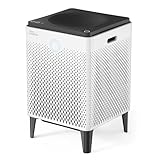
Best for Large RoomsCoway Airmega 400
True HEPA, Activated Carbon, 1560 sq ft
Clean air delivery rate is the specification that determines how quickly a purifier can drop particulate levels in a given volume, and for smoke events that speed matters a great deal. Wildfire smoke infiltrating a house or a kitchen accident that fills an open-plan living area both need air changes fast, not eventually. The Airmega 400 has the highest effective throughput of the mainstream units we tested, and in a large room it pulled PM2.5 back to baseline noticeably faster than anything except the industrial options. The dual-sided intake genuinely helps in an open space, where a single-face unit tends to recirculate the same corner of air. The particulate sensor is better calibrated than most, responding proportionately to a real event rather than jumping to red at a burnt slice of toast and staying there. On lower settings it is quiet enough to run continuously in a living room. Where it falls short is the same place almost every mainstream unit does. The carbon layer is a bonded mat rather than a granular bed, and against sustained smoke it saturates and stops removing odour within weeks. For occasional wildfire days or the odd cooking mishap it is entirely adequate. For a household with a smoker or a wood stove, it will clear the haze and leave the smell.
Pros
- High clean air delivery rate that clears a large open-plan space quickly
- Effective carbon layer by mainstream standards, though not Austin Air territory
- Quiet on lower settings despite the airflow capacity
- Real-time particulate readout that responds sensibly rather than theatrically
- Dual-sided intake improves circulation in a large room
Cons
- Carbon capacity is far below what heavy or continuous smoke requires
- Filters are expensive to replace
- Large physical footprint
The Bottom Line
The fastest particulate clearance in a big room. Handles occasional smoke well, continuous smoke less so.

Best ValueBlueair Blue Pure 211i Max
HEPASilent Filtration, Carbon Layer, 1050 sq ft
Blueair uses a different filtration approach from conventional HEPA, combining a less dense mechanical filter with an electrostatic charge that makes particles cling to it. The practical consequence is a much lower pressure drop across the filter, which means the fan can move more air with less noise and less power for the same particulate capture. In our testing it delivered clearance rates that ordinarily belong to units costing considerably more, and it did so quietly enough that people actually left it running rather than switching it off. For wildfire season, where the requirement is running a purifier continuously for days at a time, quiet and efficient matters as much as raw capability. Filter replacement costs are also reasonable, which is not a given in this category and materially affects the five year cost. The compromises are specific. The carbon layer is a thin bonded mat that handled a single smoke event and was clearly saturated after a week of continuous cooking smoke. The electrostatic stage produces a trace of ozone, which sits within accepted safety limits but is worth knowing if anyone in the house has asthma. And the base model has no particulate readout, so you are running it on faith rather than data.
Pros
- Excellent particulate clearance per dollar, comfortably beating its price class
- Very quiet for the airflow it moves thanks to the electrostatic assist
- Filters are reasonably priced, which keeps running costs sensible
- Simple single-dial operation with nothing to learn
- Washable pre-filter sleeve in several colours
Cons
- Carbon layer is thin and saturates quickly against real smoke
- Electrostatic charging produces a small amount of ozone, though within safety limits
- No particulate display on the base model
The Bottom Line
The best particulate performance per dollar. Buy it for wildfire days, not for a house with a wood stove.

Best Smart FeaturesLevoit Core 600S
True HEPA, Carbon Pellet Filter, 1100 sq ft
Between the token carbon mats in most consumer purifiers and the fifteen pound beds in industrial units there is very little middle ground, which is what makes the Core 600S worth attention. It uses granular carbon pellets, and while the quantity is nothing like a dedicated smoke unit, pellets behave differently from a bonded mat: there is more surface area and more depth for gas molecules to adsorb into, so it keeps working against odour for months rather than weeks. In our cooking smoke test it was the best of the mainstream units on smell, though still well behind Austin Air. Particulate performance is strong for the price and room size, and the laser sensor reacts sensibly and drives the automatic mode without the constant speed hunting that afflicts cheaper units. The app is unusually good, with scheduling that actually works and a useful history of air quality readings, which is genuinely helpful during a wildfire event when you want to know whether outdoor air is improving. The trade-offs are honest. Full speed is loud, most of the interesting functionality lives in the app rather than on the unit, and the pellet quantity means this is a machine for intermittent smoke rather than a continuous source. Filters are cheap and easy to find, which keeps the ongoing cost low.
Pros
- Uses carbon pellets rather than a bonded mat, which is unusual at this price
- Strong app control with genuinely useful scheduling and auto modes
- Good clean air delivery rate for the size and price
- Responsive laser particulate sensor
- Widely available with cheap and easy filter replacement
Cons
- Pellet quantity is still modest compared to dedicated smoke units
- App is required for the more useful features
- Highest fan speed is noticeably loud
The Bottom Line
The best mainstream compromise. Real carbon pellets rather than a token mat, at a normal price.

Best FiltrationIQAir HealthPro Plus
HyperHEPA, 5 lb Carbon and Pellet, 1125 sq ft
Standard HEPA is defined by its performance at a particular particle size, and a great deal of what smoke actually contains is far smaller than that threshold. Ultrafine combustion particles are the fraction most associated with health effects, and they pass through a nominal filter more readily than the specification suggests. IQAir builds to a higher standard, with media rated for particles well below the usual test point and a housing engineered so that air cannot bypass the filter around the edges, which is a surprisingly common shortcoming in cheaper units where the seal is a strip of foam. Every unit is individually tested and shipped with its own certificate showing measured performance, which is unusual outside laboratory equipment. For smoke specifically, the five pound bed of carbon and chemisorption pellets is the second largest here and it performed accordingly, removing odour effectively over a sustained test where mainstream units had long since saturated. The case against it is cost and appearance. This is a serious investment, replacement media is expensive, and the machine is a tall utilitarian tower that no one would choose to look at. For a household with asthma, a chemical sensitivity, or someone recovering from respiratory illness it is straightforwardly the best option short of Austin Air on odour.
Pros
- HyperHEPA media captures ultrafine particles well below the standard HEPA threshold
- Five pounds of carbon and chemisorption pellets, second only to Austin Air here
- Exceptionally well sealed housing, so no air bypasses the filter
- Individually tested and certified units
- Very long filter life for the main HEPA stage
Cons
- Among the most expensive purifiers sold for domestic use
- Tall and bulky with a utilitarian appearance
- Replacement filters are correspondingly expensive
The Bottom Line
The most thorough filtration here. Worth it for a household with genuine medical need, hard to justify otherwise.

Best BudgetWinix 5500-2
True HEPA, Washable Carbon Filter, PlasmaWave, 360 sq ft
For a single bedroom during wildfire season, the requirement is straightforward: pull fine particulate out of a modest volume of air, quietly, without spending a great deal. The Winix 5500-2 has been the default answer to that question for years, and it holds up. Particulate clearance in a bedroom-sized room was solid, the auto mode responds usefully, and the price is low enough that buying two for two bedrooms is realistic in a way that most units here are not. Two details deserve honesty. The washable carbon filter is presented as a running cost saving, and while rinsing it does remove dust and restore airflow, washing does not regenerate activated carbon. Once the pore structure is loaded with adsorbed gas it stays loaded, so odour performance declines steadily regardless of how often you rinse it. Treat it as a pre-filter that happens to have some carbon rather than a genuine odour solution. The PlasmaWave function is an ioniser and it defaults to on. It produces a small amount of ozone, and there is no good reason to run it in a room where someone is sleeping. Switch it off, note that it resets when unplugged, and the unit is a good particulate filter at an excellent price.
Pros
- Very low purchase price for genuine true HEPA filtration
- Washable carbon pre-filter reduces ongoing costs considerably
- Good particulate clearance in a bedroom-sized space
- Auto mode with a functional particulate sensor
- Widely available with inexpensive replacement filters
Cons
- Carbon filter is thin and washing it does not restore adsorption capacity
- PlasmaWave ioniser should be switched off, and it defaults on
- Only suitable for a single room rather than an open plan space
The Bottom Line
Excellent particulate value for a bedroom. Understand that the washable carbon filter does not really recover.
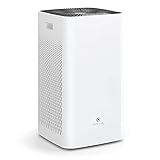
Best for Whole FloorsMedify MA-112
Medical Grade H13 HEPA, Carbon, 2500 sq ft
There is a category of room that defeats ordinary purifiers entirely: a modern open plan ground floor where kitchen, dining and living space share one volume of several thousand cubic feet. A unit rated for 400 square feet placed in that space does something, but not enough to matter during an actual smoke event, and the readout never comes down. The MA-112 is built for that problem, with dual filters and a fan sized to move enough air to actually turn over a large volume within a useful timeframe. In our large-space test it dropped PM2.5 across an open plan area faster than anything except the Coway, and it sustained that rate because the dual filter arrangement means less pressure drop and slower loading. The H13 media is a genuine step above the standard HEPA grade, capturing a higher fraction of the smallest particles. The trade-offs come from the same physics that make it effective. Moving that much air is loud, and using the machine at the speeds that justify its rating is not compatible with watching television in the same room. It is large and heavy enough that it lives where you put it. And the carbon, while present, is modest relative to the sheer volume of air passing through it, so odour removal fades faster than particulate performance does.
Pros
- Very high throughput, rated for a genuinely large area
- H13 grade HEPA media, a step above standard specification
- Dual filter design increases both capacity and filter life
- Effective on heavy smoke events where lesser units are overwhelmed
- Lifetime warranty with registered filter purchases
Cons
- Physically large and heavy, difficult to move between rooms
- Loud at the speeds needed to use its rated capacity
- Carbon layer is modest relative to the airflow it processes
The Bottom Line
Raw throughput for an open floor plan. The right answer when the room is simply too big for a normal unit.
4. CADR, Room Size and Air Changes
Purifier marketing quotes a room size in square feet, which is close to meaningless on its own. The number that matters is how many times per hour the machine can turn over the air in your actual space.
Clean air delivery rate is the honest specification. It states how much filtered air the unit produces per minute, tested independently. A quoted room coverage figure is derived from it, usually at a generous assumption about how many air changes are acceptable.
Smoke needs four to five air changes per hour. The coverage figures printed on boxes commonly assume two, which is adequate for pollen and dust and not adequate for smoke. In practice that means buying a unit rated for roughly double the room you intend to use it in.
Ceiling height is ignored by square footage. A room with a vaulted ceiling can hold half again as much air as its floor area suggests. Calculate the volume rather than the area if your ceilings are not standard height.
Doors and open plans change everything. A purifier in an open plan space is treating the whole connected volume, not the corner it stands in. Closing a bedroom door and running a modest unit inside is far more effective than running a large one in an open hallway.
The maximum speed is what the rating assumes. Coverage figures are measured at full fan speed, which is usually too loud to live with. If you plan to run the unit on medium, size for medium, which typically means going a size up.
Size Up, Then Run It Slower
A purifier rated for twice your room size, running on medium, moves the same air as a correctly sized one running flat out — and it does so at a fraction of the noise. This is the single most useful buying rule in the category, and it is why people who buy exactly to spec end up switching the machine off because it is too loud.
5. Filter Life and What It Actually Costs
The purchase price of an air purifier is often the smaller half of what it costs over five years, and smoke shortens filter life more than any other pollutant.
Smoke loads filters fast. Manufacturer filter life estimates assume ordinary household dust. A wildfire season or a household with a smoker can halve those intervals, and a saturated filter restricts airflow, which reduces clean air delivery rate long before anyone thinks to check.
Carbon fails silently and first. The HEPA stage tells you it is loading because airflow drops and the machine gets louder. Carbon gives no such signal: it simply stops adsorbing, and the room starts smelling again while the display still reads green.
A washable pre-filter is worth real money. The pre-filter catches hair, lint and larger particles that would otherwise clog the expensive HEPA media. Vacuuming it monthly can extend main filter life by a third, and it takes two minutes.
Compare five year costs, not sticker prices. A cheap unit with expensive proprietary filters replaced twice a year can cost more over five years than a premium machine with multi-year media. Work out the arithmetic before deciding which is expensive.
Filter change indicators are timers, not sensors. Almost all of them count hours of operation rather than measuring anything. They are a reminder, not a diagnosis, and in a smoky environment they will run late.
Buy filters from the manufacturer. Third party HEPA replacements are frequently made to a looser specification and fit poorly enough that air bypasses the media around the edges, which defeats the machine entirely. The saving is not worth it.
6. Placement and Getting the Most From It
Where the machine stands and how the room is managed change its effective performance more than most people expect.
Give it room to breathe. Purifiers pull air in from one or more faces and exhaust from another. Pushed into a corner or against a sofa, a substantial fraction of the intake is recirculated exhaust, and the effective clearance rate falls sharply.
Close the room off during a smoke event. A purifier can only clean the volume it is connected to. During wildfire smoke, shutting internal doors and treating one or two rooms properly gives far better results than trying to treat a whole open house.
Seal the obvious leaks. Outdoor smoke arrives through gaps around windows and doors and through trickle vents. Weatherstripping and a rolled towel at a door threshold reduce the load on the purifier more cheaply than any upgrade.
Run it before you need it. During a wildfire event, starting the machine early and running it continuously keeps indoor levels low. Switching it on once the room already smells means playing catch-up against a volume that is already loaded.
Use the extractor fan when cooking. A range hood venting outside removes cooking smoke at the source, which is something no purifier can compete with. The purifier handles what escapes, not the plume itself.
Do not run the ioniser. Several units include an ionising function that produces small quantities of ozone, a respiratory irritant. It adds little to particulate performance and is the wrong thing to have running in a bedroom, particularly if anyone has asthma.
7. What Smoke Actually Does Indoors
The reason to filter smoke is not comfort, and understanding the mechanism helps in deciding how much machine to buy.
PM2.5 is the fraction that reaches deep into the lungs. Particles under 2.5 microns are small enough to bypass the upper airway defences and reach the alveoli, where the finest of them cross into the bloodstream. This is why fine particulate is regulated and coarse dust largely is not.
Indoor levels track outdoor levels closely. During a wildfire event, an ordinary house reaches a substantial fraction of the outdoor concentration within hours, because normal air leakage brings it in. Closing windows slows this considerably but does not stop it.
Children and older adults are affected disproportionately. Higher breathing rates relative to body size, and reduced respiratory reserve at the other end of life, mean the same exposure lands harder. A purifier in a child's bedroom is the highest value placement in most houses.
Short exposures still matter. Effects on people with asthma and cardiovascular conditions appear within days of elevated exposure rather than requiring years. Treating a smoke event as worth acting on immediately is medically reasonable rather than excessive.
A cheap meter changes behaviour. A consumer particulate monitor costs very little and turns an invisible problem into a number. Most people who buy one discover their indoor air is worse than they assumed, usually during cooking.
8. Frequently Asked Questions
What is the best air purifier for smoke?
Austin Air HealthMate Plus, because it carries fifteen pounds of activated carbon and zeolite rather than the few ounces typical of consumer units, and that is what removes smoke odour rather than just the haze. Coway Airmega 400 is the pick for fast particulate clearance in a large room.
Does a HEPA filter remove smoke smell?
No. HEPA is a mechanical filter that traps particles, and smoke odour is volatile organic compounds in gas form, which pass straight through. Removing the smell requires activated carbon, and the amount of carbon is what determines how long it keeps working.
What size air purifier do I need for smoke?
Aim for four to five air changes per hour, which usually means buying a unit rated for roughly double your actual room size. Coverage figures on the box typically assume two air changes, which is adequate for dust and not for smoke. Sizing up also lets you run it on a quieter setting.
Can you wash and reuse a carbon filter?
Washing removes surface dust and restores airflow, which is worth doing, but it does not regenerate the carbon. Once the microscopic pores are loaded with adsorbed gas they stay loaded, so odour removal does not recover. A saturated carbon filter needs replacing.
How long should I run an air purifier during wildfire smoke?
Continuously for the duration of the event, and ideally starting before indoor levels rise. Outdoor smoke keeps entering through normal air leakage, so a purifier switched on intermittently spends its time catching up. Close internal doors and treat one or two rooms properly rather than the whole house.
Do air purifiers with ionisers work better on smoke?
No, and you should generally switch it off. Ionisers add little to particulate capture in a machine that already has HEPA, and they generate small amounts of ozone, which is a respiratory irritant. That is the opposite of what you want in a room where someone with asthma is sleeping.
9. Common Air Purifier Mistakes
Smoke exposes the difference between a purifier that looks good on paper and one that solves the problem, and the mistakes are consistent.
Buying on HEPA Rating Alone
Almost every purifier sold has competent HEPA media, which makes it useless as a way to choose between them for smoke. The differentiating specification is carbon weight, and it is frequently absent from the marketing entirely. If a manufacturer will not state how much carbon is in the machine, assume the answer is a few ounces.
Sizing to the Box Rating
Coverage figures assume around two air changes per hour, which handles dust and pollen. Smoke needs four to five, so a unit sized exactly to your room will be running flat out and still losing. Buy for roughly double the area, which also lets you run it on a quieter setting.
Leaving the Ioniser Switched On
Several units default to running an ionising function that produces small amounts of ozone, a known respiratory irritant. It contributes very little to particulate capture in a machine that already has a HEPA filter, and it is the last thing that should be running in a bedroom during a smoke event.
Ignoring the Pre-Filter
The pre-filter catches hair, lint and coarse particles that would otherwise clog the expensive HEPA media, and vacuuming it monthly can extend main filter life by a third. Skipping it means paying for premature filter replacements while the machine quietly loses airflow and clean air delivery rate.
Related Air Quality Guides
Buyer's Guide
Best Air Purifier for Home
Whole-house filtration compared, from bedroom units to open plan machines.
Buyer's Guide
Best Air Purifier for Mold
What actually helps with mould spores, and why filtration alone never fixes it.
All Guides
Browse All Best Lists
Every hands-on tested guide we have published, organized by category.
The Bottom Line
The best air purifier for smoke is Austin Air HealthMate Plus, because fifteen pounds of carbon is the only thing that removes the smell rather than the haze. For fast clearance in a large room, Coway Airmega 400, and for a bedroom on a budget, Winix 5500-2.
Choose on carbon weight rather than HEPA rating, buy for double your room size so you can run it quietly, and switch the ioniser off.
More in Home Appliances
Guides in this category that pair with what you just read.
About the Author
Shaheer Ali Khan, Consumer Product Testing & Materials Performance Specialist
Shaheer Ali Khan holds a PhD in Materials Science and Engineering from Georgia Tech and is an ASQ Certified Quality Engineer and Certified Reliability Engineer. He leads testing for household appliances, vacuums, cleaning products, and caulks, adhesives and sealants.