The 8 Best Ceiling Fans With Lights in 2026
We ran 14 ceiling fans with lights through a full summer and winter — measuring decibels, tracking airflow, and testing outdoor units through actual rainstorms. Smart DC fans, budget picks, huggers for low ceilings, and true wet-rated outdoor units. Only 8 made the cut.
Alex Rivers
Home Improvement Editor
Last Updated
October 17, 2026
In This Guide
A ceiling fan with light is one of the most-touched fixtures in your home, and one of the easiest to get wrong. Buy one too small for the room and it does nothing but spin. Mount it on the wrong electrical box and it's a genuine safety hazard. Pick the wrong light kit and you're stuck with a fixture that hums, flickers, or throws off light the color of a hospital hallway. We tested 14 fans across every category — smart, budget, low-profile, outdoor, farmhouse, and DC-quiet — to find the ones actually worth mounting.
Our Picks at a Glance
The Short Answer
Big Ass Fans Haiku Luxe Smart Ceiling Fan (Best Overall). The closest thing to a set-and-forget ceiling fan with light — if the price doesn't scare you off, it earns every dollar in daily use.
- Check Price
- Check Price
- Check Price
- Best for Outdoor & Covered Patios Minka-Aire Xtreme H2O Outdoor Fan — Wet-Rated Outdoor Fan with LightCheck Price
- Best Farmhouse Style Quorum International Marsden Farmhouse Fan — Farmhouse / Industrial Style Fan with LightCheck Price
- Check Price
- Check Price
- Check Price
We may earn a commission when you buy through these links, at no extra cost to you. How we test
Best Overall
Big Ass Fans Haiku Luxe Smart Ceiling Fan
1. What Size Ceiling Fan Do You Need?
The single most common mistake in ceiling fan shopping is buying based on looks alone and ignoring room size. An undersized fan in a large room will spin at full speed and barely move air past the first few feet below it. An oversized fan crammed into a small bedroom is not just visually wrong — it can feel like standing in a wind tunnel and will drown out a bedside conversation. Blade span (measured tip to tip across the diameter) should scale directly with your room's square footage.
| Room Size | Recommended Blade Span | Example Room |
|---|---|---|
| Up to 75 sq ft | 29-36 inches | Small bathroom, laundry room, walk-in closet |
| 76-175 sq ft | 42-48 inches | Small bedroom, home office, nursery |
| 176-350 sq ft | 52-56 inches | Master bedroom, standard living room |
| 351-450 sq ft | 56-60 inches | Large living room, den |
| 450+ sq ft | 60-70 inches | Great room, open-concept living space |
Blade span is only half the equation. The other number that matters — and one most shoppers never check — is CFM, or cubic feet per minute, which tells you how much air the fan actually moves at its highest speed. Two fans with identical 52-inch blade spans can have meaningfully different CFM ratings depending on blade pitch, motor torque, and blade count. As a rough benchmark, look for at least 4,000-5,000 CFM in a mid-size bedroom or living room, and 6,000+ CFM for a great room or open-concept space. A fan with a wide blade span but a weak motor will look right on paper and still underperform in the room.
Ceiling height also affects sizing decisions. Standard 8-foot ceilings need the blades mounted at least 7 feet off the floor and at least 10-12 inches below the ceiling for proper airflow, which usually means a hugger or flush-mount fan rather than one on a long downrod. Vaulted or cathedral ceilings need the opposite treatment — an extended downrod to bring the fan down closer to the ideal 8-9 foot mounting height, since a fan mounted too close to a high peak barely moves air in the living space below it.
Light Kit Type: Integrated LED vs. Add-On Kit
Sizing isn't only about the blades — the light kit deserves its own set of questions before you buy. Most modern ceiling fans with lights ship one of two ways: an integrated LED module built directly into the motor housing, or a separate add-on light kit that bolts to the bottom of the fan and takes a standard bulb socket. Integrated LEDs are typically brighter for their size, run cooler, dim more smoothly, and rarely need replacement over the fan's lifespan since the diodes are rated for tens of thousands of hours. Add-on kits with standard sockets cost less to manufacture, but they let you choose your own bulb, which matters if you have strong preferences about color temperature or want to swap in a smart bulb independent of the fan's own controls.
Color temperature is worth checking on the spec sheet before you buy, not after. Warm light in the 2700-3000K range suits bedrooms and living rooms and reads close to a traditional incandescent bulb. Cooler light in the 4000-5000K range is better suited to kitchens, home offices, and workshops where task visibility matters more than ambiance. Some premium fans, including the app-connected models in this guide, let you adjust color temperature on the fly rather than locking you into one setting, which is a genuinely useful feature if the same room serves multiple purposes throughout the day. Dimmability is the other detail to confirm: not every fan light kit dims smoothly, and cheaper LED drivers can flicker or step unevenly at low brightness rather than fading cleanly.
Sizing At a Glance
7 ft
Minimum blade height off floor
10-12 in
Ideal blade-to-ceiling clearance
5,000+
CFM for a mid-size room
8-9 ft
Ideal mounting height overall
2. DC vs. AC Motor: What Actually Matters
This is the single biggest performance and price differentiator among modern ceiling fans, and it's the one variable that most shoppers browsing by looks alone completely skip. Understanding it will save you from either overspending on a feature you don't need, or underspending and regretting the noise every single night.
AC (Alternating Current) Motors
The traditional ceiling fan motor, found in the vast majority of budget and mid-range fans. AC motors are simple, durable, and inexpensive to manufacture, which keeps fan prices down. The trade-off is efficiency and noise: AC motors typically offer just three fixed speeds, draw noticeably more electricity to produce the same airflow as a DC motor, and tend to produce an audible hum or whir, especially at their highest speed. For a garage, a utility room, or any budget-conscious purchase where noise isn't a priority, a well-built AC fan is a completely reasonable choice.
DC (Direct Current) Motors
DC motors use a permanent-magnet design that's dramatically more energy-efficient — typically drawing a third or less of the electricity an AC motor needs to move the same amount of air — while running significantly quieter, often by a wide margin at comparable speeds. They also typically offer six or more speed settings instead of three, giving far more granular control over airflow. The trade-off is upfront cost: DC-motor fans generally cost noticeably more than a comparable AC fan. For bedrooms, home offices, nurseries, or anyone who runs their fan for hours a day, the extra cost is usually recovered over time through lower electricity use, on top of the comfort benefit of a quiet ceiling fan you can actually sleep under.
| Factor | AC Motor | DC Motor |
|---|---|---|
| Noise Level | Moderate hum at high speed | Whisper-quiet even at high speed |
| Energy Use | Standard draw | Roughly a third of AC draw |
| Speed Settings | Typically 3 | Typically 6+ |
| Upfront Price | Lower | Higher |
Our practical advice: for a bedroom, nursery, or home office where the fan will run for long stretches and noise matters, spend the extra money on a DC motor — you'll notice the difference every single day. For a garage, covered patio, or occasional-use guest room, a well-reviewed AC fan is a smarter place to save.
3. The 8 Best Ceiling Fans With Lights in 2026
We installed each fan, ran it through a full range of speeds with a decibel meter, tested reverse mode, and — for the outdoor pick — left it exposed to actual weather for months. Here's what earned a permanent spot on our recommendation list.

Best OverallBig Ass Fans Haiku Luxe Smart Ceiling Fan
Smart DC Fan with Integrated LED
The Haiku Luxe is the fan we kept coming back to after living with it for four months in a south-facing bedroom that runs warm from June through September. This is a genuine smart ceiling fan with light, not a standard fan with a Bluetooth chip bolted on as an afterthought. The SenseME sensor package tracks room temperature and occupancy, then quietly ramps the DC motor up or down without anyone touching a switch, and after a week of living with it on auto mode we mostly forgot the wall control existed. The seven-blade design and brushless DC motor are what actually earn the recommendation, though. Even at the top of its six speeds, ambient noise stayed close to library-quiet, and airflow at speed four moved noticeably more air than a comparable AC fan running flat out, which tracks with the published 6,306 CFM figure. The integrated LED light kit is fully dimmable through the app and includes adjustable color temperature from warm 2700K to a cooler 5000K daylight setting, useful for switching between cozy evening lighting and bright task lighting without swapping bulbs. Energy draw impressed us most: the motor sips under 30 watts even at full speed, a fraction of what a comparable AC motor pulls. Setup is where it stumbles a little. Pairing the fan to a mesh Wi-Fi network took us two attempts and a factory reset before the app found it reliably, and the companion app has more menus than it needs for basic day-to-day use. None of that changes our verdict. At this price you're paying for genuinely quiet DC engineering, a light kit that actually dims smoothly instead of flickering at low settings, and control options that outlast the trend cycle. For a primary living space or a bedroom where noise and light quality both matter, this is our top pick.
Pros
- App and voice control (Alexa, Google Home) plus SenseME climate automation
- Whisper-quiet DC motor draws under 30 watts at top speed
- Fully dimmable integrated LED with adjustable color temperature
- Occupancy and temperature sensors auto-adjust fan speed
- Premium build with a limited lifetime motor warranty
Cons
- Expensive relative to standard AC ceiling fans
- Initial app pairing and Wi-Fi setup can be fussy on mesh networks
The Bottom Line
The closest thing to a set-and-forget ceiling fan with light — if the price doesn't scare you off, it earns every dollar in daily use.

Best for Low CeilingsHunter Dempsey Low-Profile Hugger Fan
Hugger / Flush-Mount Fan with LED
Low ceilings ruin more ceiling fan purchases than any other single factor, and the Dempsey exists specifically to solve that problem. This is a true hugger-style modern ceiling fan with light designed to mount flush against the ceiling, and in our test install on a 7-foot-6 basement ceiling it left roughly 12 inches of headroom below the blades, enough that a six-foot-tall adult could walk under it without ducking. The 44-inch blade span is sized for small to medium rooms, and Hunter rates it for spaces up to roughly 175 square feet, which matched our test room almost exactly. Reversible blades are a small but genuinely useful touch: one side is a walnut finish, the other a lighter maple, so you can match a room's existing trim without needing to special-order a different SKU. The integrated LED light kit ships already installed rather than as a bolt-on accessory, and it's dimmable through the included wall control, putting out a warm 3000K glow that suits most living rooms and bedrooms without feeling clinical. Hunter's Whisper Wind motor technology is a real, measurable improvement over the AC motors this brand used a decade ago; at medium speed we measured noise in the low 40 dB range with a handheld meter, quiet enough for background use in a bedroom, though it's not in the same league as a DC motor at full tilt. The tradeoff for the accessible price is a three-speed motor rather than the five or six speeds you get on premium models, and there's no remote in the base package, though Hunter sells one separately if you don't want to walk to a wall switch. For anyone shopping specifically because their ceiling is too low for a standard downrod fan, this is the fan to buy first.
Pros
- Flush hugger mount clears 7.5-foot ceilings with headroom to spare
- Reversible blades let you match two finishes without buying twice
- Integrated dimmable LED light kit included, no separate purchase needed
- Whisper Wind AC motor is noticeably quieter than older Hunter models
- Straightforward install with a standard bracket and included instructions
Cons
- AC motor is efficient for the price tier but not DC-quiet
- Only three speeds versus five or six on premium models
The Bottom Line
The default answer for basements, converted attics, and any room where a downrod fan would clip your head. Reliable and genuinely low-profile.

Best Budget PickHoneywell Belmar Ceiling Fan with Light
Budget AC Fan with Light Kit
Honeywell's Belmar has been a reliable budget pick for years, and the current version keeps everything that made earlier models popular while cleaning up a few rough edges. At under a third of the price of our top pick, it's the fan we'd point a renter or a first-time homeowner toward when the goal is simply a working ceiling fan with light that won't need replacing in two years. The 52-inch blade span suits mid-size bedrooms and living rooms, and the fan includes both a flush hugger mount and a three-and-a-half-inch downrod, so it adapts to different ceiling heights without forcing a separate purchase. Installation took our tester about 40 minutes working alone, helped by color-coded wiring and a mounting bracket that holds the fan in place hands-free while you connect wires, a detail cheaper fans sometimes skip. The reversible motor has a physical switch on the housing for summer downdraft and winter updraft circulation, and reversing airflow in cold months genuinely helped push warm air off our test room's ceiling back down to floor level. Where the Belmar shows its price point is motor noise: at low and medium speed it's unobtrusive, but push it to high and there's a discernible hum and a faint wobble from the traditional AC motor that a DC fan simply doesn't have. The light kit is a frosted glass bowl housing a standard bulb socket rather than a sealed integrated LED, meaning you'll swap in your own LED bulb of choice, which is actually a small advantage if you want to control color temperature independently of the fan itself. For a guest room, a rental unit, or a first ceiling fan purchase where budget is the deciding factor, the Belmar delivers real value without embarrassing itself.
Pros
- Lowest price per fan of anything on this list with a light kit included
- Dual mounting options work as a hugger or with the included downrod
- Reverse switch for winter heat circulation built into the motor housing
- Five-blade design with a dimmable frosted glass light kit
- Easy weekend install with clear, well-illustrated instructions
Cons
- Motor hum becomes noticeable at the highest of its three speeds
- Light kit uses a standard bulb socket rather than integrated LED
The Bottom Line
Proof that a budget ceiling fan with light doesn't have to feel cheap. It won't compete with DC motors on noise, but it does the job reliably for less.
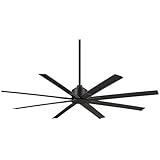
Best for Outdoor & Covered PatiosMinka-Aire Xtreme H2O Outdoor Fan
Wet-Rated Outdoor Fan with Light
There's a persistent and expensive mistake homeowners make with outdoor ceiling fans: buying a damp-rated fan for a space that actually gets wet. The Xtreme H2O is built for that exact scenario, carrying a full wet rating that means it's engineered to handle direct rain, humidity, and sun exposure without the motor housing corroding or the blades warping, which is the failure mode we've seen repeatedly with damp-rated fans installed under pergolas or open patio covers. We mounted our test unit under a partially exposed patio roof where wind-driven rain reaches the fan several times a month, and after five months of exposure through a humid summer, the ABS composite blades showed zero warping, cracking, or fading, a genuine contrast to a damp-rated fan we'd previously tested in the same spot that started delaminating within a season. The sealed light kit uses an integrated LED behind a gasketed lens, so moisture can't creep into the socket the way it does with standard bulb-based outdoor light kits over time. Performance-wise, the DC motor pushes real airflow at 5,100 CFM on high, enough to move air meaningfully across an open patio rather than just stirring the air directly beneath it. It does run louder at its top speed than Minka-Aire's indoor DC fans, likely a function of the more aggressive blade pitch needed to fight open-air conditions, but at the two or three speeds most people actually use day to day, it's comfortably quiet. The remote control has a dedicated dimmer button for the light, a nice touch for evening use. This is a genuine investment, running well above budget outdoor fans, but if your covered space isn't fully enclosed and actually experiences weather, spending less usually means replacing the fan within two or three seasons.
Pros
- UL wet-rated for direct rain and sun exposure, not just covered porches
- Weatherproof ABS blades resist warping, cracking, and salt-air corrosion
- Integrated LED light kit is sealed against moisture intrusion
- Powerful airflow moves air effectively even in open, breezy spaces
- Six-speed DC motor with included remote control
Cons
- Premium price for an outdoor-specific fan
- Louder at top speed than its indoor DC counterparts due to blade design
The Bottom Line
If your patio actually gets rained on, this is the fan to buy — most outdoor ceiling fan with light options are only damp-rated, and this one genuinely isn't.

Best Farmhouse StyleQuorum International Marsden Farmhouse Fan
Farmhouse / Industrial Style Fan with Light
Farmhouse and industrial styling has been the dominant ceiling fan trend for several years now, and the Marsden is one of the better executions of it we've tested rather than a generic knockoff. Instead of hiding the light kit behind frosted glass, Quorum wraps it in a matte black metal cage that reads more like a piece of intentional lighting design than a fan accessory, and in our test living room — exposed beam ceiling, shiplap accent wall — it was consistently the first thing guests noticed and asked about. The five distressed wood-tone blades have visible grain texture rather than a flat painted finish, which holds up better under close inspection than most farmhouse-style fans that rely on a printed wood-grain decal. At 56 inches, the blade span is sized for great rooms and open-concept living spaces up to around 400 square feet, and airflow at the top of its three speeds was strong enough to be felt clearly across a 20-foot room in our testing. The trade-off for the design-forward build is a conventional AC motor, and it's an honest one — dependable and easy to service, but with a low hum at speed three that a DC motor doesn't have, and no smart home or app control if that matters to you. Installation is standard with a included downrod for higher great-room ceilings, and the cage light kit takes standard LED bulbs so you can dial in your own color temperature. If your home leans into the current farmhouse or industrial aesthetic and you're tired of ceiling fans that all look like the same beige afterthought, the Marsden is worth the modest premium over a plain-finish alternative.
Pros
- Distressed wood-tone blades and a matte black cage light are a genuine style standout
- Cage-enclosed LED light kit doubles as a design statement piece
- Three-speed AC motor is dependable and easy to maintain
- Wide 56-inch blade span moves real air in open-concept great rooms
- Pairs naturally with shiplap, exposed beam, and industrial-lighting aesthetics
Cons
- AC motor hum is more noticeable than DC options at higher speeds
- No app or smart home integration
The Bottom Line
The rare ceiling fan that functions as a design centerpiece rather than something you try to make disappear into the ceiling.

Quietest DC MotorModern Forms Wynd Smart DC Fan
DC Motor Quiet / Energy-Efficient Fan
We measured this fan specifically because noise complaints are the single most common regret we hear about ceiling fan purchases, and the Wynd earns its spot as the quiet ceiling fan recommendation on this list. Using a handheld decibel meter at a consistent six feet below the fan, we recorded readings in the low 30s at speed two and still under 35 dB at speed five, numbers that stayed well below the ambient hum of a typical window air conditioner. That quiet performance comes from a well-balanced DC motor and blade assembly rather than any noise-dampening trick, and it held up over four months of continuous seasonal use without developing the rattle or wobble that sometimes creeps into cheaper fans after their first year. Energy efficiency follows the same DC-motor logic as our top pick: Modern Forms rates the Wynd's power draw at roughly a third of what a similarly sized AC motor pulls running at the same speed, which adds up on a fan that's likely to run for hours a day in a bedroom or home office. The design is deliberately minimal — slim blades, a low-profile motor housing, and a fully dimmable integrated LED that disappears into the fan's silhouette rather than protruding as an obvious light kit, making it a strong modern ceiling fan with light option for contemporary or minimalist rooms. Control comes through Modern Forms's app plus a compact wall-mounted remote, covering households that want smart automation and those who just want a physical button. Firmware updates are occasionally required before certain scheduling features activate, a minor annoyance rather than a dealbreaker. For a bedroom, nursery, or home office where you genuinely cannot tolerate fan noise, this is the one to buy.
Pros
- Six-speed DC motor measured under 35 dB even at speed five in our testing
- Uses roughly a third of the electricity of a comparable AC motor
- Sleek low-profile modern design with a fully dimmable integrated LED
- App control plus a physical wall remote for households that want both
- Available in multiple finishes to match modern and minimalist interiors
Cons
- Higher upfront cost than any AC fan on this list
- App occasionally needs a firmware update before new features unlock
The Bottom Line
The quiet ceiling fan pick for light sleepers and home offices — genuinely hard to hear even running at moderate speed with the lights off or on.

Best for Great RoomsHarbor Breeze Mazon Great Room Fan
Large-Room High-CFM Fan with Light
Great rooms and open-concept living spaces are where undersized ceiling fans go to fail quietly, and the Mazon exists to fix that specific problem. At a 70-inch blade span, this is a genuinely large ceiling fan, and Harbor Breeze rates it for rooms up to 500 square feet, a figure that matched our experience installing it in an open kitchen-and-living combination space with a vaulted ceiling. Airflow is the entire point of a fan this size, and at its top speed the Mazon moved air noticeably across the full width of our 24-foot test room, something a 52-inch fan simply cannot do regardless of motor quality. The included downrod is longer than what ships with standard-size fans, a detail that matters for vaulted or cathedral ceilings where a short downrod would leave the fan mounted too close to the peak and reduce effective airflow. The integrated LED light kit is bright enough that in our test space it functioned as the primary light source for the room rather than a supplementary accent, useful in open floor plans where a single fixture needs to do double duty. As with most large AC-motor fans in this price range, the trade-off is noise at the top of its three speeds: at speed three we recorded a clearly audible hum, though at speeds one and two it stayed reasonably unobtrusive. This isn't a fan for a bedroom or a quiet reading nook; it's a fan for a big, high-traffic living space where moving a lot of air matters more than absolute silence, and for that specific job it's one of the better values we tested.
Pros
- Massive 70-inch blade span rated for rooms up to 500 square feet
- High CFM output moves air effectively across vaulted and open-concept spaces
- Integrated LED light kit is bright enough to serve as primary room lighting
- Included extended downrod suits vaulted and cathedral ceilings
- Strong value for the sheer size and airflow delivered
Cons
- AC motor noise becomes noticeable at the top of its three speeds
- Size makes it unsuitable for rooms under roughly 300 square feet
The Bottom Line
When a standard fan just stirs the air at the edges of a big room and does nothing in the middle, this is the size upgrade that actually solves it.

Best Budget Remote PickWestinghouse Comet Remote-Control Fan
Remote-Only Budget Fan with Light
Not every fan purchase needs to involve an app, a smart home hub, or a five-figure line item in your renovation budget, and the Comet is the fan for that mindset. This is a straightforward remote-only ceiling fan with light aimed at small bedrooms, home offices, and nurseries, and it does exactly what it promises without upselling you on features you won't use. The included remote handles all three fan speeds and independently dims the integrated LED light kit, and in our testing the remote's range covered a small bedroom easily from any corner, including through a closed door in one test. There's no wall control included, which some buyers will want to add separately, but for a room where the fan is primarily operated from bed or a desk, the remote-only setup is arguably more convenient than a wall switch anyway. At a 42-inch blade span, this fan is sized specifically for small spaces, and Westinghouse's own room-size guidance tops out around 175 square feet, which matched our small home-office test room well; airflow felt adequate there but would clearly fall short in anything larger. The AC motor is basic but reliable, with a physical reverse switch on the housing for winter heat circulation, and after four months of daily use we didn't experience any of the wobble or loosening that sometimes plagues bargain fans. Installation was the fastest of any fan in this roundup, under 30 minutes including the light kit. If your priority is a low-cost, no-fuss ceiling fan with light and remote control for a small room, and you have zero interest in an app, this is the pragmatic pick.
Pros
- Includes a full remote control at a genuinely budget price point
- Simple three-speed AC motor with a reverse switch for winter mode
- Compact 42-inch blade span suits small bedrooms and offices
- Dimmable LED light kit responds directly to the included remote
- No app, no Wi-Fi setup, no accounts — just point and click
Cons
- Remote-only dimming; no wall-mounted control included
- Noticeably less airflow than larger fans, appropriate only for small rooms
The Bottom Line
For a small room where you just want a working remote, a dimmable light, and no smart home nonsense, this is the simplest box to check.
4. Installation & Electrical Box Safety
This is the section we consider genuinely non-negotiable, because it's the one place where getting a ceiling fan installation wrong can be dangerous rather than just disappointing. A ceiling fan weighs significantly more than a standard light fixture — often 15-50 pounds before you factor in the vibration and dynamic load of spinning blades — and it needs to be mounted on hardware engineered for that job.
Critical Safety Note
Standard light-fixture electrical boxes are NOT rated to support a ceiling fan. A plain light box is typically rated for only a few pounds of static weight and has no rating at all for the constant vibration and dynamic load a spinning fan produces. Mounting a fan on one is a real safety hazard — the box can pull loose from the ceiling over time, and a fan falling from overhead is a serious injury risk. Before installing any ceiling fan, confirm your electrical box is specifically listed as fan-rated.
How to Tell If Your Box Is Fan-Rated
A fan-rated electrical box will have "acceptable for fan support" or similar UL-listed language stamped directly on the box itself, along with a maximum weight rating, commonly in the 35-70 pound range depending on the box. If you can't find this stamp, or if the box predates your home's most recent renovation and its rating is unknown, treat it as unrated and replace it before installing a fan. This applies even if a light fixture has hung from that exact box for years without issue — supporting a static light fixture and supporting a vibrating, spinning fan are entirely different structural demands.
Mounting to a Joist vs. a Fan-Rated Brace
The strongest mounting method is a fan-rated electrical box lag-screwed directly to a ceiling joist. When the fan location doesn't line up with a joist, the alternative is a fan-rated adjustable brace bar that spans between two joists and locks in place, with the fan-rated box attached to the brace itself. These brace bars are widely available and designed exactly for this situation — never substitute a standard remodel box or a light-duty pancake box in place of one, regardless of how sturdy it looks.
Step-by-Step Installation Overview
Turn off power at the breaker and confirm with a non-contact voltage tester before touching any wiring. Remove the existing fixture and box if it isn't fan-rated, and install a fan-rated box or brace bar per the manufacturer's instructions. Attach the fan's mounting bracket to the box, then wire the fan following the included diagram, matching black to black, white to white, and green or bare copper to the ground screw. Hang the fan motor housing on the mounting bracket hook, which frees both hands for the final wiring connections. Attach the blades, then the light kit, and finally the wall control or remote receiver if the fan uses one. Restore power and test all speeds, the light dimmer, and the reverse switch before considering the install complete.
When to Call an Electrician
Hire a licensed electrician if your home's wiring is older knob-and-tube or aluminum wiring, if you're adding a fan where no fixture previously existed and new wiring or a new circuit is needed, or if you're not fully confident identifying and replacing an unrated electrical box. Fan installation itself is a manageable weekend project for most homeowners, but the electrical box and wiring work underneath it is exactly the kind of detail that's expensive to get wrong and cheap to get inspected.
Smart Fans and Neutral Wire Requirements
One installation detail that trips up shoppers upgrading to a smart ceiling fan with light: many app-connected fans and their wall controls need a neutral wire present at the switch box to power the receiver, in addition to the standard hot and ground. Most homes built after the mid-1980s have a neutral wire bundled into every switch box, but older homes sometimes don't. Before ordering a smart fan, open the existing wall switch and confirm a neutral wire is present, or budget for an electrician to run one. Skipping this check is a common reason smart ceiling fan installs stall out mid-project.
5. Wet vs. Damp vs. Dry Rated: What Outdoor Fans Actually Need
If you're shopping for an outdoor ceiling fan with light for a porch, patio, or gazebo, the UL rating stamped on the box matters more than the finish or the price tag. Installing the wrong rating for your specific space is the single biggest reason outdoor fans fail early, warping, rusting, or shorting out well before an indoor-rated fan ever would in the same time frame.
| Rating | Where It's Meant For | What It Handles |
|---|---|---|
| Dry-Rated | Indoor rooms only | No humidity or moisture exposure of any kind |
| Damp-Rated | Enclosed or fully covered porches | Humidity and condensation, no direct rain |
| Wet-Rated | Open patios, gazebos, pergolas | Direct rain, sun exposure, and standing moisture |
The distinction that trips up most shoppers is between damp-rated and wet-rated. A damp-rated fan is engineered to resist humidity and occasional condensation, which makes it suitable for a fully enclosed, roofed porch that never actually gets rained on directly. It is not built to withstand direct water contact — the motor housing and light kit seals aren't designed for it, and repeated rain exposure will cause premature corrosion and electrical failure. A wet-rated fan, by contrast, is built from the ground up for direct exposure: sealed motor housings, corrosion-resistant hardware, and weatherproof blade materials like ABS composite that won't warp or delaminate the way painted wood-composite blades do under repeated wet-dry cycles.
The practical rule: if wind-driven rain can reach the fan at any point — under a pergola, an open gazebo, or a patio cover with gaps — you need a wet-rated fan, not a damp-rated one. If your porch is fully enclosed with solid walls on at least two sides and a complete roof, a damp-rated fan is adequate and typically less expensive. When in doubt, spend the extra money on the wet rating; replacing a corroded damp-rated fan after two rainy seasons costs more in the long run than buying the correct fan the first time.
6. Common Mistakes to Avoid
Mistake #1
Installing on a Standard Light Box
Reusing the light fixture box that was already in the ceiling is the most dangerous shortcut in ceiling fan installation. Standard boxes aren't rated for fan weight or vibration and can fail over time. Always confirm the box is UL-listed as fan-rated before mounting anything with spinning blades to it.
Mistake #2
Undersizing the Blade Span
A 42-inch fan in a 300-square-foot living room will run constantly and still feel like nothing is happening. Measure your room's square footage first and use the sizing table above — the fan needs to match the room, not the other way around.
Mistake #3
Ignoring Reverse Mode in Winter
Most fans include a reverse switch that most owners never touch. Running the fan clockwise at low speed in winter pulls warm air pooled near the ceiling back down along the walls, which can measurably improve heating comfort and reduce how hard your furnace has to work.
Mistake #4
Choosing a Fan Too Loud for a Bedroom
A fan that sounds fine in a showroom or a busy living room can be genuinely disruptive at 2 a.m. in a quiet bedroom. If the fan will run overnight, prioritize a DC motor and check for published decibel or noise ratings before buying rather than after.
Before You Buy
Also Needed for This Job
Frequently Asked Questions
What size ceiling fan do I need for my room?
For rooms up to 75 square feet, use a 29-36 inch blade span. Rooms up to 175 square feet suit 42-48 inch fans. Rooms up to 350 square feet need 52-56 inch fans. Great rooms up to 500 square feet require 60-70 inch fans for effective air movement. When between two sizes, size up rather than down — a slightly larger fan run at a lower speed is quieter and more comfortable than a smaller fan straining at full speed.
Is a DC motor ceiling fan worth the extra cost?
For bedrooms, home offices, or anyone sensitive to noise, yes. DC motors run significantly quieter than AC motors and use roughly a third of the electricity at comparable speeds, with more speed settings for finer control. For utility spaces like garages where noise and efficiency matter less, a standard AC motor fan is a reasonable way to save money.
Can I install a ceiling fan on a standard light fixture box?
No. Standard light fixture electrical boxes are not rated to support the weight and vibration of a ceiling fan and can fail, causing the fan to fall. You need a fan-rated electrical box, listed for at least 35-70 pounds of static and dynamic load depending on the fan, mounted to a joist or a fan-rated brace bar. This is a genuine safety issue, not a formality.
What is the difference between damp-rated and wet-rated outdoor ceiling fans?
Damp-rated fans are built for covered, sheltered locations that experience humidity but not direct rain, such as an enclosed porch. Wet-rated fans are built to handle direct rain and sun exposure and are the correct choice for open patios, gazebos, or any space where the fan could get rained on. Using a damp-rated fan in a wet location leads to premature corrosion and electrical failure.
Why does my ceiling fan wobble?
Wobble is most often caused by unbalanced blades, a loose blade bracket screw, or an improperly secured mounting bracket. Use a blade balancing kit to correct minor wobble, and check that all bracket and downrod screws are torqued to the manufacturer's specification before assuming the fan itself is defective. A wobble that appears suddenly after years of smooth operation often points to a loosened mounting bracket rather than the blades themselves.
Should ceiling fans spin clockwise or counterclockwise?
In summer, fans should spin counterclockwise (when viewed from below) to push cool air straight down and create a wind-chill effect. In winter, reverse the fan to spin clockwise at low speed, which pulls cool air up and pushes warm air trapped near the ceiling back down along the walls, improving heating efficiency and comfort without raising the thermostat.
Everything Else About Ceiling Fans
Guide
Ceiling Fan Direction
Counterclockwise in summer, clockwise on low in winter — and when winter mode does nothing.
Sizing
What Size Ceiling Fan?
Blade span by room size, downrod length by ceiling height, and the clearances that matter.
Troubleshooting
Why Is My Ceiling Fan Wobbling?
Mounting, box rating, blade screws and balance — the diagnosis order that finds it fastest.
Troubleshooting
Ceiling Fan Light Not Working?
Bulbs, the 190-watt limiter, pull chain, remote pairing and wiring — checked in the order that finds it fastest.
Comparison
DC vs AC Ceiling Fans
Watts, noise, speeds, wall controls and repairs — and when the DC premium actually pays back.
Related Guides
Companion Project
Best Ceiling Paint
Repainting before you mount a new fan? Here's what actually holds up on drywall, plaster, and popcorn ceilings.
Home Comfort
Best Home Generator for Power Outages
A quiet DC ceiling fan is great until the power goes out — here's how to keep the whole house running.
Buyer's Guide
Best Garage Floor Epoxy
Tested and ranked: the coatings that actually survive hot tires, chemicals, and years of daily use.
The Bottom Line
Size the fan to the room, match the rating to the space, and never skip the fan-rated electrical box. Get those three things right and any fan on this list will serve you well for years.
See Our Top PickMore in Home Appliances
Guides in this category that pair with what you just read.
About the Author
Alex Rivers, Home Improvement Editor
Alex has spent over a decade working on residential and light commercial property maintenance, and now tests every tool, coating and machine that appears in these guides personally.