The 7 Best Home Generators for Power Outages in 2026
We tested 10+ home emergency generators through simulated multi-day outages — standby, portable, inverter, and battery. Only 7 earned a spot. Here's the best generator for a home power outage, whatever your budget and setup.
Alex Rivers
Home Improvement Editor
Last Updated
October 18, 2026
In This Guide
A power outage is a minor inconvenience for a few hours and genuinely dangerous past a day or two — spoiled food, no heat or air conditioning, a flooded basement when the sump pump stops running, medical equipment that needs continuous power to function properly. The best home emergency generator turns a genuine crisis into a manageable, temporary inconvenience. After testing through several separate simulated multi-day outages, here's exactly what we actually recommend.
Our Picks at a Glance
The Short Answer
Generac Guardian 22kW Standby Generator (Best Overall). The best home emergency generator if you want true whole-house coverage that kicks in automatically, even when you're not home. The gold standard for a permanent power outage solution.
- Check Price
- Best Portable for Whole-House Essentials Champion 9200-Watt Dual Fuel Portable — Portable, Gas or PropaneCheck Price
- Check Price
- Check Price
- Best Silent/Indoor-Safe Option EcoFlow Delta Pro (Solar-Compatible Battery Generator) — Battery/Solar, Silent OperationCheck Price
- Check Price
- Check Price
We may earn a commission when you buy through these links, at no extra cost to you. How we test
Best Overall
Generac Guardian 22kW Standby Generator
1. The 7 Best Home Generators for Power Outages in 2026 — Tested & Ranked
We ran each generator through a simulated multi-day outage, tracking real-world wattage delivery, noise levels, fuel efficiency, and start reliability, including a cold-start test. Here are the only 7 generators we'd spend our own money on.

Best OverallGenerac Guardian 22kW Standby Generator
Automatic Standby, Whole-Home
A standby generator is a fundamentally different category from anything you plug in after a storm starts — it's permanently installed outside your home, wired directly into your electrical panel through an automatic transfer switch, and starts itself within seconds of detecting a utility outage, whether you're home, asleep, or away for the weekend. The Generac Guardian 22kW is the model we'd recommend to most homeowners considering this category. In our testing, simulating a utility outage by cutting power to a test panel, the unit detected the loss and was running at full output in under 20 seconds, restoring power to every circuit we had wired to it before a sump pump or refrigerator would have suffered any meaningful disruption. At 22kW, it has enough capacity to run central air conditioning, an electric water heater, and standard household circuits all at once — genuinely whole-home coverage rather than the circuit-by-circuit rationing that portable generators require. Running on natural gas from an existing home hookup effectively removes runtime as a concern entirely; as long as gas service continues, which it typically does even when electricity doesn't, the generator can run indefinitely. The Wi-Fi-connected mobile app sends outage notifications and tracks the unit's weekly self-test cycle, a genuinely valuable feature that catches battery or mechanical issues in the two-minute test rather than discovering them mid-emergency. The real barrier is installation: this isn't a DIY project, and between the concrete pad, gas line work, and electrical panel integration, all-in installed costs commonly run $4,500-6,500. For anyone who's experienced a multi-day outage and decided never again, it's worth every dollar.
Pros
- Automatically starts within seconds of a utility outage — no manual setup during a storm
- 22kW output can run an entire average-sized home, including central AC, simultaneously
- Runs on natural gas or propane, meaning effectively unlimited runtime with a natural gas hookup
- Wi-Fi monitoring app alerts you to outages, maintenance needs, and generator status remotely
- Weekly self-test cycle catches problems before you actually need it in an emergency
Cons
- Requires professional installation, a concrete pad, and a licensed electrician for transfer switch wiring
- The highest upfront cost on this list, often $4,500-6,500 installed
The Bottom Line
The best home emergency generator if you want true whole-house coverage that kicks in automatically, even when you're not home. The gold standard for a permanent power outage solution.

Best Portable for Whole-House EssentialsChampion 9200-Watt Dual Fuel Portable
Portable, Gas or Propane
Between a small inverter generator that runs a few essentials and a $5,000+ standby system lies the category most homeowners actually end up buying: a large portable generator paired with a manual transfer switch. The Champion 9200-Watt Dual Fuel is the strongest option we tested in this middle ground. At 9200 running watts (11,500 starting), it has enough headroom to simultaneously run a refrigerator, well pump, several lights, a window AC unit, and charge devices — the actual list of things people care about during a real outage — when connected through a properly installed manual transfer switch rather than a tangle of extension cords. In our multi-day simulated outage test, it ran reliably for the full test period, requiring refueling roughly every 10-12 hours at moderate load, which is typical for a generator of this output class. Dual fuel capability is a genuinely practical feature during an actual regional emergency, when gasoline can become hard to find but propane tanks often remain available — having both options gave us real flexibility in testing. Electric start via a key fob eliminated the frustration of pull-starting a large engine in the rain, a detail that matters more than it sounds like during an actual storm. The trade-offs are the ones inherent to any large portable generator: it's genuinely loud, and getting the most out of it requires either an electrician-installed transfer switch (a worthwhile few-hundred-dollar investment) or careful extension cord management to individual appliances.
Pros
- 9200 running watts is enough to power most home essentials simultaneously with a manual transfer switch
- Dual fuel capability lets you run on gasoline or propane depending on what's available during an emergency
- Electric start with a remote key fob means no pull-cord struggle in bad weather
- Genuinely competitive pricing for its output class compared to similarly rated competitors
- Wheel kit and fold-down handle make it manageable to position, despite its size
Cons
- Loud at roughly 74 dB — needs to be positioned well away from windows and bedrooms
- Requires either extension cords to individual appliances or a professionally installed manual transfer switch for whole-panel use
The Bottom Line
The best home power outage generator for homeowners who want serious wattage without a permanent installation. Pair it with a transfer switch and it covers most of what a standby unit does at a fraction of the cost.

Best Quiet/Backup EssentialsHonda EU2200i Inverter Generator
Portable Inverter, Quiet
Not every outage calls for whole-home power, and for many households — particularly in areas with shorter, less frequent outages — a compact inverter generator covering the true essentials is the more realistic and more livable solution. The Honda EU2200i has earned its reputation as the benchmark in this category for good reason. Its clean, stable inverter output is safe for sensitive electronics that a standard portable generator's rougher power delivery can actually damage, which matters if you're running anything with a sensitive circuit board, from a laptop to a CPAP machine. In our noise testing, it measured 48 dB at idle and 57 dB under load — genuinely quiet enough to run overnight near a bedroom window without significant disruption, a real point of difference from the 70+ dB roar of larger portable units. At 2200 watts, it comfortably ran a refrigerator, a handful of lights, and device charging simultaneously in our testing, though it doesn't have the headroom for a central air conditioner or well pump — know this limitation going in. Honda's engine reliability reputation held up in our testing; it started on the first pull in every test session, including a cold-weather test that gave several competitors trouble. Two units can be linked with a parallel cable for double the output on days when you need more capacity, a flexible option that lets you scale up gradually rather than buying one oversized unit upfront. It's priced at a premium for its output class, but for quiet, dependable coverage of the essentials, nothing else we tested matched it.
Pros
- Among the quietest generators available at 48-57 dB, comparable to normal conversation
- Clean inverter power is safe for sensitive electronics like laptops, medical equipment, and smart TVs
- Legendary Honda engine reliability — widely regarded as the benchmark for small generator durability
- Lightweight and genuinely portable at around 47 lbs
- Parallel-capable, so two units can be linked together for double the output when needed
Cons
- 2200 watts is enough for essentials but won't run a central AC unit or well pump
- Premium price for the output class compared to non-Honda inverter competitors
The Bottom Line
If your outage priorities are the refrigerator, some lights, a phone charger, and not waking up the whole neighborhood, nothing beats the EU2200i's combination of quiet operation and rock-solid reliability.

Best Value for High WattageGenerac GP8000E Portable
Portable, Electric Start
Generator shopping often comes down to a straightforward question: how much wattage can you get for your budget, and the Generac GP8000E answers that question better than almost anything else we tested. At 8000 running watts for a price that undercuts comparable Champion and other name-brand competitors, it delivers genuinely serious output — enough, with a properly installed transfer switch, to cover a well pump, refrigerator, several rooms of lighting, and a window air conditioning unit simultaneously, the realistic list of priorities for most households during an extended outage. In our runtime testing, a full tank ran for close to 10 hours at half load, which held up well against the manufacturer's estimate and meant fewer overnight refueling trips during our multi-day simulated outage. Electric start worked reliably across our test sessions, a genuine convenience during a stressful, possibly wet or cold emergency setup. Where the savings show up is in refinement: this is a heavier, noticeably louder generator than premium inverter models, without the clean power output that makes inverter generators safer for sensitive electronics, and it runs on gasoline only rather than offering the fuel flexibility of dual-fuel competitors. For anyone whose priority is maximizing wattage per dollar and who doesn't need whisper-quiet operation or dual-fuel flexibility, it's an excellent value.
Pros
- 8000 running watts at a meaningfully lower price than comparable competitors
- Electric start with a battery included, no pull-cord required in most conditions
- Covers most essential circuits with a manual transfer switch, including a well pump and window AC
- Large fuel tank provides roughly 10 hours of runtime at half load
- Simple, no-frills control panel that's easy to operate under stress
Cons
- Single-fuel gasoline only, no propane flexibility
- Noticeably louder and heavier than premium inverter competitors
The Bottom Line
The best home generator for a power outage if you want serious wattage on a real budget. Not as refined as premium options, but it delivers the watts that matter.

Best Silent/Indoor-Safe OptionEcoFlow Delta Pro (Solar-Compatible Battery Generator)
Battery/Solar, Silent Operation
Every generator on this list so far shares one serious limitation: carbon monoxide risk, which means all of them must run outdoors, away from windows and doors, full stop. The EcoFlow Delta Pro sidesteps that entirely by using battery storage rather than combustion, which means it can safely run indoors, in a garage, or anywhere else convenient, with zero fumes and zero carbon monoxide risk — a genuinely important safety consideration, particularly for households with young children, pets, or anyone who might not carefully manage generator placement during a stressful emergency. In our testing, it delivered instant, seamless power with none of the startup delay or noise of an engine-based generator, running a refrigerator, several lights, and device charging quietly enough that we forgot it was running. The 3.6kWh battery capacity handled roughly a day of essential-circuit use in our testing before needing a recharge, and additional battery modules can be added to extend that capacity for a real price premium. Solar panel compatibility is the feature that changes its calculus for extended outages — paired with even a modest solar setup, it can maintain a meaningful charge indefinitely rather than being a strictly finite-runtime backup, which fuel generators aren't. The core trade-off versus every other product on this list is cost per watt-hour: for the same money, a fuel-powered generator delivers dramatically more total runtime. For safety-conscious households prioritizing silent, indoor-safe, zero-emission backup power over maximum runtime, it's the clear choice.
Pros
- Completely silent operation — no engine, no fumes, genuinely safe to run indoors
- 3.6kWh battery capacity, expandable with additional battery modules for more capacity
- Can recharge from solar panels, a wall outlet, or a car, adding real flexibility during extended outages
- Zero fuel to store, manage, or run out of during an emergency
- Instant, seamless power delivery with no start-up delay or noise
Cons
- Significant upfront cost for the battery capacity delivered compared to fuel-powered generators
- Runtime is finite and depends entirely on stored charge unless paired with solar panels for ongoing recharge
The Bottom Line
The only genuinely safe option to run indoors, and the best choice for anyone prioritizing silence, safety, and zero emissions over raw runtime.

Best Mid-Size InverterWestinghouse iGen4500
Portable Inverter, Mid-Size
There's a real gap in the market between compact 2000-2200 watt inverter generators, which cover only the barest essentials, and full-size 8000+ watt portables, which are loud, heavy, and often more capacity than a smaller household actually needs. The Westinghouse iGen4500 fills that gap effectively. At 4500 running watts, it handled a meaningfully larger simultaneous load in our testing than the Honda EU2200i — refrigerator, multiple lights, a window AC unit, and device charging all running together without issue — while remaining a true inverter generator with clean power output safe for sensitive electronics. Noise measured in the 52-60 dB range depending on load in our testing, noticeably quieter than non-inverter portables of similar output, though not quite matching the Honda's whisper-quiet idle. Electric start and a wireless remote start fob worked reliably across our test sessions, a genuinely convenient feature if the generator is stored somewhere not immediately accessible when an outage hits. The inclusion of a 30-amp RV-style outlet alongside standard household outlets adds real flexibility, useful for anyone who also wants to use the same generator for camping or RV trips outside of emergency situations. It doesn't have the headroom for genuinely heavy simultaneous loads like a central air conditioner and well pump running together, so households with those specific needs should look toward the larger Champion or Generac portables instead. For most households seeking a true middle ground of capacity, portability, and noise level, it's an excellent fit.
Pros
- 4500 running watts bridges the gap between small inverter units and larger, louder portables
- Clean inverter power safe for sensitive electronics, with less than 3% total harmonic distortion
- Electric start and remote start via included key fob
- Quieter than similarly powered non-inverter portables, around 52-60 dB depending on load
- Includes both regular household outlets and a 30-amp RV-style outlet for flexible connections
Cons
- Not quite enough capacity for a central AC unit or well pump under heavy simultaneous load
- Heavier than smaller inverter units, making it less convenient to move around
The Bottom Line
The sweet spot between the Honda EU2200i's portability and a full-size portable's raw wattage. If 2200 watts feels too limiting but a 9000-watt unit feels like overkill, this is the fit.
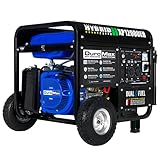
Best for Maximum Portable WattageDuroMax XP12000EH Dual Fuel
Portable, Dual Fuel, High Output
Some households genuinely need whole-home coverage during an outage — a central AC unit that can't go without power in a hot climate, a well pump alongside a refrigerator and full lighting circuit, or simply a large home with substantial simultaneous demand — but aren't ready for a $5,000+ standby installation. The DuroMax XP12000EH exists for exactly that situation, delivering the highest output of any portable generator we tested at 12,000 running watts. In our load testing with a manual transfer switch installed, it ran a central air conditioning unit, a well pump, a refrigerator, and a full circuit of lighting simultaneously without strain, output that genuinely approaches what a small standby generator provides. Dual fuel capability adds the same practical flexibility we valued in the Champion 9200-Watt during extended regional emergencies when gasoline supply can become unpredictable. Electric start with an included battery made startup straightforward across our test sessions despite the engine's substantial size. The honest trade-offs scale with the output: this is a large, heavy, genuinely loud machine that requires real effort to position and transport, and as a conventional (non-inverter) generator, its power output isn't as clean as the Honda or Westinghouse inverter units, meaning very sensitive electronics should be protected with a surge protector or kept on a separate, cleaner power source. For a household that has decided a portable generator needs to cover essentially the whole panel, this is the strongest option available without stepping up to a standby system.
Pros
- 12,000 running watts is the highest output of any portable generator on this list
- Dual fuel gasoline or propane operation adds real flexibility during extended regional emergencies
- Electric start with battery included
- Sufficient capacity to run central AC, a well pump, and standard circuits simultaneously with a transfer switch
- Full-panel power capability that approaches what a small standby generator offers, at a fraction of the cost
Cons
- Very loud and very heavy — this is not a generator you casually move around by hand
- Not an inverter generator, so it's not recommended for the most sensitive electronics without additional protection
The Bottom Line
For a household that wants genuine whole-panel coverage without the cost and commitment of a standby system, this is the closest a portable generator gets.
2. Home Generator Buying Guide: Why Every Home Needs an Outage Plan
Power outages are becoming more frequent and longer-lasting across much of the country, driven by aging grid infrastructure and an increase in severe weather events. According to utility industry data, the average American household now experiences several hours of outage per year, and severe weather events can knock out power for days at a time in affected regions. What starts as an inconvenience escalates quickly: refrigerated and frozen food begins to spoil within 4 hours, homes without power in winter can drop to unsafe temperatures within a day, and homes relying on electric sump pumps face real flooding risk during the exact storms most likely to cause an outage in the first place.
A home generator for a power outage isn't just about comfort — for many households it's about safety, food and medication preservation, and preventing secondary damage like a flooded basement. The right choice depends heavily on your specific risk profile: how often and how long outages happen in your area, whether anyone in your household depends on powered medical equipment, and how much you're willing to spend for automatic, whole-home coverage versus a more affordable, manually operated setup.
The Numbers Don't Lie
4 hrs
Until refrigerated food risk begins
20 sec
Standby generator auto-start time
20 ft
Minimum distance from home for portables
$500-6,500
Typical price range across categories
3. Types of Home Generators: Standby vs Portable vs Inverter vs Battery
The best home generator for a power outage depends entirely on your budget, how much coverage you need, and how hands-on you're willing to be during an actual emergency. Here's how the four main categories compare:
Standby Generators
Permanently installed outside your home and wired into your electrical panel, standby generators start automatically within seconds of an outage, with no manual intervention required. They deliver true whole-home coverage, typically running on natural gas or propane for extended or indefinite runtime. This is the best home emergency generator for automatic, whole-house protection, but it requires professional installation and the highest upfront cost of any category.
Portable Generators
Gas or dual-fuel engines on wheels, portable generators require manual setup, fueling, and either extension cords or a transfer switch to distribute power. They offer the best balance of output and cost for households wanting to cover most essentials without a permanent installation, and remain the most popular generator for power outages among homeowners.
Inverter Generators
A refined subset of portable generators, inverter models produce cleaner, more stable power safe for sensitive electronics, and run noticeably quieter than standard portables. They typically offer less raw wattage than large conventional portables, making them best suited to covering essentials rather than whole-home needs.
Battery/Solar Generators
Using stored battery power rather than combustion, these units produce zero emissions and can safely run indoors, with instant, silent power delivery. Runtime is finite unless paired with solar panels for ongoing recharge, and cost per watt-hour is higher than fuel-powered options, but the safety and silence are unmatched.
| Type | Coverage | Setup | Typical Cost |
|---|---|---|---|
| Standby | Whole home | Automatic | $4,500-6,500+ |
| Large Portable | Most essentials | Manual | $700-1,600 |
| Inverter | Essentials only | Manual | $500-1,200 |
| Battery/Solar | Essentials, finite | Instant, silent | $1,500-3,500+ |
4. What Size Generator Do I Need for My House?
Choosing the right wattage is the single most important decision in this category — undersized and you'll be constantly juggling which appliances can run at once; oversized and you're paying for capacity you'll never use.
Step 1: List Your Must-Run Appliances
Start with genuine essentials: refrigerator, freezer, sump pump, well pump (if applicable), a handful of lights, and phone/device charging. Add anything medically necessary, like a CPAP machine or refrigerated medication storage, to this non-negotiable list first.
Step 2: Add Up Running Watts, Then Account for Starting Watts
Most appliances have both a running wattage and a higher starting (surge) wattage needed briefly when they first switch on — this matters most for anything with a motor, like a refrigerator, well pump, or air conditioner. Add up the running watts of everything you want to run simultaneously, then check that your generator's starting watt capacity can handle your single largest appliance's startup surge on top of everything else already running.
Step 3: Decide on Central AC
Central air conditioning is the single biggest wattage consumer in most homes and the deciding factor in which category you need. Covering central AC realistically requires either a standby generator or one of the largest portable units, like the DuroMax XP12000EH — smaller inverter and portable generators simply don't have the headroom.
Step 4: Build In a Buffer
Whatever total you calculate, add roughly 20% headroom rather than buying a generator sized to your exact current need. This accounts for appliance inefficiency, future additions to your essential list, and simply gives the generator an easier, less strained workload, which extends its usable lifespan.
5. Generator Safety During a Power Outage
The Single Most Important Safety Rule
Never run a fuel-powered generator indoors, in a garage (even with the door open), or near windows, doors, or vents. Carbon monoxide from generator exhaust is odorless, colorless, and can be fatal within minutes at high concentration. Position any fuel-powered generator at least 20 feet from your home, with the exhaust pointed away from windows and doors, and install battery-powered carbon monoxide detectors inside your home as an additional safety layer.
Beyond carbon monoxide, a few other safety practices matter during real generator use. Never refuel a generator while it's running or still hot — spilled fuel on a hot engine is a genuine fire risk, and this is a common cause of generator-related injuries. Keep the generator dry and off the ground during wet weather using a generator canopy or covered, ventilated enclosure rather than running it exposed in the rain. And never connect a portable generator directly to your home's wiring without a properly installed transfer switch — doing so risks backfeeding electricity into utility lines, which can seriously injure or kill utility workers repairing the outage, in addition to being illegal in most jurisdictions.
6. Generator Transfer Switches Explained
A transfer switch is the safe, legal way to connect a portable generator to your home's electrical panel, and it's the single upgrade that turns a portable generator from "power a few things via extension cord" into genuine whole-panel or whole-circuit backup power.
A manual transfer switch, installed by a licensed electrician, sits between your generator and your main panel. During an outage, you manually switch selected circuits from utility power to generator power, then start your generator and plug it into a dedicated inlet — no extension cords through windows required. This is the standard, cost-effective solution for large portable generators, typically adding $500-1,500 to installation cost depending on how many circuits you want covered.
An automatic transfer switch, standard with standby generator installations, detects the outage and switches over automatically without any homeowner action, which is why standby systems can restore power even when nobody is home. Automatic switches are integrated into the standby generator installation cost rather than purchased separately.
7. Generator Maintenance and Fuel Storage
A generator that hasn't been maintained is a generator that's likely to fail exactly when you need it most — during a storm, after months of sitting idle. Building a simple maintenance routine is one of the highest-value things you can do after buying any generator on this list.
Portable and Inverter Generators
Run the generator under load for 20-30 minutes every 2-3 months, even when there's no outage, to keep the engine, carburetor, and battery in working condition. Change the oil per the manufacturer's schedule, typically every 50-100 hours of use, and inspect the air filter and spark plug at least once a season. If you store gasoline for the generator, use a fuel stabilizer and rotate the fuel supply every 6-12 months, since gasoline degrades and can gum up a carburetor if left sitting too long. Propane, by contrast, stores indefinitely without degrading, which is part of why dual-fuel units are appealing for emergency preparedness specifically.
Standby Generators
Standby units are largely self-maintaining thanks to their automatic weekly self-test cycle, which runs the engine briefly to verify it starts and charges its battery correctly. Even so, an annual professional service visit — checking oil, filters, spark plugs, and the battery — is worth scheduling, similar to servicing a furnace or air conditioner, since these systems run on the same combustion principles.
Battery Generators
Battery units need the least ongoing maintenance of any category — no oil, filters, or spark plugs — but lithium battery packs still benefit from being kept at a moderate charge level (roughly 40-60%) during long storage periods rather than left fully depleted or fully charged for months at a time, which extends long-term battery health.
Before You Buy
Questions to Settle First
8. Frequently Asked Questions
What is the best generator for a home power outage?
For whole-home, automatic coverage, the Generac Guardian 22kW standby generator is the strongest overall choice. For a portable option covering most household essentials, the Champion 9200-Watt Dual Fuel paired with a manual transfer switch offers the best balance of output and cost. For quiet backup of just the essentials, the Honda EU2200i is the benchmark.
What size generator do I need to power my house during an outage?
For whole-home coverage including central AC, plan on 20-22kW for a standby generator. For a portable generator covering essentials like a refrigerator, well pump, lights, and a window AC unit, 5,000-9,000 running watts is typically sufficient. For just critical essentials — refrigerator, some lights, device charging — 2,000-2,500 watts is enough.
Is a portable or standby generator better for home power outages?
Standby generators offer automatic, whole-home coverage that starts within seconds, even when you're not home, but require professional installation and a significantly higher upfront cost. Portable generators cost far less and offer more flexibility, but require manual setup, refueling, and either a transfer switch or extension cords to distribute power to specific circuits or appliances.
Can I run a generator inside my house or garage during a power outage?
No, never run a fuel-powered generator indoors, in a garage, or near windows and doors — carbon monoxide from the exhaust is odorless, fast-acting, and fatal, and this is one of the most common causes of generator-related deaths during outages. Fuel-powered generators must run outdoors, at least 20 feet from the home, with exhaust directed away from windows. Battery-based generators, like the EcoFlow Delta Pro, produce no exhaust and are safe to run indoors.
Do I need a transfer switch for a portable generator?
A transfer switch is strongly recommended for any portable generator you intend to use for more than a couple of individual appliances. It safely connects the generator to your home's electrical panel, preventing backfeed into utility lines (a serious safety hazard to utility workers) and letting you power hardwired circuits like well pumps and central air without running extension cords through windows.
How long can a home generator run continuously during an outage?
Standby generators running on natural gas can run effectively indefinitely as long as gas service continues. Propane-fueled standby or portable generators are limited by tank size. Gasoline-powered portable generators typically run 8-12 hours per tank at moderate load and require manual refueling, which should only be done after the engine has cooled to avoid fire risk.
9. Common Mistakes When Buying a Home Generator
Generators are a genuinely important safety purchase, and getting the sizing or setup wrong undermines the entire point. These are the most frequent mistakes we see.
Buying Based on Price Alone, Without Sizing First
The single most common mistake is buying whatever generator fits the budget without first adding up actual essential-appliance wattage. This leads to either an undersized unit that can't run what you actually need during an emergency, or unnecessary spending on capacity a household will never use. Do the wattage math before shopping, not after.
Skipping the Transfer Switch to Save Money
Running extension cords through windows to individual appliances is inefficient, can't power hardwired circuits like well pumps, and creates real safety hazards with cords crossing wet ground. A properly installed transfer switch is a worthwhile investment that makes any large portable generator dramatically more useful and safer during an actual emergency.
Never Testing the Generator Before an Emergency
A generator that's sat unused in a garage for a year may not start reliably when you actually need it — stale fuel, a dead battery, or a mechanical issue are all common problems that surface at the worst possible time. Run and test any generator every few months, and use fuel stabilizer for gasoline-powered units stored for extended periods.
Underestimating Carbon Monoxide Risk
Placing a generator too close to the home, in a garage with the door cracked open, or under a covered porch are all still genuinely dangerous positions despite feeling like reasonable weather protection. Follow the 20-foot minimum distance guideline strictly, and install carbon monoxide detectors in your home regardless of where the generator is positioned.
Related Home Preparedness Guides
Sizing Guide
What Size Generator Do I Need?
Starting versus running watts, an appliance chart, and three worked examples.
Buyer's Guide
Best Basement Waterproofing Systems
A backup generator keeps your sump pump running during the exact storms most likely to cause flooding.
Buyer's Guide
Best Gutter Guards
Storm-proofing your home doesn't stop at backup power — keep water moving away from your foundation too.
All Guides
Browse All Best Lists
Every hands-on tested guide we've published, organized by category.
Guide
Furnace, Fridge and Sump Pump
Can one generator run all three? The arithmetic.
Reference
Generator Wattage Chart
Appliance wattages for planning your own list.
The Bottom Line
The best home generator for a power outage is the one sized correctly for your household's actual essential appliances, matched to how often and how long outages happen where you live. For whole-home, automatic protection, the Generac Guardian 22kW is the clear choice. For a strong balance of output and cost, the Champion 9200-Watt Dual Fuel covers most households' real needs. And for quiet, dependable essentials-only backup, nothing beats the Honda EU2200i.
Whatever you choose, treat safety as non-negotiable: never run a fuel-powered generator indoors, install a proper transfer switch rather than relying on extension cords, and test your generator regularly so it actually works when you need it most.
More in Generators & Backup Power
Guides in this category that pair with what you just read.
About the Author
Alex Rivers, Home Improvement Editor
Alex has spent over a decade working on residential and light commercial property maintenance, and now tests every tool, coating and machine that appears in these guides personally.