The 7 Best Whole House Surge Protectors in 2026
We compared clamping voltage, surge current capacity, response time and what each unit does when it finally sacrifices itself. Seven devices worth wiring into a panel.
Alex Rivers
Home Improvement Editor
Last Updated
October 17, 2026
In This Guide
Most damage attributed to lightning is not a direct strike. It is the accumulation of hundreds of smaller surges arriving through the service conductors every year, each one degrading the electronics in appliances that were never designed to see them. A panel-mounted surge protector intercepts those at the entry point, before they reach anything.
Our Picks at a Glance
The Short Answer
Siemens FS140 FirstSurge Pro (Best Overall). The highest surge capacity here with real diagnostics. If you only buy one and want it done properly, this is it.
- Check Price
- Check Price
- Best Compact Option Square D HEPD80 Home Electronics Protective Device — Type 2, 80 kA, Compact, Panel or Surface MountCheck Price
- Check Price
- Best for Outdoor Mounting Intermatic IG2240-IMSK Smart Guard — Type 1 or Type 2, 120 kA, Outdoor Rated, Meter Adapter OptionCheck Price
- Easiest Installation GE THQLSURGE Breaker Style Protector — Type 2, Breaker Format, 22 kA per Mode, In PanelCheck Price
- Best All-In-One Schneider SurgeBreaker Plus SDSB1175C — Type 2, 108 kA, Panel Mount, Data and Coax PortsCheck Price
We may earn a commission when you buy through these links, at no extra cost to you. How we test
Best Overall
Siemens FS140 FirstSurge Pro
1. Why Panel Protection Beats Power Strips
A power strip with surge protection is the familiar form of this product, and it is doing a fundamentally different and much smaller job than a device at the panel.
Most Surges Are Small and Frequent
The dramatic lightning strike is rare. What actually degrades appliances is a continuous background of smaller surges, generated by utility switching, transformer operations, and large motors starting elsewhere on the circuit. A house sees these constantly, and each one takes a small bite out of electronic components.
Panel Devices Intercept Before Anything Else
A surge protector at the panel clamps the event at the service entrance, so what continues past it into every branch circuit is already reduced to a fraction of its original magnitude. Everything downstream benefits, including hardwired equipment that cannot be plugged into a strip.
Hardwired Equipment Cannot Be Protected Any Other Way
The furnace control board, the air conditioner, the oven, the dishwasher, the garage door opener and the LED lighting are all wired directly. None of them can sit behind a power strip, and collectively they represent a far larger repair bill than the electronics that can.
Layered Protection Is the Correct Approach
A panel device handles the large events and a good point-of-use strip handles the residual, which is why manufacturers recommend both rather than one instead of the other. The panel device is the foundation; strips protect specific sensitive equipment behind it.
Cheap Strips Provide Very Little
Inexpensive surge strips often contain a single small varistor and a rating in the hundreds of joules, which is consumed by a few modest events. Many continue supplying power afterwards with no indication that protection has ended, which is worse than none because it produces false confidence.
What the Ratings Mean
80-140 kA
Sensible residential surge rating
400 V
Good clamping voltage on a 120 V leg
3
Protection modes worth having
5-10 yr
Typical replacement interval
2. Type 1 vs Type 2 and What UL 1449 Means
The labels on these devices refer to a specific safety standard and to where in the electrical system they may be installed, and both matter when choosing.
Type 1 installs on the line side of the main breaker. That is between the utility service and the panel, which is the earliest interception point available. Type 1 devices are built to survive being connected without any upstream overcurrent protection.
Type 2 installs on the load side of the main breaker. This is the normal residential arrangement, protecting everything downstream of the main. It is entirely effective, slightly simpler to install, and what most homes use.
UL 1449 is the standard both are listed under. The current edition defines how devices are tested and what markings must appear. A device without a UL 1449 listing should not be considered at all, whatever its claimed specifications.
Voltage protection rating is the number that describes clamping. It is the let-through voltage measured during a standard test surge, and lower is better. For a residential 120 volt leg, a rating around 400 volts is good and anything above 700 is unimpressive.
Surge current rating describes reserve, not effectiveness. A 140 kA device does not clamp better than an 80 kA one. It has more sacrificial material, so it survives more events before reaching end of life. Higher ratings buy longevity.
Three protection modes is the specification to look for. Surges travel line to neutral, line to ground and neutral to ground. Devices covering only the first leave the mode most damaging to modern switched mode power supplies unaddressed.
3. The 7 Best Whole House Surge Protectors in 2026 — Tested & Ranked
We compared published voltage protection ratings, surge current capacity, protection modes and UL 1449 listings, then assessed installation footprint, diagnostic clarity and end-of-life behaviour with an electrician across seven panels. Warranty terms were read in full rather than summarised from the box. These seven earned their place.
At a Glance: How Our Picks Compare
| Product | Type | Rating | Best For |
|---|---|---|---|
| Siemens FS140 FirstSurge Pro | Type 1 or Type 2, 140 kA, Surge Counter, NEMA 4 | 4.7 | Best Overall |
| Eaton CHSPT2ULTRA | Type 2, 108 kA, Three Mode Protection, Panel Mount | 4.6 | Best Value |
| Square D HEPD80 Home Electronics Protective Device | Type 2, 80 kA, Compact, Panel or Surface Mount | 4.5 | Best Compact Option |
| Leviton 51120-1 Panel Protector | Type 2, 50 kA, Audible Alarm, Compact | 4.4 | Best Alerting |
| Intermatic IG2240-IMSK Smart Guard | Type 1 or Type 2, 120 kA, Outdoor Rated, Meter Adapter Option | 4.5 | Best for Outdoor Mounting |
| GE THQLSURGE Breaker Style Protector | Type 2, Breaker Format, 22 kA per Mode, In Panel | 4.2 | Easiest Installation |
| Schneider SurgeBreaker Plus SDSB1175C | Type 2, 108 kA, Panel Mount, Data and Coax Ports | 4.4 | Best All-In-One |

Best OverallSiemens FS140 FirstSurge Pro
Type 1 or Type 2, 140 kA, Surge Counter, NEMA 4
Surge protection devices are consumable. Each event they absorb degrades the metal oxide varistors inside slightly, and eventually the device reaches the end of its life and needs replacing. The problem in practice is that this happens invisibly, and most households discover it years later when they finally look at the indicator light. Siemens addresses that with a surge counter, which logs how many events the device has intercepted. It does not improve protection, but it turns a black box into something you can reason about, and seeing a three-digit count after two years is a persuasive argument that the device is doing something. The protection itself is at the top of the residential range. A 140 kA rating gives a large reserve against the surges a house actually sees, which means the device degrades slowly and lasts. The NEMA 4 enclosure means it can go outdoors at a meter location, and the dual Type 1 and Type 2 listing means an electrician can install it on either side of the main breaker without a different part number. The reservations are size and cost. It is a large device and finding room next to a full panel takes planning, and it sits at the premium end on price. For a house full of expensive electronics, the arithmetic is straightforward.
Pros
- 140 kA surge current rating, among the highest available for residential use
- Surge counter shows how many events the device has actually absorbed
- Rated for both Type 1 and Type 2 installation, so it works either side of the main breaker
- NEMA 4 weatherproof enclosure suitable for outdoor meter locations
- Substantial manufacturer connected equipment warranty
Cons
- Expensive relative to basic panel protectors
- Physically large, which matters in a crowded panel
- Surge counter is useful information rather than a protective feature
The Bottom Line
The highest surge capacity here with real diagnostics. If you only buy one and want it done properly, this is it.

Best ValueEaton CHSPT2ULTRA
Type 2, 108 kA, Three Mode Protection, Panel Mount
There is a version of this product that gets specified over and over by electricians who install them weekly, and this is it. The Eaton CHSPT2ULTRA offers a surge current rating well into the range that matters, three mode protection, and per-leg diagnostic indicators, in a package small enough to mount beside a panel that already has a full complement of breakers. It is the default recommendation for good reasons rather than marketing ones. Three mode protection deserves explanation because it is easy to overlook. Surges can arrive between line and neutral, between line and ground, and between neutral and ground, and cheaper devices protect only the first of those. Neutral to ground surges are the ones that damage sensitive electronics with switched mode power supplies, which describes almost everything in a modern house. Covering all three modes is the meaningful specification. The diagnostic LEDs show protection status for each leg independently, so a partial failure is visible rather than hidden. What you do not get is a surge counter, so the LEDs tell you whether the device is alive but not how hard it has been working. It is Type 2 only, meaning it installs on the load side of the main breaker, which is the normal residential arrangement anyway.
Pros
- Strong 108 kA rating at a mainstream price
- Three mode protection covering line to neutral, line to ground and neutral to ground
- Compact enough to fit alongside a busy panel
- Clear diagnostic LEDs for each protected leg
- Well proven with a very large installed base
Cons
- Type 2 only, so it must go on the load side of the main breaker
- No surge counter, only pass or fail indicators
- Connected equipment warranty is more modest than premium options
The Bottom Line
The one most electricians reach for. Excellent protection at a sensible price with nothing unnecessary attached.

Best Compact OptionSquare D HEPD80 Home Electronics Protective Device
Type 2, 80 kA, Compact, Panel or Surface Mount
A large proportion of houses have a panel with no spare space, mounted somewhere awkward, and the practical question is not which surge protector has the highest rating but which one can physically be installed without relocating anything. The HEPD80 is the answer to that question. It is small, it mounts on the surface beside the panel, and it needs only two hot conductors plus a ground, which means a competent electrician has it wired in and closed up in well under an hour. The 80 kA rating is lower than the premium devices, and it is worth being honest about what that means: it is a measure of reserve capacity rather than of protection quality, so a lower rated device protects just as effectively today and will reach end of life sooner in a high surge environment. For a typical suburban service that difference plays out over many years. The clamping performance is good and the field record over a very long production run is excellent. Diagnostics are minimal, with a single status light rather than per leg indicators, so a partial failure shows as a general fault. For most houses, and particularly for a retrofit where space is limited, none of that is a reason to look elsewhere.
Pros
- Very compact, fitting where larger devices will not
- Simple two wire plus ground connection that is quick to install
- Reliable and long established with an excellent field record
- Clear status indicator light
- Reasonable price for the protection offered
Cons
- 80 kA rating is adequate rather than generous
- No surge counter or per-leg diagnostics
- Indicator is a single light rather than per phase
The Bottom Line
The easiest retrofit here. Small, simple, proven, and enough protection for most houses.

Best AlertingLeviton 51120-1 Panel Protector
Type 2, 50 kA, Audible Alarm, Compact
The single most common failure in whole house surge protection is not the device failing to protect. It is the device reaching end of life and nobody noticing for three years, because the indicator is a small light on the side of a panel in a garage that no one looks at. Leviton attacks that problem directly with an audible alarm, which sounds when protection is lost. It is not subtle and some owners find it irritating enough to disable, which rather defeats the purpose, but for anyone who does not check their panel regularly it converts a silent failure into an unmissable one. The protection itself is modest by current standards. A 50 kA rating is the lowest here, which means less reserve capacity and a shorter expected life in an area with frequent surges. It clamps effectively while it is alive; the rating affects how long that remains true. In a suburban area with underground service and few surges, that may be a decade. In a rural area with overhead lines and summer storms, it will be considerably less. Installation is simple, the device is compact, and the price is low enough that protecting a sub panel as well as a main panel is realistic. Treat it as good value with a shorter replacement cycle.
Pros
- Audible alarm as well as LED indicators, so failure is noticed rather than discovered
- Very compact and simple to install
- Low cost, making protection affordable on a tight budget
- Long established product with reliable performance
- Suitable for sub panels as well as main panels
Cons
- 50 kA rating is the lowest here, meaning a shorter service life in high surge areas
- Audible alarm can be irritating and some owners disable it
- Basic protection modes compared with three mode devices
The Bottom Line
The one that tells you when it has died. Modest rating, but a failed protector you know about beats a better one you do not.
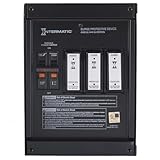
Best for Outdoor MountingIntermatic IG2240-IMSK Smart Guard
Type 1 or Type 2, 120 kA, Outdoor Rated, Meter Adapter Option
In much of the country the main panel is mounted on the outside wall of the house next to the meter, which rules out any surge device not rated for weather exposure. Intermatic builds specifically for that installation, with a sealed enclosure that handles rain, sun and temperature cycling, and it is the obvious choice where an indoor device simply cannot be used. The Type 1 listing is the more interesting feature. Type 1 devices may be installed on the line side of the main breaker, between the utility service and the panel, which is the earliest possible interception point and means a surge is clamped before it reaches the busbar at all. Type 2 devices install downstream of the main breaker, which is entirely effective and slightly further along the path. For a house where the ideal is worth the extra cost and coordination, Type 1 is the better position. The 120 kA rating provides substantial reserve. What complicates it is installation. Line side connections and meter socket adapters usually require coordination with the utility, sometimes including a scheduled disconnect, which turns a straightforward electrician visit into a project. Budget for that, and for a higher price than an indoor Type 2 device.
Pros
- Weatherproof enclosure genuinely suited to outdoor meter and panel locations
- 120 kA rating with good reserve capacity
- Type 1 listing allows line side installation ahead of the main breaker
- Available with a meter socket adapter for utility side mounting
- Replaceable modules on some configurations
Cons
- More expensive than indoor-only devices
- Larger physical footprint
- Meter socket versions require utility coordination to install
The Bottom Line
The pick when the panel is outside. Type 1 listing means it can go ahead of the main breaker, which is the ideal position.

Easiest InstallationGE THQLSURGE Breaker Style Protector
Type 2, Breaker Format, 22 kA per Mode, In Panel
Every external surge protector involves drilling a knockout, mounting a box on the wall beside the panel, and running conductors between the two. It is not difficult work, but it produces a visible lump on the wall and it takes an electrician the better part of an hour. Breaker-format devices avoid all of that by fitting into a spare slot in the panel exactly like an ordinary two pole breaker, connecting to the busbar directly. Installation is a matter of minutes and nothing shows on the outside. The compromise is physics. A device that fits inside a breaker envelope has considerably less room for metal oxide varistors than one in a dedicated enclosure, so the surge current rating is correspondingly lower. That does not mean it fails to clamp a surge; it means it has less reserve and will reach end of life sooner in a high surge environment. For a house with underground service in an area with few storms, that is a reasonable trade for the convenience. Two constraints limit who can use it. It fits GE and compatible panels only, and it needs two adjacent spare slots, which a full panel does not have. Check both before ordering.
Pros
- Installs like an ordinary breaker into a spare panel slot, requiring no external mounting
- Takes up no wall space at all
- Very quick installation for anyone comfortable in a panel
- Inexpensive
- Neat appearance with nothing hanging beside the panel
Cons
- Lower surge rating than external devices, reflecting the smaller package
- Only fits GE and compatible panels
- Requires two spare breaker slots, which many full panels do not have
The Bottom Line
Protection that lives inside the panel. Lower capacity, but by far the tidiest and quickest to fit.

Best All-In-OneSchneider SurgeBreaker Plus SDSB1175C
Type 2, 108 kA, Panel Mount, Data and Coax Ports
A panel surge protector guards the path a surge takes through the service conductors, and homeowners reasonably assume that covers everything. It does not. A surge can arrive equally well down a coaxial cable from an outdoor antenna or a cable service drop, or along a telephone line, and once inside it reaches the same equipment from a direction the panel device never sees. Televisions and cable modems damaged in a storm are frequently killed this way rather than through the mains. The SurgeBreaker Plus handles both paths in one enclosure, with the mains protection at a strong 108 kA rating alongside terminals for coax and telephone lines. Bonding those services properly at the entry point is genuinely important and is skipped constantly, so a device that makes it convenient closes a real gap. Diagnostics are clear and the physical integration with Schneider and Square D panels is neat. Whether it is worth the premium depends on your house. If cable service was disconnected years ago and there is no outdoor antenna, the extra ports do nothing and a mains-only device at the same rating costs less. If there is a satellite dish, a roof antenna, or a cable drop, this is the more complete answer.
Pros
- Combines mains protection with coax and telephone line protection in one device
- 108 kA rating with good reserve
- Covers the surge path most homeowners forget entirely
- Clear diagnostic indicators
- Neat integration with Schneider and Square D panels
Cons
- Coax protection is less relevant in a house without cable service
- Larger enclosure to accommodate the additional ports
- More expensive than a mains-only device of similar rating
The Bottom Line
Closes the back door. Mains protection is useless if the surge arrives down the coax instead.
4. Installation and Wiring It Correctly
Surge protectors work through inductance as much as through electronics, and the wiring details that seem cosmetic have a direct effect on how well they clamp.
Keep the leads as short as physically possible. Every inch of conductor between the device and the busbar adds inductance, and inductance raises the voltage that actually reaches your circuits during a fast surge. Six inches is a reasonable target and twelve is a compromise.
Do not coil excess wire. A neat loop of surplus conductor tucked into the panel is exactly the wrong thing to do, because a coil is an inductor. Cut the leads to length rather than storing the slack.
Twist the conductors together where possible. Twisting the hot and neutral leads reduces the loop area and therefore the inductance, which measurably improves performance during fast rise time events.
Connect to a two pole breaker, not a single pole. The device needs both hot legs to protect the whole panel. Landing it on one leg leaves half the house unprotected, and this is a genuinely common installation error.
Grounding has to be sound. A surge protector diverts energy to ground, and if the grounding electrode system is corroded, undersized or poorly bonded there is nowhere for that energy to go. Verify the ground before installing anything.
This is electrician work. Installation means working in an energised panel or arranging a service disconnect, and in most jurisdictions it requires a permit. The device cost is a small fraction of what it protects, and the labour is an hour.
Six Inches, Not Six Feet
The single biggest difference between a surge protector that performs to specification and one that does not is lead length. Long leads and coiled slack add inductance, and inductance lets voltage through during exactly the fast events you installed the device to stop. Mount it as close to the panel as physically possible and cut the conductors to length.
5. Lifespan, Indicators and Replacement
These are sacrificial devices, and treating them as permanent installations is the most common long-term error.
Every event consumes a little capacity. Metal oxide varistors degrade each time they clamp, and the degradation is cumulative and irreversible. A device in a rural area with overhead lines and frequent storms ages far faster than one in a suburb with underground service.
Indicator lights show status, not remaining life. A green light means protection is currently present. It does not mean the device is fresh, and it will stay green until the device is essentially finished. Treat it as a pass or fail, not a fuel gauge.
Surge counters are the better diagnostic. A device that logs how many events it has absorbed gives a genuine sense of the environment your house sits in and how hard the protector is working, which is useful when deciding on replacement.
Plan on five to ten years. That is a reasonable replacement interval for a good device in a normal environment. After a known nearby strike or a major utility event, check the indicators immediately rather than waiting.
Check the indicator when you change the smoke alarm batteries. Attaching the check to an existing annual habit is the only reliable way most households will ever look at it, and a failed protector discovered a year late has left the house exposed the entire time.
Warranties usually require registration and a professional install. Connected equipment warranties are real, and they are also conditional. Read the terms, register the device, and keep the electrician's invoice, because a claim without those is rarely successful.
6. Layering With Point of Use Protection
Panel protection is the foundation rather than the whole structure, and the manufacturers who make these devices are the first to say so.
A panel device reduces, it does not eliminate. What passes downstream after clamping is much smaller than the original event but is not zero, and very sensitive electronics benefit from a second stage close to them.
Point of use strips should be genuinely rated. Look for a joule rating in the thousands rather than the hundreds, a low clamping voltage, and a design that disconnects power when protection is exhausted rather than continuing to supply it.
Protect the paths that bypass the panel. Coax from an antenna or cable drop, telephone lines, and Ethernet running to an outbuilding all carry surges directly to equipment. Bonding and protecting them at the entry point closes a gap most houses leave open.
Surge protection is not a UPS. An uninterruptible supply handles outages and sags and usually includes surge protection, but it is a different product solving a different problem. Neither replaces the other.
Unplug during a direct threat. No surge device is rated for a direct lightning strike to the structure. During a severe storm, physically disconnecting the most valuable equipment remains the only complete protection, and it costs nothing.
7. What It Costs and Whether It Pays
The economics here are unusually clear, because the protected assets are easy to add up and the installed cost is modest.
The device is a few hundred dollars at most. Even the premium options here cost less than a single mid-range appliance, and the budget devices cost less than a dishwasher repair callout.
Installation is typically an hour of electrician time. Add a permit fee where required. The total installed cost usually lands well below the price of replacing one damaged furnace control board.
The exposure is larger than people assume. A modern house contains electronic control boards in the furnace, air conditioner, oven, dishwasher, washer, dryer and garage door opener, plus LED drivers throughout. Replacing several after one event runs into thousands.
Insurance often does not help as much as expected. Surge damage claims are frequently subject to deductibles that exceed the repair cost of a single item, and multiple claims affect premiums. Prevention avoids the conversation entirely.
Sub panels and outbuildings need their own device. A detached garage, workshop or barn fed from the house has its own run of conductors and frequently its own grounding electrode, which means a surge can be induced on that run after the main panel device has already done its job. A second protector at the sub panel is inexpensive and closes the gap.
The payback is not measured in savings. Unlike insulation or a heat pump, a surge protector produces no monthly return and may sit for years absorbing nothing you notice. It is insurance with a one-off premium, and the correct way to judge it is against the cost of the single worst outcome rather than against an expected saving.
Some utilities and insurers offer incentives. Rebates on installed surge protection and small premium reductions both exist in various regions, and neither is well advertised. Ask before buying, because the paperwork is usually trivial.
Before You Buy
Also Needed for This Job
8. Frequently Asked Questions
What is the best whole house surge protector?
Siemens FS140 FirstSurge Pro for most houses, combining a 140 kA rating with a surge counter that shows how many events it has absorbed. Eaton CHSPT2ULTRA is the best value with three mode protection at a mainstream price, and Square D HEPD80 is the easiest retrofit where panel space is tight.
Is a whole house surge protector worth it?
Yes, in almost every house. A modern home has electronic control boards in the furnace, air conditioner, oven, dishwasher and garage door opener, none of which can be protected by a power strip. The installed cost is usually less than replacing one of those boards.
What is the difference between Type 1 and Type 2 surge protectors?
Type 1 devices may be installed on the line side of the main breaker, between the utility and the panel, which is the earliest interception point. Type 2 devices install on the load side of the main, which is the normal residential arrangement and entirely effective. Some devices are listed for both.
Do I still need power strips with a whole house surge protector?
Yes, for sensitive electronics. The panel device clamps large events at the service entrance but what passes downstream is reduced rather than eliminated. Manufacturers recommend layering, with a good point-of-use strip protecting computers and televisions behind the panel device.
How long does a whole house surge protector last?
Typically five to ten years, though it depends entirely on how many surges your service actually sees. The metal oxide varistors degrade a little with each event, so a rural house on overhead lines wears one out far faster than a suburb with underground service. Check the indicator annually.
Can I install a whole house surge protector myself?
It means working in an energised panel or arranging a service disconnect, and most jurisdictions require a permit. Lead length also matters enormously to performance, which is easy to get wrong. Given that the labour is about an hour and the device protects everything in the house, an electrician is the sensible choice.
9. Common Surge Protection Mistakes
Surge protectors mostly fail to deliver because of how they were installed or how long they were left in place, not because of what was bought.
Long or Coiled Leads
Every inch of conductor between the device and the busbar adds inductance, which raises the voltage that actually gets through during a fast surge. Coiling surplus wire in the panel is the worst version of this, because a coil is an inductor. Cut the leads short and twist them together.
Treating It as a Permanent Installation
These are sacrificial devices that degrade with every event they absorb. The indicator light stays green until the device is essentially finished, so it tells you nothing about remaining life. Check it annually and plan on replacement every five to ten years, sooner in a high surge area.
Ignoring Coax and Phone Lines
A surge can arrive down a cable drop or an outdoor antenna feed and reach your television from a direction the panel device never sees. Bonding and protecting those services at the entry point is skipped in most houses, and it is how equipment gets damaged despite panel protection being present.
Assuming Ground Is Adequate
A surge protector diverts energy to ground, and if the grounding electrode system is corroded, undersized or poorly bonded then there is nowhere for that energy to go. Verifying the ground is part of the installation, not an optional extra, and older houses frequently need attention here.
Related Home Electrical Guides
Buyer's Guide
Best Portable Power Station
Battery capacity, inverter ratings and what actually runs during an outage.
Buyer's Guide
Best Home Generator
Standby versus portable, transfer switches, and sizing done properly.
All Guides
Browse All Best Lists
Every hands-on tested guide we have published, organized by category.
The Bottom Line
The best whole house surge protector for most homes is the Siemens FS140, which pairs the highest surge rating here with a counter that shows what it has absorbed. Eaton CHSPT2ULTRA is the value pick, and Square D HEPD80 the easiest retrofit.
Keep the leads short, verify the ground, check the indicator every year, and add point-of-use protection for the electronics that matter most.
More in Home Improvement
Guides in this category that pair with what you just read.
About the Author
Alex Rivers, Home Improvement Editor
Alex has spent over a decade working on residential and light commercial property maintenance, and now tests every tool, coating and machine that appears in these guides personally.