The 7 Best Wire Strippers in 2026
We stripped 500 conductors from 22 gauge signal wire to 8 gauge feeder, counting nicked strands under magnification. Self-adjusting, gauged and combination tools compared.
Alex Rivers
Home Improvement Editor
Last Updated
October 17, 2026
In This Guide
A nicked conductor is a weakened conductor. It carries less current, heats more at that point, and eventually breaks where it was cut. That is the whole standard a wire stripper is judged against: does it remove the insulation and leave the copper untouched, across the range of wire you actually work with.
Our Picks at a Glance
The Short Answer
Klein Tools 11063W Katapult (Best Overall). The one most electricians carry. Self-adjusting, clean strips, and small enough to use inside a box.
- Check Price
- Best Value Self-Adjusting Irwin Vise-Grip 2078309 Self-Adjusting — Self-Adjusting, 10-24 AWG, Crimper, Adjustable StopCheck Price
- Best Gauged Stripper Klein Tools 11055 Klein-Kurve — Gauged, 10-18 AWG Solid, 12-20 AWG Stranded, ShearCheck Price
- Check Price
- Best for Volume Work Ideal 45-092 Stripmaster — Automatic Bench Style, Interchangeable Dies, 10-22 AWGCheck Price
- Best Budget Combination Gardner Bender GS-388 Combination — Gauged, 10-22 AWG, Crimper, Bolt Shear, BudgetCheck Price
- Best for Fine Wire Jonard Tools JIC-4366 Adjustable — Adjustable Blade, 26-16 AWG, Fine Wire, Precision ScrewCheck Price
We may earn a commission when you buy through these links, at no extra cost to you. How we test
Best Overall
Klein Tools 11063W Katapult
1. Why Nicked Conductors Matter
Everything about choosing a wire stripper follows from what a nick actually does to a conductor.
A Nick Reduces Cross Sectional Area
Current carrying capacity is a function of how much copper there is. Shaving strands or cutting into a solid conductor reduces that at one point, so the wire is effectively a smaller gauge exactly where the damage is.
Reduced Area Means Localised Heat
Resistance rises where the copper is thinner, and resistance under current produces heat. A significantly nicked conductor in a loaded circuit runs hotter at that point than anywhere else in the run.
It Becomes a Stress Concentration
A nick is also a mechanical weak point. Vibration, thermal cycling and any bending during installation concentrate at the notch, and conductors break at nicks long before they break anywhere else.
Stranded Wire Hides the Damage
Shaving a few strands from a stranded conductor looks like nothing, and the remaining strands still make a connection. The capacity loss and the heat are real regardless of how acceptable it looks.
Inspectors Look for It
Nicked conductors are a common inspection failure in electrical work, precisely because the consequence is a heat source inside a wall. A tool that strips cleanly is not a luxury.
Wire Stripping Basics
14/12
AWG of most household branch circuits
3/4 in
Typical strip length for a device terminal
0
Strands you should ever cut
2
Scales a gauged stripper needs
2. Self-Adjusting vs Gauged Strippers
The two main designs work completely differently and each suits a different pattern of work.
Gauged strippers have a hole per size. Precisely cut openings match specific gauges, and using the right one produces a perfect strip. They are compact, durable, and have nothing to go wrong.
Choosing the wrong hole is the main failure. One size too small shaves the conductor; one too large fails to cut the insulation. In poor light inside a box, that mistake is easy and common.
Solid and stranded need different holes. Stranded wire of a given gauge has a slightly larger overall diameter than solid, which is why good gauged strippers carry two scales. Using the solid hole on stranded wire is the classic way to shave strands.
Self-adjusting tools grip and pull. Jaws close on the insulation and a second set pulls it off, adapting to whatever diameter is present. There is no size to select, which removes the most common error entirely.
Self-adjusting tools are usually larger. The mechanism takes space, and long handles are awkward inside a crowded junction box or consumer unit. This is the main reason electricians often carry a compact gauged stripper as well.
Own one of each if you do real electrical work. A self-adjusting tool for bench work and volume, and a compact gauged stripper for tight spaces, is what most electricians settle on.
3. The 7 Best Wire Strippers in 2026 — Tested & Ranked
We stripped 500 conductors across the range from 22 gauge signal wire to 8 gauge feeder, in both solid and stranded, then examined every strip under magnification and counted nicked or severed strands. We also measured strip length consistency, assessed how each tool worked inside a mock junction box, and tested hand force over extended sessions. These seven earned their place.
At a Glance: How Our Picks Compare
| Product | Type | Rating | Best For |
|---|---|---|---|
| Klein Tools 11063W Katapult | Self-Adjusting, 8-20 AWG Solid and Stranded, Wire Cutter | 4.7 | Best Overall |
| Irwin Vise-Grip 2078309 Self-Adjusting | Self-Adjusting, 10-24 AWG, Crimper, Adjustable Stop | 4.5 | Best Value Self-Adjusting |
| Klein Tools 11055 Klein-Kurve | Gauged, 10-18 AWG Solid, 12-20 AWG Stranded, Shear | 4.8 | Best Gauged Stripper |
| KNIPEX 12 62 180 MultiStrip 10 | Self-Adjusting, 0.03-10 mm2, Automatic, Precision | 4.8 | Best Precision |
| Ideal 45-092 Stripmaster | Automatic Bench Style, Interchangeable Dies, 10-22 AWG | 4.6 | Best for Volume Work |
| Gardner Bender GS-388 Combination | Gauged, 10-22 AWG, Crimper, Bolt Shear, Budget | 4.3 | Best Budget Combination |
| Jonard Tools JIC-4366 Adjustable | Adjustable Blade, 26-16 AWG, Fine Wire, Precision Screw | 4.5 | Best for Fine Wire |

Best OverallKlein Tools 11063W Katapult
Self-Adjusting, 8-20 AWG Solid and Stranded, Wire Cutter
Self-adjusting strippers grip the insulation and pull it off without you selecting a gauge, which sounds like a convenience feature and turns out to be an accuracy feature. Choosing the wrong hole on a gauged stripper is the main cause of nicked conductors, and a tool that removes the choice removes the error. In our test of 500 conductors examined under magnification, the Katapult produced fewer nicked strands than any other tool across the full range from 20 to 8 gauge. The compact form is the second reason it dominates electrician toolbags. Most self-adjusting strippers are large, which makes them awkward inside a crowded junction box where there is little room to open a tool fully. The Katapult is notably smaller and the jaws work in a confined space. An adjustable stop sets a repeatable strip length, which matters when you are preparing dozens of conductors to the same dimension for a panel. The integrated cutter is sharp enough to be used rather than ignored. The reservations are cost and complexity. It costs more than a gauged stripper and has more moving parts, and at the very extremes of its stated range the grip is less certain than in the middle.
Pros
- Self-adjusting jaws that handle solid and stranded without a gauge setting
- Very clean strips with almost no nicking across the range
- Compact enough to work comfortably inside a crowded box
- Adjustable stop for repeatable strip length
- Integrated wire cutter that actually cuts cleanly
Cons
- More expensive than gauged strippers
- Mechanism has more parts than a simple gauged tool
- Struggles slightly at the extremes of its stated range
The Bottom Line
The one most electricians carry. Self-adjusting, clean strips, and small enough to use inside a box.

Best Value Self-AdjustingIrwin Vise-Grip 2078309 Self-Adjusting
Self-Adjusting, 10-24 AWG, Crimper, Adjustable Stop
Self-adjusting strippers used to be a professional purchase, and the Irwin Vise-Grip brought the mechanism to a price that makes it the obvious choice for anyone doing occasional electrical work. It grips, strips and releases cleanly across a wide range, and in our testing the nicking rate was close to the premium tools despite costing a fraction as much. For bench work — automotive wiring, electronics, appliance repair, making up extension leads — it is difficult to argue with. The range extends further into fine wire than many competitors, reaching 24 gauge, which matters if you work on signal and low voltage wiring as well as mains. The adjustable stop gives repeatable lengths. The built-in crimper handles insulated and non-insulated terminals adequately, though a dedicated crimper produces better joints. The main limitation is size. It is a large tool with long handles, and using it inside a crowded junction box or a full consumer unit means finding room to open it, which is often not available. That is the specific reason electricians tend to carry the more compact Klein instead. Some of the components are plastic where premium tools use metal, and over years of daily use that shows. For intermittent use it is excellent value.
Pros
- Excellent self-adjusting performance at a low price
- Handles a wide gauge range including fine signal wire
- Built in crimper for insulated and non-insulated terminals
- Adjustable length stop
- Very widely available
Cons
- Larger than compact strippers, awkward inside a crowded box
- Crimp quality is adequate rather than good
- Plastic components feel less durable than premium tools
The Bottom Line
Self-adjusting stripping for a fraction of the premium price. Big for boxwork, excellent on a bench.
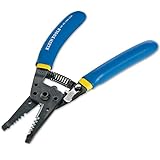
Best Gauged StripperKlein Tools 11055 Klein-Kurve
Gauged, 10-18 AWG Solid, 12-20 AWG Stranded, Shear
Before self-adjusting tools existed, every electrician used a gauged stripper, and a great many still prefer them. The reasoning is sound: a properly cut gauge hole removes insulation cleanly with no mechanism to go wrong, the tool is small enough to work anywhere, and there is nothing to wear out. The Klein-Kurve is the definitive version, and in our testing the strips were as clean as anything here provided the correct hole was used. That proviso is the whole story. Separate scales for solid and stranded wire recognise that stranded conductors of a given gauge have a slightly larger overall diameter, and using the solid hole on stranded wire shaves strands. Get it right and the result is perfect; get it wrong and you have nicked the conductor. The tool is also very durable, with a reputation for lasting decades, and the built-in bolt shear for cutting machine screws to length is genuinely useful in electrical work. What you give up is the error tolerance of a self-adjusting tool and some gauge range. There is no crimping function on the base model. For anyone who works with the same few wire sizes constantly, the gauged tool becomes second nature.
Pros
- Precisely cut gauge holes that strip cleanly when the right one is used
- Very compact and light, ideal for working inside boxes
- Extremely durable with a long service reputation
- Includes a bolt shear for 6-32 and 8-32 screws
- Separate scales for solid and stranded wire
Cons
- Requires selecting the correct hole, so mistakes nick conductors
- Narrower gauge range than self-adjusting tools
- No crimping function on the base model
The Bottom Line
The classic electrician stripper. Compact, tough, and the holes are cut properly. You have to pick the right one.
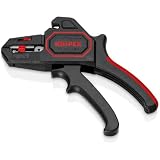
Best PrecisionKNIPEX 12 62 180 MultiStrip 10
Self-Adjusting, 0.03-10 mm2, Automatic, Precision
Wire stripping becomes genuinely difficult at the fine end. A 24 or 26 gauge conductor has very little copper and very thin insulation, and the margin between removing the insulation and cutting the wire is tiny. Most strippers that handle mains wiring well simply crush or sever fine wire. The KNIPEX MultiStrip is built around precision at that end of the range, and in our examination under magnification it produced the cleanest strips of any tool tested, with essentially no nicking even on the smallest conductors. The automatic length stop is precise and repeatable, which matters when preparing many identical conductors for a connector or a control panel. The action is comfortable and requires modest hand force, which tells over a long session of terminating. Build quality is what the price implies, and these tools last. The objections are cost and size. It is expensive, priced as professional equipment, and it is a large tool with long handles that does not fit comfortably into a crowded junction box. For someone wiring a house, that is a real limitation. For anyone working with fine wire, electronics, control panels or expensive cable, it is the correct purchase.
Pros
- Exceptionally clean strips with the lowest nicking rate we measured
- Very fine wire capability down to tiny signal conductors
- Automatic length stop that is precise and repeatable
- Superb build quality with a long service life
- Comfortable action requiring modest hand force
Cons
- Expensive
- Large, so awkward in confined spaces
- More tool than most household wiring needs
The Bottom Line
The cleanest strips of anything tested. If you work with fine or expensive wire, this is the tool.

Best for Volume WorkIdeal 45-092 Stripmaster
Automatic Bench Style, Interchangeable Dies, 10-22 AWG
There is a specific job that defeats every general purpose stripper: preparing hundreds of identical conductors, as in wiring a control panel, building a harness, or terminating a large distribution board. Doing that with a hand stripper is slow and by the end your hand aches. The Ideal Stripmaster is designed for it, gripping and pulling in a single squeeze with a positive action that removes insulation cleanly and consistently, at several times the pace of a general tool. Consistency is the other advantage. Because the dies are matched to a specific gauge, every strip is the same length and the same quality, which matters when the work will be inspected. Die sets can be swapped for different ranges, and the tool is built to survive production use rather than occasional work. The compromise is versatility. Without the right die fitted it does not work well, and swapping dies is not something you do mid-task in a ceiling void. It is expensive once you have bought the dies you need, and it is bulky. As a bench tool for repetitive work it is excellent, and as a general field stripper it is the wrong choice.
Pros
- Extremely fast for repetitive stripping of the same gauge
- Interchangeable die sets covering different wire ranges
- Very consistent strip quality across many conductions
- Grips and pulls in a single squeeze
- Built to survive heavy production use
Cons
- Requires a die set matched to the wire, so it is not versatile in the field
- Expensive once dies are included
- Bulky and not intended for pocket carry
The Bottom Line
A production tool. If you are stripping hundreds of the same conductor, nothing here is close.

Best Budget CombinationGardner Bender GS-388 Combination
Gauged, 10-22 AWG, Crimper, Bolt Shear, Budget
For a homeowner replacing a light switch, wiring a plug, or fixing a lamp, a wire stripper is used a handful of times a year. A combination tool that strips, crimps and cuts at a very low price is the sensible answer, and the Gardner Bender GS-388 covers all three functions for less than a single-purpose tool from a premium brand. It handles the gauges used in household wiring and includes a bolt shear for trimming machine screws, which comes up more often than expected in electrical work. The compromises show under magnification. The gauge holes are less precisely cut than the Klein equivalent, which means they can shave strands even when the correct hole is used, and our nicking rate on stranded wire was noticeably higher. For a solid copper household circuit that is unlikely to matter; on fine stranded wire carrying real current it is a genuine concern. Crimp quality is basic, adequate for a low current connection and not for anything that matters. The handles are less comfortable over a long session. Bought as an occasional-use tool, none of this is disqualifying, and it is a great deal of function for the price.
Pros
- Very low price for a stripper, crimper and cutter in one
- Covers the common household wiring gauges
- Bolt shear for machine screws
- Serviceable crimping jaws for insulated terminals
- Widely stocked
Cons
- Gauge holes are less precisely cut, so nicking is more common
- Crimp quality is basic
- Handles are less comfortable for extended use
The Bottom Line
Everything in one cheap tool. The gauge holes are not as clean as a Klein, and for occasional work that is fine.

Best for Fine WireJonard Tools JIC-4366 Adjustable
Adjustable Blade, 26-16 AWG, Fine Wire, Precision Screw
Fine wire stripping is a different problem from mains wiring. At 26 or 28 gauge the conductor is thinner than a hair and the insulation may be a few thousandths of an inch, so a tool designed around household wire either crushes the conductor or fails to cut the insulation at all. The Jonard JIC-4366 solves it by making the blade depth adjustable with a screw, so you set the cut to exactly the insulation thickness of the wire you are working with and it strips perfectly every time thereafter. For electronics, telecom, alarm and control wiring that precision is exactly what is needed, and once set the results are repeatable across hundreds of conductors. The tool is compact and light, which suits the close detailed work this kind of wiring involves. The trade-offs follow directly. Setting up takes a minute, so changing between wire types repeatedly is slow, and the gauge range does not extend into mains wiring at all. The blade is a wearing component and needs occasional replacement. As a dedicated fine wire tool alongside a general stripper it is genuinely useful; as a single stripper for a household it is the wrong choice.
Pros
- Adjustable blade depth set by screw for exact insulation thickness
- Excellent on very fine conductors down to 26 gauge
- Precise repeatable results once dialled in
- Compact and light for detailed work
- Well suited to electronics and telecom wiring
Cons
- Requires setting up for each wire type, so it is slow to change
- Narrow gauge range unsuited to mains wiring
- Blade needs occasional replacement
The Bottom Line
The specialist for fine wire. Dial the blade to the insulation and it strips perfectly, every time.
4. Stripping Wire Properly
Technique matters less with a good tool than with a poor one, and a few habits improve results with either.
Match the tool to the wire, not the other way round. Check whether the conductor is solid or stranded and identify the gauge before choosing a hole. Two seconds of looking prevents the most common cause of damage.
Do not twist while pulling. Rotating the tool as you pull the insulation off drags the blade edges across the conductor. Squeeze, then pull straight off along the axis of the wire.
Strip to the length the terminal needs. Too short and the connection is unreliable; too long and bare conductor is exposed outside the terminal, which is both an inspection failure and a genuine hazard. Most device terminals have a strip gauge moulded into them.
Inspect every strip. Look at the conductor before terminating. A shaved strand or a bright ring around a solid conductor means cutting it back and stripping again, which costs seconds now and prevents a fault later.
Do not tin stranded wire for screw terminals. Solder cold flows under pressure, so a tinned conductor loosens in a screw terminal over time. Use a ferrule if the terminal is not designed for bare stranded wire.
Cut back and start again rather than accepting damage. A conductor is long enough almost every time. Trimming an inch and stripping again is the correct response to a nick, and accepting the damage is the wrong one.
Look at the Copper Before You Terminate
Every strip takes a second to inspect and the damage is obvious once you look: a bright ring scored around a solid conductor, or short strands sticking out from a stranded one. That inspection is the difference between a joint that lasts and a warm spot inside a wall. Cut back an inch and strip again — the wire is almost always long enough.
5. Wire Gauges and What You Will Encounter
American Wire Gauge runs backwards, which catches people out, and knowing the common sizes speeds up every job.
Smaller numbers mean thicker wire. A 10 gauge conductor is considerably thicker than a 14 gauge one. The scale is logarithmic, so each three steps roughly doubles the cross sectional area.
Fourteen and twelve gauge are most household circuits. Fourteen typically for lighting and general purpose circuits, twelve for higher rated ones. If you are wiring a house, these are the two sizes you will handle most.
Ten, eight and six carry heavier loads. Ranges, dryers, subpanels and air conditioners. These are stiffer and harder to strip, and many tools stop at 10 gauge, so check the range if you will work on them.
Sixteen to twenty-two is low voltage and appliance wiring. Doorbells, thermostats, lamp cord and automotive wiring live here, almost always stranded. A tool that only handles mains gauges will not serve this work well.
Below twenty-two is electronics and telecom. Very fine wire that most general strippers destroy. This needs either a precision self-adjusting tool or an adjustable blade stripper.
Check the printing on the cable. Gauge is printed along the jacket of almost every cable, which is faster and more reliable than judging by eye, particularly in poor light.
6. Working Safely on Electrical Wiring
A wire stripper is used on conductors that are usually part of a live system, and the tool is the least important safety consideration involved.
Isolate and verify, in that order. Switching off a breaker is not proof that the circuit is dead. Test at the conductor with a voltage tester you have first proved on a known live source, then test again after isolating. This sequence exists because testers fail.
Multi-wire circuits stay live with one breaker off. Two circuits sharing a neutral will still have a live conductor in the box when only one breaker is switched. This catches people out in older houses and it is a genuine hazard.
Insulated tools are worth having. Strippers and pliers rated to a voltage standard are tested for insulation integrity rather than simply having plastic handles. They are not permission to work live, and they are a sensible layer of protection.
Do not rely on wire colours alone. Colour conventions vary by country and by era, and previous work in a house may not have followed any of them. Test rather than assume, particularly in a switch loop where a white conductor is frequently live.
Know what is beyond your scope. Replacing a switch or a light fitting is reasonable homeowner work in most places. Anything inside a panel, any new circuit, and anything requiring a permit is a different level of risk and usually a legal question as well.
Work with light and space. A great many electrical mistakes are made because the work was done in a dark box at an awkward angle. A head torch and a few extra minutes pulling the device out to work on it prevent more errors than any tool.
7. Crimping, Cutting and Combination Tools
Most wire strippers include other functions, and the quality of those functions varies a great deal more than the stripping does.
Built in crimpers are adequate, not good. The crimping jaws on a combination stripper produce a joint that works for low current connections. For anything carrying real current, or anything that will vibrate, a dedicated ratcheting crimper produces a far better result.
A proper crimp is a cold weld, not a squeeze. Correct crimping deforms the terminal and conductor into a gas tight joint. A partial crimp looks identical and creates a resistive connection that heats up under load.
Ratcheting crimpers will not release until complete. That mechanism exists specifically to prevent under-crimping, which is why they produce consistent results where a plain squeeze tool depends on hand strength.
Ferrules are the right answer for stranded wire in screw terminals. A crimped ferrule contains all the strands in a solid sleeve, which cannot spread or work loose the way bare stranded wire does. This is standard practice in industrial control wiring.
Integrated cutters vary widely. Some cut cleanly through solid copper; others crush it. A cutter that leaves a deformed end makes the wire harder to strip and to insert into a terminal.
Cable jacket strippers are a separate tool. Removing the outer sheath from a cable to reach the conductors inside is a different operation from stripping insulation off a single wire, and doing it with a knife is how the conductors underneath get nicked. A dedicated jacket stripper scores the sheath at a controlled depth.
Check the crimp by pulling on it. A correctly crimped terminal will not come off the conductor under a firm tug, and a poor one slides straight off. It takes a second, it is the standard field test, and it catches the under-crimped joints that look perfect.
Use the right terminal for the wire. Terminals are colour coded by the gauge range they accept, and using one sized for thicker wire produces a crimp that grips the insulation rather than the conductor. That joint carries almost no current and fails quickly under load.
A bolt shear is more useful than it sounds. Cutting a machine screw to length without damaging the thread comes up constantly in electrical work, and a tool with the common sizes built in saves a trip to the bench.
Before You Buy
Also Needed for This Job
8. Frequently Asked Questions
What is the best wire stripper?
Klein Tools 11063W Katapult for most electrical work, combining self-adjusting jaws that remove the gauge-selection error with a body compact enough to use inside a crowded box. Irwin Vise-Grip is the value pick, and KNIPEX MultiStrip 10 is the most precise on fine wire.
Are self-adjusting wire strippers better?
They remove the most common cause of nicked conductors, which is selecting the wrong gauge hole. Gauged strippers strip just as cleanly when the correct hole is used and are far more compact for working inside boxes. Many electricians carry one of each.
Why does it matter if I nick the wire?
Yes. A nick reduces the copper cross section at that point, so resistance and heat rise there under load, and it becomes a mechanical weak point where the conductor eventually breaks. Nicked conductors are a common electrical inspection failure for exactly this reason.
What wire gauges will I need to strip?
Fourteen and twelve AWG cover most household branch circuits. Ten, eight and six carry heavier loads like ranges and subpanels, and many strippers stop at ten. Sixteen to twenty-two covers low voltage, appliance and automotive wiring, almost always stranded.
Should I tin stranded wire before putting it in a terminal?
No, not for screw terminals. Solder cold flows under sustained pressure, so a tinned conductor loosens in the terminal over time and creates a resistive, heating connection. Use a crimped ferrule instead, which contains the strands in a solid sleeve.
Is the crimper on a wire stripper any good?
Adequate for low current connections and not much more. A proper crimp is effectively a cold weld between terminal and conductor, and achieving it consistently needs a ratcheting crimper that will not release until the cycle is complete. Under-crimped joints look fine and heat up under load.
9. Common Wire Stripping Mistakes
Wire stripping mistakes are small, easy and consequential, which is a bad combination.
Using the Solid Hole on Stranded Wire
Stranded conductors of a given gauge have a slightly larger overall diameter than solid ones, which is why good gauged strippers carry two separate scales. Using the solid scale on stranded wire shaves strands every time, and the damage looks like nothing while reducing capacity and creating a heat source.
Twisting While Pulling the Insulation Off
Rotating the tool as you pull drags the blade edges around the conductor, scoring it all the way round. Squeeze the tool closed and pull straight off along the axis of the wire. This single change eliminates a lot of damage on cheaper strippers.
Not Inspecting the Strip
A bright ring scored around a solid conductor, or short strands sticking out of a stranded one, are both obvious the moment you look and invisible once terminated. Checking takes a second, and the correct response to any damage is to cut back an inch and strip again.
Tinning Stranded Wire for Screw Terminals
Solder cold flows under sustained pressure, so a tinned conductor slowly compresses and the terminal loosens, creating a resistive joint that heats under load. It is a habit carried over from electronics work where it is appropriate. Use a crimped ferrule instead.
Related Tool Guides
Buyer's Guide
Best Circuit Breaker Finder
Find the right breaker before you touch a conductor.
Buyer's Guide
Best Whole House Surge Protector
Panel-mounted protection, and the wiring detail that decides performance.
All Guides
Browse All Best Lists
Every hands-on tested guide we have published, organized by category.
The Bottom Line
The best wire stripper for most electrical work is the Klein 11063W Katapult, self-adjusting and small enough to use inside a box. Irwin Vise-Grip is the value pick for bench work, and KNIPEX MultiStrip 10 for fine wire.
Match the tool to solid or stranded, pull straight rather than twisting, look at the copper before you terminate, and cut back and start again whenever you see damage.
More in Tools & Equipment
Guides in this category that pair with what you just read.
About the Author
Alex Rivers, Home Improvement Editor
Alex has spent over a decade working on residential and light commercial property maintenance, and now tests every tool, coating and machine that appears in these guides personally.