The 7 Best Framing Hammers in 2026
We drove roughly 2,000 sixteen penny nails into Douglas fir with seven hammers, counting strokes per nail and tracking how each one felt by the end of the day.
Alex Rivers
Home Improvement Editor
Last Updated
October 17, 2026
In This Guide
A framing hammer is a personal tool in a way most tools are not, because the wrong one produces elbow pain that lasts long after the job. The three variables that matter — head weight, head material and handle material — all trade driving power against how much shock reaches your arm.
Our Picks at a Glance
The Short Answer
Stiletto TB15MC TiBone (Best Overall). The hammer professional framers save up for. Titanium changes how your arm feels at the end of the day.
We may earn a commission when you buy through these links, at no extra cost to you. How we test
Best Overall
Stiletto TB15MC TiBone
1. Head Weight and Why Heavier Is Not Better
Head weight is the specification everyone looks at first, and the relationship between weight and productivity is not linear.
More Mass Means Fewer Strokes
A heavier head delivers more energy per blow, so a sixteen penny nail that takes four strokes with a 16 ounce hammer might take two or three with a 22 ounce one. On a framing job with thousands of nails that is real time.
More Mass Also Means More Fatigue
Every one of those swings has to be lifted and controlled, and the shock returned per blow is larger too. Past a certain weight the fatigue cost exceeds the stroke saving, and where that point falls depends on the person.
Twenty to Twenty-Two Ounces Suits Most People
This is the range most professional framing hammers occupy, and it balances driving power against a swing that can be sustained. Very heavy hammers in the 28 ounce range exist and are specialist tools.
Handle Length Substitutes for Weight
A longer handle increases head speed for the same effort, which is why a lighter head on a long handle can drive nails as effectively as a heavier one on a short handle, while being less tiring to control.
Titanium Changes the Calculation Entirely
Because titanium returns so much less energy to the arm, a 15 ounce titanium head can be swung harder and more often than a 22 ounce steel one, which is how a much lighter hammer drives comparably.
Framing Hammer Numbers
20-22 oz
Weight range that suits most framers
15 oz
Typical titanium head weight
16d
Nail size a framing hammer is sized for
2-3
Strokes per nail with a good hammer
2. Titanium vs Steel
The material of the head and handle determines how much of each blow ends up in the nail and how much ends up in your elbow.
Steel returns a lot of energy to your arm. When a steel head hits a nail, a substantial fraction of the impact reflects back up the handle. That is shock, and cumulatively it is what causes the elbow and wrist problems common among carpenters.
Titanium returns far less. The commonly cited figure is a small fraction of steel's shock transmission, with more of the energy going into the nail. In practice that means less fatigue for the same work, which is the entire reason these hammers cost what they do.
Titanium is softer, so the face wears. The milled waffle pattern on a titanium face degrades faster than on steel. Better titanium hammers use a replaceable face or a steel head on a titanium handle for exactly this reason.
Hickory and fibreglass sit in between. Both damp considerably better than one piece steel while costing a fraction of titanium. For most people, a steel head on a wooden or fibreglass handle is the sensible middle ground.
The handle matters as much as the head. A one piece steel hammer has no damping element at all between the face and your hand, which is why they feel harsher than a steel head on a wooden shaft.
Buy titanium if you already have elbow trouble. The economic case is weak for occasional use and strong for anyone whose living depends on their arm working. That is the honest division.
3. The 7 Best Framing Hammers in 2026 — Tested & Ranked
We drove roughly 2,000 sixteen penny nails into Douglas fir with these hammers, counting strokes per nail, recording glancing blows and bent nails, and having several testers report on fatigue after extended sessions. We also assessed grip security with wet hands and checked face wear after the full run. These seven earned their place.
At a Glance: How Our Picks Compare
| Product | Type | Rating | Best For |
|---|---|---|---|
| Stiletto TB15MC TiBone | Titanium, 15 oz, Milled Face, Replaceable Face | 4.8 | Best Overall |
| Estwing E3-22S | Steel, 22 oz, Milled Face, One Piece Forged | 4.7 | Best Steel |
| Martinez M1 Titanium | Titanium Handle, Steel Head, 15 oz Head, Replaceable | 4.8 | Best Hybrid |
| DEWALT DWHT51054 | Steel, 22 oz, Milled Face, Rubber Grip | 4.5 | Best Value |
| Vaughan 999 California Framer | Steel, 23 oz, Hickory Handle, Milled Face | 4.6 | Best Wood Handle |
| Stanley FatMax AntiVibe 22 oz | Steel, 22 oz, Torsion Control Grip, Rip Claw | 4.4 | Best Budget |
| Estwing EMRF20S Ultra Framer | Steel Head, Fibreglass Handle, 20 oz, Milled Face | 4.6 | Best Lightweight |

Best OverallStiletto TB15MC TiBone
Titanium, 15 oz, Milled Face, Replaceable Face
Titanium framing hammers cost several times what steel ones do, which invites scepticism until you understand what is being bought. When a steel head strikes a nail, a substantial proportion of the energy reflects back up the handle into your hand, wrist and elbow. Titanium returns far less of it — the commonly quoted figure is a small fraction of what steel transmits — while delivering comparable energy into the nail. After a thousand nails that difference is not subtle. In our testing the Stiletto TiBone at 15 ounces drove sixteen penny nails in a similar number of strokes to steel hammers weighing over twice as much, and the testers who used it reported markedly less forearm and elbow fatigue at the end of the day. For anyone framing regularly, particularly anyone who has already developed elbow problems, that is the whole argument. The milled face is replaceable, which matters because titanium is softer than steel and the waffle pattern wears faster. Being able to renew the striking surface rather than the hammer extends its life considerably. The objections are price and durability. It costs more than most power tools, and the softer material means the face is a consumable. For occasional use, a good steel hammer does the job.
Pros
- Titanium head transmits dramatically less shock to the arm than steel
- Drives nails as well as a much heavier steel hammer
- Replaceable milled face, so the striking surface can be renewed
- Very well balanced with a comfortable, controlled swing
- Noticeably less fatiguing across a full day of framing
Cons
- Extraordinarily expensive for a hammer
- Titanium is softer, so the face wears faster than steel
- Overkill for anyone not framing regularly
The Bottom Line
The hammer professional framers save up for. Titanium changes how your arm feels at the end of the day.

Best SteelEstwing E3-22S
Steel, 22 oz, Milled Face, One Piece Forged
Wooden and fibreglass handled hammers can separate from their heads, which is both dangerous and inconvenient on a job site. Estwing solved that permanently by forging the head and handle from a single piece of steel, and the result has been the default framing hammer for generations of carpenters. There is essentially no failure mode: the tool does not come apart, the handle does not crack, and the head does not loosen. At 22 ounces it has the mass to set a sixteen penny nail in a small number of strokes, and the milled face grips the nail head so glancing blows are rare. The shock reduction grip is genuinely effective by steel hammer standards, absorbing a useful proportion of the vibration that one piece steel construction would otherwise transmit directly to the hand. Price is very reasonable for the quality. The unavoidable limitation is the material. Steel returns far more energy to your arm than titanium, and the fact that the handle is also steel means there is no wooden or fibreglass shaft to damp it. Across a full day of framing, the difference in fatigue against a titanium hammer is real. And because it is one piece, a damaged handle means a new hammer rather than a new handle.
Pros
- One piece forged construction that will essentially never break
- Excellent 22 ounce driving power for sixteen penny nails
- Shock reduction grip that helps considerably for a steel hammer
- Legendary durability with decades of field reputation
- Very reasonable price for the quality
Cons
- Steel transmits far more shock than titanium
- Heavier swing is tiring over a full day
- One piece construction means a damaged handle cannot be replaced
The Bottom Line
The default professional steel hammer. Nearly indestructible, drives well, and priced sensibly.

Best HybridMartinez M1 Titanium
Titanium Handle, Steel Head, 15 oz Head, Replaceable
The weakness of an all-titanium hammer is that titanium is comparatively soft, so the striking face wears faster than steel and eventually needs replacing. The weakness of an all-steel hammer is that steel transmits shock. Martinez separates the two functions: a titanium handle that absorbs vibration on its way to your arm, and a replaceable steel head that takes the impact and lasts. It is the most logical arrangement in the category and it is why these hammers have a devoted following among professional framers. In use it delivers most of the fatigue reduction of an all-titanium hammer, because the shaft is where most of the damping happens, while the steel face survives the sort of abuse — striking nail pullers, hitting the odd screw, prying — that would mark titanium. Heads are available in several weights and in both milled and smooth faces, so the same handle adapts to different work. Build quality is excellent throughout. The problems are cost and availability. It is very expensive, replacement heads represent an ongoing cost, and these hammers are frequently on backorder because production is limited. For a professional it is defensible; for a homeowner it is an extravagance.
Pros
- Titanium handle with a replaceable steel head, combining the best of both
- Steel face lasts far longer than a titanium striking surface
- Excellent shock reduction through the titanium shaft
- Heads available in several weights and face patterns
- Superb build quality with a strong following among professionals
Cons
- Very expensive
- Replacement heads add ongoing cost
- Somewhat scarce, often on backorder
The Bottom Line
Titanium where it reduces shock and steel where it takes the beating. The most sensible expensive hammer here.
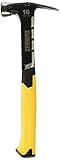
Best ValueDEWALT DWHT51054
Steel, 22 oz, Milled Face, Rubber Grip
For someone framing a shed, a deck or a partition wall rather than houses for a living, a premium hammer is difficult to justify. The DEWALT DWHT51054 covers that requirement with a 22 ounce steel head, a milled face and a rubber overmould grip, at a price that requires no deliberation. In our testing it set sixteen penny nails in a comparable number of strokes to the Estwing, which is what a 22 ounce head should do. The magnetic nail starter is more useful than it sounds. A slot in the top of the head holds a nail so it can be set with a single one handed swing, which matters when you are up a ladder or reaching overhead with one hand holding a board. Framers who use it regularly consider it close to essential. The rubber grip absorbs a reasonable amount of shock for a steel hammer. Where it sits behind the premium options is fatigue and refinement. Steel transmits more shock than titanium, and the grip, while effective, is not the equal of a fibreglass or titanium shaft. The balance is slightly head heavy, which some users like and some do not. The grip wears with use and cannot be replaced.
Pros
- Good driving power at a competitive price
- Effective rubber overmould grip that reduces shock reasonably
- Milled face grips nail heads well
- Magnetic nail starter allows one handed starting
- Widely available
Cons
- More shock transmitted than premium hammers
- Balance is slightly head heavy for some users
- Grip wears over time and cannot be replaced
The Bottom Line
A capable 22 ounce steel hammer with a magnetic nail start, at a price that makes sense for occasional framing.

Best Wood HandleVaughan 999 California Framer
Steel, 23 oz, Hickory Handle, Milled Face
Before fibreglass and titanium, framing hammers had hickory handles, and a significant number of carpenters still insist they are the best. There is a real basis for it: hickory has natural damping properties that absorb a meaningful proportion of impact energy before it reaches your hand, considerably more than a one piece steel hammer does. It is also replaceable, so a broken handle costs a few dollars rather than a new hammer. The Vaughan 999 is the classic California framer, with a long handle that gives extra leverage and reach for toe nailing and working at full reach. The 23 ounce head sets sixteen penny nails efficiently and the milled face grips reliably. Balance is what many carpenters describe as correct, which is subjective and consistently reported. The price is reasonable for a professional grade tool. The reservations are all about the handle. Wood can break, particularly on an over-strike where the shaft rather than the face contacts something. It can loosen and needs occasional attention with a wedge. And it is less tolerant of being left out in the rain than steel or fibreglass. For a carpenter who looks after tools, none of that is significant.
Pros
- Hickory handle absorbs shock better than steel and can be replaced when damaged
- Classic balance that many carpenters strongly prefer
- Long handle for extra leverage and reach
- Milled face grips nails securely
- Reasonable price for a professional grade hammer
Cons
- Wooden handles can break, though they are replaceable
- Handle needs occasional attention to stay tight
- Less weather resistant than steel or fibreglass
The Bottom Line
The traditional framer, and hickory is genuinely better at absorbing shock than steel. Handles are replaceable.
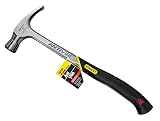
Best BudgetStanley FatMax AntiVibe 22 oz
Steel, 22 oz, Torsion Control Grip, Rip Claw
Most people who need a framing hammer need it for a specific project rather than a career, and for that a hammer that drives nails reliably and does not hurt too much is the whole requirement. The Stanley FatMax AntiVibe delivers on both at a price well below the professional tools. The one piece forged construction means there is no head to work loose, and the AntiVibe design — a tuned tip in the handle intended to cancel vibration — does produce a measurably less harsh feel than a plain steel hammer. The grip is comfortable and stays secure when hands are wet or sweaty, which matters more on a roof than in a workshop. At 22 ounces it has the mass to set sixteen penny nails without excessive strokes. It is stocked almost everywhere. Where it falls short is refinement and durability. Shock transmission is better than a bare steel hammer and clearly worse than a titanium or hickory handled one, so a full day of framing still tells. The milled face pattern wears faster than premium tools, gradually losing its grip on nail heads. Balance is functional rather than pleasant. For a project hammer, it is very good value.
Pros
- Low price for a capable framing hammer
- AntiVibe design reduces vibration measurably for the price
- One piece forged construction with no head to loosen
- Comfortable grip that does not slip when wet
- Widely stocked
Cons
- Still transmits more shock than better hammers
- Face pattern wears faster than premium tools
- Balance is less refined than professional hammers
The Bottom Line
Solid framing capability for very little money. The vibration control is real, if not premium.
Best LightweightEstwing EMRF20S Ultra Framer
Steel Head, Fibreglass Handle, 20 oz, Milled Face
The instinct when buying a framing hammer is to go heavy, on the theory that more mass drives nails faster. It does, up to a point, and past that point the extra weight costs more in fatigue than it saves in strokes. Many experienced framers have moved down in weight over their careers for exactly this reason. The Estwing Ultra Framer at 20 ounces, with a long fibreglass handle, is that compromise done well: the extra handle length provides leverage that recovers much of the driving power a lighter head gives up. Fibreglass damps better than one piece steel, absorbing a useful proportion of the impact before it reaches the hand, and it is dimensionally stable and weather resistant in a way wood is not. Balance is good and the swing feels controlled rather than effortful. The compromises are modest. A 20 ounce head occasionally needs an extra stroke on a large nail in dense timber. Fibreglass tolerates over-strikes less well than hickory and can be damaged over time by repeatedly hitting the shaft against the work, and unlike a wooden handle it cannot be replaced. For most people, this is the sensible weight and format.
Pros
- Lighter 20 ounce head that is less tiring over a long day
- Fibreglass handle absorbs more shock than one piece steel
- Long handle giving leverage that offsets the lighter head
- Weather resistant and dimensionally stable
- Well balanced with a comfortable swing
Cons
- Lighter head needs an extra stroke on larger nails
- Fibreglass can be damaged by repeated over-strikes
- Handle is not replaceable
The Bottom Line
The compromise that suits most people. Lighter than a 22 ounce, with a shaft that damps better than steel.
4. Milled Face or Smooth Face
The face pattern is a simple choice with consequences that are obvious the first time you get it wrong.
Milled faces grip the nail head. A waffle pattern of small pyramids bites into the nail head, so a slightly off-centre blow still drives rather than glancing off. For framing, where speed matters more than appearance, this is the correct choice.
Milled faces mark the wood. Any blow that lands on the timber leaves the waffle pattern stamped into it. On framing lumber that will be covered by drywall this is irrelevant; on anything visible it is permanent damage.
Smooth faces leave a clean surface. For finish carpentry, trim, and any work that will be seen, a smooth face is essential. It also grips the nail less, so glancing blows and bent nails are more common.
A framing hammer should be milled. If you are choosing one hammer for framing, choose milled. The grip advantage is significant when driving thousands of nails, and framing lumber does not need to look good.
Own both if you do both kinds of work. A milled framing hammer and a smooth faced 16 ounce finish hammer covers everything, and using the right one is faster than compensating with the wrong one.
Milled patterns wear out. The pyramids flatten with use, gradually losing grip. On premium hammers with replaceable faces this is a consumable; on others it eventually means a new hammer.
5. Swinging Efficiently
Framing is repetitive work, and technique determines both how fast you go and whether your arm still works in ten years.
Grip near the end of the handle. Choking up shortens the effective lever and costs head speed, which means more strokes for the same result. Hold near the end and let the hammer do the work.
Swing from the elbow and shoulder, not the wrist. Driving with wrist flexion concentrates strain in the smallest joint involved. A relaxed swing pivoting from the elbow uses larger muscles and produces more head speed with less effort.
Hold the handle loosely until impact. A tight grip throughout transmits far more shock into the hand and forearm. Let the hammer travel with a relaxed grip and firm up only at the moment of contact.
Set the nail with a light tap, then drive. One controlled tap to seat the nail, then full strokes. Trying to drive from the first blow is how nails bend and thumbs get hit.
Use the magnetic starter for overhead and one handed work. Setting a nail single handed at arm's length or above your head is far safer with a magnetic slot than with fingers holding the nail.
Stop when your elbow complains. Tendon damage from repetitive impact develops gradually and heals slowly. Pain during or after a day of framing is a signal to change hammer, technique or pace rather than to push through.
Loose Grip, Long Handle
Two habits do more for framing endurance than any hammer. Hold the handle near its end, which gives you the full lever and more head speed for the same effort. And keep the grip relaxed through the swing, firming up only at impact — a white knuckle grip pipes the shock of every blow straight into your forearm and elbow.
6. Hammer or Nail Gun
Framing nailers exist and are faster, which raises the reasonable question of whether a framing hammer is still a necessary purchase. It is, and the reasons are worth spelling out.
A nailer is faster on repetitive runs. Sheathing a wall, decking a floor, or nailing off a roof are jobs where a pneumatic or cordless nailer is several times quicker and far less tiring. Nobody frames a house by hand for speed.
A hammer does everything a nailer cannot. Persuading a stud into place, prying apart a mis-nailed joint, driving a nail into an awkward corner the gun will not reach, and demolition are all hammer work, and they come up constantly.
Setup time favours the hammer on small jobs. A compressor, a hose and a nailer take longer to set up than a deck repair takes to do. For anything under a few dozen nails, the hammer is genuinely faster start to finish.
Toe nailing by hand is often more controllable. Driving a nail at an angle into the edge of a stud is a job guns do inconsistently and a competent framer does reliably by hand, which is why hammers stay on the belt.
Nailers depend on power and consumables. No compressor, no battery, wrong nail collation, jammed magazine — a hammer has none of these failure modes and always works.
Most framers carry both. The gun does the volume and the hammer does everything else, and neither replaces the other. Buying a nailer is not a reason to buy a cheap hammer.
7. Claws, Starters and Other Features
Beyond weight and material, a handful of details separate hammers that suit framing from those that do not.
Rip claws, not curved claws. A straight rip claw is used for prying boards apart, splitting timber and demolition, which is most of what a framer does with the back of a hammer. Curved claws are better at pulling nails and worse at everything else.
Magnetic nail starters earn their place. A slot that holds a nail for a one handed start is genuinely useful up a ladder, overhead, or anywhere the other hand is holding something. Framers who use them rarely go back.
Side nail pullers help with bent nails. A notch in the side of the head grips a nail that has bent over, which the claw cannot get under. Small feature, frequently used.
Grip texture matters when wet. Hands get sweaty and rain happens. A grip that becomes slippery is both slower and dangerous, and it is worth checking how a hammer feels with a wet hand before committing.
Overstrike protection extends handle life. The area just below the head takes the hits that miss, and a reinforced collar there is what prevents a handle failing early. Wooden handles suffer most from this.
Head geometry affects reach into a bay. A slimmer head and a longer neck let you drive a nail in a tight stud bay or against a plate where a fat head fouls the adjacent timber. It is a detail nobody mentions until the hammer will not fit where the nail needs to go.
A hatchet claw suits some framers. Some framing hammers carry a straighter, sharper claw usable for rough splitting and prying siding. It is more aggressive than a standard rip claw and it wears the timber it touches, so it is a preference rather than an upgrade.
Handle length is a real variable. Longer handles give more leverage and reach at the cost of control in tight spaces. Sixteen to eighteen inches is typical for framing, and the difference between the ends of that range is noticeable.
Before You Buy
8. Frequently Asked Questions
What is the best framing hammer?
Stiletto TB15MC TiBone if you frame for a living, because titanium transmits far less shock to your arm across thousands of nails. Estwing E3-22S is the best steel hammer and nearly indestructible, and Estwing EMRF20S is the sensible compromise for most people.
Is a titanium hammer worth the money?
For a professional framer or anyone with existing elbow problems, yes. Titanium returns a small fraction of the shock steel does, which over thousands of nails is a real difference in fatigue and joint strain. For occasional framing, a good steel hammer is far better value.
What weight framing hammer should I buy?
Twenty to twenty-two ounces suits most people, balancing driving power against a swing you can sustain all day. Heavier heads drive faster and tire you sooner. A longer handle recovers much of the power a lighter head gives up, which is why 20 ounce long handled hammers are popular.
Milled face or smooth face?
Milled for framing. The waffle pattern grips the nail head so off-centre blows still drive rather than glancing off, which matters enormously over thousands of nails. It also stamps the pattern into any timber it touches, so use a smooth face for finish work and trim.
Rip claw or curved claw?
Rip claw for framing. The straight claw is used for prying boards apart, splitting timber and demolition, which is most of what a framer does with the back of the hammer. Curved claws pull nails more easily and are less useful for everything else.
How do I avoid hammer elbow?
Hold the handle near the end with a relaxed grip, firming up only at impact, and swing from the elbow and shoulder rather than flicking the wrist. A hammer with a damping handle, hickory, fibreglass or titanium, transmits far less shock than one piece steel.
9. Common Framing Hammer Mistakes
Hammer mistakes cost you speed in the short term and joint health in the long term.
Buying the Heaviest Hammer Available
More mass drives nails in fewer strokes and tires you faster, and past about 22 ounces the fatigue usually costs more than the strokes saved. Many experienced framers move down in weight over their careers. A longer handle recovers most of the power a lighter head gives up.
Gripping Tightly Through the Swing
A white knuckle grip pipes the shock of every blow directly into the hand, forearm and elbow. Letting the hammer travel with a relaxed grip and firming up only at the moment of impact reduces transmitted shock substantially, and it costs nothing to change.
Choking Up on the Handle
Holding near the head feels more controlled and shortens the lever, which reduces head speed and means more strokes for every nail. Gripping near the end of the handle gives the full leverage the tool was designed around and does more work for the same effort.
Using a Milled Face on Finish Work
The waffle pattern that grips nail heads so effectively also stamps itself permanently into any timber it touches. On framing lumber destined to be covered that is fine; on trim, cabinetry or anything visible it is damage that cannot be sanded out.
Related Tool Guides
The Bottom Line
The best framing hammer for a professional is the Stiletto TB15MC, because titanium is what saves your elbow over a career. Estwing E3-22S is the indestructible steel standard, and Estwing EMRF20S is the balanced choice for most people.
Choose a milled face for framing, grip near the end of the handle and keep it loose, and take the elbow warning seriously the first time it appears.
More in Tools & Equipment
Guides in this category that pair with what you just read.
About the Author
Alex Rivers, Home Improvement Editor
Alex has spent over a decade working on residential and light commercial property maintenance, and now tests every tool, coating and machine that appears in these guides personally.