The 7 Best Palm Sanders in 2026
We sanded 40 board feet of oak and pine, inspected every surface under raking light for swirl marks, weighed dust capture, and measured vibration at the handle.
Alex Rivers
Home Improvement Editor
Last Updated
October 17, 2026
In This Guide
Palm sander is a loose term covering two quite different machines. Random orbit sanders spin and oscillate at once, which leaves no directional scratch pattern and makes them the standard finishing tool. Sheet sanders vibrate in a small orbit, are cheaper and gentler, and reach into corners a round pad cannot. Most workshops want the first and benefit from owning the second.
Our Picks at a Glance
The Short Answer
Festool ETS 125 REQ (Best Overall). The finishing standard. Fine stroke, near-zero vibration, and dust collection nothing else matches.
- Check Price
- Check Price
- Check Price
- Check Price
- Best Cordless Milwaukee M18 FUEL Random Orbit Sander — Cordless, 18V Brushless, 5 in, Variable SpeedCheck Price
- Check Price
- Check Price
We may earn a commission when you buy through these links, at no extra cost to you. How we test
Best Overall
Festool ETS 125 REQ
1. Random Orbit vs Sheet Sanders
The two machines sold as palm sanders work differently, and choosing the wrong one leaves marks that only appear once the finish goes on.
Random Orbit Spins and Oscillates
The pad rotates on a spindle that is itself offset, so every point on the abrasive follows a path that never repeats. There is no consistent direction to the scratches, which is why the surface takes a finish evenly with no visible pattern.
Sheet Sanders Vibrate in a Fixed Orbit
A quarter sheet sander moves the pad in a small circle without rotating it, so the scratch pattern is consistent and fine. It is gentle and controllable, and under a clear finish that pattern can be faintly visible on some woods.
Round Pads Cannot Reach Corners
This is the practical division. A random orbit sander leaves an unfinished triangle in every inside corner and along every edge that meets another surface. A square sheet sander reaches into both, which is why the two tools complement each other.
Random Orbit Removes Material Faster
The rotation adds cutting action that a pure orbit lacks, so a random orbit machine takes stock down considerably more quickly. For flattening and for moving through grits on a panel, it is the far more efficient tool.
Own Both if You Finish Furniture
A five inch random orbit sander for panels and flats, and a quarter sheet sander for corners, edges and between finish coats. The sheet sander costs very little and eliminates a category of hand sanding entirely.
Sander Specifications That Matter
5 in
Standard random orbit pad size
2-3mm
Fine orbit stroke for finishing
5mm
Aggressive stroke for stock removal
2
Sanders a furniture workshop wants
2. Orbit Stroke, Speed and What They Do
The specifications printed on a palm sander box are largely uninformative except for two, and those two determine what the machine is good at.
Orbit stroke is the most important number. It is how far the pad moves off centre, typically between 2mm and 5mm. A small stroke sands finely and slowly; a large stroke removes material quickly and leaves a coarser pattern that needs finer grits to remove.
Choose stroke for your work, not the highest number. Furniture finishing wants a fine stroke around 2 to 3mm. Deck sanding, paint removal and shaping want 5mm. Most general purpose machines sit around 3mm as a compromise.
Variable speed is genuinely useful. Lower speeds reduce heat, which prevents clogging on finishes and burning on resinous wood, and give more control on veneer and thin material. It is worth paying for.
Pad size affects reach as well as coverage. Five inch is standard and covers ground efficiently. Six inch machines exist for large surfaces and are unwieldy on small work. Six inch discs also cost more and are less widely stocked.
Pad brake quality is worth checking. Without a brake, the pad free-spins when lifted and can dig a mark when it touches back down. Better machines slow it deliberately, which is the difference between a clean touchdown and a swirl to sand out.
Amperage tells you very little. Sanding requires modest power, and every machine here has enough. Vibration, balance, stroke and dust collection all matter far more than the motor rating.
3. The 7 Best Palm Sanders in 2026 — Tested & Ranked
We sanded 40 board feet of oak and pine through a full grit progression with every machine, then examined each panel under raking light for swirl marks and edge damage. We measured vibration at the handle, weighed dust captured by each onboard system against a vacuum, and timed material removal on identical rough stock. These seven earned their place.
At a Glance: How Our Picks Compare
| Product | Type | Rating | Best For |
|---|---|---|---|
| Festool ETS 125 REQ | Random Orbit, 5 in, 2mm Stroke, Variable Speed | 4.8 | Best Overall |
| Bosch ROS20VSC | Random Orbit, 5 in, Variable Speed, Microfilter Canister | 4.6 | Best Value |
| DEWALT DWE6423 | Random Orbit, 5 in, Variable Speed, Rubber Overmould | 4.5 | Best Grip and Control |
| Makita BO5041 | Random Orbit, 5 in, Variable Speed, Two Grip Positions | 4.6 | Best Two Handed Control |
| Milwaukee M18 FUEL Random Orbit Sander | Cordless, 18V Brushless, 5 in, Variable Speed | 4.5 | Best Cordless |
| BLACK+DECKER BDERO100 | Random Orbit, 5 in, Single Speed, Compact | 4.2 | Best Budget |
| Makita BO4556K Sheet Sander | 1/4 Sheet Orbital, Clamp and Hook Loop, Compact | 4.6 | Best Sheet Sander |

Best OverallFestool ETS 125 REQ
Random Orbit, 5 in, 2mm Stroke, Variable Speed
Sanding is the part of woodworking most people dislike, and the reasons are vibration, dust and the swirl marks that appear once finish goes on. The Festool ETS 125 addresses all three more thoroughly than anything else, and its price reflects that rather than any marketing premium. Vibration at the handle measured lower than every competitor by a substantial margin, which sounds like a comfort detail until you have sanded a tabletop for two hours and your hands are not numb afterwards. The 2mm orbit stroke is deliberately fine. A larger stroke removes material faster and leaves a coarser scratch pattern; a fine stroke does the opposite. This is a finishing machine, and on our oak panels it produced the smoothest surface of the group with the fewest visible swirls under raking light. For final grits before a finish, that is exactly the right trade. Dust extraction with a matched extractor was close to complete, leaving the workpiece clean enough to inspect without wiping. The arguments against are cost and speed. It is priced far above ordinary palm sanders, it removes material more slowly than a coarser-stroke machine, and its dust performance depends on an extractor that costs as much again. For someone who sands daily, it repays that. For occasional use it is difficult to justify.
Pros
- Almost no vibration at the handle, which transforms long sanding sessions
- Outstanding dust extraction when paired with a matched extractor
- Very fine 2mm stroke produces an exceptionally smooth finish
- Superb balance that keeps the pad flat with minimal effort
- Built to last with excellent parts availability
Cons
- Extremely expensive for a palm sander
- Fine stroke means slower stock removal than a 5mm machine
- Achieves its dust figures only with a compatible extractor
The Bottom Line
The finishing standard. Fine stroke, near-zero vibration, and dust collection nothing else matches.

Best ValueBosch ROS20VSC
Random Orbit, 5 in, Variable Speed, Microfilter Canister
Most people looking for a palm sander want a machine that produces a swirl-free surface, does not shake their hand numb, and does not fill the workshop with dust, at a price that does not require justification. The Bosch ROS20VSC has occupied that position for years and it continues to earn it. In our finish comparison it produced results very close to machines costing several times as much, with only a slight difference visible under raking light at the finest grits. Vibration was low for its class, helped by a properly balanced counterweight rather than by rubber padding. The microfilter canister is better than the usual onboard bag, capturing a genuinely useful fraction of the fine dust without a vacuum attached, which matters for anyone working somewhere a hose cannot easily follow. Variable speed with a low setting makes it usable on veneer and between finish coats. The weaknesses are consumable and capacity. The hook and loop pad surface wears faster than on premium machines, so discs eventually stop gripping and the pad needs replacing sooner. The canister is small and fills quickly on a serious job, which means frequent emptying. Neither is a reason to look elsewhere at this price, and for most workshops this is the correct purchase.
Pros
- Excellent finish quality for a mainstream price
- Variable speed with a usefully low setting for delicate work
- Microfilter canister captures fine dust better than most onboard systems
- Low vibration for its class thanks to a well balanced counterweight
- Soft grip housing that is comfortable over long sessions
Cons
- Hook and loop pad wears faster than premium machines
- Canister needs emptying frequently on a big job
- Not as refined as premium sanders on very fine grits
The Bottom Line
The one to buy if you are buying one. Close to premium finish quality at a fraction of the price.
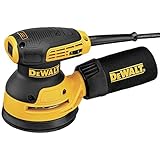
Best Grip and ControlDEWALT DWE6423
Random Orbit, 5 in, Variable Speed, Rubber Overmould
Keeping a random orbit sander flat against the work is the entire technique, because any tilt concentrates the pad edge and leaves a mark. Machines that sit tall put your hand further from the surface and make that harder, which is a subtle design factor that only becomes obvious when you use a low profile machine. The DEWALT DWE6423 is deliberately short, and in our testing that translated into fewer edge marks and less conscious effort to keep the pad level, particularly on vertical surfaces and edges. The rubber overmould grip is genuinely well executed, remaining secure when hands are dusty or sweaty, and the counterweight controls vibration effectively for a machine at this price. Variable speed steps in clear increments rather than sweeping vaguely, which makes it easy to return to a known setting. The dust port takes a standard vacuum hose directly, which is a small thing that saves an adapter and a leak. Where it is ordinary is dust and refinement. The onboard canister captures the coarse fraction only and a vacuum is needed for real performance. The pad brake, which stops the pad free-spinning when lifted, is less effective than on premium machines, so the pad can mark a surface on touchdown if you are careless.
Pros
- Low profile height keeps your hand close to the work for better control
- Rubber overmould grip that stays comfortable when hands are sweaty
- Counterweight design keeps vibration well controlled
- Variable speed dial with clear increments
- Dust port fits standard vacuum hoses without an adapter
Cons
- Dust canister is basic and needs a vacuum for real capture
- Slightly heavier than some competitors
- Pad brake is less effective than on premium machines
The Bottom Line
The most controllable of the mainstream sanders. Low profile and good grip make it easy to keep flat.

Best Two Handed ControlMakita BO5041
Random Orbit, 5 in, Variable Speed, Two Grip Positions
Single-handed palm sanders are excellent on small work and increasingly awkward as the surface grows, because keeping a pad flat with one hand across a large tabletop requires constant attention. The Makita BO5041 provides a removable front handle, converting it into a two handed machine when that helps and back to a compact one when it does not. On our large panel test, two handed control produced a measurably more even surface with less operator effort, simply because both wrists share the work of keeping the pad level. The machine is smooth running with well managed vibration, and it has one of the more effective pad brakes here — the mechanism that slows the free-spinning pad when lifted, preventing it from digging a mark when it touches back down. The sealed switch is a practical detail for a tool that lives in dust. Power is sufficient for genuine stock removal with coarse discs, not just finishing. The compromises are size and weight. It is larger than a compact palm sander and heavier in the hand, which is felt on small parts and on vertical work where the mass fights you. The onboard dust bag is ordinary. For a workshop doing furniture-scale work, it is the more capable choice.
Pros
- Removable front handle allows a genuine two handed grip for large surfaces
- Very smooth running with well controlled vibration
- Effective pad brake that prevents gouging on touchdown
- Sealed switch keeps dust out of the electrics
- Powerful enough for stock removal as well as finishing
Cons
- Larger and heavier than single grip palm sanders
- Two handed configuration is unnecessary for small work
- Dust bag is unremarkable without a vacuum
The Bottom Line
The one for big flat surfaces. A second handle changes how much control you have on a tabletop.

Best CordlessMilwaukee M18 FUEL Random Orbit Sander
Cordless, 18V Brushless, 5 in, Variable Speed
A trailing cord is a minor irritation on most power tools and a genuine problem on a sander, because it drags across the surface you have just finished, catches on corners, and pulls the machine off flat at exactly the wrong moment. Cordless sanders were long unsatisfying because brushed motors could not sustain the speed under load. The Milwaukee M18 FUEL uses a brushless motor with electronic speed control that holds its setting when pressure is applied, and in our testing the finish quality was indistinguishable from a corded machine of similar stroke. Freedom from a cord is most valuable exactly where sanding is most awkward: on a ladder, inside a cabinet, on installed trim, or working around a large piece where a cord would need repositioning constantly. Dust collection into the canister is reasonable for use away from a vacuum. The costs are weight, runtime and price. The battery sits at the back and adds mass in a place that affects balance, which is felt on vertical surfaces. A compact battery gives limited runtime for sustained sanding, so a larger pack or a spare is realistically necessary. And the tool is expensive, especially for anyone not already invested in the platform.
Pros
- Genuine corded-level performance from a brushless motor
- No cord to drag across a finished surface or catch on a corner
- Good dust capture into a canister for cordless use away from a vacuum
- Variable speed with electronic control that holds speed under load
- Part of a widely owned battery platform
Cons
- Battery adds noticeable weight and shifts the balance
- Runtime on a small battery is limited for extended sanding
- Expensive, particularly if buying into the platform
The Bottom Line
Cordless sanding that actually works. The absence of a cord matters more on finish work than anywhere else.

Best BudgetBLACK+DECKER BDERO100
Random Orbit, 5 in, Single Speed, Compact
There is a real difference between a random orbit sander and a cheap vibrating sheet sander, and the difference matters: only the random orbit action avoids leaving a directional scratch pattern that shows under finish. That capability at a very low price is what this machine offers, and for a homeowner sanding a door before painting or cleaning up a shelf, it is entirely sufficient. It takes standard five inch discs, so consumables are cheap and available everywhere. Where it falls short is comfort and dust. Vibration at the handle was among the highest measured, and after twenty minutes it is noticeably tiring in a way the better machines are not. There is no speed control, so delicate materials and between-coat sanding are handled with more aggression than ideal. Dust collection is poor, and the port fits vacuum hoses badly enough that improvising a connection with tape is common. For work that will be painted, none of this affects the outcome much. For a surface taking a clear finish, where every swirl and scratch will show, the extra refinement of a better machine is visible in the result. Bought as an occasional-use tool with realistic expectations, it represents genuine value.
Pros
- Very low price for a genuine random orbit sander
- Light and compact, easy to handle for small jobs
- Simple operation with nothing to set
- Adequate finish quality for painted work
- Uses standard 5 inch hook and loop discs
Cons
- Single speed with no control for delicate materials
- Noticeably more vibration than better machines
- Dust collection is poor and the port fits vacuums badly
The Bottom Line
A real random orbit sander for very little money. Fine for painted work, tiring on anything large.

Best Sheet SanderMakita BO4556K Sheet Sander
1/4 Sheet Orbital, Clamp and Hook Loop, Compact
A round pad cannot reach into a corner, which means every project with an inside angle — a cabinet carcass, a drawer, a window frame, a shelf against a back panel — leaves an area a random orbit sander cannot finish. A quarter sheet orbital sander has a square pad with sharp corners and does exactly that job. The Makita BO4556K is the best executed version: light, quiet, very low vibration, and gentle enough that damaging a workpiece with it is genuinely difficult. The ability to use both clamped sheet paper and hook and loop discs is more useful than it sounds, because clamped paper means cutting sheets from a roll at a fraction of the cost of discs, which matters when sanding large areas of paint. For between-coat sanding on a finish, the gentle action is precisely right. It is not a replacement for a random orbit sander. The orbital action leaves a fine directional pattern that can show under a clear finish, and material removal is slow enough that flattening a panel with one is an exercise in patience. Bought as a companion rather than an alternative, it fills the gap the round machine leaves and costs very little to do so.
Pros
- Square pad reaches fully into corners and up against edges
- Very gentle action that is hard to damage a surface with
- Accepts both clamped sheet paper and hook and loop discs
- Extremely low vibration and quiet operation
- Inexpensive and reliable
Cons
- Removes material slowly compared with a random orbit sander
- Leaves a fine directional pattern that shows on some finishes
- Not a substitute for a random orbit sander on flat panels
The Bottom Line
The corner specialist every workshop with a random orbit sander should also own. Cheap and genuinely useful.
4. Sanding Without Leaving Swirl Marks
Swirl marks are the characteristic failure of random orbit sanding, and they are invisible on bare wood and glaringly obvious once stain or finish goes on.
Move slowly, about an inch per second. The instinct is to sweep the sander around quickly, which leaves areas that have seen only a few random passes and therefore retain a pattern. A slow steady pass gives the random action time to do its job.
Do not press down. Pressure stalls the pad rotation, at which point the machine is orbiting without spinning and leaving exactly the directional pattern the design exists to avoid. The weight of the machine is the correct pressure.
Keep the pad flat. Tilting concentrates the abrasive on one edge, which cuts a curved groove. This is the most common cause of visible marks on edges and near the perimeter of a panel.
Never skip grits. Each grit removes the scratches of the previous one. Jumping from 80 to 180 leaves 80 grit scratches that the finer paper polishes around rather than removes, and they appear under finish. Step through in sensible increments.
Start and stop with the pad on the work. Switching on with the sander in the air lets the pad reach full speed, and setting it down spinning marks the surface. Place it flat, then start; stop, then lift.
Wipe with mineral spirits to check. A rag dampened with mineral spirits darkens the surface temporarily and reveals every scratch and swirl exactly as a finish would. It evaporates completely, so it costs nothing to check before committing to a finish.
The Mineral Spirits Test
Before you finish anything, wipe the surface with mineral spirits. It simulates exactly what a finish will look like, showing every swirl, scratch and glue spot you cannot see on dry bare wood. It evaporates without affecting the finish afterwards. Almost every disappointing finish would have been caught by this ten second check.
5. Abrasives and Getting Value From Them
Sanding discs are a consumable that people routinely use long past their useful life, which costs more in time than the discs would have cost to replace.
A worn disc polishes rather than cuts. Once the abrasive is dull the machine burnishes the surface, which looks smooth and then takes stain unevenly because the pores are closed. Change discs far more often than feels necessary.
Step through grits in sensible increments. A typical progression runs 80, 120, 180 and finishes at 220 for most furniture. Going beyond 220 before staining can close the grain enough to affect colour uptake.
Match hole patterns for dust extraction. Discs must have holes aligned with the pad for extraction to work. Mismatched discs block the extraction path entirely, which both fills the workshop and lets dust stay under the disc, causing swirls.
Ceramic and zirconia last longer on hardwood. They cost more per disc and less per hour because they fracture to expose fresh cutting edges rather than simply dulling. On oak and maple the difference is substantial.
Clean discs with a rubber stick. A crepe rubber cleaning block held against a running disc pulls out the loaded resin and finish. Many discs that seem finished are simply clogged, and cleaning restores most of the cut.
Replace the hook and loop pad when discs stop gripping. The pad surface wears out before the machine does, and a disc that slips loses much of its effect while feeling roughly normal. Pads are inexpensive and easy to change.
6. Matching the Sander to the Job
The same machine behaves very differently across materials, and a few job-specific rules save a great deal of rework.
Bare hardwood wants a full grit progression. Start at 80 or 100 depending on how rough the stock is, and step to 220. Oak and ash show every skipped grit under a clear finish because the open grain exaggerates any scratch running across it.
Veneer and plywood need care and a low speed. The face veneer on modern plywood can be less than a millimetre thick, and a random orbit sander removes that in seconds at an edge. Stay at 150 grit and above, keep the pad flat, and never linger near a corner.
Painted surfaces load discs fast. Paint softens with heat and clogs abrasive almost immediately. Running at a lower speed keeps the temperature down, and a sheet sander with cheap cut sheet paper is far more economical than getting through discs.
Between finish coats, sand lightly at 320 or finer. The aim is knocking down dust nibs and raised grain, not removing the coat. A quarter sheet sander or a hand block is usually better here, because a random orbit machine can cut through a thin coat before you notice.
Old finishes may contain lead. Anything painted before the late 1970s should be tested before sanding, because a power sander turns lead paint into fine airborne dust extremely efficiently. A positive test means chemical stripping or a professional, not a sander.
End grain drinks finish and needs finer sanding. Sanding end grain a grit or two beyond the face closes it slightly and stops it absorbing stain far darker than the surrounding wood, which is the usual cause of blotchy ends on a tabletop.
7. Dust Collection on a Palm Sander
Sanding dust is the largest health exposure in most home workshops, and palm sanders produce a great deal of the fine fraction.
Onboard bags and canisters are partial solutions. They capture visible dust and let the fine fraction through. Useful when a vacuum cannot follow you, but not a substitute for one.
A vacuum transforms both dust and finish quality. Beyond the health benefit, extracting dust from under the disc stops loose grit being dragged across the surface, which is a significant cause of scratches at fine grits.
Use a fine filter in the vacuum. A standard shop vacuum filter passes fine wood dust and exhausts it into the room. A HEPA or fine dust filter is what makes the extraction genuinely protective rather than merely tidy.
Hose weight affects control. A heavy vacuum hose dragging on a palm sander pulls it off flat and causes edge marks. Supporting the hose from above, or using a lighter antistatic hose, removes the problem.
Hardwood dust is a recognised carcinogen. Oak and beech dust in particular are classified as carcinogenic in several jurisdictions, which makes a rated respirator rather than a paper mask the correct precaution for extended sanding.
Let the air settle before finishing. Fine dust hangs for hours and lands on wet finish, producing a gritty surface. Finishing in the same room immediately after sanding is a common and entirely avoidable cause of a ruined topcoat.
Before You Buy
Also Needed for This Job
8. Frequently Asked Questions
What is the best palm sander?
Bosch ROS20VSC for most people, giving close to premium finish quality at a mainstream price with better than average dust collection. Festool ETS 125 is the finishing benchmark if the budget allows, and Makita BO4556K is the sheet sander worth owning alongside either.
What is the difference between a random orbit and a palm sander?
Random orbit sanders spin and oscillate simultaneously, leaving no directional scratch pattern, which is what allows an even finish. Quarter sheet sanders vibrate in a fixed small orbit, are gentler and cheaper, and their square pads reach into corners a round pad cannot.
Why does my sander leave swirl marks?
Usually pressing down, which stalls the pad rotation so the machine orbits without spinning and leaves a directional pattern. Moving too fast and skipping grits are the other two causes. Let the weight of the machine do the work and move about an inch per second.
What grit should I finish sanding at?
Around 180 to 220 for most furniture taking a stain or clear finish. Going finer closes the grain and can make stain absorb unevenly, producing a blotchy result. Painted work can stop at 150, since primer fills the remaining scratches.
Do I need a vacuum with a palm sander?
Strongly recommended. Beyond the health benefit of capturing fine dust, extracting from under the disc stops loose grit being dragged across the surface, which is a significant cause of scratches at fine grits. Use a fine dust or HEPA filter in the vacuum.
What orbit stroke should I look for?
Around 2 to 3mm for furniture finishing, which sands finely at the cost of speed. Around 5mm for stock removal, deck sanding and paint stripping, which is faster but leaves a coarser pattern that needs finer grits afterwards. Most general purpose machines sit near 3mm.
9. Common Palm Sanding Mistakes
Nearly every sanding complaint traces back to one of four habits, and all of them show up only once the finish goes on.
Pressing Down on the Sander
Pressure stalls the pad's rotation, at which point the machine is orbiting without spinning and leaving exactly the directional scratches that random orbit action exists to prevent. It also generates heat that clogs the disc. The weight of the tool is the correct downforce, and adding more slows the job.
Skipping Grits
Each grit exists to remove the scratches left by the previous one. Jumping from 80 to 180 means the fine paper polishes around the coarse scratches rather than removing them, and those scratches appear the moment stain or finish goes on. Step through in sensible increments.
Using Worn Discs
A dull disc burnishes rather than cuts, closing the wood pores so stain absorbs unevenly and producing a blotchy finish. It also takes far longer to achieve nothing. Discs are cheap relative to the time wasted, and changing them more often than feels necessary is correct.
Not Checking With Mineral Spirits
Bare wood hides swirl marks, scratches and glue residue completely, and all three become obvious under finish. Wiping the surface with mineral spirits simulates exactly what the finish will show, evaporates without trace, and takes ten seconds. Almost every disappointing finish would have been caught by it.
Related Tool Guides
Buyer's Guide
Best Belt Sander
The flattening tool that comes before every palm sander in the process.
Buyer's Guide
Best Polyurethane Brushes
What to put the finish on with once the sanding is finally done.
All Guides
Browse All Best Lists
Every hands-on tested guide we have published, organized by category.
The Bottom Line
The best palm sander for most workshops is the Bosch ROS20VSC, which gets close to premium finish quality at a mainstream price. Festool ETS 125 is the benchmark if you sand daily, and a Makita BO4556K sheet sander handles the corners a round pad cannot.
Let the machine's weight do the work, never skip a grit, change discs sooner than you think, and wipe with mineral spirits before you commit to a finish.
More in Tools & Equipment
Guides in this category that pair with what you just read.
About the Author
Alex Rivers, Home Improvement Editor
Alex has spent over a decade working on residential and light commercial property maintenance, and now tests every tool, coating and machine that appears in these guides personally.