The 7 Best Belt Sanders in 2026
We flattened rough oak, stripped four coats of paint from pine, and levelled a glued-up benchtop. Tracking drift, platen flatness and dust collection measured on every machine.
Alex Rivers
Home Improvement Editor
Last Updated
October 17, 2026
In This Guide
A belt sander removes material faster than any other sander, which makes it the right tool for flattening and stripping and the wrong tool for finishing. It will also take a gouge out of a workpiece in about two seconds if you set it down carelessly, and most of what separates a good machine from a poor one is how hard it makes that mistake to commit.
Our Picks at a Glance
The Short Answer
Makita 9403 (Best Overall). The benchmark. Flat platen, stable tracking, and quiet enough that you will actually use it without ear fatigue.
We may earn a commission when you buy through these links, at no extra cost to you. How we test
Best Overall
Makita 9403
1. What a Belt Sander Is Actually For
A belt sander is a stock removal tool. Treating it as a sander in the general sense, interchangeable with an orbital, is where most disappointment and most gouged workpieces originate.
It Removes Material Fast
The abrasive travels in one continuous direction at high speed under the weight of the machine, which removes wood at a rate no orbital or random orbit sander approaches. That is the point of the tool and the reason it is dangerous to a workpiece.
Flattening Is Its Best Use
Levelling a glued-up panel, taking down a proud joint, or flattening a rough sawn board are jobs where nothing else in a home workshop is as effective. The flat platen references against the high points and removes them first.
Stripping Is Its Second Best Use
Paint, varnish and old finish come off far faster than with any other sander, particularly with a coarse belt at a lower speed to avoid melting the finish into the abrasive.
It Is Not a Finishing Tool
A belt runs in one direction and leaves scratches along that direction, which show clearly under finish. A belt sander gets a surface flat and rough; a random orbit sander then makes it smooth. Skipping the second stage is visible on the finished piece.
It Will Gouge in Under Two Seconds
The machine must be moving before it touches the work and must stay moving until it leaves. A stationary running belt digs a hollow almost instantly, and correcting that hollow means taking the whole surface down to meet it.
Belt Sander Basics
3 x 21
The size most workshops should own
80 grit
Sensible starting grit for flattening
1300+
Surface feet per minute on most machines
0 sec
How long it may sit still on the work
2. Belt Sizes and Which to Choose
Belt sanders are described by belt width and length, and the size determines what the machine is good at far more than the brand does.
Three by twenty-one is the sensible default. It balances coverage against controllability, weighs little enough for extended use, and belts are available everywhere in every grit. For most workshops this is the machine to own.
Four by twenty-four covers ground much faster. The extra width and length remove material considerably quicker on large flat surfaces, at the cost of significant weight and much less forgiving handling. This is a benchtop and floor machine.
Three by eighteen is lighter and cheaper. Slightly less coverage and a shorter platen, which makes it marginally less good at flattening but easier to handle. A reasonable choice for occasional use.
Compact machines under three inches are specialists. They exist to reach places full size sanders cannot, and they are excellent at that and poor at everything else. Buy one as a second sander, not a first.
Platen length affects flatness more than width. A longer platen bridges across dips and removes the high spots, which is exactly what flattening requires. A short machine follows the existing contour rather than correcting it.
Check belt availability before buying. Unusual sizes mean ordering online every time and paying more. The common sizes are stocked in every hardware store in a full range of grits, which matters when a belt tears mid-job.
3. The 7 Best Belt Sanders in 2026 — Tested & Ranked
We ran three tests on every machine: flattening a glued-up oak benchtop and checking the result with a straightedge, stripping four coats of paint from pine, and dimensioning rough sawn stock while timing removal. We also measured noise, logged how often tracking needed adjustment, and weighed the dust captured by each bag against a vacuum. These seven earned their place.
At a Glance: How Our Picks Compare
| Product | Type | Rating | Best For |
|---|---|---|---|
| Makita 9403 | 4 x 24 in Belt, 11 Amp, 1640 SFPM | 4.7 | Best Overall |
| Porter-Cable 352VS | 3 x 21 in Belt, 8 Amp, Variable Speed | 4.4 | Best Value |
| Makita 9903 | 3 x 21 in Belt, 8.8 Amp, Variable Speed, Auto Tracking | 4.6 | Best Tracking |
| DEWALT DWP352VS | 3 x 21 in Belt, 8 Amp, Variable Speed, Frame Attachment | 4.5 | Best for Flat Work |
| Bosch 1274DVS | 3 x 21 in Belt, 10 Amp, Variable Speed, Flush Sanding | 4.5 | Best for Edge Work |
| WEN 6321 | 3 x 21 in Belt, 7 Amp, Dust Bag, Budget | 4.2 | Best Budget |
| Triton TCMBS Compact Belt Sander | 2.5 x 16 in Belt, 6 Amp, Compact, One Handed | 4.3 | Best Compact |

Best OverallMakita 9403
4 x 24 in Belt, 11 Amp, 1640 SFPM
Belt sanders are among the loudest tools in a workshop, and the Makita 9403 is the machine that demonstrated this was not inevitable. It runs measurably quieter than every competitor here, which sounds like a comfort feature and turns out to change how the tool gets used: a machine you are not flinching from is one you run steadily and control properly. Hearing protection is still required, but the difference across a long session is real. What makes it the benchmark is the platen. Belt sanders flatten by pressing an abrasive against a surface, and if the platen itself is not flat the result will not be either. On our glued-up benchtop test the Makita produced the most consistently level surface of any machine, checked with a straightedge across multiple axes. Tracking held without adjustment through a long session, where several competitors needed a nudge every few minutes. The 11 amp motor drives the 4 by 24 inch belt without noticeable slowing when leaned on. The reservations are weight and simplicity. It is heavy, which is an advantage on a benchtop where the mass does the work and a liability on a vertical surface or overhead. There is no variable speed, which limits it slightly on heat-sensitive materials. The dust bag works but a vacuum works far better.
Pros
- Remarkably quiet for a belt sander, measurably below most competitors
- Very flat platen that produces genuinely level results on wide panels
- Strong 11 amp motor that does not bog under load
- Excellent tracking stability, requiring almost no adjustment during use
- Large 4 by 24 inch belt covers ground fast
Cons
- Heavy, which is tiring on vertical or overhead work
- No variable speed control
- Dust bag is adequate rather than good; a vacuum is better
The Bottom Line
The benchmark. Flat platen, stable tracking, and quiet enough that you will actually use it without ear fatigue.

Best ValuePorter-Cable 352VS
3 x 21 in Belt, 8 Amp, Variable Speed
Three by twenty-one is the size that suits most woodworkers, and the reason is control. A four inch machine covers ground faster and is correspondingly harder to steer, heavier to hold, and less forgiving of a moment of inattention. The 352VS sits in the smaller class with a variable speed control that most competitors in its price range omit, and that combination makes it a genuinely sensible first belt sander. Variable speed matters more than it might appear. Running slower reduces heat, which prevents scorching on resinous woods and stops thermoplastic finishes melting and clogging the belt instead of coming off. On our painted pine stripping test, dropping the speed made the difference between the belt loading up within a minute and running clean. It is also easier to control a slower belt when you are learning. The compromises are power and refinement. The 8 amp motor is adequate rather than strong, and leaning on it in hardwood slows it noticeably, so the technique is to let the belt work rather than pushing. Tracking drifted more than on the Makita and needed periodic adjustment. Dust collection through the bag is unimpressive, though connecting a shop vacuum transforms it. For the price, none of this is unreasonable.
Pros
- Variable speed from around 850 to 1300 SFPM, useful on veneer and heat sensitive material
- Lighter and easier to control than 4 inch machines
- Good balance with a comfortable front handle
- All metal drive components rather than plastic
- Sensible price for the capability
Cons
- 8 amp motor bogs under heavy pressure on hardwood
- Tracking needs more frequent adjustment than premium machines
- Dust collection is mediocre without a vacuum attached
The Bottom Line
Variable speed at a mid-range price, in the size most people should be buying. A sensible first belt sander.

Best TrackingMakita 9903
3 x 21 in Belt, 8.8 Amp, Variable Speed, Auto Tracking
Belt tracking is the recurring irritation of this tool category. A belt that drifts sideways rubs the housing, wears unevenly, and eventually walks off the rollers entirely, usually at the least convenient moment. Most machines have a tracking knob and expect you to keep adjusting it. The Makita 9903 uses an automatic tracking system that holds the belt centred without input, and in our testing it did exactly that through a full day of work across three different belt grits, where the manually tracked machines needed attention every few minutes. That reliability changes the rhythm of using the tool. Rather than periodically stopping to check and adjust, you work continuously, which is both faster and safer because your attention stays on the workpiece. Variable speed covers a useful range for heat-sensitive materials, the machine is quiet in the way Makita tools generally are, and the balance is good enough to guide with one hand on a flat surface. The dust bag is better than most, though a vacuum still wins. The costs are price and power. It is dearer than most three inch machines, and at 8.8 amps it is not the machine for grinding down a lot of hardwood quickly. Auto tracking also becomes less absolute on a badly worn belt.
Pros
- Automatic belt tracking that genuinely holds without intervention
- Variable speed across a useful range
- Quiet operation consistent with the Makita reputation
- Well balanced for a 3 inch machine, easy to control one handed at times
- Effective dust bag by the standards of this category
Cons
- More expensive than comparable 3 inch machines
- Auto tracking still needs occasional check on worn belts
- Modest 8.8 amp motor for very heavy stock removal
The Bottom Line
The tracking is the story. Set it and forget it, which on a belt sander is worth real money.

Best for Flat WorkDEWALT DWP352VS
3 x 21 in Belt, 8 Amp, Variable Speed, Frame Attachment
The single biggest hazard with a belt sander is that it removes material extremely quickly and does not care whether that material was meant to go. Tilting the machine, letting it sit still for a moment, or setting it down while running all produce a scoop out of the workpiece that then has to be sanded out across the whole surface. The DEWALT accepts a sanding frame that surrounds the belt and rides on the workpiece, mechanically limiting how deep the belt can cut. With the frame fitted, gouging becomes very difficult to achieve, and the machine sands progressively flat rather than following whatever angle your hands introduce. For anyone learning, or for anyone working on a surface where a gouge would be expensive, that is worth more than any specification. It also makes the machine far more useful for levelling large panels. The rest is solid rather than remarkable: variable speed with a genuinely low bottom setting, a cast aluminium housing that stays rigid, a dust port that fits standard hoses properly, and an 8 amp motor that is adequate without being strong. The frame is sold separately and adds bulk and weight, which is the main argument against. Bought together, this is a very controllable machine.
Pros
- Optional sanding frame limits depth of cut and prevents gouging
- Variable speed with a usefully low bottom end
- Cast aluminium housing that resists flexing
- Good dust extraction port that fits standard vacuum hoses
- Comfortable grip position for extended work
Cons
- Sanding frame is a separate purchase and adds bulk
- 8 amp motor is adequate rather than powerful
- Heavier than some 3 inch competitors
The Bottom Line
The sanding frame is the reason to buy this. It makes gouging almost impossible, which is the main risk of the tool.

Best for Edge WorkBosch 1274DVS
3 x 21 in Belt, 10 Amp, Variable Speed, Flush Sanding
Most belt sanders have a housing that projects beyond the belt on both sides, which means the belt cannot reach into a corner or right up against an adjoining surface. In cabinet work, stair treads against a stringer, or a floor meeting a wall, that leaves a strip that has to be finished by hand. The Bosch 1274DVS is built with the belt flush to the housing on one side, so it can sand directly against a vertical face. If that describes work you do, it eliminates a genuinely tedious task. The machine is capable beyond that specialism. A 10 amp motor is strong for a three inch belt and it holds speed under pressure better than the eight amp competitors, and the variable speed dial has clear detented settings rather than a vague sweep. The handle positions are well judged for the sideways-loaded grip that edge work requires, which is a detail only apparent once you are doing it. Construction is heavy duty and it has a long reputation for durability. What holds it back is price and weight. It costs more than most three inch machines and it is heavier, both of which are harder to justify if you never need the flush capability. Dust collection is unremarkable, so plan on a vacuum.
Pros
- Flush sanding on one side, allowing work right up against a vertical surface
- Strong 10 amp motor for a 3 inch machine
- Variable speed dial with clear settings
- Well positioned handles for controlled edge work
- Robust construction with a long service reputation
Cons
- Expensive for a 3 inch belt sander
- Heavier than typical machines in this size
- Dust collection is only average
The Bottom Line
Sands flush to a vertical face, which no other machine here does. Worth it if that is a job you actually have.
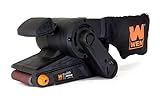
Best BudgetWEN 6321
3 x 21 in Belt, 7 Amp, Dust Bag, Budget
A belt sander is a tool many people need three or four times a year: stripping a door, shaping a rough edge, cleaning up a deck board. Buying a premium machine for that frequency is difficult to justify, and the relevant question is whether the cheapest option does the job without being actively frustrating. The WEN 6321 does, within limits that are worth being clear about. Power is adequate for stripping paint and shaping softwood, and the lock-on switch means long runs do not require holding a trigger. The tracking adjustment works, though it needs setting carefully and rechecking often. The critical limitation is the platen. In our benchtop levelling test, the surface produced by this machine was measurably less flat than the premium machines, with a slight convexity that showed up as high spots along the centre of each pass. For stripping and shaping that is irrelevant. For flattening a panel it is the whole point of the tool, and this machine cannot do it well. Vibration and noise are both higher than the better machines, which matters on a long job. Bought understanding what it is for, it represents genuine value; bought expecting benchtop work, it disappoints.
Pros
- Very low price for a functional belt sander
- Adequate power for occasional stripping and shaping
- Simple tracking adjustment that works when set correctly
- Lock-on switch for extended runs
- Includes a dust bag and a starter belt
Cons
- Noticeably less flat platen, so it is poor for levelling wide surfaces
- Louder and more vibration than premium machines
- Tracking requires frequent attention
The Bottom Line
Genuine belt sander capability for very little money. Do not expect it to level a benchtop.

Best CompactTriton TCMBS Compact Belt Sander
2.5 x 16 in Belt, 6 Amp, Compact, One Handed
Full size belt sanders are heavy, wide, and impossible to use in a confined space or above shoulder height for more than a minute. There is a category of work — inside a cabinet carcass, along a stair stringer, on the underside of a rail, on a door edge in situ — where the correct tool is much smaller. The Triton compact machine is built for that, at a size and weight that can genuinely be operated one handed while the other hand steadies the work. Within that scope it is unusually effective. The 2.5 by 16 inch belt removes material much faster than a random orbit sander would in the same position, the machine runs flush on one side for edge access, and the low weight means vertical and overhead work is possible rather than merely theoretical. The motor is modest but appropriate to the belt size. It is emphatically not a general purpose belt sander. On a large flat surface the small belt covers ground slowly and the light weight means you must supply the downforce, which produces uneven results. The belt size is also less common, so buying replacements locally is harder than for a standard three inch machine. As a second sander alongside a full size machine, it earns its space.
Pros
- Small enough to use one handed in confined spaces
- Reaches into areas full size machines cannot approach
- Light enough for vertical and overhead work without fatigue
- Belt runs flush on one side for edge access
- Surprisingly capable for its size
Cons
- Small belt covers ground slowly on large surfaces
- Belts are a less common size and harder to find locally
- Not suitable for levelling or heavy stock removal
The Bottom Line
A specialist. Brilliant in tight spaces and on vertical work, useless for flattening a tabletop.
4. Technique That Prevents Gouging
Almost every belt sander mistake produces the same result: a dish in the workpiece that then has to be sanded out across the entire surface. The technique that avoids it is specific and easy to learn.
Start the machine off the work. Bring it up to speed in the air, lower it onto the surface while already moving forward, and lift it off while still moving. Touching down a stationary belt is the classic way to dig a hollow.
Let the weight of the machine do the work. A belt sander is heavy for a reason. Adding downward pressure does not increase removal proportionally, it increases heat, clogs the belt, and makes the machine harder to steer.
Keep it flat and keep it moving. Tilting concentrates the pressure on one edge of the belt, which cuts a groove. Pausing anywhere cuts a hollow. Overlapping passes at a steady walking pace produces an even surface.
Sand with the grain, always. Cross-grain belt scratches are deep and extremely difficult to remove, and they show through any finish. The one exception is deliberate cross-grain levelling on very uneven stock, which then requires full re-sanding with the grain.
Never clamp the work with the sander running near the clamp. The belt catching a clamp head jerks the machine violently. Use bench dogs, a stop block, or a non-slip mat so the workpiece is held without anything protruding into the sanding path.
Finish with a random orbit sander. The belt leaves directional scratches that a finish will highlight. Two grits with a random orbit machine afterwards removes them and takes a fraction of the time the belt work did.
Pencil Lines Tell You When to Stop
Before flattening a panel, scribble pencil lines across the whole surface. Sand until every line has disappeared and the surface is level by definition, because the low spots keep their pencil until the high spots have come down to meet them. It costs ten seconds and it is the single most useful trick in belt sanding.
5. Choosing and Looking After Belts
The belt matters at least as much as the machine, and belts are where most people economise to their cost.
Start coarse and step through the grits. Sixty or eighty grit for flattening and stripping, then one hundred and twenty to remove those scratches. Skipping grits leaves deep scratches that the finer belt cannot reach.
Zirconia and ceramic belts outlast aluminium oxide. They cost more per belt and considerably less per hour of work, because they self-sharpen as they wear rather than simply going dull. For hardwood and stripping they are worth the difference.
Watch the direction arrow. Most belts are joined with a lap splice that must run in the direction of travel or it catches and eventually separates. The arrow is printed on the inside for exactly this reason.
Clean belts with a rubber stick. A crepe rubber cleaning stick held against a running belt pulls out the loaded resin and finish, and restores much of the cut. A belt that seems worn is very often just clogged.
Lower the speed on finishes and resinous wood. Heat is what melts finish into the abrasive and burns pitch onto the belt. Running slower keeps the belt cutting rather than glazing, which is the main practical use of variable speed.
Store belts hanging or flat, not creased. A crease in the backing becomes a bump that thumps against the workpiece every revolution and eventually cracks. Hanging them over a dowel costs nothing.
6. Dust Collection and Health
Belt sanders generate more dust per minute than any other handheld sander, and wood dust is a genuine health issue rather than merely a mess.
The bag is the minimum, not the answer. Onboard dust bags capture the coarse fraction and let the fine dust through. In our weighing tests, connecting a shop vacuum captured substantially more than any bag did.
Fine dust is the dangerous fraction. The visible sawdust settles quickly; the invisible fine particulate stays airborne for hours and is what reaches deep into the lungs. Hardwood dust in particular is classified as a carcinogen in several jurisdictions.
Use a vacuum with a fine filter. An ordinary shop vacuum without a fine filter collects the dust and then blows the finest fraction straight back into the room, which is worse than useless. A HEPA or fine dust filter is the part that matters.
Wear a proper respirator, not a nuisance mask. A rated particulate respirator that seals to the face is a different thing from a paper dust mask. For any extended sanding session it is the single most worthwhile safety purchase.
Old paint may contain lead. Sanding painted surfaces in a house built before the late 1970s can release lead dust, and a belt sander produces a great deal of it very quickly. Test first, and if it is positive, this is not a job for a belt sander.
Sand outside or ventilate properly. Even with good collection, belt sanding indoors loads the air. Working outdoors or with cross ventilation and a running air cleaner keeps exposure down for the rest of the day as well.
7. When Another Sander Is the Right Tool
Buying a belt sander for a job that wanted a different machine is common, and the distinctions are clear once stated.
Random orbit sanders are for finishing. The overlapping random pattern leaves no directional scratch, which is what allows a surface to take a finish evenly. They remove material slowly, which is a feature rather than a limitation.
Orbital sheet sanders are for light work and detail. Cheap, gentle, and useful for small areas and between coats. They will not flatten anything and they are slow, but they are difficult to damage a workpiece with.
Drum and floor sanders are for floors. Using a handheld belt sander on a floor is possible and produces a wavy result over any real area, because the platen is too short to reference across the boards. Rent the right machine.
Hand planes still beat sanders for flattening. A sharp plane removes material faster than a belt sander on many jobs, leaves a better surface, makes no dust, and costs nothing to run. It requires skill that a sander does not.
Bench mounting turns it into a stationary sander. Most belt sanders can be clamped upside down in a vice or fitted into a purpose made stand, at which point you bring the work to the machine instead. For shaping small parts, truing an end grain edge, or sharpening a scraper, that is far more controllable than trying to hold a small piece steady on a bench.
An oscillating spindle sander handles curves. Belt sanders are flat-surface tools and cannot follow an inside curve at all. If your work involves shaped edges, templates or cut-outs, a spindle sander is the machine that does that job and no amount of technique makes a belt sander a substitute.
Own a belt sander and a random orbit sander. That pairing covers flattening and finishing, which is the great majority of workshop sanding. Everything else is a refinement on top of those two machines.
Before You Buy
Also Needed for This Job
8. Frequently Asked Questions
What is the best belt sander?
Makita 9403 for benchtop and flattening work, thanks to a genuinely flat platen, stable tracking and unusually low noise. For a first belt sander in the more manageable 3 by 21 size, the Makita 9903 for its automatic tracking or the Porter-Cable 352VS for value.
What size belt sander should I buy?
Three by twenty-one inches suits most workshops, balancing coverage against controllability with belts available everywhere. Four by twenty-four removes material considerably faster on large flat surfaces but is heavy and much less forgiving. Compact machines are specialists for confined spaces.
Can I use a belt sander for finishing?
No. A belt runs in one direction and leaves directional scratches that show clearly under any finish. Use the belt sander to get the surface flat, then move to a random orbit sander for two grits to remove those scratches before finishing.
Why does my belt sander gouge the wood?
Almost always because the machine was stationary while running, or was tilted so pressure concentrated on one edge. Start the sander off the work, lower it while already moving forward, keep it flat and moving at all times, and lift it off while still moving.
Can I use a belt sander on a floor?
Over a small patch, yes. Over a room, no. The platen is too short to reference across boards, so it follows the existing contour and leaves a wavy surface that shows badly under finish. Rent a proper drum or orbital floor sander for anything beyond a repair.
What grit belt should I start with?
Sixty or eighty grit for flattening and paint stripping, then step to one hundred and twenty to remove those scratches before moving to a random orbit sander. Skipping grits leaves deep scratches the finer belt cannot reach, which then show up once finish goes on.
9. Common Belt Sander Mistakes
Belt sanders punish inattention faster than any other sander, and the errors are consistent enough to list.
Setting It Down While Running
A stationary belt cuts a hollow in under two seconds, and correcting that hollow means taking the entire surface down to meet it. The machine should be moving before it touches the work and still moving when it leaves. This single habit prevents most belt sander damage.
Pressing Down Hard
The weight of the machine is calibrated to the job. Adding pressure does not increase removal proportionally; it generates heat, clogs the belt with melted resin and finish, and makes the tool much harder to steer accurately. Guide it and let it work.
Sanding Across the Grain
Cross-grain scratches from a belt sander are deep and extremely difficult to remove, and they show through any finish as a series of hard lines. Unless you are deliberately levelling very uneven stock and plan to re-sand fully with the grain, keep every pass aligned.
Relying on the Dust Bag
Onboard bags capture the coarse fraction and let the fine dust through, and the fine fraction is the one that stays airborne and reaches your lungs. Connect a shop vacuum with a fine filter, wear a rated respirator, and test old paint for lead before sanding it.
Related Tool Guides
The Bottom Line
The best belt sander for serious flattening is the Makita 9403 — flat platen, rock-steady tracking, and quiet by the standards of the category. In the more manageable 3 by 21 size, the Makita 9903 for its auto tracking or the Porter-Cable 352VS for value.
Keep it moving, let the weight do the work, sand with the grain, and finish with a random orbit sander before any finish goes on.
More in Tools & Equipment
Guides in this category that pair with what you just read.
About the Author
Alex Rivers, Home Improvement Editor
Alex has spent over a decade working on residential and light commercial property maintenance, and now tests every tool, coating and machine that appears in these guides personally.