The 7 Best Shop Vacs in 2026
We tested 12 wet/dry vacuums on drywall dust, sawdust, wet spills, and gravel, measuring actual suction rather than trusting peak horsepower claims. Only 7 earned a spot.
Shaheer Ali Khan
Consumer Product Testing & Materials Performance Specialist
Last Updated
October 18, 2026
In This Guide
Shop vacs are marketed on peak horsepower, a number that describes a momentary electrical draw at motor stall and tells you essentially nothing about whether the machine will pick up drywall dust without clogging. The specifications that matter are water lift, airflow, hose diameter, and filtration, and three of those are rarely printed on the box. Here is what to actually look for.
Our Picks at a Glance
The Short Answer
Ridgid HD1400 14 Gallon NXT (Best Overall). The shop vac most workshops should own. Enough capacity for real jobs, a hose big enough not to clog, and a warranty that outlasts the competition.
- Check Price
- Best Cordless Milwaukee M18 FUEL 6 Gallon Wet/Dry Vac — Cordless, 6 Gallon, Dual Battery, HEPA FilterCheck Price
- Check Price
- Check Price
- Check Price
- Check Price
- Check Price
We may earn a commission when you buy through these links, at no extra cost to you. How we test
Best Overall
Ridgid HD1400 14 Gallon NXT
1. The 7 Best Shop Vacs in 2026 — Tested & Ranked
We ran each vac on drywall dust, fine sawdust, wood offcuts, gravel, a wet spill, and a car interior, tracking clogs, filter loading, suction retention as the drum filled, noise, and how much dust escaped back into the room. These seven earned their place.

Best OverallRidgid HD1400 14 Gallon NXT
14 Gallon, 6.0 Peak HP, 2.5" Hose
Shop vacs are simple machines, and the differences that matter come down to hose diameter, real suction, and whether the thing survives being knocked around a garage for a decade. The HD1400 does all three well. Its 2.5-inch hose is the specification we would prioritize above almost anything else, because it swallows wood offcuts, insulation scraps, and clumps of wet leaves that jam the 1.25 and 1.875-inch hoses on cheaper machines within seconds. In our gravel and offcut tests it never clogged once. Suction and airflow are well balanced rather than optimized for one at the expense of the other, which matters because those two properties do different jobs: airflow moves bulky debris along the hose while suction lifts fine material off surfaces. In practice it picked up drywall dust, sawdust, wet spills, and gravel without any configuration change beyond fitting the right filter. The cart is genuinely good, with large wheels that roll over extension cords and door thresholds instead of catching on them. The lifetime warranty with registration is a real differentiator in a category where machines are often treated as semi-disposable. The honest drawbacks are noise, which is inherent to a high-airflow vacuum, and size, which needs real garage floor space. For fine drywall dust you will want a dust bag or an upgraded fine-dust cartridge, since the standard filter alone loads up quickly.
Pros
- Excellent balance of suction and airflow that handled everything from fine dust to gravel
- 2.5-inch hose diameter moves bulky debris that clogs narrower hoses instantly
- Rugged drum and cart with large wheels that roll over cords, thresholds, and gravel
- Lifetime warranty on the vacuum with registration, unusual in this category
- Onboard accessory storage and a well-designed hose park that keeps everything together
Cons
- Loud, as almost all high-airflow shop vacs are
- Physically large, requiring real floor space in a garage
- The standard filter needs a fine dust bag or upgraded cartridge for drywall work
The Bottom Line
The shop vac most workshops should own. Enough capacity for real jobs, a hose big enough not to clog, and a warranty that outlasts the competition.

Best CordlessMilwaukee M18 FUEL 6 Gallon Wet/Dry Vac
Cordless, 6 Gallon, Dual Battery, HEPA Filter
The main reason a shop vac sits unused is friction: dragging it out, finding an outlet, running the cord, and coiling it afterward is enough work that people reach for a broom instead. Cutting the cord removes all of that, and in our testing this was by a wide margin the vac that got used most often for quick cleanups precisely because using it required no setup. That behavioral change matters more than any specification. Performance is not a compromise. Running on two M18 batteries it produced suction comparable to a corded mid-size vac, picking up sawdust, drywall debris, and wet spills without any sense of being underpowered. The HEPA filter is important on a portable vac, because a machine you use indoors near finished spaces should not be exhausting fine dust back into the room, and many cheaper vacs do exactly that. Construction is unmistakably jobsite grade, with a sealed housing built to survive being thrown in a truck. The limits are capacity, runtime, and price. Six gallons fills faster than you expect during a real cleanup, batteries need swapping during extended work, and the kit price is high unless you already own M18 packs. If you do own them, adding the bare tool is one of the better upgrades available for a workshop.
Pros
- Completely cordless, which removes the biggest practical annoyance of shop vac use
- Suction genuinely comparable to a corded mid-size vac, not a compromise
- HEPA filtration captures fine dust rather than blowing it back into the room
- Runs on standard M18 batteries shared across a huge tool platform
- Jobsite-grade construction with a sealed housing that tolerates real abuse
Cons
- Expensive, particularly as a kit with batteries
- Runtime is finite, so extended cleanup means swapping batteries
- 6-gallon capacity fills quickly during a real cleanup
The Bottom Line
The vac you actually reach for, because there is no cord to drag out. If you own M18 batteries, it is a genuinely transformative addition.

Best ValueVacmaster Beast VJH1211PF 12 Gallon
12 Gallon, 5.5 Peak HP, 2.5" Hose
Vacmaster is not the name most people think of first, and on raw performance per dollar that is a mistake. The Beast produces suction and airflow competitive with vacs costing substantially more, and critically it ships with a 2.5-inch hose, which is the specification that separates machines that swallow offcuts and wet leaves from machines that clog on them. In our debris testing it handled everything we fed it without a single jam. The two-stage motor design is the technical reason for the performance. Rather than a single impeller, two work in series, which produces better sustained suction under load than the single-stage motors in most consumer vacs. Over a long cleanup with a filling drum, that difference shows up as performance that holds rather than fading. The included accessory set is more complete than most, covering the nozzles and extensions that would otherwise be a separate purchase. Where it gives ground is refinement and support. The cart, casters, and hose park feel a step below Ridgid in design quality, the plastic is less substantial in places, and the warranty is conventional rather than the lifetime coverage Ridgid offers. It is also loud, though every high-airflow vac in this guide is. If you care about how a tool performs more than how it looks in the garage, this is excellent value.
Pros
- Strong suction and airflow at a price well below comparable name-brand vacs
- 2.5-inch hose diameter avoids the clogging that plagues narrow-hose machines
- Two-stage motor design produces better sustained performance than single-stage units
- Includes a good accessory set that would cost real money separately
- Sturdy drum and casters that hold up to workshop use
Cons
- Less refined than premium brands in fit, finish, and cart design
- Warranty is shorter than Ridgid lifetime coverage
- Loud even by shop vac standards
The Bottom Line
The most suction per dollar in this guide. It looks and feels less polished than premium vacs and it does not perform like it.
Best PortableDeWalt DXV06P 6 Gallon
6 Gallon, 4.0 Peak HP, Poly Tank
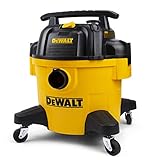
The DXV06P is built to be carried rather than rolled. Its 6-gallon poly tank keeps the weight down, and a built-in drain lets you empty water without tipping the whole vac over a sink. It is genuinely portable in a way full-size vacs are not, light enough to carry up a flight of stairs in one hand and compact enough to fit in a car trunk alongside tools. Suction is strong for the size, handling drywall dust, sawdust, and wet spills without difficulty, and the rear blower port is more useful than it sounds for clearing sawdust off a workbench or leaves off a driveway without a separate tool. The limits follow from the size. Six gallons fills quickly on any real job, which means more trips to empty it, and the smaller hose diameter compared to full-size vacs means bulky debris like wood offcuts and clumps of wet material can bridge and clog. It also costs more per gallon than a larger full-size vac, and some retailers now list it as discontinued, so check stock before you count on it. Buy it for portability, not for capacity.
Pros
- Built-in tank drain makes emptying wet spills easy
- Compact and light enough to carry up stairs or into a vehicle easily
- Strong suction for its size, handling drywall dust and wet spills well
- Rear blower port converts it into a blower for clearing sawdust and leaves
- Well-designed accessory storage and a sturdy carry handle
Cons
- 6-gallon capacity fills quickly on any substantial job
- Smaller hose diameter than full-size vacs, so bulky debris can clog
- Costs more per gallon than larger full-size vacs
- Listed as discontinued at some retailers, so stock is thinning
The Bottom Line
The vac to own if you carry it to the work rather than rolling it. Compact, light, and the built-in drain makes wet jobs easy.

Best Large CapacityCraftsman CMXEVBE17595 16 Gallon
16 Gallon, 6.5 Peak HP, 2.5" Hose
On a substantial cleanup, the limiting factor is often not suction but how many times you stop to empty the drum. A 6-gallon vac fills three times during a job that a 16-gallon vac handles in one, and each emptying means unclipping the lid, hauling the drum outside, and reassembling. The Craftsman 16-gallon is aimed squarely at that problem, and in our testing on a renovation cleanup it went the whole session without needing to be emptied while the smaller vacs stopped repeatedly. Airflow is strong enough to move heavy material, and the 2.5-inch hose swallows offcuts, insulation, and clumps of wet leaves without bridging. Filters and accessories are widely available at any home center, which matters over the life of a tool more than people account for, since a vac with hard-to-find filters gradually stops being used. Pricing is reasonable for the capacity. The trade-offs are physical. It is a large machine that needs real floor space, and a full drum, particularly of water, is genuinely heavy and awkward to empty, which is why a drain port matters at this size. The cart wheels are adequate on a smooth garage floor and less impressive on gravel or a rough job site. For a workshop where the vac stays put, none of that matters much.
Pros
- 16 gallons means far fewer stops to empty during a big cleanup
- 2.5-inch hose handles bulky debris without bridging or clogging
- Strong airflow that moves heavy material like gravel and wet leaves
- Widely available with easily sourced filters and accessories
- Reasonably priced for the capacity offered
Cons
- Large and heavy, particularly when the drum is full of wet material
- Cart wheels are adequate rather than excellent on rough surfaces
- A full 16-gallon drum of water is genuinely difficult to empty
The Bottom Line
The right vac for construction cleanup, flooded basements, and garage projects where emptying constantly is the real bottleneck.
Best for Dust ExtractionFein Turbo II Dust Extractor
8.4 Gallon, HEPA, Auto Tool Start
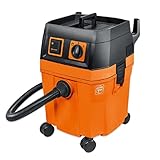
There is a meaningful distinction between a shop vac and a dust extractor, and most people buying the former actually want the latter for fine-dust work. A conventional shop vac with a standard cartridge filter captures visible debris while passing a significant amount of fine respirable dust straight through the motor and back into the room. The Fein Turbo II is built around HEPA filtration that actually captures that fraction, which matters because silica dust from concrete and the fine particulate from drywall and MDF are genuine long-term health hazards rather than merely a mess. Automatic tool start is the feature that makes it practical. Plug a sander or a track saw into the outlet on the vacuum and the vacuum starts and stops with the tool, which means dust is captured at the source every time rather than only when you remember. Combined with an antistatic hose, which eliminates the shocks that fine dust generates, and noticeably lower noise than conventional vacs, it is far more pleasant to work alongside. The costs are real. It is several times the price of a conventional shop vac, the proprietary filters and bags are expensive, and its airflow is lower than a high-CFM shop vac, so it is less effective at hoovering up gravel and offcuts. Buy it for dust control, and keep a cheap vac for debris.
Pros
- HEPA filtration captures the fine dust that ordinary shop vacs recirculate into the room
- Automatic tool start switches the vacuum on when a connected power tool starts
- Dramatically quieter than any conventional shop vac
- Antistatic hose prevents the static shocks common when vacuuming fine dust
- Built to professional standards with excellent long-term durability
Cons
- Much more expensive than a conventional shop vac of similar capacity
- Lower airflow than high-CFM shop vacs, so bulky debris pickup is weaker
- Filters and bags are proprietary and cost more than generic equivalents
The Bottom Line
Not really a shop vac. It is a dust extractor, and if you cut wood or drywall indoors, the difference to your lungs is the point.

Best BudgetShop-Vac 5989300 5 Gallon
5 Gallon, 4.5 Peak HP, Compact
Not every job needs a 14-gallon vac, and there is a legitimate case for a small, cheap machine that lives on a shelf and comes down for car interiors, a spilled bag of potting soil, or sawdust from a weekend project. The Shop-Vac 5989300 does that job for very little money, and its compact size means it actually gets stored somewhere accessible rather than buried behind the lawn mower. Suction is adequate for its intended use. It picks up dry debris, handles small wet spills, and the blower port is genuinely useful for clearing a workbench or blowing leaves off a walkway without a separate tool. Filters and bags are among the most widely available of any brand, which keeps running costs low and means you can pick up a replacement at almost any hardware store. Its limits are exactly what the price and size predict. The narrow hose bridges and clogs on wood offcuts, drywall chunks, and clumps of wet material, which is frustrating on any real cleanup. Five gallons fills fast. And it is loud relative to how much work it does, which is a common characteristic of small, cheap vacs where the motor is working hard. Buy it as a second vac or for genuinely light duty and it is good value; buy it as your only vac for a workshop and it will disappoint.
Pros
- Very inexpensive, often a fraction of the cost of full-size vacs
- Compact enough to store on a shelf or hang on a garage wall
- Adequate suction for car interiors, small spills, and light workshop cleanup
- Blower port for clearing sawdust and debris off surfaces
- Filters and bags widely available and cheap
Cons
- Narrow hose clogs readily on anything bulky
- 5-gallon capacity fills very quickly
- Loud relative to its output and built to a price
The Bottom Line
The right buy for a car, a small garage, or as a second vac. Do not ask it to handle a renovation cleanup.
2. Shop Vac Horsepower: Why Peak HP Misleads
Every shop vac box leads with a peak horsepower figure, and it is close to meaningless as a measure of cleaning ability. Understanding why redirects your attention to the numbers that matter.
Peak horsepower measures a momentary stall condition. It is derived from the electrical draw at the instant the motor is prevented from turning, a state the vacuum never operates in. A machine advertising 6.0 peak horsepower on a standard household circuit is not producing anywhere near that in use, because a 15-amp circuit physically cannot supply that much sustained power.
Water lift measures suction. Expressed in inches of water lift, this is how much vertical column of water the vacuum can pull, and it corresponds to the machine ability to lift heavy or embedded material off a surface. Higher water lift picks up wet material, gravel, and debris compacted into a corner.
CFM measures airflow. Cubic feet per minute is the volume of air the vacuum moves, and it determines how well material travels along the hose once picked up. High airflow carries bulky debris to the drum; low airflow leaves it sitting in the hose.
The two trade against each other. A narrow hose raises water lift and lowers airflow; a wide hose does the opposite. This is why a dust extractor with a small hose has excellent suction and clogs on wood chips, while a shop vac with a 2.5-inch hose swallows offcuts but is less aggressive at pulling fine dust out of a crevice.
What to actually compare. Where manufacturers publish water lift and CFM, use those. Where they do not, hose diameter is the single best available proxy for real-world usefulness on debris, and filtration type is the best proxy for usefulness on fine dust.
The Numbers Don't Lie
2.5"
Hose diameter that stops most clogs
~60-90"
Water lift range on good shop vacs
150+ CFM
Airflow for moving bulky debris
0.3 micron
Particle size a HEPA filter captures
3. What Size Shop Vac Do I Need?
Two physical specifications do more to determine your experience than the motor does, and one of them is almost never mentioned in reviews.
Shop Vac Hose Diameter Is the Most Important Spec
Shop vac hoses come in roughly 1.25, 1.875, and 2.5-inch diameters. The difference is not incremental. A 2.5-inch hose swallows wood offcuts, drywall chunks, insulation scraps, and clumps of wet leaves that bridge and jam instantly in a 1.25-inch hose. If you clean up after construction or yard work, this specification matters more than motor power, capacity, or brand.
Smaller Hoses Have Their Place
A narrower hose concentrates suction, which makes it better for fine dust, car interiors, crevices, and connecting to power tool dust ports. Many vacs ship with adapters so you can step down when needed. The mistake is buying a machine whose largest available hose is narrow.
Shop Vac Capacity Determines How Often You Stop
Drum capacity does not affect performance at all, only how often you empty it. Five to six gallons suits car cleanups and light workshop use. Twelve to sixteen gallons suits renovation cleanup, garage work, and wet pickup. The practical ceiling is that a full drum of water becomes genuinely difficult to lift, which is why larger vacs should have a drain port.
Hose Length and Cord Length Matter Too
A vac with a short hose and short cord has to be repositioned constantly, which is the friction that keeps machines sitting unused. Longer hoses lose some airflow, but the convenience usually outweighs it for household use. Check both figures, since they are often modest on budget machines.
| Capacity | Best For | Empty Frequency | Portability |
|---|---|---|---|
| 4-6 gallon | Cars, small spills, carrying | Often | Easy to carry |
| 8-12 gallon | Workshop, general garage use | Occasional | Rolls, hard to carry |
| 14-16 gallon | Renovation, wet pickup | Rarely | Stays put |
4. Shop Vac Filters Explained
Filter choice determines whether a shop vac cleans the air or redistributes fine dust into it, and using the wrong one is both the most common mistake and the one with real health consequences.
Standard Cartridge Filters
The pleated filter that comes with most vacs handles general debris and coarse dust well. It does not capture the fine respirable fraction, which passes through and exits with the exhaust. For sweeping a garage this is fine; for drywall sanding it means you are aerosolizing dust rather than removing it.
Fine Dust Filters and Bags
A fine dust cartridge combined with a collection bag is the practical answer for drywall and sanding work on a conventional vac. The bag captures the bulk before it reaches the filter, which both improves capture and prevents the filter clogging within minutes. Skipping the bag on fine dust work is why people conclude their vac lost suction.
HEPA Filters
A true HEPA filter captures 99.97 percent of particles at 0.3 microns, which includes the respirable dust that matters most. For anyone cutting concrete, working with silica, sanding drywall regularly, or vacuuming in occupied living space, this is the filtration level worth having. It costs more and requires the vacuum body to be well sealed to be meaningful.
Foam Sleeves for Wet Pickup
Wet vacuuming requires removing the paper or pleated filter entirely and fitting a foam sleeve, or using no filter at all depending on the model. Vacuuming water through a paper filter destroys it immediately and can damage the motor. This is the single most common way shop vac filters get ruined.
Why Your Shop Vac Lost Suction
Nine times out of ten it is a loaded filter, not a failing motor. Fine dust packs into the pleats and chokes airflow long before the drum is full, and the machine sounds like it is running fine while picking up almost nothing. Tap the filter clean or replace it, and use a collection bag for fine dust work. The other common cause is a clog in the hose, which you can find by disconnecting it and checking for suction at the port.
5. How to Vacuum Water With a Shop Vac
Wet vacuuming is the capability that makes a shop vac genuinely valuable in a home, and it is also where most machines get damaged through simple procedural errors.
Remove the dry filter first, every time. Paper and pleated cartridge filters are destroyed by water immediately, and a saturated filter blocks airflow so completely that the motor can overheat. Most vacs include a foam sleeve for wet use, and some are designed to run with no filter at all for water. Check your manual once and remember the answer.
Empty the drum before it gets too heavy. Water weighs roughly eight pounds per gallon, so a full 14-gallon drum holds well over a hundred pounds. That is not liftable, which is why larger vacs include a drain port at the bottom. Use it rather than trying to tip the drum.
Know the float shutoff. Most wet/dry vacs have a float that rises with the water level and blocks the intake when the drum is full, protecting the motor. If your vac suddenly stops picking up during wet work and the motor note changes, that is the float doing its job rather than a fault.
Never vacuum flammable liquids or hot ash. Gasoline, solvents, and similar liquids can be ignited by the motor, and hot embers vacuumed from a fireplace or grill will set the filter and drum contents alight. Ash vacuums with metal drums and specific filters exist for that job.
Dry the vac out afterward. Leaving water sitting in the drum grows mold and corrodes metal components, and the smell that follows is difficult to remove. Drain it, rinse it, and leave the lid off to air dry before storage.
Understand the limits on flooding. A shop vac is excellent for a burst pipe, an overflowing washing machine, or water in a basement corner. It is not a substitute for a pump on a genuinely flooded basement, where you would be emptying the drum every few minutes for hours.
6. Shop Vac Dust Extraction: Connecting to Power Tools
A shop vac connected to a sander, saw, or router captures dust at the source, which is dramatically more effective than cleaning it up afterward and far better for your lungs.
Adapters are the practical obstacle. Power tool dust ports come in a frustrating variety of diameters, and shop vac hoses come in three. A universal adapter set is inexpensive and solves most of it, and many vacs include a stepped adapter that fits several common port sizes.
Smaller hoses work better for tool connection. A 1.25 or 1.875-inch hose concentrates suction at the tool port, which is what you want when pulling fine dust out of a sander shroud. The wide hose that excels at bulk debris is actually worse here, and it is also unwieldy hanging off a hand tool.
Automatic tool start is the feature that changes habits. Vacs with a switched outlet start when a connected tool starts and stop a few seconds after. This removes the step where you decide whether it is worth turning the vac on, which in practice means dust gets collected every time rather than sometimes. It is standard on dust extractors and available on some shop vacs.
Antistatic hose prevents shocks. Fine dust moving through a plastic hose builds a substantial static charge, and the resulting shocks are unpleasant and can affect electronics. Antistatic hoses have a conductive path that dissipates it, and they are worth buying if you sand regularly.
Use a separator for volume. A cyclone separator sits between the tool and the vac and drops the majority of debris into a bucket before it reaches the filter. On a machine used for woodworking, this extends filter life enormously and keeps suction consistent throughout a session.
Before You Buy
Also Needed for This Job
7. Frequently Asked Questions
What is the best shop vac?
The Ridgid HD1400 14 Gallon NXT is the best all-around choice, with balanced suction and airflow, a 2.5-inch hose that resists clogging, and a lifetime warranty with registration. For cordless convenience, the Milwaukee M18 FUEL is genuinely capable, and for the best value the Vacmaster Beast 12 Gallon delivers comparable performance for less.
Does peak horsepower matter on a shop vac?
Not really. Peak horsepower describes the electrical draw at motor stall, a condition the vacuum never operates in, and a standard 15-amp household circuit cannot supply the advertised figures anyway. Water lift measures suction and CFM measures airflow, and where those are not published, hose diameter is the best available proxy for real-world performance.
What size hose should a shop vac have?
A 2.5-inch hose is the single best specification to prioritize if you clean up construction debris, wood offcuts, or wet leaves, because narrower hoses bridge and clog on that material constantly. Smaller 1.25 and 1.875-inch hoses concentrate suction better and are preferable for fine dust and connecting to power tool dust ports.
Why did my shop vac lose suction?
Almost always a loaded filter. Fine dust packs into the pleats and chokes airflow long before the drum is full, while the motor continues to sound normal. Tap the filter clean or replace it, and use a collection bag for fine dust work. The next most common cause is a clog in the hose, which you can confirm by checking suction at the port with the hose disconnected.
Can I vacuum water with a shop vac?
Yes, but you must remove the paper or pleated dry filter first and fit the foam sleeve, or run with no filter if your model is designed that way. Water destroys a dry filter immediately and a saturated filter blocks airflow enough to overheat the motor. Use the drain port on large vacs rather than trying to lift a full drum of water.
Do I need a HEPA filter on a shop vac?
If you sand drywall, cut concrete, work with silica, or vacuum inside occupied living space, yes. A standard cartridge filter passes the fine respirable fraction straight through and exhausts it back into the room. A true HEPA filter captures 99.97 percent of particles at 0.3 microns, which is the fraction that matters for long-term lung health.
8. Common Shop Vac Mistakes
Shop vacs are simple, and the errors people make with them are simple too, but a few of them destroy filters or motors outright.
Vacuuming Water Without Removing the Dry Filter
A paper or pleated cartridge filter is destroyed by water immediately, and once saturated it blocks airflow so completely that the motor can overheat. Every wet/dry vac has a documented procedure for wet use, usually removing the cartridge and fitting a foam sleeve. Read it once and you will never destroy a filter again.
Skipping the Collection Bag on Fine Dust
Drywall dust and sanding dust pack into a cartridge filter within minutes and choke suction while the machine still sounds like it is working. A collection bag captures the bulk before it reaches the filter, which keeps suction consistent and dramatically extends filter life. This is why professionals always bag fine dust work.
Buying on Capacity Instead of Hose Diameter
A 16-gallon vac with a 1.25-inch hose will clog on the same wood offcuts and wet leaves that an 8-gallon vac with a 2.5-inch hose swallows without hesitation. Capacity only determines how often you empty the drum; hose diameter determines whether the material gets there at all.
Vacuuming Hot Ash or Flammable Liquids
Embers from a fireplace or grill can remain hot enough to ignite the filter and drum contents hours after they look dead, and gasoline or solvent vapors can be ignited by the motor. Dedicated ash vacuums with metal drums exist for the first case, and nothing in this guide should be used for the second.
Everything Else About Shop Vacs
The decisions, specifications and problems that come up once you own one.
Sizing
What Size Shop Vac Do I Need?
Gallons decide how often you empty; hose diameter decides how well it picks up.
Specs
CFM vs Peak Horsepower
Why the biggest number on the box is the one that means least.
Maintenance
Shop Vac Filters Explained
Cartridge, fine dust, HEPA or foam — and why a bag changes everything.
Troubleshooting
Shop Vac Losing Suction?
The five causes, in the order worth checking them.
How-To
Vacuuming Water Safely
The wet pickup routine, and the one safety rule that is not optional.
FAQ
Running Without a Filter
Correct for water, damaging for everything else — and why.
Comparison
Shop Vac vs Regular Vacuum
Two machines built around opposite priorities, and what kills each.
Comparison
Shop Vac vs Dust Extractor
What three times the price actually buys, and when it is worth it.
Related Tool & Workshop Guides
Buyer's Guide
Best Cordless Drills
Drill/drivers and combo kits compared across every major battery platform.
Buyer's Guide
Best Pressure Washers
The other cleaning tool worth owning, with PSI and GPM explained properly.
All Guides
Browse All Best Lists
Every hands-on tested guide we have published, organized by category.
The Bottom Line
The best shop vac for most workshops is the Ridgid HD1400, which pairs a clog-resistant 2.5-inch hose with balanced suction and a lifetime warranty. If you already own M18 batteries, the Milwaukee M18 FUEL cordless vac gets used far more often simply because there is no cord to deal with. And if you cut wood or drywall indoors, the Fein Turbo II is a dust extractor rather than a shop vac, which is exactly the point.
Ignore peak horsepower entirely. Buy on hose diameter and filtration, use a bag for fine dust, and pull the cartridge filter before you vacuum water.
More in Tools & Equipment
Guides in this category that pair with what you just read.
About the Author
Shaheer Ali Khan, Consumer Product Testing & Materials Performance Specialist
Shaheer Ali Khan holds a PhD in Materials Science and Engineering from Georgia Tech and is an ASQ Certified Quality Engineer and Certified Reliability Engineer. He leads testing for household appliances, vacuums, cleaning products, and caulks, adhesives and sealants.