The 6 Best Table Saws in 2026
We compared six saws from jobsite to cabinet on the things that decide cut quality and safety — fence repeatability, table flatness, trunnion mounting, dust capture, and whether the blade stops before it reaches you.
Alex Rivers
Home Improvement Editor
Last Updated
September 18, 2026
In This Guide
A table saw is the most useful machine in a workshop and by a wide margin the most dangerous — around 30,000 injuries a year in the United States, thousands of them amputations. That makes this the one tool category where a safety feature, not a specification, deserves to lead the buying decision. Here is how six saws compare on both.
Our Picks at a Glance
- Best Overall: SawStop PCS 3HP Professional Cabinet Saw — Cabinet Saw, 3 HP, 240V
- Best Portable: SawStop Jobsite Saw Pro — Portable Jobsite, 15A, 120V
- Best Value Portable: DeWalt DWE7491RS 10-Inch Jobsite Saw — Portable Jobsite, 15A, 120V
- Best Value Cabinet: Grizzly G0899 10-Inch Hybrid Cabinet Saw — Hybrid Cabinet, 2 HP, 120/240V
- Best 115V Cabinet Saw: Powermatic PM1000 Cabinet Saw — Cabinet Saw, 1.75 HP, 115V
- Best for Small Shops: Laguna Fusion F2 Hybrid Saw — Hybrid Cabinet, 1.75 HP, 110V
1. The Safety Conversation Comes First
No other tool in a home shop causes injuries at the rate a table saw does. United States emergency departments treat roughly 30,000 table saw injuries a year, and several thousand of those are amputations. That is not a statistic about careless beginners, either — a substantial share of serious injuries happen to experienced woodworkers performing routine cuts, because the mechanism is fast and unforgiving.
This matters when you are comparing prices, because it is the only category where a single feature changes the outcome rather than the specification. Blade brake technology detects contact with skin and stops and drops the blade within milliseconds, turning what would have been a reconstruction into a cut that needs a plaster. A braked saw costs roughly twice its unbraked equivalent, and against the cost of a hand surgery and the recovery that follows it, that premium is not a close call for anyone using a saw regularly.
What We Measured
0.002"
Best table flatness measured
30,000
US table saw injuries a year
32.5"
Best portable rip capacity
$650-4k
Price range across the category
The other safety features are not optional either, and they are free. A riving knife — a curved plate that rides behind the blade and keeps the kerf open — is the single most effective defence against kickback, which is the other way this tool hurts people. Use it for every cut that does not require its removal, keep the guard on for through cuts, and never make a freehand cut without the fence or miter gauge.
None of that makes an unbraked saw unusable. Millions of people work safely on them for decades with good technique and good habits. But the honest framing is that technique reduces the chance of contact while a brake removes the consequence, and only one of those works on the day you are tired.
2. Jobsite, Contractor, Hybrid and Cabinet
The four classes differ in motor type, mass, and where the trunnions — the castings that hold the blade assembly — are mounted. Those three things determine how accurately a saw cuts and how long it keeps doing so.
| Class | Motor / Table | Price |
|---|---|---|
| Jobsite / portable | Universal motor, aluminum table, 40-90 lb | $400-$1,600 |
| Contractor | Induction motor hung off the back, cast iron top | $700-$1,200 |
| Hybrid | Enclosed base, cabinet trunnions, 110V or 220V | $1,200-$2,500 |
| Cabinet | 3-5 HP induction, heavy cast iron, 240V | $2,000-$5,000 |
The specification that separates a hybrid from a contractor saw, and matters more than the marketing name, is where the trunnions mount. Cabinet-mounted trunnions bolt to the base, so the blade stays aligned to the table when the saw is moved or bumped. Table-mounted trunnions hang from the top and drift out of alignment, which is why contractor saws need re-squaring far more often.
3. The 6 Best Table Saws in 2026
We judged these on the measures that show up in finished work and in the emergency room: fence repeatability across the table, measured flatness of the cast iron or aluminum top, trunnion mounting and mass, dust capture at the blade, and the presence and behaviour of blade brake technology.

SawStop PCS 3HP Professional Cabinet Saw
Cabinet Saw, 3 HP, 240V
The safety argument for the SawStop is well known and still understated: the brake does not reduce the severity of a table saw injury, it prevents it. On contact with skin, an electrical signal fires an aluminum brake into the blade and drops it below the table in a few milliseconds, and the difference in outcome is a nicked finger rather than a surgical reconstruction. Around 30,000 table saw injuries a year happen in the United States, and thousands of those are amputations — the arithmetic is not close for anyone using a saw regularly. What gets less attention is that this is also simply an excellent cabinet saw. The cast iron table on our test unit measured flat within 0.002 inches across its length, which is machine-tool territory, and the T-Glide fence locks parallel to the blade at any position we tested with no measurable deflection. Heavy cabinet-mounted trunnions hold alignment through shop moves that would knock a lighter saw out of true. Dust collection is genuinely the best we have used, with a blade shroud that captures most of what a saw normally throws into the room. The two costs are real. It is roughly double a comparable non-safety cabinet saw, plus a cartridge and blade when the brake fires. And at 240V and over 500 pounds, it is a permanent installation in a shop with the electrical service to support it.
Pros
- Blade brake stops and drops the blade in milliseconds on skin contact — the only technology that prevents amputations rather than mitigating them
- Machined cast iron table was flat within 0.002 inches across its length on our test unit
- T-Glide fence locks parallel and stays parallel; we measured no deflection across repeated settings
- The best dust collection on any table saw we have used, capturing most dust at the blade shroud
- Trunnions are heavy and cabinet-mounted, so blade alignment holds after moving the machine
Cons
- Costs roughly double a comparable non-safety cabinet saw, and a triggered brake means a new cartridge and blade
- Requires a 240V circuit and weighs over 500 pounds — this is a permanent shop installation
The Bottom Line
The best table saw made, and the only one whose safety system prevents the injury rather than reducing it. If you can afford it and have the circuit, buy it.
SawStop Jobsite Saw Pro
Portable Jobsite, 15A, 120V
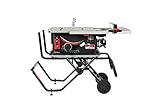
For years the blade brake was effectively a privilege of people with a dedicated shop and a 240V circuit, which excluded a great many of the hobbyists and trades who are statistically most at risk. The Jobsite Saw Pro closes that gap: the same detection and braking technology in a saw that runs on an ordinary household circuit and rolls into a corner when you are done. As a saw, it is among the best portables available. The rack-and-pinion fence is accurate and genuinely repeatable — set it, return to it, and the measurement holds, which is not something you can say about most saws at this size. Rip capacity of 24.5 inches means a full sheet of plywood can be broken down properly rather than fought, and the folding cart is one of the few that a single person can deploy and collapse without a struggle on uneven ground. The limits are those of the format rather than the brand. A universal motor is loud in a way induction motors are not, and it lacks the sustained torque to rip thick hardwood without slowing — feed rate discipline matters far more here than on a cabinet saw. The aluminum table is flat enough for good work but cannot match cast iron for damping vibration. Neither of those is a reason to choose an unbraked saw, and for anyone whose shop is also a parking space, this is the right answer.
Pros
- The only genuinely portable saw with blade brake technology — safety is no longer a shop-only feature
- Runs on a standard 120V 15A circuit, so it works in a garage or on site with no electrical work
- Excellent one-person cart system that folds and rolls over rough ground
- Rack-and-pinion fence is accurate and repeatable, unusually so for a portable saw
- 24.5-inch rip capacity handles sheet goods better than most saws in this class
Cons
- Universal motor is loud and lacks the power for heavy ripping in thick hardwood
- Aluminum table cannot match cast iron for flatness or vibration damping
The Bottom Line
The right table saw for a shared garage, a small shop, or site work. It brings the one safety feature that matters to people who cannot install a cabinet saw.
DeWalt DWE7491RS 10-Inch Jobsite Saw
Portable Jobsite, 15A, 120V
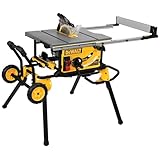
The DWE7491RS has been the default recommendation in its class for years, and using one makes the reason obvious within an hour: the rack-and-pinion fence is far better than the price suggests. It moves smoothly, locks square, and stays square across the full width of the table, which is exactly where cheap portable saws fail and where inaccuracy in the finished work comes from. Rip capacity of 32.5 inches is the other standout — that is enough to rip a full sheet of plywood to width in one pass, a capability most portable saws simply do not have, and it changes what projects are practical on a small saw. The rolling stand deploys fast and survives genuine site abuse, and the design has been in production long enough that parts, blades, and accessories are everywhere. The honest limitation is safety technology. This saw has a riving knife, a guard, and anti-kickback pawls, all of which work well, but it has no way to stop the blade if your hand reaches it. Statistically, the majority of serious table saw injuries happen to experienced users doing ordinary cuts, and that is the risk this saw leaves on the table. The universal motor is also loud and will bog in thick hardwood. If the budget genuinely cannot reach a braked saw, this is the one to buy, and a good push stick and a strict no-freehand rule matter more here than anywhere else.
Pros
- The rack-and-pinion fence is the best in the budget portable class and stays square across the table
- 32.5-inch rip capacity is exceptional for a portable — it handles a full sheet ripped to width
- Rolling stand deploys quickly and takes site abuse without complaint
- Proven design with excellent parts availability and a large accessory ecosystem
- Genuinely good value: cabinet-saw accuracy is not on offer, but nothing at this price cuts better
Cons
- No blade brake technology, so the saw's safety depends entirely on guards, riving knife and technique
- Universal motor is loud and will bog in thick hardwood rips
The Bottom Line
The best table saw under a thousand dollars, and the benchmark portable for a decade. The absence of a brake is the compromise you are accepting.
Grizzly G0899 10-Inch Hybrid Cabinet Saw
Hybrid Cabinet, 2 HP, 120/240V
There is a substantial gap in price between a good portable saw and a premium cabinet saw, and the hybrid category exists to fill it. The G0899 is the best current expression of that idea: a cast iron table, cabinet-mounted trunnions, and a 2 HP induction motor for roughly half what a premium cabinet saw costs. The practical difference between this and a portable saw is immediately obvious in the first hardwood rip. An induction motor does not scream, does not bog, and holds blade speed through 8/4 maple in a way a universal motor cannot, and the mass of a cast iron table absorbs vibration that shows up as chatter marks on the cut edge. Cabinet-mounted trunnions mean alignment holds rather than drifting. Running on 120V out of the box is a genuinely useful feature, because it means you can put the saw to work in an ordinary garage immediately and convert to 240V later when the shop wiring catches up. What you trade for the price is refinement and setup time. Expect to spend an afternoon with a dial indicator squaring the blade to the miter slots and tuning the fence — these machines ship close but not dialled in, and the quality of your cuts for the next twenty years depends on that afternoon. The fence is decent and is the component most owners eventually upgrade.
Pros
- Cast iron table and cabinet-mounted trunnions at roughly half the price of a premium cabinet saw
- Runs on 120V out of the box and converts to 240V, so no electrical work is required to start
- Induction motor is dramatically quieter than any portable saw and holds speed in hardwood rips
- Well-designed dust collection with a 4-inch port and internal shroud
- Excellent value per pound of cast iron — this is a serious stationary machine
Cons
- Fit and finish require some setup work; expect to spend an afternoon tuning it out of the crate
- Fence is good rather than great, and many owners eventually upgrade it
The Bottom Line
The most cabinet saw for the money. Budget an afternoon of setup and you have a machine that will do serious work for decades.
Powermatic PM1000 Cabinet Saw
Cabinet Saw, 1.75 HP, 115V
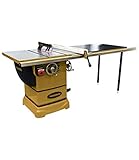
The PM1000 solves a specific and very common problem: you want a cabinet saw, your garage has a 115V circuit and no realistic path to 240V, and the alternative is settling for a contractor or portable saw. This is a genuine cabinet saw — enclosed base, cabinet-mounted trunnions, heavy machined cast iron — that runs on an ordinary 20A household circuit. The build quality is the second reason to want one. After the SawStop, this was the best-finished machine in the test: ground surfaces are flat and smooth, the handwheels move without slop, and the Accu-Fence arrived precise enough that tuning consisted of confirming it rather than correcting it. That saves an afternoon and, more importantly, it means the accuracy you set stays set. The footprint is deliberately compact for a one-car garage, which is where most of these end up. The limitation is physics. A 1.75 HP motor on 115V cannot deliver what 3 HP on 240V does, and in thick dense hardwood — 8/4 hard maple, white oak — you will feel it and need to slow the feed. For sheet goods, softwood, and typical furniture stock it is more than adequate. The pricing is the other consideration: it sits close to 3 HP cabinet saws, so you are paying a real premium for not needing an electrician.
Pros
- Full cabinet saw construction that runs on an ordinary 115V 20A circuit — rare and genuinely useful
- Beautifully machined cast iron surfaces and the best fit and finish in this test after the SawStop
- Accu-Fence system is precise and repeatable with no tuning needed out of the crate
- Quiet, smooth induction motor with excellent power delivery for its rating
- Compact footprint designed for a one-car garage shop rather than a commercial space
Cons
- 1.75 HP on 115V limits ripping in thick dense hardwood compared with a 3 HP 240V machine
- Priced close to a 3 HP cabinet saw, so you pay a premium for the 115V convenience
The Bottom Line
A real cabinet saw for a shop with no 240V service. Superb build quality, with power that matches the circuit rather than the class.

Laguna Fusion F2 Hybrid Saw
Hybrid Cabinet, 1.75 HP, 110V
Dust is the thing small-shop woodworkers underestimate and then live with, and the Fusion F2 takes it more seriously than any other hybrid we have used. The blade is shrouded inside the cabinet and the internal geometry actually directs dust toward the port rather than letting it pile up on the motor, which in a garage shop is the difference between sweeping after every session and not. The built-in mobile base is the other feature aimed squarely at this buyer. A shop that is also a parking space needs machines that roll against a wall, and having that engineered in rather than bolted on means the saw moves easily and then sits solidly when the wheels retract. Cast iron trunnions and table give it the stability of a much larger machine in a footprint that suits a single bay. The fence arrived properly aligned and glides and locks with a precision that matches saws costing more. The constraints are the familiar 110V ones: 1.75 HP is the practical ceiling on a household circuit, and ripping 8/4 hardwood means a slower feed and a sharp blade rather than muscling through. And it costs more than the Grizzly hybrid for broadly similar capability — you are paying for fit, finish, and dust handling, which for a shop inside a house is a reasonable place to spend money.
Pros
- Excellent dust collection for a hybrid, with a shrouded blade and a sensible cabinet design
- Runs on 110V and has a mobile base built in, so it can be moved and stored against a wall
- Cast iron trunnions and table give it cabinet-saw stability in a smaller footprint
- The fence glides and locks precisely and needed no adjustment out of the box in our setup
- Well-made steel and cast iron construction with a clean, considered layout
Cons
- 1.75 HP is the ceiling on 110V and will slow in thick hardwood ripping
- Costs more than the Grizzly hybrid for similar capability, largely on fit and finish
The Bottom Line
The best hybrid for a shop where the saw has to move and dust matters. Buy it for the dust collection and the mobility, not for raw power.
4. Power, Circuits and What You Can Actually Install
The electrical supply in your shop constrains this purchase more than the budget does for a lot of buyers, and it is worth resolving before you start comparing saws.
| Your Circuit | Realistic Saw | What It Rips |
|---|---|---|
| 120V 15A | Jobsite saw, universal motor | Sheet goods, 4/4 stock |
| 120V 20A dedicated | 1.75 HP hybrid or 115V cabinet | Most furniture stock, slower in 8/4 |
| 240V 20-30A | 3 HP cabinet saw | Anything, including 8/4 hard maple |
Adding a 240V circuit to an attached garage typically costs $400 to $900 if the panel has space, which is modest against the price of a cabinet saw and worth doing if you are anywhere near that class of machine. If the panel is full, the 115V cabinet and hybrid saws in this test exist precisely for that situation.
One number to ignore: peak horsepower claims on portable saws. A 15-amp 120V circuit can deliver roughly 1.8 HP at the outlet under any circumstances, so a portable saw advertising 4 HP is quoting a momentary stall figure that has nothing to do with cutting.
5. The Four Things That Decide Cut Quality
The fence. More than any other component, the fence determines the accuracy of your work. It must lock parallel to the blade at every position, return to the same measurement repeatedly, and not deflect when you press stock against it. A great fence on a mediocre saw produces better work than a mediocre fence on a great saw, which is why fence upgrades are the most common modification in woodworking.
Table flatness. Cast iron is flatter than aluminum, holds that flatness, and damps vibration that shows up as chatter on the cut edge. Premium saws are flat within a few thousandths of an inch across the table; budget portables can be ten times that, and it shows in glue-line quality.
Trunnion mounting and mass. Cabinet-mounted trunnions hold blade-to-slot alignment through moves and bumps; table-mounted ones drift. Heavy trunnions also damp vibration. This is the invisible component that separates saws that stay tuned from saws you re-square every few months.
Dust collection. Not a convenience. Fine wood dust is a recognised respiratory hazard, and a saw with an enclosed cabinet, a blade shroud, and a properly sized port captures most of it at the source. An open contractor saw throws dust into the room no matter what you connect to it, and in a shop inside a house that matters a great deal.
6. Blade Brake Technology, Honestly Assessed
The system works by running a small electrical signal through the blade and monitoring it for the change in capacitance that contact with a human body produces. On detection, a spring drives an aluminum block into the teeth and the blade's own momentum drives the assembly below the table. The whole event takes about five milliseconds — a hot dog test leaves a shallow nick, and real-world incident reports consistently describe minor cuts where an unbraked saw would have taken fingers.
The costs are worth stating plainly. A brake activation destroys the cartridge, which is a consumable of roughly $70 to $100, and usually the blade with it, so a genuine save costs a few hundred dollars in parts. Wet or green wood, and metal contact, can also trigger it — there is a bypass mode for deliberately cutting conductive material, and forgetting to use it is how most false activations happen.
It is also worth being clear about what a brake does not do. It offers no protection against kickback, which is the other major table saw injury mechanism and one that puts people in hospital with broken ribs and worse. Kickback is prevented by the riving knife, correct fence alignment, never trapping stock between blade and fence, and standing out of the line of fire. A braked saw used carelessly is still dangerous; it simply removes the worst outcome from one of the two mechanisms.
For a professional shop, insurers increasingly look favourably on braked saws, and in an environment where employees use the machine the case is effectively settled. For a home shop, the fair framing is this: it is the most expensive feature on the saw and the only one you would trade everything else for on the day it matters.
7. Budgeting Beyond the Saw
The saw is the beginning of the spend, not the end of it. A realistic first-year budget includes blades, a dust collector, and at least one accessory that makes the saw safe and accurate to use.
| Item | Typical Cost |
|---|---|
| Quality 40-tooth combination blade | $60-$130 |
| Dado stack (where the saw accepts one) | $120-$350 |
| Dust collector or shop vac with separator | $200-$900 |
| Crosscut sled and push blocks | $40-$200 |
| 240V circuit, if required | $400-$900 |
The blade deserves special emphasis. A good 40-tooth combination blade transforms a mid-range saw, and a dull or cheap blade makes an excellent saw cut badly. If the budget is tight after buying the machine, spend what is left on a blade before anything else — it is the cheapest meaningful upgrade in woodworking. Our shop vacuum guide covers the collection side if a full dust collector is out of scope.
8. Setup and Tuning Determine Everything After
A new saw is close to aligned, not aligned. Spending an afternoon with a dial indicator when the machine arrives is the highest-value time you will ever put into it, because every cut for the next twenty years inherits that setup.
Three alignments matter, in order. First, the blade must be parallel to the miter slots — measure at the front and back of the blade with a dial indicator riding in the slot, and adjust the trunnions until the readings match within a few thousandths. Second, the fence must be parallel to the miter slots, or very slightly open at the rear, never toed in toward the blade, which causes binding and kickback. Third, the blade must be square to the table at the 90-degree stop, checked with a reliable square rather than the saw's own scale.
Ongoing maintenance is light. Wax the cast iron with a paste wax containing no silicone, which cuts feed resistance noticeably and prevents surface rust. Keep the inside of the cabinet clear of packed dust, which affects both the motor's cooling and, on a braked saw, the brake mechanism. Check the alignment once a season or after moving the machine, and replace the blade well before it feels dull — a dull blade increases feed force, burns the cut, and makes kickback more likely.
9. Frequently Asked Questions
What is the best table saw in 2026?
The SawStop PCS 3HP Professional Cabinet Saw is our overall pick — the best-built saw here and the only class of machine whose safety system prevents an amputation rather than reducing its severity. For a garage or site, the SawStop Jobsite Saw Pro brings that technology to a 120V circuit. If the budget will not stretch to a braked saw, the DeWalt DWE7491RS remains the best portable under a thousand dollars.
Is a SawStop worth the extra money?
For anyone using a table saw regularly, yes. The premium is roughly the price of the saw again, and it buys a system that stops and drops the blade within about five milliseconds of skin contact — turning an amputation into a cut needing a plaster. Against the cost of hand surgery and months of recovery, it is not a close financial decision, and it is why many professional shops now require it.
What size table saw do I need?
A 10-inch saw is the right choice for essentially all home and small professional work; 12-inch saws are specialist machines. What matters more is rip capacity — 24 to 30 inches lets you break down sheet goods properly — and motor power matched to your circuit. For furniture work in hardwood, aim for a cabinet or hybrid saw rather than a portable.
Can I run a cabinet saw on a normal outlet?
Some. Most 3 HP cabinet saws require a 240V circuit, but 115V cabinet saws such as the Powermatic PM1000 and 110V hybrids like the Laguna Fusion F2 run on an ordinary 20A household circuit at 1.75 HP. They rip everything except thick dense hardwood comfortably. Adding a 240V circuit typically costs $400 to $900 if your panel has space.
What is a riving knife and do I need one?
A riving knife is a curved steel plate that sits just behind the blade, rises and falls with it, and keeps the saw kerf from closing on the blade. It is the single most effective defence against kickback and it should be fitted for every cut that does not require its removal. Any saw sold new in the US has one; use it rather than leaving it in a drawer.
Hybrid or cabinet saw for a home shop?
A hybrid saw gives you a cast iron table, cabinet-mounted trunnions, and an induction motor for roughly half the price of a cabinet saw, and for most home woodworking that is enough. Step up to a cabinet saw if you rip 8/4 hardwood regularly, want the additional mass and dust collection, and have 240V available. The gap in day-to-day results is smaller than the price gap.
How often should I align my table saw?
Check blade-to-miter-slot alignment when the saw is new, after any move, and once a season thereafter. A saw with cabinet-mounted trunnions holds alignment far better than a contractor saw with table-mounted trunnions, which may need attention every few months. The check takes fifteen minutes with a dial indicator and is the difference between glue-ready cuts and constant sanding.
10. Common Table Saw Buying Mistakes
A table saw is a twenty-year machine, and the errors people make choosing one tend to be errors they live with for the whole time.
Buying the Saw and a Cheap Blade
The blade does the cutting. A good 40-tooth combination blade makes a mid-range saw cut beautifully, and a cheap blade makes a premium saw look mediocre. If the budget is spent after buying the machine, buy the blade before any other accessory — it is the cheapest meaningful upgrade in the shop.
Ignoring the Fence in the Comparison
Fence quality decides accuracy more than any other component, and it is the one most buyers skim over while comparing motor ratings. Check that the fence locks parallel at every position and does not deflect under hand pressure. A saw with a poor fence will frustrate you for as long as you own it.
Removing the Riving Knife and Leaving It Off
It gets taken off for a non-through cut and never goes back, and that is when kickback happens. The riving knife is the most effective anti-kickback device on the machine, it does not interfere with normal cuts, and a saw with quick-release knife mounting has no excuse. Put it back before the next through cut.
Not Tuning a New Saw
Machines ship close to aligned, not aligned. An afternoon with a dial indicator squaring the blade to the miter slots and setting the fence pays back in every cut for the next two decades. Skipping it means chasing inaccuracies you will blame on technique.
Underestimating Dust
Fine wood dust is a recognised respiratory hazard, and a table saw is the largest producer of it in a small shop. Budget for collection at the same time as the saw — an enclosed cabinet with a shroud and a properly sized collector removes most of it at the source, while an open saw and a broom does not.
Related Workshop Guides
The Bottom Line
The best table saw is the SawStop PCS 3HP if you have the space, the circuit, and the budget — it is the best-built machine here and the only one that removes the worst outcome rather than reducing its odds. For a garage shop on a household circuit, the SawStop Jobsite Saw Pro brings the same protection to a saw that rolls into a corner. For the most cabinet saw per dollar, the Grizzly G0899 is hard to argue with, and the DeWalt DWE7491RS is still the portable benchmark under a thousand dollars.
Whichever you buy, do two things on day one: fit a good 40-tooth blade and spend an afternoon aligning the blade and fence to the miter slots. Those two decisions improve every cut you make for the next twenty years.
More in Tools & Equipment
Guides in this category that pair with what you just read.
About the Author
Alex Rivers, Home Improvement Editor
Alex has spent over a decade working on residential and light commercial property maintenance, and now tests every tool, coating and machine that appears in these guides personally.