The 7 Best Wood Routers in 2026
We cut dadoes in plywood, profiled oak edges, template-routed curves and mortised hinges with seven routers. Collet grip, depth adjustment and base concentricity measured on all of them.
Alex Rivers
Home Improvement Editor
Last Updated
October 17, 2026
In This Guide
A router is the most versatile tool in a workshop and the one most likely to ruin a workpiece, because it removes material at enormous speed and it will happily climb out of a cut and take your edge with it. What separates a good router from a poor one is not power but control: how precisely you can set the depth and how firmly the collet holds the bit.
Our Picks at a Glance
The Short Answer
Bosch 1617EVSPK Combo Kit (Best Overall). The router most workshops should own. Two bases, precise depth control, and a collet that does not let go.
- Check Price
- Check Price
- Check Price
- Best for Router Tables Triton TRA001 3.25 HP Plunge Router — 3.25 HP, Plunge, Above Table Adjustment, Soft StartCheck Price
- Check Price
- Check Price
- Check Price
We may earn a commission when you buy through these links, at no extra cost to you. How we test
Best Overall
Bosch 1617EVSPK Combo Kit
1. Fixed Base vs Plunge Base
Routers come in two configurations and the difference is not about power. It is about whether the cutter can be lowered into the work while the tool is running.
Fixed Base Sets Depth Once
The motor is locked at a set height and stays there. You start the cut from an edge and run through. Fixed bases are lower, more stable, easier to control on an edge, and the standard choice for router table mounting.
Plunge Base Lowers Into the Work
Spring loaded columns let you start with the bit above the surface and plunge it down into the middle of a workpiece. This is what makes mortises, stopped dadoes, and inlay recesses possible.
Plunge Bases Sit Higher
The plunge mechanism raises the centre of gravity, which makes the tool slightly more tippy on a narrow edge. For pure edge profiling, a fixed base is more stable and easier to control.
Combo Kits Give You Both
One motor and two bases is the format most workshops should buy. It costs less than two routers, covers every job, and swapping takes under a minute. This is why the Bosch 1617 kit is so widely recommended.
A Compact Router Is the Real Second Purchase
Rather than a second full size router, most people benefit more from a small compact router for edge work and template routing, kept set up while the big one lives in the table.
Router Fundamentals
1/2 in
Shank size for stability, where available
1/8 in
Sensible maximum depth per pass
2.25 HP
Enough power for almost any handheld job
10k rpm
Speed to run large diameter bits at
2. Router Bits and Shank Size
Bits are where routing accuracy and safety are decided, and the choices matter more than the router does.
Half inch shanks are stiffer than quarter inch. A thicker shank deflects less, vibrates less and cuts more cleanly, and it dissipates heat better. Where a bit is available in both, buy the half inch version.
Carbide tipped is the minimum. High speed steel bits dull very quickly in anything harder than pine, and a dull bit burns rather than cuts. Solid carbide is better again for small diameter bits where a brazed tip would be fragile.
Large diameter bits must run slower. The rim speed of a big panel raising bit at full router speed is dangerous and produces a poor cut. Variable speed exists for this, and a router without it should not be used with large bits.
Bearing guided bits follow an edge or template. A bearing riding on the workpiece or a template controls the cut, which is what makes template routing and edge profiling straightforward. Keep bearings clean and check they spin freely.
Seat the bit properly, then back it out slightly. Pushing the shank fully to the bottom of the collet and tightening there can distort the grip. Insert fully, withdraw about a sixteenth of an inch, then tighten firmly.
Clean pitch off bits regularly. Resin build-up increases friction, causes burning, and makes a sharp bit behave like a dull one. Pitch remover and a brass brush restore most bits to nearly new performance.
3. The 7 Best Wood Routers in 2026 — Tested & Ranked
We cut dadoes in plywood, profiled long oak edges, template-routed curves against a pattern, and mortised hinge recesses with every router. We measured collet creep after repeated deep cuts, checked base concentricity to the bit, timed depth adjustments to a target, and weighed the chips each dust port actually captured. These seven earned their place.
At a Glance: How Our Picks Compare
| Product | Type | Rating | Best For |
|---|---|---|---|
| Bosch 1617EVSPK Combo Kit | 2.25 HP, Fixed and Plunge Bases, Variable Speed | 4.7 | Best Overall |
| DEWALT DWP611PK Compact Router | 1.25 HP Compact, Fixed and Plunge Bases, LED Lights | 4.7 | Best Compact |
| Makita RT0701C Compact Router | 1.25 HP Compact, Fixed Base, Variable Speed | 4.6 | Best Value Compact |
| Triton TRA001 3.25 HP Plunge Router | 3.25 HP, Plunge, Above Table Adjustment, Soft Start | 4.6 | Best for Router Tables |
| Porter-Cable 690LR Fixed Base | 1.75 HP, Fixed Base, Single Speed | 4.4 | Best Simple Workhorse |
| Festool OF 1400 EQ | 1400 W Plunge, Dust Extraction, Precision Depth Stop | 4.8 | Best Precision |
| SKIL RT1323 Plunge Router | 14 Amp, Plunge, Variable Speed, Digital Readout | 4.2 | Best Budget |

Best OverallBosch 1617EVSPK Combo Kit
2.25 HP, Fixed and Plunge Bases, Variable Speed
Router bits spin at over twenty thousand revolutions per minute, and a bit that creeps downward in the collet during a cut turns a shallow profile into a gouge with no warning. Collet quality is therefore the single most important safety and accuracy feature, and it is almost never discussed. The Bosch 1617 has one of the best in this class: a self releasing collet with a long grip length that held bits without measurable creep through repeated heavy cuts in our testing, including deep dado work that made two competitors slip. The combo kit is the other reason it dominates recommendations. A fixed base for edge profiling, dadoes and router table use, and a plunge base for mortises, stopped cuts and inlay work, sharing one motor. That covers essentially every routing job a workshop encounters, and buying the two separately costs considerably more. Depth adjustment on both bases is micro-adjustable and repeatable, which is what makes precise work possible. Soft start prevents the tool twisting out of your hands, and speed stays constant under load. The reservations are minor. Base changes take a moment rather than being instant, and using it in a router table properly benefits from an aftermarket lift for above-table adjustment. It is not cheap, though it is excellent value for what is in the box.
Pros
- Both fixed and plunge bases included, covering essentially every router job
- Excellent collet grip that holds bits without creep
- Precise micro-adjustable depth on both bases
- Smooth soft start and constant speed under load
- Enormous accessory ecosystem including router table mounts
Cons
- Above budget pricing, though not for what is included
- Base changes take a moment rather than being instant
- Above-table depth adjustment needs an aftermarket lift for real convenience
The Bottom Line
The router most workshops should own. Two bases, precise depth control, and a collet that does not let go.

Best CompactDEWALT DWP611PK Compact Router
1.25 HP Compact, Fixed and Plunge Bases, LED Lights
The counterintuitive truth about routers is that the small one gets used far more than the big one. Most routing in a workshop is edge profiling, small dadoes, hinge mortises and template work, and for all of those a compact router is easier to control, easier to see past, and less likely to tip off an edge. The DEWALT DWP611 is the best executed compact router available and it has become the default for good reason. The dual LEDs illuminating the bit are genuinely useful rather than decorative, because on edge work the cut is happening in the shadow of the tool. Depth adjustment through a fine ring is precise and repeatable, which is what makes it usable for accurate work rather than just rough shaping. Electronic speed control keeps the bit steady under load, and the whole tool is smooth enough to guide with one hand while the other steadies the workpiece. Both bases are included. The limits are power and collet size. At 1.25 horsepower it will not drive a large panel raising bit or hog out a deep mortise in hardwood, and it takes quarter inch shanks only, which rules out the half inch bits that are stiffer and more accurate. As a second router alongside a full size machine, it is close to essential.
Pros
- Small enough for genuine one handed control on edge work
- Dual LED lights illuminating the bit and the cut
- Very smooth variable speed with electronic feedback
- Precise depth adjustment with a fine ring
- Both fixed and plunge bases included
Cons
- 1.25 HP limits it to smaller bits and lighter cuts
- Quarter inch collet only, so half inch bits are out
- Not suitable as a router table motor for heavy work
The Bottom Line
The router you reach for most. Small, precise, well lit, and controllable in one hand.

Best Value CompactMakita RT0701C Compact Router
1.25 HP Compact, Fixed Base, Variable Speed
Compact routers occupy a competitive part of the market and the differences between the good ones are small. The Makita RT0701C undercuts the DEWALT on price while matching most of what makes that tool good: a smooth low vibration motor, a slim body that is comfortable to grip, and a depth adjustment that holds its setting reliably rather than creeping under vibration. In use the two are difficult to tell apart on results. What it lacks is lighting. Without LEDs, edge work in a garage means positioning a lamp or accepting that you cannot see the bit clearly, and once you have used a lit router the difference is noticeable. The plunge base is a separate purchase, so the kit price advantage narrows if you need one. Like every compact router it takes quarter inch shanks only. The compensation is the accessory ecosystem. This router has become something of a standard for aftermarket bases, offset bases, trim guides and CNC mounts, so it adapts to unusual jobs more readily than most. Build quality is typically Makita, which is to say it runs quietly and keeps running. For a first compact router where budget matters, it is the sensible choice.
Pros
- Excellent value with strong performance for a compact router
- Very smooth running with low vibration
- Slim body that is easy to grip and control
- Wide range of aftermarket bases and accessories available
- Reliable depth adjustment that holds its setting
Cons
- No LED lighting
- Plunge base is a separate purchase
- Quarter inch collet only
The Bottom Line
Most of the DEWALT for less money. No lights, but the same easy one handed control.

Best for Router TablesTriton TRA001 3.25 HP Plunge Router
3.25 HP, Plunge, Above Table Adjustment, Soft Start
Mounting a router under a table is the most common upgrade a woodworker makes, and it immediately creates a problem: adjusting the bit height means reaching underneath, which is awkward and imprecise. The usual solution is a router lift, a precision mechanism costing as much as the router itself. Triton designed the TRA001 to avoid needing one, with a height adjustment that engages through the base plate from above the table using a supplied winder. That single feature accounts for most of why this router is so widely used. Power backs it up. At 3.25 horsepower it drives large panel raising bits and deep profiles without slowing, which is exactly what a table router is asked to do. Soft start prevents the whole table jumping on power up, the spindle lock is integrated so bit changes take one wrench, and both collet sizes are included. As a handheld tool it is much less appealing. It is heavy, bulky and top heavy, which makes edge work tiring and balance on a narrow edge precarious. It is loud even by the standards of a category that is not quiet. Bought as a dedicated table motor, which is how most owners use it, it represents outstanding value.
Pros
- Above table height adjustment through the base plate, no lift required
- Very powerful 3.25 HP motor that handles large panel raising bits
- Integrated spindle lock and automatic plunge lock release
- Half inch and quarter inch collets included
- Excellent value given the power and table features
Cons
- Very heavy and unwieldy for handheld use
- Bulky, taking up significant space
- Loud even by router standards
The Bottom Line
Built for a router table. Above-table adjustment saves buying a lift, which is most of the price difference.

Best Simple WorkhorsePorter-Cable 690LR Fixed Base
1.75 HP, Fixed Base, Single Speed
Some tools remain in production for decades because there is nothing wrong with them, and the Porter-Cable 690 is one. It is a straightforward fixed base router with a durable motor, a robust base, and very little to go wrong, and its base diameter became a de facto standard which means an enormous range of jigs, bases, guides and table plates fit it directly. For anyone building jigs or using older accessories, that compatibility has real value. Power at 1.75 horsepower is adequate for most handheld work including reasonably deep dadoes and moderate profiles. The build is tough and it is easy to service, with parts widely available. It is priced sensibly for what it is. Where it shows its age is control. There is no variable speed, which is a genuine limitation because large diameter bits must be run slower than small ones for both safety and cut quality, and this router runs everything at full speed. There is no soft start either, so it twists in your hands on power up in a way modern routers do not. Depth adjustment is coarser than current designs and requires more fiddling to set precisely. As a second router, a dedicated jig motor, or a first router on a budget, it still makes sense.
Pros
- Very well proven design with decades of field history
- Simple, durable and easy to service
- Standard base diameter fitting an enormous range of accessories
- Good power for a mid size router
- Sensible price
Cons
- Single speed, so large diameter bits run too fast
- No soft start, so it twists noticeably on power up
- Depth adjustment is coarser than modern routers
The Bottom Line
The old reliable. Simple, tough and cheap, and the standard base fits everything ever made.
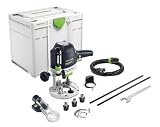
Best PrecisionFestool OF 1400 EQ
1400 W Plunge, Dust Extraction, Precision Depth Stop
Routing generates more debris per minute than almost any other woodworking operation, and most of it goes into the air and across the workshop. Every router has a dust port and most of them are close to ornamental. The Festool OF 1400 is the exception, with a shroud and extraction path designed properly around the cutter, and with a matching extractor connected it captures the overwhelming majority of chips at the source. Working without a snowstorm of shavings across the workpiece also means you can see the line, which improves accuracy directly. Precision is the other half of the argument. Depth adjustment uses a fine scale with a multi-stage turret stop that allows a deep cut to be taken in preset increments, returning exactly to the same settings each time. The plunge action is smooth with almost no stiction, so lowering the cutter is controlled rather than a sudden drop. Guide rail and accessory changes are tool free. The objection is money. This router is expensive and the accessories that make it shine are expensive too, so the real cost of the system is considerably above the tool price. For a professional or a serious hobbyist working in a shared space where dust matters, it is defensible.
Pros
- The best dust extraction of any router by a wide margin
- Extremely precise depth adjustment with a fine scale and multi-stage stop
- Tool free guide rail and accessory changes
- Very smooth plunge action with almost no stiction
- Superb build quality and long parts availability
Cons
- Extremely expensive
- Dust extraction performance requires a matching extractor
- Accessory ecosystem is expensive to buy into
The Bottom Line
The precision and dust benchmark. Routing produces enormous amounts of chips, and this is the only one that catches them.
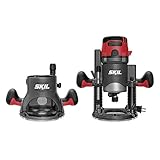
Best BudgetSKIL RT1323 Plunge Router
14 Amp, Plunge, Variable Speed, Digital Readout
Full size plunge routers are expensive, and for someone doing occasional mortising or template work the cost is difficult to justify. The SKIL RT1323 brings the format down to a price that makes sense for occasional use, and it includes a digital depth readout which is genuinely helpful for anyone who has not yet developed a feel for setting depth by eye and scale. Variable speed covers the useful range, both collets are included, and soft start reduces the startup twist that catches people out. Where the price shows is in refinement. The plunge action is stiffer than premium routers, with enough stiction that lowering the cutter smoothly takes deliberate effort, and that affects the quality of a plunge cut directly. Vibration is higher and the tool is less pleasant over a long session. Most importantly, the collet grip is adequate rather than excellent, which makes the routine of checking the bit is fully seated and firmly tightened more important here than on better routers. A bit that creeps at twenty thousand rpm is the failure mode that matters. Used within its limits, with attention to the collet, it does the job for a fraction of the money.
Pros
- Low price for a full size plunge router
- Digital depth readout that makes accurate setting easier for beginners
- Variable speed across a useful range
- Soft start reduces the startup twist
- Both collet sizes included
Cons
- Plunge action is stiffer and less smooth than premium routers
- Collet grip is adequate rather than excellent
- Build quality is basic and vibration is higher
The Bottom Line
A full size plunge router with a depth readout for very little money. Check the bit is tight, every time.
4. Routing Without Ruining the Workpiece
A router removes material fast enough that a mistake is instantaneous, and the technique that prevents it is a short list.
Feed against the rotation. The bit spins clockwise viewed from above, so on an outside edge you move the router left to right. Going the other way is a climb cut, where the bit pulls the router along and control is lost.
Take shallow passes. An eighth of an inch per pass is a sensible maximum in hardwood. Trying to remove a deep profile in one pass overloads the bit, burns the wood, and is how routers grab and kick.
Keep both hands on the router and the work clamped. Holding a workpiece with one hand while routing with the other is how people get hurt. Clamps, a bench stop, or a non-slip mat free both hands for the tool.
Let the bit reach full speed before contact. Starting a router with the bit touching the wood makes it grab and jump. Start clear, let it spin up, then move into the cut.
Rout end grain first on a four sided profile. End grain blows out at the exit corner. Doing the ends first means the subsequent long grain passes remove that tear-out, leaving clean corners.
Check the bit is tight before every session. A bit creeping down in the collet during a cut is the failure that ruins workpieces and injures people. Two seconds with the wrench each time is the whole precaution.
Left to Right on an Outside Edge
The bit turns clockwise seen from above, so feeding the router left to right along an outside edge makes the cutter push back against your feed direction, which is controllable. Reverse that and the bit grabs and runs, dragging the router along the edge faster than you can stop it. Inside a frame or an opening, the direction reverses.
5. What a Router Actually Does
The router is the most versatile tool in a workshop, and the breadth is worth spelling out because most owners use a fraction of it.
Edge profiling. Roundovers, chamfers, coves and ogees on the edge of a board, using a bearing guided bit that follows the edge. This is what most people buy a router for and it is the easiest job it does.
Dadoes, grooves and rabbets. Slots for shelves, grooves for panels and rabbets for backs, cut with a straight bit against a guide. This is the joinery half of the tool and it is where a router replaces a table saw for many people.
Template routing. A bearing bit following a template reproduces any shape exactly, as many times as needed. This is how identical curved parts get made without a bandsaw and hours of sanding.
Mortises and hinge recesses. A plunge router with a guide bush cuts flat bottomed recesses precisely, which is far faster and more accurate than chiselling hinge mortises by hand.
Flattening slabs and levelling. With a sled and a wide bit, a router flattens a slab too wide for any planer. It is slow and it works, and it is the standard method for live edge work.
Inlay, lettering and decorative work. With the right bits and jigs a router cuts inlay recesses, engraves lettering and produces decorative details that would otherwise require hand tools and considerably more skill.
6. Jigs, Guides and Router Tables
A router freehand is a shaping tool. A router referenced against something is a precision machine, and the difference is entirely in the guide you give it.
Bearing guided bits are the simplest reference. A bearing above or below the cutter rides on the workpiece edge or a template, so the cut follows that surface exactly. Most edge profiling and all template routing works this way and needs no setup at all.
An edge guide handles cuts parallel to an edge. A fence attached to the base rides along the workpiece edge, keeping a groove or rabbet a set distance in. It is the accessory most routers include and the one most owners never fit.
A clamped straightedge is often better than any accessory. Running the router base against a batten clamped to the work gives a dead straight cut anywhere on a panel, and it costs nothing. Allow for the offset between the bit and the edge of the base.
Guide bushes let a plunge router follow a template. A collar around the bit rides inside a template opening, which is how hinge jigs, letter templates and dovetail jigs work. Remember the bush is larger than the bit, so the template must be undersized accordingly.
A router table inverts everything. With the router under a table and the bit projecting up through it, you move the work instead of the tool. Small parts, repeated profiles and anything needing a fence become far easier and considerably safer.
Fence quality decides a router table. A flat fence that adjusts squarely and locks without shifting matters more than the table surface or the router underneath it. A poor fence makes an expensive table useless for accurate work.
7. Router Safety and Dust
Routers are among the more dangerous workshop tools because the cutter is exposed, fast, and capable of grabbing.
Eye protection is not optional. Routers throw chips at high speed directly toward the operator, and a carbide fragment from a chipped bit travels further and harder. Safety glasses every time, without exception.
Hearing protection matters more than people think. Routers run at very high speed and are among the loudest tools in a workshop. Cumulative exposure over years is what causes damage, not any single session.
Router dust is fine and abundant. The cutting action produces a large volume of fine particulate, and hardwood dust is classified as a carcinogen in several jurisdictions. Dust extraction plus a rated respirator is the correct approach.
Never adjust anything with the router plugged in. Changing a bit, adjusting depth, or clearing a jam with power connected is how serious injuries happen. Unplug, then work on it.
Watch for the router tipping on a narrow edge. Profiling a thin edge leaves most of the base unsupported, and a tip mid-cut gouges the workpiece and can lose control. An offset base or a wider support surface prevents it.
Support the router fully before switching it off. A bit continues spinning for several seconds after the trigger is released, and setting a router down on a bench with the cutter still turning marks the bench, damages the bit, and can walk the tool off the edge. Hold it clear until it stops completely.
Keep loose clothing and sleeves clear. A spinning bit catches fabric instantly. Long sleeves, cuffs and anything hanging should be secured before the tool is switched on.
Before You Buy
Also Needed for This Job
8. Frequently Asked Questions
What is the best wood router?
Bosch 1617EVSPK for most workshops, because the combo kit includes both fixed and plunge bases and its collet grips bits without creep. DEWALT DWP611PK is the best compact router and the one you will reach for most, and Triton TRA001 is the pick for a router table.
Should I buy a fixed base or plunge router?
Both, ideally as a combo kit sharing one motor. Fixed bases are lower, more stable and better for edge work and router tables. Plunge bases let you lower the bit into the middle of a workpiece, which is what mortises, stopped dadoes and inlay recesses require.
What size router bit shank should I use?
Half inch wherever the bit is available in both. A thicker shank deflects less, vibrates less, dissipates heat better and cuts more cleanly. Quarter inch is fine for small bits and is all that compact routers accept, which is a real limitation of that format.
Which direction should I feed a router?
Against the bit rotation. The cutter turns clockwise viewed from above, so on an outside edge you move left to right. Feeding the other way is a climb cut, where the bit pulls the router along the edge faster than you can control it.
How deep can I rout in one pass?
About an eighth of an inch in hardwood is a sensible maximum, and less for large diameter bits. Removing a deep profile in one pass overloads the cutter, burns the wood, and is the main cause of a router grabbing and kicking out of the cut.
Why is my router burning the wood?
Usually feeding too slowly, taking too deep a pass, or using a dull or pitch-covered bit. Cherry and maple burn particularly easily. Clean the bit, take shallower passes, and keep the router moving steadily rather than pausing anywhere along the cut.
9. Common Router Mistakes
Router mistakes are fast and expensive, and nearly all of them come from the same handful of habits.
Routing in the Wrong Direction
Feeding with the bit rotation instead of against it produces a climb cut, where the cutter grabs the wood and pulls the router along the edge faster than you can stop it. On an outside edge, move left to right; inside an opening, the direction reverses. Getting this wrong is the classic router accident.
Taking Too Much in One Pass
Trying to cut a deep profile in a single pass overloads the bit, burns the wood, strains the motor and is the main cause of a router kicking out of the cut. An eighth of an inch per pass in hardwood is sensible, and less for large diameter bits.
Not Checking the Collet
A bit creeping downward in the collet during a cut turns a shallow profile into a gouge instantly, and at twenty thousand rpm there is no warning. Seat the shank fully, withdraw it a fraction, tighten firmly, and check it before every session.
Holding the Workpiece by Hand
Routing with one hand while holding the work with the other means neither the tool nor the workpiece is properly controlled, and a router that grabs will move both. Clamps, bench dogs or a non-slip mat cost almost nothing and free both hands for the tool.
Related Tool Guides
The Bottom Line
The best wood router for most workshops is the Bosch 1617EVSPK combo kit — two bases, precise depth control and a collet that holds. Add a DEWALT DWP611PK compact for edge work, and a Triton TRA001 if you are building a table.
Feed against the rotation, take an eighth of an inch at a time, clamp the work, and check the bit is tight before every single session.
More in Tools & Equipment
Guides in this category that pair with what you just read.
About the Author
Alex Rivers, Home Improvement Editor
Alex has spent over a decade working on residential and light commercial property maintenance, and now tests every tool, coating and machine that appears in these guides personally.