The 7 Best Jigsaws in 2026
We cut tight curves in plywood, long straight lines in oak, and scrolled 3mm ply until the blades wandered. Blade deflection, base flatness and orbital action measured on every saw.
Alex Rivers
Home Improvement Editor
Last Updated
October 17, 2026
In This Guide
A jigsaw is the tool people buy first and complain about longest, because a cheap one cuts curves acceptably and cuts anything straight or square very badly. The difference is almost entirely blade support: how well the saw stops a thin reciprocating blade from wandering off vertical under load.
Our Picks at a Glance
The Short Answer
Bosch JS572EBK Barrel Grip (Best Overall). The most accurate jigsaw we tested. If square edges matter, blade guidance is everything and this has the best.
- Check Price
- Check Price
- Check Price
- Check Price
- Best Precision Festool Carvex PS 420 EBQ — Corded, Top Handle, Stroboscopic Light, Interchangeable BasesCheck Price
- Check Price
- Best for Job Site Use Milwaukee M18 FUEL D-Handle 2737 — Cordless, 18V Brushless, D Handle, Heavy DutyCheck Price
We may earn a commission when you buy through these links, at no extra cost to you. How we test
Best Overall
Bosch JS572EBK Barrel Grip
1. Why Cheap Jigsaws Cut Crooked
Every complaint about jigsaws — bevelled edges, wandering cuts, blades that will not follow a line — comes back to one mechanical problem.
The Blade Is Supported at One End Only
A jigsaw blade is clamped at the top and free at the bottom, and it is being pushed forward through material that resists. That resistance bends the blade backwards and, on a curve, sideways.
Bending Produces a Bevelled Cut
When the blade bows, it is no longer perpendicular to the surface, so the cut face comes out at an angle. On thin sheet material the effect is negligible. In 40mm hardwood a poorly guided saw can be several degrees out.
Guidance Systems Resist the Bending
Better saws add rollers and guide blocks that grip the blade close to the workpiece, restraining it laterally and fore and aft. That is the mechanical difference between a cheap jigsaw and an expensive one, and it is not visible in a specification list.
Blade Thickness and Width Matter Too
A thicker, wider blade resists bending better than a thin scrolling blade, which is why straight cuts want a wide blade and tight curves want a narrow one. Trying to make a wide blade turn tightly forces it sideways and produces exactly the wandering people blame on the saw.
Speed and Feed Rate Matter Most of All
Pushing hard bends the blade more than any other single factor. Letting the saw cut at its own pace, with the base held flat, produces a squarer cut on a cheap saw than forcing a good one.
Jigsaw Fundamentals
T-shank
The blade fitting to standard on
4
Orbital settings worth having
0
Orbit for metal and clean finish cuts
45°
Standard maximum bevel both ways
2. What Orbital Action Actually Does
Every jigsaw above the very cheapest has an orbital setting, and most people leave it wherever it came set, which wastes the feature entirely.
Orbital action swings the blade forward on the up stroke. Rather than moving purely up and down, the blade also moves into the cut as it rises, taking a bigger bite. This cuts dramatically faster and considerably more roughly.
Zero orbit gives the cleanest cut. A purely reciprocating blade cuts slowly and leaves the smoothest edge with the least splintering. This is the setting for finish cuts, thin veneered material, and anything where the edge will be visible.
Metal must be cut at zero orbit. Orbital action on metal snatches, breaks teeth, and can bend the blade. Metal cutting wants no orbit, a slow speed, and a fine tooth blade with cutting fluid.
Maximum orbit is for rough fast cuts in softwood. Framing, demolition, and cutting an opening that will be covered. The edge will be ragged and it does not matter.
Tight curves want low or zero orbit. Orbital action pushes the blade forward, which fights against turning. Reducing the orbit lets the blade follow a curve without being forced sideways.
Set it for every cut, not once. Thirty seconds spent matching the orbit setting to the material and the cut you are making does more for the result than the difference between two saws.
3. The 7 Best Jigsaws in 2026 — Tested & Ranked
We cut identical tight curves in 18mm plywood, long straight lines in 40mm oak with the cut face measured for squareness with a machinist square, and scrolled patterns in 3mm ply to find where each saw's blade began to wander. We measured vibration at the grip, timed blade changes, and checked base flatness on a surface plate. These seven earned their place.
At a Glance: How Our Picks Compare
| Product | Type | Rating | Best For |
|---|---|---|---|
| Bosch JS572EBK Barrel Grip | Corded, 7.2 Amp, Barrel Grip, Precision Control | 4.7 | Best Overall |
| Makita 4350FCT | Corded, 6.3 Amp, Top Handle, LED Light | 4.6 | Best Top Handle |
| DEWALT DCS334 XR Brushless | Cordless, 20V, Barrel Grip, Brushless | 4.6 | Best Cordless |
| Bosch JS470E | Corded, 7 Amp, Top Handle, Four Orbital Settings | 4.5 | Best Value |
| Festool Carvex PS 420 EBQ | Corded, Top Handle, Stroboscopic Light, Interchangeable Bases | 4.8 | Best Precision |
| SKIL 4495 Jigsaw | Corded, 6 Amp, Top Handle, Laser Guide | 4.1 | Best Budget |
| Milwaukee M18 FUEL D-Handle 2737 | Cordless, 18V Brushless, D Handle, Heavy Duty | 4.6 | Best for Job Site Use |

Best OverallBosch JS572EBK Barrel Grip
Corded, 7.2 Amp, Barrel Grip, Precision Control
A jigsaw blade is a thin strip of steel supported at one end and pushed through material, which means it wants to bend. When it bends, the cut is no longer square to the surface, and the edge you get is bevelled in a way that only becomes obvious when you try to join it to something. Every quality difference in this category traces back to how well the saw resists that. The Bosch JS572 has the best blade guidance here, with a roller and guide arrangement that holds the blade genuinely vertical, and in our test cutting 40mm oak the resulting edge was measurably squarer than any competitor. The barrel grip design contributes to this. Rather than gripping a handle above the saw, your hand wraps the body low down, close to the base and the work, which gives finer control over the line and makes it easier to feel when the blade is loading. It is a preference rather than an objective advantage, and people used to a top handle often need a week to adapt. Vibration is low, the stroke is smooth, and the dust blower keeps the pencil line visible without needing to stop and clear. The reservations are price and the grip style itself. There is no work light, which at this price is a small omission.
Pros
- Exceptional blade guidance keeping cuts genuinely square through thick stock
- Barrel grip puts your hand low and close to the work for better control
- Very low vibration and a smooth stroke
- Tool free bevel adjustment with positive detents
- Excellent dust blower keeping the cut line visible
Cons
- Barrel grip is a matter of preference and some people dislike it
- Expensive for a jigsaw
- No LED work light
The Bottom Line
The most accurate jigsaw we tested. If square edges matter, blade guidance is everything and this has the best.

Best Top HandleMakita 4350FCT
Corded, 6.3 Amp, Top Handle, LED Light
Top handle jigsaws are what most people picture and what most people find comfortable, with the grip above the motor and the trigger under your fingers. The Makita 4350FCT is the best executed version of that format, and it matches the barrel grip machines on the thing that matters most: blade guidance. In our 40mm oak test the cut face came out very close to square, with only a slight deviation over the full depth, which puts it in a different class from mainstream jigsaws that bevel noticeably. The LED work light is more useful than it sounds. Following a pencil line on dark plywood in a garage is genuinely difficult, and a light aimed at the blade removes the squinting entirely. Combined with an effective dust blower, the line stays visible throughout the cut. Blade changes are tool free with a positive lock, and the supplied anti splinter insert and base cover deal with the two most common surface damage complaints. It is expensive, and the top handle format, while comfortable, gives slightly less fine control than a barrel grip for detailed scrollwork because your hand is further from the blade. The dust port fits some vacuum hoses awkwardly and may need an adapter.
Pros
- Excellent blade guidance producing square cuts in thick material
- Built in LED work light that genuinely helps on a dark line
- Very smooth running with low vibration
- Tool free blade change with a positive lock
- Anti splinter insert and base cover included
Cons
- Expensive
- Top handle is less precise than a barrel grip for fine work
- Dust extraction port needs an adapter for some vacuums
The Bottom Line
The top handle equivalent of the Bosch. Square cuts, a real work light, and Makita smoothness.

Best CordlessDEWALT DCS334 XR Brushless
Cordless, 20V, Barrel Grip, Brushless
A trailing cord is a particular nuisance on a jigsaw because the tool is constantly being steered along a curve, and a cord that snags mid-cut pulls the saw off the line at the exact moment precision matters. Cordless jigsaws were unsatisfying for years because brushed motors lost speed under load and produced ragged cuts. The DEWALT DCS334 uses a brushless motor that holds speed properly, and in our testing the cut quality in both plywood and oak was indistinguishable from corded machines. The barrel grip format works well here, and DEWALT have balanced the tool so the battery does not make it feel back-heavy in normal use. Blade changes are keyless, the shoe bevels without tools, and the variable speed trigger has enough resolution at the bottom end for delicate starts on thin material. For anyone already using the platform, the incremental cost is modest. The compromises are weight and runtime. A battery on a jigsaw is felt during long vertical cuts or overhead work, where the mass is working against you. Runtime on a compact battery is limited if you are cutting thick stock continuously, so a larger pack matters. As a complete purchase it is expensive.
Pros
- Brushless motor delivering genuinely corded level performance
- Barrel grip with excellent balance despite the battery
- Keyless blade change and tool free shoe bevel
- Variable speed trigger with good low speed control
- Part of a very widely owned battery platform
Cons
- Battery weight is noticeable during long overhead or vertical cuts
- Expensive, particularly bare tool plus battery
- Runtime on a compact battery is limited for heavy cutting
The Bottom Line
Cordless without compromise. The cord on a jigsaw catches on everything, and losing it changes how the tool feels.

Best ValueBosch JS470E
Corded, 7 Amp, Top Handle, Four Orbital Settings
The gap between a twenty pound jigsaw and a two hundred pound one is real, and most of it is realised in the first upgrade. The Bosch JS470E sits exactly at that point: blade guidance clearly better than budget machines, a smooth low vibration stroke, and four orbital settings that let it be configured properly for the material. In our oak test the cut squareness was well ahead of the budget saws and modestly behind the premium ones, which is precisely the value proposition. Four orbital settings matter more than they appear. Off for metal and delicate work, low for hardwood and cleaner finishes, and higher settings for fast rough cutting in softwood. A saw with only on and off forces a compromise on every material. Blade change and bevel adjustment are both tool free and work reliably. What you give up is polish. There is no work light, so a dark cut line means positioning a lamp. The dust blower clears the line less effectively than the premium saws. And the base is stamped steel rather than cast aluminium, which flexes slightly under firm hand pressure and can allow the shoe to lift on a curve. None of that undermines the fundamentals, which is why this is the sensible recommendation for most workshops.
Pros
- Very good blade guidance for the price, clearly above budget saws
- Four orbital settings covering everything from metal to fast wood cutting
- Smooth running with well controlled vibration
- Tool free blade change and bevel adjustment
- Widely available and well supported
Cons
- No work light
- Dust blower is less effective than premium models
- Base is stamped steel rather than cast, so it can flex under pressure
The Bottom Line
The best jigsaw most people should buy. Real blade guidance at a price that does not require justification.

Best PrecisionFestool Carvex PS 420 EBQ
Corded, Top Handle, Stroboscopic Light, Interchangeable Bases
Following a line with a jigsaw is difficult partly because the blade is a blur and you are inferring where it is cutting rather than seeing it. Festool solve this with a stroboscopic light synchronised to the blade stroke, which makes the blade appear stationary and shows exactly where the teeth are relative to your line. It sounds like a novelty and it is the single most useful feature on any jigsaw we have used, particularly on curves where small corrections matter. Blade guidance is the other half. A triple guide arrangement holds the blade vertical better than anything else here, and on our 40mm oak test the cut face was effectively square across the full depth. Interchangeable base plates let you fit a hard base for rough work, a smooth base for delicate surfaces, or a base with a different opening for particular blades. Dust extraction with a compatible extractor is close to complete. The objection is simply cost. This is priced far beyond what most people would consider spending on a jigsaw, and the accessory ecosystem adds more. The guide system also benefits from occasional adjustment to maintain its accuracy. For a professional doing precise work daily, it earns its place; for anyone else it is hard to justify.
Pros
- Stroboscopic light appears to freeze the blade, making line following remarkably easy
- Interchangeable base plates for different materials and surfaces
- Exceptional blade guidance with a triple guide arrangement
- Outstanding dust extraction with a compatible extractor
- Superb build quality and long term parts support
Cons
- Extraordinarily expensive for a jigsaw
- Blade guidance system requires occasional adjustment to stay perfect
- Ecosystem accessories add considerably to the cost
The Bottom Line
The most precise jigsaw available and priced accordingly. The stroboscopic light alone changes how you cut.
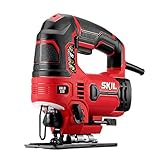
Best BudgetSKIL 4495 Jigsaw
Corded, 6 Amp, Top Handle, Laser Guide
For cutting a curve in half inch plywood, trimming a shelf to shape, or making a rough opening for a sink, a cheap jigsaw does the job and there is no need to spend more. The SKIL 4495 covers that use case competently: it takes standard T-shank blades, changes them without tools, and cuts through sheet material at a reasonable pace. The laser guide is aimed at beginners following a straight line and it does help, though it is no substitute for a straightedge. Where the price shows is in blade deflection. In our 40mm oak test the cut face was visibly bevelled, out of square by enough that the edge could not be used as a joint face. That is the defining limitation of budget jigsaws and it is not a fault so much as a consequence of minimal blade guidance. In thin sheet material it barely shows; in anything thick it is unavoidable. Vibration is higher than better saws, which is tiring on long cuts and makes precise line following harder. The stamped base flexes under hand pressure and the bevel adjustment is imprecise enough that setting an accurate 45 degrees is a matter of trial and measurement. Bought for rough work, it is fine value.
Pros
- Very low price for a functional jigsaw
- Adequate for curves in plywood and rough cutting
- Tool free blade change
- Laser guide helps beginners follow a straight line
- Widely available
Cons
- Noticeable blade deflection producing bevelled cuts in thick material
- Higher vibration than better saws
- Stamped base flexes and the shoe adjustment is imprecise
The Bottom Line
Cuts curves in plywood for very little money. Do not expect a square edge in anything thick.
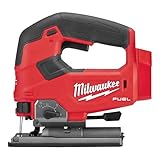
Best for Job Site UseMilwaukee M18 FUEL D-Handle 2737
Cordless, 18V Brushless, D Handle, Heavy Duty
Job site jigsaw work is different from workshop jigsaw work. Cuts are often in thick or awkward material, the saw gets dropped, and there is rarely time to be delicate about it. The Milwaukee M18 FUEL D-handle is built for that context, with a motor that simply does not slow in dense material and a housing that tolerates being thrown into a bag. In our thick stock testing it maintained stroke speed where several saws laboured, which produces a cleaner cut as well as a faster one. The blade clamp deserves specific mention. Under heavy load a poor clamp lets the blade shift or, worse, release, and this one holds firmly through the kind of cutting that makes cheaper clamps slip. The LED light and dust blower keep the line visible, and the balance is good enough that the battery does not dominate the feel. The costs are weight and precision. It is heavy, particularly with a high capacity battery, which tells during long or overhead work. The D-handle format is comfortable and controllable but places your hand further from the blade than a barrel grip, so for fine scrollwork the barrel grip machines are easier to steer. As a complete kit it is expensive.
Pros
- Very strong motor that does not slow in thick or dense material
- Robust construction built for job site handling
- Excellent blade clamp that holds under heavy load
- Good balance despite the battery
- Bright LED light and effective dust blower
Cons
- Heavy, particularly with a large battery fitted
- Expensive as a complete kit
- D handle format is less precise than barrel grip for fine curves
The Bottom Line
The one built for abuse. Powerful, rigid, and it holds a blade properly when you lean into a thick cut.
4. Choosing the Right Blade
Blade choice affects cut quality more than the saw does, and it is where most people never look.
T-shank is the standard. Almost every modern saw takes T-shank blades, which lock positively in tool free clamps. U-shank exists on older saws and the blade selection is far narrower. Buy a T-shank saw.
Tooth count controls speed against smoothness. Fewer, larger teeth cut fast and rough. More, finer teeth cut slowly and cleanly. Match this to the job rather than using one blade for everything.
Down-cut blades stop splintering on the top face. Standard blades cut on the upstroke, which tears the surface facing you. A reverse tooth blade cuts downward, giving a clean top face, which matters on laminate and veneered sheet.
Match at least three teeth to the material thickness. Fewer than three teeth in contact means the blade catches rather than cuts, which is how blades snap and thin metal gets destroyed. Thin material needs fine teeth for this reason.
Narrow blades for tight curves, wide for straight. A scrolling blade turns tightly and deflects easily. A wide blade holds a straight line and cannot turn. Using one for the other job is the most common blade mistake.
Bimetal blades last far longer. Carbon steel blades are cheap and dull quickly. Bimetal construction costs more per blade and considerably less per cut, particularly in hardwood and anything containing fasteners.
Turn the Good Face Down
Standard jigsaw blades cut on the upstroke, so the tearing happens on the surface facing up at you. On veneered plywood, laminate, or anything with a good side, cut with the good face down and the damage happens where it will not be seen. A down-cut blade solves it the other way, at the cost of a rougher underside.
5. Cutting Accurately
The technique that produces square, accurate cuts is not obvious and is mostly about restraint.
Let the saw set the pace. Pushing forward bends the blade, which bevels the cut. Guide the saw along the line and apply only enough forward pressure to keep it cutting. A saw that is labouring needs a coarser blade or more orbit, not more force.
Keep the base flat and firm on the work. The base is the reference surface, and any rocking transfers directly to the cut. Firm downward pressure on the base rather than forward pressure on the handle is the correct hand position.
Start the saw before the blade touches. Bringing a stationary blade into contact and then starting it snatches and can chip the material. Get it up to speed first, then advance into the cut.
Cut outside the line and sand back. Even a good jigsaw is not a precision instrument. Cutting a millimetre proud and finishing to the line with a sander or file gives a far better result than trying to split the line with the saw.
Use a straightedge clamped to the work for straight cuts. Running the base against a clamped batten produces a straighter cut than following a pencil line ever will, and it also stops the saw drifting under load.
Support the offcut. An unsupported offcut sags as the cut nears completion, pinching the blade and splintering the last few inches. Clamping or supporting both sides is a thirty second job that saves the end of every cut.
6. Features Worth Paying For
Jigsaw specification sheets list a great deal that makes no difference and omit the things that do. These are the features that change the tool in use.
Barrel grip versus top handle is a real choice. A barrel grip puts your hand low and close to the base, which gives finer control on curves. A top handle is more familiar and more comfortable for long cuts. Neither is better; try both if you can.
Tool free blade change is now standard and should be. A lever that ejects the blade without a hex key removes the friction that stops people changing blades as often as they should. Check it also grips positively, because a slipping clamp under load is dangerous.
A work light matters more than it sounds. Following a pencil line on dark plywood in a garage is genuinely hard, and an LED aimed at the blade removes the squinting. Combined with a dust blower it keeps the line visible throughout the cut.
Base quality decides the reference surface. A cast aluminium base stays flat under hand pressure; a stamped steel one flexes. Since the base is what everything is measured from, that flex translates directly into an inaccurate cut.
Bevel adjustment should have positive detents. A shoe that clicks into zero and 45 degrees can be reset accurately in seconds. One that slides freely against a printed scale needs measuring every time, and gets left at whatever it was.
Dust extraction is worth the port. Sawdust obscures the line and jigsaws produce it right where you are looking. A vacuum connection is more effective than any blower, and on a saw with a good shroud it keeps the cut visible throughout.
7. What a Jigsaw Is and Is Not For
A jigsaw is genuinely versatile and it is the wrong tool for several jobs people habitually use it for.
Curves are its purpose. Nothing else in a home workshop cuts an arbitrary curve in sheet material as easily. Cutting a sink opening, a shaped shelf, or a template is exactly what it exists for.
Plunge cuts are its second talent. Starting a cut in the middle of a panel, by tipping the saw on the front of its base and lowering the running blade into the material, opens up a whole category of work. Drilling a starter hole is the safer alternative.
A circular saw is better for straight cuts. Straighter, faster, squarer and cleaner in sheet material. If the cut is straight and long, reach for the circular saw with a guide rather than fighting a jigsaw along a line.
A track saw or table saw is better for sheet goods. Breaking down full sheets of plywood with a jigsaw is slow and produces edges that need work. A track saw does it in one pass with a finished edge.
A bandsaw is better for repeated curves. If you cut curves regularly, a bandsaw is faster, more accurate, and leaves a far cleaner edge. The jigsaw's advantage is that it goes to the work rather than the work coming to it.
It cuts metal, tile and plastic with the right blade. With a fine bimetal blade at zero orbit and low speed it handles sheet metal and pipe. Carbide grit blades cut tile and cement board. This versatility is a genuine reason to own one.
Before You Buy
Also Needed for This Job
8. Frequently Asked Questions
What is the best jigsaw?
Bosch JS572EBK for accuracy, because its blade guidance keeps cuts genuinely square in thick material where cheaper saws bevel noticeably. Makita 4350FCT is the top handle equivalent, and Bosch JS470E is the best value for most workshops.
Why does my jigsaw cut at an angle?
Because the blade is bending. It is supported only at the top, so forward pressure bows it and the cut face comes out bevelled. Push less, let the saw cut at its own pace, use a wider blade for straight cuts, and check the shoe is actually set at zero degrees.
What does orbital action do on a jigsaw?
It swings the blade forward on the upstroke so it takes a bigger bite, which cuts much faster and considerably more roughly. Use zero orbit for clean finish cuts, thin material and all metal cutting, and higher settings for fast rough cuts in softwood.
What jigsaw blade should I use?
Wide blades with coarse teeth for fast straight cuts in wood, narrow blades for tight curves, and fine bimetal blades at zero orbit for metal. Use a down-cut blade when the top face must stay splinter free, and always keep at least three teeth in contact with the material.
Can a jigsaw cut a straight line?
It can, but a circular saw does it better. If you must, clamp a straightedge to the work and run the saw base against it rather than following a pencil line, use a wide blade, and let the saw cut at its own pace instead of pushing it.
How do I stop a jigsaw splintering plywood?
Standard blades cut on the upstroke, so tearing happens on the face pointing up at you. Cut with the good face down, or fit a down-cut blade, or apply masking tape along the cut line. An anti splinter insert in the shoe helps as well.
9. Common Jigsaw Mistakes
Almost every complaint about jigsaw cut quality comes from one of these four habits rather than from the saw.
Pushing the Saw Through the Cut
Forward pressure bows the blade backwards and sideways, which is exactly what produces the bevelled, wandering cuts people blame on the tool. Apply firm downward pressure on the base to keep it flat, guide the saw along the line, and let the blade cut at whatever pace it wants.
Using One Blade for Everything
A wide blade will not turn a tight curve and a narrow scrolling blade will not hold a straight line. Coarse teeth tear thin material and fine teeth clog in thick softwood. Blades cost very little compared with a ruined workpiece, and matching one to the job is the single cheapest quality improvement available.
Leaving Orbital Action Set Wherever It Was
Maximum orbit in thin veneered ply destroys the edge; zero orbit in framing timber is needlessly slow. Orbit on metal snatches and breaks teeth. Setting it deliberately for each material and cut takes seconds and changes the result more than the choice of saw does.
Cutting on the Line Rather Than Beside It
A jigsaw is not a precision instrument even at its best. Cutting a millimetre outside the line and finishing to it with a sander, file or router gives a far more accurate result than trying to split the line with a reciprocating blade that is inevitably deflecting slightly.
Related Tool Guides
Buyer's Guide
Best Wood Router
The tool that cleans up every jigsaw cut you make against a template.
Buyer's Guide
Best Cordless Drills
Torque, chuck quality and battery platforms compared honestly.
All Guides
Browse All Best Lists
Every hands-on tested guide we have published, organized by category.
The Bottom Line
The best jigsaw for accuracy is the Bosch JS572EBK, whose blade guidance keeps cuts square where cheaper saws bevel. Makita 4350FCT is the top handle equivalent, and Bosch JS470E is the one most workshops should actually buy.
Stop pushing, match the blade and the orbit setting to the job, cut outside the line, and finish to it with something more precise.
More in Tools & Equipment
Guides in this category that pair with what you just read.
About the Author
Alex Rivers, Home Improvement Editor
Alex has spent over a decade working on residential and light commercial property maintenance, and now tests every tool, coating and machine that appears in these guides personally.