Best Reciprocating Saws
A reciprocating saw is the demolition tool that cuts wood, nails, pipe and branches. The right one depends on how often you take things apart and which batteries you already own.
Alex Rivers
Home Improvement Editor
Last Updated
October 17, 2026
In This Guide
Most people who buy a reciprocating saw use it a few times a year: to cut out a rotten fence post, remove an old vanity, prune an overgrown shrub or cut through a stubborn bolt. For that work, a compact one-handed saw is easier to use than a full-size one. If you do renovation or demolition, a full-size brushless saw is worth every pound.
Our Picks at a Glance
The Short Answer
Milwaukee M18 FUEL SAWZALL Reciprocating Saw (2821-20) (Best Overall). The cordless reciprocating saw that cuts like a corded one, and the one to buy if you do real demolition.
- Check Price
- Best One-Handed Milwaukee M18 FUEL HACKZALL One-Handed Reciprocating Saw (2719-20) — One-Handed, 18V BrushlessCheck Price
- Best for Makita Owners Makita 18V LXT Brushless Recipro Saw (XRJ05Z) — Full-Size, 18V Brushless, 2-SpeedCheck Price
- Best for DeWalt Owners DeWalt 20V MAX XR Brushless Reciprocating Saw with POWER DETECT (DCS368B) — Full-Size, 20V MAX BrushlessCheck Price
- Check Price
- Check Price
We may earn a commission when you buy through these links, at no extra cost to you. How we test
Best Overall
Milwaukee M18 FUEL SAWZALL Reciprocating Saw (2821-20)
1. The Short Answer
If you are buying your first reciprocating saw and you do not do demolition for a living, buy a compact one-handed saw like the Milwaukee M18 FUEL Hackzall. It handles plumbing pipe, branches, nails, studs and drywall, and it fits places a full-size saw cannot. Most homeowners who buy a full-size saw first find it heavier and longer than they needed.
If you are taking out walls, cutting cast iron, pruning thick limbs or remodeling a whole room, buy a full-size saw. The Milwaukee 2821-20 is the best cordless one, and the Makita XRJ05Z and DeWalt DCS368B are the right choices if you already own those batteries. A corded saw like the DeWalt DWE305 is the cheapest way to get full-size power if you own no battery platform at all.
Buy within your battery platform. A reciprocating saw is one tool among many, and its battery is the expensive part. The differences between the Milwaukee, Makita and DeWalt saws on this list are real but small compared with the cost of starting a second battery system. Our Ryobi vs DeWalt comparison is a good place to start if you have not chosen yet.
A reciprocating saw is a demolition and rough-cutting tool. It is fast and it goes anywhere, but it is not accurate. If you need a clean curved cut in plywood, that is a jigsaw job, and if you need a precise plunge cut in a wall or a flush cut on trim, an oscillating multi-tool does it far better.
2. Stroke Length, SPM and Orbital Action
Two numbers determine how fast a reciprocating saw cuts. Stroke length is how far the blade travels on each pass, typically 7/8 inch on compact saws and 1-1/8 to 1-1/4 inches on full-size ones. Strokes per minute, or SPM, is how many passes it makes, usually around 3,000 at full trigger. Longer strokes clear more sawdust per pass and engage more teeth, so a 1-1/4-inch saw cuts thick wood noticeably faster than a 7/8-inch one.
SPM matters more in metal than you might expect, but in the opposite direction. Faster is not better when cutting steel. A blade running at full speed in thick metal overheats, dulls quickly and chatters. That is why variable-speed triggers and two-speed selectors, like the one on the Makita XRJ05Z, matter. Slow down for metal and speed up for wood.
Orbital action moves the blade in a slight elliptical path, so it pushes into the wood on the cutting stroke and lifts on the return. It cuts faster and clears sawdust better in wood, at the cost of a rougher cut and more vibration. It should always be switched off for metal. Several of the cordless saws here, including the DeWalt DCS368B, do without it, and most people never miss it.
| Saw | Stroke | Max SPM | Approx. weight |
|---|---|---|---|
| Milwaukee 2821-20 | 1-1/4" | 3,000 | About 6.8 lbs bare |
| Milwaukee 2719-20 Hackzall | 7/8" | Variable-speed | About 4 lbs bare |
| Makita XRJ05Z | 1-1/4" | 2,300 / 3,000 | About 8.2 lbs listed |
| DeWalt DCS368B | 1-1/8" | 3,000 | Full-size |
| DeWalt DWE305 (corded) | 1-1/8" | 2,900 | Full-size |
| Ryobi PBLRS01B | 1-1/4" | 3,200 | Full-size |
Vibration is the spec nobody publishes and everyone feels. Counterbalance mechanisms, like the one Milwaukee uses in the Hackzall, cut the shaking that makes a saw wander off the line and tires your hands. A saw with poor vibration control is fine for a single afternoon of demolition and miserable for a week of it, so it is worth paying for if you use the saw often.
3. Full-Size, Compact and One-Handed Saws
Full-size reciprocating saws are 17 to 20 inches long, weigh 7 to 9 lbs with a battery and are held with two hands. They have the longest strokes and the most power, and they are the right tool for demolition, large-diameter pipe, thick limbs and anything where speed matters more than reach.
Compact saws are a halfway house: shorter and lighter than full-size saws, but still two-handed. One-handed saws like the Hackzall go further, with a pistol grip and a total length around 14 inches. They give up stroke length and speed in exchange for the ability to cut between studs, inside cabinets, under sinks and overhead without fighting the tool.
Most homeowners' cuts are small: a section of PVC drain, a rusted bolt, a branch the size of your wrist, a hole in a wall for a new box. One-handed saws do those cuts easily and are much more pleasant to use. The only time a homeowner really needs a full-size saw is during a major renovation, a big pruning job or when cutting cast iron pipe.
For pruning, a reciprocating saw with a coarse pruning blade is fast for limbs you can reach from the ground. For anything higher, a pole saw is safer than a reciprocating saw on a ladder. Using a two-handed tool at the top of a ladder with one hand on the rung is how a lot of yard injuries begin.
THE RULE
Buy one-handed first unless you already know you need a full-size saw.
If you find yourself wishing for more speed, a full-size saw is an easy second purchase. Most people who start with a full-size saw end up wanting a smaller one for everything else.
4. Our 6 Top Picks
These six saws cover the realistic choices: a full-size cordless saw from each of the three main professional platforms, Milwaukee's one-handed Hackzall, a corded saw for people without batteries and a budget pick for Ryobi owners. We ranked them on cutting speed, vibration, ergonomics and value, using manufacturer specifications and professional and owner reviews. Ratings are Amazon averages rounded down.

Best OverallMilwaukee M18 FUEL SAWZALL Reciprocating Saw (2821-20)
Full-Size, 18V Brushless
The 2821-20 is the saw most professional remodelers reach for when they need to take out a wall, cut through a nail-embedded stud or slice cast iron pipe, and the spec sheet explains why. It pairs a 1-1/4-inch stroke with up to 3,000 strokes per minute, which is the combination that removes the most material per second. Milwaukee calls it the fastest-cutting saw in its class; treat that as a marketing claim, but the stroke and speed figures back it up. It is roughly 17 inches long and about 6.8 lbs bare, so it is a full-size tool rather than a compact one, but it is well balanced and the brushless motor keeps speed under load better than older brushed saws. The practical limit is the battery. With a small 2.0 or 3.0Ah pack the saw is noticeably slower and will stop sooner on hard cuts. Pair it with a 6.0Ah pack or larger and it behaves like a corded saw. It does not offer orbital action, which some corded saws use to speed rough cuts in wood, but very few people miss it. If you are not on M18, start with the platform you already own.
Pros
- 1-1/4" stroke at up to 3,000 SPM, the numbers that set cutting speed
- About 17 inches long and roughly 6.8 lbs bare
- Brushless POWERSTATE motor that runs on any M18 battery
- Strong enough for demolition work that used to need a corded saw
- Around 1,300 Amazon ratings averaging 4.7
Cons
- Needs a large M18 pack to deliver its best speed
- No orbital setting for faster rough cuts in wood
The Bottom Line
The cordless reciprocating saw that cuts like a corded one, and the one to buy if you do real demolition.
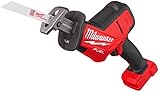
Best One-HandedMilwaukee M18 FUEL HACKZALL One-Handed Reciprocating Saw (2719-20)
One-Handed, 18V Brushless
The Hackzall is the saw that made one-handed reciprocating saws a category. The FUEL version weighs about 4 lbs and is about 14 inches long, which means you can hold it in one hand at arm's length, under a sink, between floor joists or up in a tree while your other hand holds a branch or a ladder. Milwaukee uses a 7/8-inch stroke, long for a tool this size, and a dual-gear counterbalance mechanism that the company says reduces vibration by up to four times compared with traditional reciprocating saws. That matters more than it sounds: low vibration means faster cut starts in metal and a saw that does not wander off the line. In practice, the Hackzall handles plumbing pipe, conduit, nails and bolts, small branches, 2x lumber and drywall without strain. Where it gives ground is thick material and long cuts. The shorter stroke clears sawdust less effectively, so cutting through a 4x4 or a large root takes noticeably longer than with a full-size saw. For most homeowners that is a fair trade, because the majority of household cuts are small.
Pros
- About 4 lbs and 14 inches long, small enough to use with one hand
- 7/8" stroke, long for a one-handed saw
- Counterbalance mechanism Milwaukee says cuts vibration up to 4x
- Fits between joists, studs and under sinks where full-size saws cannot
- Over 6,500 Amazon ratings averaging 4.8
Cons
- Shorter stroke cuts more slowly than a full-size saw in thick wood
- Not the tool for large-scale demolition
The Bottom Line
The reciprocating saw most homeowners should buy first: small enough to go anywhere, strong enough for pipe, branches and studs.
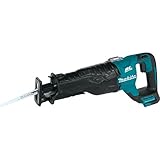
Best for Makita OwnersMakita 18V LXT Brushless Recipro Saw (XRJ05Z)
Full-Size, 18V Brushless, 2-Speed
The XRJ05 is Makita's full-size 18V brushless reciprocating saw and a natural choice for anyone already invested in LXT batteries. It uses a 1-1/4-inch stroke and adds something the Milwaukee lacks: a two-speed selector, with a low range of up to 2,300 strokes per minute and a high range of up to 3,000. The low range is genuinely useful in metal, where a slower blade starts cuts more cleanly, runs cooler and lasts longer, and it gives better control in plaster and tile backer where a fast blade chatters. Makita lists a maximum cutting capacity of 10 inches in wood with a 12-inch blade and 5-1/8 inches in pipe, and the electronically controlled brushless motor adjusts speed and torque to the cut. It is a heavier tool than the Milwaukee: retailer listings put it at about 8.2 lbs, and it is about 17-1/4 inches long. In demolition, the weight helps the saw stay planted. Overhead, it adds up. If you own Makita batteries, there is no reason to switch platforms for a reciprocating saw. If you own none, decide which ecosystem suits the rest of your tool list first, because the saw is a small part of that decision.
Pros
- 1-1/4" stroke with a two-speed setting: up to 2,300 or 3,000 SPM
- Low-speed range gives more control starting cuts in metal
- Makita lists 10" wood capacity with a 12" blade and 5-1/8" pipe
- Electronically controlled brushless motor adjusts to the load
- About 1,100 Amazon ratings averaging 4.8
Cons
- Listed at about 8.2 lbs, among the heavier saws here
- Longer than the Milwaukee at roughly 17-1/4 inches
The Bottom Line
A strong, controllable full-size saw for anyone already on Makita's 18V LXT batteries.

Best for DeWalt OwnersDeWalt 20V MAX XR Brushless Reciprocating Saw with POWER DETECT (DCS368B)
Full-Size, 20V MAX Brushless
DeWalt's DCS368 is the 20V MAX XR reciprocating saw with POWER DETECT, a system that recognizes DeWalt's high-capacity 8.0Ah battery and raises the tool's output when it is attached. DeWalt claims up to 44 percent more power in that configuration. With an ordinary 5.0Ah pack, it behaves like a strong conventional cordless saw. The base specifications are a 1-1/8-inch stroke and up to 3,000 strokes per minute through a variable-speed trigger, with a keyless lever-action blade clamp and an LED work light. Reviewers have praised the handle ergonomics and balance, and the saw has a reputation for smooth action and little kickback in heavy wood. What it lacks is equally clear. There is no orbital setting, no rafter hook and no speed dial, and reviewers note vibration control could be better than Milwaukee's. For most DeWalt owners, the DCS368 makes the 60V FLEXVOLT DCS389 unnecessary. That saw, also rated at 3,000 SPM with a 1-1/8-inch stroke, makes sense mainly if you already own FLEXVOLT batteries for other tools. The DCS368's Amazon rating count is still small, so treat its rating as provisional and lean on its specification and professional reviews.
Pros
- 1-1/8" stroke at up to 3,000 SPM with a variable-speed trigger
- POWER DETECT: DeWalt claims up to 44% more power with an 8.0Ah pack
- Keyless lever-action blade clamp and an LED work light
- Comfortable, well-balanced handle for long demolition sessions
- Uses ordinary 20V MAX packs rather than requiring FLEXVOLT
Cons
- No orbital action, no rafter hook and no speed dial
- The power boost only appears with DeWalt's largest 20V packs
The Bottom Line
The DeWalt 20V saw to buy, and the reason most DeWalt owners no longer need the 60V FLEXVOLT version.

Best CordedDeWalt 12 Amp Corded Reciprocating Saw (DWE305)
Full-Size, 12 Amp Corded
The DWE305 is the corded reciprocating saw we would buy if you do not own a battery platform, or if the saw will be used for long, continuous demolition where batteries run out. It has a 12 amp motor, up to 2,900 strokes per minute through a variable-speed trigger and a 1-1/8-inch stroke, figures close to the best cordless saws. Its most useful feature is the four-position blade clamp: you can mount the blade teeth down, teeth up, or sideways, which makes flush cuts against a floor or wall far easier, and the clamp is keyless so changes take seconds. It has been one of the best-selling corded reciprocating saws for years, and professional reviewers have pointed out why: it is compact for a corded saw and the grip is comfortable on both the main and front handles. They also point out its weaknesses, which are vibration that is noticeably worse than in the best cordless saws, a shoe design that can block your view of the cut line and a very basic feature set with no orbital action. None of that matters much in demolition, which is what most people buy a corded saw for. We could not confirm a current Amazon rating count, so the figure shown is a conservative estimate.
Pros
- 12 amp motor runs all day without batteries
- Up to 2,900 SPM with a 1-1/8" stroke and variable-speed trigger
- Four-position blade clamp mounts the blade up, down, left or right
- Keyless lever-action blade changes
- Compact for a corded saw and long a best-seller
Cons
- Vibration control is basic compared with modern cordless saws
- Minimal feature set and a shoe that can block your view of the cut
The Bottom Line
The cheapest way to get full-size reciprocating saw power if you do not want to buy into a battery platform.

Best BudgetRyobi ONE+ HP 18V Brushless Reciprocating Saw (PBLRS01B)
Full-Size, 18V Brushless
Ryobi's ONE+ HP brushless reciprocating saw is the value pick for people who already own Ryobi's 18V batteries, which is a very large number of homeowners. On paper it is competitive with saws that cost much more: Ryobi lists a 1-1/4-inch stroke and up to 3,200 strokes per minute, a brushless motor, a pivoting shoe and a tool-free blade release lever. Ryobi also claims 64 percent faster cutting and more than 380 cuts per charge, though those figures come from Ryobi's own testing, so read them as a sign that the HP version is a step up from older Ryobi saws rather than a comparison with Milwaukee or DeWalt. In practical terms, it is a capable saw for pruning, cutting up old fencing, removing a vanity or cutting through nails during a small renovation. It is less refined than the professional saws, with more vibration and a less durable build, and Ryobi tools are not designed for daily jobsite abuse. For homeowners, that line is rarely reached. It is sold mainly through Home Depot, so its Amazon rating count is small and the figure shown is conservative.
Pros
- 1-1/4" stroke at up to 3,200 SPM
- Brushless HP motor on the inexpensive ONE+ battery platform
- Pivoting shoe and tool-free blade release lever
- Ryobi claims over 380 cuts per charge
- Three-year manufacturer warranty
Cons
- Ryobi's speed claims come from its own testing, not comparisons with rivals
- Sold mainly through Home Depot, with a small Amazon review base
The Bottom Line
The saw for ONE+ owners who need a full-size reciprocating saw for yard work and occasional demolition.
5. How We Would Choose Between Them
Start with the batteries on your shelf. If you own Milwaukee M18, the choice is between the Hackzall and the 2821-20, and many owners end up with both. If you own Makita LXT, the XRJ05Z is the obvious pick. DeWalt 20V owners should buy the DCS368B, and Ryobi ONE+ owners the PBLRS01B. Switching platforms for a reciprocating saw rarely makes sense.
Next, be honest about how often you will cut. Someone who removes a vanity once every few years and prunes a hedge every spring does not need a professional demolition saw. A one-handed saw or the Ryobi will do that work comfortably. Someone gutting a kitchen, replacing a bathroom floor or tearing out a deck should buy a full-size brushless saw and a large battery.
Then think about where you will cut. Under sinks, inside cabinets, between studs and overhead, a short, light saw is easier to control and less tiring. In open demolition, on thick limbs and through cast iron, a longer stroke and more weight help. If you can only buy one saw and your work is mixed, the Hackzall covers more household jobs than a full-size saw does.
If you own no batteries and expect occasional use, the corded DeWalt DWE305 is the cheapest way to get full-size performance, and it will still run in twenty years. Just remember an extension cord in demolition is a trip hazard and something the blade can reach, so route it behind you and away from the cut.
6. Cordless vs Corded
Cordless reciprocating saws have caught up with corded ones for nearly all work. The best brushless saws on an 18V or 20V platform cut as fast as a 12 amp corded saw in most materials. The advantage of cordless is obvious in demolition, where you are moving around a room, climbing into crawlspaces and working where no outlet is nearby.
Corded saws still have two advantages. They never run down, which matters on an all-day demolition job, and they cost less if you do not already own batteries. A corded saw also has no battery to fail after a few years. If you will use the saw once or twice a year and own no cordless platform, a corded saw is the sensible buy.
Battery size matters more on a reciprocating saw than on almost any other cordless tool. A small 2.0Ah pack will run a reciprocating saw, but slowly and briefly. A 5.0Ah or larger pack lets the saw reach its rated speed and keeps it there. Our guide to cordless tool batteries explains why amp-hours affect power as well as runtime.
DeWalt also sells a 60V FLEXVOLT reciprocating saw, the DCS389, rated at 3,000 SPM with a 1-1/8-inch stroke. It is powerful, but the 20V DCS368 with POWER DETECT has closed much of the gap without requiring larger, heavier FLEXVOLT batteries. Unless you already own FLEXVOLT packs, the 20V saw is the more sensible choice.
7. Choosing the Right Blade
Blades matter as much as the saw. Reciprocating saw blades are sold by length, thickness and teeth per inch, or TPI. Low TPI blades, around 3 to 6, cut wood quickly and roughly and are the right choice for pruning and green wood. Mid-range blades, around 8 to 14 TPI, handle nail-embedded wood and general demolition. High TPI blades, 14 to 24, are for metal.
The rule for metal is that at least three teeth should be in contact with the material at once. Thin-walled conduit and sheet metal need fine teeth, often 18 to 24 TPI. Thick steel and cast iron work better with 10 to 14 TPI bimetal blades, and cast iron especially benefits from carbide-grit or carbide-tipped blades, which last far longer than bimetal ones in that material.
| Material | Typical TPI | Blade type |
|---|---|---|
| Green wood, pruning | 3-6 | Pruning blade |
| Demolition wood with nails | 6-10 | Bimetal demolition blade |
| Thick steel, pipe | 10-14 | Bimetal or carbide-tipped |
| Thin metal, conduit | 18-24 | Bimetal metal-cutting blade |
| Cast iron, tile, masonry | Grit | Carbide-grit blade |
Length matters too. A 6-inch blade is stiffer and more accurate, a 9-inch blade reaches through thicker material and a 12-inch blade cuts large limbs and timbers but flexes more. Choose the shortest blade that reaches through the material plus an inch or two, so the blade does not bottom out against the work on the forward stroke.
Buy a mixed pack of bimetal blades and a few dedicated pruning and metal blades, and treat them as consumables. A dull blade makes any saw feel underpowered, and the cheapest way to make a reciprocating saw cut faster is to change the blade sooner than you think you need to.
8. Demolition Technique That Saves Time and Fingers
Press the shoe firmly against the work. The shoe is the metal foot at the front of the saw, and keeping it planted is the single most important technique with a reciprocating saw. With the shoe pressed against the surface, the saw cuts smoothly. With it floating, the blade bucks, the saw jumps and the blade can bind and snap.
Start cuts at a lower speed, then squeeze the trigger fully once the blade is in the material. In metal, stay at a moderate speed throughout and use cutting oil on thick steel. For plunge cuts into drywall or wood, rest the shoe on the surface with the saw tilted, start the blade and slowly rotate the saw until the blade enters the material.
Before cutting into any wall, floor or ceiling, find out what is behind it. Shut off the circuit, check for wiring and plumbing, and use a shallow blade where you can. A reciprocating saw will cut through electrical cable, water pipe and gas line just as easily as it cuts studs. If you are not sure, use an oscillating tool to cut a small inspection hole first.
Expect the saw to kick if the blade binds. Keep both hands on a full-size saw and stand to the side of the blade line. Let the saw do the work. Forcing it overheats the motor and the blade, and on cordless saws drains the battery far faster than a steady, moderate pressure does.
9. Safety Gear and Habits
Wear eye protection every time. Reciprocating saws throw sawdust, metal chips and broken blade fragments toward your face, and demolition often happens overhead. Safety glasses with side shields are the minimum, and a face shield is worth wearing when cutting metal or overhead.
Hearing protection matters in demolition, where you may run a saw for hours. Gloves help with grip and protect against sharp metal edges, but avoid loose gloves near the blade. A dust mask or respirator is essential when cutting through plaster, old drywall or anything that may contain lead paint or other hazardous materials.
Unplug corded saws and remove batteries from cordless ones before changing blades. Blades get very hot during cuts, especially in metal, so let them cool or use gloves. Store saws with the blade removed or covered, since a reciprocating saw blade sticking out of a tool bag is an easy way to get cut.
If you are cutting through bolts or other fasteners, an impact driver or impact wrench may remove them faster and more neatly than a saw, which saves blades and avoids the hot, sharp ends a cut leaves behind. For cutting heavy steel, rebar and tile, an angle grinder with the right disc is often quicker.
10. Common Mistakes to Avoid
Letting the shoe float off the work
The shoe must stay pressed against the material during the cut. When it floats, the blade slaps back and forth, the saw jumps and blades bend or snap. Lean into the saw slightly so the shoe stays planted, and the cut will be faster, smoother and much less tiring for your hands and arms.
Using a wood blade on metal
Coarse wood blades tear and snag in metal, chipping teeth and throwing the saw around. Metal needs fine-toothed bimetal blades, with at least three teeth in contact with the material at all times. Use cutting oil on thick steel and slow the saw down. A matching blade does more for speed than a bigger saw.
Cutting into walls blind
A reciprocating saw cuts through wiring, water lines and gas pipes as easily as studs. Shut off circuits, check for plumbing, and use a short blade or cut a small inspection hole first. Ten minutes of checking is cheaper than a burst pipe or a damaged circuit inside a finished wall.
Buying full-size for small jobs
A full-size saw is long, heavy and awkward under a sink or between joists. If most of your cuts are pipe, bolts and small branches, a one-handed saw does the job faster because you can actually get it into position. Buy a full-size saw when you know you need the extra stroke length.
Running a big saw on a tiny battery
Reciprocating saws draw a lot of current, so a 2.0Ah pack makes even the best saw slow and short-lived. Use a 5.0Ah pack or larger for demolition and heavy cuts. If the saw feels weak, try a bigger battery before deciding the saw is the problem.
Before You Buy
Also Needed for This Job
11. Frequently Asked Questions
What is the difference between a Sawzall and a reciprocating saw?
Sawzall is Milwaukee's trademarked name for its reciprocating saws, the way Hackzall is its name for its one-handed saws. Every Sawzall is a reciprocating saw, but other brands like DeWalt, Makita and Ryobi make reciprocating saws too. People often use Sawzall to mean any reciprocating saw, much as they use Kleenex to mean any tissue.
Is a cordless reciprocating saw as powerful as a corded one?
The best brushless cordless saws now match a 12 amp corded saw in most cuts, provided they run on a large battery. Corded saws still win for long, continuous demolition because they never run down, and they cost less if you do not already own batteries. For most homeowners, cordless is more convenient and powerful enough.
Can a reciprocating saw cut metal?
Yes, with the right blade. Use a bimetal blade with 14 to 24 teeth per inch for thin metal and 10 to 14 TPI for thicker steel and pipe. Keep at least three teeth in contact with the material, slow the saw down and use cutting oil on thick steel. Carbide-grit blades work best on cast iron.
Is a one-handed reciprocating saw worth it?
For most homeowners, yes. One-handed saws like the Milwaukee Hackzall weigh around 4 lbs and fit between studs, under sinks and in cabinets. They cut pipe, bolts, branches and lumber easily. They are slower than full-size saws in thick material, so demolition crews usually own both. Most households only need the smaller one.
Can I use a reciprocating saw for tree trimming?
Yes, for limbs you can reach safely from the ground. Fit a coarse pruning blade, keep the shoe against the branch and cut from the top unless the branch could pinch the blade. Do not use a two-handed saw on a ladder. For high branches, use a pole saw, and leave large limbs to a chainsaw or an arborist.
What does orbital action do on a reciprocating saw?
Orbital action moves the blade in a slight elliptical path so it digs in on the cutting stroke and lifts on the return. That speeds cuts in wood and clears sawdust better, but leaves a rougher cut and adds vibration. Always turn it off for metal. Many good cordless saws skip orbital action entirely.
How long should a reciprocating saw blade be?
Choose a blade that reaches through the material plus an inch or two, so the tip clears the work on every stroke. Six-inch blades are stiffer and more accurate. Nine-inch blades are the general-purpose choice for demolition. Twelve-inch blades handle large limbs and thick timbers but flex more and are harder to control.
Related Saw Guides
Buyer's Guide
Best Oscillating Tools
The precise plunge and flush cuts that a reciprocating saw cannot make cleanly.
Buyer's Guide
Best Jigsaws
Curves and controlled cuts in plywood, where accuracy matters more than speed.
Buyer's Guide
Best Miter Saws
Square, repeatable crosscuts for framing, decks and trim.
The Bottom Line
Buy the Milwaukee M18 FUEL Hackzall if you want one saw for the cuts most homeowners make, and the Milwaukee 2821-20 if you do real demolition. Makita and DeWalt owners should stay on their platform with the XRJ05Z or DCS368B. If you own no batteries, the corded DeWalt DWE305 is the cheapest route to full-size power.
Whichever saw you choose, budget for good blades and a large battery, keep the shoe planted and check what is behind a wall before you cut into it.
More in Tools & Equipment
Guides in this category that pair with what you just read.
About the Author
Alex Rivers, Home Improvement Editor
Alex has spent over a decade working on residential and light commercial property maintenance, and now tests every tool, coating and machine that appears in these guides personally.