Best Pole Saws
A pole saw keeps you on the ground and off the ladder. Here is how to pick the right reach and power for your trees, and the safety rules that matter more than either.
Alex Rivers
Home Improvement Editor
Last Updated
October 17, 2026
In This Guide
The best pole saw is the one that lets you prune from the ground with both feet planted. For most yards that is an 8- or 10-inch battery saw on a platform you already own; a manual saw reaches higher than any of them, and gas only makes sense on acreage. None of them belong anywhere near a power line.
Our Picks at a Glance
The Short Answer
DeWalt 20V MAX XR Brushless Pole Saw, Tool Only (DCPS620B) (Best Overall). The pole saw most homeowners should buy: enough reach for typical yard trees, real cutting power, and a battery platform millions of people already own.
- Best Overall DeWalt 20V MAX XR Brushless Pole Saw, Tool Only (DCPS620B) — 8" Battery, 20V MAX BrushlessCheck Price
- Best Premium Battery Pole Saw EGO Power+ 10-Inch Telescopic Carbon Fiber Pole Saw, Tool Only (PS1000) — 10" Battery, 56V BrushlessCheck Price
- Best Value Combo Greenworks 40V 8-Inch Pole Saw and 20-Inch Pole Hedge Trimmer Combo Kit (PSPH40B210) — 8" Battery Combo, 40VCheck Price
- Best Budget Corded Sun Joe 8-Inch 6.5-Amp Electric Pole Chain Saw (SWJ802E) — 8" Corded Electric, 6.5 AmpCheck Price
- Best for Maximum Reach Silky Hayauchi 390 21-Foot Telescoping Pole Saw (179-39) — Manual, 15.4" BladeCheck Price
- Best Budget Manual Fiskars 7-16 Ft Chain-Drive Extendable Tree Pruner and Pole Saw (394731-1002) — Manual Pruner and SawCheck Price
- Best Gas Pole Saw ECHO 12-Inch 25.4cc Gas Telescoping Power Pruner (PPT-2620) — 12" Gas, 25.4cc 2-StrokeCheck Price
We may earn a commission when you buy through these links, at no extra cost to you. How we test
Best Overall
DeWalt 20V MAX XR Brushless Pole Saw, Tool Only (DCPS620B)
1. How We Picked
We looked at the pole saws people actually buy for yard trees: battery saws from the big platforms, a corded saw for small yards, a gas power pruner for larger properties, and two manual saws that professional arborists and orchard owners rely on. We then compared them on reach, bar length, cutting power, weight and how easy they are to control at full extension.
Reach is the headline number, but we read it carefully. Manufacturers quote total reach assuming a person of average height holding the saw at shoulder level and an angle, so a 10-foot pole becomes 15 feet of reach on paper. That is fair, but it is also the very top of the range, and you should plan to work a couple of feet below it.
Every specification here comes from the manufacturer or the retail listing, and ratings are the Amazon figures at the time of writing, rounded down. Prices move constantly, so we describe value in words. We also excluded several older models that are no longer made and only sold from leftover stock.
Finally, we were clear about what a pole saw is not. It is a pruning tool for limbs you can reach from the ground, not a felling saw and not a substitute for a tree service. If the limb is larger than your thigh, hanging over a roof, or anywhere near a power line, the right tool is the phone.
2. Battery, Corded, Gas or Manual
Battery pole saws are the right choice for most homeowners. They start instantly, are quiet, need no fuel, and the best brushless models cut quickly through limbs of several inches. The cost is the battery, so the smart buy is a saw on a platform you already own, whether that is DeWalt, EGO, Greenworks or another major brand.
Corded pole saws are cheaper and lighter at the head because there is no battery, and they never run out of charge. The trade-off is range and the cord itself, which adds drag at full extension and has to be kept clear of falling branches. They suit small yards with a few trees near an outlet.
Gas pole saws, often sold as power pruners, are the professional choice for acreage, orchards and storm cleanup. They carry longer bars and run for hours on a tank, but they are heavy, loud and need maintenance. Manual pole saws are the quiet outlier: lighter, longer and maintenance-free, at the cost of your own effort.
| Type | Typical bar or blade | Best for | Watch out for |
|---|---|---|---|
| Battery | 8 to 10 inches | Most yards and homeowners | Battery cost if you have no platform |
| Corded | 8 inches | A few trees near an outlet | Cord drag and range |
| Gas | 10 to 12 inches | Acreage, orchards, storm cleanup | Weight, noise, fuel and upkeep |
| Manual | 13 to 16-inch blade | Maximum reach, light pruning, quiet work | Effort on thick limbs |
If you already own a capable chainsaw, a pole saw complements it rather than replacing it. The chainsaw handles anything you can reach standing on the ground with both feet planted; the pole saw handles everything above shoulder height. Neither should ever be used from a ladder.
3. Our 7 Top Picks
We matched each pick to a job. DeWalt's brushless saw leads for most homeowners, EGO's carbon fiber saw is the premium battery option, and Greenworks' combo covers yards that need a pole hedge trimmer too. A corded Sun Joe is the budget powered pick, two manual saws from Silky and Fiskars cover maximum reach and minimum cost, and ECHO's gas pruner is for large properties. Reach and capacity figures are the manufacturers' own.

Best OverallDeWalt 20V MAX XR Brushless Pole Saw, Tool Only (DCPS620B)
8" Battery, 20V MAX Brushless
DeWalt's DCPS620B is the pole saw we would hand to most homeowners, and its huge rating count suggests plenty of them agree. The pole extends up to 10 feet, which DeWalt says gives a total reach of up to 15 feet for a 6-foot person holding the saw at shoulder height at a 60-degree angle. That is a realistic figure rather than a marketing stretch, and it covers the lower and middle canopy of most yard trees. The brushless motor drives an 8-inch low-kickback bar and chain, and DeWalt rates it for up to 96 cuts per charge in 4x4 pressure-treated pine with a 4Ah battery, which is far more than a typical weekend of pruning demands. The small details are the ones that make pole sawing easier. Automatic oiling keeps the bar lubricated while the cutting head is 12 feet above you where you cannot check it, a metal bucking strip bites into the branch so the saw does not skate, and a tree hook lets you pull hung-up branches down without climbing. The limitations are size and cost. An 8-inch bar is for pruning limbs, not felling, and the bare tool only makes financial sense if you already own DeWalt 20V packs. If you do, this is an easy recommendation.
Pros
- Up to 15 feet of total reach with a pole that extends to 10 feet
- Brushless motor rated for up to 96 cuts per charge on 4x4 pressure-treated pine with a 4Ah battery
- 8-inch low-kickback bar and chain
- Automatic oiling for the bar and chain
- Metal bucking strip and tree hook for gripping and pulling down cut branches
Cons
- Sold bare, so it is expensive if you do not already own DeWalt 20V batteries
- An 8-inch bar limits it to pruning-sized limbs
The Bottom Line
The pole saw most homeowners should buy: enough reach for typical yard trees, real cutting power, and a battery platform millions of people already own.
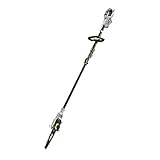
Best Premium Battery Pole SawEGO Power+ 10-Inch Telescopic Carbon Fiber Pole Saw, Tool Only (PS1000)
10" Battery, 56V Brushless
EGO's PS1000 is a dedicated pole saw, not an attachment, and it shows in the details. The telescopic shaft is carbon fiber, which EGO backs with a limited lifetime warranty, and it extends for a total reach of up to 13 feet, or up to 17 feet with the optional EP1000 extension pole. Carbon fiber matters because weight at the end of a long shaft tires your shoulders, and a stiffer shaft wobbles less when you are trying to place the chain on a branch 15 feet away. The 10-inch bar is longer than the 8-inch bars on most battery pole saws, and it runs a 1/4-inch pitch, 0.043-inch gauge chain at up to 20 meters per second, driven by a brushless motor. EGO rates it for up to 100 cuts per charge with a 2.5Ah battery. Its unique feature is an LED cut line indicator, which lights the cut point when you are working under a dense, shaded canopy, exactly where it is hardest to see. Chain tensioning is tool-free, and there is a shoulder strap hook. The drawbacks are price and base reach: the battery and charger are extra, and out of the box it reaches a little less far than DeWalt's DCPS620B. For EGO owners, it is the best pole saw available.
Pros
- Telescopic carbon fiber shaft with a limited lifetime warranty
- Up to 13 feet of total reach, or up to 17 feet with the EP1000 extension pole
- LED cut line indicator for accurate cuts in shaded canopy
- 10-inch bar with 1/4-inch pitch, 0.043-inch gauge chain at up to 20 m/s
- Up to 100 cuts per charge with a 2.5Ah battery, plus tool-free chain tensioning
Cons
- Battery and charger sold separately
- Base reach is shorter than DeWalt's unless you add the extension pole
The Bottom Line
The best-engineered battery pole saw we found, worth the premium if you already own EGO batteries or prune often.

Best Value ComboGreenworks 40V 8-Inch Pole Saw and 20-Inch Pole Hedge Trimmer Combo Kit (PSPH40B210)
8" Battery Combo, 40V
If you have tall hedges and overhanging limbs, Greenworks' 40V combo kit solves both problems for less than the price of many single pole saws. It pairs an 8-inch pole saw with a 20-inch pole hedge trimmer, and the hedge head pivots through seven positions, so you can lay it flat across the top of a hedge or angle it down the face from the ground. The saw head has an automatic oiler to keep the bar and chain lubricated and an easy-adjust tensioning system, so you can tighten a stretched chain without hunting for a scrench. The kit includes a 2.0Ah battery and charger, and Greenworks backs it with a 3-year warranty. The battery runs any of Greenworks' many 40V tools, which makes the combo a sensible way into the platform. Expectations need to be realistic. This is a homeowner pruning tool for small limbs and hedge tops, not a replacement for a full-size chainsaw or a brushless pro pole saw, and the small 2.0Ah pack will not get through a long day without a recharge or a second battery. Greenworks lists the kit at about 11 pounds. For occasional pruning and twice-a-year hedge tops, though, it is the best value here, and having both heads means you will actually use it.
Pros
- Two tools in one kit: an 8-inch pole saw and a 20-inch pole hedge trimmer
- Hedge head pivots through 7 positions for cutting tops and faces
- Automatic oiler for the bar and chain
- Easy-adjust chain tensioning
- Includes a 2.0Ah battery and charger, with a 3-year warranty
Cons
- The 2.0Ah battery limits long sessions without a spare
- Not as strong in hardwood as the brushless DeWalt and EGO saws
The Bottom Line
The best buy for a homeowner who needs both a pole saw and a pole hedge trimmer and does not want to spend twice.

Best Budget CordedSun Joe 8-Inch 6.5-Amp Electric Pole Chain Saw (SWJ802E)
8" Corded Electric, 6.5 Amp
For homeowners who prune a couple of trees near the house once or twice a year, a corded pole saw is the cheapest route, and Sun Joe's SWJ802E is the one we would buy. The 6.5-amp motor drives an 8-inch bar and chain, and Sun Joe rates it for branches up to 7.5 inches thick, which is more than most people will ever ask of a pole saw. The telescoping pole extends to 9.4 feet, which Sun Joe says provides up to 15 feet of overhead reach, roughly matching DeWalt's battery saw. The head adjusts to 0, 15 and 30 degrees, which helps you get the bar square to branches that grow at awkward angles. Because there is no battery, there is nothing to buy beyond an outdoor extension cord, nothing to charge and no pack to replace in five years. The trade-offs are the cord and the feel. A long cord trailing up a pole adds weight and drag, and you need to keep it clear of the chain and of anything you are dropping. It is also louder and less refined than brushless battery saws. It is CSA approved and carries a 2-year warranty. If you only prune occasionally and have an outlet within reach of your trees, it does the job for a fraction of the price.
Pros
- 6.5-amp motor rated for branches up to 7.5 inches thick
- Telescoping pole extends to 9.4 feet for up to 15 feet of overhead reach
- Multi-position head cuts at 0, 15 and 30 degrees
- No batteries to buy or charge
- CSA approved with a 2-year warranty
Cons
- Extension cord limits range and adds drag at full extension
- Brushed corded motor is noisier and less refined than battery saws
The Bottom Line
The cheapest credible way to prune a few trees near the house, if you do not mind managing a cord.

Best for Maximum ReachSilky Hayauchi 390 21-Foot Telescoping Pole Saw (179-39)
Manual, 15.4" Blade
The Silky Hayauchi is the manual pole saw professional arborists carry, and once you use one it is easy to see why. The four-section aluminum pole extends from 8 feet to 21 feet, and Silky quotes a maximum working reach of 26 feet, far beyond any battery pole saw here. The 15.4-inch blade is made from SK4 high-carbon steel, 1.5 mm thick, with 5.5 teeth per inch, and it cuts on the pull stroke with an aggressiveness that surprises people used to cheap pruning saws. Because there is no motor, the whole tool weighs about 6.9 pounds in operation, and the weight is spread along the pole rather than concentrated at the tip, so it is less tiring to hold aloft than a powered saw. The oval-section poles stop the blade from twisting in your hands, which helps you keep the cut straight. Silky backs it with a limited lifetime warranty against defects. The limitation is effort. On a 2-inch limb, the Hayauchi is quick and clean. On a 6-inch limb at full extension, it is a workout. It is also expensive for a hand tool. But if you have tall trees, want silence and zero maintenance, or need to reach above where a powered pole saw ends, there is nothing better.
Pros
- Four-section pole extends from 8 to 21 feet
- Silky quotes a maximum working reach of 26 feet
- 15.4-inch (390 mm) blade in SK4 high-carbon steel, 5.5 teeth per inch
- About 6.9 pounds operating weight
- Limited lifetime warranty against defects
Cons
- Manual cutting is slow and tiring on limbs over a few inches thick
- Premium price for a hand tool
The Bottom Line
The arborist favorite: lighter, quieter and longer-reaching than any powered pole saw, for anyone with tall trees and patience.

Best Budget ManualFiskars 7-16 Ft Chain-Drive Extendable Tree Pruner and Pole Saw (394731-1002)
Manual Pruner and Saw
Fiskars' 7-16 foot extendable pruner is two tools on one pole, and for many homeowners it is the only pole saw they will ever need. The top carries a bypass pruner driven by a chain-drive mechanism that Fiskars says multiplies your cutting power up to three times compared with traditional pruners, for branches up to 1.25 inches thick. That covers most of the routine work on fruit trees, ornamentals and overhanging growth along a driveway. For bigger limbs, a 15-inch WoodZig saw blade with a hooked end anchors against the branch so it does not skate as you cut. The pole adjusts from 7 to 16 feet and is made from oval fiberglass and aluminum, which keeps it light while limiting the flex that makes cheap pole pruners hard to aim. Fiskars' advanced double-locking system, a flip lock plus an internal button lock, stops the sections collapsing mid-cut. The blades are hardened steel with a low-friction coating to resist rust and sap. The saw is not as fast or as aggressive as the Silky, and pulling a rope to work a pruner 16 feet up takes some practice. Fiskars backs it with a lifetime warranty, and it costs a fraction of any powered option.
Pros
- Pole adjusts from 7 to 16 feet
- Chain-drive pruner multiplies leverage up to 3 times for branches up to 1.25 inches
- 15-inch WoodZig saw blade with a hooked end for larger limbs
- Oval fiberglass and aluminum pole for rigidity at length
- Lifetime warranty
Cons
- Saw blade is slower than the Silky on thick limbs
- Rope-operated pruner takes practice to use well at full extension
The Bottom Line
The cheapest way to keep small trees and overhanging branches in check without a motor, and a pruner and saw in one tool.

Best Gas Pole SawECHO 12-Inch 25.4cc Gas Telescoping Power Pruner (PPT-2620)
12" Gas, 25.4cc 2-Stroke
Battery pole saws handle most suburban pruning, but on larger properties, orchards and after storms, a gas power pruner is still the tool professionals reach for. ECHO's PPT-2620 is our pick. It runs a 25.4cc professional-grade 2-stroke engine and carries a 12-inch bar, the longest on this list, which lets it cut larger limbs in a single pass. The shaft telescopes from 107 inches to 146 inches, and ECHO quotes up to 16 feet of reach, or 20 feet with an optional 4-foot extension. The automatic oiler is adjustable, so you can match oil flow to the wood and the weather, and the magnesium gear case has a side-access chain tensioner, which makes adjustments easier when the saw is lying on the ground. A two-stage air filter extends service intervals, and the 20.6-ounce fuel tank keeps you working for a long time between fill-ups. ECHO backs it with a 5-year consumer warranty. The costs are weight and upkeep. At 17.4 pounds dry, it is heavy to hold at full extension, and like any 2-stroke engine it needs fresh mixed fuel and seasonal maintenance. It also has the smallest Amazon rating count here, so we lean on ECHO's specifications and reputation. For occasional suburban pruning, choose battery.
Pros
- 25.4cc professional-grade 2-stroke engine
- 12-inch bar, the longest on this list
- Telescopes from 107 to 146 inches for up to 16 feet of reach, 20 feet with an optional extension
- Automatic, adjustable oiler and side-access chain tensioner
- 5-year consumer warranty
Cons
- 17.4 pounds dry, heavy to hold at full extension
- Needs mixed fuel and regular engine maintenance
The Bottom Line
The pole saw for acreage and storm cleanup, when you need a 12-inch bar and a tank you can refill in the field.
4. Reach: How High You Can Really Cut
Total reach is the pole length plus your own height and arm reach, adjusted for the angle at which you hold the saw. DeWalt, for example, quotes 15 feet of reach for its 10-foot pole, assuming a 6-foot person holding the saw at shoulder height at 60 degrees. If you are shorter, or the ground is sloped, you will reach less.
Working at a steep angle is also more tiring and less accurate than working at a moderate one, because the weight of the head sits further from your hands. Most people cut best with the saw between about 45 and 60 degrees, standing well to the side of the branch rather than beneath it. That means planning cuts so you can reach them from a safe position.
If you need more than about 15 feet, look at saws that accept an extension pole, like the EGO PS1000 with its optional EP1000 or the ECHO PPT-2620 with its 4-foot extension. Or consider a manual saw: the Silky Hayauchi extends to 21 feet and is light enough to use at that length. Beyond that, you are in tree service territory.
Resist the urge to gain reach by standing on something. Pole saws exist so you can keep both feet on the ground. If a branch is just out of reach, it is better to leave it for next year, call a professional, or use a longer manual saw than to work from a ladder. We explain why in the safety section below, and our guide to the best telescoping ladders covers the jobs where a ladder is the right answer.
5. Bar Length, Chain and Cutting Capacity
Most battery and corded pole saws use an 8-inch bar, EGO's PS1000 uses a 10-inch bar, and gas power pruners like the ECHO run 12 inches. As with a chainsaw, a bar can cut wood up to roughly twice its length if you work from both sides, but on a pole saw you should plan on cutting limbs no thicker than the bar length in one pass.
In practice, most pruning cuts are 2 to 4 inches, well within the reach of an 8-inch bar. Pole saws struggle not with thickness but with control: a large limb is heavy, and when it starts to fall it can pinch the bar or swing toward you. That is why we recommend removing heavy limbs in sections, starting at the tip and working back toward the trunk.
Chain matters too. Pole saws use narrow, low-kickback chains, often 3/8-inch low profile or 1/4-inch pitch, which cut smoothly with small motors. Keep the chain sharp and correctly tensioned: a dull chain makes you push, and pushing a saw 12 feet away is how cuts go wrong. Our guide to the best chainsaw sharpeners covers the files and grinders that fit these small chains.
Oil the bar and chain every time. Every powered pole saw on our list has an automatic oiler, but you still have to fill the reservoir and check that oil is reaching the chain. Point the running saw at a light-colored surface for a few seconds; if you see a fine line of oil, the oiler is working.
6. Weight and Balance at Full Extension
A pole saw is a long lever, and every ounce at the cutting head feels like several by the time it is 10 feet away from your hands. That is why manufacturers compete on weight, and why carbon fiber shafts like the one on the EGO PS1000 are worth paying for if you prune often.
Gas pole saws are the heaviest. The ECHO PPT-2620 weighs 17.4 pounds dry, with the engine at the bottom acting as a counterweight. Battery saws put the motor at the head and the battery near your hands, which shifts the balance forward. Manual saws are the lightest, around 7 pounds for the Silky Hayauchi, with the weight spread along the pole.
A shoulder strap helps more than people expect, especially with heavier saws, because it lets your body carry the weight while your hands guide the saw. Several of the saws here have strap hooks. Take regular breaks: accuracy falls off noticeably once your shoulders tire, and a tired operator is when cuts drift.
When you test a pole saw, extend it fully and hold it at a 60-degree angle for a minute. If that is a struggle, choose a lighter or shorter saw. You will make more careful cuts with a tool you can control than with one that reaches farther but wavers in your hands.
7. Power Lines and Pole Saw Safety
The most important rule in pole sawing is simple: stay away from power lines. Keep yourself, the pole and any branch you are cutting at least 10 feet from any overhead line, which is the minimum clearance OSHA requires for unqualified workers near lines up to 50 kilovolts. Remember that a branch can swing toward a line as it falls.
Aluminum poles conduct electricity, and fiberglass poles are not insulated unless they are specifically rated and tested for live-line work, which consumer pole saws are not. Wet wood, wet poles and damp gloves all make contact more dangerous. If any branch is touching or near a line, including the service line to your house, call your utility. Many will trim it for free.
Never stand directly beneath the branch you are cutting. Position yourself to the side, at an angle, so a falling limb drops away from you. Wear a hard hat with a face shield or safety glasses, gloves and sturdy boots, and keep everyone else at least two tree lengths away from the drop zone.
Cut heavy limbs in stages. Make a small undercut first to prevent the bark from tearing down the trunk, then cut from the top a little further out. Remove the stub last. Never use a pole saw from a ladder, roof or tree. If a job requires climbing, it requires an arborist. Once limbs are on the ground, a hookaroon makes moving and stacking the cut wood far easier on your back.
8. When and How to Prune With a Pole Saw
Late winter, while trees are dormant, is the best time for most structural pruning. Without leaves, you can see the branch structure, cuts heal quickly when growth starts in spring, and pests and diseases are less active. Dead, damaged and crossing branches can be removed at any time of year.
Cut just outside the branch collar, the slightly swollen ring where a branch meets the trunk. Cutting flush with the trunk removes the tissue that seals the wound, while leaving a long stub invites decay. On a pole saw, angle the bar so the cut follows the line of the collar.
Do not remove more than about a quarter of a tree's canopy in a single year, and avoid topping trees. Heavy pruning stresses the tree and triggers fast, weak regrowth. If a tree needs drastic work, spread it over several seasons or consult an arborist.
Clean up as you go. Cut limbs are trip hazards, and green wood stacked against a house invites insects. Small branches can be chipped or bundled for yard waste; larger rounds can be split for firewood. If you have a lot of wood to process, our guide to the best log splitters covers the machines that make that job manageable.
9. Maintenance and Storage
Pole saws need the same basic care as chainsaws. Keep the chain sharp and correctly tensioned, keep the oil reservoir full, and clean sawdust and sap out of the bar groove and sprocket area after each use. A dirty bar groove starves the chain of oil and wears the bar quickly.
Check chain tension before every session and again after the first few cuts, because a new chain stretches. A correctly tensioned chain should snap back against the bar when you pull it out a little by hand, and still move freely along the bar with gloved fingers. Too loose and it can throw; too tight and it wears the bar and drains the battery.
For telescoping poles, wipe the sections clean before collapsing them so grit does not score the inner tubes, and check that the locking collars or levers grip firmly. A pole that slips while you are mid-cut is both frustrating and dangerous.
Store battery saws with the pack removed, indoors, at moderate temperatures. Store gas saws with the tank run dry or with stabilized fuel. Manual saws need nothing more than a wipe with a solvent to remove resin and the blade guard fitted. Hang long poles horizontally on wall hooks to keep them straight. If you also run a hedge trimmer on the same battery, a single charger and spare pack covers both.
10. Common Mistakes to Avoid
Working Near Power Lines
Keep yourself, the pole and any branch at least 10 feet from overhead lines, and remember that falling limbs swing. Aluminum conducts and consumer fiberglass poles are not insulated. If a branch is near any line, including the service drop to your house, stop and call your utility instead.
Standing Under the Branch
The natural position for cutting overhead is directly beneath the limb, which is exactly where it lands. Stand to the side and cut at an angle so the branch falls away from you. Wear a hard hat and eye protection, and keep everyone well clear of the drop zone.
Cutting Big Limbs in One Piece
A heavy limb pinches the bar, tears bark down the trunk and can swing unpredictably as it falls toward you. Remove large limbs in sections from the tip back, use an undercut before the top cut, and take the final stub off cleanly outside the branch collar.
Using a Pole Saw From a Ladder
A pole saw exists so you do not need a ladder. Combining the two puts you off-balance with a running saw overhead and nothing to hold. If you cannot reach a branch from the ground, use a longer manual saw, leave it, or call an arborist.
Ignoring Chain Tension and Oil
A loose chain can derail and a dry one overheats and dulls quickly, and you cannot see either problem when the head is 12 feet up. Check tension and the oil reservoir before every session, and confirm the oiler is working before you lift the saw.
Before You Buy
Also Needed for This Job
11. Frequently Asked Questions
What is the best pole saw for homeowners?
For most homeowners, a brushless battery pole saw with an 8- or 10-inch bar and around 15 feet of reach is the best fit. The DeWalt DCPS620B is our top pick, and the EGO PS1000 is the premium choice. If you already own a battery platform, buy that brand's pole saw to avoid paying for a new battery and charger.
How high can a pole saw reach?
Most battery and corded pole saws quote around 13 to 15 feet of total reach, which includes your own height and arm reach. Gas pruners with extensions can reach about 20 feet, and manual telescoping saws like the Silky Hayauchi extend to 21 feet. Plan to work a couple of feet below the quoted maximum for control.
How thick a branch can a pole saw cut?
Plan on cutting limbs up to about the length of the bar in one pass: 8 inches for most battery saws, 10 to 12 inches for premium and gas models. In practice, most pruning cuts are 2 to 4 inches. Larger limbs should be removed in sections, and anything very large is a job for a tree service.
Is a manual pole saw better than a powered one?
A manual saw is lighter, quieter, maintenance-free and often reaches higher, which makes it excellent for light pruning and tall trees. A powered saw is much faster and less tiring on limbs over a couple of inches. Many people with mature trees own one of each and choose by the job.
Is it safe to use a pole saw near power lines?
No. Keep yourself, the pole and the branch at least 10 feet from any overhead line, which is OSHA's minimum clearance for unqualified workers near lines up to 50 kilovolts. Consumer pole saws are not insulated, even with fiberglass poles. If branches are near a line, contact your utility; many trim them for free.
Can I use a pole saw from a ladder?
You should not. A pole saw is designed to let you prune with both feet on the ground. Using one from a ladder puts you off-balance with a running saw overhead and no free hand. If you cannot reach a branch from the ground, use a longer saw, leave it, or hire an arborist.
When is the best time to prune trees with a pole saw?
Late winter, while trees are dormant, is best for most structural pruning, because you can see the branch structure and cuts heal quickly in spring. Dead, damaged or hazardous branches can be removed at any time of year. Avoid removing more than about a quarter of the canopy in one year.
Related Tree and Yard Guides
Buyer's Guide
Best Chainsaws
For everything you can cut from the ground: gas and battery chainsaws compared for firewood and storm cleanup.
Buyer's Guide
Best Chainsaw Sharpeners
Files, guides and grinders that keep small pole saw chains cutting cleanly.
Buyer's Guide
Best Hedge Trimmers
Battery, corded, gas and pole hedge trimmers compared on cut capacity and weight.
The Bottom Line
Buy the battery pole saw that matches the platform you already own, and you will have the right tool for most yard pruning. The DeWalt DCPS620B is the best all-rounder, the EGO PS1000 the best engineered, and the Greenworks combo the best value if you have tall hedges too.
For maximum reach or silent work, a Silky Hayauchi is hard to beat, and ECHO's gas pruner is for acreage. Whichever you choose, keep both feet on the ground, stand to the side of every cut, and stay well clear of power lines. No branch is worth the risk.
More in Lawn & Yard Care
Guides in this category that pair with what you just read.
About the Author
Alex Rivers, Home Improvement Editor
Alex has spent over a decade working on residential and light commercial property maintenance, and now tests every tool, coating and machine that appears in these guides personally.