Best Hedge Trimmers
Cut capacity, not blade length, decides whether a trimmer shears your hedge or chews it. Here is how to match the trimmer to the hedge, then the battery to the rest of your yard.
Alex Rivers
Home Improvement Editor
Last Updated
October 17, 2026
In This Guide
Most people buy a hedge trimmer by blade length and regret it the first time it stalls on a woody stem. The number that matters is cut capacity. A 1-inch battery trimmer on a platform you already own is the right buy for most yards; corded still wins for small ones, and gas only makes sense for long rural hedgerows.
Our Picks at a Glance
The Short Answer
EGO Power+ 24-Inch Brushless Hedge Trimmer Kit (HT2411) (Best Overall). The trimmer we would buy for an ordinary suburban hedge line: the 1-inch cut capacity means it rarely stalls, and the EGO battery runs the rest of the yard too.
- Check Price
- Best for Big, Overgrown Hedges EGO Power+ 26-Inch Hedge Trimmer Kit with Carbon Fiber Rail (HT2601) — 26" Battery, 56V BrushlessCheck Price
- Best for Makita Owners Makita 18V LXT 22-Inch Hedge Trimmer, Tool Only (XHU02Z) — 22" Battery, 18V LXTCheck Price
- Best Value With a 1-Inch Cut Greenworks 40V 24-Inch Cordless Hedge Trimmer Kit (HT40B212) — 24" Battery, 40VCheck Price
- Best Budget Cordless BLACK+DECKER 40V MAX 24-Inch Cordless Hedge Trimmer Kit (LHT2436) — 24" Battery, 40V MAXCheck Price
- Best Corded BLACK+DECKER 20-Inch Corded Hedge Trimmer with Saw (BEHTS300) — 20" Corded Electric, 3.8 AmpCheck Price
- Check Price
- Best Pole Hedge Trimmer EGO Power+ 20-Inch Hedge Trimmer Attachment for Multi-Head System (HTA2000) — 20" Pole Hedge Attachment, 56VCheck Price
We may earn a commission when you buy through these links, at no extra cost to you. How we test
Best Overall
EGO Power+ 24-Inch Brushless Hedge Trimmer Kit (HT2411)
1. How We Picked
We started with the trimmers people actually buy for home hedges: battery models from the major platforms, the corded trimmers that still sell for small yards, a gas model for big properties, and one pole trimmer for tall hedges. Then we narrowed the list on the specifications that decide how a trimmer behaves in a real hedge, rather than the ones that look good on a box.
The first filter was cut capacity, the thickest branch a manufacturer says the blades will handle. The second was blade design: whether the blades are dual-action, how many strokes per minute they run, and whether they can be sharpened or serviced. The third was the battery platform, because a hedge trimmer bought outside the battery system you already own costs far more than its sticker price once you add a pack and charger.
Every specification quoted on this page comes from the manufacturer or the retail listing, and the star ratings are the Amazon figures at the time of writing, rounded down. We did not include trimmers we could not verify, and we left out several popular models that have been discontinued and are only still sold from old stock. Prices move constantly, so we describe value in words rather than dollar figures.
We also asked a blunt question of every candidate: who should not buy this? A 26-inch pro-grade battery trimmer is a waste on four boxwoods by the front door, and a light 20V tool is a frustrating buy for someone cutting back a neglected laurel hedge. The picks below are matched to jobs, not ranked purely on power.
2. Cut Capacity Matters More Than Blade Length
Most shoppers compare hedge trimmers by blade length, but the number that decides whether a trimmer cuts cleanly or chews and stalls is cut capacity. It is set mostly by the gap between the teeth: a branch has to fit in the gap before the blades can shear it. A trimmer rated at 3/4 inch will slice soft current-season growth all day and then jam on a woody stem from two years ago.
For homeowner trimmers, ratings fall into three bands. Budget corded and battery tools usually claim 5/8 to 3/4 inch. Better battery trimmers, including the EGO HT2411, the Greenworks 40V and EGO's pole attachment, claim 1 inch. The EGO HT2601 claims up to 1.2 inches. Treat the figure as a maximum for green wood cut slowly, not a size you should feed it all afternoon.
| Cut capacity | What it handles | Who should buy it |
|---|---|---|
| 5/8 to 3/4 inch | Current-season growth on boxwood, privet, holly and yew | Hedges trimmed two or three times a season |
| 1 inch | Thicker shoots and a season of missed trimming | Most homeowners with medium hedges |
| 1.2 inches and up | Woody, overgrown hedges and laurel | Large properties and catch-up work |
| Above that | Branches, not hedge growth | Use loppers, a pruning saw or a pole saw |
If you trim on schedule, a 3/4-inch trimmer is enough, and the lighter tools in that class are nicer to use. If you only get to the hedges once a year, or you are taking over a yard someone else neglected, buy for capacity first. A trimmer that can comfortably cut the stems in your hedge will leave a cleaner finish, too, because a struggling blade tears leaves and bark instead of shearing them.
Anything thicker than a trimmer's rating is a job for another tool. Do not force it. Branches over an inch belong to loppers or a saw, and limbs overhead belong to a pole saw, which we cover in our guide to the best pole saws. Forcing thick wood into hedge trimmer teeth is the quickest way to chip a blade or strip a gearbox.
3. Our 8 Top Picks
The list is built around jobs rather than raw power. Two EGO trimmers lead because they have the highest cut capacities of any battery models we found, one for typical hedges and one for big, overgrown ones. Makita, Greenworks and BLACK+DECKER cover the people already on those battery platforms or shopping on a budget, a corded and a gas trimmer cover the two situations where batteries are not the best answer, and a pole attachment handles hedges taller than you are. Every specification is the manufacturer's own.

Best OverallEGO Power+ 24-Inch Brushless Hedge Trimmer Kit (HT2411)
24" Battery, 56V Brushless
EGO launched the HT2411 as the first cordless hedge trimmer rated to cut 1-inch branches, and that number is the reason it sits at the top of this list. Most budget battery trimmers are rated at 3/4 inch, which sounds close but is the difference between slicing through last year's privet growth and chewing on it. The 24-inch dual-action blades are hardened steel and move at up to 3,000 strokes per minute, driven by a brushless motor that EGO says is built for longer runtime and lighter weight than a brushed design. Two details show it was designed by people who trim hedges. The electric brake stops the blades quickly when you let go of the trigger, which matters when you are reaching into a shrub near your other hand, and the blades are fully serviceable, so a nicked or dull set can be pulled, sharpened and refitted rather than replaced. The kit ships with a 2.5Ah battery and charger, and the 5-year limited warranty is generous for the category. The honest drawbacks are weight and handle design. A 56V pack is not light, and without a rotating handle you twist your wrist on vertical faces. If you own EGO already, buy the bare HT2410 version and use the battery you have.
Pros
- Rated for branches up to 1 inch, the class-leading figure for a homeowner cordless trimmer
- 24-inch dual-action, hardened steel blades running at up to 3,000 strokes per minute
- Electric brake stops the blades quickly when you release the trigger
- Blades are fully serviceable, so they can be removed and sharpened
- Kit includes a 56V 2.5Ah battery and charger, backed by a 5-year limited warranty
Cons
- The 56V pack makes it heavier in the hand than 18V and 20V trimmers
- No rotating rear handle, so vertical cuts on tall hedges take more wrist work
The Bottom Line
The trimmer we would buy for an ordinary suburban hedge line: the 1-inch cut capacity means it rarely stalls, and the EGO battery runs the rest of the yard too.

Best for Big, Overgrown HedgesEGO Power+ 26-Inch Hedge Trimmer Kit with Carbon Fiber Rail (HT2601)
26" Battery, 56V Brushless
The HT2601 is what EGO built when it decided the HT2411 was not enough for people with serious hedges. The headline is a cut capacity of up to 1.2 inches, the highest figure on any battery trimmer in this guide, paired with 26-inch dual-action steel blades running at up to 3,400 strokes per minute. Those numbers translate into a tool that keeps moving through thick, woody growth instead of bogging down. Two design changes are as useful as the extra capacity. The rail that carries the blades is carbon fiber, an industry first according to EGO, and the company backs it with a lifetime warranty. And the rear handle rotates through 180 degrees with five positions, so when you turn the trimmer on its side to square up the face of a tall hedge, your wrist stays straight. EGO quotes up to 60 minutes of runtime with the included 2.5Ah battery, and the gearbox is serviceable, which makes sharpening the blades a realistic owner job. The trade-offs are cost and size. A 26-inch bar is excellent on a 60-foot run of arborvitae and less nimble around foundation shrubs and topiary. If your hedges are trimmed every year and rarely get thicker than pencil-width growth, the HT2411 does the job for less money.
Pros
- Up to 1.2-inch cut capacity, the highest of any battery trimmer here
- Cuts at up to 3,400 strokes per minute
- Carbon fiber rail is covered by a lifetime warranty
- Five-position, 180-degree rotating rear handle for vertical cuts
- Serviceable gearbox makes blade sharpening simpler
Cons
- Costs noticeably more than the HT2411 for gains most small yards will not use
- A 26-inch bar is harder to steer around small, rounded shrubs
The Bottom Line
The upgrade pick for long, thick hedges and anyone cutting back growth that has been ignored for a season or two.

Best for Makita OwnersMakita 18V LXT 22-Inch Hedge Trimmer, Tool Only (XHU02Z)
22" Battery, 18V LXT
Makita's XHU02Z is the trimmer we point Makita owners to, because the cheapest battery is the one you already have. It uses a 22-inch dual-action, double-sided shear blade, which means you can cut on both the pull and the push stroke and sweep back and forth across a hedge face without flipping the tool. The motor delivers up to 2,700 strokes per minute, and Makita rates runtime at up to an hour and a half on the low setting with a single 18V LXT 4.0Ah battery, enough for most homeowners' entire hedge line in one go. Two things stand out in use. Makita rates it at 87 dB(A), which it says is 25 percent quieter than other cordless hedge trimmers, a real advantage if you trim early on a weekend morning. And the anti-vibration design uses five cushions inside the housing, which takes the buzz out of your hands on longer sessions. Makita lists it at roughly 7.4 pounds with a battery fitted. The limitation is capacity. A 22-inch blade on an 18V tool is built for maintenance trimming of current-season growth, not hacking back neglected hedges with thumb-thick stems. For that, a 56V EGO or a gas trimmer is the better tool. For regular shaping, the Makita is pleasant, quiet and economical.
Pros
- 22-inch dual-action, double-sided shear blade
- Up to 2,700 strokes per minute from a Makita-built motor
- Rated at 87 dB(A), noticeably quieter than most cordless trimmers
- Up to 1.5 hours of runtime on the low setting with an 18V LXT 4.0Ah battery
- Five cushioned anti-vibration elements in the housing
Cons
- Sold bare, so it only makes sense if you already own LXT batteries
- Not built for branches as thick as the EGO trimmers handle
The Bottom Line
If there are already Makita 18V batteries on your shelf, this is a quiet, well-balanced trimmer that costs you nothing in new chargers or packs.

Best Value With a 1-Inch CutGreenworks 40V 24-Inch Cordless Hedge Trimmer Kit (HT40B212)
24" Battery, 40V
Greenworks' 24-inch 40V trimmer earns its spot by offering two features that usually cost more: a 1-inch cut capacity and a rotating rear handle. Plenty of trimmers in this price band are rated at 3/4 inch and have a fixed handle, so on paper this is the value pick of the cordless field. The 24-inch steel blades are dual-action, and Greenworks rates the tool at 2,800 strokes per minute. The rear handle rotates so you can cut vertical hedge faces with your wrist in a neutral position, and the three-sided wraparound front handle gives you a secure hold whether the bar is horizontal across the top of a hedge or turned on its side. Greenworks quotes up to 60 minutes of runtime with a fully charged 2.0Ah battery, which is realistic for light trimming but optimistic for thick growth. The bare tool weighs about 5.7 pounds according to Greenworks, before you add the pack. The motor is brushed rather than brushless, which is the main place the price is saved. In practice that means a little less runtime per charge and a tool that runs warmer on heavy work. For a homeowner shaping a few hedges and shrubs every few weeks, it is a sensible buy, and the 40V battery runs a large range of Greenworks yard tools.
Pros
- 1-inch cut capacity at a mid-range price
- 24-inch dual-action steel blades
- Rotating rear handle for comfortable vertical trimming
- Three-sided wraparound front handle
- Kit includes a 2.0Ah USB battery and charger
Cons
- Brushed motor, so it is less efficient than the brushless EGO and DeWalt designs
- The included 2.0Ah battery limits long sessions without a spare
The Bottom Line
The cheapest way to get a 1-inch cut capacity and a rotating handle in one tool, especially if you already run Greenworks 40V gear.

Best Budget CordlessBLACK+DECKER 40V MAX 24-Inch Cordless Hedge Trimmer Kit (LHT2436)
24" Battery, 40V MAX
The LHT2436 has been one of the best-selling cordless hedge trimmers for years, and its rating count reflects that. It is not the most powerful trimmer here, but it is honest about what it does. The 24-inch dual-action blades are rated for branches up to 3/4 inch, and BLACK+DECKER's POWERDRIVE transmission is designed to add torque so the blades keep moving through tougher stems; the company claims it cuts twice as many 3/4-inch branches as its older NHT524. BLACK+DECKER rates a charge at up to 6,000 square feet of actual hedge, which is plenty for a typical front yard and side fence line. The ergonomics are thoughtful for a budget tool. A full-length trigger lets you grip the rear handle wherever is comfortable, the wraparound front handle works in both horizontal and vertical cutting positions, and a charge indicator on the pack tells you whether to swap before you start. Where it falls short is capacity. A 3/4-inch rating covers most current-season growth on boxwood, privet and holly, but stems from a hedge that skipped a year will slow it down. The 2-year warranty is shorter than EGO's. If your hedges get trimmed two or three times a season, though, this is all the trimmer you need.
Pros
- 24-inch dual-action blades with a 3/4-inch cut capacity
- POWERDRIVE transmission adds torque in thicker growth
- Rated for up to 6,000 square feet of hedges per charge
- Full-length trigger and wraparound front handle
- Battery state-of-charge indicator
Cons
- 3/4-inch capacity means it struggles with older, woody stems
- The included battery is a small pack, so big jobs need a recharge
The Bottom Line
A proven, inexpensive cordless trimmer for tidy hedges that get cut regularly, from a brand with thousands of satisfied owners.

Best CordedBLACK+DECKER 20-Inch Corded Hedge Trimmer with Saw (BEHTS300)
20" Corded Electric, 3.8 Amp
If your hedges are within 100 feet of an outdoor outlet, a corded trimmer is the cheapest, lightest way to do the job, and the BEHTS300 is the one we would buy. Its 3.8-amp motor drives a 20-inch dual-action hardened steel blade rated for branches up to 3/4 inch. The clever part is the SAWBLADE at the tip of the bar, which lets you cut branches up to 1.5 inches thick, the stray woody stem that would otherwise mean fetching loppers or a pruning saw. With no battery, the trimmer weighs about 5.5 pounds, so you can hold it at shoulder height for longer than most cordless tools. A cord retention slot keeps the extension cord from pulling out of the plug every time you step forward, which is a small detail that removes the most annoying thing about corded trimmers. The downsides are the ones every corded tool has. The cord limits where you can work, and it is easy to drape the cord over the hedge and cut it, which is why we cover cord handling in the safety section. A 20-inch blade also means more passes on long runs than a 24-inch trimmer. For townhouse yards, small front gardens and anyone who trims a couple of shrubs a month, it is excellent value.
Pros
- 3.8-amp motor and 20-inch dual-action hardened steel blade
- Cuts branches up to 3/4 inch, and up to 1.5 inches with the built-in SAWBLADE tip
- About 5.5 pounds with no battery to carry
- Cord retention keeps the extension cord from pulling loose
- Unlimited runtime and nothing to charge
Cons
- The cord limits range and is easy to cut if you get careless
- 20-inch blade means more passes on long hedges
The Bottom Line
For small yards near an outlet, nothing cheaper cuts as cleanly, and the saw tip handles the odd thick branch a hedge trimmer normally cannot.
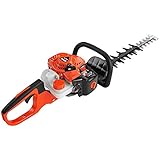
Best GasECHO 20-Inch 21.2cc Gas Hedge Trimmer (HC-2020)
20" Gas, 21.2cc 2-Stroke
Battery trimmers have taken over most suburban yards, but a gas trimmer still makes sense in one situation: long hedgerows, far from an outlet, where you want to work for hours on a tank you can refill in a minute. The ECHO HC-2020 is our pick for that job. It runs a 21.2cc professional-grade 2-stroke engine and drives 20-inch double-sided, double-reciprocating blades. ECHO's RazorEdge blades have three sharpened edges on each tooth, and the company says that gives the trimmer twice as many cutting edges as competing models. Maintenance is designed to be done in the field. The air filter cover comes off without tools, the two-stage air filtration extends service intervals, and a grease fitting on the gearbox makes lubrication a two-minute job. ECHO lists it at 10 pounds dry, with a 13.2-ounce transparent fuel tank, and backs it with a 5-year consumer warranty. The costs are real, though. It is heavier and much louder than any battery trimmer here, it needs mixed 2-stroke fuel, and a carburetor left with old fuel over winter will not start in spring. If you trim a few shrubs a month, buy battery. If you are cutting a quarter mile of farm hedge, buy this.
Pros
- 21.2cc professional-grade 2-stroke engine
- 20-inch double-sided, double-reciprocating RazorEdge blades
- Tool-free air filter cover and two-stage air filtration
- Grease fitting for easy gearbox maintenance
- 5-year consumer warranty
Cons
- About 10 pounds dry, plus fuel, and loud enough to need hearing protection
- Needs mixed fuel, seasonal carburetor care and more maintenance than battery tools
The Bottom Line
The trimmer for rural properties and long hedgerows where all-day runtime matters more than noise and upkeep.

Best Pole Hedge TrimmerEGO Power+ 20-Inch Hedge Trimmer Attachment for Multi-Head System (HTA2000)
20" Pole Hedge Attachment, 56V
Any hedge taller than about your own height is a reason to stop and think before climbing a stepladder with a running trimmer. A pole hedge trimmer solves that problem, and EGO's HTA2000 is the one we recommend because it plugs into a system many yard owners already have. It is an attachment for EGO's Multi-Head System, compatible with the PH1400 and PH1420 power heads and the EP7500 extension pole, and EGO also sells it as the MHT2001 kit with a power head, 2.5Ah battery and charger. The cutting head uses 20-inch steel blades with a 1-inch cut capacity, the same rating as EGO's flagship handheld trimmer, and it articulates through 12 positions. That articulation is the whole point: angle the head flat to cut across the top of a 9-foot hedge while you stand on the ground, or straighten it to run down the face. The construction is IPX4 water resistant, so damp morning foliage is not a concern. EGO quotes up to 35 minutes of runtime with the kit's 2.5Ah battery, which is enough for tops and high faces when the rest is done with a handheld trimmer. The catch is cost if you do not own a power head, and pole trimming is genuinely slower and more tiring than handheld work on anything below shoulder height.
Pros
- 20-inch steel blades with a 1-inch cut capacity
- 12-position articulating head for cutting tops and faces from the ground
- IPX4 water-resistant construction
- Fits EGO PH1400 and PH1420 power heads and the EP7500 extension pole
- Also sold as the MHT2001 kit with power head, battery and charger
Cons
- Needs an EGO power head, so it is expensive if you are starting from nothing
- A pole trimmer is slower and more tiring than a handheld one on low hedges
The Bottom Line
The safe way to reach the top of a tall hedge without a ladder, and a natural add-on if you already run an EGO power head.
4. Battery vs Corded vs Gas
Battery trimmers are now the default for good reason. They start instantly, are quiet enough to use without annoying the neighbors, need no fuel or tune-ups, and the best of them cut as well as gas did a decade ago. The real cost is the battery. If you already own a platform, a bare tool is cheap; if you do not, choose the trimmer whose battery runs your mower, blower and string trimmer as well.
Corded trimmers are the cheapest and lightest option and never run out of charge. They make sense when every hedge is within reach of an outlet and a 100-foot cord. The limits are range and the cord itself, which drags through flower beds and is easy to cut. Use an outdoor-rated extension cord sized for the length: a light 16-gauge cord is fine for a 3.8-amp trimmer at 100 feet, but thinner cords waste power and run warm.
Gas trimmers are now a specialist tool. They suit long rural hedgerows, commercial crews and anyone working far from power for hours at a time. You pay for that runtime with weight, noise, mixed fuel and the maintenance every small 2-stroke engine needs. For a suburban lot, we would not buy one.
| Type | Best for | Strengths | Weaknesses |
|---|---|---|---|
| Battery | Most yards | Quiet, instant start, no fuel, shares packs | Battery cost if you have no platform |
| Corded | Small yards near an outlet | Light, cheap, unlimited runtime | Cord range and cord-cutting risk |
| Gas | Long hedgerows, rural properties | All-day runtime, strong | Heavy, loud, fuel and upkeep |
| Pole (battery or gas) | Hedges over head height | Reach without a ladder | Slower and tiring at low heights |
Battery voltage is less important than it looks. A 56V or 40V trimmer generally has more headroom in thick growth than an 18V or 20V one, but blade design, motor quality and gearing matter as much. If you are deciding between platforms, our ranking of the best cordless tool brands and our explainer on how cordless batteries work will save you from buying into the wrong system.
5. Which Blade Length for Which Hedge
Blade length is about reach and speed, not cutting strength. A longer bar covers more hedge per pass and reaches farther across the top of a wide hedge. A shorter bar is lighter, easier to steer and better for rounded shapes. The mistake is assuming longer is always better: a 26-inch bar is clumsy around a dozen small shrubs.
For foundation plantings, boxwood balls and small shrubs, 16 to 20 inches is plenty and easier to control. For the typical suburban hedge, a fence-line privet or a row of holly, 22 to 24 inches is the sweet spot, which is why most of our picks sit there. Long, straight runs of arborvitae, laurel or beech are where a 26-inch bar earns its extra weight.
Width matters too. To keep the top of a hedge flat, you need to reach at least halfway across from each side. A 4-foot-wide hedge is comfortable with a 24-inch blade and long arms; a 6-foot-wide hedge usually means a stepladder or a pole trimmer for the middle of the top. Measure before you buy.
Finally, think about the shape you want. Formal hedges with crisp lines reward a longer bar held level, because you can use it almost like a straightedge. Informal, rounded shrubs reward a shorter, lighter tool you can sweep in arcs. Many people with a mix of both are best served by a 22- to 24-inch trimmer and a pair of hand shears for the detail.
6. Dual-Action Blades, Speed and Vibration
Every trimmer on our list uses dual-action blades, where both blades move against each other rather than one moving over a fixed blade. Dual action cuts faster and, because the moving masses partly cancel each other, vibrates less. Single-action trimmers still exist at the very bottom of the market, and we would skip them unless the trimmer is for very occasional use.
Double-sided blades, with teeth on both edges, let you cut on both the forward and back sweep. That is how professionals work a hedge face, in long, overlapping arcs, and it is noticeably faster than single-sided blades that only cut in one direction. The Makita, ECHO and most of the battery trimmers here are double-sided.
Strokes per minute is a useful number, with caveats. Higher speed gives a cleaner cut on soft, leafy growth, because each stem is sheared before it can bend away. But speed under load matters more than free speed, which is why brushless motors and good gearing count. The EGO HT2601 at up to 3,400 strokes per minute and the HT2411 at up to 3,000 sit at the top of this list; most others run around 2,700 to 2,800.
Vibration is the hidden cost of a cheap trimmer. Ten minutes of buzzing handles is fine; an hour leaves your hands numb. Makita builds five cushioned elements into the XHU02Z housing for that reason, and both dual-action blades and well-balanced motors help. If you have a lot of hedge to cut, this is worth paying for.
7. Weight, Balance and the Ten-Minute Test
A hedge trimmer is held out in front of your body, often at shoulder height or above, which makes every extra pound feel like three. A tool that feels light in the store can be miserable after ten minutes of holding it level across the top of a hedge. That is why we treat weight and balance as a buying criterion, not an afterthought.
The rough ranges are worth knowing. Light corded trimmers like the BEHTS300 weigh about 5.5 pounds. Battery trimmers usually land between 6 and 10 pounds once the pack is fitted, with bigger batteries pushing the total up. Gas trimmers start around 10 pounds dry, before fuel. A pole trimmer feels heavier still, because the weight sits at the end of a long lever.
Balance matters as much as total weight. A trimmer that is heavy at the back, where the battery or engine sits, feels lighter when held level than one with the weight forward. Rotating rear handles, like those on the EGO HT2601 and Greenworks 40V, let you keep your wrist straight when the blade is turned vertical, which is where fatigue sets in fastest.
If you can, hold the trimmer at arm's length for a minute before you buy. If that is uncomfortable in the store, it will be worse in July. For older users or anyone with shoulder trouble, a lighter tool with a smaller battery is often the better buy, even if it means a recharge halfway through the job.
8. When You Need a Pole Hedge Trimmer
A pole hedge trimmer puts an articulating cutting head on the end of a shaft, so you can reach the top and upper face of a tall hedge from the ground. If your hedge is taller than you are, or wider than you can reach across, one will make the job both faster and safer than working from a stepladder.
Ladders and hedge trimmers are a bad combination. You are holding a running tool with both hands, so you cannot hold the ladder, and the natural instinct to lean in for one more stretch is exactly how people fall. If you must use a ladder for hedge work, a tripod orchard ladder is far more stable on soft ground than a stepladder; our guide to the best telescoping ladders covers what to look for in a ladder that has to stand on uneven ground.
The best pole trimmers have heads that articulate through many positions, so you can lay the blade flat across the top or angle it down the face. EGO's HTA2000 attachment offers 12 positions. Many multi-head systems also accept a pole saw head, which is useful if you have overhanging limbs as well as tall hedges; see our guide to the best pole saws for how those compare.
Pole trimmers are not a replacement for a handheld trimmer. They are slower, more tiring at waist height and harder to control on detail work. Most people with tall hedges are best served by doing the sides with a handheld trimmer and only switching to the pole for the top and the upper third of the faces.
9. Hedge Trimmer Safety
The classic hedge trimmer injury is a cut to the hand that is not on the trigger, usually while clearing a jam or steadying a branch. Every trimmer on our list needs two hands to run, with a switch on the front handle as well as the rear trigger. Never defeat that interlock, and never reach into a hedge to clear a jam with the tool running or the battery in.
Wear safety glasses at the very least; clippings, dust and sap fly toward your face. Gloves, long sleeves and hearing protection are sensible, and hearing protection is essential with a gas trimmer. Keep children and pets well away, because a trimmer can throw debris several feet.
Before you start, walk the hedge and look for hidden wire, fencing, string lights and irrigation lines. Check for active bird nests, too: many songbirds nest in hedges in spring and early summer, and in the United States most native species and their active nests are protected by federal law. Light trimming late in the season is the safer habit.
With a corded trimmer, run the cord over your shoulder and behind you, so it trails away from the blade, and use the cord retention slot so it cannot pull loose. Never trim near overhead power lines; keep the tool and any pole at least 10 feet away, and call your utility if branches are touching a line. Cutting from a ladder with a running trimmer is the single riskiest habit in hedge work, and it is the reason pole trimmers exist.
10. Blade Care and Sharpening
A hedge trimmer's blades need more care than most people give them. Sap and resin build up between the blades after every session, which slows the cut, makes the motor work harder and drains batteries faster. Wipe the blades after use, brush out the debris, and spray them with a resin solvent or light lubricating oil before you put the trimmer away. Use the blade cover in storage.
Blades dull over time, and a dull trimmer tears leaves instead of shearing them, which leaves brown edges on the hedge a week later. You can touch up most blades with a flat file, following the existing bevel on each tooth and taking the same number of strokes on each. Trimmers with serviceable blades, like the EGO HT2411 and the HT2601's serviceable gearbox, make that easier because the blades can be removed.
Check the blade bolts at the start of every season and after hitting anything hard. A loose blade assembly increases vibration and can let branches jam between the blades. Bent or chipped teeth should be filed smooth; badly damaged blades should be replaced.
For gas trimmers, grease the gearbox through the fitting at the interval in the manual, clean the air filter, and either run the tank dry or use stabilized fuel before winter storage. For battery trimmers, store packs indoors at moderate temperatures and partly charged rather than fully charged or flat. Those habits are the difference between a trimmer that lasts three seasons and one that lasts ten. The same routine applies to the rest of your battery yard kit, from your leaf blower to your weed eater.
11. Common Mistakes to Avoid
Buying on Blade Length Instead of Cut Capacity
A long blade with a 3/4-inch rating will still stall on woody growth. Check the cut capacity first and compare it with the thickest stems in your hedge. If you trim once a year or are taking over a neglected hedge, a 1-inch or higher rating saves you a lot of frustration.
Buying Into a New Battery Platform for One Tool
A bare trimmer is cheap; a battery and charger are not. If you already own batteries from a brand that makes a decent trimmer, buy that one. If you own none, pick the platform that also covers your mower, blower and string trimmer, not just the best trimmer in isolation.
Trimming From a Stepladder
Holding a running trimmer with both hands means nothing is holding you to the ladder, and leaning for one more reach is how falls happen. Use a pole trimmer for tall hedges, or at least a tripod orchard ladder on firm ground, and never work above shoulder height from a ladder.
Forcing Branches Thicker Than the Rating
Jamming thick wood into the teeth chips blades, strains the gearbox and leaves a ragged cut. Anything over the trimmer's rated capacity should be cut with loppers or a pruning saw first. Your trimmer will last longer and the hedge will recover faster from clean cuts.
Putting the Trimmer Away Dirty
Sap dries between the blades and makes the next session slower, louder and harder on the battery. Brush off debris, wipe the blades, spray them with resin solvent or light oil, and fit the blade cover. It takes two minutes and is the single best thing you can do for blade life.
Before You Buy
Also Needed for This Job
12. Frequently Asked Questions
What is the best hedge trimmer for most homeowners?
For a typical suburban hedge, a 22- to 24-inch battery trimmer with a 1-inch cut capacity is the best balance of power, weight and convenience. The EGO HT2411 is our top pick. If you already own Makita, Greenworks or BLACK+DECKER batteries, buy that brand's trimmer instead, because the battery is the expensive part.
Is a cordless hedge trimmer as good as a gas one?
For homeowners, yes. The best battery trimmers now match small gas trimmers in cutting performance, start instantly, are far quieter and need no fuel or carburetor care. Gas still wins on runtime for long hedgerows and commercial work, because you can refuel in seconds, but most yards will never use that advantage.
What blade length do I need for a hedge trimmer?
For small shrubs and rounded shapes, 16 to 20 inches is easier to control. For typical hedges, 22 to 24 inches is the sweet spot. Long, straight hedges benefit from 26 inches. Remember that you need to reach at least halfway across the top from each side, so wide hedges may need a pole trimmer.
What does cut capacity mean on a hedge trimmer?
Cut capacity is the thickest branch the manufacturer says the blades can cut, set mainly by the gap between the teeth. Budget trimmers are usually rated at 5/8 to 3/4 inch, better battery models at 1 inch, and the EGO HT2601 at up to 1.2 inches. Treat it as a maximum, not an everyday size.
How often should hedge trimmer blades be sharpened?
For most homeowners, once a season is enough, or sooner if the trimmer starts tearing leaves rather than cutting cleanly. Clean and oil the blades after every use, because sap buildup causes much of the poor cutting people blame on dull blades. Use a flat file and follow each tooth's existing bevel.
Can a hedge trimmer cut branches?
Only small ones within its rated cut capacity, typically 3/4 to 1 inch. Some corded trimmers, like the BLACK+DECKER BEHTS300, add a small saw at the tip for branches up to 1.5 inches. Anything thicker should be cut with loppers, a pruning saw or a pole saw to avoid damaging the blades.
Do I need a pole hedge trimmer?
You need one if your hedge is taller than you can comfortably reach or wider than you can reach halfway across. A pole trimmer lets you cut the top from the ground instead of from a ladder. For hedges below head height, a handheld trimmer is faster and easier to control.
Related Yard Tool Guides
Buyer's Guide
Best Pole Saws
For limbs above the hedge line: battery, manual and gas pole saws compared on reach, bar length and weight.
Buyer's Guide
Best String Trimmers
The other tool every hedge owner needs, compared across gas and battery models.
Buyer's Guide
Best Cordless Tool Brands
Pick the battery platform before the trimmer, and the rest of your yard tools get cheaper.
The Bottom Line
Buy for cut capacity first, then blade length, then the battery you already own. For most yards that means a 1-inch, 22- to 24-inch battery trimmer, and the EGO HT2411 is the one we would choose if you are starting fresh. Makita, Greenworks and BLACK+DECKER owners should stay on their platforms.
Corded is still the best value for small yards near an outlet, gas only earns its keep on long rural hedgerows, and a pole trimmer is the safe answer for anything taller than you are. Keep the blades clean and oiled, and whichever trimmer you buy will cut cleanly for years.
More in Lawn & Yard Care
Guides in this category that pair with what you just read.
About the Author
Alex Rivers, Home Improvement Editor
Alex has spent over a decade working on residential and light commercial property maintenance, and now tests every tool, coating and machine that appears in these guides personally.