The 7 Best Weed Eaters in 2026
We tested 13 weed eaters the way homeowners actually use them: a lap around the house, along the driveway, and around the mailbox. Weight, line feed, and edging decided this list, not horsepower.
Alex Rivers
Home Improvement Editor
Last Updated
October 17, 2026
In This Guide
Almost nobody abandons a weed eater because it lacked power. They abandon it because it was heavy, because the line stopped feeding, or because reloading the spool turned a ten-minute job into an hour on the garage floor. We tested for those failures specifically. Here are the seven weed eaters that stayed in rotation all season.
Our Picks at a Glance
The Short Answer
EGO Power+ ST1521S Powerload (Best Overall). The one to buy if you want to stop thinking about your weed eater. It cuts well, it starts instantly, and reloading line is finally not a chore.
We may earn a commission when you buy through these links, at no extra cost to you. How we test
Best Overall
EGO Power+ ST1521S Powerload
1. What a Weed Eater Is Actually Good At
A weed eater, string trimmer, weed whacker, and weed wacker are all the same tool under different regional names. Understanding what the tool is genuinely designed to do prevents most buying disappointment, because a great deal of that disappointment comes from expecting it to do something else.
Where it excels: cutting grass and soft-stemmed weeds in places a mower physically cannot reach. Against a foundation, along a fence, around trees and mailbox posts, over a curb edge, and in the narrow strip between a driveway and a bed. This is the job it was designed for and it does it well.
Where it is adequate: creating a clean edge along a hard surface, if you have the technique or a tool with an edging mode. Holding a trimmer sideways and freehanding an edge works but produces a wavy line; a rotating head with a guide wheel produces a straight one.
Where it struggles: anything woody or thick-stalked. Saplings, brambles, established brush, and dense stands of tall stalky weeds require either a gas trimmer with real torque, a brush blade rather than string, or a dedicated brush cutter. Pushing a lightweight battery weed eater into that work is how motors get burned out.
Where it should never be used: against the bark of a young tree. String at high speed strips bark on contact, and repeated trimming around a trunk girdles and eventually kills the tree. Use a mulch ring or a tree guard instead, and stop the string well short of the trunk.
The Numbers Don't Lie
5.5 lb
Lightest tool here, versus 12+ for the heaviest
5 sec
Powerload line reload versus 10+ min by hand
20-45 min
Realistic battery runtime under load
12-16"
Cutting swath range across this guide
2. Battery vs Gas for a Homeowner
For most people reading this, the honest answer is battery, and the reasoning has changed considerably in the last several product generations.
The Case for Battery
A battery weed eater starts instantly every single time. There is no fuel to mix, nothing to gum up over winter, no spark plug to foul, no air filter to clean, and no pull cord. It is quiet enough to use at eight on a Saturday morning without becoming the neighbor everyone complains about. And for the work a typical maintained property actually presents, the cutting performance of a modern brushless tool at 40V and above is genuinely equivalent to mid-tier gas.
The Case for Gas
Gas wins on two axes and only two. The first is runtime: a fuel can gives you unlimited working time, while a battery gives you 20 to 45 minutes and then needs an hour on a charger. The second is torque in heavy growth, where a gas engine holds speed through stalky weeds that make battery motors bog. If your property is measured in acres or your edges have genuinely gotten away from you, gas remains the right answer.
The Deciding Question
Ask how long your trimming actually takes. If a full lap of your property is under half an hour of trigger time, battery is the better tool and the maintenance savings compound every year. If it is longer than that, or if you regularly cut growth thick enough to make a mower struggle, gas or an 80V battery platform with a spare pack is the honest recommendation.
| Factor | Battery | Gas |
|---|---|---|
| Starting | Instant, every time | Pull cord, needs fresh fuel |
| Runtime | 20-45 minutes | Unlimited with fuel |
| Heavy weeds | Bogs below 40V | Powers through |
| Maintenance | Line replacement only | Fuel mix, plugs, filters |
| Noise | Conversation level | Hearing protection required |
3. The 7 Best Weed Eaters in 2026 — Tested & Ranked
We tested each tool the way a homeowner uses one: a full lap of a suburban property, edging a driveway and sidewalk, trimming around trees, posts, and a chain link fence, and clearing one deliberately neglected corner. We tracked weight fatigue at 15 and 30 minutes, line consumption, and how long a reload took. These seven earned their place.

Best OverallEGO Power+ ST1521S Powerload
56V Battery, 15" Swath, Powerload Head
We came into this testing expecting cutting power to separate the field and left convinced the head design mattered more. Reloading trimmer line is the reason weed eaters end up in the back of the garage, and EGO Powerload is the only system we tested that genuinely solves it. You feed a length of line straight through the head, press a button, and the motor winds it evenly in about five seconds. No spool removal, no winding by hand, no guessing which direction the arrow points. After a season of reloading every tool in this test repeatedly, that single feature changed which one we reached for. Cutting performance is a close second. The 56V brushless motor cleared everything a normal maintained property presents, including grass grown into a chain link fence and a neglected corner of tall weeds, without the audible bogging that lower-voltage tools showed on the same targets. The variable speed trigger is genuinely useful rather than a spec-sheet item, since running at half power for routine edging roughly doubles how long a battery lasts. What you pay for it is real money and real weight. With a large battery fitted, this is around a twelve-pound tool, which is noticeable after twenty minutes and considerably more than the lightweight options here. If your yard is small and tidy, the extra capability may be more than you need. For everyone else, it is the best tool in this guide.
Pros
- Powerload winds new line automatically at the press of a button, taking about five seconds instead of ten minutes
- Cutting power that genuinely rivals a mid-size gas trimmer, with no bogging in ordinary weeds
- Variable speed trigger so you can run at low power for routine work and save battery
- Starts instantly every time with no pull cord, no fuel mixing, and no seasonal maintenance
- Same batteries fit EGO mowers and blowers, which makes a second battery do double duty
Cons
- The most expensive option here once a battery and charger are included
- Heavier than compact battery trimmers at around 12 pounds with a large pack fitted
- Full-power runtime in heavy growth can drop below 30 minutes
The Bottom Line
The one to buy if you want to stop thinking about your weed eater. It cuts well, it starts instantly, and reloading line is finally not a chore.

Best LightweightWorx WG163 GT 3.0 20V
20V Battery, 12" Swath, Convertible Edger
The specification that matters most on a weed eater is the one nobody markets: how it feels held out at arm length after fifteen minutes. At roughly five and a half pounds, the WG163 is dramatically lighter than the high-voltage machines, and in our testing it was the tool that household members who dislike yard work voluntarily chose. That matters more than a few percent of cutting speed. The edging conversion is the other genuine strength. Rotating the head 90 degrees and dropping the guide wheel turns it into an in-line edger in about three seconds without tools, and it cuts a clean, straight line along a driveway or sidewalk that no trimmer held at an angle can match. Most convertible trimmers do this badly; this one does it well enough to replace a dedicated edger on a normal suburban lot. Command Feed is the third practical advantage, advancing line with a thumb button rather than requiring you to bump the spinning head against the ground, which is awkward on gravel and impossible on a raised bed edge. The trade-off is straightforward and honest. This is a maintenance tool, not a clearing tool. Push it into stalky weeds or grass grown into a fence and it will bog and take several passes. On a small, regularly maintained lot, that limitation almost never comes up.
Pros
- At about 5.5 pounds it is light enough to hold one-handed with no fatigue
- Head rotates 90 degrees and a wheel drops down to convert it into a real in-line edger
- Command Feed advances line with a thumb button instead of bumping the head on the ground
- Telescoping shaft and rotating handle adjust to fit almost any user height
- Inexpensive, and the battery is shared across a wide Worx tool range
Cons
- Modest power that bogs in anything heavier than light grass and soft weeds
- 20 to 30 minutes of runtime from the compact battery pack
- Narrow 12-inch swath means more passes on larger areas
The Bottom Line
The weed eater most people in a household will actually pick up. Light, simple, and it edges properly, which most trimmers do not.

Best ValueRyobi ONE+ HP 18V Brushless
18V Battery, Adjustable Swath, Brushless
If someone in your household already owns a Ryobi ONE+ drill, blower, or mower, the math on this trimmer changes completely, because the bare tool costs a fraction of a full kit and the battery you already have does the work. That ecosystem effect is the single strongest argument for it, and it applies to a very large number of American garages. Judged purely on its own, it is still a strong tool. The brushless motor produces cutting performance well beyond what an 18V rating implies, clearing routine lawn edges, driveway borders, and around trees and posts without complaint. The adjustable cutting width is a genuinely useful feature: narrowing the swath reduces motor load and stretches runtime for routine work, while widening it covers ground faster on open areas. Being able to make that trade in the field is worth more than it sounds. Where it gives ground is the same place every value tool does. In the heaviest growth on our test property, thick stalky weeds along a neglected fence line, it bogged and needed multiple passes where the EGO went through in one. The head is a conventional bump-feed spool, so reloading is the traditional manual chore. And the plastic construction, while perfectly adequate for homeowner use, does not feel like it would survive being thrown into a truck bed daily. For a normal yard, none of that matters much.
Pros
- Brushless motor delivers far more cutting power than the 18V rating suggests
- Adjustable cutting width trades swath for runtime depending on the job
- Fits the huge ONE+ battery platform many households already own
- Light enough for a full lap of a suburban lot without arm fatigue
- Among the least expensive brushless tools in this guide
Cons
- Bogs in genuinely heavy stalky growth where higher-voltage tools power through
- Conventional bump-feed head with manual spool winding
- Plastic housing feels less rugged than jobsite-grade tools
The Bottom Line
The best value here by a clear margin, especially if there is already a ONE+ battery in your garage. Buy the bare tool and you are barely spending anything.

Best GasStihl FS 56 RC-E
Gas, 27.2cc 2-Stroke, Straight Shaft
There is a specific point where battery tools stop being the obvious answer, and the FS 56 RC-E is what sits on the other side of it. On our worst test area, a neglected bank of thick stalky weeds a couple of feet tall, every battery trimmer in this guide bogged, slowed, or needed repeated passes. The Stihl went through at steady throttle in a single pass without any change in engine note. Combined with runtime limited only by how much fuel you are willing to carry, it is simply a different class of tool for properties with real acreage or genuinely rough edges. The Easy2Start system addresses the objection that keeps most homeowners away from gas. Rather than needing a hard yank, it stores energy from a slow, easy pull in a spring and releases it to spin the engine, and in our testing it fired on the second pull from cold consistently, including after weeks of sitting. If your image of a gas trimmer is repeatedly yanking a cord in frustration, this is not that. What you take on is a maintenance relationship. You mix two-stroke fuel at the correct ratio every time, you stabilize or drain fuel before storage, you replace spark plugs and air filters, and you wear hearing protection. It also vibrates more than any battery tool, which is felt after an hour. For the right property those costs are worth paying; for a quarter-acre lot they are not.
Pros
- Cuts heavy stalky growth that stops every battery tool in this guide
- Runs as long as you have fuel, which matters on acreage
- Easy2Start makes pull starting genuinely easy rather than a wrestling match
- Dealer-backed with excellent parts availability and serviceability for decades
- Professional build quality that tolerates real abuse
Cons
- Two-stroke fuel must be mixed correctly, and straight gas will destroy the engine
- Loud enough that hearing protection is genuinely necessary
- More vibration than any battery tool over a long session
The Bottom Line
Buy gas when the job is bigger than a yard: acreage, fence lines, and growth that has gotten away from you. For a suburban lot it is more machine than you need.

Best BudgetBLACK+DECKER LSTE525 20V MAX
20V Battery, 12" Swath, PowerCommand + Edger
Every guide needs an honest budget pick, and the LSTE525 is ours. It typically ships as a complete kit with two batteries at a price well below the bare tool cost of premium options, which for a small townhouse lot or a condo yard is genuinely the correct economic decision. Pretending otherwise would be snobbery. What it does well is straightforward. It trims light grass around a foundation, along a fence, and around trees and posts cleanly and quietly. The automatic feed spool advances line without bumping, which is easier for casual users than a bump head. It converts to a wheeled edger for driveway borders, and while the conversion is less refined than the Worx system, it works. The PowerCommand dial is a real feature: switching to the runtime setting noticeably extends how long a charge lasts for light work, and switching to power gives a burst when needed. Its limits are exactly what the price implies. It is the least powerful tool here and will stall in anything stalky or thick. Runtime is short and charging is slow, though the second included battery mitigates that. And there is visible flex in the shaft and guard that better tools do not have. Buy it understanding it is a maintenance tool for a small maintained yard, and it is good value. Buy it expecting to clear a neglected lot and you will be disappointed within an hour.
Pros
- Among the least expensive complete kits here, typically including two batteries
- PowerCommand dial lets you switch between maximum power and maximum runtime
- Converts to a wheeled edger with a rotating head, like the Worx
- Automatic feed spool advances line without bumping the head
- Light and easy for anyone to operate with minimal instruction
Cons
- Least powerful tool in this guide, limited to light grass and soft weeds
- Shorter runtime and slower recharging than premium platforms
- Build quality reflects the price, with more flex in the shaft and guard
The Bottom Line
The right buy for a genuinely small, tidy lot on a tight budget. Do not ask it to clear anything, and it will do its job for years.
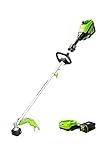
Best for Big YardsGreenworks Pro 80V 16"
80V Battery, 16" Swath, Attachment Capable
The standard complaint about battery weed eaters is that they run out of power and runtime before a large property is finished, and the Greenworks 80V is the direct rebuttal. Its higher voltage delivers meaningfully more torque, and in our heavy-growth testing it maintained cutting speed under load where 18V and 20V tools audibly bogged and required a second pass. Paired with the widest cutting swath in this guide at 16 inches, it clears long fence lines and rough property edges considerably faster than anything else in the battery category. Runtime is the other half of the case. The large 80V pack carries substantially more energy than compact batteries, and in our testing it completed a full circuit of a large property including several minutes of genuinely hard work without needing a swap. For a homeowner who wants nothing to do with two-stroke fuel but has more than a small lot, that combination is what makes going battery viable. The costs are physical. An 80V pack is heavy, and unlike total tool weight that you can partly ignore, this weight sits where you feel it. Within ten minutes it is noticeable and within thirty it is tiring, particularly for anyone with shoulder or wrist issues. Replacement packs are also expensive and the platform is smaller than EGO or Ryobi, so battery sharing across other tools is less likely. On acreage it earns its place; on a small lot it is unnecessary.
Pros
- Highest torque of any battery weed eater we tested, closing most of the gap to gas
- The widest 16-inch swath here, meaningfully faster on long fence lines
- Long runtime from the large 80V pack, enough for a big property in one charge
- Accepts attachments including a pole saw, edger, and cultivator on the same shaft
- Powers through thick weeds that stop 18V and 20V tools cold
Cons
- Heavy, and the weight is concentrated in a large battery you feel within ten minutes
- Proprietary 80V packs are expensive to replace compared to mainstream platforms
- Physically bulky to store in a crowded garage
The Bottom Line
The battery answer for a property that is genuinely too big for an 18V tool. Real power and real runtime, at the cost of real weight.

Best Multi-ToolHusqvarna 128LD
Gas, 28cc, Detachable Shaft Multi-Tool
The case for the 128LD is mostly about what else it can become. Its detachable shaft accepts a family of attachments, so a single engine you have already bought and already maintain can serve as a pole saw for high branches, a hedge trimmer, a lawn edger, and a cultivator. For a homeowner who would otherwise own several separate small engines, each requiring its own fuel, its own winter prep, and its own shelf space, that consolidation is a genuine saving in both money and garage clutter. As a weed eater on its own it is competent and unremarkable, which is meant as a compliment. The 28cc engine handled the heavy weeds that stopped the battery tools in our testing, Smart Start makes pull starting reasonable, and the build sits comfortably above budget big-box gas tools while below professional dealer models. Being available on a store shelf rather than through a dealer network suits most homeowners better. Two honest cautions. The detachable coupling is inherently a wear point. It is fine for years of normal homeowner use, but under heavy commercial-style use it can develop play that introduces vibration a one-piece shaft would not have. And the attachments cost real money individually, so the multi-tool economics only work if you genuinely buy and use them. If you only ever want a weed eater, other options here are better values for the money.
Pros
- Detachable shaft turns one engine into an edger, pole saw, hedge trimmer, or cultivator
- Splits in half for compact storage and easy transport in a car trunk
- Smart Start reduces pull resistance for easier cold starting
- Real gas power for heavy weeds at a lower price than dealer-only brands
- Sold in big-box stores rather than requiring a dealer visit
Cons
- The shaft coupling is a wear point that can develop play over years of hard use
- Two-stroke fuel mixing and seasonal maintenance apply as with any gas tool
- Attachments are sold separately and are not cheap
The Bottom Line
The value play if you want a pole saw and an edger too. One engine to buy, fuel, and store instead of three or four.
4. The Line Feed Problem Nobody Warns You About
More weed eaters are abandoned over line feed frustration than over any performance shortcoming. Here is what actually goes wrong and which head designs avoid it.
Bump Feed
The most common design. You tap the spinning head on the ground and centrifugal force releases a measured length of line. It is simple and reliable in operation, but reloading means removing the spool, winding fresh line by hand in the correct direction with the layers neat and parallel, and reassembling the head. Done wrong, and it is easy to do wrong, the line jams within minutes. This is the design behind most of the frustration.
Automatic Feed
The tool senses when line has shortened and advances it without any input from you. Convenient in operation, but it tends to consume line faster than bump feed because it advances whether or not you needed it to, and reloading is still the same manual spool-winding process.
Powered Load Systems
The genuine solution. You thread a length of line straight through the head and press a button, and the motor winds it evenly and correctly in a few seconds. EGO Powerload is the best-known implementation and it works exactly as advertised. If you trim weekly, this feature alone justifies a price premium.
Fixed-Line Heads
These abandon the spool entirely and accept individual pre-cut lengths of line that snap into the head. Replacing one takes seconds and nothing can weld or tangle. You do it more often since each piece is short, but the failure mode of a jammed spool disappears completely. Aftermarket fixed-line heads fit many popular trimmers and are a common upgrade for people who have given up on spools.
The Trick That Prevents Most Line Jams
Soak a new spool of trimmer line in water for a few hours before installing it. Nylon dries out and becomes brittle in storage, especially in a hot garage, and brittle line breaks constantly and welds to itself under heat. Hydrated line is more flexible, breaks far less, and feeds properly. Store spools in a sealed bag with a damp sponge and the problem largely disappears.
5. Weight, Balance, and Why They Decide Everything
The specification that determines whether a weed eater gets used is almost never printed prominently on the box. Here is what to check before buying.
Total weight is only half the story. A weed eater is held out from your body at the end of a long shaft, which multiplies the effective load your arms and shoulders carry. Two tools weighing the same can feel completely different depending on where the mass sits. A machine with the battery mounted near the handle feels dramatically lighter in use than one with weight concentrated at the cutting head.
Test it the right way in the store. Do not just lift it. Hold it in the operating position, out and slightly to one side, and count to thirty. If your shoulder is complaining at thirty seconds, it will be unbearable at fifteen minutes, and no amount of cutting power compensates.
Look for adjustability. A telescoping shaft and a rotating auxiliary handle let you position the tool for your height and grip rather than adapting to a fixed geometry. This matters enormously for shorter and taller users, and for anyone sharing the tool across a household with different heights.
Consider a shoulder strap. Most mid and full-size trimmers accept a harness that transfers weight from your arms to your torso. For anything over about eight pounds used for more than fifteen minutes at a time, a strap changes the experience more than any feature on the tool itself, and it typically costs very little.
Battery size is a weight decision, not just a runtime one. A larger pack extends runtime and adds weight at the same time. On a small property, a compact battery that runs 20 minutes and keeps the tool light is often the better choice than a large one you carry the whole time to get runtime you never use.
6. Technique: Trimming, Edging, and Scalping
Weed eaters reward technique more than most yard tools, and a few adjustments produce noticeably better results with the tool you already own.
Cut With the Tip, Not the Whole String
The string cuts most effectively at its outer end where speed is highest. Burying the whole length of string into thick grass bogs the motor, consumes line rapidly, and produces a ragged cut. Work the tip into the target and let it do the cutting, taking material in layers rather than trying to clear it all in one pass.
Know Which Way the Head Spins
Most trimmers spin counterclockwise, which throws clippings to the left and cuts most cleanly on the left side of the head. Working right to left along an edge means debris is thrown into the area already cut rather than back over the finished lawn, and the cut quality is better. Reversing that direction is why some people find their trimmer throws clippings all over a clean driveway.
Edging Requires a Different Motion
Trimming cuts horizontally; edging cuts vertically to create a defined line along a driveway or walkway. Rotating the head 90 degrees, or using a tool with a dedicated edging mode and guide wheel, gives a straight consistent line. Freehanding an edge by tipping the trimmer sideways works but produces a wavy result, and it wears line quickly against concrete.
Do Not Scalp
The most common technique error is cutting too low against a foundation or fence, taking grass down to bare soil. Scalped strips brown out, take weeks to recover, and invite weeds into the bare ground. Aim to match your mowing height rather than cutting as short as the tool will physically go.
7. Choosing and Refilling Line Without Frustration
Line is the consumable that determines cut quality, motor load, and how often you stop working. Choosing it well and loading it correctly removes most of the ongoing annoyance of owning a weed eater.
Diameter. Use what your tool is rated for, typically 0.065 inches for light battery tools and 0.080 to 0.095 for heavier battery and gas models. Thicker line is more durable and cuts heavier growth but increases motor load, reduces runtime, and on smaller tools can cause overheating. It is not a free upgrade.
Shape. Round line is cheapest and most durable and is right for routine grass. Twisted line runs quieter with less vibration. Square, star, and serrated profiles have actual cutting edges that slice through heavy weeds far more effectively, at the cost of breaking sooner against concrete and fences. Match the profile to what you are cutting rather than buying the most aggressive available.
Winding a spool correctly. Wind in the direction of the arrow molded into the spool, keep the line under tension so it lies flat, and lay the wraps side by side rather than crossing over each other. Crossed wraps are the single most common cause of a spool that jams after thirty seconds of use. Leave the correct length in the retaining notches before reassembling.
Pre-wound spools. For most homeowners these are worth the modest premium. They are wound correctly by machine, they eliminate the step where things go wrong, and swapping one takes under a minute. The cost difference across a season is small compared to the frustration avoided.
Keep spare line in the house, not the garage. Heat and dryness make nylon brittle. A spool stored through a hot summer in an uninsulated garage will break far more often than one kept indoors, and that difference is large enough to be mistaken for a defective tool.
Before You Buy
Also Needed for This Job
8. Frequently Asked Questions
What is the best weed eater?
For most homeowners the EGO Power+ ST1521S is the best overall choice, combining gas-comparable cutting power with a Powerload head that winds new line in about five seconds. For a small lot or anyone who wants the lightest tool, the Worx WG163 GT 3.0 at about 5.5 pounds is the easiest to use. For acreage or genuinely heavy growth, the gas Stihl FS 56 RC-E is still the right tool.
Is a weed eater the same as a string trimmer?
Yes. Weed eater, weed whacker, weed wacker, and string trimmer are regional names for the same tool, which cuts grass and weeds using a spinning nylon line rather than a blade. Weed Eater began as a brand name and became a generic term in much of the country, in the same way that many people say the brand name for a facial tissue.
Why does my weed eater line keep breaking?
The most common causes are brittle line that has dried out in a hot garage, worn eyelets in the cutting head that have developed a groove and cut the line, and trimming hard against concrete or chain link. Soak new spools in water for a few hours before use, replace the eyelet inserts, and use round line rather than an edged profile against abrasive surfaces.
How do I edge with a weed eater?
Rotate the cutting head 90 degrees so the line spins vertically rather than horizontally, then walk the tool along the hard surface with the line just at the edge of the pavement. Tools with a dedicated edging mode and a guide wheel produce a much straighter line than freehanding it by tipping the trimmer sideways, which tends to leave a wavy edge.
How long does a battery weed eater run?
Typically 20 to 45 minutes under real load. Light trimming at partial throttle extends that considerably, while sustained cutting in heavy weeds at full power can drop it below 30 minutes. Running a narrower cutting swath and using a variable speed trigger at lower settings both meaningfully extend runtime.
Can a weed eater cut thick weeds and brush?
String cuts grass and soft-stemmed weeds well, but woody stems, saplings, and brambles need either a gas trimmer with real torque, a brush blade fitted in place of the string head where the tool allows it, or a dedicated brush cutter. Forcing a lightweight battery weed eater through woody growth is the most common way to burn out its motor.
9. Common Weed Eater Mistakes
Almost every complaint about a weed eater comes down to one of these four things, and none of them are solved by buying a more powerful tool.
Trimming Against a Young Tree Trunk
Nylon line at full speed strips bark on contact, and repeated trimming around a trunk girdles the tree and eventually kills it. The damage is slow enough that most people never connect the two. Put a mulch ring or a trunk guard around young trees and stop the string well short of the bark.
Storing Line in a Hot Garage
Nylon dries out and becomes brittle with heat and time, and brittle line snaps constantly and welds to itself on the spool. People replace perfectly good tools over this. Keep spare spools indoors, and soak new line in water for a few hours before installing it.
Buying on Voltage Instead of Weight
A powerful high-voltage tool that is tiring to hold gets used less than a lighter one with less cutting power. Unless you regularly cut heavy stalky growth, the extra torque is capability you rarely use, paid for in fatigue you feel every time. Hold the tool in the operating position for thirty seconds before deciding.
Burying the Whole String Into Thick Grass
The line cuts at its tip where speed is highest. Plunging the full length of string into dense growth bogs the motor, burns through line, and gives a ragged cut. Work the tip in and take the material down in layers instead of trying to clear it in a single pass.
Everything Else About Weed Eaters
Related Yard & Tool Guides
Buyer's Guide
Best String Trimmers
The same category from a spec angle: shaft geometry, line diameter, and gas versus battery power.
Buyer's Guide
Best Cordless Leaf Blowers
Finish the job you just started. Battery blowers ranked by CFM, runtime, and noise.
All Guides
Browse All Best Lists
Every hands-on tested guide we have published, organized by category.
The Bottom Line
The best weed eater is the one you will actually pick up every week, which usually means the lightest tool with enough power for your yard and a line feed system that does not fight you. The EGO Power+ ST1521S is our overall pick because Powerload solves the one problem everyone hates. The Worx WG163 GT 3.0 wins on weight and edging for small lots, and the Stihl FS 56 RC-E is still the answer for acreage.
And before you buy anything, hold it out at arm length and count to thirty. That test predicts satisfaction better than any spec on the box.
More in Lawn & Yard Care
Guides in this category that pair with what you just read.
About the Author
Alex Rivers, Home Improvement Editor
Alex has spent over a decade working on residential and light commercial property maintenance, and now tests every tool, coating and machine that appears in these guides personally.