The 7 Best Cordless Leaf Blowers in 2026
We timed real runtime to shutdown, measured clearing power on wet and dry leaves, and recorded noise on 12 cordless blowers across every major battery platform. Only 7 earned a spot.
Alex Rivers
Home Improvement Editor
Last Updated
October 17, 2026
In This Guide
Cordless leaf blowers stopped being underpowered several product generations ago. The problem now is runtime, and it is the specification manufacturers are least honest about. A blower rated for 90 minutes will give you fifteen at the setting you actually need for wet leaves. Here is how to read those numbers properly, and the seven blowers that finish real cleanups.
Our Picks at a Glance
The Short Answer
EGO Power+ LB6504 650 CFM (Best Overall). The cordless blower that genuinely replaces a gas handheld. Enough power for wet leaves and the best platform to build around.
We may earn a commission when you buy through these links, at no extra cost to you. How we test
Best Overall
EGO Power+ LB6504 650 CFM
1. Where Cordless Blowers Now Beat Gas
The comparison between battery and gas blowers has changed substantially, and the remaining gas advantages are narrower and more specific than they used to be.
Clearing power is no longer the gap. High-voltage cordless blowers at 600 CFM and above match or exceed most gas handheld blowers on both air volume and air speed. In our testing the EGO and Greenworks units cleared soaked matted leaves as effectively as gas handhelds, which was not true of battery blowers a few product generations ago.
Noise is a decisive cordless advantage. A battery blower at around 65 dB is roughly conversation level at the operator position and largely unremarkable three houses away, while a gas blower at 95 dB carries through walls and windows. Because decibels are logarithmic, that gap is far larger than the numbers suggest, and it increasingly matters as municipalities restrict gas blower use.
Instant start and no maintenance. No fuel mixing, no pull cord, no carburetor gumming up over the winter, no spark plugs, no air filters, and no fuel stabilizer. For a tool used a handful of times a year, gas equipment failing to start after storage is a genuinely common frustration that cordless eliminates entirely.
Where gas still wins: sustained runtime and backpack output. If your cleanup runs for hours, a fuel can beats any battery, and the very high output backpack units above 900 CFM have no cordless equivalent. On acreage with a heavy leaf drop, gas remains the right answer.
The Numbers Don't Lie
473-730
CFM range across this guide
15-40 min
Real runtime depending on speed setting
~65 dB
Typical cordless blower noise level
2x
Runtime gain from halving the speed setting
2. Runtime: The Number Manufacturers Are Least Honest About
Advertised runtime figures on cordless blowers are the least reliable specification in outdoor power equipment, and understanding why prevents most buying disappointment.
Advertised Runtime Assumes the Lowest Setting
A blower advertised at 90 minutes is almost always quoting runtime at its lowest speed with its largest available battery. That setting is useful for sweeping a dry patio and useless for moving leaves. At the setting you actually need for yard cleanup, expect a fraction of the quoted figure, often fifteen to twenty-five minutes.
Power Draw Scales Steeply With Speed
Fan power consumption rises far faster than fan speed, which is why halving your speed setting can more than double runtime. This is the single most useful thing to know about operating a cordless blower: working at a moderate setting and reserving full power for stubborn spots dramatically extends how long you can work.
Battery Capacity Is the Other Half
Runtime scales directly with amp-hours, so a large pack runs proportionally longer than a compact one on the same tool. Compare watt-hours, voltage multiplied by amp-hours, when comparing across platforms, because amp-hour figures alone are not comparable between a 40V and an 80V system.
Plan for Two Batteries
For any property with a real fall leaf drop, two batteries is the practical configuration. One works while the other charges, and a swap takes seconds. Two mid-size packs typically cost less than one very large pack and provide redundancy as the first ages.
| Setting | Typical Runtime | Best For |
|---|---|---|
| Low / cruise | 45-90 min | Dry patios, light sweeping |
| Medium | 25-40 min | General dry leaf cleanup |
| High | 15-25 min | Heavy or damp leaves |
| Turbo / boost | 10-15 min | Short bursts on matted spots |
3. The 7 Best Cordless Leaf Blowers in 2026 — Tested & Ranked
We cleared a dry-leaf driveway, a rain-soaked matted lawn section, and pine needles in gravel with each blower, timed runtime to shutdown at both medium and maximum settings, measured noise at the operator, and recorded fatigue across a 30-minute session. These seven earned their place.

Best OverallEGO Power+ LB6504 650 CFM
56V, Variable Speed + Turbo, Brushless
Two things make the LB6504 the default recommendation. The first is raw capability: 650 CFM of air volume paired with 180 MPH of air speed is enough to lift and move a layer of rain-soaked matted oak leaves rather than pushing the mat around, which is the specific test that separates real blowers from patio tools. In our side-by-side testing, lower-powered cordless blowers had to work at that same test area repeatedly while the EGO cleared it on a single pass. The second is control. The variable speed dial lets you set a working level rather than holding a trigger at whatever the tool defaults to, and it matters more than it sounds because most yard work does not need full power and running at half speed roughly doubles runtime. The separate turbo button then gives you a burst for stubborn spots without changing your dial setting. Together they make the tool feel adjustable in a way most cordless blowers are not. The platform argument is the third factor. EGO 56V covers mowers, trimmers, chainsaws, snow blowers, and pressure washers, so batteries bought for this blower do useful work elsewhere. The honest costs are runtime and balance. Sustained turbo use empties a large battery in around fifteen minutes, and the tool is front-heavy enough that a thirty-minute session is felt in the wrist and forearm.
Pros
- 650 CFM and 180 MPH put it in gas-handheld territory, clearing wet matted leaves in a single pass
- Variable speed dial plus a separate turbo button gives both fine control and burst power
- Runs quiet enough at moderate settings to work without hearing protection
- Part of the largest and most mature cordless outdoor tool platform available
- Well-sealed housing that has held up to damp autumn conditions without issue
Cons
- Roughly 15 minutes of runtime at turbo, so a real cleanup needs a second battery
- Front-heavy balance is noticeable after twenty minutes of continuous use
- Premium price when bought as a kit with a large battery and charger
The Bottom Line
The cordless blower that genuinely replaces a gas handheld. Enough power for wet leaves and the best platform to build around.

Best ValueRyobi 40V HP Whisper Series 730 CFM
40V, Brushless, Low-Noise Design
Ryobi took a different design approach with the Whisper Series, optimizing the fan and housing for high volume at reduced noise rather than chasing peak air speed. The result is 730 CFM, the highest air volume in this guide, delivered at a sound level that is genuinely quieter than competitors producing less air. On a residential street in the early morning, that combination is arguably more useful than raw clearing power. On dry leaves it was the fastest tool in our test group, moving a wide swath of material forward efficiently, and the wide nozzle takes full advantage of the volume. The variable speed trigger with a cruise control lock lets you set a working level without holding the trigger, which reduces hand fatigue over a long session considerably. The Ryobi 40V platform is large and widely stocked, so if you already own a 40V mower or trimmer the effective cost is just the bare tool. The trade-off shows up on wet leaves. High volume with moderate air speed pushes a matted layer around rather than lifting it, and in our soaked-leaf test it needed several passes where the higher-MPH EGO cleared in one. Runtime also drops sharply at the top speed setting, which is where you end up working on wet material. For dry autumn leaves and general cleanup it is excellent value; for consistently wet conditions, prioritize air speed instead.
Pros
- 730 CFM is the highest air volume of any cordless blower in this guide
- Whisper Series design is genuinely quieter than competitors at similar output
- Fits the very large Ryobi 40V outdoor platform, likely already in the garage
- Variable speed trigger with a cruise control setting for extended use
- Costs meaningfully less than premium 56V and 80V blowers
Cons
- High air volume with moderate air speed means wet matted leaves take more passes
- Runtime drops sharply at the highest speed setting
- Housing feels less substantial than jobsite-grade blowers
The Bottom Line
The most air volume per dollar in cordless, and noticeably quieter than the competition. The value pick for dry leaf cleanup.

Best PowerGreenworks Pro 80V 730 CFM Blower
80V, Brushless, High Output
Most cordless blowers make a trade between air volume and air speed, and the Greenworks Pro 80V largely refuses to. Its higher-voltage platform supplies enough current to spin a large fan fast, producing both high CFM and high MPH simultaneously, which is exactly what you need for the hardest material. In our wet matted leaf test it performed comparably to a mid-size gas handheld, lifting and moving a soaked layer that gave the lower-voltage blowers real difficulty. It also cleared pine needles embedded in gravel more effectively than anything else in the cordless group. Runtime holds up better than you might expect, because the large 80V pack carries substantially more energy than compact 40V and 56V batteries. Working at a moderate setting it comfortably covered a full residential cleanup, and even at higher settings it outlasted several nominally more efficient tools simply on capacity. Battery sharing across Greenworks mowers, trimmers, and chainsaws extends the value if you are building out that platform. The costs are physical and financial. The large battery makes this a heavy tool to hold out in front of you, and a thirty-minute session is genuinely tiring in a way the lighter blowers are not. The 80V packs are proprietary and expensive to replace. And it is louder than the noise-optimized designs at similar output, which matters if neighbor relations are a consideration.
Pros
- The 80V platform delivers the strongest sustained output of any cordless blower we tested
- High air volume and high air speed together, rather than trading one for the other
- Cleared deeply matted wet leaves as effectively as a mid-size gas handheld
- Good runtime from the large 80V pack even at higher settings
- Shares batteries with Greenworks mowers, trimmers, and chainsaws
Cons
- Heavy, with a large battery that makes extended one-handed use tiring
- Proprietary 80V packs are expensive to replace
- Louder than the Whisper Series designs at comparable output
The Bottom Line
The most capable cordless blower here for genuinely difficult material. Real gas-equivalent power at real weight.

Best for M18 OwnersMilwaukee M18 FUEL Dual Battery Blower
Dual 18V, Brushless, 600 CFM
Milwaukee solved the voltage problem by running its high-output blower on two standard M18 packs in series rather than launching a dedicated outdoor platform. For anyone already invested in M18 tools, and that is a very large group among both tradespeople and serious DIYers, the batteries are already on the shelf and adding this blower costs only the bare tool. That changes the value calculation more than any specification does. The tool earns the choice on its own merits too. At 600 CFM with strong air speed it does genuine leaf work, clearing damp leaves competently and falling only slightly short of the EGO on the hardest matted material. The construction is unmistakably jobsite grade, with a housing and controls built to survive being thrown in a truck bed rather than stored carefully in a garage. Variable speed with a lock-on trigger covers both precise work around beds and sustained open-ground clearing. The reservations are cost and weight. Reaching rated performance requires two high-output batteries rather than compact packs, and buying those alone is a significant expense. Carrying two batteries also makes it heavier than single-pack tools, which is felt over a long session. If you are starting from zero, a dedicated high-voltage platform gives more power per dollar spent.
Pros
- Runs on two standard M18 batteries, which enormous numbers of people already own
- 600 CFM with strong air speed handles real leaf work, not just patios
- Jobsite-grade construction that shrugs off being dropped and thrown in a truck
- Variable speed with a lock-on trigger for sustained work
- No proprietary high-voltage battery investment required
Cons
- Needs two high-output packs to hit rated performance, which is a real expense on its own
- Carrying two batteries makes it heavier than single-pack blowers
- Poor value as a complete kit if you are not already in the M18 ecosystem
The Bottom Line
A no-brainer if your garage already runs on M18, and a hard sell if it does not. Excellent build quality either way.

Best for DeWalt OwnersDeWalt 60V FLEXVOLT Handheld Blower
60V FLEXVOLT, Brushless, 600 CFM
FLEXVOLT is a genuinely clever piece of engineering: the batteries automatically switch between 60V and 20V depending on the tool they are inserted into, which means a pack bought for this blower also runs any DeWalt 20V MAX drill, driver, or saw. For a household with DeWalt tools, that flexibility is worth real money and makes the blower a natural addition rather than a separate investment. The blower itself stands out most on ergonomics. Its weight sits noticeably closer to the grip than the front-heavy designs common in this category, and over a thirty-minute session that difference in balance was clearly felt in reduced wrist strain. It was the tool in our group that testers found least tiring to hold at full extension. At 600 CFM with good air speed it handles real leaf work, clearing dry leaves quickly and damp leaves with a bit more effort. Variable speed with a lock covers both careful work and sustained clearing. The trade-offs are battery cost and outright power. FLEXVOLT packs are expensive relative to standard 20V batteries, and runtime at full power sits toward the shorter end of this group. It is also not the most powerful cordless blower available, sitting a step below the EGO and Greenworks on the hardest matted material. For DeWalt owners, none of that outweighs the platform advantage.
Pros
- FLEXVOLT batteries also run DeWalt 20V MAX tools, so the platform is unusually flexible
- 600 CFM with good air speed for a single-battery cordless blower
- Excellent balance, with weight sitting closer to the grip than most cordless blowers
- Variable speed trigger plus a speed lock for extended runs
- Rugged construction consistent with DeWalt jobsite equipment
Cons
- FLEXVOLT batteries are expensive compared to standard 20V packs
- Runtime at full power is on the shorter side of this group
- Not the outright most powerful cordless blower available
The Bottom Line
The balance and ergonomics standout. If you own DeWalt tools, FLEXVOLT batteries do double duty and this is the obvious pick.

QuietestMakita XBU02 18V X2 (36V) Blower
Dual 18V LXT, Brushless, 473 CFM
If noise is your binding constraint rather than power, the XBU02 is the tool. In our measurements it was quieter than every other blower in the group, quiet enough that using it at eight on a Saturday morning in a dense neighborhood is unlikely to bother anyone, and quiet enough that you can hold a conversation while it runs. For anyone in a townhouse development, a condo association, or simply a street with close neighbors, that is worth more than fifty extra CFM. It also carries the practical advantages of the LXT platform. Two standard 18V batteries power it, and those are the same packs used across one of the largest professional tool ranges in the world, so anyone already in that ecosystem adds the blower for the bare tool price. Build quality is a clear step above consumer blowers, with a well-balanced housing and controls that feel engineered rather than assembled, and the three-speed selector plus cruise setting covers everything from careful bed work to sustained clearing. The honest limitation is output. At 473 CFM it is the least powerful blower in this guide, and while it handles dry leaves, driveways, and patios well, it struggles noticeably with the deeply matted wet leaves that the EGO and Greenworks clear in a pass. Buy it knowing that trade is the point.
Pros
- The quietest blower in our testing by a clear margin, usable early without disturbing anyone
- Runs on standard 18V LXT batteries shared with a huge professional tool platform
- Excellent build quality with a comfortable, well-balanced housing
- Three-speed control plus a cruise setting for consistent extended use
- Very efficient, delivering good runtime relative to its battery capacity
Cons
- 473 CFM is the lowest output here, so heavy wet leaves take real work
- Two 18V packs deliver less peak power than a single high-voltage battery
- Expensive as a kit if you do not already own LXT batteries
The Bottom Line
The blower for dense neighborhoods and early mornings. Genuinely quiet, genuinely well made, and honestly not the most powerful.
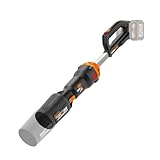
Best CompactWorx Nitro LEAFJET 40V
Dual 20V (40V), Brushless, Compact
Most compact cordless blowers are underwhelming because manufacturers shrink the fan and accept low output. Worx took a different approach with the LEAFJET, using a nozzle design borrowed from jet engine principles to produce unusually high air speed for the tool size. The practical result is a small, light blower that is genuinely effective at lifting wet leaves off pavement and blasting debris out of corners, tasks where volume-focused blowers of similar size simply fail. In our testing it outperformed several physically larger cordless blowers on the wet-leaf test specifically because of that air speed. Its size and weight are the other appeal. It is comfortable to use one-handed for extended periods, stores in a fraction of the space a full-size blower needs, and runs on two Worx 20V PowerShare batteries shared across a broad and inexpensive tool range. For a townhouse, a small yard, or someone who mainly clears a driveway, deck, and garage, it is well matched to the job. The limits are volume and runtime. Lower air volume means moving a large mass of dry leaves across a lawn takes noticeably longer than a 650 or 730 CFM blower, and the compact 20V packs give shorter runtime than the large batteries on premium tools. This is a precision cleanup tool rather than a heavy fall cleanup machine, and it is priced accordingly.
Pros
- Very compact and light, easy to store and comfortable to use one-handed
- Jet-engine inspired nozzle design produces high air speed for its size
- Runs on two common Worx 20V PowerShare batteries used across a broad tool range
- Good air speed makes it effective on wet leaves despite modest volume
- Inexpensive relative to premium cordless blowers
Cons
- Lower air volume than full-size blowers, so large areas take longer
- Short runtime from compact 20V packs
- Not suited to heavy fall leaf drop on a large property
The Bottom Line
The best small cordless blower. High air speed in a light package makes it punch above its size on driveways and patios.
4. Reading Cordless Blower Specifications
Cordless blower marketing leans harder on impressive-sounding numbers than almost any other tool category. Here is what each figure actually tells you.
CFM measures air volume. This is what moves a large mass of dry leaves forward efficiently, and it determines how fast a big cleanup goes. Above roughly 500 CFM a handheld blower stops feeling underpowered for lawn work.
MPH measures air speed. This is what breaks stubborn material loose: wet leaves stuck to pavement, matted layers, pine needles wedged in gravel. Air speed matters more than volume when material is not moving at all, which is why a compact high-speed blower can outperform a larger high-volume one on wet leaves.
Peak figures versus sustained figures. Some manufacturers quote CFM and MPH at the nozzle under ideal conditions or in a momentary boost mode that cannot be sustained. Where a manufacturer publishes both a standard and a turbo figure, the standard one is the more meaningful number for judging everyday performance.
Newtons of blowing force. Where available, this combines volume and speed into a single measure of how hard the airstream pushes, and it is much harder to inflate through marketing than either number alone. Professional-grade equipment quotes it more often than consumer gear does.
Brushless is not optional. A brushless motor converts substantially more battery energy into airflow rather than waste heat, which directly improves both power and runtime. Any cordless blower without a brushless motor belongs to a previous generation regardless of when it was made.
The Nozzle Changes the Numbers
A narrow nozzle raises air speed and lowers volume; a wide nozzle does the opposite. Manufacturers usually quote the figure that flatters the tool, so a blower advertising very high MPH may be quoting a narrow concentrator nozzle while quoting CFM with a wide one. If a blower ships with multiple nozzles, use the wide one for dry leaves on open ground and the narrow one for breaking loose wet or matted material.
5. Choosing a Battery Platform
A cordless blower is rarely the only battery tool you will own, and the platform decision outlives the tool by years. It is worth making deliberately rather than by accident.
Dedicated Outdoor Platforms
EGO 56V, Greenworks 80V, and Ryobi 40V are built specifically for outdoor equipment, covering mowers, blowers, trimmers, chainsaws, and snow throwers. They deliver the highest power for outdoor tasks, and their batteries are sized for the runtime yard work demands. The downside is that these packs do not run your drill.
Crossover Tool Platforms
Milwaukee M18, DeWalt FLEXVOLT, and Makita LXT are primarily jobsite platforms that also offer outdoor tools. If you already own drills and saws on one of these systems, adding a blower costs only the bare tool, which is a significant saving. The trade-off is that these packs are optimized for tools with intermittent draw rather than the sustained high current a blower demands, so runtime is often shorter.
Consumer Crossover Platforms
Worx PowerShare and similar systems span a broad range of inexpensive tools at lower power levels. Good value for light-duty use and small properties, and generally not the right platform if you need to clear a heavy fall leaf drop.
One factor worth weighing that rarely appears in comparisons: how easy it is to buy a replacement battery in eight years. Platforms sold through many retailers with a long track record are far safer bets than newer lines or ones tied to a single chain. A blower whose battery you cannot replace is a blower you throw away, regardless of how well the motor still works.
The Practical Rule
If you already own batteries on any platform that makes a competent blower, buy that blower. The battery savings outweigh modest performance differences. If you are starting fresh and outdoor tools are your main use, choose a dedicated outdoor platform with the tool lineup you expect to want in five years.
6. Care, Storage, and Getting More Seasons Out of a Battery
The blower will almost certainly outlast its first battery, which makes battery care the most consequential maintenance you can do.
Store packs at partial charge in a temperate place. Lithium cells age fastest held at a high state of charge and in heat. Storing at roughly half charge somewhere indoors, rather than fully charged in a garage that swings from freezing to 100 degrees, measurably slows capacity loss.
Let hot packs cool before charging. A battery pulled off a blower after twenty minutes of full-power work is warm, and charging immediately adds more heat on top. Most quality chargers wait, but if yours starts immediately, give the pack fifteen minutes first.
Keep the air intake clear. Blowers pull a large volume of air through an intake screen, and leaves, grass, and dust accumulate there. A restricted intake reduces output and makes the motor work harder, which costs both performance and runtime. Check and clear it every few uses during heavy cleanup season.
Do not use a blower in the rain. Cordless blowers handle damp conditions and wet leaves fine, but running one in actual rain pulls water through the housing and past electronics that are not sealed against it. Wait for the rain to stop; wet leaves blow fine once it does.
Match the speed to the task. Beyond saving battery, running at moderate settings reduces wear on the motor, keeps noise down, and gives you far better control over where material goes. Full power is a tool for specific stubborn spots rather than a default operating mode.
Clean the housing after dusty work. Fine dust from a dry driveway or a gravel path works its way into vents and switch mechanisms. A quick wipe down and a blast of compressed air across the vents after dusty cleanups keeps the variable speed control and trigger operating smoothly, which is where grit tends to cause problems first.
Expect gradual decline rather than failure. Batteries do not stop working, they slowly hold less. Most people notice around year four or five that a cleanup that used to take one pack now takes two, at which point a fresh battery restores the tool to like-new performance for far less than a new blower.
Before You Buy
7. Frequently Asked Questions
What is the best cordless leaf blower?
The EGO Power+ LB6504 is our overall pick, combining 650 CFM with 180 MPH air speed that clears wet matted leaves in a single pass, plus the strongest cordless outdoor platform. For the most air volume per dollar, the Ryobi 40V HP Whisper Series delivers 730 CFM more quietly, and for the hardest material the Greenworks Pro 80V has the most sustained output.
How long do cordless leaf blowers run?
Realistically 15 to 40 minutes depending on speed setting and battery capacity. Advertised figures are typically measured at the lowest speed with the largest battery, which is not the setting you use for leaves. Fan power draw rises steeply with speed, so halving your setting can more than double runtime.
Are cordless leaf blowers powerful enough for wet leaves?
High-voltage models at 600 CFM and above with air speeds around 180 MPH clear soaked matted leaves as effectively as gas handhelds. Air speed matters more than volume for wet material, so a blower advertising very high CFM but moderate MPH may push a wet mat around rather than lifting it. Prioritize MPH if your leaves are usually damp.
How many batteries do I need for a cordless blower?
For a property with a real fall leaf drop, two. One works while the other charges, and swapping takes seconds. Two mid-size packs typically cost less than one very large pack and give you redundancy as the first battery ages. For a small yard or driveway-only use, one large pack is usually enough.
Do cordless leaf blowers work as well as gas?
For handheld use, yes. Cordless blowers at 600 CFM and above match gas handhelds on clearing power while being far quieter and requiring no maintenance. Gas retains two advantages: unlimited runtime from a fuel can for multi-hour cleanups, and access to high-output backpack units above 900 CFM that have no cordless equivalent.
How loud is a cordless leaf blower?
Typically around 65 dB at the operator position, which is roughly conversation level and generally does not require hearing protection. Gas blowers commonly reach 95 dB. Because decibels are logarithmic, that gap represents a very large difference in perceived loudness and in how far the sound carries to neighbors.
8. Common Cordless Blower Mistakes
Cordless blower disappointment nearly always traces to runtime expectations or to buying on the wrong airflow specification.
Believing the Advertised Runtime
Quoted runtime figures are measured at the lowest speed setting with the largest available battery, a combination almost nobody actually uses for leaf cleanup. At a working setting, expect a fraction of that number. Plan around 15 to 25 minutes at high power and buy a second battery if your cleanup takes longer.
Buying High CFM for Wet Leaves
Air volume moves dry leaves efficiently but pushes a wet matted layer around rather than lifting it. Air speed is what breaks stuck material loose. If your leaves are typically damp, a blower with 180 MPH and moderate CFM will outperform one with 730 CFM and low air speed.
Running at Full Power Constantly
Fan power draw rises far faster than fan speed, so full throttle drains the battery disproportionately while also being louder and scattering the leaves you just gathered. Working at a moderate setting and reserving full power for stubborn spots more than doubles usable runtime.
Ignoring the Intake Screen
Blowers pull large volumes of air through an intake that clogs with leaves, grass, and dust during heavy cleanup. A restricted intake reduces output noticeably and makes the motor work harder, costing runtime as well as power. Checking and clearing it every few uses takes seconds.
Related Yard & Tool Guides
Buyer's Guide
Best Leaf Blowers
Gas, corded, and backpack blowers compared alongside cordless, with CFM and MPH explained.
Buyer's Guide
Best Weed Eaters
The other cordless yard tool worth owning, tested for weight and line feed frustration.
All Guides
Browse All Best Lists
Every hands-on tested guide we have published, organized by category.
The Bottom Line
The best cordless leaf blower for most people is the EGO Power+ LB6504, which has both the air volume and the air speed to handle wet leaves and the best platform to build a cordless yard kit around. For value and quieter operation, the Ryobi 40V HP Whisper Series delivers the most CFM per dollar here, and the Greenworks Pro 80V is the most capable on genuinely difficult material.
Whatever you buy, ignore the advertised runtime and plan on two batteries. Working at a moderate speed setting will do more for your afternoon than any spec on the box.
More in Lawn & Yard Care
Guides in this category that pair with what you just read.
About the Author
Alex Rivers, Home Improvement Editor
Alex has spent over a decade working on residential and light commercial property maintenance, and now tests every tool, coating and machine that appears in these guides personally.