The 7 Best Electric Lawn Mowers in 2026
We mowed a full season on 11 electric mowers, corded and cordless, tracking runtime under load, cut quality in damp grass, and what the switch from gas actually costs. Only 7 earned a spot.
Alex Rivers
Home Improvement Editor
Last Updated
October 17, 2026
In This Guide
The question is no longer whether an electric mower can cut grass as well as gas. For lawns up to about half an acre, that argument is settled. The real questions are which type of electric, how much battery you actually need, and whether the total cost works out in your favor. After a season of testing, here is the honest answer to all three.
Our Picks at a Glance
The Short Answer
EGO Power+ Select Cut LM2156SP 21" (Best Overall). The electric mower that stopped feeling like a compromise. If your lawn is under about half an acre, this replaces a gas mower outright.
- Check Price
- Check Price
- Check Price
- Check Price
- Best for Small Garages Toro 60V Flex-Force 22" Recycler SmartStow — Cordless, 60V, Self-Propelled, Vertical StorageCheck Price
- Best for Large Lawns Greenworks Pro 80V 21" Self-Propelled — Cordless, 80V, Self-Propelled, High TorqueCheck Price
- Best for Existing Battery Owners Makita XML08 36V (18V X2) 21" — Cordless, Dual 18V, Self-Propelled, BrushlessCheck Price
We may earn a commission when you buy through these links, at no extra cost to you. How we test
Best Overall
EGO Power+ Select Cut LM2156SP 21"
1. Why Electric Mowers Finally Make Sense
Electric mowers were a genuine compromise for a long time. Early cordless models had weak motors, short runtimes, and cut quality that fell apart in anything but short, dry grass. Three specific changes closed most of that gap, and it is worth understanding them because they explain which electric mowers are worth buying now and which still are not.
Brushless motors. Replacing carbon brushes with electronic commutation cut energy losses substantially, which means more of the battery capacity reaches the blade instead of becoming waste heat. A brushless motor also holds speed under load far better, which is what prevents the bogging that made older electric mowers stall in thick grass. If a battery mower is not brushless, it belongs to the previous generation regardless of when it was manufactured.
Higher voltage platforms. Moving from 20V and 40V to 56V, 60V, and 80V raised the torque ceiling enough to match mid-tier gas engines. Voltage is not a perfect proxy for power, but across the mowers we tested it tracked closely with how well a machine handled damp, thick grass without slowing down.
Battery energy density. Modern lithium packs store considerably more energy per pound than the packs of a decade ago, which turned 20-minute mowers into 45 to 60-minute mowers. That single change moved the practical ceiling from a small courtyard to roughly half an acre.
The result is that for lawns up to about half an acre, an electric mower now does the job as well as gas while starting instantly, running quietly, and requiring almost no maintenance. Above that size, gas still has a runtime argument, and above about an acre a riding mower is usually the right answer regardless of power source.
The Numbers Don't Lie
1/2 acre
Practical ceiling for one battery charge
45-60 min
Typical runtime of a quality battery mower
~75 dB
Electric mower noise versus ~95 dB gas
$0
Annual fuel, oil, and spark plug cost
2. Corded vs Cordless Electric
Both are electric mowers, and they suit genuinely different properties. The cord is the entire difference, and it is a bigger factor in one direction and a smaller one in the other than most buyers expect.
Corded Electric
A corded mower is the cheapest way to cut grass, full stop. It never runs out of power, it has no battery to degrade or replace, and it typically weighs half what a battery mower does. The cost of ownership over ten years is dramatically lower than any other option here, because the purchase price is very close to the total price. The limitation is reach and cord management. Practical range is around 100 feet from an outlet, and mowing around trees, beds, and house corners while keeping a cord behind you and out of the blade takes real technique. On a small, open lot it is a minor annoyance. On a lot with obstacles it is a constant one.
Cordless Battery
A cordless mower gives you the freedom of a gas mower with the convenience of electric. No cord to manage, no fuel to mix, instant starting, and quiet operation. What you pay for that is the battery, which is the single most expensive component and the one that eventually degrades. Runtime caps the lawn size you can handle in one session, and a second battery is often a practical necessity above a quarter acre.
Which to Choose
If your lawn is small, close to an outlet, and relatively open, a corded mower saves a remarkable amount of money for very little real inconvenience. If your lawn has obstacles, is larger than a couple thousand square feet, or is any distance from power, buy cordless and do not look back. The cord frustration on the wrong property is the fastest route to a mower that never gets used.
| Type | Best Lawn Size | Upfront Cost | Lifetime Cost |
|---|---|---|---|
| Corded Electric | Under 1/8 acre, near outlet | Lowest | Lowest |
| Cordless 40V | Up to 1/4 acre | Moderate | Moderate |
| Cordless 56-60V | Up to 1/2 acre | High | Moderate |
| Cordless 80V | Half acre and up | Highest | Higher battery replacement |
3. The 7 Best Electric Lawn Mowers in 2026 — Tested & Ranked
We mowed identical routes on a quarter-acre test lawn including a damp morning cut, a deliberately overgrown section, and a moderate slope, tracking runtime under load, mulch quality, clumping, bogging, and storage footprint. These seven earned their place.

Best OverallEGO Power+ Select Cut LM2156SP 21"
Cordless, 56V, Self-Propelled, Dual Blade
Cut quality is where cheap electric mowers give themselves away, and the Select Cut system is EGO answer to that. Two stacked blades work together rather than one, and the practical result in our testing was a noticeably finer mulch than any single-blade electric mower produced, fine enough that clippings disappeared into the lawn without visible clumping even on a damp morning cut. That is the specific condition where budget electric mowers leave rows of wet clumps behind, and it is the clearest quality separator in this category. Power delivery is the other half. The 56V brushless motor held blade speed through a deliberately overgrown test section that made lower-voltage mowers audibly bog, and the self-propel drive with its variable speed dial pulled itself confidently up a moderate slope where push-only electric mowers required real effort. Combined with instant push-button starting and near-silent operation compared to gas, the day-to-day experience is simply better. What you pay is a genuine premium, and the tool is heavy, which is felt when lifting it over a curb or up a step. Runtime is the one specification worth checking against your lawn honestly: a large pack comfortably handles a quarter to half acre in one session, but sustained work in thick wet grass on the highest power setting drains it considerably faster, and anyone consistently mowing toward the top of that range should budget for a second battery.
Pros
- Dual-blade Select Cut system produces the finest mulch and cleanest cut of any electric mower we tested
- The 56V platform delivers torque genuinely comparable to a mid-tier gas engine, with no bogging in damp grass
- Self-propelled with a variable speed dial that handles moderate slopes confidently
- Folds flat and stands upright for storage, taking a fraction of a gas mower footprint
- Batteries interchange across EGO trimmers, blowers, and chainsaws, lowering the real cost of a whole set
Cons
- Premium price, especially with a high-capacity battery and rapid charger included
- Heavier than most electric mowers because of the battery and self-propel drive
- Runtime in thick, wet grass on the high setting can drop under 45 minutes
The Bottom Line
The electric mower that stopped feeling like a compromise. If your lawn is under about half an acre, this replaces a gas mower outright.

Best ValueGreenworks 48V 20" Brushless
Cordless, Dual 24V, Push, Brushless
Greenworks built the 48V line around a clever idea: rather than a single expensive high-voltage pack, it runs two standard 24V batteries in series, and those same 24V packs power an enormous range of inexpensive tools. The practical effect is that expanding your battery inventory costs far less than on a proprietary high-voltage platform, and a spare pair of batteries is genuinely affordable rather than a significant purchase decision. For a homeowner building out a cordless yard kit on a budget, that structural advantage compounds. The mower itself is better than its price suggests. The brushless motor held speed through normal and moderately thick grass in our testing without the strain that cheaper brushed motors show, and the cut quality on a dry lawn was clean and even. At around 45 pounds it is light enough to maneuver around beds effortlessly and to lift into a car trunk, which matters more than people expect. Height adjustment is a single central lever rather than four separate ones, which is a small convenience that gets used every few weeks. The honest limits are deck size, drive, and runtime. Twenty inches means more passes than a 22-inch mower over the same lawn, it is push-only so hills are your job rather than the mower, and roughly 45 minutes of runtime caps it at about a quarter acre per charge. Within those limits it is excellent value.
Pros
- Runs on two 24V batteries, a widely available and inexpensive platform to expand
- Brushless motor delivers cutting power well beyond its price point
- 3-in-1 mulch, bag, and side discharge with a simple single-lever height adjustment
- Light enough at around 45 pounds to maneuver easily and lift into a car
- Typically ships as a complete kit with batteries and charger at a very competitive price
Cons
- Push-only, so slopes require real effort from the operator
- 20-inch deck means more passes than a 21 or 22-inch mower on larger lawns
- Runtime around 45 minutes limits it to roughly a quarter acre per charge
The Bottom Line
The best price-to-performance electric mower we tested. For a flat quarter-acre lot, it does everything the premium mowers do for considerably less.

Best Mid-RangeRyobi 40V HP Brushless 21" Self-Propelled
Cordless, 40V, Self-Propelled, Brushless
Ryobi built its reputation on delivering most of the capability of premium tools at a price that undercuts them substantially, and the RY401170 is a clean example of that formula applied to mowing. Its brushless motor produced more usable torque than we expected at this tier, cutting through moderately thick grass without the bogging that plagues cheaper battery mowers, and the variable-speed self-propel drive was smooth and predictable to modulate around beds and obstacles. For a normal suburban lawn, the practical difference from a mower costing several hundred dollars more is small. The ecosystem is a large part of the value. Ryobi 40V is one of the biggest outdoor battery platforms available, covering trimmers, blowers, chainsaws, and more, and if you already own any of them the effective cost of adding this mower is just the bare tool. The LED headlights sound like a gimmick and turned out to be genuinely useful, letting us finish a mow in fading evening light rather than leaving a strip for the next day. Where it gives ground is on hills and in damp conditions. Front-wheel drive loses traction on slopes more readily than rear-wheel-drive competitors, requiring the operator to help push on the steepest sections. And cut quality in wet grass is a clear step behind dual-blade premium systems, with more visible clumping. On a flat to gently sloped lawn cut in dry conditions, neither limitation bites.
Pros
- Strong brushless torque for the price, handling thick grass better than most 40V competitors
- Compatible with the very large Ryobi 40V outdoor tool ecosystem
- Variable speed self-propel drive that is smooth and easy to modulate
- LED headlights are genuinely useful for finishing a mow in fading light
- Costs meaningfully less than the comparable EGO self-propelled model
Cons
- Front-wheel drive gives less hill confidence than rear-wheel-drive competitors
- Battery life varies more with grass thickness than premium 56V and 80V platforms
- Cut quality on damp grass is a step behind dual-blade systems
The Bottom Line
The sensible middle of the market. Roughly 85 percent of the premium experience for meaningfully less money, especially if you already own Ryobi 40V tools.

Best CordedSun Joe MJ401E 14" Corded Electric
Corded Electric, 12 Amp, 14" Deck
Corded electric mowers have been largely forgotten in the rush toward battery, and for a genuinely small lot that is a mistake. The MJ401E costs a fraction of any battery mower here, weighs around 29 pounds, and never runs out of power, which removes the single most common frustration with cordless mowing. For a townhouse yard, a small city lot, or the strip of lawn beside a driveway, it does the job for less money than a decent battery costs on its own. Its lifetime economics are the strongest in this guide. There is no battery to degrade after several seasons and no replacement pack to buy at a significant cost down the line, so the purchase price is close to the total cost of ownership. Combined with essentially no maintenance beyond blade sharpening, it is the cheapest way to keep a small lawn cut. The compromises are real and worth being blunt about. Managing an extension cord while mowing around trees, garden beds, and the corners of a house is genuinely awkward, and the standard technique of mowing away from the outlet and keeping the cord behind you takes practice. Reach is capped at roughly 100 feet from an outlet, which rules out most of a larger property. And a 14-inch deck is narrow enough that even a small lawn takes noticeably more passes. Know your lot size honestly before choosing it.
Pros
- Never runs out of power, so a large lawn is only limited by cord reach
- By far the cheapest mower in this guide, often a fraction of battery mower prices
- Extremely light at around 29 pounds, easy for anyone to push and to store
- Zero batteries to degrade or replace, so the purchase price is close to the lifetime cost
- Compact enough to hang on a garage wall or store in a closet
Cons
- The extension cord is a genuine nuisance to manage around trees, beds, and corners
- Practical reach is limited to about 100 feet from an outlet
- 14-inch deck is very narrow, meaning many more passes on any real lawn
The Bottom Line
Unbeatable value for a small lot near an outlet. The cord is the entire compromise, and on a tiny yard it is a smaller problem than people assume.

Best for Small GaragesToro 60V Flex-Force 22" Recycler SmartStow
Cordless, 60V, Self-Propelled, Vertical Storage
Most mowers, electric or gas, consume a frustrating amount of garage floor even with a folding handle. Toro built SmartStow specifically to fix that, and the mower folds and stands vertically against a wall, taking roughly half the footprint of a conventional mower parked flat. In a crowded two-car garage that is not a minor convenience, it is often the deciding factor. Personal Pace is the other standout. Rather than setting a speed on a dial, the mower senses how fast you are walking through pressure on the handle and matches the drive wheels to you automatically. In our testing that meant never consciously thinking about drive speed, including when slowing to navigate around a garden bed and speeding up on an open stretch. It is the most intuitive self-propel system available, and people who have used it rarely want to go back to a dial. The 22-inch deck is the widest in this guide and meaningfully reduces the number of passes on a larger lawn, and the Recycler cutting system mulches well for a single-blade design, though not quite to the standard of EGO dual-blade setup. The trade-offs are cost and weight. The 60V platform is priced at the premium end and battery replacements are expensive, and the mower is heavy enough that standing it upright for storage takes a deliberate lift rather than a casual tip.
Pros
- SmartStow design stands the mower vertically, cutting its storage footprint roughly in half
- Personal Pace self-propel senses your walking speed and matches it automatically
- 22-inch deck is the widest here, covering ground in fewer passes
- Recycler cutting system produces excellent mulch quality for a single-blade mower
- Toro dealer network makes parts and service easy to find long term
Cons
- The 60V battery is expensive to replace and not shared with other tool categories as widely
- Heavier than most electric mowers, which is noticeable when lifting it upright to store
- Premium pricing close to the EGO without the dual-blade cut quality
The Bottom Line
The right mower when garage space is the real constraint. Personal Pace is also the most intuitive self-propel system anyone makes.

Best for Large LawnsGreenworks Pro 80V 21" Self-Propelled
Cordless, 80V, Self-Propelled, High Torque
The standard objection to battery mowers is that they run out of both power and charge before a large lawn is finished, and the Greenworks Pro 80V is the most direct answer to that in this guide. Its higher voltage delivers noticeably more torque to the blade and to the drive wheels, and in our testing it maintained cutting speed through thick, damp grass that made 40V mowers bog and require a slower walking pace. On a deliberately overgrown section it produced a clean cut in a single pass where lower-voltage machines needed two. Runtime is the other half of the case. The large 80V pack stores substantially more energy than compact batteries, and it comfortably handled a half-acre test lawn in one session with margin remaining. Rear-wheel drive gives it genuinely good hill traction, better than the front-wheel-drive machines here, which matters as much on a large property as raw cutting power does. The costs are weight and money. This is a heavy mower, and while self-propulsion means you are not pushing that weight, you feel it when lifting the machine over a curb or into a truck. The 80V batteries are proprietary and expensive to replace, and the platform is smaller than EGO or Ryobi so battery sharing across other tools is less likely. On a big lawn it earns its keep; on a quarter acre it is more machine than the job needs.
Pros
- The 80V platform provides the strongest torque of any battery mower in this guide
- Handles thick, tall, and damp grass better than any lower-voltage electric mower we tested
- Long runtime from the large pack, comfortably covering half an acre in one session
- Rear-wheel drive self-propel with genuinely good hill traction
- Attachment ecosystem covers trimmers, blowers, and chainsaws on the same battery
Cons
- Heavy, and the weight is concentrated in an expensive proprietary battery pack
- 80V replacement batteries cost considerably more than mainstream platforms
- Physically bulky, which matters in a small garage
The Bottom Line
The electric mower for a property that is genuinely too big for a 40V machine. Real torque and real runtime, at real weight and real cost.
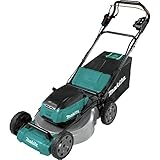
Best for Existing Battery OwnersMakita XML08 36V (18V X2) 21"
Cordless, Dual 18V, Self-Propelled, Brushless
Makita took a different approach to the voltage question, running its mowers on two standard 18V LXT batteries rather than a dedicated high-voltage pack. The strategic advantage is enormous for anyone already in the LXT ecosystem, which is one of the largest professional tool platforms in the world: the batteries in your drill, impact driver, and circular saw run the mower too, and adding it costs only the bare tool. For a contractor or a serious DIYer with a shelf of LXT packs, no other mower here comes close on effective price. The tool itself is genuinely well made. Fit and finish are a clear step above consumer mowers, the deck feels solid rather than flexy, and Automatic Torque Drive senses cutting load and adjusts blade speed accordingly, which improves both efficiency in light grass and power in thick patches. It is also the quietest mower we tested, running at a level where a normal conversation is possible alongside it. Two honest limits. Two 18V packs in series do not deliver the peak torque of a single large high-voltage battery, and in the very thickest grass the Makita worked harder than the 80V Greenworks. And runtime per pair of batteries is shorter, which is why the four-port configurations that let you carry a spare pair aboard are worth seeking out. If you do not already own LXT batteries, the value case is much weaker.
Pros
- Runs on two standard 18V LXT batteries, the same packs used across Makita huge tool lineup
- Automatic Torque Drive senses load and adjusts blade speed to conditions
- Exceptional build quality with the fit and finish of professional-grade equipment
- Quiet even by electric mower standards, at conversation-level noise
- Four battery ports on some configurations allow hot-swapping for extended runtime
Cons
- Expensive as a bare tool and very expensive as a kit if you do not already own LXT batteries
- Two 18V packs deliver less peak torque than a single high-voltage battery in the thickest grass
- Runtime per pair of batteries is shorter than a large 56V or 80V pack
The Bottom Line
The obvious choice if your garage already runs on Makita LXT. Excellent build and the quietest mower we tested, but a hard sell as a first purchase.
4. Battery Runtime: Doing the Math Before You Buy
Runtime is the specification most likely to disappoint, largely because manufacturer figures are measured under ideal conditions that do not resemble a real lawn.
Understand what amp-hours mean. Battery capacity is rated in amp-hours, and total energy is roughly voltage multiplied by amp-hours. A 56V 5.0Ah pack holds substantially more energy than a 40V 4.0Ah pack, which is why comparing amp-hours alone across different voltages is misleading. Compare watt-hours if the manufacturer lists them, or simply compare stated runtime figures from the same manufacturer.
Discount manufacturer runtime estimates. Published figures typically assume dry grass at a moderate cutting height with the mower in mulching mode and a fresh battery. Real conditions, damp grass, a lower cut, bagging rather than mulching, and a battery a few seasons old, routinely produce 60 to 75 percent of the advertised number. Plan around the lower figure.
Estimate your lawn honestly. A rough rule is that a quarter acre takes roughly 25 to 35 minutes of actual mowing at a normal pace with a 21-inch deck. Half an acre roughly doubles it. If your realistic mowing time approaches the discounted runtime figure, you need either a larger battery or a second one.
A second battery is often better value than a bigger one. Two moderate packs usually cost less than one very large pack, give you the option to swap mid-mow with no downtime, and provide redundancy when one eventually degrades. On any lawn near the edge of single-charge capacity, this is the more practical purchase.
The Setting That Costs You the Most Runtime
Bagging clippings consumes considerably more battery than mulching, because the mower has to generate the airflow to lift and carry clippings into the bag. Switching to mulching mode where lawn conditions allow it can extend runtime meaningfully on the same battery, and it returns nitrogen to the lawn as a bonus. Cutting height matters too: taking off less material per pass is easier work for the motor.
5. Cut Quality: What Separates Good Electric Mowers From Cheap Ones
On a dry lawn at a moderate height, almost any electric mower produces an acceptable cut. Differences appear in the harder conditions, and those are the conditions worth testing for.
Blade Speed Under Load
A clean cut requires the blade to be moving fast enough to slice grass rather than tear it. When a motor bogs in thick grass, blade tip speed drops and the cut quality degrades visibly, leaving ragged, whitened blade tips that brown within a day. Brushless motors and higher voltage platforms hold speed under load far better, which is the underlying reason they cut better in the conditions that matter.
Deck Design and Airflow
A well-designed deck creates a vacuum that lifts grass blades upright before they are cut, producing a more even cut height and better mulching. Cheap flat decks do this poorly, which is why budget mowers leave a wavy, uneven finish that becomes obvious across a large lawn.
Single Blade vs Dual Blade
Dual-blade systems cut the clippings a second time before they are discharged, producing a much finer mulch that settles into the lawn rather than sitting on top in visible clumps. This difference is most obvious in damp grass, which is exactly where single-blade mowers leave rows of wet clippings behind.
Blade Sharpness
The most controllable factor and the most neglected. A dull blade tears grass rather than cutting it, leaving frayed tips that turn brown and give a whole lawn a dull cast within days. Sharpening once or twice a season transforms the cut quality of any mower, and it is the cheapest upgrade available for a mower you already own.
6. Electric vs Gas: The Real Cost Over Five Years
Sticker prices make electric mowers look expensive and gas mowers look cheap. Running the numbers over a realistic ownership period changes the picture considerably.
Gas ongoing costs. A typical gas mower running 25 to 30 mowing sessions a season consumes roughly 60 to 100 dollars in fuel annually, plus 30 to 50 dollars a year in oil, spark plugs, and air filters. Add an occasional tune-up, carburetor cleaning, or starter repair every few years and five-year upkeep commonly lands in the 600 to 900 dollar range on top of the purchase price.
Electric ongoing costs. Electricity to recharge a mower battery costs a few dollars per season at most. There is no oil, no filters, no spark plugs, and no fuel stabilizer. The one real long-term cost is the battery itself, which typically holds up well for five or more years of residential use and then costs somewhere between 150 and 350 dollars to replace depending on the platform.
The crossover. A premium electric mower that costs several hundred dollars more up front than a comparable gas mower generally reaches cost parity somewhere in year three or four, and comes out ahead thereafter even accounting for an eventual battery replacement. A corded electric mower is cheaper than everything from day one and stays that way.
The costs that are not financial. Electric mowers eliminate winter fuel stabilization, spring carburetor problems, pull-starting a cold engine, storing gasoline in the garage, and roughly 20 decibels of noise. Several of those are worth more to most homeowners than the dollar difference, and none of them show up in a price comparison.
7. Maintaining an Electric Mower
Electric mowers need far less attention than gas, but the little maintenance they do need is concentrated in two places: the blade and the battery.
Sharpen the blade at least once a season. This is the single highest-impact maintenance task on any mower and it is trivially easy. A sharp blade slices cleanly; a dull one tears, leaving frayed brown tips across the lawn. Removing the blade takes a socket wrench and a block of wood to stop it turning, and sharpening takes ten minutes with a file or a bench grinder. Keeping a spare blade means you can swap and sharpen at leisure.
Clean the underside of the deck. Wet clippings pack into the deck and restrict the airflow that lifts grass for cutting, which degrades cut quality and forces the motor to work harder. Remove the battery first, tip the mower on its side per the manual, and scrape the deck out with a plastic putty knife every few mows during heavy growth.
Store batteries properly. Lithium packs last longest stored at a partial charge, roughly half, in a temperate location. Storing a fully charged battery in a hot garage all summer or a freezing one all winter measurably shortens its life. Bringing packs indoors for winter is the single best thing you can do for their longevity.
Do not spray water into the deck. Electric mowers have motors and electronics in places gas mowers do not, and hosing out the deck can force water into bearings and control boards. Scrape rather than spray, and if you must rinse, keep water away from the motor housing, battery bay, and controls.
Check the height adjustment mechanism. Grass and grit accumulate in height adjusters and make them stiff or inaccurate, leading to uneven cutting heights across the deck. Wiping them clean occasionally keeps all four wheels at genuinely the same height, which matters more for cut appearance than most people realize.
Before You Buy
8. Frequently Asked Questions
What is the best electric lawn mower?
For most lawns up to half an acre, the EGO Power+ Select Cut LM2156SP offers the best combination of cutting power, dual-blade mulch quality, and self-propelled drive. For the best value on a flat quarter-acre lot, the Greenworks 48V 20" Brushless does nearly as much for considerably less. For a very small lot near an outlet, the corded Sun Joe MJ401E is the cheapest way to keep grass cut.
Are electric lawn mowers as good as gas?
For lawns up to about half an acre, yes. Modern brushless mowers at 56V and above deliver cutting power comparable to mid-tier gas engines, with instant starting, far less noise, and almost no maintenance. Gas retains an advantage in unlimited runtime for large properties and slightly more power in extremely thick or tall grass.
How long does an electric mower battery last on one charge?
Typically 45 to 60 minutes for a quality mower with a large pack, which covers roughly a quarter to half acre. Real-world runtime commonly lands at 60 to 75 percent of manufacturer estimates because published figures assume dry grass, mulching mode, and a new battery. Bagging clippings consumes considerably more power than mulching.
How long do electric mower batteries last before needing replacement?
Quality lithium-ion mower batteries are typically rated for several hundred charge cycles and hold up well through five or more years of normal residential use. Storing packs at a partial charge in a temperate place rather than fully charged in a hot garage measurably extends that. Replacement packs generally run 150 to 350 dollars depending on the platform.
Is a corded electric mower worth it?
On a small lot close to an outlet, absolutely. A corded mower costs a fraction of a battery mower, never runs out of power, and has no battery to degrade or replace, which makes it the cheapest option over any time horizon. The trade-off is cord management around trees and beds and a practical reach limit of about 100 feet from an outlet.
Can electric mowers handle tall or wet grass?
Higher-voltage brushless mowers at 56V and above handle both reasonably well, though wet grass reduces runtime and increases clumping on any mower. Dual-blade cutting systems produce noticeably finer mulch in damp conditions than single-blade designs. Lower-voltage mowers bog more readily and are better suited to routine cutting of dry grass at a moderate height.
9. Common Electric Mower Buying Mistakes
Electric mower disappointment follows a very predictable pattern, and it is nearly always about matching the machine to the lawn.
Buying Too Little Battery for the Lawn
A mower rated for 45 minutes is genuinely fine for a quarter acre and will leave you stranded halfway through a half-acre lawn waiting on a charger. Measure your lawn, estimate roughly 30 minutes per quarter acre with a 21-inch deck, discount the manufacturer runtime figure by about a third, and buy accordingly or plan on a second pack.
Choosing Corded for a Lot Full of Obstacles
Corded mowers are excellent value on a small open lot and genuinely miserable on a lot with mature trees, garden beds, and a house to work around. The cord snags, doubles back, and has to be repositioned constantly. Be honest about your lot layout rather than only its size before choosing corded.
Ignoring the Blade
A dull blade undoes everything a good mower does, tearing grass instead of cutting it and leaving a whole lawn looking brown-tipped and dull within days. Sharpening takes ten minutes and costs nothing, and it improves cut quality more than upgrading to a more expensive mower would.
Storing Batteries Fully Charged in a Hot Garage
Heat and a full state of charge are the two things that degrade lithium batteries fastest, and a garage in summer combines both. Store packs at roughly half charge somewhere temperate, and bring them indoors for winter. This one habit adds seasons to the life of the most expensive component on the mower.
Related Lawn & Yard Guides
Buyer's Guide
Best Battery Powered Mowers
A deeper look at cordless platforms, voltage, and how to size a battery to your lawn.
Buyer's Guide
Best Gas Lawn Mowers
For the properties battery mowers still cannot cover in one charge.
Buyer's Guide
Best Self-Propelled Mowers
Gas and battery drive systems compared for hills and larger lawns.
The Bottom Line
The best electric lawn mower for most people is the EGO Power+ Select Cut LM2156SP, which delivers gas-equivalent cutting power and the cleanest mulch we tested. For value on a flat quarter acre, the Greenworks 48V 20" does nearly the same job for far less. And for a genuinely small lot near an outlet, the corded Sun Joe MJ401E remains the cheapest way to keep grass cut, period.
Whichever you pick, size the battery to your actual lawn rather than to the mower's marketing claim. Runtime is the one specification that turns a good mower into a frustrating one.
More in Lawn & Yard Care
Guides in this category that pair with what you just read.
About the Author
Alex Rivers, Home Improvement Editor
Alex has spent over a decade working on residential and light commercial property maintenance, and now tests every tool, coating and machine that appears in these guides personally.