The 7 Best Hose Reels in 2026
We mounted, cranked, dragged, and left 12 hose reels outside for a full season. Wall mount, cart, and auto-retractable. Only 7 were still working properly at the end.
Alex Rivers
Home Improvement Editor
Last Updated
October 17, 2026
In This Guide
A hose reel is one of those purchases where the cheap option costs you twice. Plastic gears strip, thin steel frames bend under a full hose, and swivel fittings leak within a season. Meanwhile the reel is doing something genuinely valuable: keeping a hose out of the sun, off the ground, and free of the twist that causes kinks. Here is what separates a reel that lasts a decade from one that lasts a summer.
Our Picks at a Glance
The Short Answer
Eley Rapid Reel Wall Mount Hose Reel (Best Overall). The buy-it-once hose reel. Everything that fails on cheap reels is metal here, and every wear part is replaceable rather than disposable.
- Check Price
- Best Wall Mount Value Liberty Garden 704 Decorative Wall Mount — Wall Mount, Cast Aluminum, 125 ft CapacityCheck Price
- Best Retractable Giraffe Tools Retractable Hose Reel 130 ft — Auto-Retractable, Wall Mount, Hose IncludedCheck Price
- Check Price
- Best Large Capacity Cart Liberty Garden 301 Navigator Hose Cart — Two-Wheel Cart, Steel Frame, 300 ft CapacityCheck Price
- Check Price
- Check Price
We may earn a commission when you buy through these links, at no extra cost to you. How we test
Best Overall
Eley Rapid Reel Wall Mount Hose Reel
1. What a Hose Reel Actually Does for You
A hose reel looks like a tidiness accessory, and the tidiness is the least valuable thing it does. Three functional benefits matter more.
It keeps the hose out of sunlight. Ultraviolet exposure is the primary thing that degrades garden hoses, turning vinyl brittle and weakening latex and polymer jackets. A hose stored on a shaded reel or inside an enclosed housing routinely lasts several times as long as the same hose left coiled on a sunny driveway. This alone often pays for the reel.
It prevents accumulated twist. Coiling a hose by hand in the same direction every time builds twist into the tube, and that stored twist is what makes a hose fight you when you lay it out and what concentrates stress into kinks. A reel winds the hose along its natural axis without adding twist, which is why reeled hoses kink dramatically less.
It supports the hose across a curve, not a point. Hanging a hose on a single narrow hook concentrates the entire weight of the water-filled hose onto one spot, creating a permanent crease there. A reel drum distributes that load across a wide radius, so no single point takes a hard bend.
It makes the hose easier to deploy. Pulling a hose off a drum as you walk toward the far end of the garden is far less work than dragging a coiled pile behind you and untangling it as you go. That difference sounds trivial until you compare how often a reeled hose gets used for a two-minute job versus how often a piled one gets skipped because dealing with it is not worth the trouble.
And yes, it removes the pile. A hose lying in the yard gets run over by mowers, tripped on, chewed by dogs, and dragged through mud. Getting it off the ground eliminates a whole category of damage.
The Numbers Don't Lie
100-300 ft
Typical reel capacity range
3x
Hose lifespan gain from shade storage
5/8"
Diameter most reels are rated for
~50 lb
Weight of 100 ft of water-filled hose
2. Wall Mount, Cart, or Retractable
The three formats suit genuinely different properties, and choosing the wrong one is the most common reason a reel ends up unused with the hose back in a pile on the ground.
Wall Mount Reels
Fixed to a wall near the spigot, connected by a short leader hose. The most compact option, the most stable, and generally the most durable since there are no wheels or spring mechanisms. The limitation is that the hose always originates from one point, so a property with widely separated watering areas may need two reels or a very long hose. Requires mounting into studs or masonry, since a full hose is heavy.
Hose Carts
Wheeled reels you pull to wherever you are working. The right answer when your watering areas are scattered, when you cannot or do not want to drill into the house, or when you want to store the reel indoors between seasons. The trade-off is wheels: small plastic wheels struggle badly on grass and gravel, so pneumatic tires are worth paying for on anything but paved routes.
Retractable Reels
Spring-loaded reels that wind the hose back automatically after a tug. By far the most convenient, which matters because convenience determines whether a reel actually gets used. Usually enclosed, which gives the best UV protection. The costs are mechanical complexity, weight requiring solid mounting, and a more involved job if you ever need to replace the hose.
| Type | Best For | Effort to Use | Durability |
|---|---|---|---|
| Wall Mount Crank | One main watering area | Manual cranking | Highest |
| Retractable | Convenience above all | Almost none | Good, more complex |
| Resin Cart | Paved routes, storage indoors | Pull and crank | Moderate |
| Steel Cart | Large property, rough ground | Pull and crank | High |
3. The 7 Best Hose Reels in 2026 — Tested & Ranked
We mounted or assembled each reel, loaded it with 100 feet of 5/8-inch hose, and used it through a full season, measuring crank effort under full load, checking for frame flex and swivel leaks, and rolling the carts across concrete, lawn, and gravel. These seven earned their place.
Best OverallEley Rapid Reel Wall Mount Hose Reel
Wall Mount, All-Metal, 100 ft Capacity
Almost every hose reel failure happens in one of three places: the crank gear strips, the frame bends under the weight of a full hose, or the swivel where water passes from the fixed inlet to the rotating drum starts leaking. The Eley Rapid Reel addresses all three by simply not using plastic anywhere it matters. The drum is powder-coated aluminum, the frame is metal, and the swivel is brass with replaceable seals rather than a sealed unit that must be thrown away when it fails. In our season of testing, winding 100 feet of 5/8-inch hose was noticeably easier than on any other reel in the group, with a smooth action and no flex or binding under load. The pivoting wall bracket is a detail that matters more than it sounds: it lets the reel rotate to face whichever direction you are pulling the hose, so the hose feeds off the drum cleanly rather than being dragged across the frame edge, which is what abrades hoses and makes reels hard to crank. Repairability is the real argument, though. Gaskets, swivels, and hardware are all sold as individual parts, which means a leak in year six is a five-dollar fix rather than a new reel. The costs are honest. It is several times the price of a plastic wall reel, it needs solid mounting into studs or masonry, and no hose is included. Over a decade, it is the cheapest reel here.
Pros
- All-metal construction with a powder-coated aluminum drum, no plastic in the load path
- Brass swivel with replaceable seals rather than a sealed plastic assembly
- Rewinds 100 feet of 5/8-inch hose smoothly with almost no crank effort
- Every component including the swivel and gaskets is available as a replacement part
- Pivots on the wall bracket so the hose feeds cleanly in any direction
Cons
- Costs several times what a plastic wall reel does
- Requires solid mounting into studs or masonry, not just siding
- No hose included, so the total cost is higher than the sticker suggests
The Bottom Line
The buy-it-once hose reel. Everything that fails on cheap reels is metal here, and every wear part is replaceable rather than disposable.

Best Wall Mount ValueLiberty Garden 704 Decorative Wall Mount
Wall Mount, Cast Aluminum, 125 ft Capacity
Wall-mounted hose reels are usually either functional and ugly or attractive and flimsy. The Liberty Garden 704 is the rare product that manages both, with a cast aluminum body that genuinely looks like a considered piece of hardware rather than a plastic box screwed to the siding. For a reel mounted on the front of a house or beside a patio where it is visible, that matters more than reviewers usually admit. The engineering underneath is sound. Cast aluminum resists rust in a way steel does not, the brass inlet and swivel avoid the plastic components that leak on cheap reels, and 125 feet of capacity handles even long hose runs with room to spare. In our testing it wound smoothly and showed no frame flex under a full hose, and after a full season of outdoor exposure the finish was still intact apart from a chip where we knocked it against a ladder. Two practical notes. It is heavy, particularly with a full hose on it, and it genuinely must be mounted into studs or solid masonry. Attaching a reel like this to siding alone will eventually pull out, taking a chunk of the wall with it. And the crank handle is on the small side, which means more turns and more grip effort to wind 100 feet than the larger handle on the Eley requires. Neither is a reason to avoid it.
Pros
- Cast aluminum construction that resists rust and looks far better than plastic reels
- Generous 125-foot capacity for 5/8-inch hose
- Solid brass water inlet and swivel rather than plastic
- Attractive decorative design that suits a visible location on a house front
- Comes largely assembled with straightforward mounting hardware
Cons
- Heavy, and it needs mounting into studs or masonry rather than siding alone
- Crank handle is smaller than ideal, requiring more turns and more grip
- Powder coat can chip if struck, exposing aluminum underneath
The Bottom Line
The wall reel to buy when it will be visible from the street. Cast aluminum and brass at a sensible price, with looks that justify a front-of-house mount.
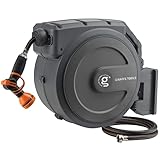
Best RetractableGiraffe Tools Retractable Hose Reel 130 ft
Auto-Retractable, Wall Mount, Hose Included
Manual cranking is the reason most hose reels end up unused, with the hose left in a pile on the ground instead. Retractable reels remove that friction entirely: you pull out the length you need, the mechanism locks, and when you are done a short tug releases the lock and the spring winds the hose back in on its own. In our testing this was the reel that got used correctly every single time, simply because putting the hose away required no effort at all. Giraffe Tools includes a quality hybrid polymer hose rather than leaving you to buy one, which makes the total cost more competitive than the headline price suggests and guarantees the hose suits the drum. The slow-return mechanism is an important safety feature, controlling the retraction speed so 130 feet of hose does not whip back across the yard. The 180-degree swivel bracket lets it feed in any direction without dragging the hose across the housing edge, and the enclosed case keeps the hose completely out of UV, which meaningfully extends hose life. The reservations are about complexity. A spring-loaded retraction mechanism has more moving parts than a crank, and while ours worked flawlessly through a season, it is the sort of assembly that eventually needs service. It is also heavy and must be mounted into structure rather than siding. And eventually replacing the hose means dealing with a wound spring, which is a more involved job than swapping a hose on a crank reel.
Pros
- Automatic spring retraction with a lock mechanism at any length you pull out
- Includes a quality hybrid polymer hose, so it is a complete solution in one purchase
- Slow-return mechanism prevents the hose whipping back dangerously
- 180-degree swivel bracket lets the hose feed in any direction
- Enclosed housing keeps the hose completely out of sunlight
Cons
- The most complex product here mechanically, with more that can eventually fail
- Heavy and requires very solid mounting into structure
- Replacing the hose eventually means working with the spring mechanism
The Bottom Line
The most convenient hose storage you can buy. Pull it out, use it, tug and it retracts itself. Just mount it properly, because it is heavy.

Best Hose CartSuncast Swivel Smart Trak Hideaway
Enclosed Cart, Resin, 225 ft Capacity
Not every property suits a wall-mounted reel. If your spigot is on one side of the house and you water on the other, or if you would rather not drill into brick, a cart lets you bring the hose to the work. The Suncast Smart Trak Hideaway is the most refined version of that idea we tested, with an enclosed resin housing that keeps the hose completely out of sight and completely out of sunlight, which is the single biggest factor in how long a hose lasts. Capacity is generous at 225 feet of 5/8-inch hose, and the Smart Trak guide is the feature that makes that capacity usable: it moves the hose back and forth across the drum as you wind, laying it evenly instead of letting it pile up in one spot and jam. Anyone who has fought a reel where the hose bunched at one end will appreciate it. Resin construction means it will never rust, which matters for something stored outside. The compromises are inherent to plastic. It is less durable over a decade than the metal reels here, and a hard knock can crack the housing where metal would dent. The wheels are small and roll poorly on soft ground or gravel, so moving it across a lawn after rain is more work than it should be. Assembly is also fiddly and the instructions are not the clearest.
Pros
- Enclosed resin housing keeps the hose fully out of sunlight and hidden from view
- Very large 225-foot capacity for 5/8-inch hose
- Smart Trak guide feeds the hose evenly across the drum, preventing bunching
- Wheels let you move it to wherever you are working rather than being fixed to a wall
- Resin construction will never rust and requires no maintenance
Cons
- Plastic construction throughout, which is less durable long term than metal reels
- Wheels are small and struggle on soft ground or gravel
- Assembly is more involved than most reels and the instructions are unclear in places
The Bottom Line
The best mobile option and the best-looking. If you want the hose hidden and portable rather than bolted to a wall, this is the pick.
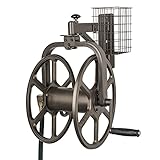
Best Large Capacity CartLiberty Garden 301 Navigator Hose Cart
Two-Wheel Cart, Steel Frame, 300 ft Capacity
On a large property, hose runs get long, and long hoses get heavy. Three hundred feet of water-filled 5/8-inch hose is a serious load, and most reels either cannot hold it or cannot be moved once they do. The Liberty Garden Navigator is built for exactly that scale, with a powder-coated steel frame that shows no flex under a full load and pneumatic tires that roll over grass, gravel, and uneven ground rather than digging in the way the small plastic wheels on lighter carts do. In our testing, moving it fully loaded across a lawn took noticeably less effort than moving a smaller resin cart with half the hose. The front-mounted handle position is a big part of that, letting you pull from a natural walking posture rather than dragging from an awkward angle. Brass fittings and a solid swivel assembly avoid the leak-prone plastic components that fail on cheaper carts, and the whole thing feels like equipment rather than a garden accessory. The limits are size and material. This is a large object that needs real storage space, and it is genuinely more cart than a normal suburban lot requires. And while powder-coated steel is strong, it will eventually rust at chips and scratches when stored outdoors, which aluminum and resin reels will not. Touching up chips occasionally keeps that in check.
Pros
- Massive 300-foot capacity for 5/8-inch hose, the largest in this guide
- Powder-coated steel frame that handles the weight of a full hose without flexing
- Large pneumatic tires roll easily over grass, gravel, and uneven ground
- Brass fittings and a durable swivel assembly
- Front-mounted handle makes it genuinely easy to pull despite the size
Cons
- Large and heavy, requiring real storage space
- Steel frame can rust at chips and scratches over years outdoors
- Overkill for a normal suburban lot
The Bottom Line
The cart for a big property with long hose runs. Pneumatic tires and a steel frame make 300 feet of hose genuinely movable.
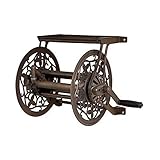
Best BudgetAmes ReelEasy Wall Mount Reel
Wall Mount, Resin, 100 ft Capacity
There is a legitimate place for a cheap hose reel, and pretending otherwise is unhelpful. If you have a 50-foot hose, a modest budget, and mainly want the hose off the ground and out of the sun, the Ames ReelEasy accomplishes that for a small fraction of the cost of a metal reel. It assembles easily, mounts with basic hardware, and is light enough that it does not demand the structural mounting that heavy cast aluminum reels do. Resin construction means it will never rust, which is a genuine advantage over cheap steel reels that corrode within a couple of seasons. For its intended job of storing a short to medium hose on a shed wall or beside a garage, it does what is asked. The compromises are visible immediately. The frame flexes when winding a full 100-foot hose, and that flex is what eventually leads to cracks at stress points. The gears are plastic and are the component most likely to strip. And crucially, nothing is repairable: there are no replacement parts to buy, so a single failed component means buying a whole new reel. Framed correctly, that is an acceptable trade. If you expect to replace it every few years and the low price makes that painless, it is a reasonable purchase. If you want a reel you never think about again, spend more.
Pros
- Very inexpensive compared to metal wall reels
- Light enough to mount on a wider range of wall surfaces
- Resin construction will never rust
- Simple design with few parts and easy assembly
- Adequate 100-foot capacity for a typical suburban hose run
Cons
- Plastic gears and frame are the weakest construction in this guide
- Frame flexes noticeably when winding a full hose
- Not repairable, so a failed component means a new reel
The Bottom Line
The reel to buy when the budget is tight and the hose is short. It works, it will not last a decade, and it is priced accordingly.
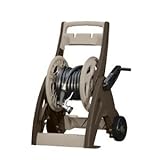
Best PortableSuncast Hosemobile Reel Cart
Portable Cart, Resin, 175 ft Capacity
Hose carts trade the permanence of a wall mount for the ability to bring the hose to the work, and the Hosemobile is the most convenient version of that trade for a normal-sized property. It is light enough to move one-handed, compact enough to store in a corner rather than dominating a shed, and its resin construction means it can live outside without rusting. For a homeowner who waters a front garden and a back garden from different spigots, being able to wheel the whole hose across is genuinely useful. Capacity is good for the size at 175 feet of 5/8-inch hose, which covers most suburban needs comfortably, and it costs meaningfully less than a steel-frame cart of similar capacity. Assembly is straightforward and there is nothing to maintain. The recurring weakness of budget carts is the wheels, and it applies here. The small solid plastic wheels roll fine on concrete and hard-packed paths and struggle noticeably on lawn, gravel, and soft ground after rain, where they sink and drag rather than roll. Combined with a relatively high center of gravity when full, that can also make it tip if you pull it briskly across uneven ground. If your route is paved, it is excellent. If you are crossing a lawn, a cart with pneumatic tires is worth the extra money.
Pros
- Lightweight and genuinely easy to move around a property one-handed
- Compact footprint that stores in a corner of a garage or shed
- Resin construction that never rusts and needs no maintenance
- Good 175-foot capacity for its size
- Inexpensive relative to steel-frame carts of similar capacity
Cons
- Small plastic wheels struggle on grass, gravel, and soft ground
- Plastic construction throughout, with less long-term durability than metal
- Can tip when pulled quickly over uneven ground with a full hose
The Bottom Line
The easiest cart to move and store, provided your ground is reasonably firm and flat. On grass and gravel, look at pneumatic tires instead.
4. What Actually Fails on a Hose Reel
Hose reels fail in a small number of predictable ways, and knowing them tells you exactly which specifications are worth paying for.
The Swivel Joint
Water has to travel from a fixed inlet into a rotating drum, and that transition happens at a swivel with seals inside. It is the highest-wear component on any reel and the most common source of leaks. Brass swivels with replaceable seals can be serviced; sealed plastic assemblies cannot, which means a leak there ends the reel.
The Crank Gear
Winding 100 feet of water-filled hose puts real torque through the crank mechanism. Plastic gears strip under that load, particularly if the hose has bunched at one end of the drum and binds. Metal gearing, or a direct-drive design with no gear reduction at all, avoids the failure entirely.
Frame Flex
A full hose reel carries a surprising amount of weight, and a frame that flexes under it concentrates stress at mounting points and welds. Visible flex when cranking is the clearest warning sign that a reel will crack within a few seasons, and it is easy to check in the store.
Mounting Failure
The most dramatic failure, and entirely preventable. A hundred feet of water-filled hose plus the reel can approach sixty pounds, and that load hanging off siding or drywall anchors will eventually pull out and take part of the wall with it. Mount into studs or solid masonry with appropriate fasteners.
The Leader Hose Nobody Buys
A wall-mounted reel needs a short leader hose connecting the spigot to the reel inlet, and it is almost never included. Buy a good one, usually 3 to 6 feet, rather than cutting down an old hose, because this short section takes constant flexing every time the reel pivots and it is the connection most likely to leak. A quality leader hose costs little and prevents a persistent drip.
5. Capacity, Hose Compatibility, and Sizing
Reel capacity figures are always quoted for a specific hose diameter, and getting the match wrong leads to a hose that will not fit or a drum that jams.
Capacity ratings assume 5/8-inch hose. Nearly every reel states its capacity in feet of 5/8-inch hose, which is the residential standard. If you use 3/4-inch hose, actual capacity drops substantially, often by a third or more, because the thicker hose takes up more drum volume per foot. Check the rating for your actual diameter before buying.
Buy more capacity than your hose length. A reel loaded to its exact rated capacity winds tightly and binds, making cranking harder and increasing the chance of the hose bunching. Leaving headroom, choosing a 150-foot reel for a 100-foot hose, makes the reel noticeably easier to use.
Stiff hoses need bigger drums. A rubber hose or a cold vinyl hose resists bending around a tight radius, and forcing it onto a small drum both makes cranking harder and creates permanent set in the hose. Larger-diameter drums are easier on every hose and essential for rubber ones.
Expandable hoses do not belong on reels. Expandable hoses contract to a bunched, irregular shape that will not wind evenly on a drum, and the winding tension damages the latex tube. Store them in a hose pot, a bucket, or on a wide hook instead.
Check the inlet thread and swivel type. Most reels use standard garden hose thread, but the orientation of the inlet matters for how the leader hose routes. A reel whose inlet points into a wall will kink the leader hose permanently, so look at the geometry before mounting.
6. Installation and Freeze Protection
A reel is only as good as its mounting, and a reel left connected through a freeze can damage both the hose and the plumbing behind the spigot.
Find the studs. Locate wall studs with a stud finder and mount through them with lag screws long enough to reach solid wood. On brick or block, use appropriate masonry anchors rated well above the expected load. Never rely on siding, drywall anchors, or plastic wall plugs for a reel that will carry a full hose.
Mount at a working height. Roughly waist height puts the crank at a comfortable position and lets the hose feed off the drum without dragging on the ground. Too low and the hose scrapes; too high and cranking becomes awkward.
Leave clearance for the pivot. Pivoting reels need room to swing, and mounting one tight into an inside corner defeats the pivot entirely. Check the swing arc before drilling.
Disconnect and drain before freezing weather. Water left in a hose on a reel freezes and splits the hose, and water left in the leader hose and spigot can freeze back into the wall and burst a pipe. Disconnect the leader hose from the spigot, drain the main hose fully, and if your spigot is not frost-free, shut off and drain the interior supply valve.
Check the reel turns freely before the first full load. Assemble the reel, connect it, and wind the empty hose on once before putting it into service. Binding, rubbing, or a drum that will not turn smoothly is far easier to diagnose and fix with an empty drum than with a hundred feet of water-filled hose wrapped around it, and a reel that binds when empty will strip its gears when loaded.
Consider bringing carts inside. One quiet advantage of a cart over a wall mount is that the whole assembly, hose included, can be wheeled into a garage for the winter, which protects both the hose and the reel mechanism from freeze damage and UV over the off season.
Before You Buy
Also Needed for This Job
7. Frequently Asked Questions
What is the best hose reel?
The Eley Rapid Reel wall mount is the best overall, with all-metal construction, a serviceable brass swivel, and every wear part available as a replacement. For the most convenient option, the Giraffe Tools retractable reel winds itself and includes a quality hose. For a mobile solution, the Suncast Swivel Smart Trak Hideaway keeps the hose enclosed and out of sunlight.
Are retractable hose reels worth it?
Yes, if convenience is what determines whether you actually put the hose away. A retractable reel winds itself after a short tug, which removes the friction that leads to hoses left in a pile. The trade-offs are more mechanical complexity, greater weight requiring solid mounting, and a more involved job if you eventually need to replace the hose.
How do I mount a hose reel to a wall?
Locate studs with a stud finder and mount through them with lag screws long enough to bite solid wood, or use masonry anchors rated well above the load on brick or block. A hundred feet of water-filled hose plus the reel can approach sixty pounds, so siding, drywall anchors, and plastic plugs are not adequate.
How much hose does a hose reel hold?
Typical residential reels hold between 100 and 300 feet, and the rating almost always assumes 5/8-inch hose. Three-quarter-inch hose takes up considerably more drum volume, often cutting capacity by a third. Buy a reel rated above your actual hose length, since a drum loaded to its exact capacity winds tightly and binds.
Can you put an expandable hose on a reel?
No. Expandable hoses contract into an irregular bunched shape that will not wind evenly on a drum, and the winding tension damages the latex tube inside. Store expandable hoses in a hose pot, a bucket, or on a wide-radius hook instead, and drain them fully before storage.
Why does my hose reel leak?
Almost always the swivel joint where water passes from the fixed inlet into the rotating drum, which contains seals that wear over time. On a quality reel with a brass swivel, replacement seals are inexpensive and easy to fit. On a reel with a sealed plastic swivel assembly, the leak usually means replacing the reel.
8. Common Hose Reel Mistakes
Hose reel problems mostly come from mounting, sizing, and one component that nobody thinks about until it leaks.
Mounting Into Siding Instead of Structure
A reel with a full hose can approach sixty pounds, and that load hanging off siding or drywall anchors will eventually pull free, taking part of the wall with it. Locate studs or use proper masonry anchors, and use lag screws long enough to reach solid material. This is the failure that turns a cheap reel into an expensive repair.
Filling the Drum to Its Exact Rated Capacity
A reel loaded to its stated maximum winds tightly, binds against the frame, and makes cranking far harder than it should be, which is also how plastic gears strip. Choose a reel rated well above your actual hose length so there is room for the hose to lie loosely on the drum.
Cutting Up an Old Hose for a Leader
The short leader hose between the spigot and a wall-mounted reel flexes every time the reel pivots, and it is the connection most likely to develop a persistent drip. Using a cut-down old hose with a clamped-on fitting almost guarantees that leak. Buy a proper leader hose with factory couplings.
Leaving the Hose on the Reel Through Winter
Water trapped in a hose on a reel freezes and splits the tube, and water left in the leader hose can freeze back into the wall and burst a supply pipe. Disconnect at the spigot, drain the hose completely, and where possible bring cart-mounted reels indoors for the season.
Related Yard & Watering Guides
Buyer's Guide
Best Garden Hoses
Rubber, hybrid polymer, and polyurethane hoses tested for flow, kinks, and lifespan.
Buyer's Guide
Best Expandable Hoses
Light and compact, and the one type of hose that should never go on a reel.
All Guides
Browse All Best Lists
Every hands-on tested guide we have published, organized by category.
The Bottom Line
The best hose reel is the one whose wear parts are metal and replaceable, which is why the Eley Rapid Reel is our overall pick. If convenience is what actually determines whether the hose gets put away, the Giraffe Tools retractable reel removes the effort entirely. And for a mobile solution that hides the hose completely, the Suncast Smart Trak Hideaway is the best cart we tested.
Whatever you buy, mount it into structure and buy a proper leader hose. Those two details account for most of the reel problems people actually have.
More in Lawn & Yard Care
Guides in this category that pair with what you just read.
About the Author
Alex Rivers, Home Improvement Editor
Alex has spent over a decade working on residential and light commercial property maintenance, and now tests every tool, coating and machine that appears in these guides personally.