The 6 Best Garden Hose Nozzles in 2026
Thumb-control, pistol, fireman and high-flow nozzles chosen for sealing, comfort and the jobs you actually do with a hose.
Alex Rivers
Home Improvement Editor
Last Updated
October 17, 2026
In This Guide
The best hose nozzle is the one that does not leak and does not make your hand ache. For most people that means a fireman-style handle or a thumb-control valve rather than a squeeze trigger. Patterns matter far less than the label suggests, because almost everyone uses three: a gentle shower, a jet and something in between.
Our Picks at a Glance
The Short Answer
GREEN MOUNT New Patent Heavy-Duty Fireman-Style Hose Nozzle (Best Overall). The nozzle we would buy for most households: every pattern you need, a strong jet, and a handle you can hold open for twenty minutes without cramping.
- Best Overall GREEN MOUNT New Patent Heavy-Duty Fireman-Style Hose Nozzle — Dial Nozzle with Fireman-Style HandleCheck Price
- Check Price
- Check Price
- Check Price
- Check Price
- Check Price
We may earn a commission when you buy through these links, at no extra cost to you. How we test
Best Overall
GREEN MOUNT New Patent Heavy-Duty Fireman-Style Hose Nozzle
1. How We Picked
A hose nozzle is a cheap tool that most people replace every couple of years without much thought, usually because it started leaking or the trigger broke. The difference between a good one and a bad one is not the number of patterns printed on the dial. It is whether it seals, whether your hand is comfortable holding it open, and whether it has the right spray for the jobs you actually do.
We looked at the main nozzle styles sold for home use: pistol grips, thumb-control nozzles, fireman-style nozzles and twist nozzles. For each style we focused on established products with large numbers of owner ratings, checked manufacturer specifications for materials, patterns and flow, and read the hands-on testing published by Bob Vila and Reviewed. Where we cite a test result, it is theirs. We have not run our own nozzle test.
Leaks counted heavily. A nozzle that dribbles at the connection or between settings wastes water and soaks your sleeve, and it is the most common complaint in owner reviews. Grip and control counted next, because you hold a nozzle open far longer than you think while watering. Patterns mattered least. Most people use three settings: a gentle shower, a jet and something in between.
Ratings are Amazon averages with counts rounded down. Prices change constantly, and every nozzle here is inexpensive compared with the hose it is attached to, so we have not let small price differences decide the rankings.
2. Pistol, Dial, Fireman, Twist and Wand
Pistol-grip nozzles are the familiar type: squeeze a trigger to open the valve, and use a clip to hold it open. Most modern ones have a dial or turret on the front with several spray patterns. They are versatile and cheap. The weakness is the trigger, which tires your hand on long sessions, and the dial seals, which are where most leaks start.
Thumb-control nozzles replace the trigger with a lever or slider under your thumb that opens the valve and sets the flow. Dramm's One Touch range is the best known. Once you get used to them, they are much easier to hold open, and you can adjust flow without changing your grip. They are our first choice for people who water by hand every day.
Fireman-style nozzles have a big lever on top that you push to open, and many adjust the spray by twisting the head. They are robust, easy to operate with a weak grip, and usually move more water. Twist nozzles are the simplest of all, a solid metal barrel you rotate to go from off, to mist, to jet, with nothing to break, and brass versions like Dramm's 12380 adjustable nozzle can last for decades.
| Style | Best for | Control | Main drawback |
|---|---|---|---|
| Pistol with dial | Mixed watering and washing | Squeeze trigger | Hand fatigue, dial leaks |
| Thumb control | Daily hand watering | Thumb lever | Takes getting used to |
| Fireman style | Cleaning, weak grip | Large push lever | Heavier, fewer set patterns |
| Twist | Rinsing, durability | Rotate the barrel | Two hands to adjust |
| Watering wand | Pots, baskets, beds | Thumb or trigger | Not for cleaning |
Watering wands are a separate category worth knowing about. A long aluminum shaft puts a gentle shower head at the base of plants or up into hanging baskets without bending or stretching. Dramm's 30-inch One Touch Rain Wand, which Dramm rates at 2.3 to 8.5 gallons per minute through a full-flow shower head, is the classic example. If most of your watering is containers, a wand is the better tool, and a nozzle the backup.
3. Our 6 Top Hose Nozzle Picks
The picks cover each control style, from two thumb-control nozzles to a classic pistol grip and three fireman-style designs. Ratings are Amazon averages with the rating count rounded down.
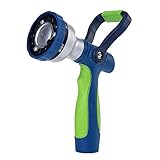
Best OverallGREEN MOUNT New Patent Heavy-Duty Fireman-Style Hose Nozzle
Dial Nozzle with Fireman-Style Handle
This Green Mount is a hybrid, and that is why it wins. The front is a seven-pattern dial like a pistol nozzle, with spray, mist, jet, shower, soaker, cone and flat. The control is a big fireman-style lever on top instead of a trigger, so there is nothing to squeeze while you water a long bed. The same lever acts as a flow control, so you can run the shower at a trickle for seedlings or wide open to rinse a car. Bob Vila's testers named it their best overall nozzle, and it did not leak in their testing, which is the most common failure in this category. Reviewed's testers singled out its jet as strong. A removable metal mesh screen sits at the inlet and catches the grit that otherwise wears dial seals. It is built from zinc alloy and ABS plastic rather than solid brass, so it will not last decades, and the mist is coarser than you get from a nozzle designed purely for watering. For one nozzle that handles most jobs, nothing here is better value.
Pros
- Seven patterns on a dial: spray, mist, jet, shower, soaker, cone and flat
- Large fireman-style on-off handle that also sets flow, with no trigger to squeeze
- Removable metal mesh screen catches grit before it reaches the dial
- Ran without leaks in Bob Vila's hands-on testing
- Nearly 8,000 Amazon ratings
Cons
- Zinc alloy and ABS rather than brass, so it is not a buy-for-life nozzle
- Testers found the mist coarser than a dedicated watering nozzle
The Bottom Line
The nozzle we would buy for most households: every pattern you need, a strong jet, and a handle you can hold open for twenty minutes without cramping.

Best Thumb ControlDramm 14502 One Touch Revolution 9-Pattern Spray Gun
Thumb-Control Dial Nozzle
Dramm is a garden-center brand that makes watering tools for commercial growers, and the One Touch Revolution is where that shows. Instead of a squeeze trigger, a lever under your thumb opens the valve and sets the flow, and it stays where you put it. That sounds like a small change until you water hanging baskets and beds for half an hour, when a trigger nozzle leaves your hand aching. Dramm pitches its One Touch range as a way to eliminate the strain of squeezing, and it is a design worth considering if your grip is weak. The front is a nine-pattern turret that clicks between settings, and Dramm rates flow at 1.6 to 3.7 gallons per minute. The body is zinc with a TPE rubber covering, it weighs about 0.8 pounds, and it carries a lifetime guarantee. It comes in six bright colors, which helps more than you would think when you drop it in a bed. It is a watering tool first. It will rinse a car or a patio well enough, but for heavy cleaning a fireman-style or twist nozzle with more flow does the job faster.
Pros
- One Touch thumb valve: open and adjust flow with your thumb, no squeezing
- Nine patterns on a quick-change turret
- Zinc body with TPE rubber grip, about 0.8 lbs
- Dramm rates flow at 1.6 to 3.7 gallons per minute
- Lifetime guarantee and six colors that are easy to find in the grass
Cons
- Thumb lever takes a few uses to get used to if you are used to triggers
- Not built for heavy cleaning jobs like stripping mud off a deck
The Bottom Line
The best nozzle for people who water by hand every day, especially anyone whose hands tire squeezing a trigger.

Best Pistol GripDramm 12703 Touch'N Flow Revolver Spray Gun
Pistol-Grip Dial Nozzle
If you want a traditional pistol-grip nozzle, the Touch'N Flow Revolver is the one to buy. It has a squeeze trigger, a lock to hold it open, and a nine-pattern turret with fan, cone, center, jet, mist, soaker, flat, angle and shower. Dramm builds it from zinc and brass with a TPE rubber covering, rates its flow at 3.8 gallons per minute, and backs it with a lifetime guarantee. The model number refers to the yellow version, and the same gun is sold in five other colors under neighboring numbers. Reviewed's testers found it did an excellent job of producing a fine, dense mist, which is the setting most cheap pistol nozzles get wrong, and the one you want for seedlings and delicate flowers. They also found it dribbled continuously, which is a common complaint with dial nozzles and usually comes down to the turret seal. A fresh hose washer and keeping grit out of the hose helps. The other drawback is shared by every trigger nozzle: holding it open for long sessions tires your hand, which is why we rank the thumb-control Dramm above it.
Pros
- Nine patterns: fan, cone, center, jet, mist, soaker, flat, angle and shower
- Zinc and brass body with TPE rubber, about 0.65 lbs
- Dramm rates flow at 3.8 gallons per minute
- Produced a fine, dense mist in Reviewed's testing
- Lifetime guarantee, with more than 3,000 Amazon ratings
Cons
- Reviewed's testers saw it dribble between uses
- Squeeze trigger is tiring on long watering sessions
The Bottom Line
The classic pistol nozzle done properly, with a better mist than most, if you prefer a squeeze trigger to a thumb lever.

Best BudgetGREEN MOUNT 6-Pattern Thumb Control Hose Nozzle
Thumb-Control Pistol Nozzle
This is the budget way to get the main benefit of the Dramm One Touch, which is a thumb valve instead of a squeeze trigger. Green Mount fits it with a thumb-operated on-off control that also switches between high and low flow, and it has six watering patterns on the front dial. The body is zinc alloy, and Green Mount uses rubber gaskets at the threaded connection to stop leaks at the hose end, the most common place a cheap nozzle drips. It is light, and Green Mount pitches it at gardeners with arthritis, for the same reason Dramm does. It has the highest Amazon average of any nozzle in this guide, from more than a thousand ratings, which is a good sign for a product at this price. You give up some refinement for the price. There are fewer patterns than on the Dramm, the flow control is a simple high-low choice rather than a smooth range, and the build is not the kind you expect to last a decade. As a first nozzle, a spare for the back yard or a gift for someone who finds triggers painful, it is excellent value.
Pros
- Thumb-operated on-off valve with high and low flow positions
- Six watering patterns
- Zinc alloy body with rubber gaskets at the threaded connection
- Light and easy to hold for people with arthritis
- Highest Amazon average of our picks
Cons
- Fewer patterns and less flow adjustment than the Dramm thumb nozzle
- Budget build that is less likely to last many seasons
The Bottom Line
A low-cost way to get thumb control instead of a trigger, fine for everyday watering and car washing.

Best for Weak GripGREEN MOUNT GSFNG98 Fireman's Hose Nozzle
Twist Fireman-Style Nozzle
A fireman-style nozzle replaces the trigger with a big lever, and this Green Mount is built around that idea. The large on-off handle can be worked with the heel of your hand rather than your fingers, so it is one of the easiest nozzles to use if you have arthritis or a weak grip. Bob Vila's testers named it their most ergonomic pick. Spray is adjusted by twisting the head, from a fine mist to a hard jet, so instead of picking a named pattern you dial in exactly the width you want. That is excellent for cleaning, where you want to tighten the jet a little at a time, and a bit less handy for watering, where it is nice to click back to the same shower. Green Mount builds it from solid metal with a rubber coating, which also keeps your hand away from cold metal and sun-heated water. It includes a sediment screen. The trade-off is weight. At nearly 2 pounds, according to Bob Vila's testers, it is heavy compared with a pistol nozzle, and you feel that on a long watering session.
Pros
- Large on-off handle you can work with a palm or wrist, not fingers
- Solid metal construction with a rubber coating
- Twist the head from fine mist to a powerful jet
- Includes a sediment screen
- Rubber coating insulates your hand from cold metal and hot water
Cons
- Nearly 2 lbs, heavy for a nozzle
- Continuous twist adjustment rather than named patterns, so it is harder to repeat a setting
The Bottom Line
Built like a tank and easy to operate with a weak grip, it is the nozzle for cleaning work and for anyone who struggles with triggers.

Best High FlowSTYDDI Industrial Fireman's High-Flow Hose Nozzle
High-Flow Twist Fireman Nozzle
Most garden nozzles restrict flow to give you patterns and pressure. The STYDDI is built the other way round. It is a classic fireman's nozzle designed to move a lot of water, and STYDDI says it delivers 300 percent greater water flow than typical nozzles, a manufacturer claim we cannot verify but which matches the design, with a wide bore and an open twist head. The body is die-cast zinc with a rubber finish, the inlet is a standard 3/4-inch female garden hose thread, and it is rated for pressures up to 250 PSI, far beyond anything a household tap produces. A large lever turns the water on and off and controls the flow, and twisting the head moves from a wide fog to a straight stream. This is a tool for rinsing a deck after a cleaner, washing mud off a driveway or equipment, and filling buckets and stock tanks fast. It is not a watering nozzle, because even the softest setting puts out a lot of water. It also has far fewer Amazon ratings than the other picks, so there is less evidence about long-term durability.
Pros
- Designed for high volume, with STYDDI claiming far more flow than standard nozzles
- Die-cast zinc body with a rubber finish
- Rated for pressure up to 250 PSI
- Large on-off lever with twist-adjustable spray
- Standard 3/4-inch female garden hose thread
Cons
- Far fewer Amazon ratings than the other picks
- High flow empties a rain barrel or weak well supply quickly and is overkill for watering
The Bottom Line
The nozzle for jobs where volume matters, such as rinsing decks, driveways and equipment, when a garden nozzle feels like it is choking the hose.
4. Thumb Control vs Squeeze Trigger
The trigger is the part of a hose nozzle you notice most and think about least. On a quick car rinse it does not matter. On twenty minutes of watering beds and pots, a stiff trigger is genuinely tiring, and for anyone with arthritis or a weak grip it can make hand watering painful.
Trigger locks help but do not solve it. A clip holds the trigger open at one position, but the moment you want to adjust flow or stop briefly you are squeezing again. And locked-open triggers make it easy to drop a running nozzle into a bed, where it sprays the house or digs a hole in the mulch.
Thumb control solves both problems. You set the flow with your thumb, it stays there, and you can turn it down to a trickle without letting go. The Dramm One Touch Revolution and the budget Green Mount thumb nozzle both work this way. Fireman-style levers achieve the same thing with an even larger lever that can be pushed with the palm.
If you water by hand most days, buy thumb control or a fireman lever. If you mostly wash cars and rinse patios, a quality pistol nozzle is fine, and some people simply prefer the feel of a trigger. Either way, try to hold the nozzle in a store before you buy, because grip size varies more than the photos suggest.
5. Metal vs Plastic, and Why Nozzles Leak
Most nozzles sold as metal are zinc alloy, often with a rubber or plastic covering. Zinc is cheap to cast into complex shapes and handles knocks well, but it is not as durable as brass. Solid brass nozzles, usually twist types, last much longer but tend to be simpler, with fewer patterns. Mostly plastic nozzles are the cheapest and the first to crack when stepped on or frozen.
Leaks almost always come from one of three places. The most common is the hose connection, where a missing, flattened or hardened rubber washer lets water spray out around the threads. The second is the dial or turret, where grit wears the seals between the pattern holes. The third is the valve itself, which causes dribbling when the nozzle is supposed to be off.
The connection leak is the easy one. A fresh hose washer costs pennies and fixes most drips at the threads. Hand-tight is enough, and cranking the nozzle on with pliers usually crushes the washer and makes the leak worse. Inlet screens, like the metal mesh on the Green Mount fireman models, catch grit before it reaches the dial and are worth having.
Valve dribble is harder. Some dribble between uses is common with dial nozzles, and Reviewed's testers noted it on several popular models. If a nozzle dribbles badly from new, return it. If it starts after a few seasons, it is usually cheaper to replace the nozzle than to hunt for seals.
6. Flow, Pressure and What a Nozzle Cannot Do
A nozzle cannot add water or pressure. It can only take what your tap and hose deliver and shape it. A narrow jet feels more powerful because the same water leaves through a smaller opening at higher speed, but the total amount of water does not increase. If your water pressure is weak, the best nozzle in the world will not fix it.
Flow figures help when comparing nozzles. Dramm, for instance, rates its One Touch Revolution at 1.6 to 3.7 gallons per minute and its Touch'N Flow Revolver at 3.8. Lower-flow nozzles are better for watering, because the water soaks in rather than running off. High-flow nozzles like the STYDDI are better for rinsing and filling buckets.
Do not expect a garden nozzle to clean like a pressure washer. A typical home tap supplies water at a fraction of the pressure a pressure washer produces, and a jet nozzle will only shift loose dirt. For stained concrete, siding or a weathered deck, our guide to pressure washer PSI and GPM explains what you actually need.
What a good jet nozzle does well is rinsing after a cleaner. Deck cleaners, siding washes and products from our best mold remover guide usually call for a thorough rinse, and a high-flow fireman or twist nozzle does that far faster than a fine pistol nozzle. Our best deck cleaner guide covers the rinse step for wood.
7. Matching the Pattern to the Job
Seedlings and new seed need the gentlest setting you have, usually labeled mist or shower, held well above the soil so drops do not wash seed away or flatten small plants. Turn the flow down as well as choosing the right pattern. This is where a quality nozzle with a genuinely fine mist, like the Dramm Revolver, earns its keep.
Beds and established plants do best with a soaker or shower pattern aimed at the base of the plant. The goal is to wet the soil, not the leaves, which reduces disease and wasted water. A watering wand makes this easier because it puts the head at soil level without stooping.
Cars, windows and outdoor furniture call for a cone, flat or full spray, enough force to lift dirt without blasting water into seals. Driveways and patios take the jet, held at a shallow angle so it pushes debris rather than splashing it back. After edging with a tool from our lawn edger guide, a jet clears the strip of clippings off the concrete in seconds.
Filling buckets, pools and watering troughs is the job for a fully open fireman or twist nozzle, or no nozzle at all. Most pattern nozzles restrict flow even on their widest setting, so a quick-connect fitting that lets you pop the nozzle off for filling saves real time.
8. Your Hose Matters as Much as the Nozzle
A nozzle can only work with what reaches it. A long, narrow or kinked hose drops flow and pressure before water gets to the nozzle, which is why the same nozzle can feel weak in one yard and strong in another. If your spray is disappointing, check the hose before blaming the nozzle.
Diameter and length matter most. A 5/8-inch hose carries noticeably more water than a 1/2-inch one, and every extra length of hose costs some pressure. Our best garden hose guide covers which hoses resist kinking and hold up in the sun, the two things that most often choke flow in practice.
Expandable hoses are light and easy to store, but their narrow inner tube tends to deliver less flow than a full-size hose, which makes high-flow nozzles less effective. Our best expandable garden hose guide covers the ones that hold up best, and a pistol or thumb nozzle is usually the better match for them.
Finally, store it properly. A hose left in a tangle kinks every time you pull it out, and a nozzle left lying on the driveway gets run over. A wall reel or cart from our best hose reel guide keeps the hose and nozzle together, off the ground and ready to use.
9. Care, Winter Storage and Leaks
Freezing is the main thing that kills nozzles. Water trapped in the valve or dial expands when it freezes and cracks the body or splits seals. Before the first hard frost, remove the nozzle, open it fully to drain, and store it indoors with the hose washers.
Keep grit out. Sand and debris in the hose wear dial seals and jam valves. Run the hose for a few seconds before attaching the nozzle if it has been lying on the ground, and keep the inlet screen in place on nozzles that have one. If a pattern starts spraying unevenly, a blocked hole is the usual cause and can be cleared with a pin.
Replace washers every season or two. They are the cheapest part of the system and the most common source of leaks. Keep a small pack in the shed and swap one in whenever you see water spraying around the threads.
Do not leave a nozzle pressurized for long periods in hot sun. Leaving the tap on with the nozzle closed puts constant pressure on the hose and valve, and heat makes it worse. Turn off the tap when you finish, then squeeze the nozzle to release the pressure. Both the hose and the nozzle will last longer.
10. When a Wand, Sprinkler or Bare Hose Is Better
A hose nozzle is the right tool for mixed jobs, but not always the best one. If most of your watering is hanging baskets and containers, a long watering wand reaches them more comfortably and delivers a gentler shower than a pistol nozzle can.
If you water large beds or a lawn, hand watering with any nozzle is slow and uneven compared with a sprinkler or soaker hose on a timer. A nozzle is best for spot watering, new plantings that need extra attention, and the occasional dry patch.
For filling large containers and rinsing heavy mud, a bare hose end or a fully open high-flow nozzle is faster than any pattern nozzle. A simple brass shut-off valve or quick-connect at the hose end gives you control without restricting flow.
For everything in between, one good nozzle covers it. Most households will be happy with the Green Mount New Patent or a Dramm thumb-control nozzle, and a twist or fireman nozzle in the garage for cleaning jobs makes a useful second.
11. Common Mistakes to Avoid
Overtightening the nozzle
Cranking a nozzle onto the hose with pliers crushes the rubber washer and often makes the leak worse, not better. Hand-tight is enough. If it still drips at the threads, the washer is missing, flattened or hardened, and replacing it costs pennies and fixes most connection leaks.
Leaving it outside over winter
Water trapped in the valve and dial freezes, expands and cracks the body or splits the seals. Before the first hard frost, take the nozzle off, open it fully to drain, and store it indoors with the hose washers. It is the main reason nozzles fail after one season.
Buying by the number of patterns
A ten-pattern dial looks better on the box, but most people use three settings. Extra patterns add holes and seals that can clog and leak. Choose by control style, sealing and grip comfort first, and treat the pattern count as a minor tiebreaker at most.
Expecting a nozzle to fix weak water pressure
A nozzle can only shape the water your tap and hose deliver. If spray is weak, check for kinks, a long or narrow hose, or a partly closed tap before buying a new nozzle. A jet setting feels stronger but never adds water to the system.
Leaving the hose pressurized
Closing the nozzle but leaving the tap on keeps constant pressure on the hose and valve, and summer heat makes it worse. Turn off the tap when you finish and squeeze the nozzle to release pressure. The hose, washers and valve will all last noticeably longer.
Before You Buy
Also Needed for This Job
12. Frequently Asked Questions
What type of hose nozzle is best?
For most people, a fireman-style or thumb-control nozzle is best, because neither needs a squeezed trigger to stay open. Fireman-style nozzles are robust and good for cleaning, while thumb-control nozzles like Dramm's One Touch are ideal for daily watering. A pistol grip is fine if you prefer a trigger and mostly do short jobs.
Are metal hose nozzles better than plastic?
Usually. Metal nozzles, mostly zinc alloy with a rubber covering, survive drops and being stepped on far better than plastic ones. Solid brass is the most durable but usually comes in simpler twist designs. Material matters less than sealing, though, and a well-made nozzle of either type that does not leak is the goal.
Why does my hose nozzle leak at the connection?
Almost always because of the rubber washer inside the nozzle inlet. It goes missing, flattens or hardens over time, and water sprays around the threads. Replace it with a new hose washer and tighten the nozzle by hand. Overtightening with pliers crushes the washer and makes the leak worse. Keep a few spare washers in the shed.
Will a hose nozzle increase water pressure?
No. A nozzle cannot add pressure or water. A narrow jet feels stronger because the same water exits through a smaller opening at higher speed, but total flow stays the same or drops. If your spray is weak, look at your tap, hose length, hose diameter and kinks before replacing the nozzle.
What is the best hose nozzle for arthritis?
Look for a fireman-style lever you can push with your palm, or a thumb-control valve that stays open without squeezing. The Green Mount GSFNG98 and the Dramm One Touch Revolution are both designed with this in mind. A lighter nozzle helps too, so the budget Green Mount thumb nozzle is worth considering.
Can I use a hose nozzle to clean my deck or driveway?
For rinsing, yes. A strong jet or high-flow fireman nozzle shifts loose dirt and rinses away deck cleaners and concrete cleaners well. It will not remove ground-in stains, mildew or weathered wood fibers the way a pressure washer does. Use the nozzle to rinse and a cleaner or pressure washer for the scrubbing.
How do I stop my hose nozzle from freezing and cracking?
Take it off the hose before the first hard frost, open the valve fully to drain trapped water, and store it indoors. Drain the hose too. Most nozzle failures in spring are cracked bodies or split seals from water that froze inside the valve or dial over the winter months.
Related Garden Hose Guides
The Bottom Line
For most households, the Green Mount New Patent fireman-style nozzle is the one to buy: seven useful patterns, a lever instead of a trigger and a strong record for not leaking. If you water by hand every day, the Dramm One Touch Revolution is more comfortable still.
Pick the Dramm Revolver if you want a classic pistol grip with a good mist, the Green Mount GSFNG98 for a weak grip, and the STYDDI for high-volume rinsing. Whatever you choose, a fresh washer and indoor winter storage will do more for its life than any spec on the box.
More in Lawn & Yard Care
Guides in this category that pair with what you just read.
About the Author
Alex Rivers, Home Improvement Editor
Alex has spent over a decade working on residential and light commercial property maintenance, and now tests every tool, coating and machine that appears in these guides personally.