The 7 Best Lawn Edgers in 2026
From a cordless stick edger to a 79cc walk-behind and a steel half-moon, matched to the length of your edges and how overgrown they are.
Alex Rivers
Home Improvement Editor
Last Updated
October 17, 2026
In This Guide
Most people buying an edger need less machine than they think. A battery stick edger or a corded wheeled edger will keep a sidewalk and driveway crisp in minutes. The heavy gas walk-behinds are for long driveways and borders that have disappeared, and a cheap half-moon edger belongs in every shed for bed lines.
Our Picks at a Glance
The Short Answer
EGO Power+ ME0800 8-Inch Multi-Head Edger (Best Overall). The best edger for most yards: cordless, deep-cutting and quiet enough to use on a weekday evening, and the obvious buy if you already own EGO batteries.
- Best Overall EGO Power+ ME0800 8-Inch Multi-Head Edger — 56V Battery Stick Edger (Power Head + Attachment)Check Price
- Check Price
- Check Price
- Best Corded for Taller Users WORX WG896 12-Amp 7.5-Inch Edger and Trencher — 12-Amp Corded Wheeled EdgerCheck Price
- Check Price
- Best for Overgrown Borders Earthquake 41273 79cc Walk-Behind Edger — Gas Walk-Behind Edger, Pivoting BladeCheck Price
- Check Price
We may earn a commission when you buy through these links, at no extra cost to you. How we test
Best Overall
EGO Power+ ME0800 8-Inch Multi-Head Edger
1. How We Picked
A lawn edger has one job, which is to cut a clean vertical line between grass and something that is not grass: a sidewalk, a driveway, a curb or a planting bed. Any tool that spins a blade or a string can do that badly. The difference between a good edger and a frustrating one is whether it holds the line and the depth without you fighting it, and whether it is still pleasant to use on the fifteenth week of the season.
We started from the types of edger actually sold to homeowners: battery stick edgers, corded wheeled edgers, gas walk-behind edgers and manual half-moon edgers. For each type we looked for models with long histories and large numbers of owner ratings, then checked the manufacturer specifications that matter for edging, mainly blade size, maximum depth, how depth is adjusted and how the tool is powered. We have not run these edgers through a lab test, and we do not pretend to have. The picks are based on published specifications, the weight of owner feedback and how each design suits a particular kind of yard.
Prices move constantly, so we describe value in tiers rather than dollar figures. Where a spec could not be confirmed from the manufacturer or a major retailer listing, we left it out. Ratings are Amazon star averages and rating counts, rounded down. A product with tens of thousands of ratings and a 4.4 average tells you more about real-world reliability than a newer model with fifty ratings and a 4.8, and we weighed them accordingly.
One thing we did not reward is raw power. A 79cc engine is impressive and pointless on a townhouse front walk. The right edger is the one that matches the length of your edges, how overgrown they are and how often you will actually use it, which is why this list runs from a 2-pound hand tool to a 55-pound walk-behind.
2. Stick, Wheeled, Walk-Behind or Manual
Stick edgers look like a string trimmer with a vertical blade where the spool would be. You carry the weight, a small guide wheel rides on the pavement, and the blade cuts beside it. Gas stick edgers are what professional crews use because they are light enough to carry all day and fast enough to edge a house in a few minutes. Battery versions like the EGO now get close to them for homeowners.
Wheeled electric edgers, like the Black+Decker LE750 and Worx WG896, put the motor and blade on a small two- or three-wheeled chassis. The chassis carries the weight and sets the blade height, so they are easy to control even if you have never edged before. Most are corded and stop at about 1-1/2 inches of depth, which is right for maintenance and shallow for reclaiming lost borders.
Gas walk-behind edgers are the heavy end. They roll on four wheels, carry a small engine and a 9-inch blade, and they will run all afternoon without a recharge. They make sense when you have a long driveway, a lot of sidewalk or curbing, or edges that have been neglected. Manual half-moon edgers sit at the other extreme: a sharpened steel blade on a long handle that you drive in with your foot.
| Type | Best for | Typical depth | Main drawback |
|---|---|---|---|
| Battery stick | Most suburban yards | Up to 3 in. on the EGO | Battery cost if you are not on a platform |
| Corded wheeled | Short walks and drives near an outlet | 1 to 1-1/2 in. | Extension cord management |
| Gas walk-behind | Long driveways, corner lots, overgrown edges | Up to 2.5 in. or more | Weight, storage, engine care |
| Gas stick | Pros and very large properties | Adjustable by guide wheel | Noise, fuel mixing, vibration |
| Manual half-moon | Bed lines, curves, small lots | As deep as you push | Slow, hard work on long runs |
If you are unsure, the default for most people is a battery stick edger on a platform you already own, or a corded wheeled edger if your edges are short and close to an outlet. Add a half-moon edger for bed lines regardless of which powered edger you buy. The two tools solve different problems, and the manual one costs less than a tank of mixed fuel over a season.
3. Our 7 Top Lawn Edger Picks
The picks run from cordless and corded edgers for typical suburban lots to two gas walk-behinds for large or neglected properties and a manual edger for bed lines. Ratings are Amazon averages with the rating count rounded down.

Best OverallEGO Power+ ME0800 8-Inch Multi-Head Edger
56V Battery Stick Edger (Power Head + Attachment)
The ME0800 is an 8-inch edger attachment on EGO's Multi-Head power head, and it is the cordless edger that comes closest to a gas stick edger in practice. The blade runs beside a guide wheel with a depth knob that EGO says goes down to 3 inches, which is deep enough to recut a border that has been left for a couple of seasons rather than just touching up a crisp one. The brushless power head has a variable-speed trigger plus a hi-low switch, so you can run it gently along a fragile paver edge and then open it up on a thick St. Augustine or Bermuda lip. The other reason it ranks first is the system around it. The same power head drives EGO's string trimmer, hedge and pole saw attachments, so one motor and one battery can cover most of the trimming jobs on a typical lot. The catch is cost and configuration. The ME0800 comes without a battery or charger. If you are new to EGO, buy the ME0801 kit, which bundles a 56V 2.5Ah battery that EGO rates for up to 35 minutes of run time, enough for the edges on most suburban lots in one pass.
Pros
- Adjustable depth down to 3 inches, deeper than any corded edger here
- Brushless power head with a variable-speed trigger and a hi-low speed selector
- The power head also drives EGO's other Multi-Head attachments, so one motor can trim and edge
- IPX4 weather resistance and a 5-year tool warranty
- The ME0801 kit adds a 56V 2.5Ah battery that EGO rates for up to 35 minutes
Cons
- The ME0800 is sold bare, so you need an EGO battery and charger, or the ME0801 kit
- Costs several times what a corded edger costs if you are not already on EGO batteries
The Bottom Line
The best edger for most yards: cordless, deep-cutting and quiet enough to use on a weekday evening, and the obvious buy if you already own EGO batteries.

Best ValueBLACK+DECKER LE750 2-in-1 Edger and Trencher
12-Amp Corded Wheeled Edger
The LE750 has been around for years, and it is still the edger we would point most budget buyers to. It is a wheeled corded machine with a 12-amp motor and a 7-1/2 inch blade, and Black+Decker gives it three blade depths of 1, 1-1/4 and 1-1/2 inches. That range is right for maintenance edging, where you are trimming the grass that has crept over a sidewalk since the last cut, but it is shallow for a border that has disappeared under runners. The 2-in-1 design is the reason to pick it over plain edgers in the same price class. Swing the blade over and it becomes a small trencher, useful for cutting a clean bed line, burying low-voltage landscape lighting cable or laying an invisible dog-fence wire. The trade-offs are the usual corded ones. You need a heavy-gauge extension cord, and on a long driveway the cord management is the most annoying part of the job. If your edging is a front walk and a short drive, that matters very little, and the price is hard to argue with.
Pros
- 12-amp motor and a 7.5-inch blade for a fraction of the cost of a battery kit
- Three depth settings: 1, 1-1/4 and 1-1/2 inches
- Converts to a trencher for bed borders, low-voltage lighting and pet-fence wire
- Wheeled chassis tracks the sidewalk edge without you holding the blade height
- More than 5,000 Amazon ratings, with the large majority at four or five stars
Cons
- Corded, so long driveways mean dragging 100 feet of heavy extension cord
- Maximum depth of 1-1/2 inches will not reclaim a badly overgrown border in one pass
The Bottom Line
If your edges are within reach of an outlet and you edge every few weeks, this does the job for very little money and doubles as a trencher.

Best Cordless KitGreenworks 40V 8-Inch Brushless Edger (ED40L410)
40V Battery Wheeled Edger Kit
The ED40L410 is the cordless edger we would buy if you do not already own batteries from one brand. It comes as a complete kit with a 40V 4.0Ah battery and charger, and Greenworks rates it for up to 60 minutes of run time, which is more than enough for the edges on a typical lot and leaves battery left for a string trimmer on the same platform. The motor is brushless, the blade is an 8-inch steel blade riding next to a guide wheel, and depth adjusts without tools. Greenworks lists a maximum cut depth of 2.25 inches, which sits between the corded machines and the EGO, and is plenty for regular maintenance and for recutting a border that has drifted a little. Greenworks backs the tool and battery for three years. The honest caveats are that it has far fewer Amazon ratings than the corded edgers in this guide, so there is less evidence about how it holds up after several seasons, and it does not cut as deep as the EGO. For most homeowners starting from scratch, neither caveat outweighs the value of the complete kit.
Pros
- Kit includes a 40V 4.0Ah battery and charger, rated for up to 60 minutes
- Brushless motor with an 8-inch steel blade and guide wheel
- Tool-free depth adjustment, with a maximum cut depth of 2.25 inches per Greenworks
- Battery runs Greenworks' wider 40V range of more than 75 tools
- 3-year tool and battery warranty
Cons
- Far fewer Amazon ratings than the corded edgers, so long-term durability is less proven
- Shallower than the EGO at full depth
The Bottom Line
The cordless edger to buy if you are not already on a battery platform and want everything in one box for less than an EGO kit.
Best Corded for Taller UsersWORX WG896 12-Amp 7.5-Inch Edger and Trencher
12-Amp Corded Wheeled Edger
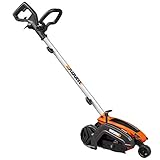
On paper the WG896 and the Black+Decker LE750 are nearly the same tool. Both have 12-amp motors, 7-1/2 inch blades and three blade depths from 1 to 1-1/2 inches, and both convert to a trencher. Worx lists a no-load speed of 4,700 rpm and a weight of about 14 pounds. Two differences decide which one you should buy. The Worx has an adjustable shaft, so you can raise the handle rather than stooping over the tool for twenty minutes, which matters more than any spec if you are tall or have a sore back. It also carries a three-year warranty, longer than most budget corded edgers. The Worx adds a cutting-line indicator that helps you hold a straight line along a sidewalk joint, which is a small thing that makes a visible difference on the first few passes. With more than 15,000 Amazon ratings it is also one of the most widely used edgers sold. Everything that limits a corded edger applies here too. Depth tops out at 1-1/2 inches and you have to manage a cord. For a typical front walk and driveway, it is excellent value.
Pros
- Adjustable-height shaft, which the fixed-handle budget edgers lack
- 12-amp motor, 7.5-inch blade and a 4,700 rpm no-load speed
- Three depth settings from 1 to 1-1/2 inches, plus trenching
- Cutting-line indicator helps you hold a straight edge
- 3-year warranty and more than 15,000 Amazon ratings
Cons
- Around 14 lbs, which you notice when lifting it over curbs and steps
- Same 1-1/2 inch depth limit and extension-cord hassle as other corded edgers
The Bottom Line
Practically the LE750's twin, with an adjustable shaft and a longer warranty, so it is the better corded pick if you are tall or have a bad back.

Best Walk-BehindMcLane 101-4.75GT-7 9-Inch Gas Walk-Behind Edger
Gas Walk-Behind Edger
A walk-behind edger is a different class of machine from a handheld stick edger, and the McLane is the traditional version of it. It is a four-wheeled gas edger with a Briggs and Stratton engine, a 9-inch by 2-inch spring steel blade and adjustable depth control. A single lever engages the blade, so you can let the engine run while you roll the machine to the next section without the blade spinning. McLane says the cutter head runs on sealed precision ball bearings and that the blade can be set to cut vertically or horizontally. The point of a machine like this is that the chassis carries the weight and holds the blade angle for you. On a long driveway, a corner lot with a lot of sidewalk or a property with curbing on several sides, you walk at a steady pace and get the same edge every time, with nothing to hold up and no cord or battery to manage. The downsides are what you would expect. It is big and heavy, it needs fuel and engine care, and on a small lot it is a lot of machine to store for twenty minutes of work.
Pros
- Briggs and Stratton engine with no cord and no battery to run out
- 9-by-2-inch spring steel blade with adjustable depth control
- Single-lever blade clutch lets the engine idle while you reposition
- Four 7-inch rubber tires and a sealed-bearing cutter head
- Made in the USA by a company that has built walk-behind edgers for decades
Cons
- Heavy and bulky compared with any stick edger, and needs real storage space
- Gas engine maintenance, fuel stabilizer and noise come with it
The Bottom Line
Worth it for long driveways, corner lots and anyone edging a lot of linear feet every week, and overkill for a front walk.

Best for Overgrown BordersEarthquake 41273 79cc Walk-Behind Edger
Gas Walk-Behind Edger, Pivoting Blade
The Earthquake 41273 is the heavy option, and it earns its place for one job in particular: putting back edges that have disappeared. Its 79cc four-cycle Viper engine spins a tri-tip steel blade at 3,400 rpm, depth adjusts through ten positions down to 2.5 inches, and the blade pivots up to 20 degrees in either direction. That pivot is what separates it from the McLane and from every handheld here. A beveled cut along a mulch bed holds its shape better than a straight vertical one, and on a border that has grown over you can make the first pass angled and the second straight. The four airless 8-inch wheels mean there is no tire to go flat in the shed, and Earthquake backs it with a five-year limited warranty. It weighs about 55 pounds, so it is a two-person lift into a truck and awkward on steps. It also has far fewer Amazon ratings than the other picks, so treat its score with caution, and note that Earthquake lists it as not available to ship to California because of its engine.
Pros
- 79cc 4-cycle Viper engine, so there is no gas and oil mixing
- Ten depth positions, cutting up to 2.5 inches deep
- Blade pivots up to 20 degrees either way for beveled bed edges
- Tri-tip steel blade and four 8-inch airless wheels
- 5-year limited warranty
Cons
- About 55 lbs and heavy to load into a car or lift over steps
- Few Amazon ratings so far, and Earthquake says it cannot ship to California
The Bottom Line
The edger to choose when you are reclaiming lost borders or cutting beveled bed edges, not just tidying a sidewalk.

Best Manual EdgerFiskars 38.5-Inch Long-Handle Steel Edger
Manual Half-Moon Edger
A half-moon edger is the oldest tool in this guide and still one of the most useful. The Fiskars has a welded 14-gauge hardened steel blade, an 18-gauge powder-coated steel shaft and a T-handle, so you can drive it with both hands and your full weight on the oversized foot platform. That combination is what makes it work: a sharp blade pressed straight down cuts turf roots cleanly, where a flimsy edger bends and tears. It is the best tool here for cutting new bed lines, following curves around trees and borders, and making the deep initial cut that a powered edger can then maintain. It needs no fuel, cord or battery, it hangs on a nail, and Fiskars backs it with a lifetime warranty. Where it falls down is long straight runs of hardscape. Edging 150 feet of sidewalk and driveway by hand every few weeks is hard, slow work, and most people who try it give up and buy a powered edger. Think of it as a bed-edging tool first and a sidewalk tool only for small properties.
Pros
- Welded 14-gauge hardened steel blade and powder-coated 18-gauge steel shaft
- T-handle for a two-handed grip and an extra-large foot platform
- No fuel, no battery, no cord and almost nothing to maintain
- Lifetime warranty from Fiskars
- Cuts bed edges and curves that wheeled edgers handle poorly
Cons
- Hard physical work on long straight runs of sidewalk
- Slow for maintenance edging compared with any powered edger
The Bottom Line
The right tool for cutting bed lines and the occasional border, and a useful partner to a powered edger even if you own one.
4. Edger vs String Trimmer Edging
Plenty of people never buy an edger at all. They rotate the head of their string trimmer 90 degrees and run the line along the sidewalk. It works, and if you already own a good trimmer it is the free option. Many trimmers, including several in our best string trimmer guide, have a rotating head or an edging wheel for exactly this reason.
The difference is in the result and the wear. A string throws grit, chews the edge rather than slicing it, and wears line quickly against concrete, so you will be reloading the spool far more often. Our guide on how to restring a weed eater makes that less painful, but it is still the main running cost of trimmer edging. A steel blade cuts a crisp vertical face, goes deeper and throws less debris across the driveway.
Depth is the other gap. A trimmer cuts at the surface and maybe a little below. That keeps a sharp edge looking neat for a week, but runners keep growing under the slab line and the grass creeps back faster. An edger cutting an inch or more down severs those runners, so a well-cut edge holds its shape longer between passes.
Our rule of thumb is simple. If you edge less than about 100 linear feet and do it every week or two, your trimmer is probably enough. If you have more than that, warm-season grasses that spread by runners, or edges you want to look professionally cut, a dedicated edger pays for itself in time and line. If you are shopping for the trimmer side of this, the best weed eater roundup covers which models edge best.
5. Blade Depth, Blade Size and Blade Wear
Edger blades are usually 7-1/2 to 9 inches across, and the blade size matters less than the maximum depth the machine allows. For routine maintenance along a clean sidewalk, about an inch is plenty. For a border that has been ignored for a season, or for grass like Bermuda, zoysia and St. Augustine that spreads by stolons over the concrete, you want 1-1/2 to 2 inches available so you can cut below the runners.
This is where the categories separate. The corded wheeled edgers in this guide stop at 1-1/2 inches. Greenworks lists 2.25 inches for the ED40L410, the Earthquake goes to 2.5 inches and EGO quotes 3 inches for its edger attachment. Deeper is not always better. Cutting deeper than you need wears blades faster, throws more soil and risks cable or irrigation lines buried close to the surface.
Blades are a consumable. An edger blade grinds against concrete on every pass and will round off over a season or two, after which it tears grass rather than cutting it. Most replacement blades are inexpensive, and you can buy them from the manufacturer or third-party suppliers, but check the arbor size and blade length match your model before ordering. A dull blade is the most common reason an edger that used to cut cleanly starts leaving a ragged line.
Pay attention to how depth is set. Tool-free knobs and levers, like those on the EGO and Greenworks, encourage you to adjust depth to suit each edge. Fixed notches that need a wrench tend to get set once and left, which usually means cutting too deep on a sharp edge and too shallow on an overgrown one.
6. Battery vs Corded vs Gas
Battery edgers are the best fit for most homeowners now. They start instantly, run quietly enough for an evening, need no fuel and have no cord to drag across the lawn. The real cost is the battery. If you already own batteries from EGO, Greenworks, Ryobi or another platform, a bare edger is a cheap add-on. If you do not, the kit price is high, and you should think about which platform you want to commit to. Our cordless tool batteries explainer covers how to choose.
Corded edgers are the value choice and are genuinely good tools. A 12-amp motor has plenty of power for a 1-1/2 inch cut, they never run out of charge and there is nothing to maintain beyond the blade. The drawback is the cord. A 12-amp tool needs a heavy-gauge outdoor extension cord, and on a long driveway you spend a lot of the job flipping the cord out of the way.
Gas makes sense in two cases: walk-behind machines for large properties and heavily overgrown edges, and stick edgers for professionals. A gas stick edger like the Echo PE-2620, which Echo specs with a 25.4cc two-stroke engine, a 2:1 gear reduction and a curved shaft, is a superb tool, but it is sold mainly through dealers and is more machine, noise and maintenance than most homeowners need. Four-stroke walk-behinds avoid fuel mixing, but still need oil changes and stabilized fuel over winter.
A practical way to decide: if you edge for less than 30 minutes at a time and own batteries, buy battery. If you do not own batteries and your edges are near an outlet, buy corded. If you have hundreds of feet of edging, or edges that have vanished, look at a walk-behind. Edging is also the job where a battery platform pays off fastest, because the same battery runs your trimmer, hedge trimmer and blower.
7. How to Cut a Clean Edge the First Time
Start by finding the line. On a sidewalk or driveway, that is the edge of the concrete, and the guide wheel on most edgers rides on the pavement to keep the blade tight against it. On a bed edge, mark the line first with a garden hose laid in the curve you want or a string line for straight runs. Cutting freehand by eye is how bed edges end up wavy.
Set the depth shallower than you think on the first pass. If the edge has grown over, make one shallow pass to establish the line, then a second at full depth. Trying to plough through 2 inches of matted turf in one go bogs the motor, throws the blade off line and leaves a ragged edge that takes weeks to grow back neatly.
Walk at a steady, slow pace and let the blade do the work. Pushing an edger fast makes it skip and wander. Keep the guide wheel on the hard surface and the blade guard positioned so clippings land on the pavement, where they are easy to blow off, rather than in the lawn or a flower bed.
Clean up immediately. Edging leaves strips of turf and soil on the concrete, and if it sits it stains, tracks inside and blows back into the lawn. A blower takes seconds. On a driveway with weeds pushing through joints as well as at the edges, our guide to killing weeds in driveway cracks covers the part an edger cannot reach.
Then keep it up. A clean edge recut every two to four weeks in the growing season takes a few minutes. Letting it go for two months means starting over with a deep, slow cut, which is exactly the job that makes people think they need a more powerful edger than they really do.
8. Edger Safety: Sparks, Rocks and Buried Lines
An edger blade spinning against concrete throws grit, small stones and, when it touches the slab, sparks. Wear safety glasses every time, long trousers and closed shoes. Keep children and pets well away, and be aware of cars parked along the driveway, because a thrown stone can chip paint or crack glass.
Know what is buried along your edges before you cut deep. Low-voltage landscape lighting cable, invisible dog-fence wire and drip irrigation are often laid just under the turf along walks and beds. A blade set to 2 or 3 inches will sever them instantly. Run the first pass shallow and check, or mark known runs with flags.
Respect the blade when clearing a jam. Turf and roots wrap around edger blades, especially on overgrown borders. Stop the engine or motor, remove the battery or unplug the cord, and then clear it. On gas walk-behinds, disengage the blade clutch and shut the engine off. Most edger injuries happen to people clearing a blade that they assumed had stopped.
Hearing protection is sensible with any gas edger and on long sessions with corded or battery tools. Walk-behind gas machines are loud enough that neighbors will notice, so the courtesy rules for any power equipment apply: not early in the morning, and not for an hour at a time on a weekend afternoon.
9. Blade Changes and Upkeep
The single most useful maintenance habit is checking the blade. Look at it every few uses. When the corners have worn round or the blade has shortened noticeably, replace it. Sharpening an edger blade is possible, but they are cheap enough and worn unevenly enough that replacement is usually the better use of time.
Change the blade with the power removed, wear gloves and note the order of washers before you take it apart. Some edgers use a reverse-threaded blade bolt, and most have washers or spacers that must go back in the right sequence, so check the manual before you start. Tighten to the manual's figure rather than as tight as you can, because overtightening can damage the shaft or bearings.
Clean the blade guard after each use. Wet clippings and soil pack into the guard and around the guide wheel, which drags the motor and holds moisture against metal. A stiff brush when the debris is dry is enough. On battery tools, store the battery indoors over winter at a partial charge, as the manufacturer recommends.
Gas edgers need the usual engine care: fresh fuel with stabilizer, clean air filters, and an oil change on four-stroke walk-behinds at the interval in the manual. Run the tank dry or stabilize the fuel before winter storage, because varnish in a small carburetor is the most common reason an edger will not start in spring.
10. Who Should Skip a Dedicated Edger
If your property has a short front walk and no driveway edge to speak of, an edger is a tool that will hang on the wall for 364 days a year. A string trimmer turned on its side and a half-moon edger for the beds will give you a result almost as good for a fraction of the cost and storage space.
If your hardscape has a mowing strip, metal or plastic edging, or a raised curb that the mower deck already trims against, you may not need to edge at all. Edging is mostly about stopping grass from creeping over flat concrete, and a physical barrier does that permanently.
If your grass is a cool-season type like fescue or Kentucky bluegrass, it creeps more slowly over edges than warm-season grasses that spread by runners. A cut every month or so may be enough, and a trimmer handles that comfortably. Warm-season lawns in the South are where a proper edger earns its keep.
And if you are tempted by a gas walk-behind because it sounds more serious, be honest about your lot. Unless you have a lot of linear feet or edges that have been lost, a battery or corded edger will do the job with less noise, less weight and far less storage. Spend the difference on a leaf cleanup tool from our leaf vacuum guide instead.
11. Common Mistakes to Avoid
Buying more edger than the yard needs
A 79cc walk-behind on a 40-foot front walk is noise, weight and storage for no benefit. Measure your linear feet of edging first. Under about 150 feet, a battery or corded edger does the job well, and a string trimmer may be enough if you edge often.
Cutting full depth on an overgrown border in one pass
Forcing the blade 2 inches into matted turf bogs the motor, throws the edger off line and leaves a ragged cut. Make a shallow pass to establish the line, then a second deeper pass. The result is straighter, faster and easier on the tool and your back.
Ignoring what is buried along the edge
Landscape lighting cable, dog-fence wire and drip lines often run just under the turf beside walks and beds. A blade set deep will cut them in an instant. Flag known runs, start with a shallow pass, and check the cut before you set the edger to its maximum depth.
Using a dull, rounded blade
Edger blades grind against concrete every pass and wear round within a season or two. A worn blade tears grass instead of slicing it and leaves a fuzzy edge that looks worse within days. Replacement blades are cheap, so check the blade every few uses and swap it out.
Using a light extension cord
A 12-amp corded edger on a long, thin indoor cord loses power, runs hot and can trip breakers. Use a heavy-gauge outdoor-rated cord sized for the length you need, and route it behind you so the blade never crosses it while you work along the driveway.
Before You Buy
Also Needed for This Job
12. Frequently Asked Questions
Do I need a lawn edger if I have a string trimmer?
Not always. Turning a trimmer head sideways works for short edges you maintain every week or two. A dedicated edger cuts deeper, leaves a cleaner vertical face, throws less grit and saves a lot of trimmer line, so it is worth buying once you have more than about 100 feet of edging or warm-season grass that creeps fast.
How deep should I edge my lawn?
For routine maintenance along a sidewalk or driveway, about an inch is enough. For an overgrown border, or grasses like Bermuda and St. Augustine that spread by runners, cut 1-1/2 to 2 inches to sever the stolons. Avoid going deeper than you need, because it wears blades and risks buried cables and irrigation.
Is a battery edger powerful enough?
For most homeowners, yes. Brushless battery edgers like the EGO and Greenworks cut cleanly through typical edges and can go deeper than corded wheeled models. Where they struggle is long sessions on badly overgrown borders, where battery life and motor load both become limits. That is the job for a gas walk-behind.
How often should I edge?
During the growing season, every two to four weeks keeps edges crisp with a quick shallow pass. Warm-season lawns in hot weather may need it every two weeks. Leaving it for two months means a slow, deep recut, so a regular schedule is actually less work overall. Cool-season lawns can usually go a little longer between cuts.
Can a lawn edger cut a new flower bed edge?
Yes, and the trenching mode on edgers like the Black+Decker LE750 and Worx WG896 is designed for it. For curves, a manual half-moon edger is easier to control. Lay a hose along the line you want, cut it by hand or with the edger, and maintain it with the powered edger afterward.
What is the difference between an edger and a trencher?
An edger cuts a narrow vertical slit along a hard edge to stop grass creeping. A trencher cuts a slightly wider, deeper slot for bed borders or for burying low-voltage cable. Several corded edgers convert between the two by changing the blade position, which makes them useful for small landscaping jobs.
How long do edger blades last?
It depends on how much concrete the blade touches and how often you edge, but most homeowners replace a blade every one or two seasons. Replace it when the corners have rounded off or the edge starts looking torn rather than sliced. Always buy the blade size and arbor that match your model.
Related Lawn Edging Guides
The Bottom Line
For most yards, the EGO ME0800 is the edger to buy if you are on EGO batteries, and the Greenworks ED40L410 kit is the cordless pick if you are starting from nothing. If your edges are short and near an outlet, the Black+Decker LE750 or Worx WG896 will do the same job for much less.
Save the gas walk-behinds for long driveways, corner lots and borders you need to reclaim, and keep a Fiskars half-moon in the shed for bed lines either way. Whatever you buy, a sharp blade and a regular schedule matter more than horsepower.
More in Lawn & Yard Care
Guides in this category that pair with what you just read.
About the Author
Alex Rivers, Home Improvement Editor
Alex has spent over a decade working on residential and light commercial property maintenance, and now tests every tool, coating and machine that appears in these guides personally.