The 7 Best String Trimmers in 2026
We ran 13 trimmers through fence lines, ditch banks, overgrown property edges, and routine lawn trimming across a full season. Gas and battery, straight shaft and curved. Only 7 earned a spot.
Alex Rivers
Home Improvement Editor
Last Updated
October 17, 2026
In This Guide
A string trimmer is the tool most homeowners buy on power specs and then quietly stop using because of weight, line feed frustration, or a shaft geometry that makes their actual job awkward. Cutting power is rarely the limiting factor. After a season of running 13 trimmers through everything from tidy lawn edges to a genuinely overgrown ditch bank, here is what separates the ones that stay in rotation from the ones that end up in the corner of the garage.
Our Picks at a Glance
The Short Answer
EGO Power+ ST1521S 15" Powerload (Best Overall). The trimmer that solves the two problems people actually quit over: cutting power and reloading line. If the price fits, it is the one to buy.
- Check Price
- Check Price
- Best for Heavy Duty Milwaukee M18 FUEL String Trimmer — Battery, 18V, Straight Shaft, Quik-Lok CompatibleCheck Price
- Best Value Battery Ryobi ONE+ HP 18V Brushless String Trimmer — Battery, 18V, Straight Shaft, BrushlessCheck Price
- Best for Large Yards Greenworks Pro 80V 16" String Trimmer — Battery, 80V, Straight Shaft, Attachment CapableCheck Price
- Check Price
- Check Price
We may earn a commission when you buy through these links, at no extra cost to you. How we test
Best Overall
EGO Power+ ST1521S 15" Powerload
1. What Actually Decides Whether You Like a Trimmer
Cutting power is the specification every trimmer is marketed on, and for most homeowners it is not the thing that determines satisfaction. Three other factors matter more in daily use, and none of them appear prominently on the box.
Weight and balance. A trimmer is held out away from your body at the end of a lever, which multiplies its effective weight considerably. A tool that feels reasonable in the store aisle for ten seconds can be genuinely fatiguing after fifteen minutes of continuous use. Balance matters as much as raw weight: a machine with its battery near the handle feels far lighter in use than one of identical weight with mass concentrated out at the head.
The line feed system. Running out of line mid-job and having to reload is the most disliked routine task in trimmer ownership, and different head designs make it anywhere from a five-second button press to a ten-minute exercise in frustration on the garage floor. This single design detail has more influence on whether a trimmer stays in regular use than motor specifications do.
Shaft geometry. Straight and curved shafts suit genuinely different jobs, and buying the wrong one makes routine work awkward in a way no amount of power fixes. A curved shaft brings the head closer and is more comfortable for short users on flat lawn edges; a straight shaft reaches under shrubs, over ditch banks, and around obstacles that a curved shaft cannot approach.
The Numbers Don't Lie
5.5-13 lb
Typical trimmer weight range
0.065-0.095"
Common line diameter range
20-45 min
Realistic battery runtime under load
50:1
Common two-stroke fuel mix ratio
2. Gas vs Battery vs Corded
The power source decision sets the ceiling on what the tool can cut and the floor on how much maintenance it demands. For most suburban properties the answer has shifted decisively in the last several product generations.
Battery
Modern brushless battery trimmers handle everything a typical maintained yard presents: lawn edges, fence lines, around trees and mailboxes, and moderate weeds. They start instantly, weigh less than comparable gas tools, require essentially no maintenance beyond line replacement, and are quiet enough to use early on a Saturday without irritating neighbors. The constraints are runtime, typically 20 to 45 minutes under real load, and reduced torque in genuinely heavy, woody growth.
Gas
Gas remains the answer for two situations: large properties where runtime is the binding constraint, and heavy, stalky, or woody growth where torque matters more than convenience. A gas trimmer with a fuel can attached to your belt runs all day. The costs are two-stroke fuel mixing, more vibration, considerably more noise, pull starting, and seasonal maintenance including spark plugs, air filters, and fuel stabilization.
Corded Electric
Corded trimmers are the cheapest and lightest option and never run out of power, but the extension cord is a genuine practical limitation. Managing a cord around trees, beds, and fences while operating a spinning cutting head is awkward, and the practical reach limit of about 100 feet from an outlet rules out most of the property for most homes. They make sense for very small lots and for occasional use.
| Power Type | Best For | Runtime | Maintenance |
|---|---|---|---|
| Battery 18-40V | Suburban lots, routine trimming | 20-40 min | Line only |
| Battery 56-80V | Large lots, heavy weeds | 30-60 min | Line only |
| Gas 2-Stroke | Acreage, brush, all-day work | Unlimited | Fuel mix, plugs, filters |
| Corded Electric | Small lots near outlets | Unlimited | Line only |
3. The 7 Best String Trimmers in 2026 — Tested & Ranked
We ran each trimmer through routine lawn edging, a fence line with grass grown into the wire, a genuinely overgrown ditch bank with stalky weeds, and a timed runtime test under continuous load, tracking cutting speed, bogging, line consumption, and fatigue over long sessions. These seven earned their place.

Best OverallEGO Power+ ST1521S 15" Powerload
Battery, 56V, Straight Shaft, Powerload Head
Most string trimmer reviews focus on cutting power, but the feature that changed how often we reached for the ST1521S was the Powerload head. Reloading trimmer line is the single most disliked routine task in yard care, normally requiring you to remove the spool, wind line by hand in the correct direction, and reassemble it while it tries to unspool. Powerload replaces all of that: you feed a length of line straight through the head and press a button, and the motor winds it for you in about five seconds. Over a season of testing where every trimmer needed reloading repeatedly, that difference showed up as a genuine change in willingness to use the tool. The cutting performance backs it up. The 56V brushless motor handled our overgrown ditch bank test, dense stalky weeds a couple of feet tall, without the bogging that stopped lower-voltage battery trimmers, and the 15-inch cutting swath covers ground quickly on routine lawn edges. Balance on the straight shaft is excellent, with weight sitting close to the body rather than out at the head, which matters after twenty minutes of continuous trimming. The honest trade-offs are cost and runtime. This is a premium-priced tool, and pushing it hard through heavy growth on full power drains a standard battery in under half an hour. For routine trimming at partial throttle, runtime is a non-issue; for clearing a large overgrown area, plan on a second battery.
Pros
- Powerload head reloads line automatically by feeding it through and pressing a button, eliminating the worst chore in trimmer ownership
- 56V brushless motor delivers cutting power genuinely comparable to a mid-tier gas trimmer
- Straight shaft with excellent balance, comfortable for extended use and for reaching under shrubs
- Variable speed trigger lets you dial power down for light trimming to preserve runtime
- Batteries interchange across EGO mowers, blowers, and chainsaws, which lowers the real cost if you own others
Cons
- Expensive, particularly when a battery and charger are included in the price
- Runtime on high power drops quickly in genuinely heavy weeds, often under 30 minutes
- Heavier than budget battery trimmers because of the larger battery pack
The Bottom Line
The trimmer that solves the two problems people actually quit over: cutting power and reloading line. If the price fits, it is the one to buy.

Best Gas TrimmerStihl FS 56 RC-E
Gas, 27.2cc 2-Stroke, Straight Shaft
Battery trimmers have closed most of the gap with gas, but not all of it, and the FS 56 RC-E is a clear demonstration of where the remaining difference lives. On our ditch bank test, dense stalky growth that made the battery trimmers bog and require a second pass, the Stihl went through in one pass at steady throttle without any sign of strain. On a property with real acreage of rough edges, the combination of that torque and unlimited runtime from a fuel can is simply a different category of tool. The Easy2Start mechanism deserves specific mention because it addresses the main practical objection to gas equipment. Rather than requiring a hard, fast pull, it uses a spring that stores energy from a slow, easy pull and releases it to turn the engine over. In our testing it started on the second pull consistently from cold and first pull warm, including after several weeks sitting. Anyone whose mental image of a gas trimmer involves yanking a cord twenty times should recalibrate. What you accept in exchange is real. You need to mix two-stroke fuel at the specified ratio, and running unmixed gasoline through it will destroy the engine quickly. It is loud enough that hearing protection is not optional. It vibrates more than a battery tool over a long session. And it is a dealer product rather than a shelf purchase, which is a hassle up front and an advantage later when you need parts.
Pros
- Easy2Start system makes starting genuinely easy, removing the main reason people avoid gas trimmers
- Unlimited runtime with a fuel can, which nothing battery-powered can match on a large property
- Handles heavy brush and thick stalks better than any battery trimmer we tested
- Serviceable at Stihl dealers nationwide with excellent long-term parts availability
- Straight shaft with a durable, professional-grade build that survives real abuse
Cons
- Requires mixing two-stroke fuel at the correct ratio, and running straight gas will destroy it
- Loud enough to require hearing protection, unlike battery alternatives
- Sold through dealers rather than big-box stores, so it is less convenient to buy
The Bottom Line
The trimmer to buy for genuine acreage or genuinely heavy growth. Gas still wins where runtime and brush-cutting power are the binding constraints.

Best for Heavy DutyMilwaukee M18 FUEL String Trimmer
Battery, 18V, Straight Shaft, Quik-Lok Compatible
On paper an 18V trimmer should not compete with 56V and 80V machines, and the M18 FUEL is the clearest evidence that voltage alone is a poor proxy for performance. Milwaukee pairs an efficient brushless motor with high-output battery packs that deliver more current than standard cells, and the result in our testing was cutting performance that sat comfortably in the same class as higher-voltage competitors. It cleared our thick-weeds test section without bogging, and it held speed under load better than several nominally more powerful tools. Build quality is where it separates itself most clearly. This is a tool designed for daily commercial use, with a robustness in the shaft, head, and guard that consumer battery trimmers do not attempt. Over a season including deliberately careless treatment, dropping it on gravel and running it into fence posts, it showed wear but no functional damage. The Quik-Lok attachment system extends its value considerably, since the same powerhead accepts an edger, a pole saw, and a brush cutter, which is a meaningful saving if you would otherwise buy three separate tools. Two caveats. The performance figures assume a high-output battery, and running a standard M18 compact pack produces noticeably weaker results, so budget for the right battery. And the head is a conventional bump-feed design, so reloading line is the traditional manual process rather than the automated one EGO offers.
Pros
- Outperforms its 18V rating substantially thanks to an efficient brushless motor and high-output battery support
- Quik-Lok attachment system accepts edgers, pole saws, and brush cutters on the same powerhead
- Built to jobsite durability standards, noticeably more robust than consumer battery trimmers
- Batteries shared with the enormous Milwaukee M18 tool platform, which many DIYers already own
- Excellent balance and a comfortable straight shaft for long working sessions
Cons
- Requires a high-output battery to reach its rated performance, and standard packs underperform
- Manual bump-feed head rather than an automatic load system
- Premium pricing, especially if you are not already invested in the M18 platform
The Bottom Line
The battery trimmer built like a jobsite tool. If you already own M18 batteries, this is an easy call and a genuinely capable trimmer.

Best Value BatteryRyobi ONE+ HP 18V Brushless String Trimmer
Battery, 18V, Straight Shaft, Brushless
Ryobi ONE+ succeeds by delivering most of the practical capability of premium tools at a fraction of the price, and the HP brushless trimmer is a strong example. On routine work, trimming around a fence, along a driveway edge, and under a deck, it was genuinely indistinguishable in outcome from tools costing three times as much. It cut cleanly, held speed, and was light enough that a full lap of a suburban lot never became tiring, which is not true of the heavier high-voltage machines. The adjustable cutting width is a small feature with real practical value. Narrowing the swath reduces the load on the motor and extends runtime considerably, which suits routine edging, while widening it covers ground faster when you have a large area of light grass. Being able to make that trade in the field rather than at purchase is genuinely useful. The ecosystem argument is the strongest one here. ONE+ is among the largest battery platforms in home tools, and if you already own the drill, the blower, or the mower, the effective cost of adding this trimmer is just the bare tool. Where it gives ground is heavy growth. Pushed into the thick, stalky weeds on our ditch bank, it bogged and needed several passes where the EGO and Stihl went through cleanly. For a typical maintained yard that is irrelevant, and for a neglected acre it matters a lot.
Pros
- Brushless motor delivers considerably more power than the price point suggests
- Works with the enormous ONE+ 18V battery ecosystem, likely already in the garage
- Adjustable cutting width lets you trade swath for runtime depending on the job
- Light enough for extended use without arm fatigue, unlike higher-voltage battery tools
- Widely available and inexpensive to replace or expand
Cons
- Bogs down noticeably in genuinely heavy, stalky growth where higher-voltage tools do not
- Bump-feed head is more prone to line welding than premium designs
- Plastic construction feels less durable than jobsite-grade competitors
The Bottom Line
The smart buy for a normal suburban lot, especially if you already own ONE+ batteries. It is not a brush cutter, and it is not priced like one.
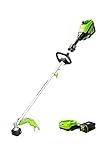
Best for Large YardsGreenworks Pro 80V 16" String Trimmer
Battery, 80V, Straight Shaft, Attachment Capable
If your objection to battery trimmers is that they run out of power and runtime before your property is finished, the Greenworks 80V is the direct answer. Its higher-voltage platform produces meaningfully more torque than the 18V and 40V tools we tested, and it maintained cutting speed under load in growth that made lower-voltage machines audibly bog. Combined with the widest cutting swath here at 16 inches, it covers long fence lines and property edges faster than anything else in the battery category. Runtime is the other half of the argument. The larger 80V pack stores substantially more energy, and in our testing it handled a full pass around a large property, including several minutes of heavy work, without needing a swap. For a homeowner who wants to leave gas behind but has more than a small suburban lot to maintain, that combination of torque and endurance is what makes it viable. The costs are physical and financial. An 80V battery is heavy, and the weight is noticeable within the first ten minutes and unmistakable after thirty, particularly for anyone with shoulder or wrist issues. The batteries are also proprietary and more expensive to replace than more widely adopted platforms. And the whole tool is physically larger, which matters in a crowded garage. On the right property it is the best battery choice here; on a small lot it is more tool than the job needs.
Pros
- The 80V platform delivers the highest torque of any battery trimmer we tested
- 16-inch cutting swath is the widest here, covering ground faster on long runs
- Attachment capable, accepting edgers, pole saws, and cultivators on the same shaft
- Handles thick weeds noticeably better than 18V and 40V competitors
- Strong runtime from the larger battery, comfortably covering a large property in one charge
Cons
- The 80V batteries are heavy, and the tool is tiring over long sessions
- Proprietary 80V packs cost more to replace than mainstream platforms
- Larger and more awkward to store than compact battery trimmers
The Bottom Line
The battery trimmer for genuine acreage. Power and swath width close most of the gap to gas, at the cost of real weight.

Best Attachment SystemHusqvarna 128LD
Gas, 28cc 2-Stroke, Detachable Straight Shaft
The strongest argument for the 128LD has little to do with trimming. Its detachable shaft turns a single gas engine into the powerhead for an entire family of yard tools, so an edger, a pole saw for high branches, a hedge trimmer, and a cultivator can all run off one motor you have already bought and already maintain. For a homeowner who would otherwise own four separate small engines, each needing its own fuel, oil, and winter storage, that consolidation saves real money and real garage space. As a trimmer on its own it is a capable, unremarkable performer in the best sense. The 28cc engine handled our thick-weed test comfortably, well beyond what any 18V battery tool managed, and the Smart Start system reduces the pull resistance enough that starting is not a battle. Build quality sits below dealer-grade Stihl and Husqvarna professional lines but comfortably above budget big-box gas trimmers, and it is sold in stores rather than through dealers, which most buyers prefer. Two things to weigh. The detachable coupling is inherently a wear point, and after years of heavy use it can develop enough play to introduce vibration that a one-piece shaft would not have. And attachments are sold separately at real prices, so the multi-tool savings only materialize if you genuinely buy and use them rather than intending to. As a trimmer alone, other options here are better values.
Pros
- Detachable shaft accepts a wide range of attachments including edger, pole saw, hedge trimmer, and cultivator
- Splits down for genuinely compact storage and easy transport in a car trunk
- Smart Start reduces starter cord resistance for easier pull starting
- Solid gas power for heavy weeds at a lower price than premium dealer brands
- Widely available in big-box stores rather than dealer-only
Cons
- The detachable coupling is a wear point and can develop play over years of heavy use
- Requires two-stroke mixed fuel and the associated maintenance discipline
- Attachments are sold separately and add up quickly in cost
The Bottom Line
The best value in a gas multi-tool system. Buy the powerhead once and add attachments instead of buying four separate engines.

Best LightweightWorx WG163 GT 3.0 20V
Battery, 20V, Convertible Trimmer/Edger
Every other trimmer in this guide is designed around cutting capability, and the WG163 is designed around ease of use. At roughly five and a half pounds it is light enough to hold comfortably at arm length with one hand, which fundamentally changes the experience for anyone with wrist, shoulder, or back limitations, or simply anyone who finds a nine-pound tool at the end of a long shaft tiring. In our testing, it was the trimmer that non-enthusiast household members reached for voluntarily, which is a meaningful signal. The convertible edger is well executed rather than a gimmick. The head rotates 90 degrees and a wheel drops down to guide the tool along a hard edge, converting it into a functional in-line edger for driveway and sidewalk borders in a few seconds without tools. Combined with Command Feed, which advances line at the push of a button rather than by bumping the head against the ground, it is the most beginner-friendly tool here by a wide margin. The limits are straightforward. It has modest power and will bog in anything more substantial than light grass and soft weeds, so it is a maintenance tool rather than a clearing tool. Runtime on the compact battery runs 20 to 30 minutes. And the narrow swath means more passes on larger areas. For a small, maintained lot, those limits rarely bite.
Pros
- Among the lightest trimmers available at roughly 5.5 pounds, genuinely usable one-handed
- Head rotates 90 degrees to convert into an in-line edger without any tools
- Command Feed spool advances line with a push button rather than bumping the head on the ground
- Adjustable shaft length and handle position fit a wide range of user heights
- Inexpensive, with the battery platform shared across a broad Worx tool line
Cons
- Limited power, struggling with anything beyond light grass and soft weeds
- Short runtime on the compact 20V battery, typically 20 to 30 minutes
- Small cutting swath means more passes on larger areas
The Bottom Line
The trimmer for someone who wants light, simple, and easy rather than powerful. Ideal for small lots, and genuinely the best pick for users with limited strength.
4. Line Diameter, Shape, and Feed Systems
The consumable and the head that holds it have more day-to-day effect on your experience than almost anything else about the tool.
Line Diameter
Thinner line, around 0.065 inches, cuts light grass cleanly with less motor load and better runtime on battery tools. Thicker line, 0.080 to 0.095 inches, is far more durable against fences and concrete and cuts heavier weeds, at the cost of more power draw and more vibration. Match the diameter to your tool's rating: running line thicker than the head is designed for strains the motor and can damage the tool.
Line Shape
Round line is the cheapest, most durable, and least aggressive, and it is the right default for routine trimming. Twisted line reduces the noise and vibration that round line produces. Square, star, and serrated profiles have cutting edges that slice through thick weeds far more effectively, at the cost of breaking more readily against hard surfaces. For a maintained lawn use round; for heavy growth, an edged profile makes a real difference.
Bump Feed Heads
The most common design. Tapping the spinning head against the ground releases a measured length of line. Simple, reliable, and universally understood, but reloading means disassembling the spool and winding line by hand in the correct direction, which is where most trimmer frustration comes from.
Automatic and Powered Feed Heads
Automatic heads advance line by sensing when it has shortened, and powered load systems like EGO Powerload wind a fed-through length of line at the press of a button. The latter genuinely eliminates the worst chore in trimmer ownership and is worth paying for if you trim frequently.
Fixed-Line Heads
These accept pre-cut lengths of line that you insert individually, with no spool at all. Reloading takes seconds and there is nothing to tangle or weld, but you replace individual pieces more often. They are popular with people who have given up on spools entirely, and replacement heads are available for many trimmers.
Why Your Line Keeps Welding Itself
When line runs out and the head keeps spinning hot, or when a trimmer is stored in a hot garage, the nylon layers on the spool can fuse together, which is why line stops feeding and the spool has to be pulled apart. Two habits prevent almost all of it: stop trimming as soon as the line gets short rather than running it out, and soak new spools in water for a few hours before installing, since hydrated nylon is more flexible and resists welding.
5. Straight Shaft vs Curved Shaft
This is a genuine functional difference rather than a style preference, and it is the spec most likely to make a buyer quietly dissatisfied without being able to say why.
Straight Shaft
A straight shaft puts the cutting head farther from you and in line with the shaft, which lets it reach under shrubs, beneath deck edges, and out over the lip of a ditch or retaining wall where a curved shaft cannot go. It generally uses a solid drive shaft rather than a flexible cable, which transmits power more efficiently and lasts longer under load. It is also the geometry accepted by attachment systems. Taller users typically find it more comfortable because it does not require stooping.
Curved Shaft
A curved shaft brings the cutting head closer to the operator, which many people find more natural and better balanced for routine work along flat lawn edges. It tends to be lighter and cheaper. The limitations are reach and drive: it cannot get under low obstacles as effectively, and it typically uses a flexible drive cable that is less efficient and wears faster than a solid shaft.
Which to Buy
If your trimming is mostly flat lawn edges, sidewalks, and around a mailbox, a curved shaft is comfortable and sufficient. If you have shrub beds, fences, drainage ditches, retaining walls, or any interest in attachments, buy a straight shaft. Most of the trimmers in this guide are straight-shaft designs precisely because that flexibility suits more properties.
6. Matching the Trimmer to Your Property
Small Suburban Lot, Maintained
A light 18V or 20V battery trimmer is genuinely sufficient and the weight advantage is worth more than extra power you will never use. Prioritize a good feed system and low weight over voltage. The Worx and Ryobi options here are aimed squarely at this case.
Half Acre to an Acre, Mixed Conditions
Step up to a 40V to 56V straight-shaft battery trimmer with a wider swath. You want enough torque for occasional heavy patches and enough runtime to finish in one session, and this is where the EGO sits.
Acreage, Fence Lines, and Rough Edges
Either gas or a high-voltage battery platform with a spare pack. Runtime becomes the binding constraint before cutting power does, and a fuel can never needs recharging. Consider a brush cutter attachment or a dedicated brush blade for anything woody.
Anyone With Strength or Mobility Limitations
Weight is the single most important specification, ahead of everything else. A five and a half pound trimmer that you use comfortably beats a nine pound trimmer that sits unused. Look for adjustable shaft length, a rotating handle, and a push-button line feed rather than a bump head that requires tapping the tool against the ground.
7. Maintenance and Common Trimmer Problems
String trimmers are simple machines, and nearly all of their failures come from a handful of predictable causes.
Line will not feed. Almost always welded line on the spool from heat, or line wound in the wrong direction or crossed over itself during reloading. Pull the spool, unwind it, and rewind in the direction of the arrow marked on the spool, keeping the layers neat and side by side rather than overlapping.
Gas trimmer will not start after storage. Ethanol-blended fuel degrades within a few weeks and gums up small carburetors, which is the leading cause of small-engine failure. Either drain the fuel before storage or use a stabilizer, and consider ethanol-free fuel for equipment used seasonally. A fresh spark plug and a clean air filter resolve most of the rest.
Battery runtime dropping over time. Lithium packs degrade with cycles and with heat. Storing batteries at a partial charge in a temperate location rather than fully charged in a hot garage measurably extends their usable life. Expect several seasons of good service from a quality pack.
Excessive vibration. On gas trimmers, check for a worn flexible drive cable on curved-shaft models or a loose shaft coupling on detachable systems. On any trimmer, an unbalanced head from unevenly extended line causes vibration that disappears once both sides are trimmed to equal length.
Cutting head damage. Trimming against concrete, brick, and chain link wears line and eyelets rapidly. Replaceable eyelet inserts are inexpensive on most heads, and swapping them out when they get grooved prevents the groove from cutting line prematurely, which is a common cause of what feels like a line that keeps breaking for no reason.
Before You Buy
Also Needed for This Job
8. Frequently Asked Questions
What is the best string trimmer?
For most homeowners the EGO Power+ ST1521S offers the best combination of gas-comparable cutting power and a Powerload head that eliminates manual line winding. For genuinely heavy growth or large acreage, the Stihl FS 56 RC-E remains the strongest gas option. For a small maintained lot or anyone prioritizing low weight, the Worx WG163 GT 3.0 is the easiest tool here to use.
Is a straight or curved shaft trimmer better?
A straight shaft reaches under shrubs, decks, and over ditch banks, uses a more durable solid drive shaft, and is required for most attachment systems. A curved shaft is lighter, cheaper, and often more comfortable for routine flat lawn edging. Choose straight if you have beds, fences, or uneven terrain, and curved if your trimming is mostly flat edges.
What size trimmer line should I use?
Use the diameter your trimmer is rated for, which is typically 0.065 inches for light-duty battery trimmers and 0.080 to 0.095 inches for heavier battery and gas models. Thinner line cuts grass cleanly with less motor load, while thicker line is more durable against fences and concrete and cuts heavier weeds. Running line thicker than the head is rated for strains the motor.
Why does my trimmer line keep breaking?
The most common causes are worn eyelets in the cutting head that have developed a groove and cut the line, line that has dried out and become brittle in storage, and trimming hard against concrete or chain link. Replace the eyelet inserts, soak new spools in water for a few hours before use, and use a thicker or edged line profile for abrasive surfaces.
Are battery string trimmers as good as gas?
For routine trimming on a typical maintained property, yes. Modern brushless battery trimmers at 40V and above cut as cleanly as mid-tier gas tools with far less noise and maintenance. Gas retains a clear advantage in two situations: unlimited runtime on large acreage, and torque in heavy stalky or woody growth where battery tools bog.
How long do battery string trimmers run?
Realistically 20 to 45 minutes under load, depending on voltage, battery capacity, and how hard you push it. Trimming light grass at partial throttle can extend that considerably, while sustained work in heavy weeds at full power can cut it to under 30 minutes. For large properties, a second battery is usually the practical solution.
9. Common String Trimmer Buying Mistakes
Trimmer regret is remarkably consistent, and it almost never comes down to buying an underpowered tool.
Buying for Peak Power Instead of Weight
A heavy high-voltage trimmer that is genuinely tiring after fifteen minutes gets used less than a lighter tool with less power. Unless you regularly cut heavy stalky growth, the extra torque is capability you will rarely use, paid for with fatigue you will feel every single time. Pick up the tool and hold it out at arm length before buying.
Ignoring the Line Feed System
The head design determines whether reloading takes five seconds or fifteen frustrating minutes on the garage floor, and it is the single biggest predictor of whether a trimmer stays in regular use. Powered load systems and fixed-line heads are worth real money over a conventional bump-feed spool if you trim often.
Running Line Thicker Than the Tool Is Rated For
Thicker line seems like a free upgrade and is not. It increases motor load, drains battery faster, increases vibration, and on smaller tools can cause overheating and premature motor failure. Check the rated diameter in the manual and stay within it.
Storing a Gas Trimmer With Untreated Fuel
Ethanol-blended gasoline degrades in weeks and gums up small carburetors, which is the single most common reason a gas trimmer will not start in spring. Either run the tank dry before storage or add a fuel stabilizer, and consider ethanol-free fuel for seasonal equipment. This one habit prevents most off-season small-engine repair bills.
Related Yard & Tool Guides
Buyer's Guide
Best Weed Eaters
The same category from a homeowner angle: weight, line feed, and edging rather than raw power.
Buyer's Guide
Best Leaf Blowers
The other half of yard cleanup, tested by CFM, MPH, and how loud they really are.
All Guides
Browse All Best Lists
Every hands-on tested guide we have published, organized by category.
The Bottom Line
The best string trimmer is the one whose weight, shaft geometry, and line feed match how you actually trim. For most homeowners, the EGO Power+ ST1521S is the strongest all-around choice, combining real cutting power with the only line reload system that is genuinely pleasant to use. For acreage and heavy growth, the Stihl FS 56 RC-E is still the tool. And for a small lot or a lighter tool, the Worx WG163 GT 3.0 is the one people actually pick up.
Whatever you buy, hold it out at arm length in the store first. Power specs are easy to compare on paper; fatigue is the thing you will feel every week.
More in Lawn & Yard Care
Guides in this category that pair with what you just read.
About the Author
Alex Rivers, Home Improvement Editor
Alex has spent over a decade working on residential and light commercial property maintenance, and now tests every tool, coating and machine that appears in these guides personally.