The 7 Best Garden Hoses in 2026
We dragged 14 hoses around corners, left them in full sun for a season, kinked them deliberately, and measured actual flow rate. Rubber, hybrid polymer, and polyurethane. Only 7 earned a spot.
Alex Rivers
Home Improvement Editor
Last Updated
October 17, 2026
In This Guide
A garden hose is the cheapest thing in your yard that you interact with most often, which is exactly why buying a bad one is so quietly annoying. Kinks that stop the water at the worst moment, couplings that crack after one winter, and vinyl that goes stiff in the sun are all avoidable with one decision made correctly: the material. Here is what that decision actually costs and which hoses get it right.
Our Picks at a Glance
The Short Answer
Flexzilla Garden Hose 5/8" (Best Overall). The hose that best solves the problems people actually have: kinks, weight, and stiffness in cold. The default recommendation for most homeowners.
- Check Price
- Check Price
- Best Heavy Duty Continental ContiTech Premium Rubber Hose — Rubber, 5/8 inch, Heavy Duty, Hot Water RatedCheck Price
- Check Price
- Check Price
- Check Price
- Check Price
We may earn a commission when you buy through these links, at no extra cost to you. How we test
Best Overall
Flexzilla Garden Hose 5/8"
1. Hose Material Is the Whole Decision
Nearly every meaningful difference between garden hoses comes down to what the tube is made of. Length, color, and branding are secondary. Here is what each material actually does.
Vinyl
The cheapest and most common material, usually sold as multi-layer with reinforcement between layers. Light and inexpensive, but it degrades under ultraviolet light, becoming stiff and eventually cracking, and it kinks readily and retains coil memory. It also contains plasticizers that can leach into standing water in a hot hose, which is why sun-baked vinyl hose water tastes and smells the way it does. Fine for occasional light use, and the reason most people buy a new hose every few years.
Rubber
The commercial standard. Highly durable, abrasion resistant, UV stable, and often rated for hot water and high pressure. The drawback is weight, which is genuinely significant on longer lengths, and stiffness in cold. Rubber hoses last many years and are the right choice for a workshop, a farm, or any property where hoses get abused.
Hybrid Polymer
A newer category that combines flexibility with durability. Stays pliable across a wide temperature range, resists kinking far better than vinyl, and weighs considerably less than rubber. Not typically hot water rated. This is the best all-around choice for most homeowners, and the reason Flexzilla dominates the category.
Polyurethane
The premium option. Highly UV stable, drinking water safe because it has no leaching plasticizers, lighter than rubber, and it delivers excellent flow. It costs the most and is firmer to coil than hybrid polymer. If you want a hose that lasts a decade and produces water safe for pets and people, this is the material.
The Numbers Don't Lie
5/8"
Standard diameter for most home use
17 GPM
Typical flow through 5/8" at 50 ft
350+ PSI
Burst pressure worth looking for
3 vs 10 yrs
Typical vinyl versus polyurethane lifespan
2. Diameter, Length, and Water Flow
Two specifications determine how much water actually reaches the end of your hose, and buyers routinely get both wrong in the same direction: too narrow and too long.
Diameter Determines Flow
Garden hoses come in three common inner diameters. Half inch is light and suits container watering and short runs. Five eighths inch is the standard for general home use and the right default, delivering good flow without excessive weight. Three quarter inch delivers the most water and is used for long runs, high-demand sprinklers, and commercial applications, at a considerable weight penalty.
Length Costs You Pressure
Water loses pressure to friction as it travels through a hose, and that loss compounds with length. A 100-foot hose delivers noticeably less flow at the nozzle than a 50-foot hose of the same diameter connected to the same spigot. Buying more length than you need is the most common way people accidentally reduce their own water pressure.
Buy the Shortest Hose That Reaches
The practical rule is to measure the farthest point you actually need to water and buy that length rather than the next size up for insurance. Two 50-foot hoses joined when needed is a better arrangement than one permanent 100-foot hose, because most of the time you run only the first fifty feet at full pressure.
When to Go Up a Diameter
If you run oscillating or impact sprinklers, fill large containers, or need a run longer than 75 feet, stepping from 5/8 to 3/4 inch recovers a meaningful amount of flow. For hand watering with a nozzle, the difference is far less noticeable and the extra weight is not worth carrying.
| Diameter | Best Use | Flow | Weight |
|---|---|---|---|
| 1/2 inch | Containers, patios, short runs | Lowest | Lightest |
| 5/8 inch | General home use, the default | Good | Moderate |
| 3/4 inch | Long runs, sprinklers, commercial | Highest | Heaviest |
3. The 7 Best Garden Hoses in 2026 — Tested & Ranked
We measured flow rate at the nozzle, forced kinks at multiple points to see whether flow recovered, dragged each hose repeatedly across rough concrete, left them coiled in full sun for a season, and coiled them on cold mornings to test cold-weather flexibility. These seven earned their place.

Best OverallFlexzilla Garden Hose 5/8"
Hybrid Polymer, 5/8 inch, Aluminum Fittings
Most garden hose frustration comes down to three things, and Flexzilla addresses all three better than anything else we tested. Its hybrid polymer construction stays flexible across a wide temperature range, which matters most in early spring and late fall when vinyl hoses become rigid enough to be genuinely difficult to coil. In our cold-morning testing it handled essentially the same as it did in July, while a comparable vinyl hose had to be warmed before it would bend. Kink resistance was the standout result. We deliberately forced tight bends at multiple points along the length, and the Flexzilla either resisted kinking outright or popped back and restored full flow the moment tension released, where several competitors held a kink that had to be walked back by hand. Combined with a jacket that lies flat rather than retaining coil memory, the practical result is a hose that follows you around the yard instead of fighting you. The anodized aluminum fittings deserve a mention too, since they resist the corrosion that seizes cheap fittings onto spigots and are less likely to crush out of round than thin brass. The honest limitations are cosmetic and thermal. The distinctive green jacket picks up dirt and grass stains and looks used within a season. And it is not rated for hot water, so if you need a hose for a water heater drain or similar, a heavy rubber hose is the right tool.
Pros
- Stays genuinely flexible in cold weather, where rubber and vinyl hoses go stiff and unmanageable
- Extremely kink resistant in our testing, recovering flow immediately when a kink was forced
- Lightweight for its diameter, noticeably easier to drag around a yard than rubber
- Anodized aluminum fittings resist corrosion and are less prone to crushing than brass
- Lies flat and coils easily without the memory that makes vinyl hoses fight you
Cons
- The bright green jacket picks up dirt and stains visibly over a season
- Not rated for hot water, unlike heavy rubber hoses
- Costs meaningfully more than a basic vinyl hose of the same length
The Bottom Line
The hose that best solves the problems people actually have: kinks, weight, and stiffness in cold. The default recommendation for most homeowners.
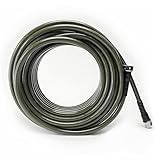
Best PremiumEley Polyurethane Garden Hose
Polyurethane, 5/8 inch, Brass Fittings
Polyurethane is the material that solves the problem most garden hose buyers do not know they have. Vinyl hoses degrade under ultraviolet light, becoming brittle and eventually cracking, and they contain plasticizers that can leach into water sitting in a hot hose, which is why the water from a sun-baked vinyl hose tastes the way it does. Polyurethane has neither problem: it is highly UV stable, and it is inert enough to be certified drinking water safe. If anyone in your household fills a dog bowl or a water bottle from the hose, that distinction matters. The Eley also performed at the top of our flow testing. Its interior bore is smooth and consistent, and measured flow at the nozzle was among the highest of any 5/8-inch hose in the group, which is noticeable when running a sprinkler at the end of a long run. The machined brass fittings are considerably heavier walled than typical stamped brass, which means they resist the crushing that turns a coupling into a leaking, un-tightenable mess. What you pay is genuinely a lot, and there is no getting around it. This costs several times what a basic hose does. The value argument depends entirely on time horizon: if you replace a cheap hose every three seasons, the polyurethane wins over a decade. If you tend to lose or damage hoses regardless, it does not.
Pros
- Polyurethane construction is essentially immune to the UV degradation that kills vinyl hoses
- Drinking water safe, with no plasticizers that leach into the water sitting in the hose
- Excellent flow rate, among the highest measured in our testing at the same diameter
- Machined brass fittings with substantial wall thickness that resist crushing
- Lightweight relative to rubber hoses of the same diameter
Cons
- The most expensive hose in this guide by a considerable margin
- Firmer feel than hybrid polymer hoses, requiring slightly more effort to coil tightly
- Sold primarily direct rather than in hardware stores, so it is harder to buy on impulse
The Bottom Line
Buy it once. If you are tired of replacing a hose every three years, the polyurethane and brass here genuinely last, and the water is safe to drink.

Best Heavy DutyContinental ContiTech Premium Rubber Hose
Rubber, 5/8 inch, Heavy Duty, Hot Water Rated
Rubber garden hoses are the commercial standard for a reason, and the ContiTech is a clear example of what that buys you. Its construction tolerates being dragged across gravel, run over by a vehicle, left kinked under tension, and connected to a pressure washer without complaint. In our abrasion testing, after being dragged repeatedly across a rough concrete pad, it showed surface scuffing where lighter hoses showed genuine wear through the outer layer. Two specifications separate it from everything else here. It is rated for hot water, which polymer and vinyl hoses are not, making it the correct choice for draining a water heater, connecting to a utility sink, or any application involving heated water. And its burst pressure rating is high enough for pressure washer feed lines and demanding commercial use, where a consumer hose can fail under sustained high pressure. The cost is weight, and it is substantial. Rubber is dense, and a 50-foot rubber hose is genuinely tiring to move around a large property compared to a polyurethane or hybrid polymer hose of the same length. It also stiffens noticeably in cold weather, which makes spring and fall coiling more work. And rubber can leave dark marks on light concrete and siding where it rubs. For a workshop or a property where hoses get destroyed, it is the right buy.
Pros
- Commercial-grade rubber construction that tolerates abuse well beyond consumer hoses
- Rated for hot water up to significant temperatures, unlike polymer and vinyl hoses
- Very high burst pressure rating for use with pressure washers and demanding applications
- Excellent resistance to abrasion from being dragged over concrete and gravel
- Heavy brass couplings that stand up to repeated wrenching
Cons
- By far the heaviest hose here, which is genuinely tiring to drag around a large yard
- Stiff in cold weather and requires effort to coil
- Rubber can leave marks on light-colored concrete and siding
The Bottom Line
The hose for a workshop, a farm, or anywhere the hose gets abused. Overkill for casual watering, and indestructible where it belongs.

Best Traditional HoseGilmour Flexogen Super Duty
Multi-Layer Vinyl-Rubber, 5/8 inch, Brass
Most garden hoses sold in America are multi-layer vinyl, and most of them are mediocre. Flexogen Super Duty is what happens when that construction is done properly, with eight distinct layers including reinforcement that gives it meaningfully better burst resistance and durability than the three and four-layer hoses that dominate the same shelf. Over a full season left largely in the sun, it stiffened noticeably less than a standard vinyl hose alongside it and showed no cracking. It occupies a useful middle ground on weight. Rubber hoses are tough and heavy, hybrid polymers are light and expensive, and Flexogen sits between them: substantially lighter than the ContiTech rubber hose while considerably tougher than a basic vinyl hose. For a homeowner who drags a hose around a normal yard and wants it to last, that balance is sensible. The brass couplings are solid rather than thin-walled, with a grip collar that makes hand-tightening onto a spigot much easier than a smooth hex fitting. Its limitations are the limitations of the category. It kinks more readily than a hybrid polymer hose, and once kinked it holds the bend until you walk it back. It retains coil memory, so a freshly uncoiled hose wants to curl. And like all vinyl hoses it is neither hot water rated nor drinking water certified. For the price, none of that is unreasonable.
Pros
- Eight-layer construction is far more durable than typical multi-layer vinyl hoses
- Good balance of weight and durability, lighter than rubber but tougher than plain vinyl
- Solid brass couplings with a comfortable grip collar for hand tightening
- Widely available in hardware stores and reasonably priced for its quality tier
- Held up well to a full season of sun exposure with minimal stiffening
Cons
- Still kinks more readily than hybrid polymer hoses under tight bends
- Retains coil memory, so it fights you slightly when laid out straight
- Not rated for hot water and not certified for drinking
The Bottom Line
The best conventional hose you can buy at a hardware store. A genuine step above the vinyl hoses stacked next to it for a modest premium.
Best LightweightWater Right Slim & Light Polyurethane
Polyurethane, 7/16 inch, Lead-Free Brass
Not every watering job needs maximum flow, and the Slim & Light is built around that observation. Its 7/16-inch diameter, smaller than the 5/8-inch standard, makes it dramatically lighter and easier to handle, coil, and store. For watering containers on a patio, tending raised beds, or simply for anyone who finds dragging a full-size hose around genuinely difficult, that reduction in weight and bulk changes the experience more than any other feature could. The polyurethane construction carries all the material advantages of the premium Eley hose at a smaller scale: it resists UV degradation rather than becoming brittle in the sun, it stays flexible in cold weather, and it is drinking water safe with lead-free brass fittings, which matters if you fill pet bowls or watering cans from it. It also coils very tightly and stores in a fraction of the space a 5/8-inch hose needs. The trade-off is flow rate, and it is not trivial. A narrower hose delivers less water per minute at the same pressure, which is fine for hand watering and light nozzle work and noticeably limiting if you run an oscillating sprinkler or need to fill a large container quickly. Friction losses also compound over distance, so this is a hose for short and medium runs rather than a 100-foot line to the back of a property.
Pros
- Exceptionally light and easy to handle, ideal for container gardens and small spaces
- Drinking water safe with lead-free brass fittings and no plasticizers
- Polyurethane construction resists UV damage and stays flexible in cold
- Small diameter coils very tightly and stores in minimal space
- Available in several attractive colors that hide dirt better than bright jackets
Cons
- The 7/16-inch diameter delivers less flow than a 5/8-inch hose, which matters for sprinklers
- Not intended for long runs where friction losses compound
- Costs more per foot than conventional hoses despite the smaller diameter
The Bottom Line
The right hose for container gardens, patios, and anyone who finds a standard hose too heavy to handle comfortably.
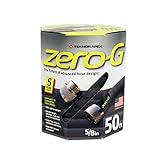
Best for Easy HandlingZero-G Lightweight Garden Hose
Woven Fabric Composite, 5/8 inch, Aluminum
The Zero-G takes a different approach to the weight problem than the narrow-diameter Water Right. Rather than shrinking the bore, it uses a woven fabric composite jacket over a full 5/8-inch inner tube, which cuts weight dramatically while preserving flow. In practice, that means you get roughly the water delivery of a conventional 5/8-inch hose at close to half the weight of rubber, which is a meaningful difference when moving a hose around a large property. Kink resistance is the other strength. The woven construction distributes bending stress rather than concentrating it at a single point, and in our deliberate kink testing it resisted forming the hard creases that stop flow entirely in conventional hoses. It also has essentially no coil memory, so it lies where you put it rather than curling back. Storage is exceptionally easy, since it collapses into a much smaller coil than a rigid hose. The weaknesses follow from the same construction. A woven fabric jacket abrades when repeatedly dragged across rough concrete or gravel, so this is a hose that suits lawns and beds better than a workshop apron. It is not hot water rated and not appropriate as a pressure washer feed. And the jacket holds moisture, so draining it properly before freezing weather matters more than with a solid-wall hose.
Pros
- Remarkably light for a 5/8-inch hose, roughly half the weight of a comparable rubber hose
- Woven jacket construction makes it highly kink resistant and puncture resistant
- Coils into a very small footprint and stores easily on a hook or in a small container
- Full 5/8-inch bore so it maintains good flow despite the light construction
- Stays flexible in cold and does not retain coil memory
Cons
- The woven jacket abrades if repeatedly dragged over rough concrete or gravel
- Not rated for hot water and not suited to pressure washer feed use
- Fabric can absorb and hold water, so it needs draining before winter storage
The Bottom Line
The best compromise between full flow and low weight. Ideal for large yards where a rubber hose is exhausting to move.

Best ValueCraftsman Premium Rubber Hose
Rubber, 5/8 inch, Brass Fittings
Rubber hoses generally last far longer than vinyl ones, and the main obstacle to buying one is price. The Craftsman premium rubber hose narrows that gap considerably, offering genuine rubber construction with solid brass couplings at a price much closer to good vinyl hoses than to commercial rubber. For a homeowner who has replaced a cracked vinyl hose every few years and wants to stop, it is the most economical route to durability. In our testing it handled abrasion well, showing surface scuffing rather than jacket damage after repeated dragging across concrete. It resisted UV degradation across a full season in the sun considerably better than vinyl hoses, and it stayed workable in cold weather where vinyl went rigid. The brass couplings are the detail that separates it most clearly from budget hoses, since plastic and thin stamped fittings are the single most common failure point on cheap hoses and a solid brass coupling can be wrenched tight repeatedly without deforming. The compromises are those of rubber generally, plus a few of price. It is heavy, which is the standing objection to every rubber hose, and it is stiffer and holds coil memory more than the premium ContiTech. Despite being rubber, it is not rated for hot water, so do not assume that capability comes automatically with the material. For general yard use where durability matters more than weight, it is excellent value.
Pros
- Genuine rubber construction at a price well below premium rubber hoses
- Good abrasion resistance and durability for the money
- Solid brass couplings rather than the plastic or thin stamped fittings on budget hoses
- Widely available and easy to replace or match
- Handles cold better than vinyl and resists UV degradation well
Cons
- Heavy, with all the handling drawbacks of rubber construction
- Stiffer than premium rubber hoses and more prone to holding coil memory
- Not hot water rated despite the rubber construction
The Bottom Line
Rubber durability without premium pricing. If you want a hose that lasts and do not mind the weight, this is the value pick.
4. Fittings and Couplings: Where Hoses Actually Fail
Ask anyone why they threw out their last hose and the answer is usually a leak at the spigot or a coupling that would not tighten. The tube outlasts the fittings on most cheap hoses.
Solid brass is the standard worth insisting on. Thin stamped brass and plastic couplings deform when wrenched, and once a coupling is out of round it will never seal properly again. Solid machined brass tolerates being tightened repeatedly and lasts as long as the hose does. Check the wall thickness by feel, since heavier is genuinely better here.
Anodized aluminum is a legitimate alternative. Lighter than brass, corrosion resistant, and less prone to galling when threaded onto an aluminum spigot. Flexzilla uses it well. The one caution is galvanic corrosion when aluminum is threaded directly onto certain dissimilar metals for long periods, which a washer and occasional disconnection prevents.
Look for a grip collar or octagonal fitting. A smooth cylindrical coupling is genuinely hard to tighten by hand, especially when wet. A ribbed grip collar or a hex shape lets you get it snug without a wrench, which reduces the temptation to over-tighten and crush the fitting.
Crush-resistant designs matter at the spigot. The coupling nearest the faucet takes the most abuse from being stepped on, driven over, and wrenched. Some hoses use a reinforced or oversized fitting there specifically. If yours does not, a short leader hose absorbs that wear instead of the main hose.
Replace the Washer Before Replacing the Hose
A leak at the spigot connection is almost always a failed rubber washer inside the coupling, not a failed hose. Washers cost pennies, take ten seconds to swap with a small screwdriver, and are the single most common reason people throw away a perfectly good hose. Keep a handful in the garage and check them at the start of every season.
5. Burst Pressure, Kinking, and Drinking Water Safety
Three specifications on a hose package deserve more attention than they get, and one of them is a genuine health consideration rather than a performance one.
Burst pressure. This is the pressure at which the hose fails, and household water pressure typically sits between 40 and 80 PSI. A burst rating of 350 PSI or higher provides good margin for pressure spikes, for the hose being left pressurized with a closed nozzle in the sun, and for use with attachments. Cheap hoses often rate well below that, which is why they split at the coupling on a hot afternoon.
Kink resistance is about construction, not marketing. Every hose claims to be kink resistant. What actually determines it is the material stiffness and the reinforcement layer. Hybrid polymer and woven composite hoses genuinely resist kinking; vinyl hoses generally do not regardless of what the packaging says. The practical test is whether flow returns immediately when you release a forced bend, or whether the crease holds.
Drinking water safety is a real distinction. Hoses not certified for potable water can contain plasticizers, and lead in brass fittings, that leach into water standing in the hose, particularly when it heats in the sun. If anyone fills a pet bowl, a kiddie pool, a water bottle, or a watering can for edible plants from your hose, buy a hose specifically labeled drinking water safe with lead-free fittings.
Always flush a hose before drinking from it. Even with a certified hose, water that has been sitting in a hot hose is warm and stale. Run it for fifteen or twenty seconds to clear the standing water before filling anything anyone will drink from. This is good practice regardless of the hose you own.
6. Matching a Hose to How You Use It
General Yard Watering
A 5/8-inch hybrid polymer hose in the length that actually reaches your farthest target. This covers hand watering, sprinklers, washing a car, and most other household tasks with the best balance of flow, weight, and kink resistance. Flexzilla is the default answer here.
Container Gardens and Patios
A smaller-diameter polyurethane hose. Flow matters less when you are filling pots by hand, and the reduced weight and tighter coiling make it far more pleasant to use in a confined space. Drinking water safety is also more relevant here since you may be watering edibles.
Workshops, Garages, and Farm Use
Rubber, without hesitation. Abrasion from concrete, being run over, connection to pressure washers, and hot water use are all things rubber handles and polymer hoses do not. Accept the weight as the price of a hose that survives.
Long Runs to the Back of a Property
Step up to 3/4-inch diameter to recover the flow lost to friction, and consider running a permanent line with a second spigot if the distance is significant. A 100-foot hose at 5/8 inch delivers disappointing flow for sprinklers.
Anyone With Grip or Strength Limitations
Weight and coil memory matter more than anything else. A lightweight woven composite or small-diameter polyurethane hose, paired with a hose reel that does the coiling for you, transforms a difficult task into a manageable one.
7. Care, Storage, and Winter Protection
Hoses rarely die of old age. They die of sun, freezing, and being stored under tension, all of which are avoidable.
Do not leave a hose pressurized. Shutting the nozzle and leaving the spigot on traps water under full pressure, and a hose lying in the sun with trapped water can see pressure rise well above supply pressure as the water heats. This is the most common cause of a hose bursting at a coupling. Turn the spigot off and relieve pressure at the nozzle when you finish.
Store it out of direct sun. Ultraviolet exposure is what degrades vinyl and, more slowly, most other materials. A hose reel in shade, a wall hook under an eave, or a hose pot roughly doubles the service life of a vinyl hose compared to leaving it coiled on a sunny driveway.
Coil without twisting. Repeatedly coiling a hose the same direction builds twist into it, which is what makes a hose fight you when you lay it out. Coiling in a figure-eight pattern, or using a reel that lets the hose rotate, prevents accumulated twist entirely.
Drain before freezing weather. Water expanding as it freezes inside a hose splits the inner tube and destroys the hose, and it can damage the spigot too. Disconnect from the spigot, stretch the hose out downhill to drain fully, then coil it loosely and store it somewhere it will not freeze solid. Woven-jacket hoses in particular need thorough draining.
Do not hang a full hose from a single small hook. Concentrating the weight of a water-filled hose on one narrow point creates a permanent kink at that spot. Use a wide-radius hanger or a reel, both of which support the hose across a curve rather than a point.
Before You Buy
Also Needed for This Job
8. Frequently Asked Questions
What is the best garden hose?
For most homeowners the Flexzilla 5/8-inch hybrid polymer hose is the best choice, because it resists kinks, stays flexible in cold weather, and weighs far less than rubber. For a hose that lasts a decade and is safe to drink from, the Eley polyurethane hose is the premium pick, and for workshop or farm abuse the Continental ContiTech rubber hose is the durable answer.
What diameter garden hose should I buy?
Five eighths inch is the right default for general home use, balancing flow and weight. Half inch is lighter and suits container watering and short runs but delivers less water. Three quarter inch is worth stepping up to for runs longer than about 75 feet, for oscillating sprinklers, or for filling large containers quickly.
Why does my garden hose keep kinking?
Kinking is mostly a function of material. Vinyl hoses kink readily and hold the crease, while hybrid polymer and woven composite hoses resist kinking and recover flow when tension releases. Accumulated twist from always coiling the same direction makes it worse, so coil in a figure-eight pattern or use a reel that lets the hose rotate.
Is garden hose water safe to drink?
Only from a hose specifically labeled drinking water safe with lead-free fittings. Standard vinyl hoses can leach plasticizers into water standing in a hot hose, and some brass fittings contain lead. Polyurethane hoses like the Eley and Water Right models are certified for potable water. Even with a certified hose, flush it for fifteen to twenty seconds before filling anything.
How long do garden hoses last?
A basic vinyl hose left in the sun typically lasts around three years before stiffening and cracking. A quality rubber, hybrid polymer, or polyurethane hose stored out of direct sun and drained before winter commonly lasts ten years or more. Sun exposure and freezing with water inside are the two things that kill hoses.
How do I stop my hose leaking at the spigot?
Almost always a failed rubber washer inside the hose coupling. Pull the old washer out with a small screwdriver, push a new one in, and hand-tighten the connection. Washers cost pennies and are the most common reason a working hose gets thrown away. If the leak persists, check whether the coupling has been crushed out of round.
9. Common Garden Hose Mistakes
Hoses fail for a small number of predictable reasons, and almost all of them are habits rather than product defects.
Leaving the Hose Pressurized in the Sun
Shutting the nozzle while leaving the spigot on traps water under pressure, and as that water heats in the sun the pressure climbs well above supply pressure. This is the single most common cause of a hose bursting at a coupling. Turn the spigot off and open the nozzle briefly to relieve pressure when you finish watering.
Buying More Length Than You Need
Water loses pressure to friction over distance, so a 100-foot hose delivers noticeably weaker flow at the nozzle than a 50-foot one on the same spigot. Measure to the farthest point you actually water and buy that length. Two shorter hoses joined when needed beat one long hose that costs you pressure every day.
Storing a Hose With Water Inside Over Winter
Water expands as it freezes and splits the inner tube, destroying the hose and sometimes damaging the spigot too. Disconnect, stretch the hose out to drain fully, then coil loosely and store somewhere protected. This one habit is the difference between a hose lasting one winter and ten.
Judging a Hose by the Tube and Ignoring the Fittings
Most cheap hoses fail at the coupling, not in the middle. Thin stamped brass and plastic fittings deform when wrenched and never seal again once out of round. Solid machined brass or anodized aluminum fittings cost a little more up front and outlast several cheap hoses.
Related Yard & Watering Guides
Buyer's Guide
Best Expandable Garden Hoses
Lightweight and compact, with real limitations. What they do well and how to make one last.
Buyer's Guide
Best Hose Reels
Wall mount, cart, and retractable reels that stop your hose from kinking and cracking.
All Guides
Browse All Best Lists
Every hands-on tested guide we have published, organized by category.
The Bottom Line
The best garden hose for most homes is the Flexzilla 5/8-inch, which resists kinks, stays flexible in cold, and weighs far less than rubber. If you want a hose that will still be working in ten years and produces water safe for pets and people, the Eley polyurethane hose is worth the premium. And for a workshop or a property that destroys hoses, the Continental ContiTech rubber hose is genuinely hard to kill.
Whatever you buy, keep it out of the sun, drain it before winter, and never leave it pressurized on a hot afternoon. Those three habits matter more than the price on the tag.
More in Lawn & Yard Care
Guides in this category that pair with what you just read.
About the Author
Alex Rivers, Home Improvement Editor
Alex has spent over a decade working on residential and light commercial property maintenance, and now tests every tool, coating and machine that appears in these guides personally.