The 7 Best Weed Killers in 2026
We sprayed 14 weed killers across driveway cracks, lawn broadleaf, fence lines, and gravel beds over a full growing season. Only 7 killed what they promised without killing what they shouldn't.
Alex Rivers
Home Improvement Editor
Last Updated
October 18, 2026
In This Guide
Most weed killer disappointment comes from one mistake: buying the wrong type. A product that clears a gravel driveway for a year will scorch a bare patch in your lawn that takes a season to grow back. A product safe on turf will barely dent a woody vine. After a full season of side-by-side spraying, here is what each type actually does — and the seven products that did it best.
Our Picks at a Glance
The Short Answer
Roundup Weed & Grass Killer Super Concentrate (Best Overall). The weed killer to buy if you want one bottle that handles almost everything outside your lawn. Slow to show results, but the only category that reliably kills roots.
- Best Overall Roundup Weed & Grass Killer Super Concentrate — Non-Selective, Systemic, 50.2% GlyphosateCheck Price
- Check Price
- Best for Driveways & Gravel Ortho GroundClear Year Long Vegetation Killer — Non-Selective, Soil Residual, Imazapyr + GlyphosateCheck Price
- Best Natural Option Green Gobbler 20% Horticultural Vinegar — Non-Selective, Contact, 20% Acetic AcidCheck Price
- Check Price
- Check Price
- Best Budget Concentrate Compare-N-Save Concentrate Grass & Weed Killer — Non-Selective, Systemic, 41% GlyphosateCheck Price
We may earn a commission when you buy through these links, at no extra cost to you. How we test
Best Overall
Roundup Weed & Grass Killer Super Concentrate
1. The 7 Best Weed Killers in 2026 — Tested & Ranked
We treated marked test rows of dandelion, crabgrass, clover, bindweed, and mixed annual weeds, plus a gravel strip and a set of paver cracks, then tracked knockdown speed, regrowth at two and six weeks, and collateral damage to nearby turf. These are the seven that earned their place.

Best OverallRoundup Weed & Grass Killer Super Concentrate
Non-Selective, Systemic, 50.2% Glyphosate
Glyphosate remains the benchmark for non-selective weed control, and the Super Concentrate is the most cost-effective way to buy it. Because glyphosate is systemic, the plant absorbs it through the leaves and translocates it down into the root system over roughly a week, which is why it succeeded on the targets that defeated everything else in our testing. Our worst test area was a fence line with established field bindweed, a perennial that regenerates from root fragments and shrugs off contact killers entirely. Two applications of Roundup at the tough-weed mix rate cleared it, and it stayed clear through the rest of the season, while a contact-only vinegar product on an adjacent section browned the visible growth in a day and had fresh shoots back within two weeks. The economics also favor the concentrate heavily: a single bottle mixes into many gallons of finished spray, and the per-gallon cost lands far below buying ready-to-use trigger bottles for the same coverage area. The trade-offs are real and worth stating plainly. It kills grass, so it has no place on a lawn except for spot-treating a patch you intend to reseed. It is slow, and impatient homeowners routinely re-spray at day three assuming it failed, wasting product on plants that were already dying. And a fine mist drifting onto a prized hosta will do exactly what it does to a weed. Spray on a still day, use a coarse nozzle setting, and give it the full two weeks before judging results.
Pros
- Systemic action travels to the root, so perennial weeds do not regrow from what is left underground
- At 50.2% glyphosate it is the most concentrated consumer formula we tested, making cost per gallon of mixed spray very low
- Rainfast in about 30 minutes, which matters enormously in a wet spring
- Handles the hardest targets in our test plot: bindweed, quackgrass, and established thistle
- Mix rate can be dialed up for tough perennials or down for annual weeds, unlike ready-to-use bottles
Cons
- Non-selective, so any overspray onto lawn or ornamentals will kill them too
- Visible results take 7 to 14 days on perennials, which feels slow next to contact killers
- Requires your own sprayer, measuring, and mixing rather than pointing and pulling a trigger
The Bottom Line
The weed killer to buy if you want one bottle that handles almost everything outside your lawn. Slow to show results, but the only category that reliably kills roots.

Best for LawnsTenacity Turf Herbicide
Selective, Systemic, Mesotrione
Tenacity is the product lawn care professionals reach for, and it solves a problem that consumer lawn sprays generally do not: it can be applied at the same time you seed. Mesotrione, the active ingredient, blocks a pigment pathway in susceptible plants, which is why treated weeds bleach to a stark white before they die rather than simply browning. In our test lawn, that visual made progress unusually easy to track. Weeds that took the dose went white within four to five days and collapsed by day ten to fourteen, while the surrounding fescue and Kentucky bluegrass showed no injury at all. Its dual pre-emergent and post-emergent activity is the genuinely unusual part. Applied at seeding, it suppresses crabgrass germination while new turf establishes, which is normally an impossible combination since traditional crabgrass preventers also prevent grass seed from sprouting. The use rate is tiny, measured in teaspoons per gallon, so a small bottle treats a surprisingly large area and the effective cost per application is lower than most ready-to-use lawn sprays despite the higher shelf price. Two honest cautions. It requires a non-ionic surfactant mixed in to work properly, which is an extra purchase most first-time buyers miss, and it is labeled for cool-season grasses. On bermuda, zoysia, or St. Augustine lawns, this is the wrong product and a selective made for warm-season turf is the right one.
Pros
- Kills over 45 broadleaf and grassy weeds without harming most cool-season turf grasses
- Works as both a pre-emergent and a post-emergent, which almost no consumer product does
- Safe to apply at seeding time, so you can kill weeds and overseed in the same weekend
- Extremely low use rate makes one small bottle cover a large lawn
- Effective on crabgrass, nutsedge suppression, clover, and the ground ivy that defeats most consumer sprays
Cons
- Turns treated weeds bone white before they die, which looks alarming for a week or two
- Not labeled for use on warm-season lawns like bermuda, zoysia, or St. Augustine
- Requires a surfactant mixed in and careful measuring at teaspoon-level precision
The Bottom Line
The professional-grade lawn herbicide that homeowners can actually buy. If your problem is weeds in turf rather than weeds in gravel, start here.

Best for Driveways & GravelOrtho GroundClear Year Long Vegetation Killer
Non-Selective, Soil Residual, Imazapyr + Glyphosate
Most weed killers solve today problem and leave next month problem untouched, which is why gravel driveways and paver cracks need spraying again and again through a season. GroundClear Year Long is built for exactly that frustration. Alongside a knockdown ingredient that kills what is already growing, it lays down imazapyr, a soil-active residual that stops new seeds from establishing. On our gravel test strip, a single April application produced bare ground that stayed bare through the end of the season, while an adjacent strip treated with straight glyphosate needed three repeat sprays over the same period. For a long gravel drive or a fence line you would rather not walk twice a summer, that difference is the entire value proposition. The residual is also the danger, and it deserves more emphasis than the label gives it. Imazapyr does not stay politely inside the area you sprayed. It moves with water, and it is absorbed by roots, which means a slope that drains toward a flower bed or a spray line that runs under a mature tree canopy can produce damage far from where you aimed. We would not use it within the drip line of any tree or shrub you care about, and we would not use it uphill of a bed. Used where it belongs, on gravel, cracked pavement, and bare utility areas away from desirable plants, it saves more labor than any other product in this guide.
Pros
- Leaves a soil residual that prevents new weeds from germinating for up to a full year
- One spring application kept our gravel test strip essentially clear through November
- Kills existing weeds and blocks the next generation in a single pass
- Dramatically reduces how often you have to treat driveway cracks and fence lines
- Available in both concentrate and ready-to-use formats
Cons
- The soil residual means nothing will grow there for a long time, including anything you later want to plant
- Can move downhill with runoff and damage plants well outside the sprayed area
- Absolutely not for lawns, garden beds, or anywhere near tree and shrub root zones
The Bottom Line
The right tool for gravel, cracks, and fence lines where you want bare ground for a year. The wrong tool almost everywhere else.

Best Natural OptionGreen Gobbler 20% Horticultural Vinegar
Non-Selective, Contact, 20% Acetic Acid
Horticultural vinegar at 20% acetic acid is a genuinely different mechanism from everything else in this guide. It does not travel through the plant. It destroys plant cell membranes on contact, which is why the results are so dramatic and so fast. In our testing, young annual weeds in patio cracks were visibly wilting within an hour on a sunny 80-degree afternoon and fully brown by evening. Nothing else here comes close on speed. That same mechanism explains its limitation just as clearly. Because it never reaches the root, anything perennial simply regrows from below. Our dandelion test rows browned beautifully and had new leaves within twelve days. For annual weeds, seedlings, and anything you are willing to treat repeatedly, that is an acceptable trade. For established bindweed or thistle, it is not a real solution. Two practical notes. First, this is not food-grade vinegar. At 20% it is roughly four times the strength of what is in your kitchen, and it will cause chemical burns on skin and serious injury to eyes. Gloves and eye protection are genuinely required, not a formality. Second, it works far better in strong sun and heat than on a cool, cloudy day, so time applications for the hottest, brightest part of the afternoon. Used with those expectations, it is the best non-synthetic option we tested and the one we reach for near raised beds.
Pros
- Visible results in hours rather than days, often complete browning within a single afternoon
- No glyphosate, no synthetic residual, and safe for pets and kids once the treated area has dried
- Certified for organic use, which matters if you grow food nearby
- Excellent on young annual weeds in cracks, patios, and paths
- No soil residual, so you can replant the area almost immediately
Cons
- Contact-only, meaning it burns the top growth but leaves perennial roots alive to regrow
- At 20% acetic acid it is far stronger than kitchen vinegar and will burn skin and eyes without gloves and protection
- Requires more volume and more frequent reapplication than systemic products
The Bottom Line
The fastest visible results of anything we tested, and the right choice near vegetable gardens. Just accept that perennials will come back and plan to respray.
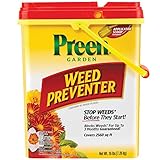
Best Pre-EmergentPreen Garden Weed Preventer
Pre-Emergent Granular, Trifluralin
Every product above is a reaction to weeds that already exist. Preen is the one that prevents them, and in terms of hours of labor saved per dollar it is arguably the best value in this entire guide. Trifluralin forms a thin chemical barrier in the top layer of soil that stops germinating weed seeds from establishing roots. It does not touch established plants, which is exactly why it can be sprinkled safely around hostas, roses, shrubs, and a long list of vegetables without harming them. In our mulched test bed, a March application followed by a mid-June reapplication cut visible weed emergence by a large margin compared to an untreated control bed a few feet away, and the weeds that did appear were almost entirely ones blown in on top of the mulch rather than germinating from the soil seed bank. The application experience is the other selling point. There is no mixing, no sprayer to clean, no drift to worry about on a breezy day, and no chance of accidentally killing a neighbor plant with overspray. You shake it over the bed, water it in, and walk away. The one rule that trips people up is that it cannot distinguish between a weed seed and a zinnia seed. If you direct-sow flowers or vegetables in a bed, keep Preen out of it until your seedlings are well established, and stick to transplants in areas you treat.
Pros
- Stops weed seeds from germinating for up to three months per application
- Safe to apply around more than 200 established ornamentals, shrubs, and vegetables per label
- Granular format spreads by hand or shaker with no mixing, measuring, or sprayer cleanup
- Dramatically reduces the total amount of weeding a mulched bed needs over a season
- Very forgiving to apply, with no drift risk and no overspray damage
Cons
- Prevents germination only, so it does nothing to weeds that are already up and growing
- Will also block flower and vegetable seeds, so it cannot be used in areas you plan to direct-sow
- Needs watering in after application to activate the barrier
The Bottom Line
The most underused product category in home weed control. Applied in early spring, it prevents most of the weeding you would otherwise spend the summer doing.

Best Fast-ActingSpectracide Weed & Grass Killer Concentrate
Non-Selective, Contact, Diquat
Diquat works fast, and that speed is the entire reason to choose this over glyphosate. In our side-by-side rows, Spectracide-treated weeds showed obvious wilting within about three hours and were fully brown the next morning, while the glyphosate row still looked green and healthy at the 48-hour mark despite already being fatally dosed. If you are clearing a patio, prepping an area before laying landscape fabric, or simply want a visible result before guests arrive on the weekend, that difference matters. Its 15-minute rainfast window is the shortest here and genuinely useful in unsettled weather, where waiting for a dry half-day is not realistic. The catch is the same one that applies to every contact herbicide. It burns down what it touches and nothing more. Dandelions, thistle, bindweed, and quackgrass all regrew from intact roots in our plots within two to three weeks, which means on perennials you are managing weeds rather than eliminating them. Our practical recommendation is to treat it as a complement rather than a competitor to glyphosate: use diquat when speed matters and the target is annual, and use a systemic when the target is perennial and you want it gone for the season. Because it leaves no meaningful soil residual, it is also the better choice when you intend to plant something in the same spot within a few days.
Pros
- Visible wilting within a few hours and complete browning usually within a day
- Rainfast in about 15 minutes, the shortest window of anything we tested
- You can replant a treated area within about a day, unlike residual products
- Very affordable per mixed gallon as a concentrate
- Excellent for clearing an area quickly ahead of planting or landscaping work
Cons
- Contact-only action means deep-rooted perennials regrow, often within a couple of weeks
- Non-selective, so it kills lawn grass and ornamentals just as readily as weeds
- Frequently needs repeat applications on anything more established than an annual weed
The Bottom Line
Buy it when you need an area brown by tomorrow rather than dead by next week. For perennial weeds, pair it with a systemic or expect regrowth.

Best Budget ConcentrateCompare-N-Save Concentrate Grass & Weed Killer
Non-Selective, Systemic, 41% Glyphosate
Once you understand that glyphosate is glyphosate, the case for paying a premium gets harder to make, and Compare-N-Save is the product that proves the point. At 41% concentration it sits just below the premium Roundup concentrate, and in our fence-line and brush-clearing tests the practical difference in outcome was small enough that we would not pay double for it. What premium formulas add is convenience and speed: pre-blended surfactants that help the spray stick to and penetrate waxy leaves, and sometimes a fast-acting co-ingredient that browns the plant sooner so it looks like it is working. Compare-N-Save is the bare active ingredient, and it rewards a bit of user knowledge. Adding a few drops of non-ionic surfactant, or in a pinch a small amount of dish soap, to each gallon of mixed spray closed most of the performance gap we observed on tough, glossy-leaved targets. For anyone with a large property, a long fence line, gravel areas, or brush to knock back, the economics are decisive. A single jug covers ground that would take several premium bottles to match, and the cost difference across a season is substantial. If you only need to spot-treat a few driveway cracks a year, the convenience of a ready-to-use bottle probably wins. If you own a sprayer and have real acreage, this is the smart buy.
Pros
- By far the lowest cost per mixed gallon of any systemic weed killer we tested
- Same active ingredient class as premium glyphosate products at a fraction of the price
- A single jug mixes into enough spray to treat a large property multiple times
- Root-killing systemic action on perennial weeds, unlike cheap contact sprays
- Widely available and shelf-stable for years if stored sealed and out of freezing temperatures
Cons
- No surfactant included, so results on waxy-leaved weeds improve noticeably if you add your own
- Slower visible results than premium formulas that include additional fast-acting ingredients
- Bare concentrate with no measuring aids, so you need your own sprayer and measuring cup
The Bottom Line
The value pick for anyone treating real acreage. Add your own surfactant and it performs within a hair of products costing several times more per gallon.
2. Weed Killer Buying Guide: How Weed Killers Actually Work
Every product in this guide falls into one of a small number of mechanisms, and knowing which one you are holding explains almost everything about how it will behave in your yard: how fast it works, whether the weed comes back, and what it will do to the plants around it.
Systemic herbicides are absorbed through the leaves and travel through the plant vascular system down into the roots. This is why they are slow, often taking a week or more to show meaningful damage, and it is also why they are the only category that reliably kills perennial weeds outright. The plant is dying from the inside for days before it looks like anything is happening on the surface.
Contact herbicides destroy plant tissue wherever the spray physically lands. They are dramatically faster, often producing visible wilting within hours, but they never reach the root. On an annual weed with a shallow root system, that is often enough to finish the job. On a dandelion or a patch of bindweed, the crown survives and sends up new growth within a couple of weeks.
Pre-emergent herbicides do not kill living plants at all. They create a chemical barrier in the top inch of soil that prevents germinating seeds from establishing. Applied before the weeds appear, they are the most labor-efficient product category in home weed control, and the one most homeowners skip entirely because it feels like treating a problem that is not there yet.
Soil-residual herbicides combine a knockdown ingredient with a compound that stays active in the soil for months, preventing anything from re-establishing. They are extraordinarily effective in gravel and cracked pavement, and genuinely destructive if used anywhere near roots you care about.
The Numbers Don't Lie
7-14 days
Time for systemic killers to fully work
2-6 hrs
Time for contact killers to show damage
3 mo
Typical pre-emergent barrier duration
55°F+
Soil temp when crabgrass starts germinating
3. Selective vs Non-Selective Weed Killer: The Decision That Matters Most
This is the single distinction that separates a successful weekend from a lawn full of dead brown patches, and it is the one that product labels communicate least clearly.
Non-Selective Weed Killers
A non-selective herbicide kills essentially any plant it lands on. Glyphosate, diquat, and horticultural vinegar are all non-selective. They belong on driveways, gravel, patio cracks, fence lines, and areas being cleared for new landscaping. They do not belong on a lawn, because grass is a plant and the product does not know the difference. The most common weed killer failure we hear about is someone spraying a non-selective product across a weedy lawn and being genuinely surprised when the lawn dies alongside the weeds.
Selective Weed Killers
A selective herbicide exploits biochemical differences between plant families to kill some plants and spare others. The most common home category targets broadleaf weeds while leaving grasses unharmed, which is exactly what you want for dandelions, clover, and plantain in turf. Selectives are more specific and therefore more demanding of the buyer: a product that is safe on cool-season fescue may seriously injure a St. Augustine lawn, so matching the product to your grass type is not optional.
The practical rule is simple. If the weed is growing in something you want to keep alive, you need a selective. If the weed is growing in gravel, cracks, or bare ground, a non-selective is faster, cheaper, and more thorough. Buying one product to do both jobs is the mistake, not a shortcut.
| Type | Kills | Use Where | Root Kill |
|---|---|---|---|
| Non-Selective Systemic | Everything, slowly | Gravel, cracks, fence lines | Yes |
| Non-Selective Contact | Everything it touches, fast | Patios, paths, quick cleanup | No |
| Selective Broadleaf | Broadleaf weeds only | Lawns and turf | Usually |
| Pre-Emergent | Nothing already growing | Beds, mulch, lawns in spring | N/A |
4. When to Apply Weed Killer: Why the Calendar Beats the Product
Weed control is far more sensitive to timing than to which brand you buy. The same product applied in the right week can outperform a better product applied in the wrong one.
Early Spring: The Pre-Emergent Window
Crabgrass and most annual weeds germinate when soil temperature at a two-inch depth holds around 55 degrees Fahrenheit for several consecutive days. A pre-emergent applied before that threshold prevents the entire season of crabgrass in one pass. Applied two weeks after it, the seeds have already sprouted and the barrier is useless against them. The traditional local cue is to apply when forsythia finishes blooming, which tracks soil temperature better than any calendar date.
Late Spring and Early Summer: Post-Emergent on Young Weeds
Young, actively growing weeds absorb herbicide far more efficiently than mature ones. A dandelion treated at the rosette stage takes a much lower dose than the same plant treated after it has flowered and set a deep taproot. If you find yourself repeatedly disappointed by weed killer results, spraying earlier in the weed life cycle usually fixes more than switching products does.
Fall: The Most Underrated Window
Fall is the best time of year to treat perennial broadleaf weeds, and almost nobody does it. As temperatures drop, perennials move sugars downward into their root systems to store for winter, and a systemic herbicide applied in that window rides along with them straight to the roots. A fall application on dandelion and clover consistently produces better long-term control than an identical spring application.
When Not to Spray
Skip application when temperatures are above the mid-80s, since heat-stressed plants slow their metabolism and absorb less. Skip windy days entirely, because drift damage to neighboring plants is the most common regret we hear. And check the rainfast window on the label before spraying ahead of rain, as most systemics need at least 30 minutes to a few hours of dry time to be absorbed.
5. Which Weed Killer to Use: Lawns, Driveways, Garden Beds, and More
Lawns and Turf
Use a selective broadleaf herbicide matched to your grass type, or a professional-grade turf product like Tenacity on cool-season grass. Never use glyphosate or vinegar on a lawn except to deliberately kill a patch you plan to reseed. Combine a spring pre-emergent with a targeted post-emergent spot treatment and you will do far less work than someone blanket-spraying all summer.
Driveways, Gravel, and Paver Cracks
This is where a soil-residual product earns its cost. There is nothing here you want to grow, so a year-long residual saves repeated trips with a sprayer. The only caution is drainage: if the gravel slopes toward a planting bed, use straight glyphosate instead and accept the repeat applications.
Garden and Landscape Beds
Pre-emergent granules are the primary tool, applied in early spring and again mid-season, with hand pulling or careful spot treatment for anything that gets through. If you spray anything non-selective in a bed, use a shield or a cardboard barrier to block drift, and spray on a completely still day.
Fence Lines and Property Edges
These are the areas that get away from homeowners fastest because they are out of sight. A concentrate glyphosate in a backpack or pump sprayer is the efficient choice, and two applications a season, one in late spring and one in early fall, keeps most fence lines under control.
Near Vegetables and Edibles
Stick to horticultural vinegar, hand pulling, and mulch. Read every label carefully for pre-harvest intervals, and when in doubt about a product near food crops, do not use it.
6. How to Apply Weed Killer: Technique That Actually Changes Results
Two people spraying the same product on the same weeds can get very different outcomes. Most of the difference comes down to a handful of technique details that labels mention briefly and buyers skip.
Add a surfactant to bare concentrates. Many weeds have waxy leaf surfaces that cause spray droplets to bead up and roll off. A non-ionic surfactant breaks that surface tension so the herbicide stays in contact long enough to be absorbed. Premium formulas include one; budget concentrates usually do not, and adding your own is the single highest-impact upgrade to a cheap glyphosate jug.
Wet the leaves, do not drench the ground. Systemic herbicides enter through foliage, not soil, so spraying until liquid runs off the leaves and puddles on the ground wastes product and increases drift and runoff risk. Aim for even coverage that leaves the leaf surface wet but not dripping.
Spray in the morning on a still day. Plants are actively transpiring in the morning, wind is typically lowest, and you avoid the midday heat that slows uptake. Anything above a light breeze is enough to carry fine droplets onto plants you did not intend to treat.
Give systemics the full waiting period. The most wasteful habit we see is re-spraying at day three because nothing looks dead. Glyphosate is already working at that point. Re-spraying doubles your cost and your chemical load for no additional effect.
The Mistake That Wastes the Most Product
Mowing right before or right after spraying a lawn. Mowing before removes the leaf surface the herbicide needs to be absorbed through, and mowing within a couple of days after removes treated foliage before the chemical has fully translocated to the roots. Wait two days on either side of a spray for meaningfully better results at zero extra cost.
7. Weed Killer Safety: Pets and Rainfast Windows
Every product here is a pesticide, and the label is a legal document rather than a suggestion. The good news is that the practical safety rules are short and easy to follow.
Keep pets and children off treated areas until dry. This is the standard guidance on nearly every consumer herbicide label, and drying time is typically a few hours depending on temperature and humidity. Granular pre-emergents generally require watering in, after which the area is safe once the surface dries.
Wear gloves and eye protection when mixing concentrates. The mixing step, when you are handling undiluted product, carries far more exposure risk than the spraying step. This applies especially to 20% horticultural vinegar, which is strong enough to cause chemical burns and serious eye injury despite reading as the natural choice on the shelf.
Respect the rainfast window. Rain falling before a systemic herbicide has been absorbed washes it off the leaf and onto the soil, wasting the application and putting the chemical where you did not want it. Rainfast times range from about 15 minutes for diquat to 30 minutes or more for glyphosate formulations, and longer for some selectives. Check the label and give yourself a margin.
Store concentrates properly. Keep them sealed, out of freezing temperatures, and out of reach in an original labeled container. Never decant herbicide into a beverage bottle, which is a genuinely dangerous habit and a leading cause of accidental pesticide poisoning in homes.
Finally, mind your neighbors and any water features. Herbicide drift onto a neighbor garden is both a real harm and a real liability, and most consumer herbicides carry label restrictions on application near ponds, streams, and storm drains. A coarse spray setting, a still day, and a shield around the nozzle prevent nearly all of these problems.
Before You Buy
Also Needed for This Job
8. Frequently Asked Questions
What is the best weed killer?
For general non-selective use on driveways, gravel, and fence lines, Roundup Weed & Grass Killer Super Concentrate offers the best combination of root-killing systemic action and cost per mixed gallon. For weeds growing in a cool-season lawn, Tenacity Turf Herbicide is the strongest selective option available to homeowners. For gravel areas where you want a full year of bare ground, Ortho GroundClear Year Long is the most labor-saving choice.
What is the difference between selective and non-selective weed killer?
A non-selective weed killer kills any plant it contacts, including lawn grass and ornamentals, and belongs on gravel, cracks, and fence lines. A selective weed killer targets specific plant families, most commonly killing broadleaf weeds while leaving grasses unharmed, which is what makes it safe to use across a lawn.
How long does weed killer take to work?
Contact herbicides such as diquat and horticultural vinegar show visible wilting within two to six hours and complete browning within a day. Systemic herbicides such as glyphosate take seven to fourteen days to fully kill a plant because they must travel from the leaves down into the root system, and re-spraying before that window is complete simply wastes product.
Is there a weed killer that is safe for lawns?
Yes. Selective broadleaf herbicides are formulated to kill weeds like dandelion, clover, and plantain without harming turf grass. Tenacity is the strongest option for cool-season lawns and can even be applied at seeding time, but it is not labeled for warm-season grasses like bermuda, zoysia, or St. Augustine, which need a product matched to that turf type.
When should I apply a pre-emergent weed killer?
Apply pre-emergent when soil temperature at a two-inch depth reaches about 55 degrees Fahrenheit for several consecutive days, which is when crabgrass and most annual weeds begin germinating. A common regional cue is to apply as forsythia finishes blooming. Applied after germination has started, a pre-emergent will not control weeds that are already up.
Will weed killer harm my pets?
Most consumer herbicide labels direct you to keep pets and children off treated areas until the spray has fully dried, typically a few hours. Granular pre-emergents should be watered in and allowed to dry before pets return. Handling undiluted concentrate carries far more risk than the dried treated area, so gloves and eye protection at the mixing stage matter most.
9. Common Weed Killer Mistakes
Nearly every weed killer complaint we see traces back to one of four errors, and none of them are about buying the wrong brand.
Spraying Non-Selective Herbicide on a Weedy Lawn
This is the most common and most expensive mistake in home weed control. Glyphosate and vinegar do not distinguish between a dandelion and your fescue, and the result is a lawn full of dead brown patches that take a full season and a bag of seed to recover. If the weed is in turf you want to keep, you need a selective product, full stop.
Re-Spraying Systemics Too Soon
Glyphosate takes seven to fourteen days to show its full effect on a perennial weed, and the plant looks completely healthy for the first several days while it is already dying. Re-spraying at day three doubles your cost and chemical load for no additional result. Mark the date you sprayed and do not judge the outcome until two weeks have passed.
Using a Soil-Residual Product Near Trees or Beds
Year-long vegetation killers contain soil-active ingredients that move with water and are absorbed through roots. Spraying them along a fence line that runs under a mature tree canopy, or uphill of a flower bed, can kill plants many feet away from where you aimed. Reserve residuals for gravel and pavement that drains away from anything you value.
Skipping Pre-Emergent and Fighting Weeds All Summer
The single biggest reduction in annual weeding effort comes from a product most homeowners never buy. One well-timed pre-emergent application in early spring prevents the crabgrass and annual weeds that otherwise consume a full season of spot spraying and hand pulling. Skipping it guarantees the harder, more expensive job later.
Everything Else About Weed Killers
Related Lawn & Yard Guides
Buyer's Guide
Best Fertilizer for Grass
A thick lawn crowds out weeds better than any herbicide. Here is what actually feeds it.
Buyer's Guide
Best Grass Seed
Repairing the bare patches left behind after weed control, matched to your climate zone.
All Guides
Browse All Best Lists
Every hands-on tested guide we have published, organized by category.
The Bottom Line
The best weed killer is the one matched to where the weed is growing, not the one with the biggest promise on the label. For gravel, cracks, and fence lines, Roundup Super Concentrate kills roots at the lowest cost per gallon. For weeds in a cool-season lawn, Tenacity is the professional-grade answer. For a gravel drive you would rather not treat twice, Ortho GroundClear Year Long buys you a season of bare ground in one pass.
And if you only change one thing this year, add a spring pre-emergent. Preventing weeds costs a fraction of what killing them does, in both money and weekends.
More in Lawn & Yard Care
Guides in this category that pair with what you just read.
About the Author
Alex Rivers, Home Improvement Editor
Alex has spent over a decade working on residential and light commercial property maintenance, and now tests every tool, coating and machine that appears in these guides personally.