The 7 Best Lawn Fertilizers in 2026
We fed marked test plots with 12 fertilizers across a full season, tracking green-up speed, burn risk, and how many weeks each application actually lasted. Only 7 earned a spot.
Alex Rivers
Home Improvement Editor
Last Updated
October 17, 2026
In This Guide
Lawn fertilizer is sold on the promise of a greener lawn next weekend, which is exactly the wrong thing to optimize for. Fast green-up is easy and mostly cosmetic. What separates a lawn that looks good in May from one that survives August is nitrogen release rate, application timing, and whether you burned the turf getting there. After a season of side-by-side feeding, here is what actually works.
Our Picks at a Glance
The Short Answer
Scotts Turf Builder Lawn Food (Best Overall). The default lawn feed for a reason. Fast enough to see results, slow enough to last, and forgiving enough that most homeowners get it right.
- Check Price
- Check Price
- Check Price
- Check Price
- Best Liquid Simple Lawn Solutions Advanced 16-4-8 Liquid — Liquid Concentrate, Hose-End, Seaweed + FishCheck Price
- Check Price
- Best Weed & Feed Scotts Turf Builder Halts Crabgrass Preventer with Lawn Food — Granular, Weed & Feed, Pre-Emergent + FertilizerCheck Price
We may earn a commission when you buy through these links, at no extra cost to you. How we test
Best Overall
Scotts Turf Builder Lawn Food
1. What N-P-K Actually Means for a Lawn
Every fertilizer bag carries three numbers, and for lawns specifically, only one of them usually matters much. Understanding why saves both money and unnecessary product.
Nitrogen, the first number, drives leaf growth and green color. Grass is grown entirely for its leaves, so nitrogen is the nutrient that produces almost everything a homeowner notices about a lawn. It is also the nutrient most readily lost from soil through leaching and volatilization, which is why lawns need it repeatedly while other nutrients often last for years.
Phosphorus, the second number, supports root development and is genuinely important for new seedlings. Established lawns, however, are rarely phosphorus-deficient, and phosphorus runoff into waterways causes algae blooms. That is why many states now restrict or ban phosphorus in fertilizer applied to established lawns, and why so many bags read 32-0-4 with a zero in the middle. Use phosphorus when seeding, and generally skip it otherwise unless a soil test says otherwise.
Potassium, the third number, supports stress tolerance: drought resistance, cold hardiness, and disease resistance. It does not produce visible color, so it gets little attention, but it is why fall fertilizers often carry a higher potassium share to prepare turf for winter.
The practical implication is that for an established lawn, you are mostly buying nitrogen. A 32-0-4 and a 16-4-8 applied at rates that deliver the same nitrogen will produce broadly similar visible results, which means comparing bags by price per pound of actual nitrogen delivered is far more useful than comparing the sticker price of the bag.
The Numbers Don't Lie
1 lb
Nitrogen per 1,000 sq ft, typical rate
6-8 wks
Duration of a good slow-release granular
2-3 wks
Duration of a liquid foliar feed
55°F
Soil temp that triggers crabgrass germination
2. Granular vs Liquid: Which You Actually Need
The format choice changes how fast you see results, how long the feeding lasts, and how much skill the application demands. Neither is universally better, and most good lawn programs use both.
Granular Fertilizer
Granules dissolve gradually with watering and release nutrients into the soil over weeks. A quality slow-release granular feeds for six to eight weeks from a single pass, which makes it the efficient backbone of any fertilizer program. The cost is application skill: an uncalibrated spreader, an inconsistent walking pace, or poor overlap produces visible stripes that persist for weeks. Granular is also the only practical format for large lawns, since covering an acre with a hose-end sprayer is impractical.
Liquid Fertilizer
Liquids are absorbed partly through the leaf, so color change appears within two to three days rather than a week or more. Application through a hose-end sprayer is close to foolproof and produces genuinely even coverage without calibration. The trade-off is duration: two to three weeks per application means many more applications across a season and a higher total cost if liquid is your only fertilizer.
The Combination That Works Best
Use a slow-release granular as your baseline, applied roughly every six to eight weeks through the growing season, and keep a liquid on hand for a fast supplemental green-up when you want a visible improvement in days rather than weeks. This gives you the economics and duration of granular with the speed and evenness of liquid where it matters.
| Format | Time to See Results | Duration | Application Skill |
|---|---|---|---|
| Slow-Release Granular | 5-10 days | 6-8 weeks | Spreader calibration needed |
| Quick-Release Granular | 3-5 days | 2-4 weeks | Higher burn risk |
| Liquid Hose-End | 2-3 days | 2-3 weeks | Very easy |
| Organic Granular | 3+ weeks | 8-12 weeks | Very forgiving |
3. The 7 Best Lawn Fertilizers in 2026 — Tested & Ranked
We applied each fertilizer to marked plots at the labeled rate, plus a deliberate over-application plot to test burn risk, then photographed and rated color, density, and clipping volume weekly across a full season. These seven earned their place.

Best OverallScotts Turf Builder Lawn Food
Granular, 32-0-4, Slow-Release Blend
Turf Builder is the product most American lawns are fed with, and after a season of testing it is genuinely hard to argue with as a default. Its 32-0-4 analysis is nitrogen-dominant with a modest potassium component and no phosphorus, which reflects both the reality that most established lawns are not phosphorus-deficient and the fact that many states restrict phosphorus in lawn fertilizer to protect waterways. The nitrogen is split between a quick-release fraction that greens the lawn within roughly five to seven days and a coated slow-release fraction that continues feeding for six to eight weeks. In our plots, that combination produced the most satisfying overall curve: visible improvement soon enough to feel worthwhile, without the sharp surge-and-crash pattern of a pure quick-release product. Spread quality deserves a mention because it is where cheap granular fertilizers fall down. Scotts particles are relatively uniform in size and weight, so they throw consistently from a broadcast spreader rather than separating by weight and producing green stripes and pale gaps. In our test area the coverage was noticeably more even than a bargain-brand granular applied with the same spreader on the same setting. The limitations are worth stating. It contains no phosphorus, so if you are seeding, buy a starter fertilizer instead. And while it is more forgiving than high quick-release products, it is not burn-proof: applied heavily on drought-stressed grass in high heat, it will scorch.
Pros
- Balanced mix of quick and slow-release nitrogen gives visible green-up within about a week and feeding that lasts 6 to 8 weeks
- All-in-one Particle Technology spreads evenly, reducing the striping that plagues cheaper granulars
- Safe to apply on any grass type at the labeled rate, warm-season or cool-season
- Very forgiving of moderate over-application compared to high quick-release products
- Available everywhere and priced sensibly per thousand square feet
Cons
- The 32-0-4 analysis contains no phosphorus, so it is not a starter fertilizer for new seed
- Requires a spreader, and calibration matters more than the bag suggests
- Not organic, and the quick-release fraction can burn turf if applied heavily to dry grass in heat
The Bottom Line
The default lawn feed for a reason. Fast enough to see results, slow enough to last, and forgiving enough that most homeowners get it right.
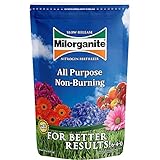
Best Slow-ReleaseMilorganite 6-4-0
Granular, Organic Nitrogen, Slow-Release
Milorganite occupies an unusual position in lawn care: it is a heat-dried biosolid product with a low 6-4-0 analysis, and it has one of the most loyal followings of any lawn product in the country. The reason is simple. Because its nitrogen is bound in organic form and must be broken down by soil microbes before the plant can use it, the release is slow, steady, and nearly impossible to over-apply into a burn. In our deliberate abuse test, we applied Milorganite at roughly double the labeled rate to a plot during a hot, dry stretch and saw no injury at all, while a synthetic quick-release product applied the same way on an adjacent plot scorched visibly within four days. For anyone who has ever burned stripes into their lawn with a miscalibrated spreader, that alone justifies the choice. The iron content is the second reason people stay loyal. At roughly 2.5 percent, it produces a deep green color that comes from pigment rather than from forcing rapid leaf growth, which means better color without the surge of clippings that follows a heavy nitrogen feed. The honest trade-offs are volume and speed. At 6 percent nitrogen you carry and spread several times as many pounds as with a 32 percent product to deliver the same nutrition, which is real work on a large lawn. And green-up takes two weeks or more rather than five days, which frustrates people expecting immediate results. There is also a mild earthy odor for a day or two. Most owners consider all of that a fair trade.
Pros
- Essentially impossible to burn a lawn with, even at double the labeled rate
- Slow, steady nitrogen release over roughly 8 to 10 weeks with no surge and crash
- Contains about 2.5 percent non-staining iron, which deepens color without pushing excessive top growth
- Organic nitrogen source that also adds a small amount of organic matter to the soil
- Safe to apply in summer heat when synthetic fertilizers carry real burn risk
Cons
- Low analysis means you apply a lot more product by weight to deliver the same nitrogen
- Distinctive earthy odor for a day or two after application, especially in warm, damp weather
- Slower visible green-up than synthetic quick-release products, typically two weeks or more
The Bottom Line
The safest fertilizer here and the one we would hand to a first-time homeowner. Slow, steady, and genuinely difficult to misuse.

Best Premium GranularThe Andersons PGF Complete 16-4-8
Granular, Small-Particle, Humic Coated
PGF Complete is what happens when a fertilizer is engineered for coverage uniformity rather than shelf appeal. Its Dispersing Granule technology uses very small particles that break apart on contact with water, and the practical effect is a dramatically higher particle count per square foot than a conventional granular. More particles means shorter distances between nutrient release points, which in our plots translated into visibly more uniform color with none of the faint striping that showed up in the standard-granular test areas. By week four it was the best-looking plot in our trial by a clear margin. The formulation is also genuinely more complete than most consumer products. Alongside a 16-4-8 nitrogen, phosphorus, and potassium ratio, it includes iron and a set of micronutrients, and it is coated with humic acid, a soil conditioner that improves nutrient uptake and supports soil microbial activity. Most lawn fertilizers treat soil as an inert medium; this one does not, and over a full season the difference showed in overall turf density rather than just color. Two practical cautions. The small particle size means most spreaders throw it faster than expected, so start with a narrower gate opening and verify coverage over a small area first. And because it contains phosphorus, it may not be legal to apply to an established lawn in states with phosphorus restrictions, though it is generally permitted when seeding. Check your local rules before buying.
Pros
- Dispersing Granule technology breaks down into far more particles per square foot for exceptionally even coverage
- Balanced 16-4-8 with phosphorus and potassium alongside nitrogen, plus iron and micronutrients
- Humic acid coating improves nutrient uptake and soil biology, which most fertilizers ignore entirely
- Very low burn potential thanks to a high slow-release nitrogen fraction
- Produced the deepest, most uniform color of anything we tested by week four
Cons
- Costs meaningfully more per thousand square feet than mass-market granulars
- Small particle size requires slowing down and closing the spreader gate further than usual
- Contains phosphorus, which is restricted or banned for established lawns in some states
The Bottom Line
The best-performing granular we tested and the one that produced the most professional-looking result. Worth the premium if you actually care about your lawn.
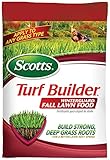
Best Fall FeedScotts Turf Builder WinterGuard Fall Lawn Food
Granular, Fall Feed, High Nitrogen
The most consequential fertilizer decision most homeowners make is not which bag to buy but when to apply it, and the fall feeding is the one that matters most. As air temperatures drop in autumn while soil stays warm, cool-season grasses shift their energy from producing leaves to growing roots and storing carbohydrates for winter. Nitrogen applied in that window goes into root mass and reserves rather than into blade growth, and the result shows up the following spring as a lawn that greens up earlier, thicker, and more evenly than one fed only in April. In our trial, the plot that received a fall feeding and no spring feeding outperformed the plot that received a spring feeding and no fall feeding at every observation point the following season. WinterGuard is formulated specifically for that job, with a nitrogen load and release profile matched to autumn conditions. It is also the best moment to address a lawn that has been beaten up by summer, since fall is when cool-season grass recovers most readily and when a thin stand can be thickened, particularly if you overseed at the same time. The obvious limitation is that this is a seasonal product with a narrow correct window, generally from late summer through mid-autumn depending on climate, and it is aimed at cool-season lawns. Warm-season grasses in the South follow a different schedule and should not receive a heavy late-season nitrogen application, which can push tender growth into frost damage.
Pros
- Formulated for the fall application window, which is the single most valuable feeding of the year
- Drives root growth and carbohydrate storage rather than top growth heading into winter
- Produces markedly faster and stronger spring green-up than lawns fed only in spring
- Helps damaged and thin lawns recover from summer stress before dormancy
- Same even-spreading particle quality as the standard Turf Builder line
Cons
- Only appropriate in a narrow seasonal window, so it is not a year-round product
- Aimed primarily at cool-season lawns, with different timing needed for warm-season grasses
- No phosphorus, so it does not replace a starter fertilizer if you are also seeding
The Bottom Line
If you only fertilize once a year, do it in fall with this. A single fall feeding outperforms a single spring feeding by a wide margin.
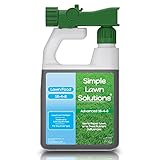
Best LiquidSimple Lawn Solutions Advanced 16-4-8 Liquid
Liquid Concentrate, Hose-End, Seaweed + Fish
Liquid fertilizer works differently from granular in a way that explains both its appeal and its limits. Nutrients in solution are absorbed partly through the leaf surface rather than exclusively through roots, which bypasses the soil entirely and produces color change within days rather than the week or more a granular needs. In our plots, the liquid-treated area was visibly deeper green at the 72-hour mark while the granular plots showed no change at all. For anyone with an event coming up or simply impatient after a rough summer, that speed is genuinely valuable. The application experience is the other advantage, and it is underrated. A hose-end sprayer produces even coverage almost automatically, with none of the calibration, walking-pace discipline, or overlap management that determines whether a granular application ends up striped. For homeowners who have struggled to get an even result with a spreader, liquid removes the skill requirement entirely. The catch is duration. Foliar-absorbed nutrients are used quickly and are not stored in the soil for gradual release, so a liquid feed lasts roughly two to three weeks compared to six to eight for a good granular. Running a full season on liquid alone means many more applications and a higher total cost. Our recommendation is to use it as a supplement, applying a granular for baseline nutrition every six to eight weeks and reaching for the liquid when you want a fast improvement in between.
Pros
- Foliar absorption produces visible color improvement within 2 to 3 days, faster than any granular
- Hose-end applicator means no spreader, no calibration, and no striping
- Includes seaweed and fish hydrolysate for micronutrients and soil biology, not just N-P-K
- Extremely easy to apply evenly, which is where most homeowners struggle with granulars
- Excellent as a supplemental feed between granular applications or for a quick pre-event green-up
Cons
- Short duration, typically 2 to 3 weeks, so it needs far more frequent application than granular
- Cost per season is higher than granular if used as a primary fertilizer program
- Hose-end dilution is less precise than a calibrated spreader, so rates are approximate
The Bottom Line
The fastest visible results here and the easiest to apply evenly. Best used to supplement a granular program rather than replace it.
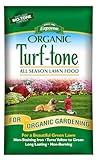
Best OrganicEspoma Organic Lawn Food
Granular, Certified Organic, 9-0-0
Organic lawn fertilizer asks you to change what you are measuring. Synthetic fertilizers feed the plant directly with nutrients in immediately available form, and the result is visible within a week. Organic fertilizers feed soil microbes, which break down organic nitrogen into plant-available form over a much longer period, and the result is a soil that gradually becomes better at supporting turf on its own. Espoma Organic Lawn Food, with its Bio-tone beneficial microbes, is squarely in the second camp. In our trial, the organic plot was the last to show any color change, taking well past three weeks to distinguish itself from the untreated control, and it never matched the peak color of the synthetic plots in a single season. Over multiple seasons, the argument shifts. Repeated organic feeding builds soil organic matter and microbial activity, improving water retention and nutrient cycling in ways that reduce how much fertilizer the lawn needs at all. That is a genuinely different value proposition than a bag that produces a green lawn in five days. The practical advantages are immediate, though. There is essentially no burn risk regardless of how carelessly you spread it, and pets and children can return to the lawn as soon as it is watered in, which is a meaningful consideration for a lot of households. The costs are volume, patience, and price per unit of nitrogen delivered. If those are acceptable, it is the best organic option we tested.
Pros
- Certified organic with plant and animal-based nitrogen sources rather than synthetics
- Includes beneficial soil microbes that improve nutrient cycling over time
- Safe for pets and children to return to the lawn as soon as the granules are watered in
- Effectively zero burn risk, even applied unevenly or in warm weather
- Builds soil organic matter across seasons rather than only feeding the current flush of growth
Cons
- Slowest green-up of anything tested, typically three weeks or more to show clear results
- Low 9-0-0 analysis means a lot of product weight per thousand square feet
- Costs more per unit of actual nitrogen delivered than synthetic alternatives
The Bottom Line
The right choice if soil health and pet safety outrank speed. Judge it over seasons rather than weeks and it delivers.

Best Weed & FeedScotts Turf Builder Halts Crabgrass Preventer with Lawn Food
Granular, Weed & Feed, Pre-Emergent + Fertilizer
Crabgrass is the most labor-intensive weed problem in a typical lawn, and unlike most weeds it is entirely preventable with one correctly timed application. Halts combines a spring fertilizer feeding with a pre-emergent herbicide that forms a barrier in the top layer of soil, stopping crabgrass seeds from establishing as they germinate. In our test area, the treated plot showed a fraction of the crabgrass pressure of the untreated plot through the entire season, and the difference in hand-weeding and spot-spraying hours was substantial. Combining the two jobs into one pass is what makes it the highest-leverage application on the spring calendar. Timing is everything, and it is where most people fail. Crabgrass germinates when soil temperature at a two-inch depth holds around 55 degrees Fahrenheit for several consecutive days, and the barrier must be in place before that happens. Applied two weeks late, the seeds have already sprouted and a pre-emergent does nothing to them, since it prevents establishment rather than killing existing plants. The traditional cue of applying as forsythia finishes blooming tracks soil temperature better than any fixed date. The other rule is absolute: this product prevents lawn seed from germinating exactly as effectively as it prevents crabgrass. If you plan to seed or overseed this spring, do not use it. Seed in fall and use Halts the following spring, or choose a seeding-safe herbicide instead.
Pros
- Combines a spring feeding with crabgrass prevention in a single pass, halving the work
- Prevents crabgrass for up to about four months from one application
- Same even-spreading granule quality as the standard Turf Builder line
- Removes the most labor-intensive weed problem of the season before it starts
- Genuinely the highest-leverage single application in a spring lawn program
Cons
- Prevents grass seed from germinating too, so it cannot be used in a season you plan to seed
- Timing is narrow and unforgiving, requiring application before soil hits about 55 degrees
- Does nothing to weeds already growing, since it is preventive rather than curative
The Bottom Line
The single most efficient spring application in lawn care, on the strict condition that you are not seeding and you apply it before crabgrass germinates.
4. Quick-Release vs Slow-Release Nitrogen
This is the specification that determines burn risk, how long a feeding lasts, and whether your lawn grows steadily or in surges. It is printed on every bag in the guaranteed analysis, and almost nobody reads it.
Quick-release nitrogen is water-soluble and immediately available to the plant. It produces fast green-up, typically within three to five days, and it is cheap. It is also what burns lawns, because a heavy application delivers a salt load to the root zone faster than the plant can use it. Quick-release nitrogen is largely used up within two to four weeks, after which growth slows sharply until the next application.
Slow-release nitrogen is either coated so it dissolves gradually, or bound in an organic form that soil microbes must break down. Either way it becomes available over six to ten weeks, producing steady growth instead of a surge, dramatically lower burn risk, and less nitrogen lost to leaching. It costs more per unit of nitrogen and takes longer to show results.
Most good consumer fertilizers blend the two, using quick-release for visible early results and slow-release for duration. On the bag, look for the percentage listed as slowly available or water-insoluble nitrogen. A product where a substantial share of total nitrogen is slow-release will feed longer and burn less than one that is nearly all quick-release, and that difference is far more meaningful than a few points of difference in the headline analysis number.
The practical consequence is that comparing two bags by their first number alone is misleading. A 32-0-4 that is almost entirely quick-release and a 24-0-6 that is largely slow-release will behave completely differently in your lawn, and the second will generally produce a better result over a season despite the smaller number on the front.
5. Building a Feeding Schedule by Season
When you fertilize matters as much as what you use. The schedule below is written for cool-season lawns, with warm-season adjustments noted, and it assumes roughly four applications a year, which suits most homeowners.
Early Spring
A light feeding as the lawn breaks dormancy, ideally combined with a crabgrass pre-emergent if you are not seeding. Resist the urge to apply heavily here. Cool-season grass is already growing vigorously in spring, and pushing it harder produces excessive top growth at the expense of root development, plus a lot of extra mowing.
Late Spring
A second feeding roughly six to eight weeks after the first, timed before summer heat arrives. This is the last heavy nitrogen application cool-season lawns should receive until fall.
Summer
Cool-season grasses slow down or go dormant in heat, and pushing nitrogen into a heat-stressed lawn invites disease and burn. If you feed at all in summer, use a low-rate organic product like Milorganite, which carries no burn risk. Warm-season lawns are the opposite case: summer is their peak growth period and their heaviest feeding window.
Early Fall
The most valuable feeding of the year for cool-season grass. Soil is still warm, air is cooling, and nitrogen goes into root growth and carbohydrate storage rather than blade growth. This is also the ideal time to overseed. If you only fertilize once a year, do it now.
Late Fall
A final feeding roughly four to six weeks before the ground freezes, sometimes called a winterizer, builds reserves that drive early, strong spring green-up. Warm-season lawns should not receive a late-season nitrogen application, since tender new growth going into frost is easily damaged.
6. Application: Spreaders, Rates, and Avoiding Burn
A good fertilizer applied badly produces a worse lawn than a mediocre fertilizer applied well. These are the details that separate the two outcomes.
Calibrate the spreader, do not trust the bag setting. Spreader settings printed on fertilizer bags are approximations across many spreader models and wear conditions. The reliable method is to measure a known area, weigh out the correct amount of product for it, and adjust until you use that amount over that area. A worn or dirty spreader throws differently than a new one at the same setting.
Use a broadcast spreader and half rates in two passes. Applying at half the rate in two perpendicular passes rather than full rate in one pass dramatically reduces striping, because the gaps from one direction get covered by the other. It takes marginally longer and produces a visibly more uniform result.
Water in after applying. Granular fertilizer needs water to dissolve and move into the root zone. Watering in also washes granules off leaf blades, which is where burn happens, since a granule sitting on a wet blade concentrates salt against plant tissue. A quarter inch of irrigation after application is enough.
Never fertilize a drought-stressed or dormant lawn. Grass under water stress cannot use nitrogen and is far more vulnerable to salt injury. If the lawn is browning from heat and lack of water, water it and let it recover before feeding.
How Lawn Burn Actually Happens
Fertilizer burn is osmotic, not chemical. A concentrated band of soluble salts in the soil pulls water out of grass roots rather than letting water in, and the plant dehydrates. That is why burn appears as sharply defined stripes or spills matching exactly where product was over-applied, why it is far worse in heat and drought, and why watering in immediately after application prevents most of it.
7. Soil Testing and Why It Changes the Answer
Every recommendation in this guide is a reasonable default in the absence of information. A soil test replaces defaults with facts, costs very little through most county extension services, and occasionally reveals that the reason a lawn looks bad has nothing to do with fertilizer at all.
pH is the most common hidden problem. Grass takes up nutrients most efficiently in a soil pH range of roughly 6.0 to 7.0. Outside that range, nutrients present in the soil become chemically unavailable to the plant, which means you can fertilize a lawn repeatedly and see minimal response because the nitrogen is there but the grass cannot access it. Acidic soil is corrected with lime, alkaline soil with elemental sulfur, and both take months to shift, which is why testing early matters.
Phosphorus and potassium levels rarely need supplementing. Most established lawns test adequate or high in both, which is exactly why so many fertilizers now carry a zero for phosphorus. Applying nutrients the soil already has in sufficient quantity wastes money and, in the case of phosphorus, contributes to water pollution with no benefit to your lawn.
Organic matter tells you about water retention. A soil low in organic matter drains fast, holds little water, and needs more frequent irrigation and feeding. Raising it is slow work through topdressing with compost, returning clippings rather than bagging them, and using organic fertilizers, but it changes the underlying performance of the lawn rather than treating symptoms.
A test through a county extension office typically costs less than a single bag of fertilizer and is valid for around three years. For anyone who has fertilized diligently and been disappointed with the result, it is the most useful next step available.
Before You Buy
8. Frequently Asked Questions
What is the best fertilizer for grass?
For most lawns, Scotts Turf Builder Lawn Food offers the best balance of visible results, six to eight week duration, and forgiving application. Milorganite is the safest choice with essentially no burn risk, and The Andersons PGF Complete 16-4-8 produced the most uniform, professional-looking result in our testing thanks to its small dispersing granules.
When should I fertilize my lawn?
For cool-season lawns, early fall is the single most valuable feeding of the year because nitrogen goes into root growth and carbohydrate storage rather than blade growth. A typical program is a light early spring feeding, a late spring feeding, an early fall feeding, and a late fall winterizer. Warm-season lawns feed most heavily through summer instead.
What do the numbers on fertilizer mean?
They are the percentages of nitrogen, phosphorus, and potassium by weight. Nitrogen drives leaf growth and green color, phosphorus supports root development and matters most for new seed, and potassium supports drought, cold, and disease tolerance. For established lawns, nitrogen is the number that matters most, which is why many bags read 32-0-4.
How do I avoid burning my lawn with fertilizer?
Choose a product with a high slow-release nitrogen fraction, calibrate your spreader rather than trusting the bag setting, apply half rates in two perpendicular passes, water in with about a quarter inch of irrigation immediately after applying, and never fertilize a lawn that is drought-stressed or dormant. Organic products like Milorganite carry essentially no burn risk at all.
Is liquid or granular fertilizer better?
Granular is the better backbone because a slow-release application feeds for six to eight weeks and is more economical across a season. Liquid is absorbed through the leaf and shows color change in two to three days, and a hose-end applicator makes even coverage nearly automatic, but it only lasts two to three weeks. Most good programs use granular as the base and liquid as a supplement.
Can I fertilize and seed at the same time?
Yes, but use a starter fertilizer containing phosphorus rather than a standard high-nitrogen lawn food, since phosphorus supports the root development new seedlings need. Never use a combination weed and feed product containing a crabgrass pre-emergent when seeding, because that pre-emergent prevents grass seed from germinating just as effectively as it prevents crabgrass.
9. Common Lawn Fertilizing Mistakes
Fertilizer problems are rarely about which bag you bought. They are almost always about rate, timing, or the state of the lawn when you applied it.
Applying a Weed and Feed in a Season You Plan to Seed
The crabgrass pre-emergent in a combination product blocks lawn seed from germinating exactly as effectively as it blocks crabgrass. Every year homeowners apply both within a few weeks of each other and conclude they bought bad seed. Choose one or the other for a given spring, and seed in fall where possible.
Heavy Spring Feeding on a Cool-Season Lawn
Cool-season grass is already in a vigorous growth phase in spring, and heavy nitrogen then produces excess top growth at the expense of root development, plus considerably more mowing. It also leaves the lawn shallow-rooted heading into summer heat. Feed lightly in spring and save the heavy application for fall.
Trusting the Spreader Setting Printed on the Bag
Those settings are approximations across many spreader models, and a worn or dirty spreader throws very differently from a new one. The result is either wasted product and burn risk from over-application, or disappointing results and visible stripes from under-application. Calibrate over a measured area once and the number is good for years.
Fertilizing a Drought-Stressed or Dormant Lawn
Grass under water stress cannot take up nitrogen, and the concentrated salts pull moisture out of already stressed roots. Applying fertilizer to a browning summer lawn does not revive it, it damages it further. Water first, let the lawn recover, then feed once it is actively growing again.
Everything Else About Lawn Fertilizer
Related Lawn & Yard Guides
Buyer's Guide
Best Grass Seed
Fertilizer thickens what is there. Seed fills what is missing. Matched by climate zone.
Buyer's Guide
Best Weed Killers
Selective and pre-emergent herbicides tested, including what pairs safely with a feeding program.
All Guides
Browse All Best Lists
Every hands-on tested guide we have published, organized by category.
The Bottom Line
The best fertilizer for grass is a slow-release nitrogen product applied at the right time of year, and for most lawns Scotts Turf Builder Lawn Food is the sensible default. If you want something that is nearly impossible to misapply, Milorganite is the safest bag on the shelf. And if you want the most uniform, professional-looking result, The Andersons PGF Complete 16-4-8 was the clear winner in our plots.
If you take one thing from this guide, make it the fall feeding. A single well-timed autumn application does more for next year's lawn than three spring ones.
More in Lawn & Yard Care
Guides in this category that pair with what you just read.
About the Author
Alex Rivers, Home Improvement Editor
Alex has spent over a decade working on residential and light commercial property maintenance, and now tests every tool, coating and machine that appears in these guides personally.