Best Broadcast Spreaders
Push, tow-behind and handheld spreaders compared on the things that decide whether your lawn greens evenly: spread pattern, edge control, rate settings and whether it survives salt.
Alex Rivers
Home Improvement Editor
Last Updated
September 29, 2026
In This Guide
Stripes, burned patches and wasted fertilizer are almost never the fault of the product in the bag. They come from the spreader: an uneven throw, a rate setting that drifted, or a pattern that sprays half the load onto the driveway. Pick the right spreader for your lawn size and set it correctly, and the product does what the label promises.
Our Picks at a Glance
- Best Overall: Scotts Elite Spreader — Dual-Rotor Broadcast, up to 20,000 sq ft
- Best Commercial-Grade: LESCO 101186 High Wheel Commercial Spreader — 80 lb Commercial Rotary, Stainless Frame
- Best Value: Scotts Turf Builder EdgeGuard DLX Broadcast Spreader — Broadcast, up to 15,000 sq ft
- Best Mid-Size Pro Spreader: Earthway 2150 Commercial Broadcast Spreader — 50 lb Commercial Walk-Behind
- Best Tow-Behind: Agri-Fab 45-0463 130 lb Tow Behind Broadcast Spreader — 130 lb Tow-Behind, up to 12 ft Spread
- Best for Ice Melt: Chapin 8003A Residential Salt Spreader with Baffles — 65 lb Walk-Behind, Ice Melt Specialist
- Best for Small Lawns: Scotts Turf Builder EdgeGuard Mini Broadcast Spreader — Compact Broadcast, up to 5,000 sq ft
- Best Handheld: Scotts Wizz Hand-Held Spreader — Battery Handheld, up to 2,500 sq ft
1. How We Picked
A broadcast spreader looks like the simplest tool in the garage: a hopper, a hole, a spinning disc. But it determines whether a bag of fertilizer greens your lawn evenly or leaves it striped, whether seed germinates in a uniform carpet or in patches, and whether a winter of ice melt destroys the machine. We picked spreaders by focusing on the parts that decide those outcomes.
We started with what homeowners and professionals actually buy and can get parts for: Scotts for consumer spreaders, LESCO and Earthway for commercial-grade walk-behinds, Agri-Fab for tow-behinds, and Chapin for winter work. Each was compared on hopper capacity, spread width and evenness, how the rate gate is controlled, wheel type, frame material, gearbox protection and how easy it is to find the correct setting for the product you are applying.
Settings availability matters more than most reviews admit. Scotts spreaders have settings printed on almost every Scotts bag, which makes them the easiest for beginners. Commercial spreaders from LESCO and Earthway rely on manufacturer charts or on your own calibration, which is more accurate once done but a real step up in effort. We rated both approaches on their merits rather than assuming either was better.
Durability was the other key test. Fertilizer and ice melt are both salts, and salt corrodes steel, seizes axles and eats cheap gearboxes. We read through long-term owner reviews looking specifically at failure points — rusted axles, stripped gears, stuck gates and cracked hoppers — and weighted build quality heavily for anyone planning to also spread ice melt.
Finally, every spec here comes from the manufacturer or consistent retail listings. Where a figure was unclear, we left it out. We do not quote exact prices, which change weekly; we describe each spreader as budget, mid-range or premium instead.
2. Broadcast vs Drop vs Handheld Spreaders
There are three main types of lawn spreader, and choosing the right one matters more than choosing between brands.
Broadcast (rotary) spreaders
A broadcast spreader drops product onto a spinning impeller, which throws it in a fan several feet wide. This is the right choice for almost every lawn. It covers ground quickly, the edges of the pattern taper off so overlapping passes blend together, and it is forgiving of slightly wandering lines. The downside is precision: product lands beyond the edge of the lawn unless you use an edge shield, and the pattern can be uneven on windy days or with light materials like grass seed.
Drop spreaders
A drop spreader releases product straight down through a row of holes between the wheels, so it only covers the width of the hopper. It is extremely precise, which makes it good for lawns bordered by gardens, ponds or streams where stray fertilizer does damage. It is also slow, and because the edges of each pass are hard lines, missing by a couple of inches leaves a visible stripe and overlapping leaves a dark one. For most homeowners, a broadcast spreader with EdgeGuard gives most of the precision with far less effort.
Handheld spreaders
Handheld spreaders, crank or battery-powered, are for small areas: patches, narrow side yards, beds and steps. They are the best tool for spot-seeding bare patches with grass seed, and a useful companion to a push spreader. They are not a substitute for one on a full lawn.
| Type | Best for | Trade-off |
|---|---|---|
| Broadcast push | Most lawns, 2,000-20,000 sq ft | Needs edge control |
| Drop | Lawns next to water or gardens | Slow, easy to stripe |
| Handheld | Patches, side yards, steps | Tiring on large areas |
| Tow-behind | Half an acre and up | Needs a tractor |
For the rest of this guide, we focus on broadcast spreaders, because they are the right tool for most readers.
3. Our 8 Top Picks
These eight spreaders cover every lawn size, from a battery handheld for patch repairs to a 130 lb tow-behind for acreage. The three Scotts push models are the easiest for beginners because the settings are printed on the bag. The LESCO and Earthway are commercial-grade walk-behinds that last far longer but need calibrating. The Chapin is a dedicated winter spreader for ice melt. We ranked them on accuracy, edge control and durability, and every spec comes from the manufacturer or consistent retail listings.

Scotts Elite Spreader
Dual-Rotor Broadcast, up to 20,000 sq ft
The Elite takes the thing Scotts spreaders already do well — easy, printed-on-the-bag settings — and fixes the thing they traditionally did poorly, which is spread width. Instead of a single spinning disc, it uses two rotors side by side, which produces a 6-foot spread pattern that is more even across its width than single-rotor designs. Scotts rates it as about 20 percent faster than a standard 5-foot spreader, and on a quarter-acre lawn that is the difference between a dozen passes and fifteen. The dual rotors also reduce the familiar striping pattern that appears when a single-disc spreader throws more product in the middle than at the edges. The hopper holds enough for up to 20,000 square feet, which covers most suburban lawns in one fill. EdgeGuard is a lever on the handle that blocks the right side of the pattern, so you can run the spreader along a driveway or flower bed without throwing fertilizer onto concrete or mulch. The 10-inch foam-filled tires will never go flat, and while they do not cushion quite as well as air-filled tires, they roll easily over rough lawns. It arrives fully assembled and pre-calibrated, has a phone holder on the handle, and the handle folds for storage. The limitations are about durability: the frame and gearbox are plastic, and Scotts backs it with its satisfaction guarantee rather than a mechanical warranty. For a homeowner applying four or five times a year, that is an acceptable trade.
Pros
- Dual rotors throw a 6-foot pattern, so you make fewer passes than with a standard 5-foot spreader
- Hopper holds enough product for up to 20,000 sq ft, enough for most suburban lawns in one fill
- EdgeGuard lever blocks the right side of the pattern along driveways, beds and walks
- 10-inch foam-filled tires never go flat and roll well over bumpy turf
- Arrives fully assembled, and every Scotts bag prints its setting for this dial
Cons
- Plastic frame and gearbox are homeowner grade, not built for daily professional use
- Scotts publishes no mechanical warranty, only its satisfaction guarantee
The Bottom Line
The best broadcast spreader for most homeowners: wide, accurate, easy to set, and ready to use straight out of the box.

LESCO 101186 High Wheel Commercial Spreader
80 lb Commercial Rotary, Stainless Frame
The LESCO 101186 is the spreader you see bolted to the side of landscaping trailers, and the reasons carry over to a homeowner with a big lawn. The first is corrosion resistance. Fertilizer is salt, and salt eats steel; the most common way a spreader dies is a rusted axle or a seized impeller shaft. LESCO builds the frame, axle, impeller shaft and on/off assembly from stainless steel, so it survives years of fertilizer and ice melt in a way painted steel spreaders do not. The second is the drivetrain: a fully enclosed gearbox with a 5:1 ratio keeps grit and granules out of the gears, and a cam-operated oscillating agitator keeps product flowing through the drop holes without crushing coated fertilizer. The 80 lb hopper holds far more than any homeowner push spreader, which on a half-acre lawn or larger means far fewer trips back to the garage. The large 13 x 5.00-6 pneumatic tires roll over lumpy turf without jolting the hopper, which helps keep the pattern steady, and the handle adjusts to three heights. Two caveats: this is a premium-priced spreader, and it weighs about 42 lb empty. The more important one is settings. Because it is not a Scotts spreader, the bag will not always print a setting for it; you will rely on conversion charts or, better, your own calibration. For experienced users, that is a feature, not a problem.
Pros
- 80 lb hopper covers large lawns without constant refilling
- Stainless steel frame, axle, impeller shaft and on/off assembly resist fertilizer corrosion
- 13 x 5.00-6 pneumatic tires roll smoothly and keep the spread steady on rough ground
- Enclosed 5:1 gearbox is protected from dust and granules, and the oscillating agitator keeps product flowing
- Three-position handle adjusts for operator height
Cons
- Premium price, and heavier than homeowner spreaders at about 42 lb empty
- No Scotts-style settings on the bag, so you need a conversion chart or your own calibration
The Bottom Line
The spreader landscapers buy, and the one to get if you have a large lawn or want a spreader that will last a decade.

Scotts Turf Builder EdgeGuard DLX Broadcast Spreader
Broadcast, up to 15,000 sq ft
The EdgeGuard DLX is one of the best-selling broadcast spreaders around for a reason: it does everything a typical homeowner needs, for a mid-range price, with no setup. It comes out of the box assembled and pre-calibrated, and every Scotts bag prints a setting for it, so you can put down a bag of fertilizer on a Saturday morning without doing any maths. The hopper holds enough for up to 15,000 square feet, which covers most lawns up to about a third of an acre in one fill. EdgeGuard works the same way it does on the Elite: flip the lever, and a shield blocks the right side of the throw so you can walk along a driveway or bed edge without spraying granules onto concrete or mulch. Scotts lists the spread width at up to about 6 feet, though the effective even pattern is narrower than that, so plan overlapping passes. Compared with the Elite, the DLX gives up the dual rotors, which means a slightly narrower and less even pattern and more attention needed to avoid stripes. It also gives up the foam-filled tires. Compared with a commercial spreader, it gives up durability: the plastic gearing and frame will not last as many years if you also use the spreader for ice melt, and it should be rinsed after every use. For most homeowners with a standard suburban lot, those compromises are worth the lower price.
Pros
- Holds enough product for up to 15,000 sq ft of lawn
- EdgeGuard blocks the right side of the pattern along edges
- Arrives assembled and pre-calibrated, with settings printed on every Scotts bag
- Mid-range price with the features most homeowners actually use
Cons
- Single rotor gives a narrower, less even pattern than the Elite's dual rotors
- Plastic construction and gearing wear out faster than steel spreaders
The Bottom Line
The best balance of price and function for lawns up to about a third of an acre.

Earthway 2150 Commercial Broadcast Spreader
50 lb Commercial Walk-Behind
The Earthway 2150 sits in the middle ground between a homeowner Scotts spreader and a full commercial rig like the LESCO, and for a lot of buyers it is the sweet spot. It has the features that make commercial spreaders last and spread accurately — large pneumatic tires, an enclosed gearbox and a proper rate control linkage — in a lighter package with a 50 lb hopper. The tires are 13 x 4.00 pneumatic on rustproof poly rims, which roll far more smoothly over bumpy turf than hard plastic wheels and keep the spread pattern consistent. The rate control is mounted high on the handle, and the linkage from lever to gate is a solid direct connection rather than a flexible cable. That matters more than it sounds: cable-operated gates stretch and drift, which means the same setting gives a different rate after a couple of seasons. A direct linkage stays calibrated. The gearbox is fully enclosed and heavy duty, and the spreader includes a hopper screen to catch clumps and a nylon shut-off plate. The side-throw adjustment helps along edges, though it is not as simple as Scotts' EdgeGuard lever. At about 23 lb empty, it is easy to push and load into a truck. The trade-offs: settings are not on the bag of most retail fertilizers, so plan to calibrate it yourself, and the 50 lb hopper means refilling more often on large properties.
Pros
- Large 13 x 4.00 pneumatic tires on rustproof poly rims handle rough ground
- Rate control sits high on the handle with a direct-connect linkage for accurate, repeatable settings
- Fully enclosed super-duty gearbox for long life
- Adjustable side-throw control helps keep product off beds and walks
- Light at about 23 lb empty, with a hopper screen and nylon shut-off plate included
Cons
- 50 lb hopper is smaller than the LESCO, so large lawns mean more refills
- Settings are not printed on Scotts bags, so calibration is on you
The Bottom Line
Commercial-grade build at a mid-range price, and the best step up from a Scotts spreader for most owners.

Agri-Fab 45-0463 130 lb Tow Behind Broadcast Spreader
130 lb Tow-Behind, up to 12 ft Spread
Once your lawn is larger than about half an acre, walking behind a push spreader stops making sense, and the Agri-Fab 45-0463 is the most sensible tow-behind for residential use. The 130 lb hopper holds enough to cover an estimated acre, about 25,000 square feet, in one fill, and the spread pattern reaches up to 12 feet wide. That means a one-acre lawn takes a fraction of the passes and walking a push spreader would require. The flow control is a steel rod that runs forward to the tractor seat, so you can open, close and adjust the rate without stopping and climbing off, which is essential for shutting off at the ends of rows. The gear housing is fully enclosed and uses a commercial-grade gearbox, and the hopper is rustproof poly, which matters because this spreader will spend its life full of salty fertilizer and ice melt. It rides on two 13 x 4 pneumatic tires and connects with a universal hitch that fits most lawn tractors. Agri-Fab covers it with a three-year limited warranty. The big trade-off is edge control. A 12-foot throw is hard to keep off driveways, beds and ponds, and there is no EdgeGuard-type shield; plan to finish the perimeter with a push or handheld spreader. If you are shopping for a tractor to pull it, our riding mower guide covers hitch-equipped models.
Pros
- 130 lb hopper covers an estimated acre (about 25,000 sq ft) per fill
- Spreads up to 12 ft wide, roughly double a push spreader
- Flow control rod adjusts from the tractor seat
- Enclosed gear housing and 13 x 4 pneumatic tires
- Rustproof poly hopper and a 3-year limited warranty
Cons
- Wide throw is harder to keep off beds and driveways, with no EdgeGuard-style shield
- Needs a lawn tractor or zero-turn with a hitch; overkill below half an acre
The Bottom Line
The obvious choice for an acre or more if you already own a lawn tractor.

Chapin 8003A Residential Salt Spreader with Baffles
65 lb Walk-Behind, Ice Melt Specialist
Using the same spreader for fertilizer in spring and ice melt in winter is common, and it is also the quickest way to kill a spreader. Salt is highly corrosive, it clumps in damp air, and it demands a different spread pattern — a narrow, controllable strip on a sidewalk rather than a wide, even fan on a lawn. The Chapin 8003A is designed for that job. Its key feature is a set of adjustable baffles on the sides and front that let you aim the spread onto a sidewalk or driveway and away from the lawn and plantings beside it, which is exactly where salt does the most damage. The hopper holds about 65 lb, and a spiked auger breaks up the clumps that form when ice melt absorbs moisture in storage. The 9-inch pneumatic wheels grip on snow and ice better than hard plastic wheels, and the frame is powder-coated steel with an enclosed gearbox to keep salt away from the gears. Chapin lists a 10 to 12 foot spread width with the baffles open. Chapin does not recommend it for rock salt, sand or sand blends, so it is best matched to commercial ice melt products; see our guide to the best ice melt for concrete for the right ones. We would not buy it as a primary lawn spreader. Buy it as a second, winter-only spreader, and your lawn spreader will last years longer.
Pros
- Adjustable side and front baffles aim the spread onto sidewalks and driveways
- Spiked auger breaks up clumps of damp ice melt
- 9-inch pneumatic wheels roll on snow and ice
- Powder-coated steel frame and enclosed gearbox
- 10 to 12 ft spread width for wide driveways
Cons
- Built and marketed for ice melt; a dedicated lawn spreader is the better tool for fertilizer
- Chapin does not recommend it for rock salt, sand or sand mixes
The Bottom Line
Buy it as a dedicated winter spreader so salt never goes near your lawn spreader.
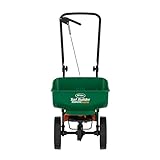
Scotts Turf Builder EdgeGuard Mini Broadcast Spreader
Compact Broadcast, up to 5,000 sq ft
Not every lawn needs a big spreader, and for a small yard the EdgeGuard Mini is the best value in the category. It holds enough product for up to 5,000 square feet, which matches the coverage of many standard bags of lawn fertilizer, so you can empty one bag into the hopper and finish the lawn without a refill. It weighs about 11 lb and the handle folds down, so it hangs on a hook or slides onto a shelf in a way that the larger spreaders do not. It arrives fully assembled, and like every Scotts spreader, the settings are printed on Scotts bags, which removes most of the guesswork for first-time users. The EdgeGuard shield is a genuine benefit on small lawns, where a much higher share of the lawn sits beside a driveway, walk or bed. The Scotts redesign also improved the hopper and agitator so product funnels more smoothly and coverage is more consistent than on earlier versions. The limits are obvious: the spread pattern is up to 5 feet, so you will make more passes than with the DLX or the Elite, and on a lawn larger than about 5,000 square feet you will be stopping to refill. It is not built for heavy ice melt use either, since its plastic components will not stand up to salt for long. For a small front yard or a townhouse strip, though, it is all the spreader you need.
Pros
- Holds enough for up to 5,000 sq ft, one bag of most Scotts products
- EdgeGuard shield for driveways and beds
- Only about 11 lb, with a fold-down handle for easy storage
- Comes fully assembled with settings on every Scotts bag
- Budget price
Cons
- Small hopper means refilling on anything larger than a small lawn
- Up to 5 ft spread is narrower than the larger Scotts models
The Bottom Line
The best spreader for small lawns, townhouses and anyone who wants something light and cheap to store.

Scotts Wizz Hand-Held Spreader
Battery Handheld, up to 2,500 sq ft
The Wizz is the tool for jobs that are too small or too awkward for a walk-behind spreader. It is a handheld broadcast spreader with a battery-powered rotor, which solves the main problem with crank-operated hand spreaders: the throw varies with how fast you turn the crank, so the rate varies too. With a motor spinning the rotor at a constant speed, the spread is far more even. It runs on four AA batteries, which is convenient but means you should keep spares or rechargeables on hand. It holds enough for up to 2,500 square feet and throws a pattern about 5 feet wide, and it offers 23 settings, with rates printed on Scotts bags. An edge guard lets you direct product away from walkways, beds and patios. Where it earns its place: overseeding bare patches, feeding narrow side yards and strips between a house and fence where a push spreader cannot turn, spreading granular products around shrubs, and putting ice melt on steps and small walks in winter. It is also the easiest way to spot-treat a patch of weeds with a granular weed and feed. As a primary spreader for a lawn of any real size, it is the wrong tool; your arm will tire and the coverage will be patchy. Pair it with a push spreader and it covers everything the big one cannot reach.
Pros
- Battery-powered rotor (4 AA batteries) gives a consistent throw without hand cranking
- 23 settings, with rates printed on Scotts bags
- Edge guard directs product away from non-lawn areas
- Up to 2,500 sq ft per fill and a 5 ft spread
- Works for patches, beds, steps and ice melt on small areas
Cons
- Uses AA batteries, so keep spares or rechargeables on hand
- Too small to be anyone's main spreader on a real lawn
The Bottom Line
The best tool for patch repairs, small side yards and salting steps, and a smart companion to a push spreader.
4. EdgeGuard and Edge Control
The biggest weakness of any broadcast spreader is the edge. The impeller throws product several feet to both sides, so when you walk along a driveway, sidewalk or flower bed, half your pattern lands where it should not. On concrete, that means fertilizer stains, wasted product and granules washing into storm drains. On a bed, it means feeding weeds or burning ornamental plants with a weed and feed product.
Scotts' EdgeGuard is the best-known fix. On the Elite, DLX and Mini, a lever on the handle drops a shield that blocks the right side of the throw. You walk the perimeter with the lawn on your left and the edge on your right, the shield stops product crossing onto the driveway, and the lawn edge still receives product. It is simple, it works, and it is the main reason we recommend Scotts spreaders to beginners.
Commercial spreaders handle edges differently. The Earthway 2150 has adjustable side-throw control, and the LESCO has a built-in deflector. These work, but they need more attention than flipping a lever. Tow-behind spreaders, with their very wide throw, generally have no effective edge control; plan to do the perimeter with a push or handheld spreader.
The correct technique regardless of spreader is to do the perimeter first. Walk two header strips around the whole lawn with the edge control engaged. Then fill in the middle with back-and-forth passes, shutting the gate off as you reach the header strip at each end. This gives the turnarounds somewhere to land and prevents the doubled-up dark green stripes that appear where you turn.
THE RULE
Perimeter first, then the middle.
Two header strips around the edge with EdgeGuard on, then parallel passes through the center with the gate closed during every turn.
Edge control matters most with herbicide products. A granular weed killer or weed and feed thrown into a flower bed can damage ornamentals, and on a pre-emergent product it can stop desired seeds from germinating. Always check the label for keep-away distances.
5. Spreader Settings and Calibration
Every bag of lawn product lists a rate, usually in pounds per thousand square feet, and most list a setting for common spreaders. The setting is the number on the rate dial that opens the hopper gate enough to put down the correct rate at a normal walking pace. Get it wrong in one direction, and you waste product and can burn the lawn with fertilizer; get it wrong in the other, and the product does nothing.
With Scotts spreaders, calibration is mostly done for you. Scotts prints settings on its bags for its own spreaders, and its website has a lookup tool for other brands' products. Walk at the pace Scotts assumes — a steady, normal walking pace — and the setting will be close. If you walk much faster or slower, the rate changes, because the gate opening is fixed but the ground speed is not.
With commercial spreaders, or with products that do not list your spreader, calibrate yourself. The simple method: mark out 1,000 square feet of driveway or lawn, weigh a known amount of product into the hopper, spread it at your normal pace, and weigh what is left. The difference is your rate per thousand square feet at that setting. Adjust and repeat until it matches the bag. It takes 20 minutes and it is the single best thing you can do for even results.
A widely used professional trick is to set the spreader to half the recommended rate and cover the lawn twice, in perpendicular directions. It takes twice as long, but it virtually eliminates striping because any unevenness in one pass is filled in by the other. For expensive products like starter fertilizer before seeding, or when using a slow-release fertilizer where uneven coverage shows for months, it is worth the extra time.
Always close the gate when you stop, turn or stand still. Product keeps flowing when the gate is open, and a spreader standing still for ten seconds leaves a dead patch. Check the calibration every season, too; gates and linkages drift, and cable-operated controls stretch.
6. Hopper Capacity and Lawn Size
Spreader capacity is quoted two ways, and the difference catches people out. Scotts quotes coverage — the hopper holds enough product for 5,000, 15,000 or 20,000 square feet — while commercial brands quote weight, like 50 lb or 80 lb. Coverage is more useful for homeowners, but it assumes a typical Scotts fertilizer; heavy products like ice melt or light products like seed will fill the hopper differently.
The goal is to finish your lawn on one or two fills. Refilling is not just an inconvenience: it is where most mistakes happen, because you set the spreader down, spill product and restart in the wrong place. Measure your lawn before you shop. Pace off the length and width of each section and multiply; subtract the house, driveway and beds. Most suburban lawns are smaller than their owners think.
COVERAGE PER FILL
2,500
sq ft, Scotts Wizz
5,000
sq ft, EdgeGuard Mini
20,000
sq ft, Scotts Elite
~1 acre
Agri-Fab 130 lb tow
As a rough guide: under 5,000 square feet, the EdgeGuard Mini is all you need. From 5,000 to about 15,000, the DLX or the Elite. From 15,000 to half an acre, the Elite or a 50 lb commercial walk-behind like the Earthway. Beyond half an acre, an 80 lb LESCO if you prefer to walk, or a tow-behind if you own a tractor.
Bigger is not free. A full 80 lb hopper is heavy to push up a slope, and a large hopper on a small lawn means leftover product sitting in the spreader. Never store product in the hopper: fertilizer absorbs moisture, cakes and corrodes the gate. Empty the hopper back into the bag, then rinse and dry the spreader after every use.
7. Pneumatic Tires, Stainless vs Plastic
Two build details separate spreaders that last one season from spreaders that last ten: the tires and the materials the frame and gearbox are made from.
Tires
Pneumatic, air-filled tires, like those on the LESCO, Earthway and Agri-Fab tow-behind, are the best for spread accuracy. They absorb bumps, so the hopper does not jolt and the impeller throws a steady pattern. They also roll more easily on soft or lumpy ground. The downside is that they can go flat. Foam-filled tires, like the Elite's, never go flat and still roll reasonably well. Hard plastic wheels are the cheapest and the worst: they bounce over every bump, the pattern varies with each jolt, and they slip on wet grass.
Frame and gearbox
Fertilizer and ice melt are both salts, and salt corrodes steel quickly. Painted steel frames rust wherever the paint chips, and axles and impeller shafts seize. That is why commercial spreaders like the LESCO use stainless steel for the frame, axle and impeller shaft. Plastic frames and hoppers, like the Scotts models, do not rust at all, but they flex, crack and wear, and plastic gears strip under load. For homeowner use a few times a year, plastic is fine. For heavy use, or year-round use including ice melt, stainless is worth the premium.
An enclosed gearbox matters as much as the frame. Open gears collect grit and fertilizer dust, which grinds them down. All of the commercial spreaders here, and the Agri-Fab tow-behind, use enclosed gear housings.
Maintenance evens out a lot of these differences. Rinse the spreader after every use, including the underside and the impeller, let it dry completely, and store it indoors. A drop of oil on the axle and gate pivots each season keeps it moving. A well-kept plastic spreader will outlive a neglected steel one.
8. Using a Spreader for Ice Melt
Most broadcast spreaders are marketed for fertilizer, seed and ice melt, and a spreader is far better than a scoop for putting down an even, economical layer of ice melt on a long driveway. But there are good reasons to think twice before using your lawn spreader in winter.
Salt is the problem. Rock salt and most ice melts are highly corrosive, far more so than fertilizer, and they get into gears, axles and gate linkages. Ice melt also absorbs moisture and clumps, which jams gates and agitators. A lawn spreader used for a winter of ice melt and not rinsed carefully will usually show it by spring: a seized wheel, a stuck gate or a rate that no longer matches the setting.
There is also a precision issue. On a driveway, you want the spread to stay on the pavement. A lawn spreader's wide fan throws salt onto the turf and beds beside the driveway, and salt kills grass. The browned strip along many driveways every spring is salt damage, not winter kill.
The best answer, if you use a lot of ice melt, is a dedicated winter spreader like the Chapin 8003A, with baffles that aim the spread onto the pavement and a spiked auger that breaks up clumps. If you only have one spreader, choose one with stainless components or plastic construction, engage the edge shield when working along the lawn, rinse it thoroughly after every use, and dry it before storage. Pair it with a product designed for your surface; our guide to the best ice melt for concrete covers which products are safest on newer driveways.
WINTER RULE
One spreader for the lawn, one for the salt.
If you salt more than a handful of times a year, a dedicated winter spreader pays for itself by keeping your lawn spreader corrosion-free and your turf salt-free.
9. When a Tow-Behind Spreader Makes Sense
A tow-behind spreader hitches to a lawn tractor, garden tractor or zero-turn and does the walking for you. On a large property it is transformative: the Agri-Fab 45-0463 covers roughly an acre on one fill and throws up to 12 feet, so an acre that takes well over an hour on foot takes a fraction of that from the seat.
The threshold where a tow-behind starts to make sense is about half an acre, assuming you already own a tractor. Below that, the time saved does not justify the storage space, and the wide throw is hard to control on a small lot. Above an acre, it becomes the obvious choice. If you do not already own a tractor, a tow-behind spreader is not a reason to buy one; a LESCO or Earthway commercial walk-behind covers an acre comfortably on foot. If you are already shopping for a tractor, our riding lawn mower guide covers models with a proper hitch.
Tow-behind spreaders need a slightly different technique. Ground speed changes the rate, so pick the steady ground speed your manual recommends and stick to it. Open and close the gate using the control rod as you reach the end of each pass. Because the throw is so wide, measure the effective spread width, which is usually well under the maximum, and space your passes accordingly.
The edges will need separate treatment. A 12-foot throw along a driveway puts product on the concrete, so do the perimeter with a push spreader with EdgeGuard, or a handheld, then fill the middle with the tow-behind. It sounds like extra work, but it only takes a few minutes and it keeps fertilizer out of storm drains.
Tow-behinds are also a natural fit for large-scale seeding. After core aeration with a tow lawn aerator, a tow-behind spreader puts seed and starter fertilizer into the holes across the whole property in one trip, and the cores and seed get dragged together into the soil.
10. Seeding, Feeding and Timing: Getting Even Results
A good spreader gives you the ability to spread evenly; technique is what makes it happen. These habits matter most.
Prepare the lawn before you spread. For fertilizer, the granules need to reach the soil, not sit on top of leaves or thatch. In fall, clear leaves first, with a lawn sweeper on larger lawns, before a fall feeding. For seeding, dethatch and aerate first; seed that lands on a thatch layer rarely reaches the soil and fails to germinate.
Match the product to the season. Most cool-season lawns benefit most from fertilizer in early fall and again in late fall, with a lighter feeding in spring. Our fertilizer guide covers which formulas suit which season. For overseeding, early fall is the best window in the north, because soil is warm and weeds are slowing down. Pick a grass seed matched to your sun and region, and set the spreader using the seed bag's rate.
Spread on a still, dry day. Wind distorts the pattern, especially with light seed. For most granular fertilizers, spread on dry grass and then water in lightly, unless the label says otherwise. For granular weed and feed products, the opposite is often true: they need to stick to wet weed leaves, so apply to damp grass in the morning. Always read the label.
Walk at a steady pace, overlap correctly and never stand still with the gate open. On a broadcast spreader, overlap each pass so the edge of one throw just reaches the wheel track of the previous pass. That gives the tapered edges room to blend. Use the half-rate, two-direction technique for expensive or critical applications.
Clean up as you go. Blow or sweep any granules off hard surfaces back onto the lawn. Fertilizer left on the driveway washes into storm drains and stains concrete, and herbicide on the patio can be tracked indoors. Rinse the spreader, let it dry, and store it with the gate closed.
11. Common Mistakes to Avoid
Leaving the gate open while turning
Every time you stop, turn or pause with the gate open, product piles up in one spot and leaves a burned patch or a dark green blotch. Close the gate before each turn and reopen it as you start walking. Doing header strips around the perimeter first gives you room to turn without missing ground.
Trusting the setting without checking your pace
Bag settings assume a steady, normal walking pace. Walk slower and you over-apply; walk faster and you under-apply. If you tend to stroll, or you are using a tow-behind, calibrate on a measured 1,000 square foot area rather than relying on the printed number.
Storing product in the hopper
Fertilizer and ice melt absorb moisture, cake solid and corrode the gate and axle. Leaving even a small amount in the hopper between applications is the most common way spreaders fail. Pour leftover product back into the bag, rinse the spreader including the impeller, and let it dry before storing.
Using the lawn spreader for salt all winter
Ice melt is far more corrosive than fertilizer, and it clumps. A lawn spreader used for a winter of salt often has a seized wheel or stuck gate by spring. If you salt regularly, buy a dedicated winter spreader, or at minimum rinse and dry your lawn spreader after every use.
Spreading onto driveways and beds
Granules on concrete wash into storm drains and stain, while weed and feed thrown into flower beds damages ornamentals. Use EdgeGuard or a side deflector for the perimeter, and blow any stray granules off hard surfaces back onto the lawn before watering in.
12. Frequently Asked Questions
What is the best broadcast spreader for homeowners?
For most homeowners with lawns up to about half an acre, the Scotts Elite is the best choice. Its dual rotors give a wider, more even pattern than single-rotor spreaders, EdgeGuard keeps product off edges, and settings are printed on every Scotts bag. For smaller lawns or a tighter budget, the EdgeGuard DLX or Mini do the same job with fewer features.
Can I use a Scotts spreader with other brands of fertilizer?
Yes. Many non-Scotts fertilizer bags print a setting for common Scotts spreaders, and Scotts has an online lookup tool. If you cannot find a setting, calibrate by spreading a weighed amount over a measured 1,000 square foot area and adjusting until the rate matches the bag. The spreader itself works with any granular product.
Is a drop spreader or broadcast spreader better?
For most lawns, a broadcast spreader is better. It covers ground much faster and its tapered pattern blends overlapping passes, so it is less likely to leave stripes. A drop spreader is more precise and suits lawns next to water, vegetable gardens or delicate beds. A broadcast spreader with an edge shield gives most of that precision with far less effort.
How do I avoid stripes when spreading fertilizer?
Set the spreader to half the recommended rate and cover the lawn twice, walking the second pass perpendicular to the first. Overlap each pass so the edge of the throw reaches the previous wheel track, walk at a steady pace, and close the gate during every turn. Spreading on a calm day also helps keep the pattern even.
Can I use a broadcast spreader for ice melt?
Yes, and it is much more even and economical than a scoop. But ice melt is corrosive and clumps, so rinse and dry the spreader after every use and never store salt in the hopper. If you salt frequently, a dedicated spreader like the Chapin 8003A with baffles will protect both your lawn spreader and the grass beside your driveway.
What size spreader do I need?
Measure your lawn first. Under 5,000 square feet, a compact spreader like the EdgeGuard Mini is enough. From 5,000 to 20,000 square feet, a full-size push spreader like the DLX or Elite. From about half an acre up, a 50 to 80 lb commercial walk-behind, or a tow-behind spreader if you own a lawn tractor.
Are pneumatic tires worth it on a spreader?
Yes, if your lawn is bumpy or you spread often. Air-filled tires absorb bumps, which keeps the hopper steady and the throw pattern consistent, and they roll more easily on soft ground. Foam-filled tires, like on the Scotts Elite, are a good compromise that never go flat. Hard plastic wheels are the least accurate on rough turf.
Related Lawn Care Guides
Buyer's Guide
Best Fertilizer for Grass
Which lawn food to put in the hopper, and when in the season to apply it.
Buyer's Guide
Best Grass Seed
Seed matched to sun, shade and region for an even fall overseeding.
Buyer's Guide
Best Lawn Sweepers
Clear leaves and thatch first so fertilizer and seed reach the soil.
The Bottom Line
For most homeowners, the Scotts Elite is the broadcast spreader to buy: its dual rotors give a wider, more even pattern, EdgeGuard keeps product off hard surfaces, and the settings are on the bag. On a budget or a smaller lawn, the EdgeGuard DLX or Mini do the same job with fewer extras. If you want a spreader that lasts a decade or you have a large lawn, the stainless LESCO 101186 is worth its premium, and the Earthway 2150 gets you most of the way there for less.
Own a tractor and more than half an acre? The Agri-Fab 130 lb tow-behind will save you hours every season. And whichever spreader you choose, keep salt out of it if you can, rinse it after every use, and calibrate once a year. That matters more than the brand.
More in Lawn & Yard Care
Guides in this category that pair with what you just read.
About the Author
Alex Rivers, Home Improvement Editor
Alex has spent over a decade working on residential and light commercial property maintenance, and now tests every tool, coating and machine that appears in these guides personally.