Best Lawn Aerators
Aeration only works if it pulls soil out of the ground. Here are the plug aerators worth owning, the soil treatments worth adding, and the spike tools most lawns should skip.
Alex Rivers
Home Improvement Editor
Last Updated
September 29, 2026
In This Guide
Most of what is sold as a lawn aerator does not aerate anything. Spike shoes, spike rollers and cheap spike drums punch holes by shoving soil sideways, which packs the ground tighter around every hole. If your lawn is compacted, you need a tool that pulls cores out, used on moist soil at the right time of year, followed by seed. Everything below is built around that.
Our Picks at a Glance
- Best Overall: Agri-Fab 45-0299 48-Inch Tow Plug Aerator — 48-Inch Tow-Behind Plug Aerator
- Best for Zero-Turns: Brinly PA-40BH 40-Inch Tow-Behind Plug Aerator — 40-Inch Tow-Behind Plug Aerator
- Best for Heavy Clay: Brinly PA-48BH 48-Inch Tow-Behind Plug Aerator — 48-Inch Tow-Behind Plug Aerator
- Best Manual Aerator: Yard Butler ID-6C Manual Lawn Coring Aerator — Manual Two-Tine Core Aerator
- Best Soil Amendment: Jonathan Green Love Your Soil — Granular Gypsum and Humate Soil Amendment
- Best Liquid Aerator: Simple Lawn Solutions Liquid Soil Loosener — Liquid Aerator, 32 oz
- Best for Seeding Loose Soil: Agri-Fab 45-0543 Tow Spiker/Seeder/Spreader — 32-Inch Tow Spike Aerator with 100 lb Hopper
1. How We Picked
We started from what research on turf actually supports, not from what sells. Core aeration, which pulls plugs of soil out of the lawn, is the method university extension services recommend for relieving compaction. Spiking and liquid products each have narrower uses. So our main picks are tools that pull real cores, and everything else is judged against them.
For tow-behind aerators we looked at the specifications that decide results in the ground: number of tines, working width, rated penetration depth, and above all how much weight the tray will hold. An aerator that cannot be loaded with 150 lb or more will ride on top of firm soil. We also weighed practical details: whether you can lift the tines from the tractor seat, whether worn spoons can be replaced one at a time, and what tractor the maker says you need.
For the manual pick we required actual hollow tines. There are dozens of foot-powered spike tools and spiked sandals on the market, and we excluded all of them. For the soil treatments we read the labels closely and favored products whose claims and directions are modest and specific, such as the coverage rate, what to do with water afterward and how long to wait before seeding.
Every product here is widely sold, including on Amazon, and made by a company that has been selling lawn equipment for years. We do not quote exact prices because they move constantly, and where we could not confirm a specification from the manufacturer or a major retailer, we left it out rather than guess.
One more filter: we assumed a homeowner, not a landscaping crew. That rules out walk-behind commercial core aerators as purchases. They are the best tool for the job, but for most people they are a rental, and we cover when renting makes more sense than buying further down.
2. Core vs Spike vs Liquid Aeration
Compaction happens when the pore spaces between soil particles are squeezed out by foot traffic, mowers, cars, and heavy rain on bare soil. Roots need those spaces for air and water. When they disappear, water runs off, roots stay shallow, and grass thins in exactly the places people use most.
Core aeration
A core aerator uses hollow tines or curved spoons to pull plugs of soil, usually 1/2 to 3/4 inch wide and 2 to 3 inches long, and drops them on the surface. Removing soil is the point. The surrounding soil has room to relax into the holes, and the holes give air, water, fertilizer and seed a direct route to the root zone. The plugs break down on the lawn within a couple of weeks.
Spike aeration
A spike aerator pushes a solid spike into the ground. Nothing is removed, so the soil displaced by the spike is pressed into the walls and floor of the hole. On sandy soil that barely matters, and the holes can help seed and water get in. On clay it makes compaction around each hole worse, and the holes close quickly. Spiked lawn shoes are the extreme case: an adult's weight spread over dozens of short spikes rarely penetrates more than an inch in firm soil, and you walk on the lawn to use them.
Liquid aeration
Liquid aerators are soil conditioners and surfactants. They can improve how water moves into tight soil and support soil life, but they do not open channels or remove soil. Think of them as a maintenance product for drainage, not a treatment for compaction.
| Method | Removes soil? | Helps compacted clay? | Best use |
|---|---|---|---|
| Core (plug) | Yes | Yes, the most | Annual aeration of any trafficked or heavy lawn |
| Spike | No | No, can worsen it | Seed contact on loose or sandy soil |
| Liquid | No | Modestly, over time | Runoff, puddling, slopes, between core aerations |
| Spike shoes | No | No | Nothing we would recommend |
3. Our 7 Top Picks
The first four picks are true core aerators: three tow-behind plug aerators for anyone with a lawn tractor or zero-turn, and one manual corer for small lawns and problem patches. The next two are soil treatments, one granular and one liquid, that can help heavy soil but do not replace pulling plugs. The last is a spike aerator, included because it has a legitimate job at seeding time on loose soil, and we are specific about where that job ends.
Agri-Fab 45-0299 48-Inch Tow Plug Aerator
48-Inch Tow-Behind Plug Aerator
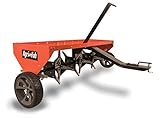
The Agri-Fab 45-0299 is a rolling plug aerator, which means it pulls short cores with curved hollow knives rather than punching holes with solid spikes. Agri-Fab lists 32 galvanized knives across a 48-inch working width and up to 3 inches of penetration. That width is the main reason it earns the top spot: on a big lawn, a 48-inch aerator needs noticeably fewer passes than a 40-inch one, and aeration works best when you cover the lawn twice in a crisscross pattern. The weight tray matters more than any other feature on a tow-behind aerator. An empty rolling aerator rides on top of firm soil and barely scratches it. The 45-0299 takes up to 175 lb of added weight, which is enough for three or four concrete blocks or several sandbags and makes the difference between shallow dimples and real plugs. The cantilever transport handle lets you raise the tines from the tractor seat to cross a driveway or turn at the end of a row, and the 10-inch flat-proof tires will not leave you with a flat at the start of the season. Agri-Fab says it needs a tractor of 9 HP or more, and backs it with a 3-year limited warranty. Set expectations correctly: like every spoon-style tow aerator, it pulls shallower, less uniform plugs than a rented gas core aerator on dry clay. Water first, load it up and make two passes.
Pros
- 48-inch working width with 32 galvanized plugging knives
- Rated to 3 inches of penetration on well-prepared soil
- Weight tray takes up to 175 lb of added weight for hard ground
- Cantilever transport handle raises and lowers the tines from the tractor seat
- Universal hitch and 10-inch flat-proof tires
Cons
- Agri-Fab calls for a lawn tractor of 9 HP or more to pull it
- About 93 lb assembled before you add any weight, so it is awkward to store and move by hand
The Bottom Line
The tow-behind plug aerator we would buy for a half-acre or larger lawn: wide, heavy enough to load properly, and easy to lift from the seat.

Brinly PA-40BH 40-Inch Tow-Behind Plug Aerator
40-Inch Tow-Behind Plug Aerator
Brinly has been making tow-behind lawn attachments for a long time, and the PA-40BH is its mainstream plug aerator. It carries 24 heat-treated 16-gauge steel spoons that Brinly rates to 3 inches of penetration, with an enclosed steel weight tray that takes up to 150 lb of additional weight for compacted soil or hard clay. We like it for a specific kind of owner: someone with a zero-turn or a smaller lawn tractor and a lawn in the quarter- to half-acre range. The 40-inch width is easier to steer around beds and trees than a 48-inch unit, and it does not need a big tractor to pull it once loaded. The feature that matters over years of ownership is the individually replaceable spoons. On stony ground, spoons bend and wear, and on many cheaper aerators that means replacing a whole tine section or the entire shaft. Here you replace one spoon. Transport wheels engage with a lever, so you can cross a driveway or sidewalk without dragging the tines over concrete. The honest downsides are the assembly, which buyers commonly report taking an hour or more, and the fact that it shares the limits of every spoon aerator: it needs moist soil and real weight in the tray to pull full plugs. Treat 3 inches as the best case, not the typical result on dry clay.
Pros
- 24 heat-treated steel plugging spoons rated to 3 inches deep
- Enclosed steel weight tray takes up to 150 lb of added weight
- Each plugging spoon is individually replaceable
- Built for lawn tractors and zero-turn mowers
- Transport wheels engage for crossing drives and paths
Cons
- Assembly takes a while, commonly around an hour or more
- Narrower 40-inch path means more passes on a big lawn
The Bottom Line
The best fit for smaller tractors and zero-turns on quarter- to half-acre lawns, and the easiest to keep running because every spoon is replaceable.
Brinly PA-48BH 48-Inch Tow-Behind Plug Aerator
48-Inch Tow-Behind Plug Aerator
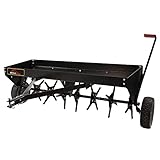
The PA-48BH is Brinly's larger plug aerator, and the reason to choose it over the Agri-Fab is weight. Brinly rates the fully enclosed steel tray for up to 200 lb of added weight, the most of any tow-behind here, and on heavy clay that extra load is the difference between pulling plugs and bouncing across the surface. It carries 32 heat-treated steel tines across 48 inches, rated to 3-inch plugs. The design detail we like most is the four separately welded tine sections that rotate independently. A single solid shaft drags and twists the turf when you turn; independent sections let the inside and outside of the aerator roll at different speeds, so corners and curves do far less damage. Like the smaller PA-40BH, each plugging spoon is individually replaceable, which keeps long-term maintenance cheap. Never-flat transport wheels engage with a side lever for crossing hard surfaces. The catch with any heavily weighted aerator is the tractor. Two hundred pounds of blocks plus the aerator itself is a real load, and a light zero-turn can lose traction on slopes or wet grass. If you have the machine for it, this is the most effective homeowner tow aerator we can recommend for clay. If your tractor is small, the PA-40BH is the better match. Brinly also points out that the plugs themselves carry soil microbes, so leave them on the lawn to break down.
Pros
- 32 heat-treated steel tines pulling plugs up to 3 inches
- Weight tray accepts up to 200 lb of added weight, the most of our tow picks
- Four tine sections rotate independently, so turns tear the turf less
- Individually replaceable plugging spoons
- Never-flat transport wheels on a side lever
Cons
- Needs a tractor with enough weight and traction to pull it fully loaded
- Sits at the top of the price range for homeowner tow aerators
The Bottom Line
The tow-behind to buy for stubborn clay, where the extra 200 lb of weight capacity is what gets tines into the ground.

Yard Butler ID-6C Manual Lawn Coring Aerator
Manual Two-Tine Core Aerator
The Yard Butler ID-6C is a simple steel frame with two hollow coring tubes at the bottom, a foot bar and a pair of cushioned grips on top. You set it down, step on the bar and pull it up, and it removes two plugs about 1/2 inch in diameter and 3-1/2 inches deep. That depth is better than most tow-behind aerators achieve on firm soil, which is the whole point: this is a real core aerator, not a spike tool dressed up as one. Each new step pushes the previous cores out of the top of the tubes. What it is not is fast. At 6-inch spacing, a square foot needs four holes, so every thousand square feet takes around two thousand steps. That is a long afternoon for a small front lawn and not a sensible plan for a quarter acre. Where it shines is targeted work: the worn strip along a fence where the dog runs, the path the kids cut across the lawn, compacted soil around a tree where a machine cannot go, or a small city lawn that never justifies a rental. In sticky clay, plugs sometimes jam inside the tubes; a screwdriver or a stick clears them. Moist soil makes it dramatically easier, as with every aerator. The steel is powder-coated and the whole tool is light enough to hang on a garage wall.
Pros
- Pulls two real cores, about 1/2 inch wide and 3-1/2 inches deep, per step
- Powder-coated steel with a foot bar for leverage
- Light enough to carry anywhere and hang on a wall
- Ideal for dog runs, paths and patches a machine cannot reach
- No tractor, rental or fuel needed
Cons
- Slow and tiring: a thousand square feet at 6-inch spacing is roughly two thousand steps
- Cores can stick in the tubes in sticky clay and need clearing
The Bottom Line
The only manual aerator we recommend, because it actually pulls cores, but it is a tool for small areas and problem spots, not a whole lawn.

Jonathan Green Love Your Soil
Granular Gypsum and Humate Soil Amendment
Love Your Soil is Jonathan Green's granular soil amendment for hard, compacted ground. The label analysis is 21 percent calcium, 3.8 percent sulfur and 1 percent iron, from gypsum plus humates, and one 15.5 lb bag covers up to 5,000 square feet of established lawn or 2,500 square feet when preparing new ground. The pitch is that it loosens clay, feeds soil microbes and builds humus over time. The honest reading of that is useful rather than magical. Gypsum improves structure most clearly where sodium is the problem, which is common along driveways, sidewalks and roads that get de-icing salt and on some arid-region soils. There it can make a real difference. On ordinary clay without a sodium issue, research shows smaller effects, and the humate portion works slowly by supporting soil life. That is why we treat it as a partner to core aeration rather than an alternative. The best time to apply it is right after aerating, when a share of the granules can fall into the open holes, and it spreads with the same broadcast spreader you use for fertilizer and seed. Because it is calcium rather than lime, it does not raise pH much, which makes it safe to use on lawns that are already neutral or alkaline. Expect results over a season, not a week.
Pros
- Gypsum-based amendment with humates, sold to loosen hard, compacted soil
- One 15.5 lb bag treats up to 5,000 sq ft of established lawn
- Applied with an ordinary broadcast or drop spreader
- Adds calcium and sulfur without changing soil pH much
- Pairs well with core aeration, since granules can fall into the holes
Cons
- Works gradually over a season, not overnight
- Gypsum does most for sodic or salt-affected soil; ordinary clay responds less dramatically
The Bottom Line
A sensible add-on after core aeration on clay, especially along salted drives and walks, but not a substitute for pulling plugs.

Simple Lawn Solutions Liquid Soil Loosener
Liquid Aerator, 32 oz
Liquid aerators are the most oversold products in lawn care, so we picked the one whose own instructions are most honest about how it should be used. Simple Lawn Solutions' Liquid Soil Loosener is a 32 oz concentrate that the company rates for up to 32,000 square feet, aimed at compacted soil, standing water and poor drainage. Products like this act mainly as soil conditioners and wetting agents: they help water soak down into tight soil rather than running off or sitting on top, and over time that can support deeper roots. What they cannot do is remove soil. A core aerator physically pulls plugs, which gives compacted soil somewhere to expand into and opens a direct path for air, water and seed. No liquid does that, and anyone telling you a bottle replaces aeration on heavy, trafficked clay is overselling it. Where a liquid makes sense is on lawns with runoff or puddling that are not badly compacted, on slopes where towing an aerator is unsafe, or as a follow-up between core aerations. Pay attention to the timing rules on the label: water the lawn for about 20 minutes within 24 hours of applying, apply at least 4 weeks before seeding because it can reduce germination, and at least 2 weeks before fertilizer. That seeding gap is the detail most buyers miss.
Pros
- 32 oz bottle rated to cover up to 32,000 sq ft
- Helps water move down into tight soil and reduces puddling
- Nothing to rent, tow or push, and no plugs on the lawn
- Suitable for all grass types
- Can be used alongside core aeration
Cons
- Does not create physical channels, so it cannot replace core aeration on compacted ground
- Must go down at least 4 weeks before seeding because it can reduce germination
The Bottom Line
A reasonable maintenance product for lawns with drainage and runoff problems, as long as you do not expect it to do what a core aerator does.

Agri-Fab 45-0543 Tow Spiker/Seeder/Spreader
32-Inch Tow Spike Aerator with 100 lb Hopper
We include one spike tool on this list, and we want to be precise about why. The Agri-Fab 45-0543 combines a row of galvanized steel spike disks with a 100 lb hopper, so it can open the surface and drop seed or granular product in the same pass across a 32-inch width. On loose, sandy or loamy soil that is not compacted, that is genuinely useful at overseeding time. The spikes break the surface and create small pockets where seed settles and makes contact with soil, which is what seed needs to germinate. It also works as a tow spreader on its own. What it will not do is fix compacted ground. A spike pushes soil sideways and down as it enters, so on clay each hole is surrounded by soil that is now packed tighter than before, and the holes close back up quickly. That is the main reason extension services recommend core aeration over spiking for compaction. So if your lawn is hard, drains poorly or grows thin where people walk, start with a plug aerator, then consider this for seeding. If your soil is sandy and your goal is simply to get seed into contact with the ground in autumn, it is an efficient single-pass tool. The large flat-free tires and a steel lift handle for raising the spikes are practical touches.
Pros
- Spikes, seeds or spreads in a single pass
- 32-inch working width with galvanized steel spike disks
- 100 lb hopper for seed or granular products
- Large flat-free tires and a steel lift handle
- Useful for seed-to-soil contact when overseeding loose or sandy soil
Cons
- Spikes push soil aside instead of removing it, so it does not relieve compaction
- Narrower than the plug aerators, so big lawns take more passes
The Bottom Line
Worth buying only as an overseeding tool for loose or sandy soil; on compacted clay, buy a plug aerator instead.
4. Does Your Lawn Need Aerating?
Not every lawn needs aerating every year, and on a healthy lawn with sandy soil it can be a waste of an afternoon. The quickest test costs nothing. Push a long screwdriver into the lawn a day after rain or a good watering. If it slides in 6 inches with little effort, compaction is not your problem. If you have to lean on it to get past an inch or two, the soil is compacted.
The lawn gives other signs. Water that puddles or runs off before it soaks in, grass that thins along paths and play areas, and turf that browns quickly in heat even when watered are all consistent with compaction. So is a lawn that responds poorly to fertilizer, because nutrients are not reaching roots. Pull up a small section of sod: roots that stop at an inch or two, often turning sideways, point to hard soil underneath.
Soil type sets the baseline. Clay and silty soils compact easily and usually benefit from aeration every year, especially if the lawn gets regular traffic. Loamy lawns with light use may need it every two to three years. Sandy soils rarely compact enough to need it at all. Lawns on new-build lots are a special case: heavy equipment packs the subsoil, and a thin layer of topsoil over it hides the problem. Those lawns almost always benefit.
Aeration also helps with thatch. The plugs deposited on the surface carry soil microbes that help break thatch down, which is why aeration is often the better first step than aggressive dethatching. If your lawn has a spongy layer thicker than about half an inch, read our guide to the best dethatchers as well; the two jobs complement each other.
THE SCREWDRIVER TEST
If a screwdriver will not go in 6 inches on moist soil, aerate.
Test in several places, including high-traffic paths and the middle of the lawn. Compaction is often patchy, which is where a manual corer earns its keep.
5. When to Aerate Cool- and Warm-Season Grass
The rule is simple: aerate when the grass is growing strongly and has several weeks of good growing weather ahead to fill the holes back in. Aerating a dormant or heat-stressed lawn opens it to weeds and drying out with nothing to recover.
Cool-season grass
Kentucky bluegrass, tall fescue, fine fescues and perennial ryegrass grow best in cool weather. For these lawns, early fall is the best time by a clear margin, roughly late August through September in much of the northern half of the US. The soil is still warm, which is ideal for seed germination, nights are cool, and weed pressure is falling. Early spring is the second choice, but aerating then brings up weed seed at the same time crabgrass is getting ready to germinate, and new seed has only a short window before summer heat.
Warm-season grass
Bermudagrass, zoysia, St. Augustine and centipede grow in summer heat. Aerate from late spring into early summer, once the lawn has fully greened up and you have mowed it two or three times. That gives it the whole peak growing season to recover. Avoid aerating warm-season grass in fall, when it is heading toward dormancy.
Two practical timing notes. First, if you use a pre-emergent crabgrass control in spring, aerating after applying it can break the barrier; aerate first, or plan fall aeration instead. Second, plan around seeding. Fall aeration for cool-season lawns works so well partly because it is also the best time to overseed, and seed that falls into aeration holes germinates reliably.
| Grass type | Best time | Second choice | Avoid |
|---|---|---|---|
| Cool-season | Early fall | Early spring | Summer heat, dormancy |
| Warm-season | Late spring to early summer | Midsummer with water | Fall, winter dormancy |
6. Soil Moisture Decides the Result
If there is one step that separates a lawn that was aerated from one that was merely driven over, it is moisture. Dry clay is close to concrete. Tines skid across it or pull shallow, broken plugs no matter how much weight is on the tray. Saturated soil is the opposite problem: the tines smear the walls of the holes and the plugs turn to paste, and running equipment on a waterlogged lawn compacts it further.
What you want is soil that is moist several inches down but not muddy at the surface. The simplest way to get there is to water about an inch the day or two before you aerate, or to aerate a day or two after a good soaking rain. The screwdriver test doubles as a moisture check: if it pushes in easily and comes out clean or only slightly damp, you are in the right range. If it comes out coated in mud, wait.
Moisture matters most for tow-behind spoon aerators, which rely on weight and rolling motion rather than an engine driving the tines down. The difference between dry and moist soil can be the difference between half-inch dimples and full 3-inch plugs from the same aerator. It matters for manual corers too, just in a more personal way: on moist soil, the Yard Butler slides in with a firm step; on dry clay, you will be bouncing on the foot bar.
Before you water, mark sprinkler heads, shallow irrigation lines, invisible dog fence wire and any buried cable with small flags. Tines will not usually reach utility lines, which are buried deeper, but shallow sprinkler heads are an easy thing to break. Mow the lawn a little shorter than usual beforehand, too, so the tines reach soil instead of pushing through tall grass.
AERATION BY THE NUMBERS
1 in
water a day or two before
2-3 in
target plug depth
2 passes
crisscross for coverage
150+ lb
added weight on a tow aerator
7. Tow-Behind vs Manual vs Renting
There are three realistic ways for a homeowner to core-aerate, and the right one depends on lawn size and what you already own.
Tow-behind plug aerator
If you own a lawn tractor or zero-turn, a tow-behind plug aerator is the most convenient choice for lawns of roughly a quarter acre and up. It lives in the shed, you can aerate the day the soil is right instead of the day a rental is available, and over several years it costs less than renting. The trade-off is depth. These are spoon-style rolling aerators that rely on weight, and they typically pull shallower, less regular plugs than an engine-driven machine, especially on clay. Load the tray and make two passes, and results are good. If you are shopping for a tractor to pull one, our guide to the best riding lawn mowers covers towing capacity and which models handle attachments well.
Manual core aerator
A step-on corer like the Yard Butler pulls excellent plugs, deeper than most tow aerators, but at human speed. It is the right tool for small lawns under a few hundred square feet, for spot-treating paths and dog runs, and for spaces a machine cannot reach. It is the wrong tool for anything larger, unless you enjoy several thousand repetitions.
Renting a gas core aerator
A walk-behind gas core aerator from an equipment rental store drives hollow tines straight down with an engine. It pulls the deepest, cleanest plugs of any option and is what lawn care companies use. For a lawn with no tractor, or a clay lawn where tow-behind results disappoint, renting once a year is often the smartest choice. Plan for the weight: these machines are heavy, commonly well over 150 lb, need a truck or trailer and two people to load, and can be tiring to steer. Splitting a day's rental with a neighbor is common and halves the cost.
A simple rule: under about 5,000 square feet with no tractor, rent or go manual. Over that with a tractor, buy a tow-behind. Heavy clay with disappointing results from either, rent the gas machine.
8. How to Aerate a Lawn Properly
The job itself is straightforward, and a few habits make a large difference to the result.
Start two or three days out. Mow a little shorter than usual, flag sprinkler heads and shallow lines, and water about an inch so the soil is moist on the day. If you plan to overseed, have seed and a spreader ready, because the best time to put seed down is within a day or two of aerating while the holes are open.
With a tow-behind, add weight before you start, not after the first disappointing pass. Concrete blocks, sandbags or bags of sand work; secure them so they cannot slide. Run the first pass in straight lines across the lawn, then a second pass at an angle to the first. Crisscrossing matters because a single pass with any tow aerator leaves holes spaced several inches apart. Raise the tines to turn at the ends of rows, as turning with them down tears the turf, and slow down: a moderate walking pace gives the spoons time to bite.
Afterward, check your work. Pull a few plugs and look at them. You want plugs roughly 2 to 3 inches long. If you are getting half-inch nubs, the soil is too dry or the aerator is too light. On a lawn aerated properly, you should see plugs spaced a few inches apart across the whole area.
Leave the plugs where they fall. They look untidy for a week or two, but they break down with rain, watering and mowing, and the soil and microbes they carry help decompose thatch. Running over them with the mower once they dry speeds that up. Raking them away removes the benefit.
Finally, go easy on the lawn for a couple of weeks. Keep traffic light, water if the weather turns dry, and hold off on herbicides while any new seed establishes.
9. Overseeding and Feeding After Aeration
Aeration on its own relieves compaction. Aeration followed by seed and fertilizer is how thin lawns get thick, and it is the reason fall aeration of cool-season grass is such a well-established practice.
Seed immediately, ideally the same day. The holes and the loose soil around the plugs give seed the contact with soil it needs, and seed that lands in a hole is protected from drying and birds. Use the seeding rate for overseeding on the bag, which is usually around half the rate for a new lawn, and choose a variety suited to your region and light. Our guide to the best grass seed goes through which mixes suit sun, shade, heavy traffic and different climates.
A spreader makes this far more even than broadcasting by hand. Split the seed in half and apply it in two directions, the same crisscross pattern you used for aerating. If you do not own one, our guide to the best broadcast spreaders covers push and tow-behind models, several of which are also what you would use for granular soil amendments.
Feed at the same time. A starter fertilizer, higher in phosphorus where local rules allow it, supports new roots; on an established lawn that is not being seeded, a normal fall feeding is fine. Fertilizer applied after aeration reaches the root zone more easily. See our picks for the best fertilizer for grass for products suited to seeding and to established turf.
Then water lightly and often. New seed needs the surface kept moist, typically a short watering once or twice a day until it germinates, then tapering to deeper, less frequent watering as it establishes. Hold off on crabgrass pre-emergents and broadleaf weed killers until the new grass has been mowed a few times, because most will stop seed from germinating or harm young grass. And do not use a liquid soil loosener in the same window; its label asks for a four-week gap before seeding.
10. Aerating Heavy Clay
Clay is where most aeration disappointment happens, and it is also where aeration matters most. Clay particles are tiny and flat, they pack tightly under pressure, and once packed they drain slowly, dry hard and stay compacted for years. A clay lawn with regular traffic will usually benefit from core aeration every year.
This is also where spike tools do the most harm, and it is worth being specific about why. When a solid spike enters clay, the soil it displaces has nowhere to go but sideways and down. The walls of the hole become a glazed, compressed layer, and the zone around each hole ends up denser than before. Spike rollers and spiked shoes add the weight of the roller or the person to that effect. On a wet day the holes may look open, but they are not letting air and water into loose soil; they are small, smeared pockets in tighter soil. Core tines avoid all of that by taking the soil out.
Getting good plugs from clay comes down to three things: moisture, weight and passes. Water deeply a day or two ahead. Load a tow-behind with as much weight as the tray allows, which is why the Brinly PA-48BH with its 200 lb capacity is our pick for clay. Make two or even three passes in different directions. If results are still shallow, rent a gas core aerator for a season or two, then maintain with your own equipment.
Over the long run, the best fix for clay is organic matter. Topdressing with a thin layer of screened compost, about a quarter inch, right after core aeration lets it work into the holes and gradually improves structure. Gypsum products like Love Your Soil can help too, especially along drives and walks where de-icing salt has damaged soil structure, but they work best alongside aeration, not instead of it. Keep clippings on the lawn, mow high, and avoid driving on the lawn when it is wet, and the compaction you relieve will not come back as quickly.
11. Common Mistakes to Avoid
Buying spike shoes or a spike roller for clay
Spikes push soil sideways instead of removing it, so each hole ends up surrounded by tighter soil than before. On compacted clay that makes the problem worse. If your screwdriver will not go in, you need a tool that pulls plugs, whether that is a tow-behind, a manual corer or a rented gas machine.
Aerating bone-dry soil
Dry clay shrugs off tines. A tow-behind will bounce across it pulling half-inch nubs, and you will conclude that aeration does not work. Water about an inch a day or two ahead, or wait for a good soaking rain, and aim for soil that is moist several inches down but not muddy at the surface.
Running a tow aerator with an empty tray
Rolling plug aerators rely on weight to drive the spoons in. Empty, most barely scratch firm soil. Load the tray with blocks or sandbags up to the maker's limit before the first pass, secure them, and check a few plugs to confirm you are getting 2 to 3 inches before doing the whole lawn.
Aerating at the wrong time of year
Aerating cool-season grass in summer or warm-season grass in fall leaves open holes in a lawn that cannot grow into them, which invites weeds and drought stress. Aerate cool-season lawns in early fall and warm-season lawns from late spring into early summer, when each is growing hardest.
Raking up the plugs
The plugs look messy, but they are soil and microbes that help break down thatch and refill the holes as they crumble. Leave them on the lawn to dry, then let rain, watering and a pass or two with the mower break them up. Raking them away throws out part of the benefit.
12. Frequently Asked Questions
What is the best type of lawn aerator?
A core or plug aerator, which pulls plugs of soil out of the lawn. It is the method university extension services recommend for compacted soil, because removing soil gives the surrounding ground room to loosen and opens a direct path for air, water and seed. Spike aerators and liquids have narrower uses and do not relieve real compaction.
Do spike aerator shoes work?
Not for compaction. Spiked shoes push short spikes into the surface, which on firm soil rarely reach more than an inch, and like every spike tool they press soil sideways rather than removing it. On clay that tightens the soil around each hole. They are not worth buying. A manual core aerator is the cheapest tool that genuinely works.
How often should I aerate my lawn?
Clay soil or lawns with heavy traffic usually benefit from core aeration once a year. Loamy lawns with light use can go two or three years between aerations. Sandy soil rarely needs it. Use the screwdriver test each season: if a screwdriver will not push 6 inches into moist soil, it is time to aerate again.
Should I aerate before or after dethatching?
If you need both, dethatch first, then aerate, then seed and feed. Dethatching clears the matted layer so tines reach soil and seed reaches the ground. On lawns with only moderate thatch, aeration alone is often enough, because the soil in the plugs helps break the thatch down naturally without the stress of dethatching.
Do liquid aerators really work?
They work as soil conditioners, helping water soak into tight soil and supporting soil life over time. They do not remove soil or open physical channels, so they cannot do what core aeration does on compacted ground. They are reasonable for drainage and runoff problems or slopes, but check the label; some need a gap of weeks before seeding.
How deep should aeration plugs be?
Aim for plugs about 2 to 3 inches long, spaced a few inches apart. Shallower plugs mean the soil was too dry, the tow aerator needs more weight, or the soil is heavy enough to justify renting a gas core aerator. Pull a few plugs early in the job to check before covering the whole lawn.
Is it better to rent an aerator or buy one?
Buy a tow-behind if you own a lawn tractor or zero-turn and have more than about a quarter acre, since it pays for itself over a few seasons and lets you aerate when conditions are right. Rent a gas core aerator if you have no tractor, a very compacted clay lawn, or a small lawn aerated only occasionally.
Related Lawn Care Guides
Buyer's Guide
Best Dethatchers
Electric, tow-behind and manual dethatchers compared, with the half-inch thatch rule and when to scarify.
Buyer's Guide
Best Grass Seed
The seed mixes worth putting down after aeration, matched to sun, shade, traffic and climate.
Buyer's Guide
Best Fertilizer for Grass
Starter and maintenance fertilizers that reach the root zone best right after you aerate.
The Bottom Line
Aeration works when it removes soil, on moist ground, at the time of year your grass is growing hardest, followed by seed and fertilizer. For most tractor owners that means a weighted tow-behind plug aerator like the Agri-Fab 45-0299, or the Brinly PA-48BH if you are fighting heavy clay. For small lawns and problem patches, the Yard Butler corer does the same job by hand.
Skip the spike shoes and spike rollers, treat liquids and gypsum as helpers rather than cures, and if your own equipment keeps pulling shallow plugs from clay, rent a gas core aerator for a season. Then put seed down the same day. That combination is what turns a thin, hard lawn into a thick one.
More in Lawn & Yard Care
Guides in this category that pair with what you just read.
About the Author
Alex Rivers, Home Improvement Editor
Alex has spent over a decade working on residential and light commercial property maintenance, and now tests every tool, coating and machine that appears in these guides personally.