Best Dethatchers
A little thatch is good for a lawn and a lot of it starves the roots. Measure first, then pick the dethatcher that matches your lawn size and how aggressive the job needs to be.
Alex Rivers
Home Improvement Editor
Last Updated
September 29, 2026
In This Guide
Most lawns that get dethatched did not need it, and most lawns that need it get dethatched at the wrong time. Thatch under half an inch protects the crown of the grass. Over half an inch, water and fertilizer stall in it and roots start growing up into it instead of down into soil. Measure before you buy anything, and if you do need to dethatch, do it when the grass can grow back fast.
Our Picks at a Glance
- Best Overall: Greenworks 10 Amp 14-Inch Corded Dethatcher 27022 — 14-Inch Corded Electric Dethatcher
- Best Budget 2-in-1: Sun Joe AJ801E 12 Amp Electric Scarifier and Dethatcher — 12.6-Inch 2-in-1 Corded Dethatcher/Scarifier
- Best for Mid-Size Lawns: Sun Joe AJ805E 13 Amp 15-Inch Electric Dethatcher and Scarifier — 15-Inch 2-in-1 Corded Dethatcher/Scarifier
- Best Cordless: Greenworks 40V 15-Inch Brushless Dethatcher/Scarifier — 15-Inch Cordless 2-in-1 Dethatcher/Scarifier
- Best Tow-Behind: Brinly DT-48BH 48-Inch Tow-Behind Dethatcher — 48-Inch Tow-Behind Spring-Tine Dethatcher
- Best Budget Tow-Behind: Agri-Fab 45-0294 40-Inch Tow Dethatcher — 40-Inch Tow-Behind Spring-Tine Dethatcher
- Best Manual: Ames 15-Inch Adjustable Thatch Rake 2915100 — Manual Thatch Rake
1. How We Picked
We began by separating the tools by what they physically do, because that decides which one a lawn needs. Spring-tine dethatchers comb out loose dead material. Scarifiers, also called verticutters, use fixed blades to slice through thatch and into the soil surface. Rakes do the dethatcher's job by hand. We wanted at least one good option of each type, and 2-in-1 machines that do both jobs got extra credit because most homeowners only want to store one.
For walk-behind machines we compared motor size, working width, the range and number of depth settings, what the tines and blades are made of, and whether replacement tines and blades are sold. Width matters more than people expect: a thorough dethatch covers the lawn twice, so a 15-inch machine saves real time over a 12-inch one on a mid-size yard. We weighed owner reviews for reliability, particularly reports of tines breaking, motors stalling in thick thatch, and collection bags that fill after a few yards.
For tow-behinds we looked at width, tine count and diameter, how much weight the tray will hold, how the tines are protected and lifted, and whether the hitch fits the tractors most people own. For the rake, we wanted curved tines, a long handle and a head that does not clog.
Every pick is a real, widely available product from an established maker. We do not list exact prices because they change constantly, and we left out any specification we could not confirm from the manufacturer or a major retailer. Where we mention testing, we mean hands-on use on ordinary cool-season lawns, not lab measurements.
Finally, we left out gas power rakes. They are the right tool for severe thatch, but they are heavy, expensive and used once a year, which makes them a rental for nearly every homeowner. We cover when to rent one in the section on choosing a type.
2. What Thatch Is and the Half-Inch Rule
Thatch is the layer of dead and living stems, stolons, rhizomes and roots that builds up between the green grass blades and the soil surface. It is tough, fibrous material that decomposes slowly. Every lawn has some, and in moderation it is good for the grass. A thin layer insulates the soil against temperature swings, cushions the crowns of the grass plants against foot traffic, and slows evaporation.
The problems start when it gets thick. Beyond about half an inch, thatch behaves like a sponge that is hard to wet and quick to dry. Rain and irrigation soak into it and stop there instead of reaching the soil. Fertilizer gets tied up in it. Roots, following the moisture, begin growing into the thatch itself instead of down into the soil, and a lawn rooted in thatch is shallow, drought-prone and easily damaged by heat and cold. Thick thatch also harbors insects and disease.
That is why the half-inch threshold is the standard guidance. Under half an inch, leave it alone. Around half an inch to an inch, a dethatcher is worth using. Over an inch, you likely need a more aggressive approach, such as a rented power rake or verticutter, and possibly a staged plan over two seasons.
How to measure it
Use a trowel or a knife to cut a small wedge of turf a few inches deep and lift it out. Look at the side. You will see green grass at the top, soil at the bottom, and between them a brown, spongy layer of tangled material. Measure that layer. Do this in several spots, because thatch is often worse in sunny areas, heavily fertilized areas and parts of the lawn with vigorous creeping grasses. A lawn that feels springy underfoot is a hint, but the wedge tells you for certain.
THE HALF-INCH RULE
Under 1/2 inch, leave it. Over 1/2 inch, dethatch. Over 1 inch, plan a staged job.
Measure before you buy anything. Dethatching a lawn that does not need it just stresses healthy grass and gives weeds an opening.
3. Our 7 Top Picks
Four of our picks are walk-behind electric machines, which suit most suburban lawns: two corded 2-in-1 units that switch between spring-tine dethatching and bladed scarifying, a larger corded model for mid-size lawns, and a cordless option. Two are tow-behind spring-tine dethatchers for tractor owners with big lawns. The last is a thatch rake, which is all a small lawn or a few problem patches really needs. None of them replaces a rented power rake for severe thatch, and we explain where that line falls.
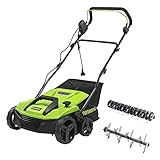
Greenworks 10 Amp 14-Inch Corded Dethatcher 27022
14-Inch Corded Electric Dethatcher
The Greenworks 27022 is the dethatcher we would hand to most people with a quarter-acre lawn or less, and its huge base of owner reviews on Amazon backs that up. It pairs a 10 amp motor with a 14-inch path, which is noticeably wider than the 12- to 13-inch budget machines and cuts the number of passes on a typical lawn. The tines are stainless steel, and the depth adjusts through three positions. That is fewer settings than the Sun Joe machines offer, but in practice most people use one setting for a light spring pass and one deeper setting for a proper dethatch, so three is enough. The machine is light enough to lift over bed edging and carry up steps, and the padded grip and adjustable handle make a long session more comfortable. Greenworks backs it with a 4-year warranty, which is longer than several rivals. As with any corded tool, plan the cord first: start near the outlet, work away from it, and keep the cord on the finished side of the lawn so you do not run over it. What it does not do is scarify. It is a spring-tine dethatcher, which combs out dead material rather than slicing into the soil. That is what most lawns need. If you want to scarify before overseeding, look at the Sun Joe AJ801E or AJ805E.
Pros
- 10 amp motor with a 14-inch dethatching path
- 3-position depth adjustment, from a light comb to a deeper pull
- Stainless steel tines that hold up well
- Light enough to lift over edging and carry to the back yard
- Padded grip and adjustable handle
Cons
- Corded, so you manage an outdoor extension cord across the lawn
- Only three depth settings, fewer than the Sun Joe models
The Bottom Line
The simplest, most proven electric dethatcher for typical suburban lawns, with enough width to finish in a reasonable time.
Sun Joe AJ801E 12 Amp Electric Scarifier and Dethatcher
12.6-Inch 2-in-1 Corded Dethatcher/Scarifier
The Sun Joe AJ801E is the entry point to 2-in-1 machines, and on a small lawn it is hard to beat for value. It comes with two interchangeable reels. The dethatching reel carries 27 spring steel tines that comb out dead grass and moss, and the scarifying reel carries 20 fixed blades that slice into the thatch and the top of the soil. Having both matters: you can do a light dethatch in spring and a scarify before overseeding in fall without buying a second tool. The motor is 12 amps and the path is 12.6 inches wide, which is narrow, so we would keep it to lawns up to a few thousand square feet. The depth knob has five positions, spanning about 0.4 inch above to 0.4 inch below the soil surface. That range is the useful part; the highest settings are for a light comb, and the lowest are for scarifying. A collection bag catches a good share of the material, which saves raking, though owners consistently report that it fills fast on a thatchy lawn and has to be emptied often. On heavy thatch, it is often easier to remove the bag and rake or blow the debris afterward. Sun Joe backs it with a 2-year warranty, and replacement tines and blades are available, which matters because scarifier blades wear on sandy or stony ground.
Pros
- Includes both a spring-tine dethatching reel and a bladed scarifying reel
- 27 spring steel tines, and 20 slicing blades on the scarifier
- 5-position depth knob from about 0.4 in above to 0.4 in below the soil
- Collection bag catches much of the thatch
- Light and compact for small lawns
Cons
- The collection bag fills quickly on a thatchy lawn
- 12.6-inch path makes larger lawns a slow job
The Bottom Line
The cheapest way to get both dethatching and scarifying in one machine, best on small lawns where the narrow path and small bag do not matter.

Sun Joe AJ805E 13 Amp 15-Inch Electric Dethatcher and Scarifier
15-Inch 2-in-1 Corded Dethatcher/Scarifier
The AJ805E is the bigger sibling of the AJ801E, and on a mid-size lawn the difference is worth paying for. Sun Joe gives it a 13 amp motor and a 15-inch working path, the widest of the corded machines here, with a larger head and collection bag intended to clear medium-size yards without constant stops. Like the smaller model, it comes with two reels: a dethatcher with 27 spring steel tines for combing out dead material and moss, and a scarifying cylinder with fixed blades for slicing through thatch and scoring the soil surface before overseeding. Depth is set with a five-position knob across roughly 0.4 inch above to 0.4 inch below the soil, which covers everything from a gentle spring pass to a proper scarify. The extra width means fewer passes, and because a thorough dethatch involves going over the lawn twice in different directions, that saving adds up quickly on a lawn of a quarter acre or so. The trade-offs are size and the cord. It takes up more space in the garage, and on a larger lawn, managing 100 feet of extension cord takes some attention. Sun Joe backs it with a 2-year warranty and sells replacement tines and blades. If your lawn is small, the AJ801E does the same work for less; if it is much larger than a quarter acre, look at a tow-behind.
Pros
- Wider 15-inch path and a 13 amp motor
- Both a dethatching reel and a scarifying reel included
- 5-position depth control from about 0.4 in above to 0.4 in below the soil
- Larger head and collection bag than the AJ801E
- Replacement tines and scarifier blades are sold separately
Cons
- Bulkier and heavier to store than the smaller Sun Joe
- Still corded, which gets awkward on the largest lawns
The Bottom Line
The corded 2-in-1 to buy if your lawn is too big for the AJ801E but not big enough for a tractor.

Greenworks 40V 15-Inch Brushless Dethatcher/Scarifier
15-Inch Cordless 2-in-1 Dethatcher/Scarifier
Cordless is the one real improvement in walk-behind dethatchers in recent years, and the Greenworks 40V model is the one we would buy. It uses a brushless motor with a 15-inch path, and it is a 2-in-1: quick-swap reels switch between a spring-tine dethatcher and a bladed scarifier. Greenworks gives each reel its own depth range across five positions, roughly from 1/10 inch below to 3/4 inch above the surface for dethatching, and from 1/2 inch below to 1/5 inch above for scarifying. Greenworks sells it as a kit with a 5.0Ah battery and rapid charger, model DT1504, and quotes about 45 minutes of runtime. That is enough for a typical suburban lawn at one pass, but a thorough two-direction dethatch on a bigger lawn may need a second battery or a recharge break. The case for it is convenience. Not having a cord means you can work in any direction, cross beds and paths freely, and never worry about cutting the cord with the reel. If you already own Greenworks 40V batteries, the bare tool closes much of the price gap with corded machines. If you do not, the kit is a premium purchase for a tool you will use once or twice a year, and the corded Greenworks 27022 does the dethatching part of the job just as well.
Pros
- No cord to drag, trip over or cut
- Brushless motor with a 15-inch path
- Quick-swap reels for dethatching and scarifying
- 5-position depth adjustment with separate ranges for each reel
- Runs on the same 40V batteries as a wide range of Greenworks tools
Cons
- The most expensive walk-behind here, especially with battery and charger
- Greenworks quotes around 45 minutes of runtime on the 5.0Ah battery, so a large lawn may need a second battery
The Bottom Line
Worth the premium if you already own Greenworks 40V batteries or have a lawn where running a cord is a genuine nuisance.

Brinly DT-48BH 48-Inch Tow-Behind Dethatcher
48-Inch Tow-Behind Spring-Tine Dethatcher
For a lawn of half an acre or more, a tow-behind dethatcher is the practical choice, and the Brinly DT-48BH is the one we would buy. It is a simple tool done well: a 48-inch steel frame carrying two staggered rows of 12 spring steel tines, 24 in all, each one a triple-coil 3/16-inch tine that flexes independently over bumps. That independence is what keeps it from gouging on uneven ground. A safety rod sits behind the tines to catch one if it ever breaks, so it cannot be flung into your mower deck. The drawbar mounts at different heights to match your tractor's hitch, and the universal hitch pin fits most riders, lawn tractors, zero-turns and ATVs. There is a weight tray on top; load it with blocks or sandbags when you need the tines to dig deeper. Keep in mind what a tow-behind spring-tine dethatcher does. It is a large power-less rake. It lifts and loosens thatch and brings it to the surface, where you then collect it with a bagging mower, a lawn sweeper or a rake. It does not slice into soil like a scarifier, and on very thick, matted thatch it will do a partial job. For moderate thatch across a big lawn, though, it is quick, effective and nearly maintenance-free. Brinly makes it in the USA.
Pros
- 48-inch width with 24 independently flexing spring steel tines in two rows
- Triple-coil 3/16-inch tines stay flexible and resist breaking
- Safety rod catches a broken tine before it can reach mower blades
- Adjustable drawbar mounting to suit different hitch heights
- Universal hitch pin fits most riders, tractors, ZTRs and ATVs
Cons
- Spring-tine design combs thatch up but does not collect it
- Needs added weight on the tray for deeper thatch
The Bottom Line
The tow-behind dethatcher to buy for large lawns, well built and wide enough to make a half-acre job quick.

Agri-Fab 45-0294 40-Inch Tow Dethatcher
40-Inch Tow-Behind Spring-Tine Dethatcher
The Agri-Fab 45-0294 is the more affordable tow-behind dethatcher, and it is the right choice for a tractor owner with a moderately sized lawn and moderate thatch. It carries 20 heat-treated spring tines, each 3/16 inch in diameter, across a 40-inch width, and a 40-inch weight tray that holds up to 70 lb. That is a lower weight limit than the Brinly's, which matters on firm ground where more weight means deeper raking, but it is enough for most lawns with a thatch problem rather than a thatch crisis. The practical touch we like is the cantilever transport handle, which lifts the tines clear of the ground from the tractor seat when you turn at the end of a row or cross a path. That saves both the turf and the tines. Semi-pneumatic 7-inch tires carry it between jobs, and at about 33 lb assembled it is easy to hang on a garage wall. The universal hitch fits any lawn tractor regardless of brand, and Agri-Fab backs it with a 3-year limited warranty. It shares the limits of every spring-tine tow dethatcher: it pulls thatch to the surface but does not collect it, so plan to follow up with a bagging mower, a lawn sweeper or a leaf blower and rake. Where it earns its place is speed. A 40-inch pass covers ground far faster than any walk-behind.
Pros
- 20 heat-treated 3/16-inch spring tines across a 40-inch width
- Weight tray takes up to 70 lb for deeper raking
- Cantilever transport handle to lift tines for turns and crossings
- Universal hitch fits any brand of lawn tractor
- Light at about 33 lb assembled, easy to hang up and store
Cons
- Lower weight capacity than the Brinly limits how deep it bites
- Narrower than the Brinly, so more passes on a large lawn
The Bottom Line
A lighter, simpler tow-behind that suits quarter- to half-acre lawns with moderate thatch and smaller tractors.
Ames 15-Inch Adjustable Thatch Rake 2915100
Manual Thatch Rake
A thatch rake is the oldest dethatching tool, and for a small lawn it is still a sensible one. The Ames 2915100 has a 15-inch head with 19 curved steel tines on a 54-inch North American hardwood handle, with a 10-inch cushion grip. The curved tines are the key difference from a leaf rake or a garden rake. They are shaped to dig into the thatch layer and drag it up as you pull, and the head is designed to shed the material rather than clog, so you are not stopping every few strokes to pick it clean. Used with short, firm pulls in one direction and then across, it will open up a thatchy lawn well. It is also where we would start on a lawn you are not sure needs a machine: rake a test patch, see how much comes up and how the grass looks a couple of weeks later. The limits are your back and your time. Raking a small city lawn is a reasonable weekend job. Raking a quarter acre is punishing, and on thick, matted thatch a machine will do more in less time. Even if you buy a machine, a thatch rake earns its place. It reaches along fences, into corners and around trees and beds where a dethatcher cannot go, and it is handy for scratching up the surface of bare patches before reseeding.
Pros
- 15-inch head with 19 curved steel tines
- Long hardwood handle, 54 inches, with a cushion grip
- Self-cleaning head sheds thatch as you work
- No cord, battery or storage headache
- Precise for spot work around beds, trees and edges
Cons
- Hard physical work on anything more than a small lawn
- Cannot match a machine for depth on heavy, matted thatch
The Bottom Line
All a small lawn or a few thatchy patches really need, and a useful partner to any machine for edges and corners.
4. Dethatcher vs Scarifier
The words get used interchangeably on product listings, but the tools do different things, and choosing the right one for your lawn matters.
Dethatcher: spring tines
A dethatcher uses a reel of flexible spring steel tines that spin and comb through the grass. They catch loose dead material, moss and debris near the surface and flick it up and out. Because the tines flex, the action is relatively gentle: it removes the loose top of the thatch layer without cutting much living grass. It is the right choice for routine maintenance, for lawns with thatch around half an inch, and for a spring cleanup after winter.
Scarifier or verticutter: fixed blades
A scarifier uses a reel of fixed, rigid blades that slice vertically down through the thatch and a short way into the soil. It cuts through matted thatch that spring tines would skate over, it cuts the runners of creeping grasses, and it scores the soil surface. That last point is why scarifying is so useful before overseeding: the grooves give seed contact with soil. The downside is stress. Scarifying removes more material and cuts more living grass, so the lawn looks rough for a few weeks and needs good growing conditions to recover.
A verticutter is essentially a heavier-duty scarifier, often a gas-powered rental with more widely spaced blades set to cut into the soil. A power rake is sometimes used for the same machine and sometimes for a heavy flail-type dethatcher; ask the rental store what the blades look like.
For most homeowners, a 2-in-1 electric machine covers both needs. Use the dethatching reel for a light pass in spring or for maintenance, and switch to the scarifier in early fall on cool-season grass when you plan to overseed. If your thatch is over an inch, rent a verticutter rather than asking a homeowner machine to do it.
| Dethatcher | Scarifier / verticutter | |
|---|---|---|
| Mechanism | Flexible spring tines | Fixed slicing blades |
| Aggressiveness | Gentle | Aggressive |
| Reaches soil? | Barely | Yes, a little |
| Best for | Maintenance, thatch near 1/2 in | Matted thatch, overseeding prep |
| Recovery | Days | Several weeks |
5. Electric vs Tow-Behind vs Manual Rake
The right kind of dethatcher depends mostly on lawn size, and to a lesser degree on what you already own.
Corded electric
Corded walk-behind dethatchers suit most suburban lawns, up to roughly a quarter acre. They are light, cheap to run, need no maintenance beyond occasional tine replacement, and the 2-in-1 models scarify as well. The only real downside is the cord. Use a heavy-gauge outdoor extension cord of the length the manual specifies, plan your pattern to work away from the outlet, and keep the cord behind you on the finished side. The Greenworks 27022 and the Sun Joe pair are the models to consider.
Cordless
A battery machine like the Greenworks 40V removes the cord problem and the trip hazard. Runtime is the constraint, so check it against your lawn size. It makes the most sense if you already own batteries from the same system, because a kit with battery and charger costs substantially more than a corded machine.
Tow-behind
For half an acre and up, a tow-behind spring-tine dethatcher behind a lawn tractor or zero-turn is the only sensible option. It covers ground many times faster than a walk-behind. Understand the trade-off: these are power-less rakes, so they comb thatch up but do not slice or collect it. Add weight for deeper action, then pick up the debris with a bagging mower, a lawn sweeper or a blower.
Manual thatch rake
For a small lawn, a strip along a path or a few patches, a good thatch rake does the job without a machine to store. It is also the tool for edges and corners after a machine pass.
Renting
If your thatch is over an inch or you only plan to dethatch once, rent a gas power rake or verticutter for a day. It is heavier, more aggressive and faster than homeowner machines, and it is the right tool for a lawn that has been neglected for years.
6. When to Dethatch
Dethatching is stressful for grass, so the rule is the same one that applies to aeration: do it when the grass is growing strongly and has several weeks of good weather to recover. Dethatching at the wrong time is one of the most common ways people damage a lawn they were trying to help.
Cool-season grass
For Kentucky bluegrass, fine fescues, tall fescue and perennial ryegrass, early fall is the best time, around late August through September across much of the northern US. The grass is growing vigorously in cool weather, the soil is still warm enough for overseeding, and weeds are slowing down. Early spring is the second choice, once the lawn has greened up and been mowed once or twice, but keep a spring pass light. A hard spring dethatch opens the ground just as crabgrass is germinating and leaves the lawn little time to recover before summer heat.
Warm-season grass
Bermudagrass, zoysia and St. Augustine should be dethatched from late spring into early summer, after the lawn has fully greened up and is growing actively. These grasses spread by stolons and rhizomes and recover fast in heat, which also makes them prone to thatch. Do not dethatch them in fall, when they are slowing toward dormancy, or in early spring before they have fully woken up.
Whichever grass you have, avoid dethatching during drought, in extreme heat, or when the lawn is dormant. The soil should be slightly moist, not wet. Dry thatch is tough and the machine skates over it; wet ground lets tines tear out living grass by the roots. Watering lightly a day or two before usually gets conditions right.
DETHATCHING BY THE NUMBERS
1/2 in
thatch that justifies dethatching
1 in+
time to rent a power rake
2 passes
crisscross for an even job
3-4 wks
typical recovery after scarifying
7. How to Dethatch Without Wrecking the Lawn
Dethatching looks brutal the first time. Done correctly, the lawn looks thin and scruffy for a week or two and then comes back thicker. Done badly, it tears out healthy grass. These steps keep you on the right side of that line.
Mow first, lower than usual but not scalped, about one notch below your normal height. Shorter grass lets the tines reach the thatch rather than tangling in blades, and it makes cleanup easier. A sharp mower blade matters here and afterward, because ragged tips on already stressed grass invite disease; our guide to the best lawn mower blades covers what to replace a dull one with. Flag sprinkler heads and anything else low in the lawn.
Start at the highest depth setting and test on a small area. Look at what comes up and at the grass left behind. You want a pile of brown, dead material and grass that is thinned but still rooted. If the machine is barely pulling anything, go one setting deeper. If it is ripping out green grass with roots attached, go shallower. Most homeowner machines do their best work in the middle of the range for dethatching and at the lower settings for scarifying.
Work in straight, overlapping lines across the lawn, then do a second pass at an angle to the first. Two moderate passes are better than one aggressive one. Walk at a steady pace, and on a corded machine keep the cord behind you.
Clean up everything the machine pulls. Left on the lawn, the loose thatch smothers grass and blocks seed. A collection bag helps but fills quickly on a thatchy lawn. A rake works, a bagging mower set high picks up a lot, and a blower is the fastest way to push the debris into piles; our guide to the best leaf blowers covers models with enough air to move damp thatch. Compost the material if you can; it breaks down well mixed with green waste.
If your lawn also has compacted soil, this is the moment to aerate, before you seed. Our guide to the best lawn aerators explains why a core aerator, not a spike tool, is the one to use.
8. Recovery and Overseeding
Right after dethatching, a lawn is at its most open, and that is both the risk and the opportunity. Bare soil between thinned grass is an invitation to weeds, and it is also the best seedbed you will get all year. Fill it with grass before something else does.
If you dethatched lightly and the lawn is still dense, you may not need to seed at all. Water it, feed it and let it fill back in. If you scarified, or if the lawn looks noticeably thin, overseed the same day or the next. The grooves and loosened surface give seed good contact with the soil, which is the single biggest factor in germination. Use the overseeding rate on the bag and a variety matched to your climate and light; our guide to the best grass seed goes through the best mixes for sun, shade and heavy wear.
Feed the lawn at the same time. A starter fertilizer supports new seedlings, and an established lawn that was only dethatched benefits from a normal feeding to push new growth. Nutrients reach the soil more easily with the thatch out of the way. Our picks for the best fertilizer for grass cover starter and seasonal options.
Watering is what makes or breaks recovery. Keep the surface consistently moist until new seed germinates, usually with short waterings once or twice a day, then shift to deeper, less frequent watering as the grass establishes. On a lawn that was only dethatched, deep watering a couple of times a week is enough.
Hold off on weed control. Most pre-emergent crabgrass products and many broadleaf weed killers stop grass seed from germinating or damage seedlings, so wait until new grass has been mowed three or four times. Keep foot traffic light, and mow once new growth reaches your normal height, with a sharp blade and the deck set high. Expect a cool-season lawn scarified in early fall to look better than it did before by the end of the season.
9. Why Thatch Builds Up and How to Stop It
Thatch builds up when grass produces tough stems, runners and roots faster than soil organisms can break them down. Dethatching removes the excess, but if you do not change what caused it, you will be back in two years. The good news is that the causes are mostly habits.
Start with a myth. Grass clippings do not cause thatch. Clippings are mostly water and break down quickly, and leaving them on the lawn returns nutrients to the soil. Mulching mowing is a good practice, not a thatch problem. The real culprits are the woody parts of the grass plant that decompose slowly.
Heavy nitrogen feeding is the most common cause. Fertilizing too often or too heavily pushes fast top growth and a lot of stem and runner production. Follow the rates on the bag, favor slow-release nitrogen, and feed at the times of year your grass actually uses it.
Frequent shallow watering is the second. It keeps the surface constantly moist and encourages roots to stay near the top, where they add to the thatch layer. Water deeply and less often, so roots follow moisture down into the soil.
Compacted and acidic soils slow down the microbes and earthworms that break thatch down. This is where core aeration earns its reputation as a thatch treatment. The plugs it deposits on the surface carry soil and microbes into the thatch layer and speed its decomposition, while the holes let air and water reach the soil. On lawns with moderate thatch, yearly aeration often keeps it in check without dethatching at all. A soil test will tell you whether pH is part of the problem.
Grass type sets the baseline. Creeping grasses such as Kentucky bluegrass, bermudagrass, zoysia and St. Augustine build thatch more readily than bunch-type grasses like tall fescue and perennial ryegrass. If you grow one of the creeping types, plan on measuring your thatch every year, and on a light dethatch every couple of years as routine maintenance rather than an emergency fix.
10. Common Mistakes to Avoid
Dethatching a lawn that does not need it
Thatch under half an inch protects grass crowns and slows evaporation, and removing it just stresses healthy turf and opens space for weeds. Cut a small wedge of turf in several spots and measure the brown, spongy layer between the grass and the soil before you buy or rent anything.
Dethatching at the wrong time of year
Dethatching cool-season grass in summer or warm-season grass in fall leaves a torn-up lawn that cannot grow back before heat or dormancy arrives. Do cool-season lawns in early fall and warm-season lawns from late spring into early summer, when the grass is growing hard enough to recover.
Starting at the deepest setting
The lowest setting on most machines is for scarifying, and on a first pass it can rip out living grass by the roots. Start high, test on a small patch, and lower one step at a time until you are pulling brown dead material while leaving green grass rooted. Two moderate passes beat one savage one.
Leaving the thatch on the lawn
The material a dethatcher pulls up has to come off, or it smothers the grass and stops seed reaching soil. Empty the bag often, then rake, blow or bag the rest with a mower set high. Most of it composts well mixed with green waste.
Skipping the overseeding and watering
A dethatched lawn is thin and open for a few weeks. If you do not fill it with grass seed and keep it watered, weeds fill it instead. Overseed within a day, feed with a starter fertilizer, keep the surface moist until germination, and hold weed control until the new grass is established.
11. Frequently Asked Questions
What is the best dethatcher for most lawns?
For lawns up to about a quarter acre, a corded electric dethatcher like the Greenworks 27022 is the best balance of width, weight and value. If you also want to scarify before overseeding, choose a 2-in-1 like the Sun Joe AJ801E or AJ805E. For half an acre or more with a tractor, a tow-behind like the Brinly DT-48BH is far faster.
How do I know if my lawn needs dethatching?
Cut a small wedge of turf a few inches deep and look at the side. Measure the brown, spongy layer between the green grass and the soil. Under half an inch is healthy and should be left alone. Over half an inch is worth dethatching, and over an inch usually calls for a rented power rake or a staged job.
What is the difference between a dethatcher and a scarifier?
A dethatcher combs out loose dead material with flexible spring tines and is fairly gentle. A scarifier, or verticutter, slices down through thatch and into the soil with fixed blades, which is more aggressive and better for matted thatch and overseeding preparation. Many electric machines include both reels so you can switch between them.
Should I dethatch or aerate first?
Dethatch first, then aerate, then seed and fertilize. Removing thatch lets aerator tines reach the soil and lets seed land on soil instead of dead material. If your thatch is only moderate, aeration alone may be enough, because the soil plugs help break thatch down naturally without the stress of dethatching.
Do tow-behind dethatchers work?
Yes, for moderate thatch on large lawns. They are spring-tine rakes pulled by a tractor, so they lift and loosen thatch quickly but do not slice into it or collect it. Add weight to the tray for deeper action, and follow up with a bagging mower, sweeper or blower. For thick, matted thatch, rent a power rake instead.
How often should I dethatch my lawn?
Only when thatch is over about half an inch, which for many lawns means every two to three years, and for some never. Lawns of creeping grasses like Kentucky bluegrass, bermudagrass and zoysia build thatch faster and may need it more often. Measure every year rather than dethatching on a fixed schedule.
Can I dethatch in the spring?
You can, but keep it light. For cool-season grass, fall is better, because a hard spring dethatch opens the soil just as crabgrass germinates and leaves little recovery time before summer heat. For warm-season grass, late spring to early summer is the right time, once the lawn is fully green and actively growing.
Related Lawn Care Guides
Buyer's Guide
Best Lawn Aerators
Core vs spike vs liquid aeration, with the tow-behind and manual aerators that actually relieve compaction.
Buyer's Guide
Best Grass Seed
The seed mixes to put down after dethatching, matched to sun, shade, traffic and climate.
Buyer's Guide
Best Fertilizer for Grass
Starter and seasonal fertilizers that help a dethatched lawn fill back in quickly.
The Bottom Line
Measure before you dethatch. If the thatch is under half an inch, leave it, aerate if the soil is hard, and adjust your feeding and watering. If it is over half an inch, a corded machine like the Greenworks 27022 handles most suburban lawns, a Sun Joe 2-in-1 adds a scarifier for overseeding, and a Brinly DT-48BH behind a tractor makes short work of a big lawn.
Whatever you use, do it when your grass is growing hardest, start shallow, clean up everything the machine pulls, and put seed and fertilizer down straight away. Then change the habits that built the thatch, and you should not need to do it again for years.
More in Lawn & Yard Care
Guides in this category that pair with what you just read.
About the Author
Alex Rivers, Home Improvement Editor
Alex has spent over a decade working on residential and light commercial property maintenance, and now tests every tool, coating and machine that appears in these guides personally.