The 6 Best Robotic Lawn Mowers in 2026
We ran six robot mowers across a full season on real lawns — boundary wire, RTK GPS, and camera-guided. Here is which navigation actually works, and where robots still fall short.
Alex Rivers
Home Improvement Editor
Last Updated
October 17, 2026
In This Guide
Robot mowers have crossed the line from novelty to genuinely practical, and 2026 is the first year we would recommend one without heavy caveats — mostly because wire-free RTK GPS navigation has finally become reliable enough to trust. The catch is that the category is now split between three navigation technologies that behave completely differently, and choosing the wrong one for your yard is the difference between a machine you forget about and one you rescue from a flowerbed twice a week.
Our Picks at a Glance
The Short Answer
Segway Navimow X3 Series (Best Overall). The best robotic lawn mower for most open lawns. Wire-free setup that genuinely works, with systematic mowing patterns and easy zone editing.
We may earn a commission when you buy through these links, at no extra cost to you. How we test
Best Overall
Segway Navimow X3 Series
1. How Robot Mowers Actually Cut Grass
A robot mower does not cut like a conventional mower, and understanding the difference explains almost everything about how they perform.
Instead of a single wide rotating blade, most robots use small razor blades on a spinning disc, trimming perhaps a millimeter or two off the grass tips on each pass. They run several times a week — sometimes daily — so the lawn is never cut short in one go. The clippings are microscopic and fall between the blades to decompose, returning nitrogen to the soil. This is mulching taken to its logical extreme, and the result is a genuinely healthier, denser lawn than weekly cutting produces, which is the benefit owners consistently mention that they did not expect.
A Season of Testing
6
Mowers run across a full season
±2 cm
RTK GPS positioning accuracy achieved
45%
Max slope handled by the best unit
$800-4k
Price range across the category
The trade-off is that robots cannot recover an overgrown lawn. Trim a millimeter off grass that is eight inches tall and you accomplish nothing while bogging the machine. Robots maintain; they do not rescue. If your lawn is currently long, cut it conventionally first, then hand it over.
3. The 6 Best Robotic Lawn Mowers in 2026
Each mower ran a full season on a mixed test property: an open front lawn, a rear section under partial tree canopy, a measured 30% slope, and flower beds requiring no-go zones. We tracked cut quality, how often we had to intervene, and how each handled rain, wet grass, and obstacles left out deliberately.

Best OverallSegway Navimow X3 Series
RTK GPS, Wire-Free
The Navimow X3 is the machine that convinced us wire-free robot mowing has actually arrived. Setup took 50 minutes start to finish: mount the reference antenna on the garage gable, power it, then drive the mower around the lawn perimeter and each flower bed from a phone. No pegs, no trenching, no wire to catch an aerator two years from now. In operation it mowed in systematic parallel passes rather than the random bouncing that older robots use, which is both faster and visually obvious — the lawn showed light striping like a conventionally mown yard, which owners of random-pattern robots do not get. Positioning held to roughly two centimeters across the season, and critically it maintained accuracy under the partial tree canopy at the back of our test property where a cheaper GPS unit drifted into a bed. On our measured 30% slope it climbed and, more importantly, turned on the incline without slipping or losing its line. The no-go zone editing is the feature that changes daily life with the machine: when we added a new bed mid-season, redrawing the boundary took under a minute rather than re-running wire. The requirements are a clear-sky spot for the antenna and a premium price relative to wire-guided mowers of similar capacity. For an open lawn, both are worth it.
Pros
- RTK GPS setup took under an hour with no boundary wire to install anywhere
- Mowed in systematic parallel lines rather than bouncing randomly, producing visible stripes
- Handled our measured 30% slope confidently, including turns on the incline
- No-go zones around beds can be drawn and redrawn in the app in seconds
- Maintained position under partial tree canopy where cheaper GPS units drifted
Cons
- Requires a clear-sky mounting location for the reference antenna
- Premium pricing compared to boundary-wire alternatives of similar cutting capacity
The Bottom Line
The best robotic lawn mower for most open lawns. Wire-free setup that genuinely works, with systematic mowing patterns and easy zone editing.
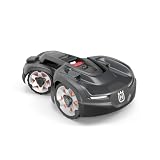
Best ReliabilityHusqvarna Automower 430X
Boundary Wire, Premium
Husqvarna has been building robot mowers longer than anyone, and the 430X is where that experience shows — across a full season it required less intervention than any other machine here, and never once needed to be carried back to its dock. The boundary wire that looks like a drawback on a spec sheet turns out to be a genuine advantage in two specific situations: dense tree canopy, where satellite-based systems lose accuracy, and complex properties where you want absolute certainty about where the machine will and will not go. Under the mature canopy at the back of our test property, the 430X operated with exactly the same reliability as in the open, which no GPS unit here matched. Its 45% slope rating is the highest in this test and it earned it, climbing and turning on our steepest bank without hesitation where two competitors slipped. Weather sealing is a step above the category norm; heavy rain that made us check on other machines simply did not affect it. The costs are real and worth stating plainly: installing the wire is a genuine half-day of pegging around every bed and tree, and any future landscaping change means pulling and re-running it. It is also the most expensive machine here. For a wooded, sloped, or complex property, it is still the one we would trust.
Pros
- The most refined and reliable robot we tested — it simply never needed rescuing
- Handles a 45% slope, the steepest rating in this test by a wide margin
- Boundary wire works flawlessly under dense tree canopy where GPS units struggle
- Weather-sealed to a genuinely higher standard, unbothered by heavy rain
- Excellent dealer network with real service support, unusual in this category
Cons
- Boundary wire installation is a half-day job and inflexible if you change landscaping
- The most expensive machine in this test
The Bottom Line
The most dependable robot mower made. If your yard has heavy tree cover or serious slopes, the boundary wire is a feature rather than a compromise.
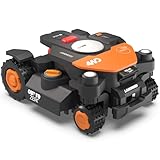
Best Obstacle AvoidanceWorx Landroid Vision
Camera Vision, Wire-Free
Most robot mowers detect obstacles by bumping into them. The Landroid Vision sees them coming, and in a yard with children, pets, or a garden hose that never quite gets coiled, that difference is the whole argument. In our testing it identified and steered around a coiled hose, a pair of garden shoes, and a sleeping dog without contact, where every wire-guided machine in this test nudged them. Setup is the simplest of anything here — no wire to peg, no antenna to mount, just a mapping run — which makes it the lowest-commitment entry into the category. The offset blade disc also cuts noticeably closer to edges than centrally mounted decks, meaningfully reducing how often you need a string trimmer. Where it gives ground is navigational certainty. Vision needs light, so scheduling it at dusk or overnight produced unreliable behavior, and it occasionally hesitated at a boundary where grass met a mulch bed of similar tone, lacking the visual contrast to be confident. Heavy rain also degraded performance. This is the fundamental trade against RTK GPS: the camera understands what is in front of it far better, but knows where it is less precisely. For a daytime-mowing yard where obstacles are the actual problem, it is the right tool.
Pros
- Camera-based obstacle recognition reliably avoided pets, hoses, and toys left on the lawn
- No boundary wire and no reference antenna to mount — the simplest setup of anything here
- Cuts close to edges thanks to an offset blade disc, reducing string trimming
- Shares the Worx PowerShare battery platform with their other tools
- Compact and light enough to carry easily between separated lawn areas
Cons
- Vision performance degrades in low light, so night mowing is unreliable
- Can be confused by lawn edges that are not visually distinct from the grass
The Bottom Line
The right pick if things get left on your lawn. Its obstacle recognition is genuinely the best here, at the cost of some navigation certainty.

Best Cut QualityEcoFlow Blade
RTK GPS + LiDAR, Wire-Free
The EcoFlow Blade takes a different design path from the rest of the category: a wider deck, a larger chassis, and LiDAR layered on top of RTK GPS. The result is the best-cutting robot in this test. Its wider blade path and higher blade speed produced a visibly more even finish than the small-disc designs, closer to what a conventional mower leaves, and it completed our test lawn in meaningfully fewer running hours per week. The sensor combination is the smart part — RTK GPS tells it precisely where it is, while LiDAR tells it what is in the way, which addresses the main weakness of GPS-only machines without the light dependency of camera vision. It navigated confidently in dusk conditions that gave the vision-based mower trouble. The optional lawn sweeper attachment is genuinely unique: no other robot here does anything useful about autumn leaves, and while it will not replace a proper leaf cleanup, it extends the usable season. It is also remarkably quiet, quieter than ambient suburban background noise, so scheduling is unconstrained by neighbors. The constraints follow from its size. It needs more room to turn than compact robots, making narrow side yards and tight gates a genuine problem, and its slope rating trails the Husqvarna and Segway. On an open, gently graded lawn, it produces the best result here.
Pros
- Wider cutting deck than typical robots, finishing the lawn in fewer hours per week
- Combines RTK GPS with LiDAR obstacle detection — accurate positioning plus real obstacle avoidance
- Produced the cleanest, most even finish of any mower in this test
- Optional lawn sweeper attachment collects leaves and debris, unique in this category
- Genuinely quiet in operation, quieter than the ambient sound of a suburban street
Cons
- Large footprint means it needs more room to maneuver in tight side yards
- Slope rating is modest compared to the Husqvarna and Segway units
The Bottom Line
The best-looking cut here, and the only robot that also handles leaves. Best suited to open lawns without steep banks or narrow passages.
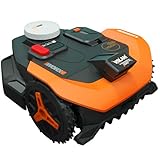
Best Budget PickWorx Landroid M
Boundary Wire, Compact
The Landroid M is the machine that makes robot mowing accessible rather than aspirational, and for a small, simple lawn it does the job perfectly well. It runs a random pattern rather than systematic parallel lines, which means it takes more hours to cover the same ground and leaves no stripes — but on a small lawn that it can cover several times a week, the practical result is still a consistently trimmed lawn that you never think about. The offset blade disc cuts closer to edges than most, which measurably reduces string trimming. It is also the lightest machine here, genuinely easy to pick up and carry between a front and back lawn that are not connected, which for many suburban properties is more useful than any amount of navigational sophistication. The modular accessory ports let you add capabilities later — anti-collision sensors, GPS tracking for theft protection — spreading the cost rather than paying for everything upfront. The compromises are the expected ones. Boundary wire installation takes the same half day as the premium wire systems, with the same vulnerability to aerators and edgers. Random mowing means it works harder for the same result, so it does not scale to larger lawns. Within its limits, it is honest value.
Pros
- By far the lowest entry price into a genuinely functional robot mower
- Compact and light — easy to carry between separated front and back lawns
- Cuts close to edges thanks to the offset blade disc
- Modular accessory ports allow adding features like anti-collision or GPS tracking later
- Shares batteries with the broader Worx PowerShare tool platform
Cons
- Random-pattern mowing rather than systematic lines — less efficient and no stripes
- Boundary wire installation required, with the same inflexibility as premium wire systems
The Bottom Line
The cheapest way into robot mowing that we would actually recommend. Best for a small, simple lawn where efficiency matters less than price.

Best for SlopesMammotion Luba 2 AWD
RTK GPS, All-Wheel Drive
All-wheel drive is not a common feature in this category, and on our steepest test section it was decisive: the Luba 2 climbed and turned on a bank where two-wheel-drive machines lost traction and reversed out. If your property has real grade rather than gentle undulation, this is the mechanical advantage that matters most, and no amount of software cleverness substitutes for it. Capacity is the other standout — it is rated for well over an acre, meaningfully more than most robots here, and its multi-zone support handles disconnected front and back lawns more gracefully than competitors. Construction is genuinely rugged, and across a season on rough, uneven ground it showed no signs of the wear that lighter machines can develop. RTK setup follows the same fast wire-free process as the Segway, taking about an hour including antenna mounting. Where it trails is software polish. The app is less refined than Husqvarna's or Segway's, we hit occasional connectivity glitches, and firmware updates changed behavior in ways that required re-checking settings. None of it prevented the machine from mowing, but it demands more patience than the premium alternatives. It is also heavier and pricier than equivalent two-wheel-drive robots. For a large, hilly property, the traction is worth the rough edges.
Pros
- All-wheel drive climbed our steepest test slope where two-wheel-drive robots slipped
- Handles larger properties than most, with capacity ratings well over an acre
- Wire-free RTK setup with the same fast configuration as other GPS systems
- Rugged construction that shrugged off the rough, uneven ground on our test property
- Multi-zone support handles disconnected lawn areas better than most competitors
Cons
- App and firmware are less polished than Husqvarna or Segway, with occasional glitches
- Heavier and more expensive than comparable two-wheel-drive robots
The Bottom Line
The one to buy for genuinely hilly or rough ground on a big lawn. Rough software edges are the price of the traction.
4. Matching a Robot Mower to Your Lawn
Manufacturers publish a maximum lawn area, and that number assumes ideal conditions — open ground, few obstacles, and running most days. Real yards reduce it.
| Lawn Size | Rated Capacity to Look For | Typical Price |
|---|---|---|
| Up to 1/8 acre | 0.25 acre rated | $800-1,300 |
| 1/8 to 1/4 acre | 0.5 acre rated | $1,200-2,000 |
| 1/4 to 1/2 acre | 0.75-1 acre rated | $1,800-3,000 |
| 1/2 to 1.25 acres | 1.5-2 acre rated | $2,800-4,000 |
Buy Roughly Double Your Actual Area
Obstacles, narrow passages, slopes, and irregular shapes all cost efficiency, and a mower operating at its rated limit runs constantly and still falls behind during spring growth. Sizing to roughly double your measured lawn area gives the machine margin to keep up when grass grows fastest, and lets it finish in fewer hours per week.
Check the Slope Rating Against Your Steepest Section
Slope ratings are given as a percentage, not degrees — a 45% slope is about 24 degrees. Most robots handle 25-35%; a few reach 45%. Robots struggle most where a slope meets a boundary, since they must turn on the incline. If you have a steep bank, check the rating specifically and expect to trim that section by hand regardless.
Multiple Zones Need Multi-Zone Support
If your front and back lawns are separated by a driveway or gate, the mower cannot cross unless you create a passage. Wire systems handle this with a guide wire through a corridor; RTK systems can define separate zones, but most still need to be physically carried between them unless a mowable path connects them. Confirm how the model handles disconnected areas before buying.
5. Installation and Setup: What to Expect
Setup effort varies enormously by technology, and it is the part homeowners most consistently underestimate.
Boundary Wire Installation
Plan a half day. The wire runs around the entire mowable perimeter at a specified distance from hard edges — typically a hand's width from walls, closer to lawn edges the mower can overhang. You peg it into the turf every few feet and it disappears into the grass within a couple of weeks. Bury it a few inches deep if you aerate or edge regularly, because those are what cut wires. Keep a wire repair kit on hand from day one; you will eventually need it.
RTK GPS Installation
Plan an hour. Mount the reference antenna where it has clear sky view — a roof edge, garage gable, or a supplied pole — and give it power. Then drive the mower around the perimeter from your phone to record the boundary, and drive around each bed or feature to define no-go zones. The whole map can be redrawn in minutes later, which is the genuine convenience advantage over wire.
The Base Station Needs Power and Shelter
Every robot needs a charging dock on a level spot at the lawn edge with an outdoor outlet nearby. Ideally it sits in shade or under a cover, since sustained sun heat is hard on batteries and electronics. Plan this location before you buy — a lawn with no outdoor power anywhere near it becomes an electrician's visit you did not budget for.
First Two Weeks Are the Shakedown
Expect to make adjustments: a boundary that is slightly too close to a bed, a corner the mower cannot reach, a low branch that catches it, a downspout splash zone that leaves a soft rut. This settling-in period is normal for every system. After it, most owners report going weeks without touching the machine.
6. What Robot Mowers Still Cannot Do
The category has improved enormously, and it is still worth being clear about where it falls short before spending $2,000.
They do not edge or trim. Every robot leaves an uncut margin along walls, fences, and beds — typically two to six inches depending on how the deck is offset. You will still need a string trimmer every few weeks. Models with the blade disc offset toward one edge reduce this but do not eliminate it.
They cannot recover an overgrown lawn. Robots trim a millimeter at a time. If the grass gets ahead of the machine after a vacation or a wet spring week, you need to cut it conventionally before the robot can resume.
They struggle with leaves. Autumn leaf fall defeats most robots — they either push leaves around or interpret the covered surface as an obstacle. Most owners store the mower once leaves start falling and clear leaves conventionally.
Theft is a real consideration. A visible $2,500 machine mowing an unfenced front lawn is a target. All models have PIN locks and most have GPS tracking that disables and locates a stolen unit, but check what your model includes and enable it.
Wildlife needs consideration. Robots running at night can injure hedgehogs, frogs, and other small animals. Schedule mowing during daylight hours, which is both safer for wildlife and lets you notice problems.
Blades Are Sharp and Kids Are Curious
Robot mowers have lift and tilt sensors that stop the blades within fractions of a second, and their small blades sit well inside the body — they are far safer than conventional mowers. They are not toys, though. Teach children not to touch or lift a running mower, keep pets clear during operation, and use the app to pause mowing when the yard is in use.
7. Maintenance and Winter Storage
Robot mowers need less maintenance than any other mower type, but the small amount they do need is easy to forget precisely because the machine is invisible.
Replace Blades Every 6-10 Weeks
The razor blades are small, inexpensive, and dull far faster than a conventional mower blade because they run daily. Dull blades tear rather than slice, producing brown tips and a lawn that looks subtly wrong for no obvious reason. A pack of blades costs a few dollars and takes five minutes to swap; this is the single highest-impact maintenance task.
Clean the Underside Monthly
Wet clippings build up around the blade disc and wheels, unbalancing the disc and adding drag. Unplug or power down first, tip the mower, and clear it with a brush or wooden scraper — most manufacturers advise against pressure washing because water intrudes into bearings and electronics.
Keep the Charging Contacts Clean
Corroded or dirty dock contacts cause the most common owner-reported fault: a mower that returns to the dock but does not charge. A wipe with a cloth every few weeks prevents it entirely.
Winter Storage
Charge the battery to roughly 60-80%, clean the machine thoroughly, and store it indoors above freezing. Storing a lithium battery fully depleted through a cold winter is the most reliable way to shorten its life. Leave the base station outside or bring it in per the manual, and check the boundary wire in spring before the first run.
Expect to Replace the Battery Eventually
Batteries typically last three to five seasons before capacity drops enough to matter. Replacements generally run $150-350 and are user-serviceable on most models. Factor this into the total cost when comparing against a conventional mower.
Before You Buy
Also Needed for This Job
8. Frequently Asked Questions
What is the best robotic lawn mower in 2026?
The Segway Navimow X3 is our overall pick for open lawns — wire-free RTK GPS setup in under an hour, systematic parallel mowing, and reliable positioning even under partial canopy. For heavily wooded or steep properties, the Husqvarna Automower 430X remains the most dependable, and its boundary wire is an advantage rather than a compromise under dense trees.
Are robot lawn mowers worth it?
For a lawn between roughly an eighth and half an acre that is open and free of heavy leaf fall, yes. You get a consistently trimmed, denser lawn from frequent micro-cutting, and you stop spending weekends mowing. They are less compelling if your lawn is heavily wooded, steeply banked, or under mature deciduous trees that drop heavy leaf loads.
Do robot mowers need a boundary wire?
Not anymore. RTK GPS models define boundaries by walking the mower around the perimeter in an app, and vision-based models map visually. Boundary wire remains the more reliable choice under dense tree canopy, where satellite reception degrades, and it is generally cheaper.
Can robot mowers handle hills?
Most handle 25-35% slopes, which is roughly 14-19 degrees. The Husqvarna Automower 430X is rated to 45%, and all-wheel-drive models like the Mammotion Luba 2 climb steep, loose ground far better than two-wheel-drive units. Robots struggle most when they must turn on an incline, so check the rating against your steepest section specifically.
Do robotic mowers cut the edges of the lawn?
No robot cuts fully to the edge. Every one leaves an uncut margin of roughly two to six inches along walls, fences, and beds, depending on how the blade disc is offset. Models with offset discs — the Worx Landroid units, for instance — leave less. You will still need a string trimmer every few weeks.
How long do robot lawn mower batteries last?
Typically three to five seasons before capacity declines enough to matter, after which replacements run $150-350 and are user-serviceable on most models. Storing the mower over winter at roughly 60-80% charge, indoors and above freezing, meaningfully extends battery life.
Can a robot mower cut an overgrown lawn?
No. Robots trim about a millimeter per pass, running several times a week to maintain a length rather than reduce it. Grass that has gotten ahead of the machine must be cut conventionally first, then the robot can resume maintaining it.
9. Common Mistakes When Buying a Robot Mower
The regrets in this category cluster around a few predictable errors, and all of them are avoidable before purchase.
Buying GPS for a Heavily Wooded Lawn
RTK GPS is the better technology on open ground and a genuine liability under mature canopy, where satellite reception degrades and the mower drifts or stalls. If your lawn is shaded by large trees, boundary wire remains the more reliable choice despite the installation work.
Sizing to Your Exact Lawn Area
Rated capacities assume open ground and near-daily running. Obstacles, slopes, and narrow passages all cost efficiency, and a mower at its rated limit falls behind during spring growth. Buy roughly double your measured area so the machine has margin when grass grows fastest.
Forgetting About Autumn Leaves
Most robots either push leaves around or read a leaf-covered lawn as an obstacle. Plan to store the mower once leaf fall starts and clear leaves conventionally, or choose a model with a sweeper attachment if extending the season matters.
Neglecting Blade Changes
The small razor blades dull far faster than a conventional mower blade because they run nearly every day. Dull blades tear grass and leave brown tips, and owners blame the machine for a lawn that looks subtly wrong. Swap them every six to ten weeks — it takes five minutes and costs a few dollars.
Not Planning the Dock Location Before Buying
The charging station needs a level spot at the lawn edge with outdoor power nearby, ideally shaded. Discovering after purchase that the nearest outlet is on the wrong side of the house turns a weekend setup into an electrician's visit.
Related Lawn Care Guides
Buyer's Guide
Best Battery Powered Lawn Mower
If a robot is not right for your yard, cordless mowers are the next-best quiet option.
Buyer's Guide
Best Zero Turn Mower
For acreage well beyond what any robot can maintain, tested over 40+ acres.
Buyer's Guide
Best String Trimmer
You will still need one — no robot mower cuts fully to the edge.
The Bottom Line
The best robotic lawn mower for you depends almost entirely on tree cover and slope. On an open lawn, the Segway Navimow X3 delivers wire-free setup that genuinely works, with systematic mowing and instant zone editing. Under mature canopy or on steep ground, the Husqvarna Automower 430X remains the most dependable machine made, and its boundary wire is the reason why.
Two rules make ownership work: size to roughly double your actual lawn area so the mower keeps up during spring growth, and change the blades every six to ten weeks. Almost every complaint about robot mower cut quality traces back to one of those two.
More in Lawn & Yard Care
Guides in this category that pair with what you just read.
About the Author
Alex Rivers, Home Improvement Editor
Alex has spent over a decade working on residential and light commercial property maintenance, and now tests every tool, coating and machine that appears in these guides personally.