The 7 Best Telescoping Ladders in 2026
We extended and collapsed seven telescoping ladders hundreds of times, loaded every one to its rating, and paid close attention to how each behaves during retraction. Only 7 earned a recommendation.
Alex Rivers
Home Improvement Editor
Last Updated
October 17, 2026
In This Guide
A telescoping ladder collapses into about a third of its extended length, which solves the real problem with ladders: not using them, but storing and transporting them. What you trade for that is a set of moving parts holding you above the ground, which makes the locking mechanism the only specification that genuinely matters.
Our Picks at a Glance
The Short Answer
Xtend & Climb 780P (Best Overall). The one that inspires confidence. Clear lock indicators and a controlled retraction are worth the premium.
- Check Price
- Check Price
- Check Price
- Best Versatility Werner MT-13 Multi Position — 13 ft Multi Position, Type IA 300 lb, Hinged SectionsCheck Price
- Check Price
- Check Price
- Check Price
We may earn a commission when you buy through these links, at no extra cost to you. How we test
Best Overall
Xtend & Climb 780P
1. How Telescoping Ladders Work
The mechanism is what you are buying, and understanding it explains both the appeal and the risks of the format.
Nested Sections, One Lock Each
Each rung sits on a pair of tubes that slide inside the pair below. Extending the ladder pulls each section up in turn, and a lock engages to hold it. Collapsed, the sections nest into roughly a third of the extended length.
Locks Are the Only Thing Holding You Up
Unlike a conventional extension ladder where a rope and pawl hold two large sections, a telescoping ladder has a separate lock at every rung. Each one has to be engaged, which is why visual indicators matter so much.
Partial Extension Is Normal and Must Be Deliberate
These ladders can be extended part way, which is genuinely useful. It also means you must confirm that the locks below your working height are engaged, because an unlocked section under load is the failure mode.
Flex Is Inherent to the Design
Sliding sections need clearance to slide, and that clearance becomes movement under load. Every telescoping ladder flexes more than a conventional extension ladder of the same length, and the taller they extend the more noticeable it becomes.
They Trade Rigidity for Storage
That is the whole bargain. If storage and transport are not constraints, a conventional extension ladder is more rigid, cheaper, and has fewer things to go wrong. If they are, a telescoping ladder is the reason you own a ladder at all.
Ladder Ratings Explained
IAA
375 lb, the highest common rating
IA
300 lb, sensible for most buyers
II
250 lb, light duty only
4:1
Angle rule: 1 ft out per 4 ft up
2. Duty Ratings and Reach
Two numbers determine whether a ladder suits your job, and both are routinely misread.
Duty rating includes everything, not just you. A 250 pound rating covers your body weight plus clothing, tools, and whatever material you are carrying up. A 200 pound person with a bag of tools and a bundle of guttering is closer to that limit than they expect.
Type IA at 300 pounds is the sensible default. It gives realistic headroom for a person plus equipment. Type II at 250 is adequate for light indoor work and Type IAA at 375 is what heavier trades specify.
Working height is not ladder length. You cannot safely stand on the top few rungs, and the ladder must lean at an angle rather than stand vertical. A twelve foot ladder gives a working reach of roughly fifteen feet allowing for arm extension.
The four to one angle rule costs you height. A ladder should stand one foot out from the wall for every four feet of height, which means a twelve foot ladder reaches a point slightly under twelve feet up the wall. Standing it more vertically to gain reach is how ladders tip backwards.
Extending above a roof edge matters. If you are climbing onto a roof, the ladder must extend around three feet above the edge to give something to hold while transitioning. Factor that into the length you buy.
Buy longer than you think. The most common regret with ladders is buying one that just reaches, because just reaching means working at the top of it, which is exactly where it is least safe. A ladder that reaches comfortably is used comfortably.
3. The 7 Best Telescoping Ladders in 2026 — Tested & Ranked
We extended and collapsed every ladder several hundred times, checking whether locks continued to engage cleanly. We loaded each to its rated capacity and measured deflection at full extension, assessed lateral stability on both hard and soft ground, and paid particular attention to how each behaves during retraction. These seven earned their place.
At a Glance: How Our Picks Compare
| Product | Type | Rating | Best For |
|---|---|---|---|
| Xtend & Climb 780P | 12.5 ft, Type IA 300 lb, Individual Rung Locks | 4.6 | Best Overall |
| Telesteps 1600EP | 16 ft, Type IA 300 lb, One Touch Release | 4.6 | Best Tall Reach |
| Ohuhu 12.5 ft Telescoping Ladder | 12.5 ft, Type IA 330 lb, Thumb Release Locks | 4.4 | Best Value |
| Werner MT-13 Multi Position | 13 ft Multi Position, Type IA 300 lb, Hinged Sections | 4.5 | Best Versatility |
| Little Giant Velocity M17 | 17 ft Multi Position, Type IA 300 lb, Wide Flare Base | 4.7 | Best Stability |
| SocTone 10.5 ft Telescoping Ladder | 10.5 ft, Type II 250 lb, Compact, Lightweight | 4.3 | Best Compact |
| Louisville L-2092 Telescoping | 12 ft, Type IA 300 lb, Fibreglass Rails | 4.4 | Best for Electrical Work |

Best OverallXtend & Climb 780P
12.5 ft, Type IA 300 lb, Individual Rung Locks
Every telescoping ladder relies on a mechanism to hold each section extended, and every anxiety about these ladders comes down to whether that mechanism is properly engaged. Xtend and Climb address this directly with individual rung locks that show a clear visual indicator when engaged, so you can look along the ladder before climbing and see the state of every section rather than assuming. That sounds minor until you are twelve feet up. Build quality supports the confidence. At full extension the flex is modest for this type of ladder, the rungs feel solid underfoot rather than springy, and the rails have no sharp edges or exposed pinch points where a hand naturally goes. The Type IA rating at 300 pounds covers a person plus a reasonable amount of tools and material, which is the realistic requirement rather than the marketing minimum. Retraction is the other thing done properly. Cheaper ladders collapse quickly once released, which is how fingers get caught. This one comes down in a controlled way with a deliberate release, and the difference is significant. The reservations are weight and price. It is heavier than the budget options, which partly offsets the portability argument, and it costs meaningfully more. Both are reasonable trades for the mechanism.
Pros
- Individual rung locking with clear visual indicators showing engagement
- Type IA 300 pound duty rating suitable for a person plus tools
- Slow controlled retraction rather than a sudden collapse
- Solid feel underfoot with minimal flex at full extension
- Well finished with no sharp edges or pinch points at the rails
Cons
- Heavier than budget telescoping ladders
- Premium price
- Still not as rigid as a conventional extension ladder
The Bottom Line
The one that inspires confidence. Clear lock indicators and a controlled retraction are worth the premium.
Best Tall ReachTelesteps 1600EP
16 ft, Type IA 300 lb, One Touch Release
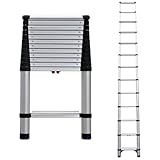
Most telescoping ladders top out around twelve or thirteen feet, which reaches a single storey gutter and stops short of a two storey roofline. The Telesteps 1600EP extends to sixteen, and that difference decides whether the ladder is useful for the job you bought it for. Collapsed it is still short enough to fit in a car boot, which remains the whole point of the format. The one touch release is the standout mechanism. Rather than unlocking each section individually while supporting the weight above it, a single action retracts the ladder in a controlled sequence from the top down. This is both faster and considerably safer, because the sequence is deliberate rather than a cascade, and your hands are away from the rungs while it happens. Sections lock automatically as they extend, with positive engagement you can hear. What you have to accept is flex. Sixteen feet of telescoping aluminium sections will move underfoot noticeably more than a conventional extension ladder of the same length, and at full height that takes some getting used to. It is also expensive and, collapsed, heavier and bulkier than shorter models. For the reach, in a format that stores in a cupboard, there is very little competition.
Pros
- Sixteen feet of reach in a package that still fits in a car boot
- One touch release retracts the whole ladder in a controlled sequence
- Automatic locking as each section extends
- Strong Type IA rating
- European construction with a long durability record
Cons
- Expensive, at the top of the category
- Heavier and bulkier collapsed than shorter ladders
- Considerable flex at full extension, as any 16 ft telescoping ladder has
The Bottom Line
The reach champion. Sixteen feet that still fits in a car, with the best retraction mechanism here.
Best ValueOhuhu 12.5 ft Telescoping Ladder
12.5 ft, Type IA 330 lb, Thumb Release Locks
Telescoping ladders divide sharply into premium products with well engineered locking and budget products where the mechanism is the compromise. The Ohuhu sits between them, offering a genuine 330 pound rating and a locking system that works reliably, at a price much closer to the budget end. For a homeowner cleaning gutters and changing bulbs a few times a year, that is the right place on the curve. The thumb release locks are easy to operate one handed, which matters when you are supporting the ladder with the other hand. Rigidity at full extension is reasonable for the class, with less unsettling movement than the cheapest ladders exhibit. The included carrying strap is a small thing that makes the portability argument real rather than theoretical. Where the price shows is in the details around retraction. The sections come down faster than on the premium ladders and with less damping, which makes a careful, deliberate technique important rather than optional. Lock engagement indicators are present but less clearly readable, so checking them requires looking properly rather than glancing. Rung edges are finished less smoothly than on the better ladders. None of that is dangerous with correct handling, and the capacity and price are hard to argue with.
Pros
- Strong 330 pound rating at a mid-range price
- Thumb release locks that are easy to operate with one hand
- Reasonable rigidity for the price point
- Includes a carrying strap
- Widely available with straightforward returns
Cons
- Retraction is faster and less controlled than premium ladders
- Lock indicators are less clear, requiring a careful visual check
- Rung edges are less well finished
The Bottom Line
Good capacity and a fair price. Retract it slowly and deliberately and it is a lot of ladder for the money.

Best VersatilityWerner MT-13 Multi Position
13 ft Multi Position, Type IA 300 lb, Hinged Sections
It is worth being clear that this is not a telescoping ladder, because people shopping for one frequently end up buying a multi-position ladder instead and are usually better served. Rather than sliding sections, the Werner MT-13 uses hinged joints that lock in several positions, converting between an extension ladder, an A-frame stepladder, a stairway configuration with uneven legs, and a base for a work platform. That range covers jobs a telescoping ladder simply cannot attempt. The rigidity advantage is substantial. Hinged sections locked with heavy pins do not have the sliding tolerances that make telescoping ladders flex, so at full extension it feels dramatically more solid underfoot. The locking joints are simple, visible and hard to misjudge, which removes the main anxiety of the telescoping format. Werner parts support is excellent, which matters for a tool with a long life. What you give up is compactness. Folded it is bulkier than a collapsed telescoping ladder and it is heavy, at the limit of comfortable one person handling. Reconfiguring takes longer than extending a telescoping ladder. If it has to live in a hall cupboard or ride inside a car, the telescoping format wins; if it lives in a garage, this is the better ladder.
Pros
- Converts between extension, stepladder, scaffold base and stairway configurations
- Hinged locking joints that are simple and very robust
- Type IA rating with a strong reputation for durability
- Far more rigid than a pure telescoping ladder
- Backed by a manufacturer with excellent parts support
Cons
- Not a true telescoping ladder, so it is bulkier when folded
- Heavy, at the upper end of what one person handles comfortably
- More complex to reconfigure than simply extending a ladder
The Bottom Line
The most useful ladder here if storage is less critical than versatility. Far more rigid than any telescoping design.

Best StabilityLittle Giant Velocity M17
17 ft Multi Position, Type IA 300 lb, Wide Flare Base
Ladder accidents are overwhelmingly about stability rather than structural failure, and the geometry that causes instability is a narrow base. Most ladders have parallel rails, so the footprint at the bottom is no wider than at the top. Little Giant flares the base outward, which widens the footprint substantially and makes the ladder far harder to tip sideways. Standing on the Velocity at full extension, the difference against every telescoping ladder here was immediately obvious: it simply does not move. Construction is heavy duty throughout, with rock locks that operate quickly and engage positively, and multiple configurations including stairway use and a 90 degree position for working against a wall. Some configurations are rated for two people, which no telescoping ladder approaches. For anyone working at height regularly, this is the ladder that removes the anxiety. The price of all that is weight. It is genuinely heavy, to the point where carrying it any distance is a task in itself and getting it into position alone takes planning. It folds but remains bulky. It is expensive. If your constraint is storage or transport, it is the wrong ladder; if your constraint is confidence at height, nothing here comes close.
Pros
- Wide flared base gives exceptional stability compared with parallel rails
- Extremely rigid construction with very little flex
- Multiple configurations including stairway and 90 degree wall
- Rock locks are quick and positive to operate
- Rated for two people in some configurations
Cons
- Very heavy, genuinely difficult for one person to carry far
- Expensive
- Bulky in storage despite folding
The Bottom Line
The most stable ladder we tested by a distance. It is also the heaviest, and you will notice every time.
Best CompactSocTone 10.5 ft Telescoping Ladder
10.5 ft, Type II 250 lb, Compact, Lightweight
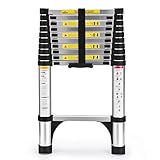
The best ladder for a lot of jobs is the one that happens to be present, and that is a genuine argument for a compact model. At ten and a half feet this reaches an indoor ceiling comfortably, gets to a single storey gutter, and handles light fittings, smoke alarms and the top of a wardrobe, which covers the majority of household ladder use. Collapsed it fits in a car boot alongside the shopping and stands in a cupboard, so it is available rather than stored somewhere inconvenient. Light weight is the other real advantage. Carrying it one handed is easy, which means moving it around a job takes no effort and there is no temptation to overreach rather than reposition — the single most common cause of ladder falls. Setup is quick. The limitations follow from the same design decisions. A Type II rating at 250 pounds covers a person and light tools and does not cover a person carrying a bundle of shingles. Flex is more noticeable than on the sturdier ladders. It is not the right choice for extended work or for anything heavy. Bought as the convenient ladder rather than the only ladder, it makes a great deal of sense.
Pros
- Very compact collapsed, fitting easily in a car boot or a cupboard
- Light enough to carry one handed without difficulty
- Adequate reach for indoor work and single storey gutters
- Low price
- Quick to set up for a short job
Cons
- Type II 250 pound rating limits what you can carry up it
- More flex than taller rated ladders
- Not suitable for heavy or extended work
The Bottom Line
The one that actually lives in the car. Limited capacity, but a ladder you have with you beats one in the garage.
Best for Electrical WorkLouisville L-2092 Telescoping
12 ft, Type IA 300 lb, Fibreglass Rails
Aluminium is an excellent ladder material and an excellent conductor, and those two facts collide badly around overhead service drops, meter connections, and any work near live equipment. Electricians use fibreglass ladders for exactly this reason, and a telescoping ladder in fibreglass is unusual enough to be worth noting. The Louisville L-2092 offers the compact storage of a telescoping design with non conductive rails, which is the right combination for anyone whose ladder work happens near electricity. Beyond the material, it is a solid ladder. The Type IA rating at 300 pounds covers a person with tools, construction is robust throughout, and it feels sturdier underfoot than most telescoping ladders, partly because fibreglass sections are inherently stiffer than thin aluminium ones. The costs are weight and price, both consequences of the material. Fibreglass is considerably heavier than aluminium for equivalent strength, so this ladder is noticeably harder to carry and to extend, and it is bulkier collapsed. It costs more than an aluminium ladder of the same reach. For general household use those trades are not worth making. For anyone who works near live conductors, they are not optional.
Pros
- Fibreglass rails are non conductive, which aluminium ladders are not
- Type IA 300 pound rating
- Sturdier feel than most telescoping ladders
- Suitable for work near live electrical equipment
- Robust construction throughout
Cons
- Considerably heavier than aluminium telescoping ladders
- Expensive relative to aluminium equivalents
- Bulkier collapsed than comparable aluminium models
The Bottom Line
The only sensible choice for electrical work. Aluminium ladders and live conductors are a bad combination.
4. The Retraction Risk and Ladder Safety
Telescoping ladders introduce one hazard that conventional ladders do not, and it accounts for most injuries associated with them.
Retraction traps fingers. Releasing the locks lets sections drop, and a hand resting on a rung when the section above comes down is exactly the injury these ladders are known for. It happens quickly and it is serious.
Hold the rails, not the rungs, during retraction. Keep hands on the outside of the rails where nothing can close on them, release the locks in sequence from the top, and let each section down deliberately rather than releasing several at once.
Buy a ladder with controlled retraction. Better ladders damp the descent or use a sequenced release, which removes most of the risk. This is worth paying for and it is the main functional difference between price tiers.
Confirm every lock before climbing. Look along the ladder and check each indicator. A partially engaged lock can hold under no load and give way under yours, and that is the failure that causes falls.
Set it at the correct angle on level ground. One foot out for every four feet of height, on a firm level surface, with the feet properly seated. Soft ground, decking gaps and sloped surfaces all need attention before you climb.
Keep your belt buckle between the rails. Overreaching sideways is the most common cause of ladder falls. If you have to lean past the rails, climb down and move the ladder. It takes twenty seconds and it is the whole difference.
Hands on the Rails, Always
The one habit that prevents the injury telescoping ladders are known for: during retraction, keep both hands on the outside of the rails and never on the rungs. Release locks from the top downward and let each section settle before releasing the next. Sections that drop unexpectedly cannot catch a hand that is not in their path.
5. What to Look for When Buying
Beyond reach and rating, a handful of features separate a ladder you trust from one you approach warily.
Clear lock indicators. Coloured markers that show engaged or not engaged at a glance mean you can verify the whole ladder in two seconds from the ground, rather than assuming.
Controlled or sequenced retraction. Any mechanism that slows or orders the collapse addresses the main hazard of the format. Ladders that simply drop when released are the ones that cause injuries.
Wide, grippy feet. The contact patch at the bottom is where stability comes from. Broad rubber feet that pivot to sit flat on the ground make a substantial difference on hard surfaces, and any ladder used on soft ground needs a board underneath.
Rung width and profile. Wider rungs with a flat top are dramatically more comfortable underfoot over a long job than narrow round ones, which is worth checking if you will be standing on it for extended periods.
ANSI or EN certification, verified. A duty rating printed on a sticker without a corresponding standard means little. Look for an ANSI type rating or an EN 131 mark, both of which involve actual testing.
Fibreglass if there is any electrical risk. Aluminium conducts, and overhead service drops are closer to gutters than people assume. If your work goes anywhere near live conductors, the material is not a preference.
6. Telescoping, Multi Position or Extension
Telescoping is one of three formats competing for the same jobs, and the right answer depends almost entirely on where the ladder will live.
Telescoping wins on storage and transport. Collapsing to roughly a third of its length is what lets a ladder live in a cupboard, an apartment, or the boot of a car. If that is your constraint, nothing else in this category competes.
Conventional extension ladders win on rigidity and price. Two large sections with a rope and pawl flex far less, cost considerably less for the same reach, and have almost nothing to go wrong. They also need a garage wall and a vehicle with a roof rack.
Multi-position ladders win on versatility. Hinged joints convert between extension, A-frame, stairway and platform configurations, covering jobs a straight ladder cannot attempt. They fold rather than collapse, so they are bulkier, and they are heavy.
Stepladders remain the right tool indoors. Free standing, no wall required, and stable on a flat floor. A great deal of household ladder use is genuinely a stepladder job, and using a leaning ladder indoors because it is what you own is a common source of trouble.
Consider how often you will actually use it. A ladder used twice a year that lives somewhere accessible gets used properly. One that needs dragging out from behind the garden furniture encourages standing on a chair instead, which is how most household falls happen.
Two ladders is often the honest answer. A compact telescoping ladder for the frequent short jobs and a longer rigid ladder for annual work at height cost less combined than one compromise ladder that does neither job comfortably.
7. Maintenance and Storage
Telescoping ladders have moving parts exposed to weather and grit, which makes maintenance more relevant than for a conventional ladder.
Keep the sections clean. Grit and dried mud between nested tubes prevents sections sliding and, worse, prevents locks seating fully. Wiping the rails down after use takes a minute and prevents the most common cause of stiff or unreliable operation.
Dry it before collapsing it. Water trapped inside nested sections encourages corrosion and freezes in winter, which can lock a ladder solid. Let it drain and dry before storing collapsed.
Do not lubricate with oil. Oil attracts grit and turns it into a grinding paste inside the sections. A dry silicone or PTFE spray is the correct product where movement becomes stiff.
Inspect the locks before each use. Look for bent tabs, sluggish engagement, or an indicator that does not change properly. Any lock behaving differently from the others is a reason to stop using the ladder until it is resolved.
Store it horizontally or hanging, not leaning. A collapsed ladder stood in a corner can slip and fall, and long term pressure on the bottom section can distort it. Hooks on a garage wall solve both.
Check the feet for wear. Rubber ladder feet harden and wear smooth over years, and a smooth foot on a smooth surface slides at exactly the wrong moment. Replacement feet are inexpensive on most brands and are among the cheapest safety improvements available.
Retire a ladder that has been dropped from height. Aluminium sections that have taken an impact can be subtly bent in a way that binds or weakens without being visible. Given what a ladder is holding up, replacement is the correct response.
Before You Buy
Also Needed for This Job
8. Frequently Asked Questions
What is the best telescoping ladder?
Xtend & Climb 780P for most people, thanks to clear lock indicators and a controlled retraction that removes the main hazard of the format. Telesteps 1600EP is the pick if you need sixteen feet of reach, and Ohuhu offers strong capacity at a mid-range price.
Are telescoping ladders safe?
Yes, when used correctly and bought with a good locking mechanism. The specific risk of the format is finger injury during retraction, which is avoided by keeping both hands on the outside of the rails and releasing locks in sequence from the top down.
How tall a telescoping ladder do I need?
More than you think. A ladder must lean at roughly one foot out per four feet of height and you cannot safely stand on the top rungs, so a twelve foot ladder gives a comfortable working reach of around fifteen feet. If climbing onto a roof, add three feet above the edge.
What duty rating do I need?
Type IA at 300 pounds is the sensible default, because the rating covers your body weight plus clothing, tools and anything you carry up. Type II at 250 pounds suits light indoor work only. A person with a full tool bag is closer to the limit than they usually realise.
Can I use a telescoping ladder on stairs?
Not safely as a straight ladder, because the feet need to be level. A multi-position ladder such as the Werner MT-13 or Little Giant Velocity has independently adjustable legs designed for exactly this, and that is the correct tool for stairwell work.
Are telescoping ladders as sturdy as extension ladders?
No. Sliding sections need clearance to slide, and that clearance becomes flex under load, so a telescoping ladder always moves more than a conventional extension ladder of the same length. What you gain is storage and transport, which is why the format exists.
9. Common Telescoping Ladder Mistakes
Telescoping ladders are safe used properly, and the mistakes that cause injuries are consistent and avoidable.
Holding the Rungs During Retraction
This is the injury telescoping ladders are known for. Releasing a lock lets the section above drop onto whatever is below it, and a hand on a rung is exactly in that path. Keep both hands on the outside of the rails, release locks from the top down, and let each section settle before the next.
Not Checking Every Lock
A partially engaged lock holds under no load and gives way under yours, which is the failure that causes falls. Look along the ladder from the ground and confirm every indicator before climbing. Partial extension is fine, but only when you have verified the locks below your working height.
Standing It Too Vertically
The four to one angle rule exists because a ladder leaned too upright tips backwards, and the temptation to stand it steeper to gain a little reach is exactly how that happens. If the ladder does not reach at the correct angle, it is the wrong ladder for the job.
Overreaching Instead of Moving It
Leaning sideways past the rails shifts your centre of gravity outside the ladder's base and is the most common cause of ladder falls. Keeping your belt buckle between the rails is the standard rule. Climbing down and moving the ladder takes twenty seconds.
Related Home Maintenance Guides
Buyer's Guide
Best Gutter Guards
The upgrade that cuts how often you need the ladder in the first place.
Buyer's Guide
Best Attic Ladder
Permanent loft access compared: wood, aluminium and scissor designs.
All Guides
Browse All Best Lists
Every hands-on tested guide we have published, organized by category.
The Bottom Line
The best telescoping ladder for most people is the Xtend & Climb 780P, whose clear lock indicators and controlled retraction address the format's real risk. Telesteps 1600EP is the pick for reach, and Little Giant Velocity if stability matters more than storage.
Buy longer than you think you need, check every lock from the ground before climbing, and keep both hands on the rails when you bring it down.
More in Tools & Equipment
Guides in this category that pair with what you just read.
About the Author
Alex Rivers, Home Improvement Editor
Alex has spent over a decade working on residential and light commercial property maintenance, and now tests every tool, coating and machine that appears in these guides personally.