Best Angle Grinders
An angle grinder cuts bolts, cleans rust, sharpens blades and grinds welds. It is also the most dangerous handheld tool most people own, so the safety features matter as much as the power.
Alex Rivers
Home Improvement Editor
Last Updated
October 17, 2026
In This Guide
Most homeowners need an angle grinder a few times a year, for a seized bolt, a rusty trailer or a dull mower blade. For that work, the features that matter most are not power or speed but a paddle switch that stops the tool when you let go and a brake that stops the wheel quickly. This guide ranks grinders with that in mind.
Our Picks at a Glance
The Short Answer
Milwaukee M18 FUEL 4-1/2" / 5" Grinder, Paddle Switch No-Lock (2880-20) (Best Overall). The cordless grinder with the safety features that matter, and the power to replace a corded one.
- Best Overall Milwaukee M18 FUEL 4-1/2" / 5" Grinder, Paddle Switch No-Lock (2880-20) — 4-1/2" / 5", 18V Brushless, PaddleCheck Price
- Best for DeWalt Owners DeWalt 20V MAX XR 4-1/2" Paddle Switch Angle Grinder with Kickback Brake (DCG413B) — 4-1/2", 20V MAX Brushless, PaddleCheck Price
- Best for Makita Owners Makita 18V LXT Brushless 4-1/2" / 5" Cut-Off/Angle Grinder (XAG04Z) — 4-1/2" / 5", 18V Brushless, Slide SwitchCheck Price
- Best Corded DeWalt 4-1/2" 11 Amp Paddle Switch Small Angle Grinder (DWE402) — 4-1/2", 11 Amp Corded, PaddleCheck Price
- Best Budget Cordless Ryobi ONE+ HP 18V Brushless 4-1/2" Angle Grinder (PBLAG01B) — 4-1/2", 18V BrushlessCheck Price
- Best Budget Corded Metabo HPT 4-1/2" 6.2 Amp Angle Grinder Kit (G12SR4) — 4-1/2", 6.2 Amp Corded, Slide SwitchCheck Price
We may earn a commission when you buy through these links, at no extra cost to you. How we test
Best Overall
Milwaukee M18 FUEL 4-1/2" / 5" Grinder, Paddle Switch No-Lock (2880-20)
1. The Short Answer
For most people, the best angle grinder is a 4-1/2-inch or 5-inch model with a no-lock paddle switch and an electronic brake. The Milwaukee 2880-20 and DeWalt DCG413B both stop the wheel quickly and shut off if you let go, which matters more than raw power for anyone who does not grind every day. Buy whichever matches the batteries you already own.
If your grinder will stay in a garage near an outlet, a corded grinder gives you more power for less money. The DeWalt DWE402 is an 11 amp, 11,000 RPM grinder with a paddle switch and a tool-free guard, and it is one of the best-selling grinders on Amazon. Budget buyers should look at the Metabo HPT G12SR4, which is light and comes with a five-year warranty.
Variable speed is worth paying for if you polish, sand or strip paint as well as cut and grind. A variable-speed model lets you turn the speed down for that work. For cutting bolts, sharpening blades and grinding welds, single-speed grinders are fine.
An angle grinder is the most dangerous handheld power tool most homeowners own. It spins an abrasive wheel at around 10,000 RPM with no blade guard on the cutting side, and wheels can shatter. If your job can be done with a hacksaw, a reciprocating saw or an oscillating tool, consider that first. If it really needs a grinder, buy one with the safety features below.
2. 4-1/2 vs 5 vs 7 Inch: Which Size You Need
The number is the maximum wheel diameter. A 4-1/2-inch grinder is the standard size for homeowners and most trades: light, easy to control and compatible with the widest range of wheels and discs. A 5-inch grinder uses slightly larger wheels, which gives a bit more cutting depth and a longer-lasting wheel, at the cost of a little more weight. Many grinders, including the Milwaukee 2880 and Makita XAG04Z, accept both.
Large grinders, 7 and 9 inches, are a different class of tool. They are heavy, two-handed tools with large motors, used for heavy fabrication, grinding concrete and cutting thick material. They spin at lower RPM because their bigger wheels travel faster at the rim. They are not good first grinders, and most homeowners will never need one.
| Size | Typical use | Who it suits |
|---|---|---|
| 4-1/2" | Cutting bolts and rebar, rust removal, sharpening, tile | Homeowners, most trades |
| 5" | Same jobs with a bit more depth and wheel life | Frequent users, metalworkers |
| 7" and 9" | Heavy grinding, concrete, large cuts | Fabricators, masons |
Always use wheels that match your grinder. Never fit a larger wheel than the grinder and guard are designed for, and never remove a guard to make a bigger wheel fit. A 5-inch wheel on a 4-1/2-inch-only grinder is exposed beyond the guard and may be rated for a lower RPM than the grinder spins.
If you only occasionally need to grind or cut concrete, a 4-1/2-inch grinder with a diamond cup wheel or blade handles small jobs. Large floor-grinding projects need dedicated equipment, and our guide to acid etching vs grinding a garage floor explains when grinding is worth it.
3. Paddle vs Slide Switches, Brakes and Anti-Restart
The switch is the most important safety decision you will make. A no-lock paddle switch runs only while you squeeze it. Let go, and the motor stops. A slide switch with lock-on keeps the grinder running until you push the switch back, so if the grinder kicks out of your hands, it keeps spinning on the floor. Many workplace safety programs require paddle switches for this reason.
Slide switches have defenders, mostly experienced users doing long grinding sessions, because holding a paddle for an hour is tiring. For an occasional user, the paddle is the safer choice. If you buy a slide-switch grinder like the Makita XAG04Z or Metabo HPT G12SR4, never lock it on and always switch it off before setting it down.
Electronic brakes stop the wheel within a couple of seconds after you release the switch. Without one, a wheel can coast for several seconds, and putting a grinder down while the wheel is still spinning is a common way to damage a bench or catch a leg. Milwaukee's RAPIDSTOP and DeWalt's kickback brake both stop the wheel in about two seconds.
Kickback protection and anti-restart features are the other two features worth looking for. Kickback sensing, like the electronic clutch on the Milwaukee, cuts power when the wheel binds and the grinder jerks. Anti-restart, or no-volt release, keeps a grinder from starting by itself when the power returns or a battery is inserted while the switch is on.
THE RULE
For an occasional user, buy a paddle switch with a brake.
The extra cost is small compared with the cost of an injury, and those two features handle the most common ways grinders hurt people: being dropped while running and being set down too soon.
4. Our 7 Top Picks
These six grinders cover the realistic choices: braked paddle-switch cordless grinders from Milwaukee and DeWalt, a popular Makita cordless grinder, two corded grinders at different power and price levels and a budget cordless option for Ryobi owners. We ranked them on safety features, power, ergonomics and value, using manufacturer specifications and owner feedback. Ratings are Amazon averages rounded down.

Best OverallMilwaukee M18 FUEL 4-1/2" / 5" Grinder, Paddle Switch No-Lock (2880-20)
4-1/2" / 5", 18V Brushless, Paddle
The 2880-20 is the cordless grinder we would buy for most people, because it combines the safety features we think every grinder should have with enough power to retire a corded tool. The switch is a no-lock paddle: you squeeze it to run and release it to stop, so if the grinder is dropped or kicks out of your hand, it shuts off. Milwaukee's RAPIDSTOP brake then stops an abrasive wheel in under two seconds, compared with the long coast-down of an unbraked grinder, and an electronic clutch is designed to react when the wheel binds and the tool starts to kick. Overload protection guards the motor. Performance is strong. Milwaukee rates it at 8,500 RPM and describes its output as equivalent to an 11 amp corded grinder when paired with a High Output battery, and it accepts both 4-1/2-inch and 5-inch wheels on a standard 5/8-11 spindle. The caveats are battery and cost: with a small pack it slows noticeably under heavy grinding, and buying into M18 just for a grinder is expensive. Its Amazon rating count is modest, but the 2880 is a long-running professional tool with a strong reputation.
Pros
- No-lock paddle switch: let go and the grinder shuts off
- RAPIDSTOP brake stops an abrasive wheel in under 2 seconds, per Milwaukee
- Electronic clutch for kickback protection plus overload protection
- 8,500 RPM, takes 4-1/2" or 5" wheels on a 5/8-11 spindle
- Milwaukee rates its output as equivalent to an 11 amp corded grinder
Cons
- Needs a large High Output pack for full power
- Its Amazon rating count is small, so we lean on spec and reputation
The Bottom Line
The cordless grinder with the safety features that matter, and the power to replace a corded one.

Best for DeWalt OwnersDeWalt 20V MAX XR 4-1/2" Paddle Switch Angle Grinder with Kickback Brake (DCG413B)
4-1/2", 20V MAX Brushless, Paddle
DeWalt's DCG413 is built around the same idea as the Milwaukee: a grinder should stop itself when something goes wrong. Its kickback brake senses a pinch, stall or bind-up, applies the electronic brake hard to stop the wheel, limits how far the grinder twists in your hands and shuts the tool off. DeWalt says the brake stops the wheel in two seconds or less on average. The E-Switch protection adds a no-volt release, so if the battery is removed or the tool cuts out, you must cycle the switch before it will restart, and the two-stage paddle trigger needs two separate actions to start the motor. Those are exactly the features we would look for in a grinder for someone who does not use one every day. It is also light. DeWalt lists it at about 3.8 lbs bare and 12.2 inches long, with a 9,000 RPM brushless motor and 850 max watts out, which is plenty for cutting rebar, bolts and tile and for cleaning welds. It takes 4-1/2-inch wheels, so if you want 5-inch capacity, look at a 5-inch model. We found too few Amazon ratings to treat its score as settled, so we lean on DeWalt's specification and professional reviews.
Pros
- Kickback brake stops the wheel in 2 seconds or less on average, per DeWalt
- E-Switch no-volt release prevents restart after a power interruption
- Two-stage paddle trigger takes two actions to start
- About 3.8 lbs bare and 12.2 inches long
- 9,000 RPM brushless motor
Cons
- 4-1/2-inch wheels only
- Small Amazon rating count so far
The Bottom Line
A light, well-protected grinder and the obvious choice for anyone on DeWalt 20V batteries.

Best for Makita OwnersMakita 18V LXT Brushless 4-1/2" / 5" Cut-Off/Angle Grinder (XAG04Z)
4-1/2" / 5", 18V Brushless, Slide Switch
The XAG04Z is one of the most popular cordless grinders on Amazon, with around 3,100 ratings averaging 4.7, and it has earned that reputation by being consistently strong on Makita's 18V LXT batteries. Its brushless motor runs at 8,500 RPM, it accepts 4-1/2-inch and 5-inch wheels on a 5/8-11 spindle and Makita's automatic speed change technology raises torque and lowers speed under load so the motor keeps working rather than bogging down. Retail listings put it at about 14-1/4 inches long and roughly 5.6 lbs with a battery. The reason it is not our top pick is its safety package. It uses a slide switch with a lock-on function rather than a no-lock paddle, so if you drop it while locked on, it keeps running. It also has no electric brake, so the wheel coasts to a stop after you switch off, which is a hazard if you set the grinder down too soon. Many experienced users prefer a slide switch for long grinding sessions, and the XAG04Z is a fine tool in their hands. For an occasional user, we prefer a paddle switch with a brake. Makita sells other LXT grinders with paddle switches and brakes if you want them on the same batteries.
Pros
- 8,500 RPM brushless motor accepts 4-1/2" or 5" wheels
- Automatic speed change adjusts speed and torque under load
- Strong, consistent performance on LXT batteries
- Around 3,100 Amazon ratings averaging 4.7
- Long-running model with a large base of owner feedback
Cons
- No electric brake, so the wheel coasts after you switch off
- Lock-on slide switch rather than a no-lock paddle
The Bottom Line
A well-proven cordless grinder for Makita owners, as long as you are comfortable with a slide switch and no brake.
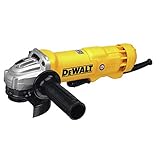
Best CordedDeWalt 4-1/2" 11 Amp Paddle Switch Small Angle Grinder (DWE402)
4-1/2", 11 Amp Corded, Paddle
If your grinder will mostly be used in a garage, a corded tool like the DWE402 gives you more power for less money than any cordless option. It has an 11 amp motor spinning a 4-1/2-inch wheel at 11,000 RPM, with 1,400 max watts out according to DeWalt, which is more than enough for cutting rebar, removing rust with a wire wheel or flap disc and grinding welds. The paddle switch has a safety lock-off, so the tool will not start accidentally when you pick it up. Two convenience features make it easier to use safely: a one-touch guard that rotates 360 degrees without tools, so you are more likely to position it correctly, and a quick-change wheel release that lets you remove wheels without a wrench. A dust ejection system clears debris from the motor intake, which extends tool life in dirty work. It is one of the most popular grinders on Amazon, with around 5,400 ratings averaging 4.7. What it lacks is the electronic safety of the newer cordless tools: there is no brake and no kickback sensing. Use the side handle, keep the guard between you and the wheel and keep the cord behind you, away from the cut.
Pros
- 11 amp, 11,000 RPM motor never runs out of battery
- Paddle switch with a safety lock-off to prevent accidental starts
- One-touch guard rotates 360 degrees without tools
- Quick-change wheel release removes wheels without a wrench
- About 5,400 Amazon ratings averaging 4.7
Cons
- No brake or electronic kickback protection
- The cord limits where you can work and can be cut by the wheel
The Bottom Line
A powerful, inexpensive corded grinder for a garage or shop with outlets close at hand.

Best Budget CordlessRyobi ONE+ HP 18V Brushless 4-1/2" Angle Grinder (PBLAG01B)
4-1/2", 18V Brushless
For the millions of homeowners already on Ryobi's 18V ONE+ batteries, the PBLAG01B is the grinder that makes the most sense. Its brushless HP motor runs a 4-1/2-inch wheel at up to 9,200 RPM, which Ryobi says gives up to 30 percent faster cutting than its earlier grinders, and it comes with both a grinding guard and a cut-off guard, plus one wheel for each job. That matters, because many budget grinders ship with only a grinding guard and owners end up using cut-off wheels without the correct guard. Tool-free wheel removal and a three-position side handle round out a sensible feature set. In homeowner use, cutting a seized bolt, sharpening a lawn mower blade, cleaning rust off a trailer or cutting a tile, it has more than enough power. Where it falls short of the professional grinders is safety electronics and durability. It lacks the electronic brake and kickback sensing of the Milwaukee and DeWalt, and it is not designed for daily fabrication. Its Amazon rating is the lowest here at 4.5, from only about 16 ratings, partly because Ryobi sells mainly through Home Depot. For occasional work, it is excellent value.
Pros
- 9,200 RPM brushless motor on the ONE+ battery platform
- Tool-free wheel removal
- Three-position side handle
- Ships with grinding and cut-off guards
- Three-year manufacturer warranty
Cons
- Lacks the brake and kickback electronics of the Milwaukee and DeWalt
- Less durable than professional grinders in daily heavy use
The Bottom Line
The sensible grinder for Ryobi owners who cut bolts, sharpen blades and clean rust a few times a year.

Best Budget CordedMetabo HPT 4-1/2" 6.2 Amp Angle Grinder Kit (G12SR4)
4-1/2", 6.2 Amp Corded, Slide Switch
If you need a grinder a few times a year and do not own a battery platform, the Metabo HPT G12SR4 is the cheapest grinder we would recommend. It is a 6.2 amp, 980-watt grinder spinning a 4-1/2-inch wheel at 10,000 RPM, and at about 4 lbs it is easy to control with one hand on the body and the other on the side handle. The kit includes five grinding wheels and a hard case, and Metabo HPT backs it with a five-year warranty, which is unusually long at this price. A spindle lock makes wheel changes straightforward. For cutting a rusted bolt, cleaning a weld, sharpening a mower blade or removing surface rust with a flap disc, it has enough power. For heavy grinding or cutting thick steel, it will slow down, and an 11 amp corded grinder like the DeWalt DWE402 is the better tool. The main drawback is the switch. It uses a slide switch rather than a no-lock paddle and has no brake, so you must switch it off and let the wheel stop before setting it down. It is highly rated across retailers, but we could not confirm a current Amazon rating count, so the figure shown is conservative.
Pros
- About 4 lbs, light and easy to control
- 10,000 RPM, 980 W motor
- Kit includes five grinding wheels and a case
- Five-year warranty from Metabo HPT
- Spindle lock for easy wheel changes
Cons
- Only 6.2 amps, so it slows under heavy grinding
- Slide switch rather than a no-lock paddle, and no brake
The Bottom Line
An inexpensive, light grinder for occasional rust removal, bolt cutting and blade sharpening.
5. How We Would Choose Between Them
Start with batteries. If you already own Milwaukee M18 or DeWalt 20V tools, buy the 2880-20 or the DCG413B and use the packs you have. Makita owners will find the XAG04Z a strong tool, but should consider one of Makita's paddle-switch models if safety features matter to them. Ryobi ONE+ owners get a capable grinder for little money in the PBLAG01B.
If you own no battery platform, a corded grinder is the better value. The DeWalt DWE402 is the one we would buy for most people: an 11 amp motor, a paddle switch with lock-off and a tool-free guard. The Metabo HPT G12SR4 costs less and is lighter, at the cost of power and a slide switch. A variable-speed corded model is worth the extra if you polish, sand or strip paint.
Then weigh how often you will grind. An occasional user, someone who cuts a few bolts and sharpens mower blades each year, benefits most from a brake and a no-lock paddle, because unfamiliarity is when accidents happen. A frequent user who grinds for hours may prefer a slide switch for comfort, and should invest in good technique and protective gear to match.
Finally, consider where you will use it. In a garage with outlets, corded is simpler. On a fence line, a trailer or a vehicle in the driveway, cordless saves dragging an extension cord across the work, where the wheel can catch it. For metalwork far from power, a cordless grinder and a couple of large batteries are hard to beat.
6. Wheels, Discs and RPM Ratings
Every abrasive wheel and disc is marked with a maximum operating speed. That number must be equal to or higher than the no-load RPM of your grinder. A wheel spun faster than its rating can shatter, and fragments leave the wheel at very high speed. Check the rating every time you fit a wheel, particularly if you are using a wheel from a different grinder.
Use the right type of wheel for the job. Thin, flat cut-off wheels are for cutting and must never be used for side grinding, because they are not designed to take side loads and can break. Thicker depressed-center grinding wheels are for grinding. Flap discs are for blending welds and removing rust and paint. Wire wheels and cups strip rust and scale quickly.
| Accessory | Use | Watch out for |
|---|---|---|
| Cut-off wheel | Cutting bolts, rebar, sheet metal | Never side-grind; use a cut-off guard |
| Grinding wheel | Removing metal, beveling, grinding welds | Check the RPM rating |
| Flap disc | Blending welds, rust and paint removal | Choose grit for the finish |
| Wire wheel or cup | Heavy rust and scale | Wires fly off; wear a face shield |
| Diamond blade | Tile, stone, concrete | Dust; use water or extraction |
Cut-off wheels need the correct guard. Many manufacturers specify a closed, two-sided cut-off guard for cutting, and some grinders ship with both a grinding guard and a cut-off guard, as the Ryobi PBLAG01B does. If your grinder came with only one guard, check the manual before cutting with it.
Never fit a saw blade or a woodcarving chain disc to a grinder that was not designed for it. Woodworking discs made for angle grinders exist, but they are among the most dangerous accessories sold and cause severe injuries when they catch. For wood, use a multi-tool, a jigsaw or a saw.
7. Cordless vs Corded Grinders
Brushless cordless grinders have reached the point where they replace corded tools for most users. A large battery on the Milwaukee or DeWalt delivers similar power to a mid-size corded grinder, and cordless grinders are easier to take to a fence, a trailer or a car in the driveway. They are also safer in one specific way: there is no cord for the wheel to cut.
Corded grinders still win on cost and endurance. A good corded grinder costs much less than a cordless tool and battery, and it never runs down in the middle of a long grinding job. If you grind for long periods at a bench, or you do not own a battery platform, a corded grinder is the better buy.
Grinders are among the most power-hungry cordless tools, so battery size matters. Small packs make even the best grinder slow under load. Use a high-capacity pack and expect to swap batteries on long jobs. If you are choosing a battery platform, our best cordless tool brand guide compares the major systems.
For automotive work, grinders are useful for cutting off seized exhaust hangers and rusted bolts, but they are not always the best tool. A powerful impact wrench will often remove a seized nut without destroying it, which saves you cutting and replacing the hardware.
8. What Homeowners Actually Use a Grinder For
The most common household jobs are cutting a seized bolt or padlock, cutting rebar or threaded rod to length, removing rust from trailers, railings and garden tools, sharpening lawn mower blades and cutting tile. A 4-1/2-inch grinder with a handful of cut-off wheels, a flap disc and a wire cup will cover all of them.
Sharpening a mower blade is one of the best reasons to own a grinder. Clamp the blade firmly, follow the original bevel with a flap disc or grinding wheel and check the balance afterward. Our guide on how often to sharpen mower blades covers how often to do it.
Always clamp the work. Holding a piece of metal in one hand and a grinder in the other is how wheels catch and grinders kick. A solid bench vise is the safest way to hold small parts for cutting and grinding, and C-clamps work for larger pieces on a bench.
For rust removal, start with a wire wheel or cup to remove heavy scale, then a flap disc to smooth the surface. Afterwards, prime bare steel quickly, since it starts to rust again almost immediately. For hand tools, our guide on preventing rust on hand tools covers what to do after cleaning.
Chainsaw chains can be sharpened with small grinders, but a dedicated chainsaw sharpener is safer and more accurate. A general-purpose angle grinder is not the right tool for chain teeth.
9. Safety Gear and Habits
Wear a face shield over safety glasses for any grinding, and always for wire wheels, which throw wires. Grinders throw sparks and fragments with enough force to cause serious eye injuries, and wheels can shatter. Hearing protection is essential, since grinders are loud, and leather gloves protect against sparks and hot metal.
Keep the guard between you and the wheel, use the side handle and keep both hands on the grinder. Stand to the side of the wheel's plane when starting the grinder, and run a newly fitted wheel for a minute with the guard in place before using it, because defective wheels tend to fail early. Let the grinder reach full speed before touching the work.
Sparks start fires. Clear away sawdust, rags, solvents and anything flammable before grinding, and watch where the sparks land. Keep a fire extinguisher nearby when grinding in a garage, and check the area for smoldering material after you finish.
Inspect wheels before fitting them and after any drop. A cracked or chipped wheel can break apart at speed. Replace worn wheels before they get too small, store them flat and dry and never use a wheel that has been dropped or damaged. A new wheel costs much less than an emergency room visit.
10. Common Mistakes to Avoid
Using a cut-off wheel for side grinding
Thin cut-off wheels are built to cut, not to take side loads. Grinding with the flat face of a cut-off wheel can break it apart at full speed. Use a depressed-center grinding wheel or a flap disc for grinding, and save cut-off wheels for straight cuts with the correct guard fitted.
Removing the guard
People take the guard off to fit a bigger wheel or to reach into a tight space. Without it, nothing stands between you and a shattering wheel. Position the guard between you and the wheel, rotate it as needed and choose a smaller wheel or a different tool rather than removing it.
Ignoring the wheel's RPM rating
Every wheel lists its maximum safe speed. That rating must equal or exceed the grinder's no-load RPM. A wheel spun past its rating can burst. This is a particular risk when moving wheels between grinders or using a larger wheel on a faster tool, so check the label every time.
Holding the work by hand
Holding a piece of steel in one hand while grinding with the other invites the wheel to catch and the grinder to kick. Clamp small parts in a vise and large ones to a bench. With both hands on the grinder, you can control it if something goes wrong.
Setting it down while the wheel spins
A grinder without a brake keeps spinning for several seconds after you switch it off. Put it down too soon and it can walk across the bench, catch your leg or damage the work. Wait for the wheel to stop, or buy a grinder with an electronic brake.
Before You Buy
Also Needed for This Job
11. Frequently Asked Questions
What size angle grinder should I buy?
Buy a 4-1/2-inch grinder, or one that accepts both 4-1/2-inch and 5-inch wheels. That size handles cutting bolts, rust removal, sharpening and tile, and it is light enough to control easily. Large 7-inch and 9-inch grinders are for heavy fabrication and concrete work, and most homeowners never need one, or the extra weight that comes with it.
Is a paddle switch better than a slide switch?
For most people, yes. A no-lock paddle switch stops the grinder when you let go, so a dropped grinder shuts off. A slide switch with lock-on keeps running until switched off. Experienced users sometimes prefer slide switches for long sessions, but occasional users are safer with a paddle, ideally combined with an electronic brake.
Are cordless angle grinders powerful enough?
The best brushless cordless grinders, like the Milwaukee 2880-20 and DeWalt DCG413B, are powerful enough for most work when paired with a large battery. Corded grinders still cost less and run indefinitely, so they suit long sessions at a bench. For occasional jobs around the house and yard, cordless is more convenient and powerful enough.
What does a kickback brake do?
A kickback brake senses when the wheel suddenly binds, such as when a cut pinches it, and applies the electronic brake to stop the wheel quickly and shut the tool off. That limits how far the grinder twists in your hands. DeWalt says its DCG413 brake stops the wheel in two seconds or less on average.
Can I use a 5-inch wheel on a 4-1/2-inch grinder?
Only if the manufacturer says the grinder accepts 5-inch wheels and you fit the matching guard. Some grinders, like the Milwaukee 2880 and Makita XAG04Z, are rated for both. Never remove a guard to fit a larger wheel, and always check that the wheel's maximum RPM is at least the grinder's no-load speed.
Can an angle grinder cut wood?
It can, but we do not recommend it. Woodcarving discs and chain wheels for grinders are among the most dangerous accessories sold, because they catch and kick violently. For wood, use a jigsaw, an oscillating multi-tool or a saw. Keep the grinder for metal, tile, stone and concrete, which is what it is designed for.
Can I sharpen mower blades with an angle grinder?
Yes. Clamp the blade firmly in a vise, follow the original bevel with a flap disc or grinding wheel, and avoid overheating the edge; if the steel turns blue, you are pressing too hard. Grind both ends evenly and check the balance afterward. An unbalanced blade vibrates and can damage the mower, so remove metal carefully and evenly.
Related Tool Guides
The Bottom Line
Buy the Milwaukee 2880-20 or the DeWalt DCG413B if you want the safest cordless grinder for occasional use, matched to the batteries you already own. Buy the DeWalt DWE402 for a powerful corded grinder at a low price and the Metabo HPT G12SR4 if you need a grinder only a few times a year.
Whichever grinder you buy, keep the guard on, check every wheel's RPM rating, clamp the work and wear a face shield. Those habits matter more than any feature on the tool.
More in Tools & Equipment
Guides in this category that pair with what you just read.
About the Author
Alex Rivers, Home Improvement Editor
Alex has spent over a decade working on residential and light commercial property maintenance, and now tests every tool, coating and machine that appears in these guides personally.