The 7 Best Bench Vises in 2026
We clamped, hammered, levered and abused seven vises, measuring jaw deflection under load and checking whether the castings survive being hit. Only 7 earned a place on a bench.
Alex Rivers
Home Improvement Editor
Last Updated
October 17, 2026
In This Guide
A bench vise is the tool everything else in a workshop happens against, which means the important question is not how hard it clamps but whether it stays where you put it when you lean on the work. Jaw deflection under load, and whether the casting survives being struck, are the two things that separate a lifetime tool from a disappointment.
Our Picks at a Glance
The Short Answer
Wilton 1755 Tradesman (Best Overall). The vise you buy once. Ductile iron, minimal deflection, and it will outlive the bench it is bolted to.
- Check Price
- Check Price
- Check Price
- Check Price
- Best for Metalwork Eclipse Mechanics Vise 5 in — 5 in Jaw, Cast Steel, Fixed Base, Engineering GradeCheck Price
- Check Price
- Best Woodworking Vise Groz Woodworking Bench Vise 7 in — 7 in Jaw, Under Bench Mount, Quick Release, Wood FacesCheck Price
We may earn a commission when you buy through these links, at no extra cost to you. How we test
Best Overall
Wilton 1755 Tradesman
1. Cast Iron vs Ductile Iron vs Steel
The material a vise is cast from determines how it fails, and vises fail by cracking rather than wearing out.
Grey Cast Iron Is Strong and Brittle
Most affordable vises are grey iron, which handles clamping loads well and has graphite in flake form that acts as internal crack starters under impact. A sharp blow can propagate a crack across the casting with no warning.
Ductile Iron Bends Instead
Treating the iron so the graphite forms nodules rather than flakes makes it far tougher. Under an impact that would crack grey iron, ductile iron deforms. For a tool that gets hammered on, that is the difference that matters.
Cast Steel Is Tougher Again
Engineering vises in cast steel offer the highest toughness and rigidity, at correspondingly higher cost and weight. This is the specification for a metalworking bench where precision under load matters.
A Cracked Vise Is Scrap
Cast iron cannot be reliably welded in a home workshop, so a cracked body ends the tool. That is why material choice is really a question of how long you expect the vise to last rather than how well it works today.
Weight Alone Does Not Tell You
A heavy grey iron vise and a lighter ductile one can weigh similarly and behave completely differently under impact. If the listing does not state the material, assume grey iron.
Vise Specifications
4-6 in
Jaw width covering most workshops
3-5 in
Throat depth worth having
Ductile
Material that survives being hit
4
Bolts a vise should be mounted with
2. Jaw Width, Throat Depth and Opening
Three dimensions describe a vise and only one of them appears in the product name, which leads people to buy the wrong size.
Jaw width is the headline number. It is how much of the workpiece the jaws grip across, and wider grips longer work more securely. Four to six inches covers almost everything a home workshop encounters.
Throat depth decides what fits. This is how far down between the jaws a workpiece can sit before hitting the body. A shallow throat means large work is gripped near the top of the jaws where leverage works against you.
Maximum opening limits thickness. Usually similar to the jaw width, and it is worth checking against what you actually clamp. A vise that will not open wide enough for a piece of four by two is frustrating in a woodworking context.
Bigger is not automatically better. A very large vise dominates a small bench, obstructs work, and its mass makes the bench harder to use for anything else. Match it to the bench and the work rather than buying the biggest available.
Swivel bases trade rigidity for versatility. Rotating a workpiece to a comfortable angle is genuinely useful, and the swivel joint is a flex point that a fixed base does not have. For general work the trade is worth it; for precision metalwork it is not.
Check the mounting footprint against your bench. Bolt spacing, base size and whether the bolts land on a solid part of the bench rather than an overhang all matter, and finding out after purchase is inconvenient.
3. The 7 Best Bench Vises in 2026 — Tested & Ranked
We clamped a standard test bar in every vise and measured jaw deflection under a controlled load, checked jaw parallelism with feeler gauges at rest and under pressure, levered against the jaws with a long bar, and struck each anvil surface. We also assessed screw smoothness before and after greasing, and how solidly each swivel base locked. These seven earned their place.
At a Glance: How Our Picks Compare
| Product | Type | Rating | Best For |
|---|---|---|---|
| Wilton 1755 Tradesman | 5.5 in Jaw, Ductile Iron, 360 Swivel, 5.25 in Throat | 4.8 | Best Overall |
| Yost 750-DI | 5 in Jaw, Ductile Iron, 360 Swivel, Pipe Jaws | 4.6 | Best Value Ductile |
| Irwin 226361 Multi-Purpose Vise | 6.5 in Jaw, Cast Iron, Swivel Base, Wide Jaws | 4.4 | Best Wide Jaw |
| Yost 455 Combination Vise | 5.5 in Jaw, Cast Iron, Pipe Jaws, Swivel | 4.4 | Best Combination |
| Eclipse Mechanics Vise 5 in | 5 in Jaw, Cast Steel, Fixed Base, Engineering Grade | 4.7 | Best for Metalwork |
| Olympia Tools 38-615 | 6 in Jaw, Cast Iron, Swivel Base, Budget | 4.2 | Best Budget |
| Groz Woodworking Bench Vise 7 in | 7 in Jaw, Under Bench Mount, Quick Release, Wood Faces | 4.5 | Best Woodworking Vise |

Best OverallWilton 1755 Tradesman
5.5 in Jaw, Ductile Iron, 360 Swivel, 5.25 in Throat
The failure mode that ends most bench vises is not wear, it is a crack. Grey cast iron is strong in compression and brittle under impact, and a vise that is hammered on, levered against, or dropped can shatter without warning. Ductile iron has graphite in nodular rather than flake form, which makes it far tougher: it deforms rather than fracturing. The Wilton Tradesman is built from it, and in our abuse testing it took hammer blows to the jaws and anvil that would have concerned us on a grey iron vise. Beyond durability, the measurable difference is deflection. Under heavy clamping load the jaws stayed close to parallel where cheaper vises visibly splayed at the top, which matters because splayed jaws grip only along one edge and let work rotate. The deep throat means a large workpiece can sit well down between the jaws rather than perched near the top, which is the difference between clamping something and merely touching it. The swivel base locks solidly rather than creeping under side load. The objections are cost and mass. It is expensive and extremely heavy, which means a bench built for it rather than the other way round.
Pros
- Ductile iron construction that bends rather than shattering under abuse
- Very little jaw deflection under heavy clamping load
- Deep throat allowing large workpieces to sit well down in the jaws
- Smooth 360 degree swivel base that locks solidly
- Replaceable jaw inserts and pipe jaws built in
Cons
- Expensive
- Very heavy, requiring a substantial bench
- More vise than light workshop use requires
The Bottom Line
The vise you buy once. Ductile iron, minimal deflection, and it will outlive the bench it is bolted to.

Best Value DuctileYost 750-DI
5 in Jaw, Ductile Iron, 360 Swivel, Pipe Jaws
The argument for ductile iron is straightforward: it survives the abuse a bench vise actually receives, where grey cast iron eventually cracks. What has historically made it hard to recommend to a home workshop is the price gap. Yost narrows that considerably, offering a genuinely ductile iron vise at a price closer to grey iron competitors, and for a workshop where the vise gets hammered on that is the important specification. Our testing bore it out: jaw deflection under heavy clamping was well controlled, and the casting shrugged off impact testing. The integral pipe jaws below the main jaws are genuinely useful for anyone doing plumbing work, and the anvil surface is flat and solid enough for light forming. The swivel base rotates smoothly and locks positively. What separates it from premium vises is finish rather than function. The machining is rougher, the paint is basic, and the handle and screw feel less refined in operation. The swivel lock, while adequate, allows a little more movement under heavy side load than the best vises do. None of that affects whether the vise does its job, and for most workshops this is the sensible purchase.
Pros
- Ductile iron at a considerably lower price than premium vises
- Good jaw rigidity with limited deflection under load
- Integral pipe jaws and a usable anvil surface
- Smooth swivel base with a positive lock
- Replaceable jaw faces
Cons
- Machining and finish are less refined than premium vises
- Swivel lock is not as rigid as the best
- Heavy for a five inch vise
The Bottom Line
Ductile iron toughness for far less money. The finish is rougher and the metallurgy is what matters.

Best Wide JawIrwin 226361 Multi-Purpose Vise
6.5 in Jaw, Cast Iron, Swivel Base, Wide Jaws
Jaw width determines how much of a workpiece the vise actually grips, and for anything long or awkward that is more important than clamping force. A narrow jaw holding a long board grips a small area and lets everything else flex; a wide jaw distributes the grip and holds the piece rigid. The Irwin 226361 offers 6.5 inches, wider than almost anything at the price, and for general workshop use where workpieces vary that width is genuinely useful. The anvil surface is large and flat, the swivel base rotates a full circle and locks adequately, and pipe jaws are included. For a general purpose vise it covers a great deal of ground. The compromise is the material. This is grey cast iron rather than ductile, which means it is strong in normal use and brittle under impact. Heavy hammering on the anvil, levering against the jaws with a long bar, or dropping it are all things that can crack it, and a cracked vise is scrap rather than repairable. Jaw deflection under heavy clamping is also greater than the ductile vises, showing as visible splay at the top of the jaws. Used sensibly it is good value; used hard it will eventually fail.
Pros
- Very wide 6.5 inch jaws that grip long workpieces along their length
- Large flat anvil surface
- 360 degree swivel base
- Good value for the jaw width offered
- Pipe jaws included
Cons
- Grey cast iron rather than ductile, so it is more brittle under impact
- More jaw deflection under heavy load than premium vises
- Heavy without the durability that usually accompanies weight
The Bottom Line
The widest jaws here for the money. Grey iron means treating it gently on the anvil.

Best CombinationYost 455 Combination Vise
5.5 in Jaw, Cast Iron, Pipe Jaws, Swivel
Round stock is difficult to hold in flat jaws, because the contact area is a line rather than a face and any torque rotates the workpiece. Pipe jaws — a set of V-shaped serrated jaws below the main pair — grip round material properly, and for anyone working with pipe, tube or bar they turn an awkward job into a routine one. The Yost 455 integrates them well, with jaws that align properly and grip securely rather than being a token feature. As a general purpose vise it is competent. Rigidity is adequate for normal workshop use, the swivel base locks positively, and the jaw faces are replaceable when they eventually mark or wear. The price is reasonable for the size. The material is the usual caveat. Grey cast iron handles clamping loads well and impact loads poorly, so heavy hammering on the anvil or levering against the jaws is a risk rather than routine use. The screw action stiffens noticeably if it is not greased periodically, which is a five minute annual job that most owners never do and then blame the vise for. For a home workshop doing mixed work without abusing the tool, it is a sensible purchase.
Pros
- Well integrated pipe jaws that grip round stock securely
- Reasonable price for the size
- Adequate rigidity for general workshop use
- Swivel base with a positive lock
- Replaceable jaw faces
Cons
- Grey cast iron, so impact resistance is limited
- Screw action becomes stiff without periodic greasing
- Finish is basic
The Bottom Line
A capable general purpose vise with proper pipe jaws. Fine for a home workshop that does not abuse it.

Best for MetalworkEclipse Mechanics Vise 5 in
5 in Jaw, Cast Steel, Fixed Base, Engineering Grade
There is a distinction between a general workshop vise and an engineering vise, and it comes down to precision under load. A metalworking vise must hold a part exactly where it was placed while it is filed, drilled or sawn, and any deflection or jaw splay shows up directly in the finished work. The Eclipse is built to that standard, with cast steel construction and jaws machined to stay parallel under clamping force. In our deflection testing it was the most rigid vise here by a clear margin. Cast steel is tougher than both grey and ductile iron, so impact resistance is excellent, and the precisely machined jaws grip a workpiece across their full face rather than along one edge. For filing flat, sawing square or drilling accurately, that rigidity is the difference between a good result and a struggle. The compromises are versatility and price. A fixed base gives maximum rigidity and no ability to rotate the work, which for general workshop use is a genuine limitation — swivelling a vise to bring a workpiece to a comfortable angle is something you do constantly. It is expensive and less widely distributed than mainstream brands. For a metalworking bench, it is the right tool.
Pros
- Cast steel construction, tougher again than ductile iron
- Extremely rigid with minimal jaw deflection
- Precisely machined jaws that stay parallel under load
- Fixed base gives maximum rigidity
- Long standing engineering reputation
Cons
- Fixed base means no swivel, which limits versatility
- Expensive
- Heavy and less common than mainstream brands
The Bottom Line
An engineering vise rather than a general one. Nothing here holds metal more rigidly.
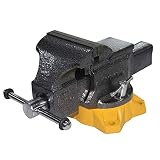
Best BudgetOlympia Tools 38-615
6 in Jaw, Cast Iron, Swivel Base, Budget
A workshop without a vise is missing something fundamental, and for a great many household tasks — holding a bolt while you cut it, gripping a bracket while you drill it, squeezing a bearing into place — almost any vise is transformative compared with none. The Olympia 38-615 provides six inch jaws, a swivel base, pipe jaws and an anvil surface at a price that requires no thought, which makes it a reasonable first vise. Where the price shows is in rigidity and durability. Jaw deflection under moderate clamping load was clearly visible, with the tops of the jaws splaying so that grip concentrated at the bottom edge. That reduces holding power and lets work rotate under torque. The grey cast iron construction has limited tolerance for impact, so the anvil surface should be treated as a flat area rather than a place to hammer. The screw and nut wear faster than better vises, and the action stiffens over time. None of that means it is a bad purchase at the price. It means it is a clamping tool rather than a working surface, and treating it that way will get years of use out of it.
Pros
- Very low price for a six inch vise
- Adequate for light workshop and household use
- Swivel base included
- Pipe jaws and anvil surface present
- Widely available
Cons
- Noticeable jaw deflection under moderate load
- Grey cast iron with limited impact tolerance
- Screw and nut wear faster than better vises
The Bottom Line
A lot of vise for very little money. Clamp things, do not hammer things.

Best Woodworking ViseGroz Woodworking Bench Vise 7 in
7 in Jaw, Under Bench Mount, Quick Release, Wood Faces
Metalworking vises and woodworking vises solve different problems and are not interchangeable, which catches out a lot of people who bolt a mechanics vise to a woodworking bench and wonder why it is awkward. A metal vise sits on top of the bench with narrow serrated jaws that mark timber and stand proud of the surface, obstructing work. A woodworking vise mounts underneath, with its jaws flush to the benchtop and faced with wood so nothing is marked. The Groz is a proper woodworking vise with the right geometry: wide jaws that grip a board across its width, deep capacity for holding a board on edge for planing or jointing, and a quick release that lets you open and close it in one motion rather than winding. Faced with hardwood jaw liners it holds work securely without marking it. For anyone planing, sawing or chiselling at a bench, this is the correct tool. The costs are installation and scope. It has to be mounted under the bench, which usually means cutting a recess and fitting a spacer — an afternoon of careful work. And it is not for metal, and definitely not for hammering.
Pros
- Mounts under the bench so the jaws sit flush with the benchtop
- Quick release mechanism for fast opening and closing
- Wide jaws designed to take wooden faces that will not mark work
- Deep capacity for holding boards on edge
- Proper woodworking geometry rather than an adapted metal vise
Cons
- Requires cutting into the bench to install properly
- Not suitable for metalwork or hammering
- Installation takes an afternoon
The Bottom Line
A different tool entirely. If you work wood, a metalworking vise is the wrong answer and this is the right one.
4. Mounting It Properly
A vise transmits everything you do to the bench it is bolted to, and a poor installation undermines a good tool completely.
Use four bolts, not lag screws. Through bolts with washers and nuts underneath hold far better than lag screws driven into the bench top, which pull out over time as the wood compresses around them.
Mount it at a bench leg. The corner of the bench directly above a leg is the most rigid point. A vise mounted in the middle of an unsupported span flexes the top and the whole bench moves when you lever against it.
Set the jaw flush with the bench edge or slightly proud. Jaws set back from the edge prevent clamping long work vertically, because the workpiece hits the bench. Flush or a fraction proud is the correct position.
Add a spacer if the bench top is thin. A thin top under a heavy vise will crush and eventually split around the bolts. A hardwood spacer beneath spreads the load and stiffens the mounting.
Height matters for comfort. For metalwork, the top of the jaws around elbow height suits filing and sawing. For woodworking, lower is better because planing uses body weight. A bench built for one is uncomfortable for the other.
Anchor the bench itself if it moves. A vise is only as rigid as what it is attached to, and a light bench that slides across the floor when you lever against the vise makes the whole installation useless. Bolt the bench to the wall or the floor.
Bolt Through, at a Leg
Two decisions determine whether your vise feels solid: through bolts with nuts and washers rather than lag screws into the benchtop, and a position directly over a bench leg rather than mid span. Get both right and a modest vise feels rigid. Get either wrong and the best vise in this guide will feel like it is mounted on a trampoline.
5. Jaw Faces and Protecting Work
The serrated hardened jaws that grip so well are also what puts diamond patterns into everything soft you clamp.
Serrated jaws mark almost everything. They are designed to bite, which is what stops work slipping under torque. On steel bar that is fine; on aluminium, brass, plastic, finished timber or a threaded part it is damage.
Soft jaws solve it cheaply. Magnetic aluminium or plastic covers slip over the hardened jaws in a second and prevent marking entirely. They cost very little and every workshop should own a set.
Wood or leather faces work just as well. Two pieces of hardwood or thick leather held against the jaws do the same job for nothing, and are easy to shape for a particular workpiece.
Replaceable jaw faces are worth having. Serrations flatten over years and jaws get chewed by hardened parts. A vise with bolt-on faces can be renewed; one with integral jaws cannot.
V-grooves hold round stock. Many vise jaws have a vertical or horizontal V machined into them for gripping bar and tube. Using them rather than the flats stops round work rotating.
Never clamp so hard the work distorts. Thin tube, threaded fittings and machined parts crush easily, and a vise generates far more force than intuition suggests. Tighten until it holds, then stop.
6. Mechanics, Woodworking and Specialist Vises
Bench vise covers several distinct tools, and buying the wrong category is a more expensive mistake than buying the wrong size.
A mechanics vise is the general purpose default. Bolted on top of the bench, with hardened serrated jaws, an anvil surface and usually pipe jaws underneath. It holds metal, plastic and awkward objects, and it is what most people mean by a bench vise.
A woodworking vise mounts underneath. The jaws sit flush with the benchtop and take wooden faces, so nothing is marked and the bench surface stays clear. Wide jaws grip a board across its width for planing, sawing and chiselling.
A machinist vise clamps to a machine table. Precision ground jaws, a low profile, and slots for bolting to a drill press or mill table. It is not a bench vise and using one as such wastes both its precision and your money.
Portable and clamp-on vises trade rigidity for flexibility. Useful on a workbench that has other jobs, or for taking to site. They flex under load and they are a compromise rather than an equivalent.
Pipe vises grip round stock properly. A chain or yoke vise holds pipe securely for threading and cutting, which flat jaws cannot do without crushing it. Most mechanics vises include small pipe jaws that cover light work.
Most workshops want two. A mechanics vise at one corner of the bench and a woodworking vise at the other covers everything, and neither compromises the other. Trying to make one vise do both jobs is what produces frustration.
7. Looking After a Vise
A bench vise is a simple machine and it will last a lifetime with about ten minutes of attention a year.
Grease the screw and nut annually. This is the single maintenance task that matters. A dry screw becomes stiff, wears the nut, and eventually strips. Wipe out the old grease, check for swarf, and apply fresh.
Keep swarf out of the slide. Metal chips work into the sliding jaw and act as an abrasive, wearing the ways. Brushing the vise off after metalwork prevents years of accumulated damage.
Do not use the handle as a lever. Slipping a pipe over the handle for extra force is how screws bend and nuts strip. Hand tight with the supplied handle is what the design assumes.
Treat the anvil surface with respect. On grey iron vises it is a flat surface for light forming, not a real anvil. Heavy hammering is the most common cause of a cracked casting.
Never hammer on the sliding jaw. Force applied to the moving jaw is transmitted through the screw and the ways, neither of which is designed for impact. Support work against the fixed jaw when hammering.
Check the mounting bolts once a year. Repeated levering works bolts loose over time, and a vise that has developed a slight rock puts all of that movement into the bench top around the bolt holes. Half a turn on each nut annually keeps the installation as rigid as the day it went on.
Replace jaw faces before they are useless. Serrations flatten gradually, so grip declines slowly enough that you adapt without noticing until work starts slipping under load. Bolt-on faces are inexpensive and swapping them restores the vise completely.
Wipe it with oil in a damp workshop. Surface rust on the ways makes the action stiff and eventually pits them. A rag with light oil after use in a garage or unheated shop prevents it entirely.
Before You Buy
Also Needed for This Job
8. Frequently Asked Questions
What is the best bench vise?
Wilton 1755 Tradesman for a lifetime tool, built from ductile iron that deforms rather than cracking under impact, with very little jaw deflection. Yost 750-DI offers the same ductile iron toughness for considerably less, and Eclipse is the pick for precision metalwork.
What size bench vise do I need?
Four to six inch jaw width covers almost everything a home workshop encounters. Also check throat depth, which determines how far down a workpiece can sit between the jaws, and maximum opening. Bigger is not automatically better, since a large vise dominates a small bench.
Is ductile iron better than cast iron for a vise?
Yes, meaningfully. Grey cast iron is strong in clamping and brittle under impact, so a sharp blow can crack the casting with no warning, and a cracked vise is scrap. Ductile iron deforms instead of fracturing, which matters because vises get hammered on.
How should I mount a bench vise?
Four through bolts with washers and nuts underneath, positioned directly over a bench leg rather than mid span, with the jaws flush with or slightly proud of the bench edge. Lag screws into the benchtop pull out over time as the wood compresses around them.
How do I stop a vise marking my work?
Fit soft jaws. Magnetic aluminium or plastic covers slip over the hardened serrated jaws and prevent marking entirely, and they cost very little. Two pieces of hardwood or thick leather do the same job for nothing and can be shaped for a particular workpiece.
Can I use a metalworking vise for woodworking?
Poorly. A metal vise sits on top of the bench with narrow serrated jaws that mark timber and stand proud of the surface, obstructing work. A woodworking vise mounts underneath with jaws flush to the top, faced with wood, and wide enough to grip a board properly.
9. Common Bench Vise Mistakes
Vises are simple, and the ways people ruin them are consistent enough to be worth listing.
Hammering on the Anvil Surface
On a grey cast iron vise the anvil is a flat surface for light forming, not a real anvil, and heavy hammering is the most common cause of a cracked casting. A cracked vise cannot be reliably repaired and becomes scrap. If you need an anvil, buy an anvil.
Extending the Handle for More Force
Slipping a pipe over the handle generates far more force than the screw and nut were designed for, which bends screws and strips nuts. A vise tightened by hand with the supplied handle already exerts more clamping force than most work can survive.
Mounting With Lag Screws Mid Span
Lag screws driven into a benchtop pull out over time as the wood compresses, and a vise mounted between the legs flexes the whole bench when you lever against it. Four through bolts, over a bench leg, is what makes a vise feel solid.
Never Greasing the Screw
Ten minutes once a year is the entire maintenance requirement, and skipping it is why old vises feel stiff and eventually strip their nuts. Wipe the old grease off, check for metal chips that have worked into the thread, and apply fresh.
Related Tool Guides
The Bottom Line
The best bench vise for a lifetime is the Wilton 1755 Tradesman, ductile iron with the least jaw deflection here. Yost 750-DI gets you the same toughness for far less, and Eclipse is the engineering choice for metalwork.
Buy ductile iron if you can, bolt it through the bench over a leg, keep a set of soft jaws to hand, and grease the screw once a year.
More in Tools & Equipment
Guides in this category that pair with what you just read.
About the Author
Alex Rivers, Home Improvement Editor
Alex has spent over a decade working on residential and light commercial property maintenance, and now tests every tool, coating and machine that appears in these guides personally.